




Urethral Dilators Market Synopsis:
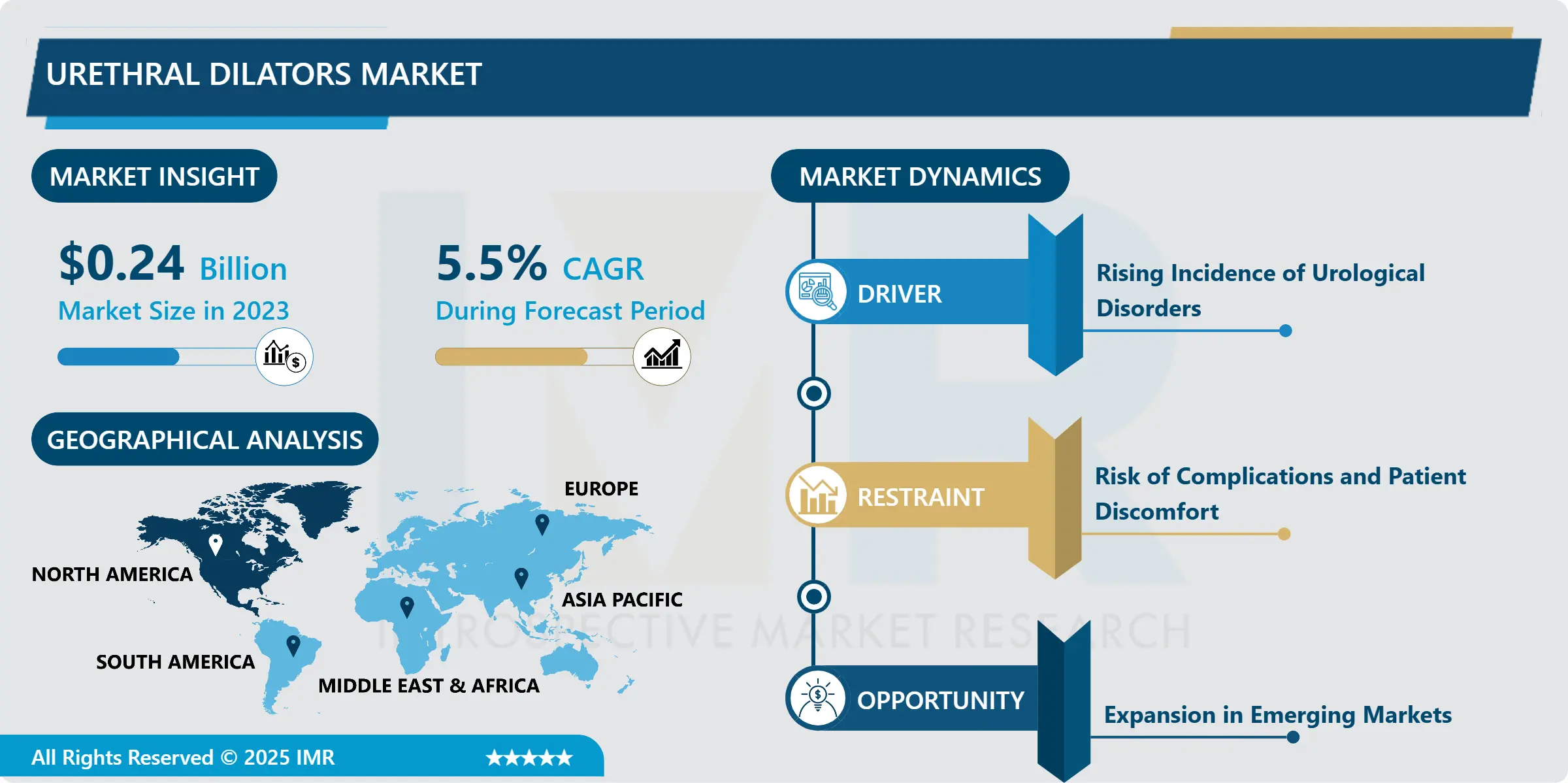
Urethral Dilators Market Size Was Valued at USD 0.24 Billion in 2023, and is Projected to Reach USD 0.39 Billion by 2032, Growing at a CAGR of 5.50% From 2024-2032.
The Urethral Dilators Market includes medical tools intended to expand the urethra in cases of urethral strictures, which are mechanical targeted conveying systems, a medical technology appliance intended to disengage areas of strictures to allow easy passage of urine. These dilators come in metal or plastic versions which are used in urological processes and may be used to treat issues associated with stricture or obstruction. Urethral dilators are mainly used in hospitals, clinics, and ambulatory surgical centers for male and female patient with urological disorders.
The rising rate of urological disease including urethral strictures, which can be a result of infections, prior surgery, and trauma is the major factor for the growth of the Urethral Dilators Market. This is because older people experience urological conditions that may see them using the urethral dilators more often than other people. Also, an increase in the knowledge of patients seeking treatment at the initial stages of the disease and urological diseases increases the demand for market products.
Improvement in healthcare facility in various parts of the developing world made it easy for people to access the urological procedures as well as the use of urethral dilators. These procedures are proving popular across the globe, and urethral dilators are often employed in these types of surgery thus contributing to the growth of the global market. As healthcare Facilities enhance their competencies and provide better urological services the need for efficient treatment instruments, dilators in particular, increases throughout the world.
Urethral Dilators Market Trend Analysis:
Increasing Use of Disposable Dilators
-
The major trend defining the Urethral Dilators Market is the shifting towards the use of disposable dilators. These disposable tools minimize contact transmission and complications in compliance with strict infection standards of care. Lately, disposable dilators are being utilized by clinicians and hospitals more often due to high compliance with hygiene and safety protocols. Consequently, this development may be sustained in the future, thus helping the whole market to expand.
- Another new development that is already begin to show is the improvement wheel design to be very accurate and comfortable for patients. User Friendliness: In recent years, manufacturers responded positively to this by aiming at manufacturing dilators that cause least discomfort to the patient. Evolutions in material engineering relating to the nature of the dilating tools have favored the production of dilators that are friendlier to the patient than before due to factors such as biocompatibility and flexibility. This has been especially so in developed regions of the world, which want more sophisticated medical products.
Investing Heavily in Improving Healthcare Infrastructure
-
The increasing trend of requirement of healthcare in emerging economies has provided a favorable scope for the Urethral Dilators Market. Asian Pacific countries, some of the Latin American countries and countries within the Middle East & Africa are heavily investing in upgrading their health facilities, this has fostered a conducive environment for the uptake of medical devices such as urethral dilators. The fact that the governments of these regions have lately shifted their focus towards the modernization of healthcare also creates great potential for market growth.
- Besides, increased costs of healthcare and proliferation of medical tourism in the developing nations [are] accelerating the need for professional urological services. This coupled with the increasing number of patients traveling from one country to another in search for affordable quality treatment especially in the specialty of urology, shall lead to higher demand for the product. The trends show that companies engaging in these emerging markets have an excellent opportunity to reap from increased demand of/for efficient and affordable urological products.
Urethral Dilators Market Segment Analysis:
Urethral Dilators Market is Segmented on the basis of Type, Application, End User, and Region.
By Type, Metal Dilators segment is expected to dominate the market during the forecast period
-
The urethral dilators market can be classified based on the type of product as the metal dilators and plastic dilators. Some of the most commonly used types of dilators are metal ones, that are made from stainless steel; these models are constructed to be reusable that makes them ideal for use in hospitals or clinics. They are much preferred given their sparring nature and the fact that they are used to treat extensive urethral strictures. Plastic dilators are on the other hand more flexible and can also be disposed after use, this are common for the less invasive procedures or where patient’s comfort is considered important. These are quite common especially when the facilities observe certain infection control precaution such as outpatient /ambulatory care units.
By Application, Hospitals segment expected to held the largest share
-
Based on application, the urethral dilators market is divided into hospitals, ambulatory surgical centers, and specialty clinics. Because hospitals primarily deal with health needs of their patients, they are leading consumers of urethral dilators, and usually manage severe cases that need special instruments and skilled human resource. Urethral dilators are also used by ambulatory surgical centers, which are surgical centers that perform surgeries for patients who may require minor surgery and then be discharged the same day. For specific treatments in specialty clinics relating to only urethral area, urethral dilators are also required because those clinics target patients with specific urological diseases and provide treatment with further individualized considerations.
Urethral Dilators Market Regional Insights:
North America is Expected to Dominate the Market Over the Forecast period
-
North America holds the largest share in the global Urethral Dilators Market because the region disposes of a relatively highly developed healthcare system and features a higher rate of urological diseases. An increasing geriatric population base in United States and Canada, along with awareness regarding urological health has led to the demand for urethral dilators. Also, strong healthcare reimbursement policies have improved on health care accessibility to many individuals in the region.
- The leadership has been reinforced by the presence of major market players especially in North America. Some of these firms dedicate a lot of their resources into research and development hence comes the new products. In addition, the stringent healthcare rules and safety concerns of the patients have led to the use of the high-quality medical technologies such as disposable and flexible urethral dilators, which enable North America to occupy the larger market share.
Active Key Players in the Urethral Dilators Market
-
B. Braun Melsungen AG (Germany)
- BD (Becton, Dickinson and Company) (United States)
- Boston Scientific Corporation (United States)
- C.R. Bard, Inc. (United States)
- Coloplast A/S (Denmark)
- Cook Medical (United States)
- Medline Industries, Inc. (United States)
- Olympus Corporation (Japan)
- Stryker Corporation (United States)
- Teleflex Incorporated (United States)
- Other Active Players.
|
Global Urethral Dilators Market |
|||
|
Base Year: |
2023 |
Forecast Period: |
2024-2032 |
|
Historical Data: |
2017 to 2023 |
Market Size in 2023: |
USD 0.24 Billion |
|
Forecast Period 2024-32 CAGR: |
5.50% |
Market Size in 2032: |
USD 0.39 Billion |
|
Segments Covered: |
By Type |
|
|
|
By Application |
|
||
|
By End User |
|
||
|
By Region |
|
||
|
Key Market Drivers: |
|
||
|
Key Market Restraints: |
|
||
|
Key Opportunities: |
|
||
|
Companies Covered in the report: |
|
||
Chapter 1: Introduction
1.1 Scope and Coverage
Chapter 2:Executive Summary
Chapter 3: Market Landscape
3.1 Market Dynamics
3.1.1 Drivers
3.1.2 Restraints
3.1.3 Opportunities
3.1.4 Challenges
3.2 Market Trend Analysis
3.3 PESTLE Analysis
3.4 Porter's Five Forces Analysis
3.5 Industry Value Chain Analysis
3.6 Ecosystem
3.7 Regulatory Landscape
3.8 Price Trend Analysis
3.9 Patent Analysis
3.10 Technology Evolution
3.11 Investment Pockets
3.12 Import-Export Analysis
Chapter 4: Urethral Dilators Market by Type
4.1 Urethral Dilators Market Snapshot and Growth Engine
4.2 Urethral Dilators Market Overview
4.3 Metal Dilators
4.3.1 Introduction and Market Overview
4.3.2 Historic and Forecasted Market Size in Value USD and Volume Units (2017-2032F)
4.3.3 Key Market Trends, Growth Factors and Opportunities
4.3.4 Metal Dilators: Geographic Segmentation Analysis
4.4 Plastic Dilators)
4.4.1 Introduction and Market Overview
4.4.2 Historic and Forecasted Market Size in Value USD and Volume Units (2017-2032F)
4.4.3 Key Market Trends, Growth Factors and Opportunities
4.4.4 Plastic Dilators): Geographic Segmentation Analysis
4.5
4.5.1 Introduction and Market Overview
4.5.2 Historic and Forecasted Market Size in Value USD and Volume Units (2017-2032F)
4.5.3 Key Market Trends, Growth Factors and Opportunities
4.5.4 : Geographic Segmentation Analysis
Chapter 5: Urethral Dilators Market by Application
5.1 Urethral Dilators Market Snapshot and Growth Engine
5.2 Urethral Dilators Market Overview
5.3 Hospitals
5.3.1 Introduction and Market Overview
5.3.2 Historic and Forecasted Market Size in Value USD and Volume Units (2017-2032F)
5.3.3 Key Market Trends, Growth Factors and Opportunities
5.3.4 Hospitals: Geographic Segmentation Analysis
5.4 Ambulatory Surgical Centers
5.4.1 Introduction and Market Overview
5.4.2 Historic and Forecasted Market Size in Value USD and Volume Units (2017-2032F)
5.4.3 Key Market Trends, Growth Factors and Opportunities
5.4.4 Ambulatory Surgical Centers: Geographic Segmentation Analysis
5.5 Specialty Clinics)
5.5.1 Introduction and Market Overview
5.5.2 Historic and Forecasted Market Size in Value USD and Volume Units (2017-2032F)
5.5.3 Key Market Trends, Growth Factors and Opportunities
5.5.4 Specialty Clinics): Geographic Segmentation Analysis
5.6
5.6.1 Introduction and Market Overview
5.6.2 Historic and Forecasted Market Size in Value USD and Volume Units (2017-2032F)
5.6.3 Key Market Trends, Growth Factors and Opportunities
5.6.4 : Geographic Segmentation Analysis
Chapter 6: Urethral Dilators Market by End User
6.1 Urethral Dilators Market Snapshot and Growth Engine
6.2 Urethral Dilators Market Overview
6.3 Male
6.3.1 Introduction and Market Overview
6.3.2 Historic and Forecasted Market Size in Value USD and Volume Units (2017-2032F)
6.3.3 Key Market Trends, Growth Factors and Opportunities
6.3.4 Male: Geographic Segmentation Analysis
6.4 Female)
6.4.1 Introduction and Market Overview
6.4.2 Historic and Forecasted Market Size in Value USD and Volume Units (2017-2032F)
6.4.3 Key Market Trends, Growth Factors and Opportunities
6.4.4 Female) : Geographic Segmentation Analysis
Chapter 7: Company Profiles and Competitive Analysis
7.1 Competitive Landscape
7.1.1 Competitive Benchmarking
7.1.2 Urethral Dilators Market Share by Manufacturer (2023)
7.1.3 Industry BCG Matrix
7.1.4 Heat Map Analysis
7.1.5 Mergers and Acquisitions
7.2 TELEFLEX INCORPORATED (UNITED STATES)
7.2.1 Company Overview
7.2.2 Key Executives
7.2.3 Company Snapshot
7.2.4 Role of the Company in the Market
7.2.5 Sustainability and Social Responsibility
7.2.6 Operating Business Segments
7.2.7 Product Portfolio
7.2.8 Business Performance
7.2.9 Key Strategic Moves and Recent Developments
7.2.10 SWOT Analysis
7.3 COOK MEDICAL (UNITED STATES)
7.4 BOSTON SCIENTIFIC CORPORATION (UNITED STATES)
7.5 MEDLINE INDUSTRIES INC. (UNITED STATES)
7.6 COLOPLAST A/S (DENMARK)
7.7 B. BRAUN MELSUNGEN AG (GERMANY)
7.8 BD (BECTON
7.9 DICKINSON AND COMPANY) (UNITED STATES)
7.10 OLYMPUS CORPORATION (JAPAN)
7.11 STRYKER CORPORATION (UNITED STATES)
7.12 C.R. BARD INC. (UNITED STATES)
7.13 OTHER ACTIVE PLAYERS
Chapter 8: Global Urethral Dilators Market By Region
8.1 Overview
8.2. North America Urethral Dilators Market
8.2.1 Key Market Trends, Growth Factors and Opportunities
8.2.2 Top Key Companies
8.2.3 Historic and Forecasted Market Size by Segments
8.2.4 Historic and Forecasted Market Size By Type
8.2.4.1 Metal Dilators
8.2.4.2 Plastic Dilators)
8.2.4.3
8.2.5 Historic and Forecasted Market Size By Application
8.2.5.1 Hospitals
8.2.5.2 Ambulatory Surgical Centers
8.2.5.3 Specialty Clinics)
8.2.5.4
8.2.6 Historic and Forecasted Market Size By End User
8.2.6.1 Male
8.2.6.2 Female)
8.2.7 Historic and Forecast Market Size by Country
8.2.7.1 US
8.2.7.2 Canada
8.2.7.3 Mexico
8.3. Eastern Europe Urethral Dilators Market
8.3.1 Key Market Trends, Growth Factors and Opportunities
8.3.2 Top Key Companies
8.3.3 Historic and Forecasted Market Size by Segments
8.3.4 Historic and Forecasted Market Size By Type
8.3.4.1 Metal Dilators
8.3.4.2 Plastic Dilators)
8.3.4.3
8.3.5 Historic and Forecasted Market Size By Application
8.3.5.1 Hospitals
8.3.5.2 Ambulatory Surgical Centers
8.3.5.3 Specialty Clinics)
8.3.5.4
8.3.6 Historic and Forecasted Market Size By End User
8.3.6.1 Male
8.3.6.2 Female)
8.3.7 Historic and Forecast Market Size by Country
8.3.7.1 Russia
8.3.7.2 Bulgaria
8.3.7.3 The Czech Republic
8.3.7.4 Hungary
8.3.7.5 Poland
8.3.7.6 Romania
8.3.7.7 Rest of Eastern Europe
8.4. Western Europe Urethral Dilators Market
8.4.1 Key Market Trends, Growth Factors and Opportunities
8.4.2 Top Key Companies
8.4.3 Historic and Forecasted Market Size by Segments
8.4.4 Historic and Forecasted Market Size By Type
8.4.4.1 Metal Dilators
8.4.4.2 Plastic Dilators)
8.4.4.3
8.4.5 Historic and Forecasted Market Size By Application
8.4.5.1 Hospitals
8.4.5.2 Ambulatory Surgical Centers
8.4.5.3 Specialty Clinics)
8.4.5.4
8.4.6 Historic and Forecasted Market Size By End User
8.4.6.1 Male
8.4.6.2 Female)
8.4.7 Historic and Forecast Market Size by Country
8.4.7.1 Germany
8.4.7.2 UK
8.4.7.3 France
8.4.7.4 The Netherlands
8.4.7.5 Italy
8.4.7.6 Spain
8.4.7.7 Rest of Western Europe
8.5. Asia Pacific Urethral Dilators Market
8.5.1 Key Market Trends, Growth Factors and Opportunities
8.5.2 Top Key Companies
8.5.3 Historic and Forecasted Market Size by Segments
8.5.4 Historic and Forecasted Market Size By Type
8.5.4.1 Metal Dilators
8.5.4.2 Plastic Dilators)
8.5.4.3
8.5.5 Historic and Forecasted Market Size By Application
8.5.5.1 Hospitals
8.5.5.2 Ambulatory Surgical Centers
8.5.5.3 Specialty Clinics)
8.5.5.4
8.5.6 Historic and Forecasted Market Size By End User
8.5.6.1 Male
8.5.6.2 Female)
8.5.7 Historic and Forecast Market Size by Country
8.5.7.1 China
8.5.7.2 India
8.5.7.3 Japan
8.5.7.4 South Korea
8.5.7.5 Malaysia
8.5.7.6 Thailand
8.5.7.7 Vietnam
8.5.7.8 The Philippines
8.5.7.9 Australia
8.5.7.10 New Zealand
8.5.7.11 Rest of APAC
8.6. Middle East & Africa Urethral Dilators Market
8.6.1 Key Market Trends, Growth Factors and Opportunities
8.6.2 Top Key Companies
8.6.3 Historic and Forecasted Market Size by Segments
8.6.4 Historic and Forecasted Market Size By Type
8.6.4.1 Metal Dilators
8.6.4.2 Plastic Dilators)
8.6.4.3
8.6.5 Historic and Forecasted Market Size By Application
8.6.5.1 Hospitals
8.6.5.2 Ambulatory Surgical Centers
8.6.5.3 Specialty Clinics)
8.6.5.4
8.6.6 Historic and Forecasted Market Size By End User
8.6.6.1 Male
8.6.6.2 Female)
8.6.7 Historic and Forecast Market Size by Country
8.6.7.1 Turkiye
8.6.7.2 Bahrain
8.6.7.3 Kuwait
8.6.7.4 Saudi Arabia
8.6.7.5 Qatar
8.6.7.6 UAE
8.6.7.7 Israel
8.6.7.8 South Africa
8.7. South America Urethral Dilators Market
8.7.1 Key Market Trends, Growth Factors and Opportunities
8.7.2 Top Key Companies
8.7.3 Historic and Forecasted Market Size by Segments
8.7.4 Historic and Forecasted Market Size By Type
8.7.4.1 Metal Dilators
8.7.4.2 Plastic Dilators)
8.7.4.3
8.7.5 Historic and Forecasted Market Size By Application
8.7.5.1 Hospitals
8.7.5.2 Ambulatory Surgical Centers
8.7.5.3 Specialty Clinics)
8.7.5.4
8.7.6 Historic and Forecasted Market Size By End User
8.7.6.1 Male
8.7.6.2 Female)
8.7.7 Historic and Forecast Market Size by Country
8.7.7.1 Brazil
8.7.7.2 Argentina
8.7.7.3 Rest of SA
Chapter 9 Analyst Viewpoint and Conclusion
9.1 Recommendations and Concluding Analysis
9.2 Potential Market Strategies
Chapter 10 Research Methodology
10.1 Research Process
10.2 Primary Research
10.3 Secondary Research
|
Global Urethral Dilators Market |
|||
|
Base Year: |
2023 |
Forecast Period: |
2024-2032 |
|
Historical Data: |
2017 to 2023 |
Market Size in 2023: |
USD 0.24 Billion |
|
Forecast Period 2024-32 CAGR: |
5.50% |
Market Size in 2032: |
USD 0.39 Billion |
|
Segments Covered: |
By Type |
|
|
|
By Application |
|
||
|
By End User |
|
||
|
By Region |
|
||
|
Key Market Drivers: |
|
||
|
Key Market Restraints: |
|
||
|
Key Opportunities: |
|
||
|
Companies Covered in the report: |
|
||


