




U.K. Medical Pendants Market Synopsis:
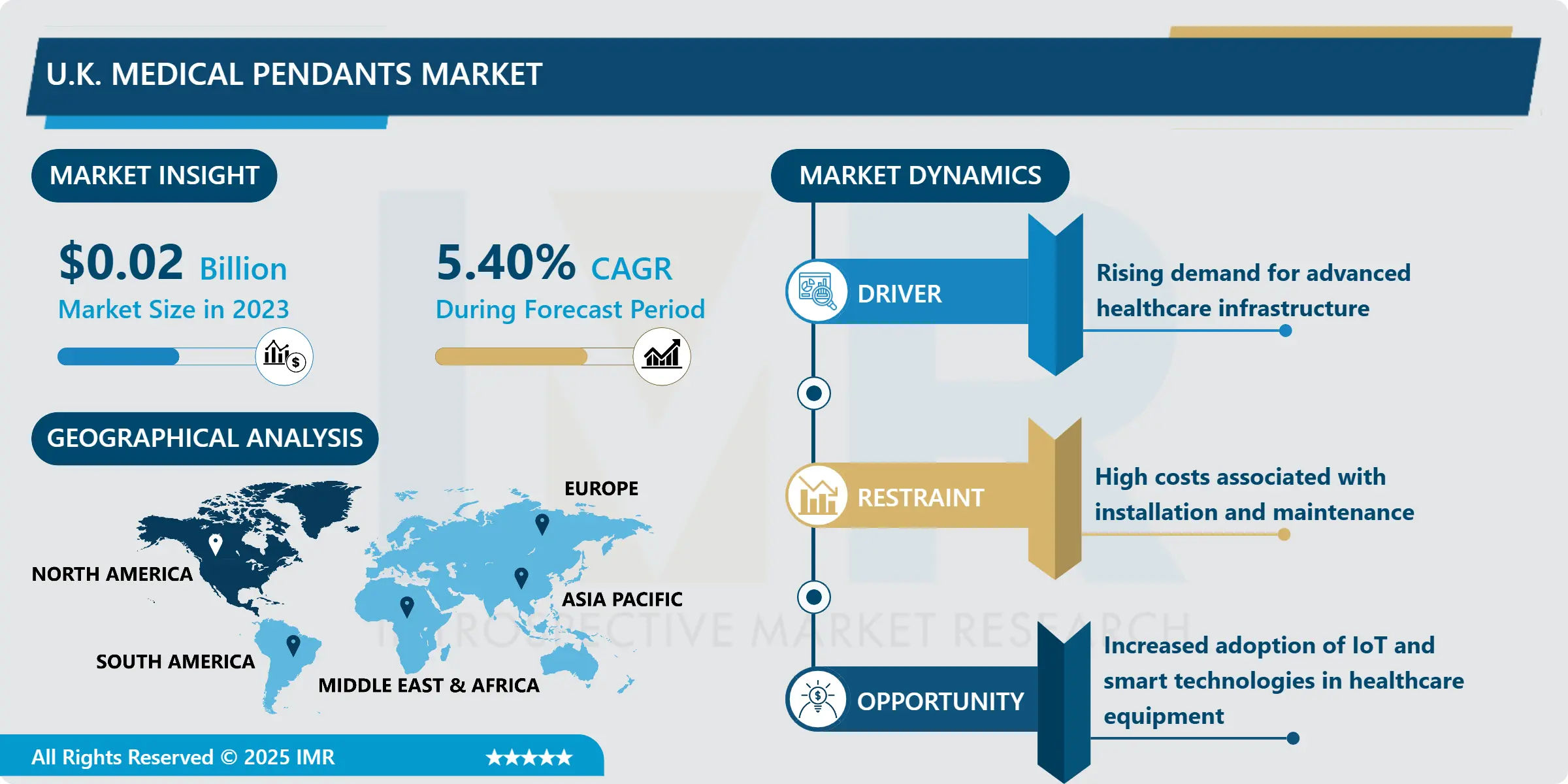
U.K. Medical Pendants Market Size Was Valued at USD 0.02 Billion in 2023, and is Projected to Reach USD 0.03 Billion by 2032, Growing at a CAGR of 5.40% From 2024-2032.
The U.K. medical pendants are the medical pendant systems manufactured, distributed and used across the medical facilities in the United Kingdom. Medical pendants on the facility are office ceiling fixtures used to suspend medical equipment and make utilities such as gases, electricity, and data connections easily accessible. They are essential when used in setting such as the operating room or intensive care units and other wards to improve operating efficiency and patient outcomes. It consists of; single arm suspension, dual arm suspension and retracting suspension depending on the functional style within healthcare institutions.
The market for medical pendants in the U.K has had a relatively constant growth over the years majorly due to the fact that more and more health care facilities are being established. Medical pendants are today very important in any healthcare facility since they provide operational flexibility and enhance access to required medical accessories and services. As we progressed in various healthcare technologies, the pendant has become a necessity or a crucial component of critical care delivery that organizes and makes items available in intense areas such as operating theatres and Intensive Care Units.
Another factor that can be contributing to growth of market is the increased attention government of USA pays to the subject of healthcare and hospital infrastructure. Apparently, a growing amount of people over the age of fifty is also one of the factors that contribute to the growth of demand for such specialized medical equipment as medical pendants, in addition to the fact that the fundamental cause of increased attention to people’s health is a constantly rising amount of chronic diseases and various conditions that require special attention. It has been more common to come across modular and customizable pendants systems that enable the health care organizations, to undertake solutions that are most suitable with the provided space complexities and organizational requirements. Hence adapting improves the organization efficiency and patient health results, factors that shape the continuously expanding market in the U.K.
U.K. Medical Pendants Market Trend Analysis:
Customizable and Modular Medical Pendants
- In the U.K., there is constant increased demand of flexible and modular medical pendants since hospitals require unique one to address different functional needs and infrastructure challenges. Modular pendant designs and layouts can be installed and easily changed to bring out a layout that is most suitable for various wards and categories of wards, such as Intensive care units (ICUs), operating theatres etc. This flexibility is crucial in: Propriety workspace management; storage and location of crucial tools; general work flow within health facilities which are highly calloused.
- However, it is important here to note that most of these pendant systems have started to incorporate some advanced technological features. Smart features that include touch screens, automated arms and others are improving pictorials to simplify the use of pendants by medical staff to control equipment more efficiently. Such a trend fits well with the population focus in healthcare andbelongs to the general trend toward increasing equipment efficiency, which must be as multifunctional and technologically introduced as possible to address high-pressure situations. Given that healthcare institutions are more and more concerned with flexibility and process efficiency, the need for technology enhanced modular medical pendants in the United Kingdom market is estimated to remain high.
Growing Demand for Smart and IoT-Integrated Pendants
- The combination of IoT and smart technologies in the healthcare segment offers humongous opportunities for theUKmedical pendants market, at this point. Wearable pendant systems that rely on IoT and enable real time sensor data acquisition are becoming more popular in healthcare since they offer better and faster workflow in patient management. These pendants enable better control of important utilities since hospitals can track them in detail in real-time, including oxygen levels, power consumption rates, and the status of other equipment. Besides preserving suitable environmental conditions for the patients, this capability also allows for timely checks and supervision, thus reducing the time that equipment is off line and disruptions in daily business operations.
- The demand for smart healthcare facilities is also increasing in the U.K. owing to the government as well as private sector’s expenditure at new-age digitized structures. IoT-integrated medical pendants also smoothly exist in such an environment and they provide the functions which correspond to the existing tendencies in the sphere of medicine. With this shift towards smart interconnected systems adaptive IoT technology pendants have become a very profitable investment for manufacturers who want to respond to the changing needs of UK hospitals. Since the application of digital methods in healthcare organizations gains more popularity year after year, IoT integrated medical pendants also have constant potential for further market development.
U.K. Medical Pendants Market Segment Analysis:
U.K. Medical Pendants Market is Segmented on the basis of product Type, Application, end user.
By Product Type, Fixed pendants segment is expected to dominate the market during the forecast period
- Fixed pendants are mainly used in situations where the design is more important as well as a non-wheeled setup - that is, applications that will be limited to critical care like Intensive care units, and some operating rooms. These pendants offer positive, stable suspension solutions for important equipment and utilities to maintain their availability in densely used zones. Single-arm movable pendants for their part give both stability and mobility, that gives the carrier a benefit to reposition the arm in whichever way they prefer while at the same time keeping it simple and more compact in structure. These are useful particularly when there is limited area but little modification may be needed to access utilities more easily.
- Double arm movable pendants are even more versatile for larger higher activity areas such as large surgical theatres. These pendants have two adjustable arms, which provide extra mobility and flexibility and can easily move and position equipment in a larger working radius. Retractable features another superior feature in that the pendant can also be moved vertically. This feature is particularly useful in flexible environment where the height of pendants could be changed to fit a wide range of procedures and equipment setups. All these options are therefore flexible enough to be fit into the dynamic needs of a modern hospital in the U.K., while offering utility support that existing or future health related institutions require.
By Application, Intensive Care Units (ICUs) segment expected to held the largest share
- Intensive Care Units (ICUs) require medical pendants for hanging life sustaining equipment since ICU have several high acuity patients requiring extensive monitoring and availability of a number of devices. Pendants in ICUs are designed in a way that successfully accommodates equipment, gas line supply, and power connections with regard to space and accessibility so that essential interventions can be provided promptly without much interference.
- Medical pendants are also commonly used in operating theatres, where cast construction is required due to the extreme flexibility needed in these areas to support major operations. In such conditions, chair pendants contain an adjustable arm that can be pivoted according to the situation, while keeping tools and equipment within the reach of the operating personnel. For example, medical pendants are also used in emergency rooms though such systems generally consist of easier and faster access configurations due to nature of the environment. Similarly, other specialty departments like neonatal and radiology use pendant systems that are specific to equipment for the department to ensure that the overall patient care need is well taken within different healthcare facilities.
U.K. Medical Pendants Market Regional Insights:
England is Expected to Dominate the Market Over the Forecast period
- England was the largest market in the U.K. medical pendants industry due to the development of the healthcare system and intensive distribution of hospitals, research organizations, and specialized medical facilities. In view of data that England alone occupies the major part of the overall UK market share and is estimated to be as high as 60%, it is worth mentioning that it is due to substantial government interventions for improvement of healthcare facilities and implementation of hospitalisation facilities. These programmes have triggered the need for advanced medical pendant systems that facilitate effective functioning in challenging environments such as Intensive care units and Operation theatres.
- This is particularly evident in regions hosted by major cities such London and Manchester, within the UK, where several classy hospitals and medical centers prop the demand for quality health care technologies. Many of these urban areas have numerous facilities that cater for the needs of many and complex patient population where availability of the latest in health care equipment’s is essential. High acceptance of advanced medical pendants in England is in line with England’s general investment in new medical solutions that have placed it at the fore of the U. K’s medical pendants business.
Active Key Players in the U.K. Medical Pendants Market
- Amico Group of Companies (Canada)
- BeaconMedaes (U.S.)
- Drägerwerk AG & Co. KGaA (Germany)
- Elektra Hellas S.A. (Greece)
- ESCO Medicon (Singapore)
- Hutz Medical (South Africa)
- INMED-Karczewscy (Poland)
- Mediland Enterprise Corporation (Taiwan)
- Medtronic (U.S.)
- Ondal Medical Systems GmbH (Germany)
- Palakkad Surgical Industries (India)
- Starkstrom (U.K.)
- Steris PLC (U.S.)
- Tedisel Medical (Spain)
- TRILUX Medical GmbH & Co. KG (Germany)
- Other Active Players
|
U.K. Medical Pendants Market |
|||
|
Base Year: |
2023 |
Forecast Period: |
2024-2032 |
|
Historical Data: |
2017 to 2023 |
Market Size in 2023: |
USD 0.02 Billion |
|
Forecast Period 2024-32 CAGR: |
5.40 % |
Market Size in 2032: |
USD 0.03 Billion |
|
Segments Covered: |
By Product Type |
|
|
|
By Application |
|
||
|
By Installation Type |
|
||
|
By End User |
|
||
|
Key Market Drivers: |
|
||
|
Key Market Restraints: |
|
||
|
Key Opportunities: |
|
||
|
Companies Covered in the report: |
|
||
Chapter 1: Introduction
1.1 Scope and Coverage
Chapter 2:Executive Summary
Chapter 3: Market Landscape
3.1 Industry Dynamics and Opportunity Analysis
3.1.1 Growth Drivers
3.1.2 Limiting Factors
3.1.3 Growth Opportunities
3.1.4 Challenges and Risks
3.2 Market Trend Analysis
3.3 Strategic Pestle Overview
3.4 Porter's Five Forces Analysis
3.5 Industry Value Chain Mapping
3.6 Regulatory Framework
3.7 Princing Trend Analysis
3.8 Patent Analysis
3.9 Technology Evolution
3.10 Investment Pockets
3.11 Import-Export Analysis
Chapter 4: U.K. Medical Pendants Market by Product Type
4.1 U.K. Medical Pendants Market Snapshot and Growth Engine
4.2 U.K. Medical Pendants Market Overview
4.3 Fixed Pendants
4.3.1 Introduction and Market Overview
4.3.2 Historic and Forecasted Market Size in Value USD and Volume Units (2017-2032F)
4.3.3 Fixed Pendants: Geographic Segmentation Analysis
4.4 Single-Arm Movable Pendants
4.4.1 Introduction and Market Overview
4.4.2 Historic and Forecasted Market Size in Value USD and Volume Units (2017-2032F)
4.4.3 Single-Arm Movable Pendants: Geographic Segmentation Analysis
4.5 Double-Arm Movable Pendants
4.5.1 Introduction and Market Overview
4.5.2 Historic and Forecasted Market Size in Value USD and Volume Units (2017-2032F)
4.5.3 Double-Arm Movable Pendants: Geographic Segmentation Analysis
4.6 Retractable Pendants
4.6.1 Introduction and Market Overview
4.6.2 Historic and Forecasted Market Size in Value USD and Volume Units (2017-2032F)
4.6.3 Retractable Pendants: Geographic Segmentation Analysis
Chapter 5: U.K. Medical Pendants Market by Application
5.1 U.K. Medical Pendants Market Snapshot and Growth Engine
5.2 U.K. Medical Pendants Market Overview
5.3 Intensive Care Units (ICUs)
5.3.1 Introduction and Market Overview
5.3.2 Historic and Forecasted Market Size in Value USD and Volume Units (2017-2032F)
5.3.3 Intensive Care Units (ICUs): Geographic Segmentation Analysis
5.4 Operating Theatres
5.4.1 Introduction and Market Overview
5.4.2 Historic and Forecasted Market Size in Value USD and Volume Units (2017-2032F)
5.4.3 Operating Theatres: Geographic Segmentation Analysis
5.5 Emergency Rooms
5.5.1 Introduction and Market Overview
5.5.2 Historic and Forecasted Market Size in Value USD and Volume Units (2017-2032F)
5.5.3 Emergency Rooms: Geographic Segmentation Analysis
5.6 Other Specialty Departments
5.6.1 Introduction and Market Overview
5.6.2 Historic and Forecasted Market Size in Value USD and Volume Units (2017-2032F)
5.6.3 Other Specialty Departments: Geographic Segmentation Analysis
Chapter 6: U.K. Medical Pendants Market by End User
6.1 U.K. Medical Pendants Market Snapshot and Growth Engine
6.2 U.K. Medical Pendants Market Overview
6.3 Hospitals
6.3.1 Introduction and Market Overview
6.3.2 Historic and Forecasted Market Size in Value USD and Volume Units (2017-2032F)
6.3.3 Hospitals: Geographic Segmentation Analysis
6.4 Ambulatory Surgical Centers
6.4.1 Introduction and Market Overview
6.4.2 Historic and Forecasted Market Size in Value USD and Volume Units (2017-2032F)
6.4.3 Ambulatory Surgical Centers: Geographic Segmentation Analysis
6.5 Clinics
6.5.1 Introduction and Market Overview
6.5.2 Historic and Forecasted Market Size in Value USD and Volume Units (2017-2032F)
6.5.3 Clinics: Geographic Segmentation Analysis
6.6 Specialty Care Centers)
6.6.1 Introduction and Market Overview
6.6.2 Historic and Forecasted Market Size in Value USD and Volume Units (2017-2032F)
6.6.3 Specialty Care Centers) : Geographic Segmentation Analysis
Chapter 7: Company Profiles and Competitive Analysis
7.1 Competitive Landscape
7.1.1 Competitive Benchmarking
7.1.2 U.K. Medical Pendants Market Share by Manufacturer (2023)
7.1.3 Concentration Ratio(CR5)
7.1.4 Heat Map Analysis
7.1.5 Mergers and Acquisitions
7.2 AMICO GROUP OF COMPANIES
7.2.1 Company Overview
7.2.2 Key Executives
7.2.3 Company Snapshot
7.2.4 Operating Business Segments
7.2.5 Product Portfolio
7.2.6 Business Performance
7.2.7 Key Strategic Moves and Recent Developments
7.3 BEACONMEDAES
7.4 DRÄGERWERK AG & CO. KGAA
7.5 ONDAL MEDICAL SYSTEMS GMBH
7.6 STERIS PLC
7.7 OTHER ACTIVE PLAYERS
Chapter 8: Global U.K. Medical Pendants Market By Region
8.1 Overview
8.2. North America U.K. Medical Pendants Market
8.2.1 Historic and Forecasted Market Size by Segments
8.2.2 Historic and Forecasted Market Size By Product Type
8.2.2.1 Fixed Pendants
8.2.2.2 Single-Arm Movable Pendants
8.2.2.3 Double-Arm Movable Pendants
8.2.2.4 Retractable Pendants
8.2.3 Historic and Forecasted Market Size By Application
8.2.3.1 Intensive Care Units (ICUs)
8.2.3.2 Operating Theatres
8.2.3.3 Emergency Rooms
8.2.3.4 Other Specialty Departments
8.2.4 Historic and Forecasted Market Size By End User
8.2.4.1 Hospitals
8.2.4.2 Ambulatory Surgical Centers
8.2.4.3 Clinics
8.2.4.4 Specialty Care Centers)
8.2.5 Historic and Forecast Market Size by Country
8.2.5.1 US
8.2.5.2 Canada
8.2.5.3 Mexico
8.3. Eastern Europe U.K. Medical Pendants Market
8.3.1 Historic and Forecasted Market Size by Segments
8.3.2 Historic and Forecasted Market Size By Product Type
8.3.2.1 Fixed Pendants
8.3.2.2 Single-Arm Movable Pendants
8.3.2.3 Double-Arm Movable Pendants
8.3.2.4 Retractable Pendants
8.3.3 Historic and Forecasted Market Size By Application
8.3.3.1 Intensive Care Units (ICUs)
8.3.3.2 Operating Theatres
8.3.3.3 Emergency Rooms
8.3.3.4 Other Specialty Departments
8.3.4 Historic and Forecasted Market Size By End User
8.3.4.1 Hospitals
8.3.4.2 Ambulatory Surgical Centers
8.3.4.3 Clinics
8.3.4.4 Specialty Care Centers)
8.3.5 Historic and Forecast Market Size by Country
8.3.5.1 Bulgaria
8.3.5.2 The Czech Republic
8.3.5.3 Hungary
8.3.5.4 Poland
8.3.5.5 Romania
8.3.5.6 Rest of Eastern Europe
8.4. Western Europe U.K. Medical Pendants Market
8.4.1 Historic and Forecasted Market Size by Segments
8.4.2 Historic and Forecasted Market Size By Product Type
8.4.2.1 Fixed Pendants
8.4.2.2 Single-Arm Movable Pendants
8.4.2.3 Double-Arm Movable Pendants
8.4.2.4 Retractable Pendants
8.4.3 Historic and Forecasted Market Size By Application
8.4.3.1 Intensive Care Units (ICUs)
8.4.3.2 Operating Theatres
8.4.3.3 Emergency Rooms
8.4.3.4 Other Specialty Departments
8.4.4 Historic and Forecasted Market Size By End User
8.4.4.1 Hospitals
8.4.4.2 Ambulatory Surgical Centers
8.4.4.3 Clinics
8.4.4.4 Specialty Care Centers)
8.4.5 Historic and Forecast Market Size by Country
8.4.5.1 Germany
8.4.5.2 UK
8.4.5.3 France
8.4.5.4 Netherlands
8.4.5.5 Italy
8.4.5.6 Russia
8.4.5.7 Spain
8.4.5.8 Rest of Western Europe
8.5. Asia Pacific U.K. Medical Pendants Market
8.5.1 Historic and Forecasted Market Size by Segments
8.5.2 Historic and Forecasted Market Size By Product Type
8.5.2.1 Fixed Pendants
8.5.2.2 Single-Arm Movable Pendants
8.5.2.3 Double-Arm Movable Pendants
8.5.2.4 Retractable Pendants
8.5.3 Historic and Forecasted Market Size By Application
8.5.3.1 Intensive Care Units (ICUs)
8.5.3.2 Operating Theatres
8.5.3.3 Emergency Rooms
8.5.3.4 Other Specialty Departments
8.5.4 Historic and Forecasted Market Size By End User
8.5.4.1 Hospitals
8.5.4.2 Ambulatory Surgical Centers
8.5.4.3 Clinics
8.5.4.4 Specialty Care Centers)
8.5.5 Historic and Forecast Market Size by Country
8.5.5.1 China
8.5.5.2 India
8.5.5.3 Japan
8.5.5.4 South Korea
8.5.5.5 Malaysia
8.5.5.6 Thailand
8.5.5.7 Vietnam
8.5.5.8 The Philippines
8.5.5.9 Australia
8.5.5.10 New Zealand
8.5.5.11 Rest of APAC
8.6. Middle East & Africa U.K. Medical Pendants Market
8.6.1 Historic and Forecasted Market Size by Segments
8.6.2 Historic and Forecasted Market Size By Product Type
8.6.2.1 Fixed Pendants
8.6.2.2 Single-Arm Movable Pendants
8.6.2.3 Double-Arm Movable Pendants
8.6.2.4 Retractable Pendants
8.6.3 Historic and Forecasted Market Size By Application
8.6.3.1 Intensive Care Units (ICUs)
8.6.3.2 Operating Theatres
8.6.3.3 Emergency Rooms
8.6.3.4 Other Specialty Departments
8.6.4 Historic and Forecasted Market Size By End User
8.6.4.1 Hospitals
8.6.4.2 Ambulatory Surgical Centers
8.6.4.3 Clinics
8.6.4.4 Specialty Care Centers)
8.6.5 Historic and Forecast Market Size by Country
8.6.5.1 Turkey
8.6.5.2 Bahrain
8.6.5.3 Kuwait
8.6.5.4 Saudi Arabia
8.6.5.5 Qatar
8.6.5.6 UAE
8.6.5.7 Israel
8.6.5.8 South Africa
8.7. South America U.K. Medical Pendants Market
8.7.1 Historic and Forecasted Market Size by Segments
8.7.2 Historic and Forecasted Market Size By Product Type
8.7.2.1 Fixed Pendants
8.7.2.2 Single-Arm Movable Pendants
8.7.2.3 Double-Arm Movable Pendants
8.7.2.4 Retractable Pendants
8.7.3 Historic and Forecasted Market Size By Application
8.7.3.1 Intensive Care Units (ICUs)
8.7.3.2 Operating Theatres
8.7.3.3 Emergency Rooms
8.7.3.4 Other Specialty Departments
8.7.4 Historic and Forecasted Market Size By End User
8.7.4.1 Hospitals
8.7.4.2 Ambulatory Surgical Centers
8.7.4.3 Clinics
8.7.4.4 Specialty Care Centers)
8.7.5 Historic and Forecast Market Size by Country
8.7.5.1 Brazil
8.7.5.2 Argentina
8.7.5.3 Rest of SA
Chapter 9 Analyst Viewpoint and Conclusion
9.1 Recommendations and Concluding Analysis
9.2 Potential Market Strategies
Chapter 10 Research Methodology
10.1 Research Process
10.2 Primary Research
10.3 Secondary Research
|
U.K. Medical Pendants Market |
|||
|
Base Year: |
2023 |
Forecast Period: |
2024-2032 |
|
Historical Data: |
2017 to 2023 |
Market Size in 2023: |
USD 0.02 Billion |
|
Forecast Period 2024-32 CAGR: |
5.40 % |
Market Size in 2032: |
USD 0.03 Billion |
|
Segments Covered: |
By Product Type |
|
|
|
By Application |
|
||
|
By Installation Type |
|
||
|
By End User |
|
||
|
Key Market Drivers: |
|
||
|
Key Market Restraints: |
|
||
|
Key Opportunities: |
|
||
|
Companies Covered in the report: |
|
||


