




Tumor Microenvironment Market Synopsis:
Tumor Microenvironment Market Size Was Valued at USD 1.48 Billion in 2023, and is Projected to Reach USD 3.45 Billion by 2032, Growing at a CAGR of 12.12% From 2024-2032.
The Tumor Microenvironment (TME) Market is a relatively new niche area in oncology dedicated to the study of the complex relationship of cancer cells and their supporting stroma. This environment contains other cell types such as immune cells, fibroblasts endothelial cells and the extracellular matrix components that in concert with cancer cells and influence tumor growth additional, metastatic potential and the reaction to treatments. It is important to understand the TME because obtaining new and specific therapeutic strategies and immunotherapies that interlink and accurately interpose with these interactions creates sensible modality for cancer cure and control.
The market for products and services related to tumor microenvironment has been expanded due to the increasing appreciation for the importance of the tumour microenvironment. Discovery programs, focused on the identification of the cellular and molecular components of the TME, are progressing, resulting from the higher development investments by drug firms and universities. Furthermore, the advance in the field of personalized medicine and biomarker therapies makes the development of new diagnostic and therapeutic targeting TME components more demanding in order to produce effective and less toxic treatments.
Moreover, there are more business relations between biopharmaceutical companies and research institutions to accent the knowledge of the TME that leads to the creation of new approaches in treatment. The continuous research on the synergistic effects of immune checkpoint inhibitors alongside targeted treatments and TME-modulating agents to the treatment effect should help drive the market forward. With increased knowledge of the TME and its role in tumorgenesis, additional treatment strategies may be developed and the indications for products that can modify the TME to enhance cancer treatment will also grow.
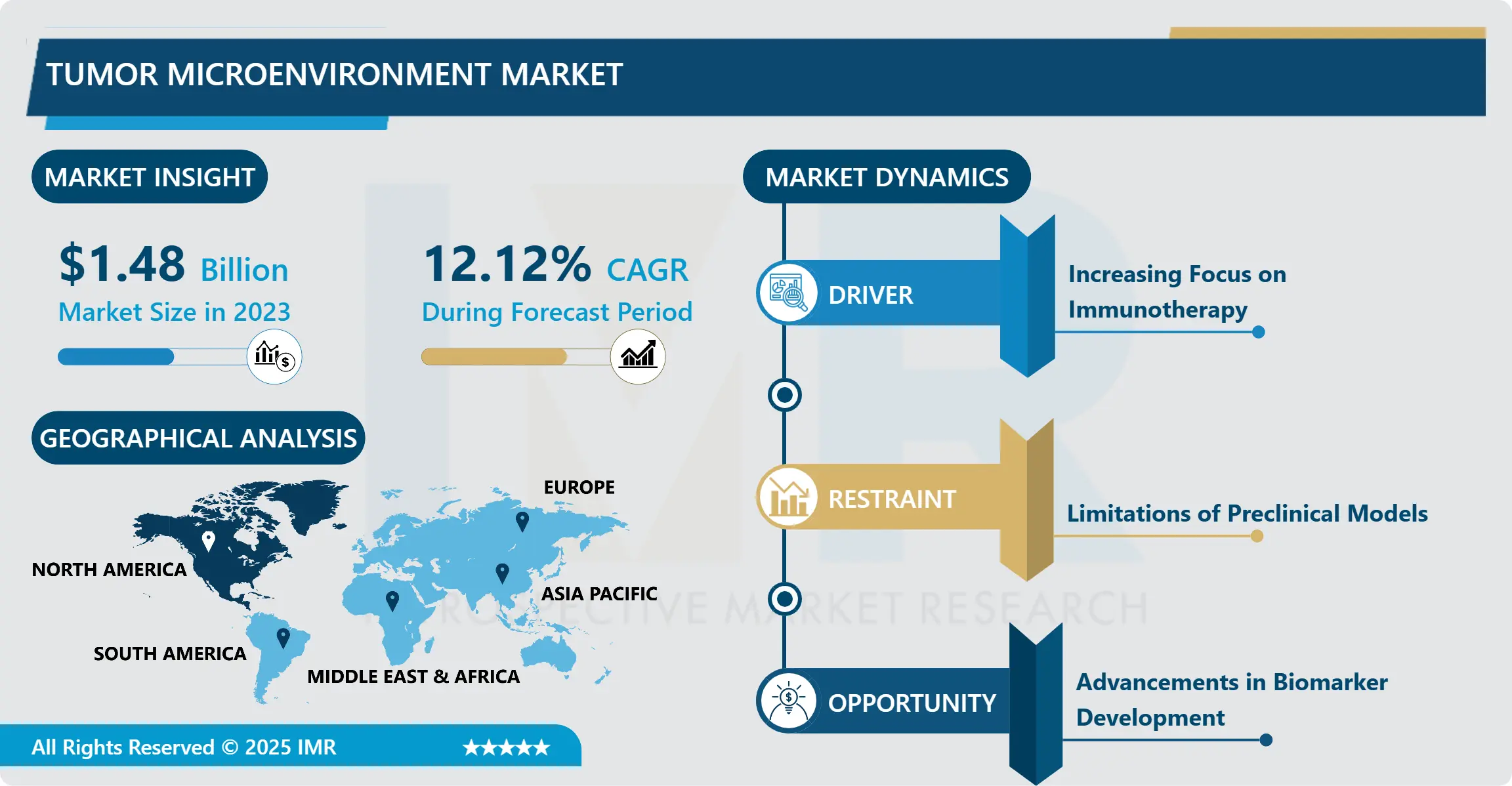 Tumor Microenvironment Market Trend Analysis:
Increasing Focus on Immunotherapy
-
Tumor microenvironment (TME) is one of the main focuses in immunotherapy research today, since it is involved in regulating the result of immunochemical treatments. Investigators have begun to appreciate that communication between the tumor component and immune cells in the TME can either enhance or suppress anti-tumor immunity. This has led to designing of new immunotherapies targeting to change TME to make it better for activating the immune system for better treatment. These include immune checkpoints, fibroblasts or matrix, by altering these components, physicians can reformat the surrounding to favor the activity of immune cells against the tumor. They relate to this trend towards improved end points and are now shaping the future of therapeutic development for cancer.
Advancements in Biomarker Development
-
There is also another large and rapidly developing trend in the market for tumor microenvironment – the development of biomarkers for individualized therapy of cancer. Biomarkers originated from TME is a useful tool to understand the tumor dynamics, response to therapy, and outcomes of the patient. The discoveries of biomarkers associated with the TME make it possible to categorize patients according to their likely response to specific treatments thus making treatment plans more targeted. Businesses and academics are seeking to identify and verity these biomarkers for better diagnostic outcomes and appropriate treatment modalities. The increasing application of biomarker-based strategies in the management of cancer patients will provide cumulative benefits in cancer treatment by increasing the efficacy of treatment while at the same time reducing the impact of toxicity on the patients.
Tumor Microenvironment Market Segment Analysis:
Tumor Microenvironment Market is Segmented on the basis of By Cancer Type, Target, Therapy, End User, and Region.
By Cancer Type, Lung Cancer segment is expected to dominate the market during the forecast period
-
The market by TME type depends on the specific cancer type treated; it includes lung cancer, Colo-rectal, breast cancer, prostate cancer, bladder cancer, and others lung cancer, melanoma, renal carcinoma, and ovary cancer. There are specific elements within the TME of each cancer type concerning cellularity and cytokine abundance and differing metabolic conditions that affect tumor progression and therapeutic reactions. For instance, lung cancer contains a tumor microenvironment with immunosuppressive properties to T cells, thus, an important candidate for immunotherapy research.
- Breast cancer’s TME-a heterogeneous milieu of immune cells –presents opportunities for selective therapeutic approaches. The continued discovery of subtleties of each cancer’s microenvironment allows for further market expansion and novel specified treatment strategies capable of specifically interrupting the interactions within the TME for each cancer type. This partitioning does help the development of the concept of pharma and therapeutic individualization and it helps in increasing the likelihood of achieving better therapeutic results across different grouping of cancer patients.
By End User, Biopharmaceutical Companies segment expected to held the largest share
-
According to end user, the global Tumor Microenvironment market can be categorized into biopharmaceutical companies, hospitals, diagnostic labs and Visualization service, research institutes, CROs, and others such as academic institutions. The principal consumers of tumor microenvironment research are biopharmaceutical firms who use information derived from it to create new treatment methods and enhance existing product performance.
- TME related technologies particularly molecular imaging and image guided therapy are used in the hospital and diagnostic laboratory to aid in diagnosis of patients as well as to plan therapies, to fit the type of tumor the patient has. In research institutes and CROs TME research is a fundamental part since TME studies and clinical trials are performed that will elucidate the interactions in the TME and their consequences for cancer treatment. These cases show the broad spectrum of end-users’ engagement and demonstrate the emerging role of the tumor microenvironment in oncology and the joint effort needed to raise the quality of care and outcomes of cancer treatments.
Tumor Microenvironment Market Regional Insights:
Asia Pacific market is expected to be the fastest-growing market for the tumor microenvironment market.
-
Asia Pacific region as the market that will grow faster than any other for the tumor microenvironment (TME): cancer incidence is increasing, investment in biotechnology and pharma is on the upswing, and personalized medicine is attracting more attention than ever before. Places like China and India are experiencing ever-escalating cancer incidences making governments as well as health care institutions to establish and enhance cancer related research and treatment agendas.
- Improvements in the healthcare framework and launches of new clinical trials on TME targeted products are also contributing towards the further growth of the market in the region. It is for this reason, that as awareness of the tumor microenvironment becomes even more integrated with investigations into cancer destruction and treatment response, is being seen as a significant network of TME.
Active Key Players in the Tumor Microenvironment Market
- 10x Genomics (U.S.)
- Abcam (U.K.)
- BD Biosciences (U.S.)
- Bethyl Laboratories (U.S.)
- BioLegend (U.S.)
- Bio-Rad Laboratories (U.S.)
- BioTechne Corporation (U.S.)
- Cell Signaling Technology (U.S.)
- Danaher Corporation (U.S.)
- F. Hoffmann-La Roche Ltd (Switzerland)
- Fluidigm Corporation (U.S.)
- Illumina (U.S.)
- Merck KGaA (Germany)
- Miltenyi Biotec (Germany)
- NanoString Technologies (U.S.)
- PerkinElmer (U.S.)
- Promega Corporation (U.S.)
- QIAGEN N.V. (Netherlands)
- Sartorius AG (Germany)
- Takara Bio (Japan)
- Thermo Fisher Scientific (U.S.)
- Others Active Players.
|
Tumor Microenvironment Market |
|||
|
Base Year: |
2023 |
Forecast Period: |
2024-2032 |
|
Historical Data: |
2017 to 2023 |
Market Size in 2023: |
USD 1.48 Billion |
|
Forecast Period 2024-32 CAGR: |
12.12% |
Market Size in 2032: |
USD 3.45 Billion |
|
Segments Covered: |
By Cancer Type |
|
|
|
By Target |
|
||
|
By Therapy |
|
||
|
By End User |
|
||
|
By Region |
|
||
|
Key Market Drivers: |
|
||
|
Key Market Restraints: |
|
||
|
Key Opportunities: |
|
||
|
Companies Covered in the report: |
|
||
Chapter 1: Introduction
1.1 Scope and Coverage
Chapter 2:Executive Summary
Chapter 3: Market Landscape
3.1 Market Dynamics
3.1.1 Drivers
3.1.2 Restraints
3.1.3 Opportunities
3.1.4 Challenges
3.2 Market Trend Analysis
3.3 PESTLE Analysis
3.4 Porter's Five Forces Analysis
3.5 Industry Value Chain Analysis
3.6 Ecosystem
3.7 Regulatory Landscape
3.8 Price Trend Analysis
3.9 Patent Analysis
3.10 Technology Evolution
3.11 Investment Pockets
3.12 Import-Export Analysis
Chapter 4: Tumor Microenvironment Market by Cancer Type
4.1 Tumor Microenvironment Market Snapshot and Growth Engine
4.2 Tumor Microenvironment Market Overview
4.3 Lung Cancer
4.3.1 Introduction and Market Overview
4.3.2 Historic and Forecasted Market Size in Value USD and Volume Units (2017-2032F)
4.3.3 Key Market Trends, Growth Factors and Opportunities
4.3.4 Lung Cancer: Geographic Segmentation Analysis
4.4 Colorectal Cancer
4.4.1 Introduction and Market Overview
4.4.2 Historic and Forecasted Market Size in Value USD and Volume Units (2017-2032F)
4.4.3 Key Market Trends, Growth Factors and Opportunities
4.4.4 Colorectal Cancer: Geographic Segmentation Analysis
4.5 Breast Cancer
4.5.1 Introduction and Market Overview
4.5.2 Historic and Forecasted Market Size in Value USD and Volume Units (2017-2032F)
4.5.3 Key Market Trends, Growth Factors and Opportunities
4.5.4 Breast Cancer: Geographic Segmentation Analysis
4.6 Prostate Cancer
4.6.1 Introduction and Market Overview
4.6.2 Historic and Forecasted Market Size in Value USD and Volume Units (2017-2032F)
4.6.3 Key Market Trends, Growth Factors and Opportunities
4.6.4 Prostate Cancer: Geographic Segmentation Analysis
4.7 Bladder Cancer and Others (Melanoma
4.7.1 Introduction and Market Overview
4.7.2 Historic and Forecasted Market Size in Value USD and Volume Units (2017-2032F)
4.7.3 Key Market Trends, Growth Factors and Opportunities
4.7.4 Bladder Cancer and Others (Melanoma: Geographic Segmentation Analysis
4.8 Kidney cancer
4.8.1 Introduction and Market Overview
4.8.2 Historic and Forecasted Market Size in Value USD and Volume Units (2017-2032F)
4.8.3 Key Market Trends, Growth Factors and Opportunities
4.8.4 Kidney cancer: Geographic Segmentation Analysis
4.9 Ovarian cancer etc.))
4.9.1 Introduction and Market Overview
4.9.2 Historic and Forecasted Market Size in Value USD and Volume Units (2017-2032F)
4.9.3 Key Market Trends, Growth Factors and Opportunities
4.9.4 Ovarian cancer etc.)): Geographic Segmentation Analysis
4.10 Target (T Cells
4.10.1 Introduction and Market Overview
4.10.2 Historic and Forecasted Market Size in Value USD and Volume Units (2017-2032F)
4.10.3 Key Market Trends, Growth Factors and Opportunities
4.10.4 Target (T Cells: Geographic Segmentation Analysis
4.11 Tumor-Associated Macrophages
4.11.1 Introduction and Market Overview
4.11.2 Historic and Forecasted Market Size in Value USD and Volume Units (2017-2032F)
4.11.3 Key Market Trends, Growth Factors and Opportunities
4.11.4 Tumor-Associated Macrophages: Geographic Segmentation Analysis
4.12 Myeloid-Derived Suppressor Cells
4.12.1 Introduction and Market Overview
4.12.2 Historic and Forecasted Market Size in Value USD and Volume Units (2017-2032F)
4.12.3 Key Market Trends, Growth Factors and Opportunities
4.12.4 Myeloid-Derived Suppressor Cells: Geographic Segmentation Analysis
4.13 Cancer Associated Fibroblasts
4.13.1 Introduction and Market Overview
4.13.2 Historic and Forecasted Market Size in Value USD and Volume Units (2017-2032F)
4.13.3 Key Market Trends, Growth Factors and Opportunities
4.13.4 Cancer Associated Fibroblasts: Geographic Segmentation Analysis
4.14 Regulatory T Cells and Others (Tumor-associated neutrophils
4.14.1 Introduction and Market Overview
4.14.2 Historic and Forecasted Market Size in Value USD and Volume Units (2017-2032F)
4.14.3 Key Market Trends, Growth Factors and Opportunities
4.14.4 Regulatory T Cells and Others (Tumor-associated neutrophils: Geographic Segmentation Analysis
4.15 Dendritic cells etc.))
4.15.1 Introduction and Market Overview
4.15.2 Historic and Forecasted Market Size in Value USD and Volume Units (2017-2032F)
4.15.3 Key Market Trends, Growth Factors and Opportunities
4.15.4 Dendritic cells etc.)): Geographic Segmentation Analysis
4.16 Therapy (Monoclonal Antibodies
4.16.1 Introduction and Market Overview
4.16.2 Historic and Forecasted Market Size in Value USD and Volume Units (2017-2032F)
4.16.3 Key Market Trends, Growth Factors and Opportunities
4.16.4 Therapy (Monoclonal Antibodies: Geographic Segmentation Analysis
4.17 Cytokines
4.17.1 Introduction and Market Overview
4.17.2 Historic and Forecasted Market Size in Value USD and Volume Units (2017-2032F)
4.17.3 Key Market Trends, Growth Factors and Opportunities
4.17.4 Cytokines: Geographic Segmentation Analysis
4.18 Cancer Vaccines
4.18.1 Introduction and Market Overview
4.18.2 Historic and Forecasted Market Size in Value USD and Volume Units (2017-2032F)
4.18.3 Key Market Trends, Growth Factors and Opportunities
4.18.4 Cancer Vaccines: Geographic Segmentation Analysis
4.19 Oncolytic Viruses
4.19.1 Introduction and Market Overview
4.19.2 Historic and Forecasted Market Size in Value USD and Volume Units (2017-2032F)
4.19.3 Key Market Trends, Growth Factors and Opportunities
4.19.4 Oncolytic Viruses: Geographic Segmentation Analysis
4.20 Adoptive Cell Therapies and Others (Gene therapies
4.20.1 Introduction and Market Overview
4.20.2 Historic and Forecasted Market Size in Value USD and Volume Units (2017-2032F)
4.20.3 Key Market Trends, Growth Factors and Opportunities
4.20.4 Adoptive Cell Therapies and Others (Gene therapies: Geographic Segmentation Analysis
4.21 Immunomodulators
4.21.1 Introduction and Market Overview
4.21.2 Historic and Forecasted Market Size in Value USD and Volume Units (2017-2032F)
4.21.3 Key Market Trends, Growth Factors and Opportunities
4.21.4 Immunomodulators: Geographic Segmentation Analysis
4.22 Checkpoint inhibitors etc.)
4.22.1 Introduction and Market Overview
4.22.2 Historic and Forecasted Market Size in Value USD and Volume Units (2017-2032F)
4.22.3 Key Market Trends, Growth Factors and Opportunities
4.22.4 Checkpoint inhibitors etc.): Geographic Segmentation Analysis
4.23
4.23.1 Introduction and Market Overview
4.23.2 Historic and Forecasted Market Size in Value USD and Volume Units (2017-2032F)
4.23.3 Key Market Trends, Growth Factors and Opportunities
4.23.4 : Geographic Segmentation Analysis
Chapter 5: Tumor Microenvironment Market by End User
5.1 Tumor Microenvironment Market Snapshot and Growth Engine
5.2 Tumor Microenvironment Market Overview
5.3 Biopharmaceutical Companies
5.3.1 Introduction and Market Overview
5.3.2 Historic and Forecasted Market Size in Value USD and Volume Units (2017-2032F)
5.3.3 Key Market Trends, Growth Factors and Opportunities
5.3.4 Biopharmaceutical Companies: Geographic Segmentation Analysis
5.4 Hospitals
5.4.1 Introduction and Market Overview
5.4.2 Historic and Forecasted Market Size in Value USD and Volume Units (2017-2032F)
5.4.3 Key Market Trends, Growth Factors and Opportunities
5.4.4 Hospitals: Geographic Segmentation Analysis
5.5 Diagnostic Laboratories
5.5.1 Introduction and Market Overview
5.5.2 Historic and Forecasted Market Size in Value USD and Volume Units (2017-2032F)
5.5.3 Key Market Trends, Growth Factors and Opportunities
5.5.4 Diagnostic Laboratories: Geographic Segmentation Analysis
5.6 Research Institutes
5.6.1 Introduction and Market Overview
5.6.2 Historic and Forecasted Market Size in Value USD and Volume Units (2017-2032F)
5.6.3 Key Market Trends, Growth Factors and Opportunities
5.6.4 Research Institutes: Geographic Segmentation Analysis
5.7 Contract Research Organizations (CROs) and Others (Academic Institutes and Others)
5.7.1 Introduction and Market Overview
5.7.2 Historic and Forecasted Market Size in Value USD and Volume Units (2017-2032F)
5.7.3 Key Market Trends, Growth Factors and Opportunities
5.7.4 Contract Research Organizations (CROs) and Others (Academic Institutes and Others) : Geographic Segmentation Analysis
Chapter 6: Company Profiles and Competitive Analysis
6.1 Competitive Landscape
6.1.1 Competitive Benchmarking
6.1.2 Tumor Microenvironment Market Share by Manufacturer (2023)
6.1.3 Industry BCG Matrix
6.1.4 Heat Map Analysis
6.1.5 Mergers and Acquisitions
6.2 THERMO FISHER SCIENTIFIC (U.S.)
6.2.1 Company Overview
6.2.2 Key Executives
6.2.3 Company Snapshot
6.2.4 Role of the Company in the Market
6.2.5 Sustainability and Social Responsibility
6.2.6 Operating Business Segments
6.2.7 Product Portfolio
6.2.8 Business Performance
6.2.9 Key Strategic Moves and Recent Developments
6.2.10 SWOT Analysis
6.3 ILLUMINA (U.S.)
6.4 DANAHER CORPORATION (U.S.)
6.5 MERCK KGAA (GERMANY)
6.6 BD BIOSCIENCES (U.S.)
6.7 PROMEGA CORPORATION (U.S.)
6.8 BIOTECHNE CORPORATION (U.S.)
6.9 BIO-RAD LABORATORIES (U.S.)
6.10 F. HOFFMANN-LA ROCHE LTD (SWITZERLAND)
6.11 QIAGEN N.V. (NETHERLANDS)
6.12 SARTORIUS AG (GERMANY)
6.13 PERKINELMER (U.S.)
6.14 MILTENYI BIOTEC (GERMANY)
6.15 CELL SIGNALING TECHNOLOGY (U.S.)
6.16 BIOLEGEND (U.S.)
6.17 ABCAM (U.K.)
6.18 TAKARA BIO (JAPAN)
6.19 FLUIDIGM CORPORATION (U.S.)
6.20 NANOSTRING TECHNOLOGIES (U.S.)
6.21 10X GENOMICS (U.S.)
6.22 BETHYL LABORATORIES (U.S.)
6.23 OTHER ACTIVE PLAYERS
Chapter 7: Global Tumor Microenvironment Market By Region
7.1 Overview
7.2. North America Tumor Microenvironment Market
7.2.1 Key Market Trends, Growth Factors and Opportunities
7.2.2 Top Key Companies
7.2.3 Historic and Forecasted Market Size by Segments
7.2.4 Historic and Forecasted Market Size By Cancer Type
7.2.4.1 Lung Cancer
7.2.4.2 Colorectal Cancer
7.2.4.3 Breast Cancer
7.2.4.4 Prostate Cancer
7.2.4.5 Bladder Cancer and Others (Melanoma
7.2.4.6 Kidney cancer
7.2.4.7 Ovarian cancer etc.))
7.2.4.8 Target (T Cells
7.2.4.9 Tumor-Associated Macrophages
7.2.4.10 Myeloid-Derived Suppressor Cells
7.2.4.11 Cancer Associated Fibroblasts
7.2.4.12 Regulatory T Cells and Others (Tumor-associated neutrophils
7.2.4.13 Dendritic cells etc.))
7.2.4.14 Therapy (Monoclonal Antibodies
7.2.4.15 Cytokines
7.2.4.16 Cancer Vaccines
7.2.4.17 Oncolytic Viruses
7.2.4.18 Adoptive Cell Therapies and Others (Gene therapies
7.2.4.19 Immunomodulators
7.2.4.20 Checkpoint inhibitors etc.)
7.2.4.21
7.2.5 Historic and Forecasted Market Size By End User
7.2.5.1 Biopharmaceutical Companies
7.2.5.2 Hospitals
7.2.5.3 Diagnostic Laboratories
7.2.5.4 Research Institutes
7.2.5.5 Contract Research Organizations (CROs) and Others (Academic Institutes and Others)
7.2.6 Historic and Forecast Market Size by Country
7.2.6.1 US
7.2.6.2 Canada
7.2.6.3 Mexico
7.3. Eastern Europe Tumor Microenvironment Market
7.3.1 Key Market Trends, Growth Factors and Opportunities
7.3.2 Top Key Companies
7.3.3 Historic and Forecasted Market Size by Segments
7.3.4 Historic and Forecasted Market Size By Cancer Type
7.3.4.1 Lung Cancer
7.3.4.2 Colorectal Cancer
7.3.4.3 Breast Cancer
7.3.4.4 Prostate Cancer
7.3.4.5 Bladder Cancer and Others (Melanoma
7.3.4.6 Kidney cancer
7.3.4.7 Ovarian cancer etc.))
7.3.4.8 Target (T Cells
7.3.4.9 Tumor-Associated Macrophages
7.3.4.10 Myeloid-Derived Suppressor Cells
7.3.4.11 Cancer Associated Fibroblasts
7.3.4.12 Regulatory T Cells and Others (Tumor-associated neutrophils
7.3.4.13 Dendritic cells etc.))
7.3.4.14 Therapy (Monoclonal Antibodies
7.3.4.15 Cytokines
7.3.4.16 Cancer Vaccines
7.3.4.17 Oncolytic Viruses
7.3.4.18 Adoptive Cell Therapies and Others (Gene therapies
7.3.4.19 Immunomodulators
7.3.4.20 Checkpoint inhibitors etc.)
7.3.4.21
7.3.5 Historic and Forecasted Market Size By End User
7.3.5.1 Biopharmaceutical Companies
7.3.5.2 Hospitals
7.3.5.3 Diagnostic Laboratories
7.3.5.4 Research Institutes
7.3.5.5 Contract Research Organizations (CROs) and Others (Academic Institutes and Others)
7.3.6 Historic and Forecast Market Size by Country
7.3.6.1 Russia
7.3.6.2 Bulgaria
7.3.6.3 The Czech Republic
7.3.6.4 Hungary
7.3.6.5 Poland
7.3.6.6 Romania
7.3.6.7 Rest of Eastern Europe
7.4. Western Europe Tumor Microenvironment Market
7.4.1 Key Market Trends, Growth Factors and Opportunities
7.4.2 Top Key Companies
7.4.3 Historic and Forecasted Market Size by Segments
7.4.4 Historic and Forecasted Market Size By Cancer Type
7.4.4.1 Lung Cancer
7.4.4.2 Colorectal Cancer
7.4.4.3 Breast Cancer
7.4.4.4 Prostate Cancer
7.4.4.5 Bladder Cancer and Others (Melanoma
7.4.4.6 Kidney cancer
7.4.4.7 Ovarian cancer etc.))
7.4.4.8 Target (T Cells
7.4.4.9 Tumor-Associated Macrophages
7.4.4.10 Myeloid-Derived Suppressor Cells
7.4.4.11 Cancer Associated Fibroblasts
7.4.4.12 Regulatory T Cells and Others (Tumor-associated neutrophils
7.4.4.13 Dendritic cells etc.))
7.4.4.14 Therapy (Monoclonal Antibodies
7.4.4.15 Cytokines
7.4.4.16 Cancer Vaccines
7.4.4.17 Oncolytic Viruses
7.4.4.18 Adoptive Cell Therapies and Others (Gene therapies
7.4.4.19 Immunomodulators
7.4.4.20 Checkpoint inhibitors etc.)
7.4.4.21
7.4.5 Historic and Forecasted Market Size By End User
7.4.5.1 Biopharmaceutical Companies
7.4.5.2 Hospitals
7.4.5.3 Diagnostic Laboratories
7.4.5.4 Research Institutes
7.4.5.5 Contract Research Organizations (CROs) and Others (Academic Institutes and Others)
7.4.6 Historic and Forecast Market Size by Country
7.4.6.1 Germany
7.4.6.2 UK
7.4.6.3 France
7.4.6.4 The Netherlands
7.4.6.5 Italy
7.4.6.6 Spain
7.4.6.7 Rest of Western Europe
7.5. Asia Pacific Tumor Microenvironment Market
7.5.1 Key Market Trends, Growth Factors and Opportunities
7.5.2 Top Key Companies
7.5.3 Historic and Forecasted Market Size by Segments
7.5.4 Historic and Forecasted Market Size By Cancer Type
7.5.4.1 Lung Cancer
7.5.4.2 Colorectal Cancer
7.5.4.3 Breast Cancer
7.5.4.4 Prostate Cancer
7.5.4.5 Bladder Cancer and Others (Melanoma
7.5.4.6 Kidney cancer
7.5.4.7 Ovarian cancer etc.))
7.5.4.8 Target (T Cells
7.5.4.9 Tumor-Associated Macrophages
7.5.4.10 Myeloid-Derived Suppressor Cells
7.5.4.11 Cancer Associated Fibroblasts
7.5.4.12 Regulatory T Cells and Others (Tumor-associated neutrophils
7.5.4.13 Dendritic cells etc.))
7.5.4.14 Therapy (Monoclonal Antibodies
7.5.4.15 Cytokines
7.5.4.16 Cancer Vaccines
7.5.4.17 Oncolytic Viruses
7.5.4.18 Adoptive Cell Therapies and Others (Gene therapies
7.5.4.19 Immunomodulators
7.5.4.20 Checkpoint inhibitors etc.)
7.5.4.21
7.5.5 Historic and Forecasted Market Size By End User
7.5.5.1 Biopharmaceutical Companies
7.5.5.2 Hospitals
7.5.5.3 Diagnostic Laboratories
7.5.5.4 Research Institutes
7.5.5.5 Contract Research Organizations (CROs) and Others (Academic Institutes and Others)
7.5.6 Historic and Forecast Market Size by Country
7.5.6.1 China
7.5.6.2 India
7.5.6.3 Japan
7.5.6.4 South Korea
7.5.6.5 Malaysia
7.5.6.6 Thailand
7.5.6.7 Vietnam
7.5.6.8 The Philippines
7.5.6.9 Australia
7.5.6.10 New Zealand
7.5.6.11 Rest of APAC
7.6. Middle East & Africa Tumor Microenvironment Market
7.6.1 Key Market Trends, Growth Factors and Opportunities
7.6.2 Top Key Companies
7.6.3 Historic and Forecasted Market Size by Segments
7.6.4 Historic and Forecasted Market Size By Cancer Type
7.6.4.1 Lung Cancer
7.6.4.2 Colorectal Cancer
7.6.4.3 Breast Cancer
7.6.4.4 Prostate Cancer
7.6.4.5 Bladder Cancer and Others (Melanoma
7.6.4.6 Kidney cancer
7.6.4.7 Ovarian cancer etc.))
7.6.4.8 Target (T Cells
7.6.4.9 Tumor-Associated Macrophages
7.6.4.10 Myeloid-Derived Suppressor Cells
7.6.4.11 Cancer Associated Fibroblasts
7.6.4.12 Regulatory T Cells and Others (Tumor-associated neutrophils
7.6.4.13 Dendritic cells etc.))
7.6.4.14 Therapy (Monoclonal Antibodies
7.6.4.15 Cytokines
7.6.4.16 Cancer Vaccines
7.6.4.17 Oncolytic Viruses
7.6.4.18 Adoptive Cell Therapies and Others (Gene therapies
7.6.4.19 Immunomodulators
7.6.4.20 Checkpoint inhibitors etc.)
7.6.4.21
7.6.5 Historic and Forecasted Market Size By End User
7.6.5.1 Biopharmaceutical Companies
7.6.5.2 Hospitals
7.6.5.3 Diagnostic Laboratories
7.6.5.4 Research Institutes
7.6.5.5 Contract Research Organizations (CROs) and Others (Academic Institutes and Others)
7.6.6 Historic and Forecast Market Size by Country
7.6.6.1 Turkiye
7.6.6.2 Bahrain
7.6.6.3 Kuwait
7.6.6.4 Saudi Arabia
7.6.6.5 Qatar
7.6.6.6 UAE
7.6.6.7 Israel
7.6.6.8 South Africa
7.7. South America Tumor Microenvironment Market
7.7.1 Key Market Trends, Growth Factors and Opportunities
7.7.2 Top Key Companies
7.7.3 Historic and Forecasted Market Size by Segments
7.7.4 Historic and Forecasted Market Size By Cancer Type
7.7.4.1 Lung Cancer
7.7.4.2 Colorectal Cancer
7.7.4.3 Breast Cancer
7.7.4.4 Prostate Cancer
7.7.4.5 Bladder Cancer and Others (Melanoma
7.7.4.6 Kidney cancer
7.7.4.7 Ovarian cancer etc.))
7.7.4.8 Target (T Cells
7.7.4.9 Tumor-Associated Macrophages
7.7.4.10 Myeloid-Derived Suppressor Cells
7.7.4.11 Cancer Associated Fibroblasts
7.7.4.12 Regulatory T Cells and Others (Tumor-associated neutrophils
7.7.4.13 Dendritic cells etc.))
7.7.4.14 Therapy (Monoclonal Antibodies
7.7.4.15 Cytokines
7.7.4.16 Cancer Vaccines
7.7.4.17 Oncolytic Viruses
7.7.4.18 Adoptive Cell Therapies and Others (Gene therapies
7.7.4.19 Immunomodulators
7.7.4.20 Checkpoint inhibitors etc.)
7.7.4.21
7.7.5 Historic and Forecasted Market Size By End User
7.7.5.1 Biopharmaceutical Companies
7.7.5.2 Hospitals
7.7.5.3 Diagnostic Laboratories
7.7.5.4 Research Institutes
7.7.5.5 Contract Research Organizations (CROs) and Others (Academic Institutes and Others)
7.7.6 Historic and Forecast Market Size by Country
7.7.6.1 Brazil
7.7.6.2 Argentina
7.7.6.3 Rest of SA
Chapter 8 Analyst Viewpoint and Conclusion
8.1 Recommendations and Concluding Analysis
8.2 Potential Market Strategies
Chapter 9 Research Methodology
9.1 Research Process
9.2 Primary Research
9.3 Secondary Research
|
Tumor Microenvironment Market |
|||
|
Base Year: |
2023 |
Forecast Period: |
2024-2032 |
|
Historical Data: |
2017 to 2023 |
Market Size in 2023: |
USD 1.48 Billion |
|
Forecast Period 2024-32 CAGR: |
12.12% |
Market Size in 2032: |
USD 3.45 Billion |
|
Segments Covered: |
By Cancer Type |
|
|
|
By Target |
|
||
|
By Therapy |
|
||
|
By End User |
|
||
|
By Region |
|
||
|
Key Market Drivers: |
|
||
|
Key Market Restraints: |
|
||
|
Key Opportunities: |
|
||
|
Companies Covered in the report: |
|
||


