




Transcutaneous Electrical Nerve Stimulation Market Synopsis:
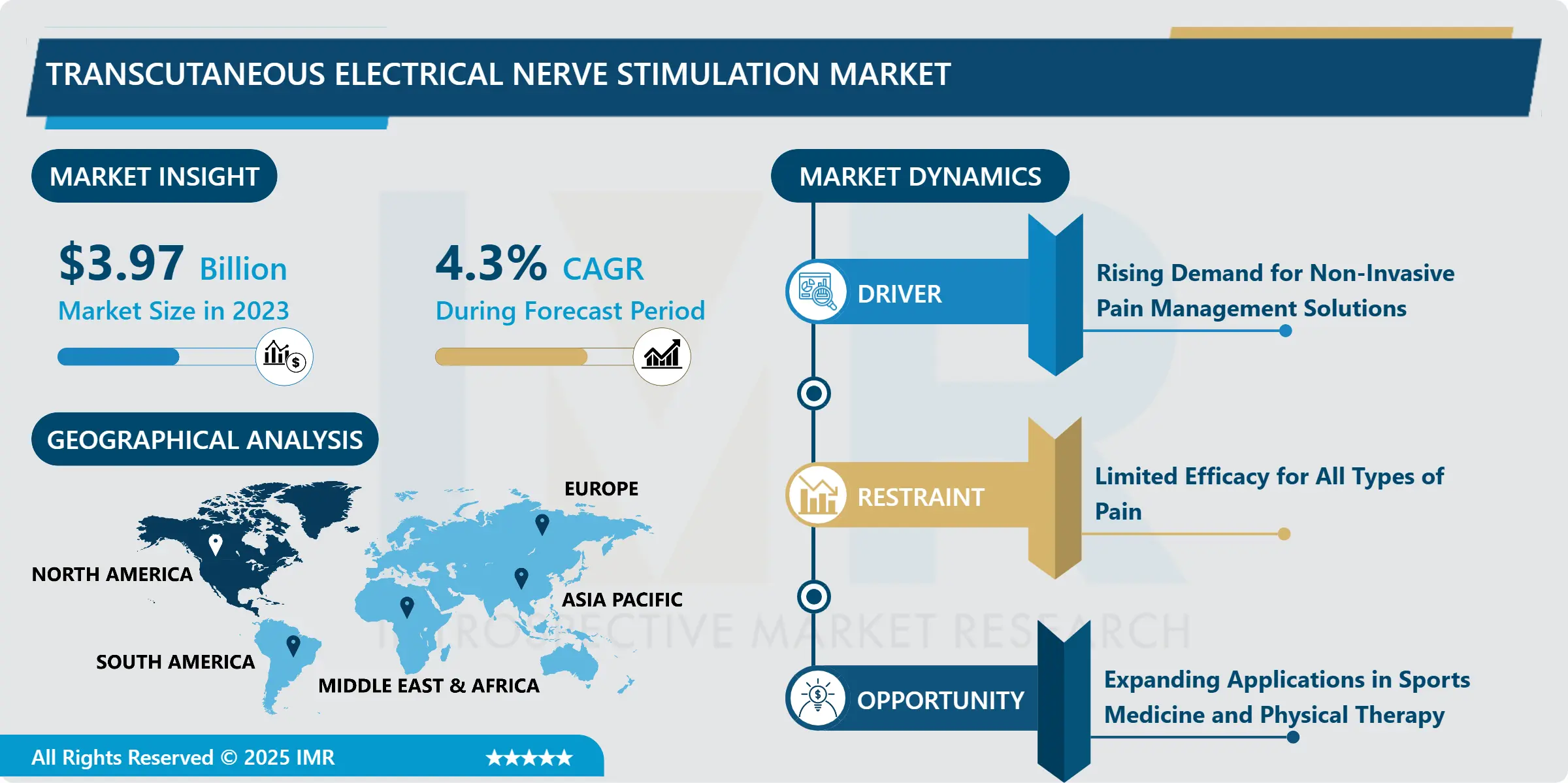
Transcutaneous Electrical Nerve Stimulation Market Size Was Valued at USD 3.97 Billion in 2023, and is Projected to Reach USD 5.80 Billion by 2032, Growing at a CAGR of 4.3% From 2024-2032.
The Transcutaneous Electrical Nerve Stimulation (TENS) market is solely involved in manufacturing and selling of TENS devices that utilizes electrical current in low intensities to reduce pain. They are used greatly in conditions such as arthritis, labor, post – operative pain and many others that can be classified as a chronic or acute pain. TENS therapy is painless with no use of drugs and hence popular among patients and health care practitioners looking for other methods of pain control.
TENS Market has had enormous growth because of the increasing preference by people for non-drug therapies for the management of pain. TENS devices are small, portable, battery-operated apparatus that use electrodes to pass electrical impulses in skin to nerves; may help reduce pain. Their ability to penetrate tissues and cells and exert analgesic effects with minimal systemic side effects has placed them among the preferred options for many pain- related situations encompassing chronic and acute pain, labour pain and post operative pain.
TENS devices may be used at home because these devices can help control pain without necessarily requiring a physician’s constant monitoring. Thus, new models of TENS devices are much easier to operate, transport, and to be individualized; that is why it is used in homecare and in rehabilitation centers. The market is also steadily attaining a higher level of awareness of TENS therapy that can be used in sports medicine and physical therapy, along with the existing pains relief services. In total this market will grow as higher numbers of patrons require an alternative to drug-based pain relief while technology advances and enhances the already progressing TENS devices.
Transcutaneous Electrical Nerve Stimulation Market Trend Analysis:
Growing Adoption of Portable TENS Devices
- Transportable TENS appliances have recently gained tremendous popularity because of their convenience, operational simplicity and ability to be used at home. Most desktop models used in clinical practice; on the other hand, portable TENS units come in handy since it enables patients to handle pain on their own. This trend is mostly found within the chronic pain patient population due to conditions like arthritis, which can only be occasionally treated with highly effective methods, such as joint injections. Mobile TENS units provide the patient with a convenient solution to minimize pain due to the modularity of the device as a portable? effective analgesic alternative.
- The portability factor also makes it suitable for the emerging needs for remote care and DIY management solutions. Due to improvements in battery technology, display technologies, and portability options, manufacturers are developing TENS devices that are as small as a pocket or handbag for convenience to the activated or working patients. As for market development, this shift towards portability helps expand the user group and increases the frequency of TENS therapy utilisation among patients in real-world settings.
Expanding Applications in Sports Medicine and Physical Therapy
- The usage of TENS devices is increasing in the sports medicine and physical therapy segments and therefore, holds a growth opportunity with the market. Both athletes and other physically active people apply TENS therapy to ease pain in injuries, reduce discomfort, and treat muscle soreness. This is viewed as a huge benefit to programs of rehabilitation where new athletes are able to train without the use of pain killer which has side effects on performance.
- Modern TENS devices are widely employed in the physical therapy to facilitate client’s healing and treat musculoskeletal pain; they become more popular in the context of the patient’s ability to address the pain from a muscle strain or after a surgery without injections. With an increasing understanding of physiotherapists and trainers on the possibilities that TENS has on injury treatment, there will be incrementation of clinics and rehabilitation centres which will adopt the gadgets. The expansion of this product to sports and physical therapy seems to be a viable route for market penetration since two of these categories are not as populated with current consumers.
Transcutaneous Electrical Nerve Stimulation Market Segment Analysis:
Transcutaneous Electrical Nerve Stimulation Market is Segmented on the basis of Type, Application, Distribution Channel, End User and Region.
By Product Type, Portable TENS segment is expected to dominate the market during the forecast period
- Portable and desktop TENS are the other subcategories of TENS available to better satisfy the users’ needs. Transportable AMS TENS devices were found to be preferred because of their modality of use and are mostly for home use so that the patient can control the pain without the use of any other assistance. These usually are of smaller size, portable, and thus can be used to offer more variety in pain control options making them suitable for those patients with chronic pain who need TENS therapy frequently.
- C247 Desktop TENS devices on the other hand, are much more powerful and are usually used in clinical or therapeutic capacity. These devices are generally bigger in size, may demand professional installation, and include higher end facilities for fine adjustments. The market for desktop TENS units is still significant in various facilities, but the portable type is growing more rapidly because consumers are increasingly seeking home remedies.
By Application, Chronic Pain segment expected to held the largest share
- TENS devices have numerous functions, the most common of which is in the treatment of chronic pain. Conditions like arthritis, fibromyalgia, and back pain fall under chronic, and for this reason, TENS therapy has gained a lot of popularity. Sufferers of these diseases need chronic, pharmacological-free pain control, which is where TENS devices come in handy. This segment has displayed aggressive growth due to the increasing patient demand for painless therapies for chronic pain issues.
- Moderate to severe pain, pain during labor and postoperative pain. TENS therapy is applied for short-term pain treatment in cases of spikes, and for labor pain, it is applied as an application without the use of drugs during childbirth. There has also been a rise in post-surgical pain management with TENS therapy especially in clients who are have sought to minimize on their use of drugs in the aftermath of the surgery. The above examples under different pains show how TENS therapy can be used in many forms of pains.
Transcutaneous Electrical Nerve Stimulation Market Regional Insights:
North America is Expected to Dominate the Market Over the Forecast period
- North America is the largest market for TENS due to high healthcare expenditure, developed healthcare infrastructure along with emphasis on avoiding use of narcotics for pain control. The region also has one of the highest incidences of chronic pain related disorders, which has influenced the need for safe and efficient non-surgical pain control. TENS therapy market in North America continues to thrive due to high number of patients with diseases such as arthritis and backache.
- Moreover, the legal requirements for non-opioid pain management systems are also standard in North America which in turn boosts TENS market. Knowledge of adverse effects of long-term use of opioids has led to the search for better therapeutic alternatives, and this have created interest in TENS devices. These more focused approaches are expected to continue to sustain the leadership of North America in terms of demand for these therapies.
Active Key Players in the Transcutaneous Electrical Nerve Stimulation Market
- Beurer GmbH (Germany)
- BioMedical Life Systems (United States)
- DJO Global (United States)
- HealthmateForever (United States)
- iReliev (United States)
- NeuroMetrix, Inc. (United States)
- Omron Healthcare (Japan)
- Pure Enrichment (United States)
- Roscoe Medical (United States)
- RS Medical (United States)
- TENS Units (United States)
- Zynex Medical (United States)
- Other Active Players.
Key Industry Developments in the Transcutaneous Electrical Nerve Stimulation Market:
In October 2023, NeuroMetrix and the National Fibromyalgia Association collaborated to enhance the quality of life for people suffering from fibromyalgia. NeuroMetrix would sponsor and help the NFA’s mission to offer education, support, & advocacy for fibromyalgia patients.
|
Transcutaneous Electrical Nerve Stimulation Market |
|||
|
Base Year: |
2023 |
Forecast Period: |
2024-2032 |
|
Historical Data: |
2017 to 2023 |
Market Size in 2023: |
USD 3.97 Billion |
|
Forecast Period 2024-32 CAGR: |
4.3% |
Market Size in 2032: |
USD 5.80 Billion |
|
Segments Covered: |
By Product Type |
|
|
|
By Application |
|
||
|
By End User |
|
||
|
By Distribution Channel |
|
||
|
By Region |
|
||
|
Key Market Drivers: |
|
||
|
Key Market Restraints: |
|
||
|
Key Opportunities: |
|
||
|
Companies Covered in the report: |
|
||
Chapter 1: Introduction
1.1 Scope and Coverage
Chapter 2:Executive Summary
Chapter 3: Market Landscape
3.1 Market Dynamics
3.1.1 Drivers
3.1.2 Restraints
3.1.3 Opportunities
3.1.4 Challenges
3.2 Market Trend Analysis
3.3 PESTLE Analysis
3.4 Porter's Five Forces Analysis
3.5 Industry Value Chain Analysis
3.6 Ecosystem
3.7 Regulatory Landscape
3.8 Price Trend Analysis
3.9 Patent Analysis
3.10 Technology Evolution
3.11 Investment Pockets
3.12 Import-Export Analysis
Chapter 4: Transcutaneous Electrical Nerve Stimulation Market by Product Type
4.1 Transcutaneous Electrical Nerve Stimulation Market Snapshot and Growth Engine
4.2 Transcutaneous Electrical Nerve Stimulation Market Overview
4.3 Portable TENS
4.3.1 Introduction and Market Overview
4.3.2 Historic and Forecasted Market Size in Value USD and Volume Units (2017-2032F)
4.3.3 Key Market Trends, Growth Factors and Opportunities
4.3.4 Portable TENS: Geographic Segmentation Analysis
4.4 Desktop TENS
4.4.1 Introduction and Market Overview
4.4.2 Historic and Forecasted Market Size in Value USD and Volume Units (2017-2032F)
4.4.3 Key Market Trends, Growth Factors and Opportunities
4.4.4 Desktop TENS: Geographic Segmentation Analysis
Chapter 5: Transcutaneous Electrical Nerve Stimulation Market by Application
5.1 Transcutaneous Electrical Nerve Stimulation Market Snapshot and Growth Engine
5.2 Transcutaneous Electrical Nerve Stimulation Market Overview
5.3 Chronic Pain
5.3.1 Introduction and Market Overview
5.3.2 Historic and Forecasted Market Size in Value USD and Volume Units (2017-2032F)
5.3.3 Key Market Trends, Growth Factors and Opportunities
5.3.4 Chronic Pain: Geographic Segmentation Analysis
5.4 Acute Pain
5.4.1 Introduction and Market Overview
5.4.2 Historic and Forecasted Market Size in Value USD and Volume Units (2017-2032F)
5.4.3 Key Market Trends, Growth Factors and Opportunities
5.4.4 Acute Pain: Geographic Segmentation Analysis
5.5 Labor Pain
5.5.1 Introduction and Market Overview
5.5.2 Historic and Forecasted Market Size in Value USD and Volume Units (2017-2032F)
5.5.3 Key Market Trends, Growth Factors and Opportunities
5.5.4 Labor Pain: Geographic Segmentation Analysis
5.6 Post-Surgical Pain
5.6.1 Introduction and Market Overview
5.6.2 Historic and Forecasted Market Size in Value USD and Volume Units (2017-2032F)
5.6.3 Key Market Trends, Growth Factors and Opportunities
5.6.4 Post-Surgical Pain: Geographic Segmentation Analysis
5.7 Other)
5.7.1 Introduction and Market Overview
5.7.2 Historic and Forecasted Market Size in Value USD and Volume Units (2017-2032F)
5.7.3 Key Market Trends, Growth Factors and Opportunities
5.7.4 Other): Geographic Segmentation Analysis
5.8
5.8.1 Introduction and Market Overview
5.8.2 Historic and Forecasted Market Size in Value USD and Volume Units (2017-2032F)
5.8.3 Key Market Trends, Growth Factors and Opportunities
5.8.4 : Geographic Segmentation Analysis
Chapter 6: Transcutaneous Electrical Nerve Stimulation Market by End-User
6.1 Transcutaneous Electrical Nerve Stimulation Market Snapshot and Growth Engine
6.2 Transcutaneous Electrical Nerve Stimulation Market Overview
6.3 Hospitals & Clinics
6.3.1 Introduction and Market Overview
6.3.2 Historic and Forecasted Market Size in Value USD and Volume Units (2017-2032F)
6.3.3 Key Market Trends, Growth Factors and Opportunities
6.3.4 Hospitals & Clinics: Geographic Segmentation Analysis
6.4 Rehabilitation Centers
6.4.1 Introduction and Market Overview
6.4.2 Historic and Forecasted Market Size in Value USD and Volume Units (2017-2032F)
6.4.3 Key Market Trends, Growth Factors and Opportunities
6.4.4 Rehabilitation Centers: Geographic Segmentation Analysis
6.5 Homecare Settings)
6.5.1 Introduction and Market Overview
6.5.2 Historic and Forecasted Market Size in Value USD and Volume Units (2017-2032F)
6.5.3 Key Market Trends, Growth Factors and Opportunities
6.5.4 Homecare Settings): Geographic Segmentation Analysis
6.6 Distribution Channel(Online
6.6.1 Introduction and Market Overview
6.6.2 Historic and Forecasted Market Size in Value USD and Volume Units (2017-2032F)
6.6.3 Key Market Trends, Growth Factors and Opportunities
6.6.4 Distribution Channel(Online: Geographic Segmentation Analysis
6.7 Offline)
6.7.1 Introduction and Market Overview
6.7.2 Historic and Forecasted Market Size in Value USD and Volume Units (2017-2032F)
6.7.3 Key Market Trends, Growth Factors and Opportunities
6.7.4 Offline) : Geographic Segmentation Analysis
Chapter 7: Company Profiles and Competitive Analysis
7.1 Competitive Landscape
7.1.1 Competitive Benchmarking
7.1.2 Transcutaneous Electrical Nerve Stimulation Market Share by Manufacturer (2023)
7.1.3 Industry BCG Matrix
7.1.4 Heat Map Analysis
7.1.5 Mergers and Acquisitions
7.2 DJO GLOBAL (UNITED STATES)
7.2.1 Company Overview
7.2.2 Key Executives
7.2.3 Company Snapshot
7.2.4 Role of the Company in the Market
7.2.5 Sustainability and Social Responsibility
7.2.6 Operating Business Segments
7.2.7 Product Portfolio
7.2.8 Business Performance
7.2.9 Key Strategic Moves and Recent Developments
7.2.10 SWOT Analysis
7.3 ZYNEX MEDICAL (UNITED STATES)
7.4 OMRON HEALTHCARE (JAPAN)
7.5 NEUROMETRIX INC. (UNITED STATES)
7.6 PURE ENRICHMENT (UNITED STATES)
7.7 IRELIEV (UNITED STATES)
7.8 TENS UNITS (UNITED STATES)
7.9 BEURER GMBH (GERMANY)
7.10 OTHER ACTIVE PLAYERS
Chapter 8: Global Transcutaneous Electrical Nerve Stimulation Market By Region
8.1 Overview
8.2. North America Transcutaneous Electrical Nerve Stimulation Market
8.2.1 Key Market Trends, Growth Factors and Opportunities
8.2.2 Top Key Companies
8.2.3 Historic and Forecasted Market Size by Segments
8.2.4 Historic and Forecasted Market Size By Product Type
8.2.4.1 Portable TENS
8.2.4.2 Desktop TENS
8.2.5 Historic and Forecasted Market Size By Application
8.2.5.1 Chronic Pain
8.2.5.2 Acute Pain
8.2.5.3 Labor Pain
8.2.5.4 Post-Surgical Pain
8.2.5.5 Other)
8.2.5.6
8.2.6 Historic and Forecasted Market Size By End-User
8.2.6.1 Hospitals & Clinics
8.2.6.2 Rehabilitation Centers
8.2.6.3 Homecare Settings)
8.2.6.4 Distribution Channel(Online
8.2.6.5 Offline)
8.2.7 Historic and Forecast Market Size by Country
8.2.7.1 US
8.2.7.2 Canada
8.2.7.3 Mexico
8.3. Eastern Europe Transcutaneous Electrical Nerve Stimulation Market
8.3.1 Key Market Trends, Growth Factors and Opportunities
8.3.2 Top Key Companies
8.3.3 Historic and Forecasted Market Size by Segments
8.3.4 Historic and Forecasted Market Size By Product Type
8.3.4.1 Portable TENS
8.3.4.2 Desktop TENS
8.3.5 Historic and Forecasted Market Size By Application
8.3.5.1 Chronic Pain
8.3.5.2 Acute Pain
8.3.5.3 Labor Pain
8.3.5.4 Post-Surgical Pain
8.3.5.5 Other)
8.3.5.6
8.3.6 Historic and Forecasted Market Size By End-User
8.3.6.1 Hospitals & Clinics
8.3.6.2 Rehabilitation Centers
8.3.6.3 Homecare Settings)
8.3.6.4 Distribution Channel(Online
8.3.6.5 Offline)
8.3.7 Historic and Forecast Market Size by Country
8.3.7.1 Russia
8.3.7.2 Bulgaria
8.3.7.3 The Czech Republic
8.3.7.4 Hungary
8.3.7.5 Poland
8.3.7.6 Romania
8.3.7.7 Rest of Eastern Europe
8.4. Western Europe Transcutaneous Electrical Nerve Stimulation Market
8.4.1 Key Market Trends, Growth Factors and Opportunities
8.4.2 Top Key Companies
8.4.3 Historic and Forecasted Market Size by Segments
8.4.4 Historic and Forecasted Market Size By Product Type
8.4.4.1 Portable TENS
8.4.4.2 Desktop TENS
8.4.5 Historic and Forecasted Market Size By Application
8.4.5.1 Chronic Pain
8.4.5.2 Acute Pain
8.4.5.3 Labor Pain
8.4.5.4 Post-Surgical Pain
8.4.5.5 Other)
8.4.5.6
8.4.6 Historic and Forecasted Market Size By End-User
8.4.6.1 Hospitals & Clinics
8.4.6.2 Rehabilitation Centers
8.4.6.3 Homecare Settings)
8.4.6.4 Distribution Channel(Online
8.4.6.5 Offline)
8.4.7 Historic and Forecast Market Size by Country
8.4.7.1 Germany
8.4.7.2 UK
8.4.7.3 France
8.4.7.4 The Netherlands
8.4.7.5 Italy
8.4.7.6 Spain
8.4.7.7 Rest of Western Europe
8.5. Asia Pacific Transcutaneous Electrical Nerve Stimulation Market
8.5.1 Key Market Trends, Growth Factors and Opportunities
8.5.2 Top Key Companies
8.5.3 Historic and Forecasted Market Size by Segments
8.5.4 Historic and Forecasted Market Size By Product Type
8.5.4.1 Portable TENS
8.5.4.2 Desktop TENS
8.5.5 Historic and Forecasted Market Size By Application
8.5.5.1 Chronic Pain
8.5.5.2 Acute Pain
8.5.5.3 Labor Pain
8.5.5.4 Post-Surgical Pain
8.5.5.5 Other)
8.5.5.6
8.5.6 Historic and Forecasted Market Size By End-User
8.5.6.1 Hospitals & Clinics
8.5.6.2 Rehabilitation Centers
8.5.6.3 Homecare Settings)
8.5.6.4 Distribution Channel(Online
8.5.6.5 Offline)
8.5.7 Historic and Forecast Market Size by Country
8.5.7.1 China
8.5.7.2 India
8.5.7.3 Japan
8.5.7.4 South Korea
8.5.7.5 Malaysia
8.5.7.6 Thailand
8.5.7.7 Vietnam
8.5.7.8 The Philippines
8.5.7.9 Australia
8.5.7.10 New Zealand
8.5.7.11 Rest of APAC
8.6. Middle East & Africa Transcutaneous Electrical Nerve Stimulation Market
8.6.1 Key Market Trends, Growth Factors and Opportunities
8.6.2 Top Key Companies
8.6.3 Historic and Forecasted Market Size by Segments
8.6.4 Historic and Forecasted Market Size By Product Type
8.6.4.1 Portable TENS
8.6.4.2 Desktop TENS
8.6.5 Historic and Forecasted Market Size By Application
8.6.5.1 Chronic Pain
8.6.5.2 Acute Pain
8.6.5.3 Labor Pain
8.6.5.4 Post-Surgical Pain
8.6.5.5 Other)
8.6.5.6
8.6.6 Historic and Forecasted Market Size By End-User
8.6.6.1 Hospitals & Clinics
8.6.6.2 Rehabilitation Centers
8.6.6.3 Homecare Settings)
8.6.6.4 Distribution Channel(Online
8.6.6.5 Offline)
8.6.7 Historic and Forecast Market Size by Country
8.6.7.1 Turkiye
8.6.7.2 Bahrain
8.6.7.3 Kuwait
8.6.7.4 Saudi Arabia
8.6.7.5 Qatar
8.6.7.6 UAE
8.6.7.7 Israel
8.6.7.8 South Africa
8.7. South America Transcutaneous Electrical Nerve Stimulation Market
8.7.1 Key Market Trends, Growth Factors and Opportunities
8.7.2 Top Key Companies
8.7.3 Historic and Forecasted Market Size by Segments
8.7.4 Historic and Forecasted Market Size By Product Type
8.7.4.1 Portable TENS
8.7.4.2 Desktop TENS
8.7.5 Historic and Forecasted Market Size By Application
8.7.5.1 Chronic Pain
8.7.5.2 Acute Pain
8.7.5.3 Labor Pain
8.7.5.4 Post-Surgical Pain
8.7.5.5 Other)
8.7.5.6
8.7.6 Historic and Forecasted Market Size By End-User
8.7.6.1 Hospitals & Clinics
8.7.6.2 Rehabilitation Centers
8.7.6.3 Homecare Settings)
8.7.6.4 Distribution Channel(Online
8.7.6.5 Offline)
8.7.7 Historic and Forecast Market Size by Country
8.7.7.1 Brazil
8.7.7.2 Argentina
8.7.7.3 Rest of SA
Chapter 9 Analyst Viewpoint and Conclusion
9.1 Recommendations and Concluding Analysis
9.2 Potential Market Strategies
Chapter 10 Research Methodology
10.1 Research Process
10.2 Primary Research
10.3 Secondary Research
|
Transcutaneous Electrical Nerve Stimulation Market |
|||
|
Base Year: |
2023 |
Forecast Period: |
2024-2032 |
|
Historical Data: |
2017 to 2023 |
Market Size in 2023: |
USD 3.97 Billion |
|
Forecast Period 2024-32 CAGR: |
4.3% |
Market Size in 2032: |
USD 5.80 Billion |
|
Segments Covered: |
By Product Type |
|
|
|
By Application |
|
||
|
By End User |
|
||
|
By Distribution Channel |
|
||
|
By Region |
|
||
|
Key Market Drivers: |
|
||
|
Key Market Restraints: |
|
||
|
Key Opportunities: |
|
||
|
Companies Covered in the report: |
|
||


