




Textured Vegetable Protein Market Synopsis:
Textured Vegetable Protein Market Size Was Valued at USD 1.8 Billion in 2023, and is Projected to Reach USD 3.09 Billion by 2032, Growing at a CAGR of 6.20% From 2024-2032.
The Textured Vegetable Protein (TVP) market deals with the market chain of plant protein products obtained primarily from soy, wheat, and other vegetable sources. TVP is used widely in meat free products due to a high protein being low in fat and it possesses a textural appearance similar to that of meat. It’s a common ingredient in processed foods, snack, ready-to-eat meals and meat substitute products. This is due to increased vegan and vegetarian population across the world, increase in the health-conscious population and the increase of plant base foods in the market.
The market dynamics of TVP have been on the rise in the last few years because of change in population food habits and their life style. With a growing awareness of health around the world, customers are shifting towards vegetable protein diets to gain perceived health benefits and this has led to higher demand of TVP. However, mounting concerns about environmental problems associated with livestock rearing including greenhouse gas emissions, deforestation and water use have boosted interest in plant protein sources including texturized vegetable protein; The nature of this market is constantly evolving, manufacturing companies target both quality, flavour, texture, and nutritional value of TVP products and their functionality so they can be applied in a variety of food processing, and retail products.
The market has also been boosted by advancement in urbanization and the increase in convenience consumption as people look for cheap and easily accessible source of protein. The increasing number of occasions of flexitarianism – the consumption of foods that include a small quantity of meat has also boosted TVP market growth. Moreover, quick-service and fast-coal restaurants segment food service industry is also going for more of plant base products and this also increases the demand for the TVP. Market reach by smallholder farmers also involves other forms of government support for sustainable agriculture and a diversified diet. However, there is stiff competition from other plant-based proteins such as pea protein and a mycoprotein that affect the producers of TVP.
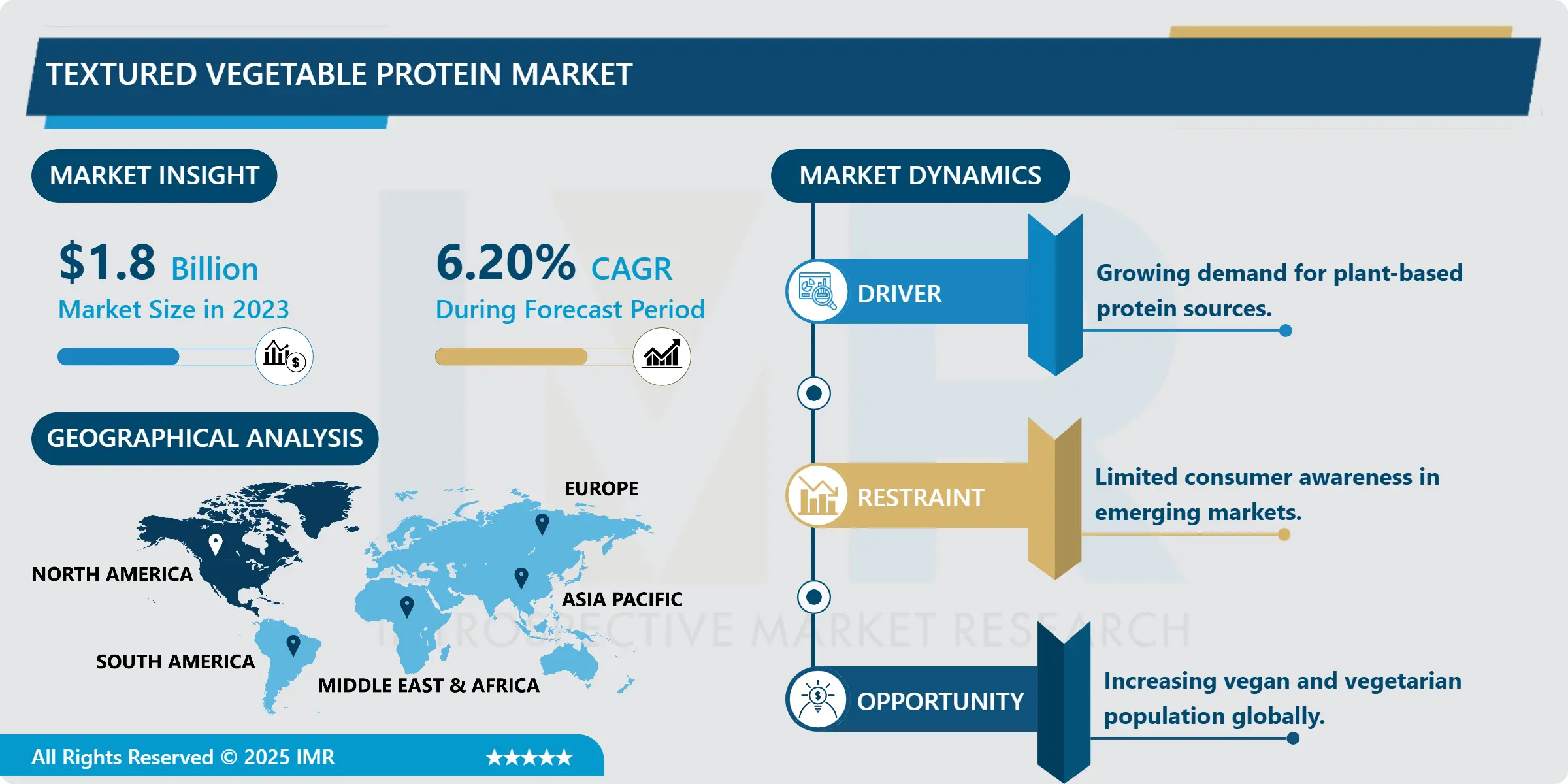
Textured Vegetable Protein Market Trend Analysis:
Increased Adoption of High-Protein Diets
- Among the leading trends influencing the purchasing patterns of Textured Vegetable Protein (TVP) the growth of the high-protein diets among the target consumers, the health-conscious and active physically individuals. Protein is vital for muscle building, slimming and general health hence many people would look for protein foods. TVP since it has high protein and low-fat content is ideal, plant protein sources and can target the market of animal product avoidant consumers. For those who wants to add more protein to their diet but who do not want the negative effects of eating meat, TVP is an ideal substitute. The mentioned trend is most evident in the areas like North America and Europe since people know all the advantages of protein and pay more attention to plant protein than before.
- As a result, there has been a significant process launched by food manufactures to create and diversify the varied TVP products targeted for consuming segments such as athletes, body builders and all those who are interested in exercising. These innovations have promoted the production of protein-dense TVP food products such as protein bar, shake, and supplement food products suitable for the physically active cohort. It’s similar to the current trends of consumers searching for quick, protein rich foods, as they transition to healthier and more vegetarian oriented diets. The use of TVP by sport and fitness lovers also adds value to the product and makes it a more fixed item in the market for food lovers who are in seek of balanced foodstuffs, nevertheless, healthy and sustainable food products.
Expanding Vegan and Vegetarian Population
- The increasing number of consumers following vegan and vegetarian diets across the globe is therefore presenting a massive plus for the Textured Vegetable Protein (TVP) market. As the number of conscious culinarians increases opting for veganism, vegetarianism or flexitarianism diets for various reasons including the current plant-based diets the global demand for quality meat substitutes such as the TVP increases. A texturized vegetable protein, or TVP, is a significant addition to food products including vegetarian burgers, sausages, nuggets, and meals due to its economic value, nutritive benefits, and use as a protein source thus signalling a convenient shift towards meatless diets. This tendency is the most evident in the developed countries where consumers have a greater level of awareness about plant-based diets and it is them who actively look for healthy sustainable foods.
- Asian Pacific, Latin American and African countries which have not fully adopted the plant-based eating culture are other areas of opportunity for the TVP market. Manufacturers of food products are currently exploiting this chance to create products within the regional specifics including the industry’s TVP that targets letting in a more diverse populace. Thus, the scope of the TVP market is not only growing geographically, but also increasing the types of its products that can reach more and more users traditionally oriented at plant-based diets in different cultures and age groups. It is important for manufacturers in the regions to create regional contingencies that will expand the global appeal and market reach of TVP.
Textured Vegetable Protein Market Segment Analysis:
Textured Vegetable Protein Market is Segmented on the basis of source, Application, End User and Region.
By Type, Soy Protein segment is expected to dominate the market during the forecast period
- The Textured Vegetable Protein (TVP) market is primarily led by soy protein due to its high protein content, adaptability, and cost-effectiveness. Its mature distribution channels and ability to mimic meat texture and flavor make it ideal for vegan burgers, sausages, and ready-to-eat meals. Soy’s complete amino acid profile adds nutritional value, appealing to health-conscious consumers.
- Alternative sources like wheat and pea protein are gaining traction. Wheat offers elasticity and chewiness suitable for meat substitutes, though it is unsuitable for gluten-intolerant individuals. Pea protein, being allergen-friendly, GMO-free, and mild in taste, attracts consumers avoiding soy. These alternatives enhance product differentiation and cater to diverse dietary needs and preferences. The rise in popularity of wheat and pea protein expands the TVP market across various consumer segments and demographics, supporting its sustained global growth.
By Application, Food Industry segment expected to held the largest share
- Textured Vegetable Protein (TVP) is widely used in the food industry as a meat substitute in vegan burgers, sausages, nuggets, protein bars, and ready-to-eat meals. Its meat-like texture appeals to vegans and health-conscious consumers seeking plant-based protein options. With the growing demand for convenient, high-protein meals, TVP has become a key ingredient in microwaveable and quick-preparation foods.
- Beyond human consumption, TVP is also used in animal feed for livestock and pets due to its high protein and fiber content, offering an economical alternative to traditional protein sources. It supports animal growth and health, especially in regions with rising demand for affordable, nutritious feed. While food applications dominate the TVP market, its versatility across sectors ranging from functional snacks to animal nutrition ensures continued market growth as industries increasingly seek sustainable, flexible protein sources.
Textured Vegetable Protein Market Regional Insights:
North America is Expected to Dominate the Market Over the Forecast period
- North America region dominance is mainly because of a higher percentage of mature plant-based food market and the conscious knowledge by customer of embracing more plant-based diets. As more of the population shifts to healthier, more environmentally friendly eating habits, the sales of TVP have skyrocketed. The United States especially, is an ideal market for the adoption of TVP because of the concentration of manufacturers, distribution channels, strong research and development investment by food manufacturers especially in plant-based foods. These foundational capacities facilitate fast changes to growing consumer taste preferences, enabling TVP to effectively move from the periphery to grocery shelves and food service distribution.
- In addition, other factors contributing to North America ‘s dominance in the TVP market is increased uptake by flexitarian consumers who partially or intermittent reduce on meat intake. Further, this segment is beneficial from the favourable government policies on organic farming, making it more suitable for plant base food business. Also, key players in North America are investing in research and marketing to diversify TVP; it is being marketed to different consumers through product differentiation. In the meantime, as the developments persist, North America stands to retain its primacy in the TVP market with promising constant expansion due to constant innovations in meeting the various preferences, nutritional requirements and sustainability concerns and objectives.
Active Key Players in the Textured Vegetable Protein Market
- ADM (United States)
- Axiom Foods (United States)
- BENEO GmbH (Germany)
- Burcon Nutra Science Corporation (Canada)
- Cargill Incorporated (United States)
- CHS Inc. (United States)
- DuPont Nutrition & Biosciences (United States)
- Ingredion Incorporated (United States)
- Kerry Group (Ireland)
- Roquette Frères (France)
- Shandong Yuwang Industrial Co., Ltd. (China)
- Sonic Biochem Extractions Ltd. (India)
- Sotexpro S.A (France)
- The Scoular Company (United States)
- Wilmar International Ltd. (Singapore)
- Other Active Players.
|
Textured Vegetable Protein Market |
|||
|
Base Year: |
2023 |
Forecast Period: |
2024-2032 |
|
Historical Data: |
2017 to 2023 |
Market Size in 2023: |
USD 1.8 Billion |
|
Forecast Period 2024-32 CAGR: |
6.20 % |
Market Size in 2032: |
USD 3.09 Billion |
|
Segments Covered: |
By Source |
|
|
|
By Application |
|
||
|
By End User |
|
||
|
By Region |
|
||
|
Key Market Drivers: |
|
||
|
Key Market Restraints: |
|
||
|
Key Opportunities: |
|
||
|
Companies Covered in the report: |
|
||
Chapter 1: Introduction
1.1 Scope and Coverage
Chapter 2:Executive Summary
Chapter 3: Market Landscape
3.1 Industry Dynamics and Opportunity Analysis
3.1.1 Growth Drivers
3.1.2 Limiting Factors
3.1.3 Growth Opportunities
3.1.4 Challenges and Risks
3.2 Market Trend Analysis
3.3 Strategic Pestle Overview
3.4 Porter's Five Forces Analysis
3.5 Industry Value Chain Mapping
3.6 Regulatory Framework
3.7 Princing Trend Analysis
3.8 Patent Analysis
3.9 Technology Evolution
3.10 Investment Pockets
3.11 Import-Export Analysis
Chapter 4: Textured Vegetable Protein Market by Source
4.1 Textured Vegetable Protein Market Snapshot and Growth Engine
4.2 Textured Vegetable Protein Market Overview
4.3 Soy Protein
4.3.1 Introduction and Market Overview
4.3.2 Historic and Forecasted Market Size in Value USD and Volume Units (2017-2032F)
4.3.3 Soy Protein: Geographic Segmentation Analysis
4.4 Wheat Protein
4.4.1 Introduction and Market Overview
4.4.2 Historic and Forecasted Market Size in Value USD and Volume Units (2017-2032F)
4.4.3 Wheat Protein: Geographic Segmentation Analysis
4.5 Pea Protein
4.5.1 Introduction and Market Overview
4.5.2 Historic and Forecasted Market Size in Value USD and Volume Units (2017-2032F)
4.5.3 Pea Protein: Geographic Segmentation Analysis
4.6 Others
4.6.1 Introduction and Market Overview
4.6.2 Historic and Forecasted Market Size in Value USD and Volume Units (2017-2032F)
4.6.3 Others: Geographic Segmentation Analysis
Chapter 5: Textured Vegetable Protein Market by Application
5.1 Textured Vegetable Protein Market Snapshot and Growth Engine
5.2 Textured Vegetable Protein Market Overview
5.3 Food Industry
5.3.1 Introduction and Market Overview
5.3.2 Historic and Forecasted Market Size in Value USD and Volume Units (2017-2032F)
5.3.3 Food Industry: Geographic Segmentation Analysis
5.4 Animal Feed
5.4.1 Introduction and Market Overview
5.4.2 Historic and Forecasted Market Size in Value USD and Volume Units (2017-2032F)
5.4.3 Animal Feed: Geographic Segmentation Analysis
5.5 Others
5.5.1 Introduction and Market Overview
5.5.2 Historic and Forecasted Market Size in Value USD and Volume Units (2017-2032F)
5.5.3 Others: Geographic Segmentation Analysis
Chapter 6: Textured Vegetable Protein Market by End User
6.1 Textured Vegetable Protein Market Snapshot and Growth Engine
6.2 Textured Vegetable Protein Market Overview
6.3 Household
6.3.1 Introduction and Market Overview
6.3.2 Historic and Forecasted Market Size in Value USD and Volume Units (2017-2032F)
6.3.3 Household: Geographic Segmentation Analysis
6.4 Food Service Industry
6.4.1 Introduction and Market Overview
6.4.2 Historic and Forecasted Market Size in Value USD and Volume Units (2017-2032F)
6.4.3 Food Service Industry: Geographic Segmentation Analysis
6.5 Food Processing Industry
6.5.1 Introduction and Market Overview
6.5.2 Historic and Forecasted Market Size in Value USD and Volume Units (2017-2032F)
6.5.3 Food Processing Industry: Geographic Segmentation Analysis
Chapter 7: Company Profiles and Competitive Analysis
7.1 Competitive Landscape
7.1.1 Competitive Benchmarking
7.1.2 Textured Vegetable Protein Market Share by Manufacturer (2023)
7.1.3 Concentration Ratio(CR5)
7.1.4 Heat Map Analysis
7.1.5 Mergers and Acquisitions
7.2 ADM
7.2.1 Company Overview
7.2.2 Key Executives
7.2.3 Company Snapshot
7.2.4 Operating Business Segments
7.2.5 Product Portfolio
7.2.6 Business Performance
7.2.7 Key Strategic Moves and Recent Developments
7.3 AXIOM FOODS
7.4 BENEO GMBH
7.5 BURCON NUTRA SCIENCE CORPORATION
7.6 AND CARGILL INCORPORATED
7.7 OTHER ACTIVE PLAYERS
Chapter 8: Global Textured Vegetable Protein Market By Region
8.1 Overview
8.2. North America Textured Vegetable Protein Market
8.2.1 Historic and Forecasted Market Size by Segments
8.2.2 Historic and Forecasted Market Size By Source
8.2.2.1 Soy Protein
8.2.2.2 Wheat Protein
8.2.2.3 Pea Protein
8.2.2.4 Others
8.2.3 Historic and Forecasted Market Size By Application
8.2.3.1 Food Industry
8.2.3.2 Animal Feed
8.2.3.3 Others
8.2.4 Historic and Forecasted Market Size By End User
8.2.4.1 Household
8.2.4.2 Food Service Industry
8.2.4.3 Food Processing Industry
8.2.5 Historic and Forecast Market Size by Country
8.2.5.1 US
8.2.5.2 Canada
8.2.5.3 Mexico
8.3. Eastern Europe Textured Vegetable Protein Market
8.3.1 Historic and Forecasted Market Size by Segments
8.3.2 Historic and Forecasted Market Size By Source
8.3.2.1 Soy Protein
8.3.2.2 Wheat Protein
8.3.2.3 Pea Protein
8.3.2.4 Others
8.3.3 Historic and Forecasted Market Size By Application
8.3.3.1 Food Industry
8.3.3.2 Animal Feed
8.3.3.3 Others
8.3.4 Historic and Forecasted Market Size By End User
8.3.4.1 Household
8.3.4.2 Food Service Industry
8.3.4.3 Food Processing Industry
8.3.5 Historic and Forecast Market Size by Country
8.3.5.1 Bulgaria
8.3.5.2 The Czech Republic
8.3.5.3 Hungary
8.3.5.4 Poland
8.3.5.5 Romania
8.3.5.6 Rest of Eastern Europe
8.4. Western Europe Textured Vegetable Protein Market
8.4.1 Historic and Forecasted Market Size by Segments
8.4.2 Historic and Forecasted Market Size By Source
8.4.2.1 Soy Protein
8.4.2.2 Wheat Protein
8.4.2.3 Pea Protein
8.4.2.4 Others
8.4.3 Historic and Forecasted Market Size By Application
8.4.3.1 Food Industry
8.4.3.2 Animal Feed
8.4.3.3 Others
8.4.4 Historic and Forecasted Market Size By End User
8.4.4.1 Household
8.4.4.2 Food Service Industry
8.4.4.3 Food Processing Industry
8.4.5 Historic and Forecast Market Size by Country
8.4.5.1 Germany
8.4.5.2 UK
8.4.5.3 France
8.4.5.4 Netherlands
8.4.5.5 Italy
8.4.5.6 Russia
8.4.5.7 Spain
8.4.5.8 Rest of Western Europe
8.5. Asia Pacific Textured Vegetable Protein Market
8.5.1 Historic and Forecasted Market Size by Segments
8.5.2 Historic and Forecasted Market Size By Source
8.5.2.1 Soy Protein
8.5.2.2 Wheat Protein
8.5.2.3 Pea Protein
8.5.2.4 Others
8.5.3 Historic and Forecasted Market Size By Application
8.5.3.1 Food Industry
8.5.3.2 Animal Feed
8.5.3.3 Others
8.5.4 Historic and Forecasted Market Size By End User
8.5.4.1 Household
8.5.4.2 Food Service Industry
8.5.4.3 Food Processing Industry
8.5.5 Historic and Forecast Market Size by Country
8.5.5.1 China
8.5.5.2 India
8.5.5.3 Japan
8.5.5.4 South Korea
8.5.5.5 Malaysia
8.5.5.6 Thailand
8.5.5.7 Vietnam
8.5.5.8 The Philippines
8.5.5.9 Australia
8.5.5.10 New Zealand
8.5.5.11 Rest of APAC
8.6. Middle East & Africa Textured Vegetable Protein Market
8.6.1 Historic and Forecasted Market Size by Segments
8.6.2 Historic and Forecasted Market Size By Source
8.6.2.1 Soy Protein
8.6.2.2 Wheat Protein
8.6.2.3 Pea Protein
8.6.2.4 Others
8.6.3 Historic and Forecasted Market Size By Application
8.6.3.1 Food Industry
8.6.3.2 Animal Feed
8.6.3.3 Others
8.6.4 Historic and Forecasted Market Size By End User
8.6.4.1 Household
8.6.4.2 Food Service Industry
8.6.4.3 Food Processing Industry
8.6.5 Historic and Forecast Market Size by Country
8.6.5.1 Turkey
8.6.5.2 Bahrain
8.6.5.3 Kuwait
8.6.5.4 Saudi Arabia
8.6.5.5 Qatar
8.6.5.6 UAE
8.6.5.7 Israel
8.6.5.8 South Africa
8.7. South America Textured Vegetable Protein Market
8.7.1 Historic and Forecasted Market Size by Segments
8.7.2 Historic and Forecasted Market Size By Source
8.7.2.1 Soy Protein
8.7.2.2 Wheat Protein
8.7.2.3 Pea Protein
8.7.2.4 Others
8.7.3 Historic and Forecasted Market Size By Application
8.7.3.1 Food Industry
8.7.3.2 Animal Feed
8.7.3.3 Others
8.7.4 Historic and Forecasted Market Size By End User
8.7.4.1 Household
8.7.4.2 Food Service Industry
8.7.4.3 Food Processing Industry
8.7.5 Historic and Forecast Market Size by Country
8.7.5.1 Brazil
8.7.5.2 Argentina
8.7.5.3 Rest of SA
Chapter 9 Analyst Viewpoint and Conclusion
9.1 Recommendations and Concluding Analysis
9.2 Potential Market Strategies
Chapter 10 Research Methodology
10.1 Research Process
10.2 Primary Research
10.3 Secondary Research
|
Textured Vegetable Protein Market |
|||
|
Base Year: |
2023 |
Forecast Period: |
2024-2032 |
|
Historical Data: |
2017 to 2023 |
Market Size in 2023: |
USD 1.8 Billion |
|
Forecast Period 2024-32 CAGR: |
6.20 % |
Market Size in 2032: |
USD 3.09 Billion |
|
Segments Covered: |
By Source |
|
|
|
By Application |
|
||
|
By End User |
|
||
|
By Region |
|
||
|
Key Market Drivers: |
|
||
|
Key Market Restraints: |
|
||
|
Key Opportunities: |
|
||
|
Companies Covered in the report: |
|
||


