




Key Market Highlights
Strand Displacement Amplification Market Size Was Valued at USD 4.39 Billion in 2024, and is Projected to Reach USD 11.21 Billion by 2035, Growing at a CAGR of 8.9% from 2025-2035.
- Market Size in 2024: USD 4.39 Billion
- Projected Market Size by 2035: USD 11.21 Billion
- CAGR (2025–2035): 8.9%
- Leading Market in 2024: North America
- Fastest-Growing Market: Asia-Pacific
- By Product: The Reagents & Kits segment is anticipated to lead the market by accounting for 57.05% of the market share throughout the forecast period.
- By End-User: The Diagnostic Laboratories segment is expected to capture 29.20% of the market share, thereby maintaining its dominance over the forecast period.
- By Region: North America region is projected to hold 31.98% of the market share during the forecast period.
- Active Players: Abbott Laboratories (United States), Agilent Technologies, Inc. (United States), Becton, Dickinson and Company (United States), bioMérieux SA (France), and Other Active Players.
Strand Displacement Amplification Market Synopsis:
Strand Displacement Amplification (SDA) is a molecular technique used to make many copies of a specific DNA sequence without the need for repeated heating and cooling, as required in traditional PCR. Instead, SDA works at a constant temperature using specialized enzymes that separate DNA strands during replication. This makes the process faster, simpler, and more cost-effective. In the current market scenario, SDA is gaining attention as healthcare systems seek rapid and accurate diagnostic solutions. Its ease of use and compatibility with portable devices make it especially valuable in point-of-care testing and low-resource settings. The growing burden of infectious diseases, rising demand for early diagnosis, and expansion of nucleic acid testing are creating strong market need. Continued innovation in diagnostic platforms is further supporting SDA adoption worldwide.
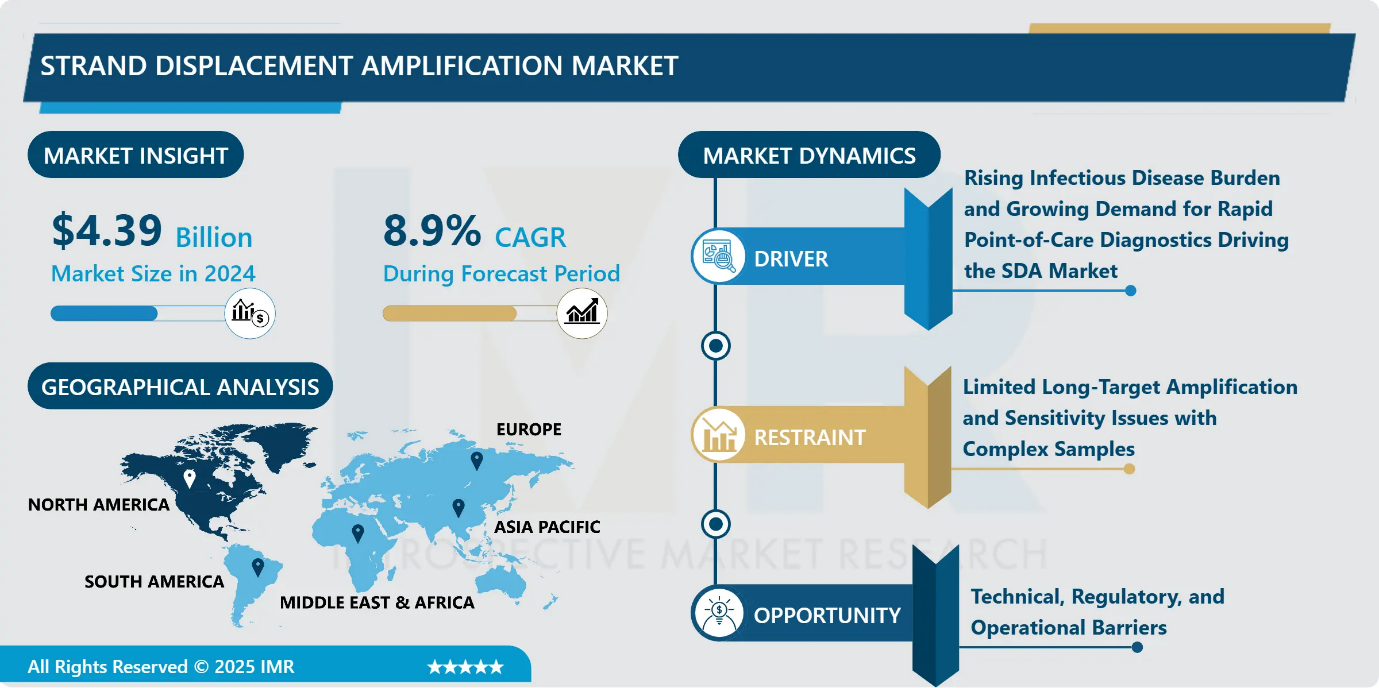
Strand Displacement Amplification Market Dynamics and Trend Analysis:
Strand Displacement Amplification Market Growth Driver - Rising Infectious Disease Burden and Growing Demand for Rapid Point-of-Care Diagnostics Driving the SDA Market
-
The global SDA market is primarily driven by the growing burden of infectious diseases and the increasing demand for point-of-care (POC) diagnostics. Rising prevalence of conditions such as tuberculosis, HIV, and other viral and bacterial infections underscores the need for rapid, reliable diagnostic tools.
- SDA’s isothermal amplification capability allows nucleic acid detection without complex thermocyclers, making it ideal for portable, fast, and sensitive point-of-care testing, including emergency, remote, and home-based settings. The technique supports timely clinical decision-making, early intervention, and improved patient outcomes. Additionally, the focus on personalized medicine and genetic testing further fuels demand for precise, rapid diagnostics. The World Health Organization’s reports on increasing infectious disease cases highlight the critical role of SDA in addressing global healthcare needs.
Strand Displacement Amplification Market Limiting Factor - Limited Long-Target Amplification and Sensitivity Issues with Complex Samples
-
One of the primary limitations of strand displacement amplification (SDA) is its inability to efficiently amplify long DNA target sequences, which restricts its use in applications such as gene sequencing and large-fragment analysis, where PCR remains the preferred method.
- Additionally, SDA can face challenges with sensitivity and specificity when working with complex or inhibitory samples, including whole blood, sputum, or environmental specimens. Components within these samples can interfere with the amplification process, potentially leading to reduced detection accuracy or false negatives. Overcoming these issues requires robust and universal sample preparation protocols that effectively remove inhibitors while preserving nucleic acids. Developing such standardized methods remains a significant technical hurdle for expanding SDA adoption in diverse clinical, research, and environmental applications.
Strand Displacement Amplification Market Expansion Opportunity - Multiplex Testing, Decentralized Diagnostics, and Technological Advancements
-
The SDA market offers significant opportunities through the expansion into multiplex and syndromic testing, allowing simultaneous detection of multiple pathogens from a single sample. This capability is especially valuable for diagnosing infections with overlapping symptoms, such as respiratory and sexually transmitted diseases, improving diagnostic accuracy while reducing turnaround time and resource use. At the same time, the growing adoption of SDA in resource-limited and decentralized settings presents a strong growth avenue, as the technology does not require complex equipment or thermocyclers.
- Further opportunities arise from ongoing advancements in isothermal amplification technologies, including integration with microfluidics and point-of-care platforms, which enhance speed, sensitivity, and affordability. Rising infectious and chronic disease burdens, along with aging populations, continue to drive demand for rapid, accessible, and reliable diagnostic solutions worldwide.
Strand Displacement Amplification Market Challenge and Risk - Technical, Regulatory, and Operational Barriers
-
The SDA market faces several challenges that could limit its growth. The technique’s technical complexity requiring carefully designed primers, nicking endonucleases, and strand-displacing polymerases makes assay development labor-intensive and difficult to multiplex. Adoption is further hindered by the lack of standardized validation protocols and clear regulatory frameworks, making clinical integration slower. Manufacturers also struggle to maintain consistent sensitivity and specificity across diverse targets, particularly for low-abundance nucleic acids in point-of-care or resource-limited settings.
- Additionally, regulatory hurdles, including rigorous approval processes by bodies like the U.S. FDA, can extend time to market and increase costs. New entrants face competition from established players, while market dynamics can be disrupted by global health crises, requiring strategic innovation and collaboration to remain competitive.
Strand Displacement Amplification Market Trend - Integration of Digital & Automated Diagnostic Platforms and Growing Focus on Rapid, Multiplex Testing Solutions
-
The SDA market is witnessing notable trends driven by technological innovation and evolving diagnostic needs. A key trend is the integration of SDA with digital technologies, including cloud computing and AI-driven analytics, enabling real-time data analysis, improved accuracy, and remote diagnostics, particularly in point-of-care settings.
- Another important trend is the development of integrated and automated platforms that combine sample preparation, amplification, and detection into single, user-friendly systems, reducing hands-on time and contamination risks. The market is also shifting toward ultra-rapid turnaround assays for critical infections, supporting faster clinical decision-making. Additionally, enhanced multiplexing capabilities are gaining traction, allowing simultaneous detection of multiple pathogens from one sample, improving diagnostic efficiency, workflow optimization, and patient management across clinical and public health applications.
Strand Displacement Amplification Market Segment Analysis:
Strand Displacement Amplification Market is segmented based on Product, Technology, Application, End-User and Region
By Product, Reagents & Kits segment is expected to dominate the market with around 57.05% share during the forecast period.
-
The Reagents & Kits segment dominates the Strand Displacement Amplification (SDA) market, accounting for approximately 57.05% of total revenue in 2024, driven by their recurring demand and essential role in every SDA workflow. This segment’s dominance is primarily due to the widespread use of enzymes, primers, buffers, and probes across clinical diagnostics, research laboratories, and point-of-care testing. The growing preference for ready-to-use and lyophilized kits has simplified assay preparation, reduced contamination risks, and improved reproducibility, making them highly attractive to end users. Increasing adoption of multiplex and syndromic testing panels further strengthens demand. Overall, frequent repurchasing, ease of use, and broad applicability explain the dominance of reagents and kits in the SDA market.
By End-User, Diagnostic laboratories is expected to dominate with close to 29.20% market share during the forecast period.
-
By end user, diagnostic laboratories accounted for the largest share of the SDA market in 2024, contributing over 29.20% of total revenue. Their dominance is driven by high testing volumes, advanced laboratory infrastructure, and the availability of skilled professionals capable of performing complex molecular diagnostics. Diagnostic laboratories play a central role in infectious disease testing, confirmatory diagnostics, and outbreak surveillance, making SDA a preferred technology due to its scalability and automation potential. In contrast, the hospitals & clinics segment is expected to register the fastest growth, as healthcare providers increasingly establish in-house diagnostic facilities to improve turnaround time, reduce dependency on external labs, and enhance patient care efficiency amid rising diagnostic demand.
Strand Displacement Amplification Market Regional Insights:
North America region is estimated to lead the market with around 31.98% share during the forecast period.
-
North America is expected to remain the largest market for strand displacement amplification (SDA), accounting for nearly 31.98% of global revenue in 2024. This leadership is driven by several key factors. The region has a strong healthcare infrastructure, high diagnostic testing rates, and early adoption of advanced molecular technologies. A rising disease burden also plays a major role, with the United States reporting approximately 25 million influenza cases, 280,000 hospitalizations, and 17,000 deaths during the 2022–2023 flu season, along with 43.4 RSV-related hospitalizations per 100,000 people.
- In addition, more than 1.9 million new cancer cases were diagnosed in the U.S. in 2023. The presence of leading diagnostic companies, robust government funding for research, and increasing demand for rapid point-of-care testing further explain why North America continues to dominate the SDA market.
Strand Displacement Amplification Market Active Players:
- Abbott Laboratories (United States)
- Agilent Technologies, Inc. (United States)
- Becton, Dickinson and Company (BD) (United States)
- BioMérieux SA (France)
- Bio-Rad Laboratories, Inc. (United States)
- Danaher Corporation (United States)
- Eiken Chemical Co., Ltd. (Japan)
- Hologic, Inc. (United States)
- Meridian Bioscience, Inc. (United States)
- QIAGEN N.V. (Netherlands)
- Roche Diagnostics (Switzerland)
- Siemens Healthineers AG (Germany)
- Sysmex Corporation (Japan)
- Thermo Fisher Scientific Inc. (United States)
- TwistDx Limited (Abbott subsidiary) (United Kingdom)
- Other Active Players
Key Industry Developments in the Strand Displacement Amplification Market:
-
In September 2025, Thermo Fisher Scientific (U.S.) expanded collaborations with research institutions to advance next-generation isothermal amplification technologies, reinforcing its focus on innovation and leadership in emerging molecular diagnostics.
- In August 2025, Abbott Laboratories (U.S.) introduced a new isothermal amplification platform for rapid infectious disease detection, strengthening its portfolio to address the rising demand for fast and accurate diagnostics in decentralized and point-of-care settings.
Technical Overview of the Strand Displacement Amplification (SDA) Market: Mechanism, Isothermal Amplification Advantages, and Applications in Molecular Diagnostics
-
Strand Displacement Amplification (SDA) is an isothermal nucleic acid amplification technique that enables rapid and exponential replication of target DNA sequences at a constant temperature. Unlike PCR, SDA does not require thermal cycling; instead, it relies on a combination of specially designed primers, a strand-displacing DNA polymerase, and nicking endonucleases. The process begins with primer extension, followed by nicking and strand displacement, allowing continuous amplification of the target sequence.
- This mechanism makes SDA faster, energy-efficient, and well suited for portable and point-of-care diagnostic platforms. Technically, SDA offers high sensitivity and specificity for short DNA targets, making it ideal for infectious disease detection and genetic testing. Advances in enzyme chemistry, probe design, and integration with automated and microfluidic systems are improving assay robustness and usability. These technical strengths support SDA’s growing adoption in clinical diagnostics, research laboratories, and decentralized testing environments.
|
Strand Displacement Amplification Market |
|||
|
Base Year: |
2024 |
Forecast Period: |
2025-2035 |
|
Historical Data: |
2018 to 2024 |
Market Size in 2024: |
USD 4.39 Bn. |
|
Forecast Period 2025-35 CAGR: |
8.9% |
Market Size in 2035: |
USD 11.21 Bn. |
|
Segments Covered: |
By Product |
|
|
|
By Technology |
|
||
|
By Application
|
|
||
|
By End-User |
|
||
|
By Region |
|
||
|
Growth Driver: |
|
||
|
Limiting Factor |
|
||
|
Expansion Opportunity |
|
||
|
Challenge and Risk |
|
||
|
Companies Covered in the Report: |
|
||
Chapter 1: Introduction
1.1 Scope and Coverage
Chapter 2:Executive Summary
Chapter 3: Market Landscape
3.1 Market Dynamics and Opportunity Analysis
3.1.1 Growth Drivers
3.1.2 Limiting Factors
3.1.3 Growth Opportunities
3.1.4 Challenges and Risks
3.2 Market Trend Analysis
3.3 Industry Ecosystem
3.4 Industry Value Chain Mapping
3.5 Strategic PESTLE Overview
3.6 Porter's Five Forces Framework
3.7 Regulatory Framework
3.8 Pricing Trend Analysis
3.9 Intellectual Property Review
3.10 Technology Evolution
3.11 Import-Export Analysis
3.12 Consumer Behavior Analysis
3.13 Investment Pocket Analysis
3.14 Go-To Market Strategy
Chapter 4: Strand Displacement Amplification Market by Product Type (2018-2035)
4.1 Strand Displacement Amplification Market Snapshot and Growth Engine
4.2 Market Overview
4.3 Instruments
4.3.1 Introduction and Market Overview
4.3.2 Historic and Forecasted Market Size in Value USD and Volume Units
4.3.3 Key Market Trends, Growth Factors, and Opportunities
4.3.4 Geographic Segmentation Analysis
4.4 Reagents and Kits
Chapter 5: Strand Displacement Amplification Market by Technology (2018-2035)
5.1 Strand Displacement Amplification Market Snapshot and Growth Engine
5.2 Market Overview
5.3 Real-Time PCR
5.3.1 Introduction and Market Overview
5.3.2 Historic and Forecasted Market Size in Value USD and Volume Units
5.3.3 Key Market Trends, Growth Factors, and Opportunities
5.3.4 Geographic Segmentation Analysis
5.4 Polymerase Chain Reaction (PCR)
Chapter 6: Strand Displacement Amplification Market by Application (2018-2035)
6.1 Strand Displacement Amplification Market Snapshot and Growth Engine
6.2 Market Overview
6.3 Tuberculosis
6.3.1 Introduction and Market Overview
6.3.2 Historic and Forecasted Market Size in Value USD and Volume Units
6.3.3 Key Market Trends, Growth Factors, and Opportunities
6.3.4 Geographic Segmentation Analysis
6.4 Hepatitis
6.5 Malaria
6.6 Influenza
6.7 Cancer
6.8 Other Applications
Chapter 7: Strand Displacement Amplification Market by End-User (2018-2035)
7.1 Strand Displacement Amplification Market Snapshot and Growth Engine
7.2 Market Overview
7.3 Hospitals & Clinics
7.3.1 Introduction and Market Overview
7.3.2 Historic and Forecasted Market Size in Value USD and Volume Units
7.3.3 Key Market Trends, Growth Factors, and Opportunities
7.3.4 Geographic Segmentation Analysis
7.4 Diagnostic Laboratories
7.5 Research Institutes
7.6 Biotechnology & Pharmaceutical Companies
Chapter 8: Company Profiles and Competitive Analysis
8.1 Competitive Landscape
8.1.1 Competitive Benchmarking
8.1.2 Strand Displacement Amplification Market Share by Manufacturer/Service Provider(2024)
8.1.3 Industry BCG Matrix
8.1.4 PArtnerships, Mergers & Acquisitions
8.2 ABBOTT LABORATORIES (UNITED STATES)
8.2.1 Company Overview
8.2.2 Key Executives
8.2.3 Company Snapshot
8.2.4 Role of the Company in the Market
8.2.5 Sustainability and Social Responsibility
8.2.6 Operating Business Segments
8.2.7 Product Portfolio
8.2.8 Business Performance
8.2.9 Recent News & Developments
8.2.10 SWOT Analysis
8.3 AGILENT TECHNOLOGIES
8.4 INC. (UNITED STATES)
8.5 BECTON
8.6 DICKINSON AND COMPANY (UNITED STATES)
8.7 BIOMÉRIEUX SA (FRANCE)
8.8 BIO-RAD LABORATORIES
8.9 INC. (UNITED STATES)
8.10 DANAHER CORPORATION (UNITED STATES)
8.11 EIKEN CHEMICAL CO.
8.12 LTD. (JAPAN)
8.13 HOLOGIC
8.14 INC. (UNITED STATES)
8.15 MERIDIAN BIOSCIENCE
8.16 INC. (UNITED STATES)
8.17 QIAGEN N.V. (NETHERLANDS)
8.18 ROCHE DIAGNOSTICS (SWITZERLAND)
8.19 SIEMENS HEALTHINEERS AG (GERMANY)
8.20 SYSMEX CORPORATION (JAPAN)
8.21 THERMO FISHER SCIENTIFIC INC. (UNITED STATES)
8.22 TWISTDX LIMITED (UNITED KINGDOM) AND OTHER ACTIVE PLAYERS
Chapter 9: Global Strand Displacement Amplification Market By Region
9.1 Overview
9.2. North America Strand Displacement Amplification Market
9.2.1 Key Market Trends, Growth Factors and Opportunities
9.2.2 Top Key Companies
9.2.3 Historic and Forecasted Market Size by Segments
9.2.4 Historic and Forecast Market Size by Country
9.2.4.1 US
9.2.4.2 Canada
9.2.4.3 Mexico
9.3. Eastern Europe Strand Displacement Amplification Market
9.3.1 Key Market Trends, Growth Factors and Opportunities
9.3.2 Top Key Companies
9.3.3 Historic and Forecasted Market Size by Segments
9.3.4 Historic and Forecast Market Size by Country
9.3.4.1 Russia
9.3.4.2 Bulgaria
9.3.4.3 The Czech Republic
9.3.4.4 Hungary
9.3.4.5 Poland
9.3.4.6 Romania
9.3.4.7 Rest of Eastern Europe
9.4. Western Europe Strand Displacement Amplification Market
9.4.1 Key Market Trends, Growth Factors and Opportunities
9.4.2 Top Key Companies
9.4.3 Historic and Forecasted Market Size by Segments
9.4.4 Historic and Forecast Market Size by Country
9.4.4.1 Germany
9.4.4.2 UK
9.4.4.3 France
9.4.4.4 The Netherlands
9.4.4.5 Italy
9.4.4.6 Spain
9.4.4.7 Rest of Western Europe
9.5. Asia Pacific Strand Displacement Amplification Market
9.5.1 Key Market Trends, Growth Factors and Opportunities
9.5.2 Top Key Companies
9.5.3 Historic and Forecasted Market Size by Segments
9.5.4 Historic and Forecast Market Size by Country
9.5.4.1 China
9.5.4.2 India
9.5.4.3 Japan
9.5.4.4 South Korea
9.5.4.5 Malaysia
9.5.4.6 Thailand
9.5.4.7 Vietnam
9.5.4.8 The Philippines
9.5.4.9 Australia
9.5.4.10 New Zealand
9.5.4.11 Rest of APAC
9.6. Middle East & Africa Strand Displacement Amplification Market
9.6.1 Key Market Trends, Growth Factors and Opportunities
9.6.2 Top Key Companies
9.6.3 Historic and Forecasted Market Size by Segments
9.6.4 Historic and Forecast Market Size by Country
9.6.4.1 Turkiye
9.6.4.2 Bahrain
9.6.4.3 Kuwait
9.6.4.4 Saudi Arabia
9.6.4.5 Qatar
9.6.4.6 UAE
9.6.4.7 Israel
9.6.4.8 South Africa
9.7. South America Strand Displacement Amplification Market
9.7.1 Key Market Trends, Growth Factors and Opportunities
9.7.2 Top Key Companies
9.7.3 Historic and Forecasted Market Size by Segments
9.7.4 Historic and Forecast Market Size by Country
9.7.4.1 Brazil
9.7.4.2 Argentina
9.7.4.3 Rest of SA
Chapter 10 Analyst Viewpoint and Conclusion
Chapter 11 Our Thematic Research Methodology
11.1 Research Process
11.2 Primary Research
11.3 Secondary Research
Chapter 12 Case Study
Chapter 13 Appendix
13.1 Sources
13.2 List of Tables and figures
13.3 Short Forms and Citations
13.4 Assumption and Conversion
13.5 Disclaimer
|
Strand Displacement Amplification Market |
|||
|
Base Year: |
2024 |
Forecast Period: |
2025-2035 |
|
Historical Data: |
2018 to 2024 |
Market Size in 2024: |
USD 4.39 Bn. |
|
Forecast Period 2025-35 CAGR: |
8.9% |
Market Size in 2035: |
USD 11.21 Bn. |
|
Segments Covered: |
By Product |
|
|
|
By Technology |
|
||
|
By Application
|
|
||
|
By End-User |
|
||
|
By Region |
|
||
|
Growth Driver: |
|
||
|
Limiting Factor |
|
||
|
Expansion Opportunity |
|
||
|
Challenge and Risk |
|
||
|
Companies Covered in the Report: |
|
||


