




Key Market Highlights
Stem Cell Reconstructive Market Size Was Valued at USD 16.80 Billion in 2024, and is Projected to Reach USD 48.90 Billion by 2035, Growing at a CAGR of 10.2% from 2025-2035.
- Market Size in 2024: USD 16.80 Billion
- Projected Market Size by 2035: USD 48.90 Billion
- CAGR (2025–2035): 10.2%
- Leading Market in 2024: North America
- Fastest-Growing Market: Asia-Pacific
- By Therapy Type: The Allogeneic segment is anticipated to lead the market by accounting for 36.8% of the market share throughout the forecast period.
- By Application: The Oncology segment is expected to capture 27.3% of the market share, thereby maintaining its dominance over the forecast period.
- By Region: North America region is projected to hold 32.6% of the market share during the forecast period.
- Active Players: AlloSource (U.S.), AstraZeneca (U.K.), Athersys, Inc. (U.S.), BrainStorm Cell Therapeutics, Inc. (U.S.), Cellino (U.S.), Celgene Corporation (U.S.), and Other Active Players.
Stem Cell Reconstructive Market Synopsis:
The Stem Cell Reconstructive Market focuses on the use of stem cell–based therapies to restore, repair, or regenerate damaged tissues and organs resulting from injury, disease, or congenital conditions. This market is gaining momentum due to the rising burden of chronic, degenerative, and trauma-related disorders, including musculoskeletal injuries, cardiovascular diseases, neurological conditions, and complex wounds. Advances in stem cell isolation, expansion, cryopreservation, and delivery technologies have improved treatment efficacy and scalability, supporting wider clinical adoption. Favorable regulatory pathways, increasing government and private funding, and expanding clinical research activity further strengthen market growth. The need for stem cell reconstructive therapies is driven by limitations of conventional treatments, growing demand for personalized and regenerative solutions, and the ability of stem cells to accelerate healing, modulate immune responses, and improve functional recovery.
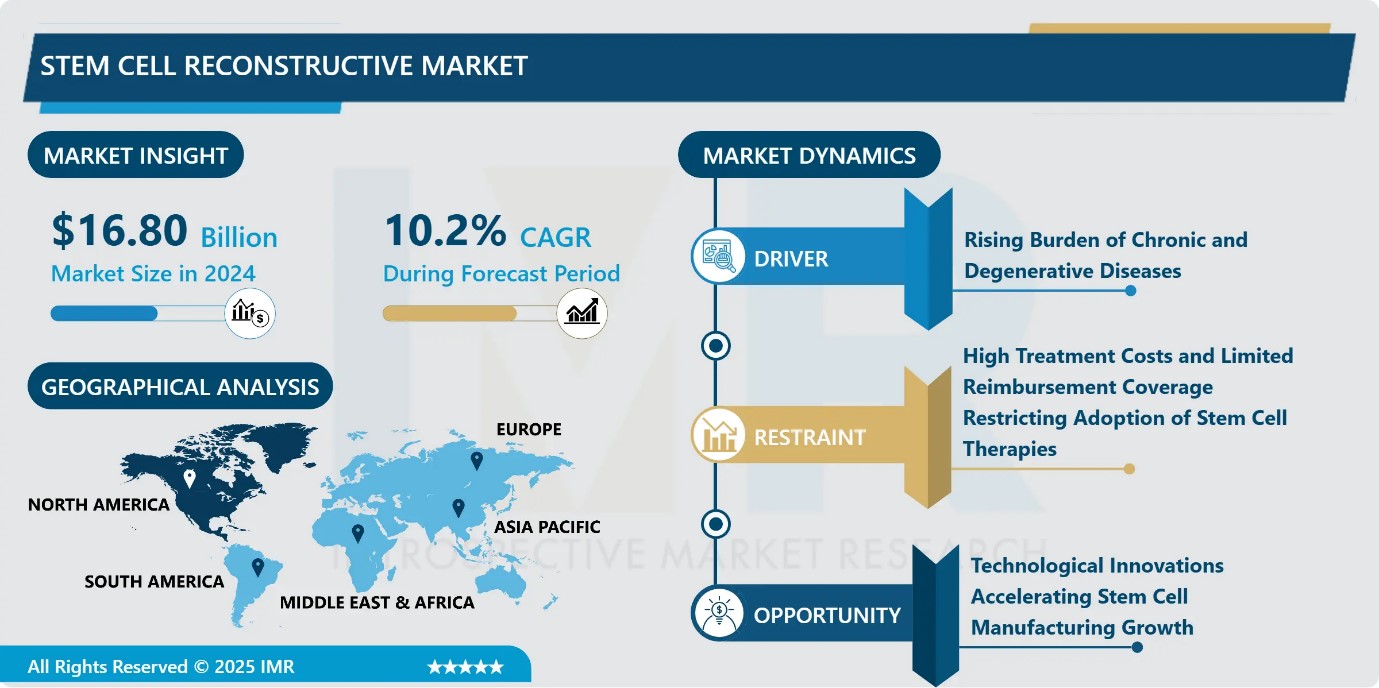
Stem Cell Reconstructive Market Dynamics and Trend Analysis:
Stem Cell Reconstructive Market Growth Driver-Rising Burden of Chronic and Degenerative Diseases
- The rising prevalence of chronic and degenerative diseases, driven by rapidly aging populations, is a key growth driver for the stem cell market. Neurodegenerative conditions such as Parkinson’s disease are expected to increase significantly, with population aging accounting for the majority of new cases. This demographic shift is intensifying demand for regenerative and disease-modifying therapies. Mesenchymal stem cells (MSCs), known for their anti-inflammatory properties, ability to slow tissue degeneration, and capacity to promote repair, are increasingly viewed as cost-effective solutions for long-term disease management. Consequently, healthcare systems are redirecting spending toward MSC-based therapies to reduce long-term care costs.
Stem Cell Reconstructive Market Limiting Factor-High Treatment Costs and Limited Reimbursement Coverage Restricting Adoption of Stem Cell Therapies
- High treatment costs and limited reimbursement frameworks represent major restraints on the growth of the stem cell market. Many stem cell–based therapies remain classified as experimental or investigational, restricting their eligibility for public and private insurance coverage. As a result, patients are often required to bear a substantial portion of treatment costs out of pocket, limiting adoption rates. Coverage under programs such as Medicare is largely confined to FDA-approved procedures, including select allogeneic stem cell transplants, leaving most advanced therapies uncovered. These financial barriers reduce patient access, slow clinical uptake, and discourage widespread commercialization, thereby constraining market expansion despite strong therapeutic potential.
Stem Cell Reconstructive Market Expansion Opportunity-Technological Innovations Accelerating Stem Cell Manufacturing Growth
- Rapid advancements in stem cell research present a significant growth opportunity for the stem cell manufacturing market. Breakthroughs in technologies such as induced pluripotent stem cells (iPSCs) and CRISPR-based gene editing are transforming cell engineering and manufacturing capabilities. These innovations enable the efficient generation of targeted, high-quality cell types for a wide range of therapeutic applications, expanding the commercial potential of stem cell–based products. Continued progress in stem cell biology is improving scalability, consistency, and clinical viability, making large-scale manufacturing more feasible. As a result, the market is projected to grow at a strong pace over the next five years, attracting increased investment, strategic partnerships, and collaborative research initiatives.
Stem Cell Reconstructive Market Challenge and Risk-Safety, Efficacy, and Regulatory Uncertainties Challenging Stem Cell Therapy Development
- Safety and efficacy uncertainties continue to pose a significant challenge to the stem cell market. Concerns related to tumorigenicity and immunogenic responses, particularly with pluripotent stem cell–based therapies, raise risks during clinical development and commercialization. In addition, variability between manufacturing batches complicates potency testing and quality assurance, prompting stricter regulatory scrutiny. While advances such as immune-evasive or “cloaked” grafts show promise in improving compatibility and therapeutic integration, they are still in early stages of validation. Furthermore, regulatory rulings reinforcing oversight of cell therapies, although providing clarity, may extend approval timelines and increase development complexity for market participants.
Stem Cell Reconstructive Market Trend-Rapid Expansion of Regenerative Medicine Pipeline Driven by Gene Editing, AI Integration, and Clinical Validation
- The regenerative medicine landscape is witnessing rapid expansion, emerging as a key trend shaping the stem cell market. A growing pipeline of gene, cell, and RNA-based therapies reflects increasing clinical and commercial momentum, with early-stage development activity continuing to rise. Advances in CRISPR gene editing are enhancing the efficacy of cell therapies such as CAR-T and enabling their application beyond oncology into autoimmune disorders.
- In parallel, artificial intelligence–driven analytics are streamlining cell characterization and quality testing, significantly reducing processing timelines. Expanding clinical evidence, including successes in retinal regeneration and iPSC-based therapies for metabolic diseases, is broadening target patient populations and strengthening long-term market prospects.
Stem Cell Reconstructive Market Segment Analysis:
Stem Cell Reconstructive Market is segmented based on Therapy Type, Cell Source, Cell Type, Product, Application, End User, and Region.
By Therapy Type, Allogenic segment is expected to dominate the market with around 36.8% share during the forecast period.
- Allogeneic stem cell therapies continue to dominate the market, accounting for approximately 36.8% of total market share in 2024, primarily due to their cost efficiency, scalability, and off-the-shelf availability. Batch manufacturing enables standardized production and rapid deployment, making allogeneic products more accessible for large patient populations. A robust clinical pipeline, with over 500 active trials across oncology, autoimmune, and infectious diseases, further reinforces their leadership. Ongoing innovations, including immune-evasive iPSC platforms, are addressing rejection risks and strengthening clinical viability. Meanwhile, autologous therapies are gaining momentum, driven by technological advances that reduce processing time, though their higher costs currently limit broader adoption.
By Application, Oncology is expected to dominate with close to 27.3% market share during the forecast period.
- Oncology is the leading therapeutic application in the stem cell therapy market, capturing about 27.3% of total market share and continuing to expand steadily. This dominance is largely driven by the high incidence of cancer worldwide and the well-established clinical role of stem cell therapies in oncology. Hematopoietic stem cell transplantation is a standard of care for cancers such as leukemia, lymphoma, and multiple myeloma. Moreover, the integration of stem cell therapies with advanced modalities including immunotherapy and gene editing has significantly improved treatment outcomes. Strong clinical evidence, mature treatment protocols, and sustained research investment collectively reinforce oncology’s dominant position in the stem cell therapy market.
Stem Cell Reconstructive Market Regional Insights:
North America region is estimated to lead the market with around 32.6% share during the forecast period.
- North America leads the stem cell therapy and manufacturing market, accounting for approximately 32.6% of global revenue, and is expected to remain dominant throughout the forecast period. This leadership is driven by a high concentration of biotechnology companies, extensive clinical trial activity, and strong commercialization capabilities, particularly in mesenchymal and hematopoietic stem cell therapies. Robust funding from government bodies such as the NIH, along with substantial private and venture capital investment, continues to accelerate innovation. Supportive regulatory frameworks, including FDA programs like RMAT, enable faster approvals. Advanced healthcare infrastructure, skilled research institutions, and scalable manufacturing capabilities collectively reinforce North America’s dominance in the global stem cell market.
Stem Cell Reconstructive Market Active Players:
- Allergan Aesthetics (AbbVie Inc.) (U.S.)
- AlloSource (U.S.)
- AstraZeneca (U.K.)
- Athersys, Inc. (U.S.)
- BrainStorm Cell Therapeutics, Inc. (U.S.)
- Bristol-Myers Squibb Company (U.S.)
- Cellino (U.S.)
- Cynata Therapeutics Limited (Australia)
- Mesoblast Ltd. (Australia)
- Novartis AG (Switzerland)
- ReNeuron Group plc (U.K.)
- Smith & Nephew (U.K.)
- Stryker (U.S.)
- Takeda Pharmaceutical Company Limited (Japan)
- Vericel Corporation (U.S.)
- Other Active Players
Key Industry Developments in the Stem Cell Reconstructive Market:
- In May 2025, AstraZeneca finalized the acquisition of EsoBiotec in a deal valued at up to USD 1 billion, strengthening its cell therapy pipeline by leveraging EsoBiotec’s Engineered NanoBody Lentiviral platform to accelerate advanced therapeutic development.
- In April 2025, Cellino entered a strategic partnership with Karis Bio to commercialize an autologous induced pluripotent stem cell (iPSC)–based therapy targeting peripheral artery disease (PAD) and coronary artery disease (CAD), expanding its presence in cardiovascular regenerative medicine.
Technical Overview of the Stem Cell Reconstructive Market
- The stem cell reconstructive market is technically driven by advances in cell sourcing, processing, and delivery technologies that enable tissue repair and functional restoration. Key cell types include mesenchymal stem cells (MSCs), hematopoietic stem cells (HSCs), and induced pluripotent stem cells (iPSCs), each selected based on regenerative potential and immunocompatibility. Manufacturing processes involve cell isolation, expansion, differentiation, and cryopreservation under Good Manufacturing Practice (GMP) conditions to ensure safety, potency, and scalability.
- Innovations such as 3D bioprinting, scaffold-based tissue engineering, and biomaterial integration enhance cell survival and structural support at target sites. Gene-editing tools like CRISPR are increasingly applied to improve cell function and reduce immunogenicity. Quality control relies on advanced analytics, including flow cytometry and molecular assays, to assess viability and consistency. Collectively, these technologies enable precision-driven reconstruction of damaged tissues across orthopedic, dermatologic, and neurological applications.
|
Stem Cell Reconstructive Market |
|||
|
Base Year: |
2024 |
Forecast Period: |
2025-2035 |
|
Historical Data: |
2018 to 2023 |
Market Size in 2024: |
USD 16.80 Bn. |
|
Forecast Period 2025-32 CAGR: |
10.2% |
Market Size in 2035: |
USD 48.90 Bn. |
|
Segments Covered: |
By Therapy Type |
|
|
|
By Cell Source |
|
||
|
By Cell Type |
|
||
|
By Product |
|
||
|
By Application
|
|
||
|
By End User |
|
||
|
By Region |
|
||
|
Growth Driver: |
|
||
|
Limiting Factor |
|
||
|
Expansion Opportunity |
|
||
|
Challenge and Risk |
|
||
|
Companies Covered in the Report: |
|
||
Chapter 1: Introduction
1.1 Scope and Coverage
Chapter 2:Executive Summary
Chapter 3: Market Landscape
3.1 Market Dynamics and Opportunity Analysis
3.1.1 Growth Drivers
3.1.2 Limiting Factors
3.1.3 Growth Opportunities
3.1.4 Challenges and Risks
3.2 Market Trend Analysis
3.3 Industry Ecosystem
3.4 Industry Value Chain Mapping
3.5 Strategic PESTLE Overview
3.6 Porter's Five Forces Framework
3.7 Regulatory Framework
3.8 Pricing Trend Analysis
3.9 Intellectual Property Review
3.10 Technology Evolution
3.11 Import-Export Analysis
3.12 Consumer Behavior Analysis
3.13 Investment Pocket Analysis
3.14 Go-To Market Strategy
Chapter 4: Stem Cell Reconstructive Market by Therapy Type (2018-2035)
4.1 Stem Cell Reconstructive Market Snapshot and Growth Engine
4.2 Market Overview
4.3 Allogeneic
4.3.1 Introduction and Market Overview
4.3.2 Historic and Forecasted Market Size in Value USD and Volume Units
4.3.3 Key Market Trends, Growth Factors, and Opportunities
4.3.4 Geographic Segmentation Analysis
4.4 Autologous
4.5 Syngeneic
4.6 and Others
Chapter 5: Stem Cell Reconstructive Market by Cell Source (2018-2035)
5.1 Stem Cell Reconstructive Market Snapshot and Growth Engine
5.2 Market Overview
5.3 Adipose Tissue
5.3.1 Introduction and Market Overview
5.3.2 Historic and Forecasted Market Size in Value USD and Volume Units
5.3.3 Key Market Trends, Growth Factors, and Opportunities
5.3.4 Geographic Segmentation Analysis
5.4 Bone Marrow
5.5 Placenta/Umbilical Cord
5.6 and Others
Chapter 6: Stem Cell Reconstructive Market by Cell Type (2018-2035)
6.1 Stem Cell Reconstructive Market Snapshot and Growth Engine
6.2 Market Overview
6.3 Embryonic Stem Cells and Adult Stem Cells
6.3.1 Introduction and Market Overview
6.3.2 Historic and Forecasted Market Size in Value USD and Volume Units
6.3.3 Key Market Trends, Growth Factors, and Opportunities
6.3.4 Geographic Segmentation Analysis
Chapter 7: Stem Cell Reconstructive Market by Product (2018-2035)
7.1 Stem Cell Reconstructive Market Snapshot and Growth Engine
7.2 Market Overview
7.3 Cell Therapy
7.3.1 Introduction and Market Overview
7.3.2 Historic and Forecasted Market Size in Value USD and Volume Units
7.3.3 Key Market Trends, Growth Factors, and Opportunities
7.3.4 Geographic Segmentation Analysis
7.4 Gene Therapy
7.5 Tissue Engineering
7.6 and Platelet-Rich Plasma
Chapter 8: Stem Cell Reconstructive Market by Application (2018-2035)
8.1 Stem Cell Reconstructive Market Snapshot and Growth Engine
8.2 Market Overview
8.3 Oncology
8.3.1 Introduction and Market Overview
8.3.2 Historic and Forecasted Market Size in Value USD and Volume Units
8.3.3 Key Market Trends, Growth Factors, and Opportunities
8.3.4 Geographic Segmentation Analysis
8.4 Cardiovascular Disorders
8.5 Musculoskeletal Disorders
8.6 Inflammatory & Autoimmune Diseases
8.7 Wound Care
8.8 Severe Burns
8.9 Diabetes
8.10 Traumatic Skin Defects
8.11 Orthopedics
8.12 Rare Diseases
8.13 and Others
Chapter 9: Stem Cell Reconstructive Market by End User (2018-2035)
9.1 Stem Cell Reconstructive Market Snapshot and Growth Engine
9.2 Market Overview
9.3 Hospitals
9.3.1 Introduction and Market Overview
9.3.2 Historic and Forecasted Market Size in Value USD and Volume Units
9.3.3 Key Market Trends, Growth Factors, and Opportunities
9.3.4 Geographic Segmentation Analysis
9.4 Research Institutes
9.5 and Others
Chapter 10: Company Profiles and Competitive Analysis
10.1 Competitive Landscape
10.1.1 Competitive Benchmarking
10.1.2 Stem Cell Reconstructive Market Share by Manufacturer/Service Provider(2024)
10.1.3 Industry BCG Matrix
10.1.4 PArtnerships, Mergers & Acquisitions
10.2 ALLOSOURCE (U.S.)
10.2.1 Company Overview
10.2.2 Key Executives
10.2.3 Company Snapshot
10.2.4 Role of the Company in the Market
10.2.5 Sustainability and Social Responsibility
10.2.6 Operating Business Segments
10.2.7 Product Portfolio
10.2.8 Business Performance
10.2.9 Recent News & Developments
10.2.10 SWOT Analysis
10.3 ASTRAZENECA (U.K.)
10.4 ATHERSYS
10.5 INC. (U.S.)
10.6 BRAINSTORM CELL THERAPEUTICS
10.7 INC. (U.S.)
10.8 CELLINO (U.S.)
10.9 CELGENE CORPORATION (U.S.)
10.10 CYNATA THERAPEUTICS LIMITED (AUSTRALIA)
10.11 INTEGRA LIFESCIENCES CORPORATION (U.S.)
10.12 MESOBLAST LTD. (AUSTRALIA)
10.13 MIMEDX (U.S.)
10.14 NOVARTIS AG (SWITZERLAND)
10.15 OSIRIS THERAPEUTICS
10.16 INC. (U.S.)
10.17 PLURISTEM THERAPEUTICS
10.18 INC. (ISRAEL)
10.19 SMITH & NEPHEW (U.K.)
10.20 STRYKER (U.S.)
10.21 TAKEDA PHARMACEUTICAL COMPANY LIMITED (JAPAN)
10.22 VERICEL CORPORATION (U.S.)
10.23 AND OTHER ACTIVE PLAYERS.
Chapter 11: Global Stem Cell Reconstructive Market By Region
11.1 Overview
11.2. North America Stem Cell Reconstructive Market
11.2.1 Key Market Trends, Growth Factors and Opportunities
11.2.2 Top Key Companies
11.2.3 Historic and Forecasted Market Size by Segments
11.2.4 Historic and Forecast Market Size by Country
11.2.4.1 US
11.2.4.2 Canada
11.2.4.3 Mexico
11.3. Eastern Europe Stem Cell Reconstructive Market
11.3.1 Key Market Trends, Growth Factors and Opportunities
11.3.2 Top Key Companies
11.3.3 Historic and Forecasted Market Size by Segments
11.3.4 Historic and Forecast Market Size by Country
11.3.4.1 Russia
11.3.4.2 Bulgaria
11.3.4.3 The Czech Republic
11.3.4.4 Hungary
11.3.4.5 Poland
11.3.4.6 Romania
11.3.4.7 Rest of Eastern Europe
11.4. Western Europe Stem Cell Reconstructive Market
11.4.1 Key Market Trends, Growth Factors and Opportunities
11.4.2 Top Key Companies
11.4.3 Historic and Forecasted Market Size by Segments
11.4.4 Historic and Forecast Market Size by Country
11.4.4.1 Germany
11.4.4.2 UK
11.4.4.3 France
11.4.4.4 The Netherlands
11.4.4.5 Italy
11.4.4.6 Spain
11.4.4.7 Rest of Western Europe
11.5. Asia Pacific Stem Cell Reconstructive Market
11.5.1 Key Market Trends, Growth Factors and Opportunities
11.5.2 Top Key Companies
11.5.3 Historic and Forecasted Market Size by Segments
11.5.4 Historic and Forecast Market Size by Country
11.5.4.1 China
11.5.4.2 India
11.5.4.3 Japan
11.5.4.4 South Korea
11.5.4.5 Malaysia
11.5.4.6 Thailand
11.5.4.7 Vietnam
11.5.4.8 The Philippines
11.5.4.9 Australia
11.5.4.10 New Zealand
11.5.4.11 Rest of APAC
11.6. Middle East & Africa Stem Cell Reconstructive Market
11.6.1 Key Market Trends, Growth Factors and Opportunities
11.6.2 Top Key Companies
11.6.3 Historic and Forecasted Market Size by Segments
11.6.4 Historic and Forecast Market Size by Country
11.6.4.1 Turkiye
11.6.4.2 Bahrain
11.6.4.3 Kuwait
11.6.4.4 Saudi Arabia
11.6.4.5 Qatar
11.6.4.6 UAE
11.6.4.7 Israel
11.6.4.8 South Africa
11.7. South America Stem Cell Reconstructive Market
11.7.1 Key Market Trends, Growth Factors and Opportunities
11.7.2 Top Key Companies
11.7.3 Historic and Forecasted Market Size by Segments
11.7.4 Historic and Forecast Market Size by Country
11.7.4.1 Brazil
11.7.4.2 Argentina
11.7.4.3 Rest of SA
Chapter 12 Analyst Viewpoint and Conclusion
Chapter 13 Our Thematic Research Methodology
13.1 Research Process
13.2 Primary Research
13.3 Secondary Research
Chapter 14 Case Study
Chapter 15 Appendix
15.1 Sources
15.2 List of Tables and figures
15.3 Short Forms and Citations
15.4 Assumption and Conversion
15.5 Disclaimer
|
Stem Cell Reconstructive Market |
|||
|
Base Year: |
2024 |
Forecast Period: |
2025-2035 |
|
Historical Data: |
2018 to 2023 |
Market Size in 2024: |
USD 16.80 Bn. |
|
Forecast Period 2025-32 CAGR: |
10.2% |
Market Size in 2035: |
USD 48.90 Bn. |
|
Segments Covered: |
By Therapy Type |
|
|
|
By Cell Source |
|
||
|
By Cell Type |
|
||
|
By Product |
|
||
|
By Application
|
|
||
|
By End User |
|
||
|
By Region |
|
||
|
Growth Driver: |
|
||
|
Limiting Factor |
|
||
|
Expansion Opportunity |
|
||
|
Challenge and Risk |
|
||
|
Companies Covered in the Report: |
|
||


