




Spirometer Market Synopsis:
Spirometer Market Size Was Valued at USD 1.35 Billion in 2023, and is Projected to Reach USD 3.23 Billion by 2032, Growing at a CAGR of 10.20 % from 2024-2032.
The spirometer market is an important segment of the healthcare industry providing specialized equipment for pulmonary function testing. Spirometers are critical instruments used in the identification and tracking of specific pulmonary disorders such as asthma, chronic obstructive pulmonary disease (COPD) and restrictive lung diseases. Respiratory disorders are becoming more common with factors for instance pollution, smoking, and increasing population of ageing people and so there is a need for spirometer devices. Owing to advancement in technology, manufacturers have come up with enhanced accuracy, high digital spirometers, convenient to use and compatible with the electronic health records, improving patient outcomes. The market is also efficiently boosted by the awareness of the need for early diagnosis of ailments and timely healthcare resulting in more health care practitioners recommending spirometer in the process of diagnosing ailment.
Markets for spirometers are a subset of the global respiratory care market that is centered on products utilized to assess lung capacity and respiratory status. As people turn into health-conscious and with a rise in respiratory ailments such as asthma and chronic obstructive pulmonary disease (COPD), spirometer devices’ need is growing sharply. Incidence of respiratory disease is up due to rise in pollution levels, the ever-rising rates of smoking, and increase in the population’s average age caused sometimes the necessity for appropriate diagnostic and follow-up instruments. The market is influenced by the numerous developments in the technology being used in the spirometer. The lung function measurement continues to be advanced by the modern digital spirometers with additional features such as Bluetooth and compatibility with EHR, optical characters, and better graphical user interfaces. This innovation enables early management of patients and the ability to monitor the patient through technology when they are at home.
Additionally, the rising knowledge of early detection and prevention through adequate medical check-ups is putting pressure on the health institutions to incorporate spirometer into normal physical tests. Regionally, North America has the largest market share of spirometers resulting from effective healthcare system in the region and high spending on the healthcare sector. However, the Asia-Pacific region is likely to experience the fastest growth due to factors such as; development of healthcare infrastructure, increased knowledge concerning respiratory disease, and enhancements in healthcare expenditure. All in all, the spirometer market is estimated for the growth in near future due to technological development, preventive care approach, and increasing global prevalence of respiratory disorders.
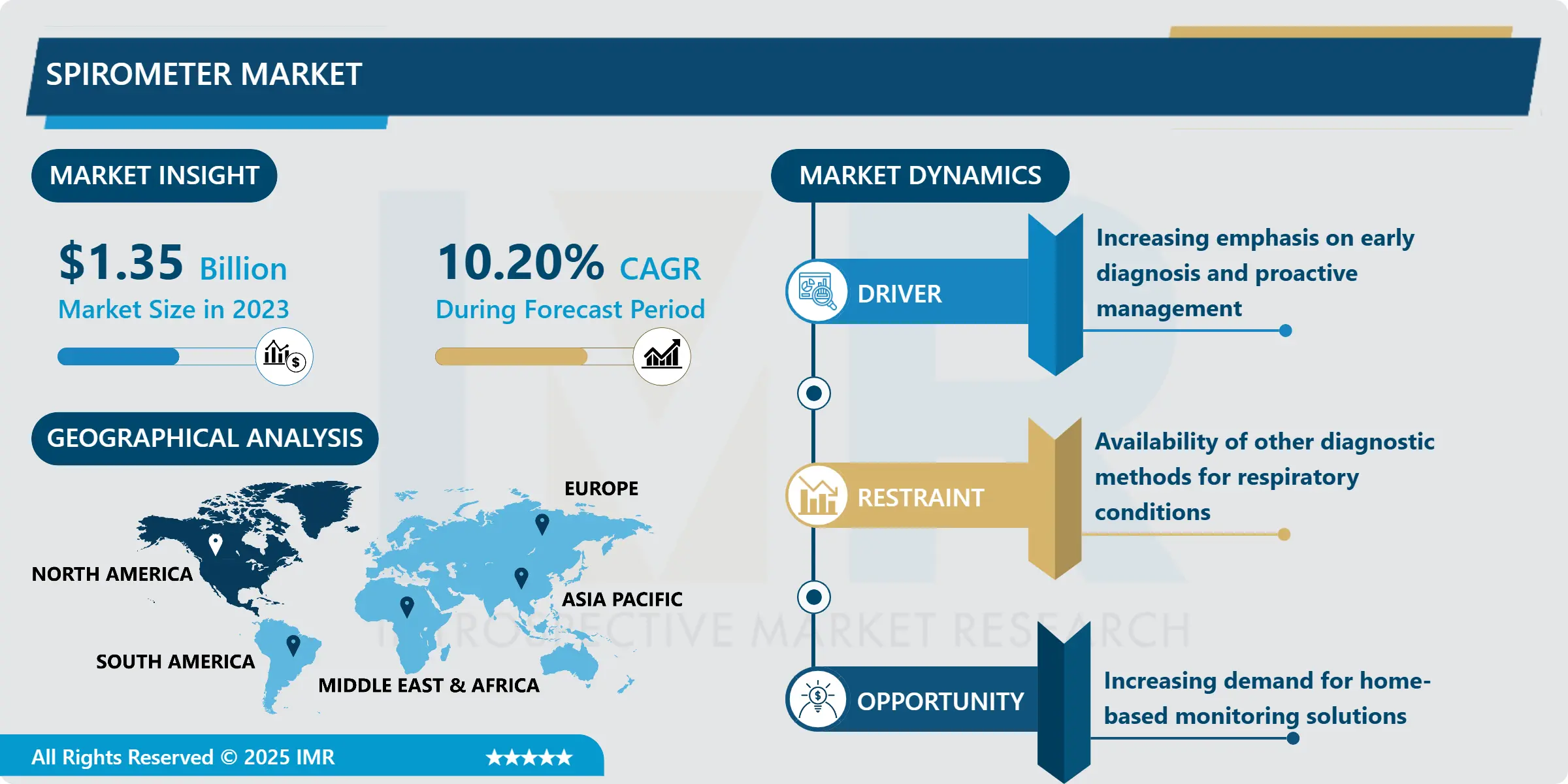
Spirometer Market Trend Analysis
Increasing Demand for Home Healthcare Solutions
- One of the biggest trends in the spirometers market is moving towards home healthcare, because patients want to save time and have more personal control over treatments. When Chronic Respiratory Diseases are now treated more than ever outside the hospital, portable spirometry has proven to be an indispensable asset to the patient. These devices allow the people to perform some lung tests from the comfort of their homes: the devices thus help the mechanisms of self- management and provide the patients with the power to manage their own condition. This took is especially important for population groups with chronic diseases including asthma and COPD in which early monitoring is key in the management process.
- Many organizations have built telehealth solutions and remote patient monitoring, which have also contributed more to this trend. The newer technologies that are found in spirometers include real-time tracking, and interfaces to applications on a smartphone or to the healthcare provider systems. As a result of this integration, it is possible to ensure efficient and continuous collaboration between patients and clinicians with a view of making timely intercession any time that lung function of the patient deteriorates. Furthermore, when data is shared remotely it leads to fewer hospitalizations hence decrease health care costs but increased quality of health delivery. Therefore, it is expected that the demand developed by a home-based spirometer will elevate in the future as evidencing a general trend for more personalized and differentially accessible healthcare services.
Improving healthcare infrastructure in emerging markets presents substantial opportunities
- The spirometer market has the chance to grow due to improvements in the framework of healthcare facilities in the developing markets. In regions such as Asia Pacific, Latin America and African countries continue to improve their health facilities, new better diagnosis techniques are called for as the number of respiratory diseases continues to rise. As people’s lifestyles evolve from rural ones to more urban ones, and as pollution levels continue to rise, the requirement for accurate assessments of lung function has never been greater. Hadrons: Early diagnosis and management of these diseases are now being embraced and adopted by governments as well as private players in the clinical systems, extending the use of spirometer. These short-term shifts do not only lead to enhanced patient safety, but also enhance the efficiency of the larger health system.
- Furthermore, the increasing flow of international aids and investments in healthcare technologies is a good entry opportunity for the spirometer devices manufacturers in these countries. When it comes to preparing for the increasingly technological approach to diagnosing patients, healthcare providers interested in reliable spirometry will benefit from the most accessible, easy-to-control, and transportable models that firms can develop. The adoption of spirometer into current and prevalent care systems, hence its integration, can be promoted by more partnerships with local health systems and educational units. The consciousness of respiratory health and the call for holistic healthcare are expected to enhance the market demand for spirometer in these areas, and it could be the right time for companies to invest to expand and help deliver sound respiratory care in the emergent markets. This not only benefits business opportunities but it is also a critical factor to overall health status of the population.
Spirometer Market Segment Analysis:
Spirometer Market Segmented on the basis of type, application, end user and region.
By Type, Devices Segment is expected to dominate the market during the forecast period
- The Devices segment, which is expected to lead the market during the forecast years, due to high demand of complicated and easy to use Devices of spirometers in the medical field. Due to the concern of healthcare providers to enhance patient outcomes in respiratory care there is a growing focus on the new spirometers design that facilitates accuracy, portability and functionality. Among the spirometers the internal use of digital spirometers is also increasing as they provide real-time data and are compatible with EHR. This can be done through this technology improvement, thereby improving the surgeon’s ability to track lung function thus early intervention and accurate treatment for the patients.
- Increasing incidence of long-term respiratory diseases including asthma and COPD has added to its growth rate for spirometer devices. Due to the rising trends of self-monitoring and tele-monitoring the market for portable, simple to use spirometer devices is growing. To satisfy this requirement, manufacturers are coming up with solutions whose primary purpose is to fulfil the health care requirements besides addressing client satisfaction. Those factors make the Devices segment the key to the spirometer market development and innovation in the context of the constant focus on the respiratory health sector’s growth.
By Application, Asthma Management segment expected to held the largest share
- Asthma Management segment is anticipated to capture the largest market share in the spirometer market and these attributions the importance of spirometer in diagnosing asthma and as a tool for monitoring its management. Asthma is one of the most common chronic diseases affecting the respiratory system, therefore has a great impact on patient’s overall health and increased need for resource utilization during acute episodes. As a consequence, spirometry is an effective diagnostic instrument that helps healthcare providers diagnose aspects of lung functioning, observe changes or alleviation of symptoms, and consistently assess the efficacy of certain treatment programs.
- With the improvement of the knowledge regarding asthma self-management, the usage of spirometer in the daily evaluation process is gradually being adopted regularly by patients and their caregivers. One advantage of self-reports is that it facilitates early identification of disease flare-ups so that interventions can be made to modifications in clinical regimens or therapy. Also, patient and provider educational activities that demonstrate the proper utilization of spirometer also focus on the ability of the individual to be involved in managing the condition. This increasing appreciation of spirometer in the management of asthma therefore places this application segment in a lucrative position for growth, while pointing to its usefulness in the improvement of respiratory health indexed success.
Spirometer Market Regional Insights:
North America is Expected to Dominate the Market Over the Forecast period
- North America is expected to emerge as the leading region during the given forecast period due to some factors specific to the region. For instance, in the United States has a developed health care sector, where much attention is paid to early identification and adequate control of respiratory illnesses including asthma and COPD. This focus is evident by the fact that spirometer is widely used and recommended as one of the standard diagnostic tools in both the clinical and home health care setting.
- Technology has continued to influence the growth of the North American spirometer market in the following ways. The region contains many Original Equipment Manufacturers (OEM) and new product developers/innovators of spirometers in various medical-device segments, and they frequently present more technologically-advanced solutions with better connectivity outlets, data link and user-friendly interfaces. Not only does it enhance patient health, but it also is consistent with the tendency of expanding telehealth and remote supervision which makes spirometer more convenient for patients in various contexts.
Active Key Players in the Spirometer Market
- Apex Medical (Taiwan)
- Bionet (South Korea)
- Breas Medical (Sweden)
- CareFusion (USA)
- COSMED (Italy)
- Fisher & Paykel Healthcare (New Zealand)
- Fukuda Denshi (Japan)
- Medtronic (USA)
- MGC Diagnostics (USA)
- NDD Medical Technologies (Switzerland)
- Omron Healthcare (Japan)
- Philips Healthcare (Netherlands)
- Schiller AG (Switzerland)
- SIMEON Medical (Germany)
- Smiths Medical (USA)
- Vitalograph (UK)
- Welch Allyn (USA)
- Other Active Players
|
Spirometer Market |
|||
|
Base Year: |
2023 |
Forecast Period: |
2024-2032 |
|
Historical Data: |
2017 to 2023 |
Market Size in 2023: |
USD 1.35 Billion |
|
Forecast Period 2024-32 CAGR: |
10.20% |
Market Size in 2032: |
USD 3.23 Billion |
|
Segments Covered: |
By Type |
|
|
|
By Application |
|
||
|
By End User |
|
||
|
By Region |
|
||
|
Key Market Drivers: |
|
||
|
Key Market Restraints: |
|
||
|
Key Opportunities: |
|
||
|
Companies Covered in the report: |
|
||
Chapter 1: Introduction
1.1 Scope and Coverage
Chapter 2:Executive Summary
Chapter 3: Market Landscape
3.1 Industry Dynamics and Opportunity Analysis
3.1.1 Growth Drivers
3.1.2 Limiting Factors
3.1.3 Growth Opportunities
3.1.4 Challenges and Risks
3.2 Market Trend Analysis
3.3 Strategic Pestle Overview
3.4 Porter's Five Forces Analysis
3.5 Industry Value Chain Mapping
3.6 Regulatory Framework
3.7 Princing Trend Analysis
3.8 Patent Analysis
3.9 Technology Evolution
3.10 Investment Pockets
3.11 Import-Export Analysis
Chapter 4: Spirometer Market by Type
4.1 Spirometer Market Snapshot and Growth Engine
4.2 Spirometer Market Overview
4.3 Accessories
4.3.1 Introduction and Market Overview
4.3.2 Historic and Forecasted Market Size in Value USD and Volume Units (2017-2032F)
4.3.3 Accessories: Geographic Segmentation Analysis
4.4 Software
4.4.1 Introduction and Market Overview
4.4.2 Historic and Forecasted Market Size in Value USD and Volume Units (2017-2032F)
4.4.3 Software: Geographic Segmentation Analysis
4.5 Consumables
4.5.1 Introduction and Market Overview
4.5.2 Historic and Forecasted Market Size in Value USD and Volume Units (2017-2032F)
4.5.3 Consumables: Geographic Segmentation Analysis
4.6 and Devices
4.6.1 Introduction and Market Overview
4.6.2 Historic and Forecasted Market Size in Value USD and Volume Units (2017-2032F)
4.6.3 and Devices: Geographic Segmentation Analysis
Chapter 5: Spirometer Market by Application
5.1 Spirometer Market Snapshot and Growth Engine
5.2 Spirometer Market Overview
5.3 Asthma Management
5.3.1 Introduction and Market Overview
5.3.2 Historic and Forecasted Market Size in Value USD and Volume Units (2017-2032F)
5.3.3 Asthma Management: Geographic Segmentation Analysis
5.4 COPD Management
5.4.1 Introduction and Market Overview
5.4.2 Historic and Forecasted Market Size in Value USD and Volume Units (2017-2032F)
5.4.3 COPD Management: Geographic Segmentation Analysis
5.5 Preoperative Assessments
5.5.1 Introduction and Market Overview
5.5.2 Historic and Forecasted Market Size in Value USD and Volume Units (2017-2032F)
5.5.3 Preoperative Assessments: Geographic Segmentation Analysis
Chapter 6: Spirometer Market by End User
6.1 Spirometer Market Snapshot and Growth Engine
6.2 Spirometer Market Overview
6.3 Hospitals
6.3.1 Introduction and Market Overview
6.3.2 Historic and Forecasted Market Size in Value USD and Volume Units (2017-2032F)
6.3.3 Hospitals: Geographic Segmentation Analysis
6.4 Clinics
6.4.1 Introduction and Market Overview
6.4.2 Historic and Forecasted Market Size in Value USD and Volume Units (2017-2032F)
6.4.3 Clinics: Geographic Segmentation Analysis
6.5 Home Care
6.5.1 Introduction and Market Overview
6.5.2 Historic and Forecasted Market Size in Value USD and Volume Units (2017-2032F)
6.5.3 Home Care: Geographic Segmentation Analysis
6.6 Research and Academia
6.6.1 Introduction and Market Overview
6.6.2 Historic and Forecasted Market Size in Value USD and Volume Units (2017-2032F)
6.6.3 Research and Academia: Geographic Segmentation Analysis
Chapter 7: Company Profiles and Competitive Analysis
7.1 Competitive Landscape
7.1.1 Competitive Benchmarking
7.1.2 Spirometer Market Share by Manufacturer (2023)
7.1.3 Concentration Ratio(CR5)
7.1.4 Heat Map Analysis
7.1.5 Mergers and Acquisitions
7.2 APEX MEDICAL (TAIWAN)
7.2.1 Company Overview
7.2.2 Key Executives
7.2.3 Company Snapshot
7.2.4 Operating Business Segments
7.2.5 Product Portfolio
7.2.6 Business Performance
7.2.7 Key Strategic Moves and Recent Developments
7.3 BIONET (SOUTH KOREA)
7.4 BREAS MEDICAL (SWEDEN)
7.5 CAREFUSION (USA)
7.6 COSMED (ITALY)
7.7 FISHER & PAYKEL HEALTHCARE (NEW ZEALAND)
7.8 FUKUDA DENSHI (JAPAN)
7.9 OTHER ACTIVE PLAYERS
Chapter 8: Global Spirometer Market By Region
8.1 Overview
8.2. North America Spirometer Market
8.2.1 Historic and Forecasted Market Size by Segments
8.2.2 Historic and Forecasted Market Size By Type
8.2.2.1 Accessories
8.2.2.2 Software
8.2.2.3 Consumables
8.2.2.4 and Devices
8.2.3 Historic and Forecasted Market Size By Application
8.2.3.1 Asthma Management
8.2.3.2 COPD Management
8.2.3.3 Preoperative Assessments
8.2.4 Historic and Forecasted Market Size By End User
8.2.4.1 Hospitals
8.2.4.2 Clinics
8.2.4.3 Home Care
8.2.4.4 Research and Academia
8.2.5 Historic and Forecast Market Size by Country
8.2.5.1 US
8.2.5.2 Canada
8.2.5.3 Mexico
8.3. Eastern Europe Spirometer Market
8.3.1 Historic and Forecasted Market Size by Segments
8.3.2 Historic and Forecasted Market Size By Type
8.3.2.1 Accessories
8.3.2.2 Software
8.3.2.3 Consumables
8.3.2.4 and Devices
8.3.3 Historic and Forecasted Market Size By Application
8.3.3.1 Asthma Management
8.3.3.2 COPD Management
8.3.3.3 Preoperative Assessments
8.3.4 Historic and Forecasted Market Size By End User
8.3.4.1 Hospitals
8.3.4.2 Clinics
8.3.4.3 Home Care
8.3.4.4 Research and Academia
8.3.5 Historic and Forecast Market Size by Country
8.3.5.1 Bulgaria
8.3.5.2 The Czech Republic
8.3.5.3 Hungary
8.3.5.4 Poland
8.3.5.5 Romania
8.3.5.6 Rest of Eastern Europe
8.4. Western Europe Spirometer Market
8.4.1 Historic and Forecasted Market Size by Segments
8.4.2 Historic and Forecasted Market Size By Type
8.4.2.1 Accessories
8.4.2.2 Software
8.4.2.3 Consumables
8.4.2.4 and Devices
8.4.3 Historic and Forecasted Market Size By Application
8.4.3.1 Asthma Management
8.4.3.2 COPD Management
8.4.3.3 Preoperative Assessments
8.4.4 Historic and Forecasted Market Size By End User
8.4.4.1 Hospitals
8.4.4.2 Clinics
8.4.4.3 Home Care
8.4.4.4 Research and Academia
8.4.5 Historic and Forecast Market Size by Country
8.4.5.1 Germany
8.4.5.2 UK
8.4.5.3 France
8.4.5.4 Netherlands
8.4.5.5 Italy
8.4.5.6 Russia
8.4.5.7 Spain
8.4.5.8 Rest of Western Europe
8.5. Asia Pacific Spirometer Market
8.5.1 Historic and Forecasted Market Size by Segments
8.5.2 Historic and Forecasted Market Size By Type
8.5.2.1 Accessories
8.5.2.2 Software
8.5.2.3 Consumables
8.5.2.4 and Devices
8.5.3 Historic and Forecasted Market Size By Application
8.5.3.1 Asthma Management
8.5.3.2 COPD Management
8.5.3.3 Preoperative Assessments
8.5.4 Historic and Forecasted Market Size By End User
8.5.4.1 Hospitals
8.5.4.2 Clinics
8.5.4.3 Home Care
8.5.4.4 Research and Academia
8.5.5 Historic and Forecast Market Size by Country
8.5.5.1 China
8.5.5.2 India
8.5.5.3 Japan
8.5.5.4 South Korea
8.5.5.5 Malaysia
8.5.5.6 Thailand
8.5.5.7 Vietnam
8.5.5.8 The Philippines
8.5.5.9 Australia
8.5.5.10 New Zealand
8.5.5.11 Rest of APAC
8.6. Middle East & Africa Spirometer Market
8.6.1 Historic and Forecasted Market Size by Segments
8.6.2 Historic and Forecasted Market Size By Type
8.6.2.1 Accessories
8.6.2.2 Software
8.6.2.3 Consumables
8.6.2.4 and Devices
8.6.3 Historic and Forecasted Market Size By Application
8.6.3.1 Asthma Management
8.6.3.2 COPD Management
8.6.3.3 Preoperative Assessments
8.6.4 Historic and Forecasted Market Size By End User
8.6.4.1 Hospitals
8.6.4.2 Clinics
8.6.4.3 Home Care
8.6.4.4 Research and Academia
8.6.5 Historic and Forecast Market Size by Country
8.6.5.1 Turkey
8.6.5.2 Bahrain
8.6.5.3 Kuwait
8.6.5.4 Saudi Arabia
8.6.5.5 Qatar
8.6.5.6 UAE
8.6.5.7 Israel
8.6.5.8 South Africa
8.7. South America Spirometer Market
8.7.1 Historic and Forecasted Market Size by Segments
8.7.2 Historic and Forecasted Market Size By Type
8.7.2.1 Accessories
8.7.2.2 Software
8.7.2.3 Consumables
8.7.2.4 and Devices
8.7.3 Historic and Forecasted Market Size By Application
8.7.3.1 Asthma Management
8.7.3.2 COPD Management
8.7.3.3 Preoperative Assessments
8.7.4 Historic and Forecasted Market Size By End User
8.7.4.1 Hospitals
8.7.4.2 Clinics
8.7.4.3 Home Care
8.7.4.4 Research and Academia
8.7.5 Historic and Forecast Market Size by Country
8.7.5.1 Brazil
8.7.5.2 Argentina
8.7.5.3 Rest of SA
Chapter 9 Analyst Viewpoint and Conclusion
9.1 Recommendations and Concluding Analysis
9.2 Potential Market Strategies
Chapter 10 Research Methodology
10.1 Research Process
10.2 Primary Research
10.3 Secondary Research
|
Spirometer Market |
|||
|
Base Year: |
2023 |
Forecast Period: |
2024-2032 |
|
Historical Data: |
2017 to 2023 |
Market Size in 2023: |
USD 1.35 Billion |
|
Forecast Period 2024-32 CAGR: |
10.20% |
Market Size in 2032: |
USD 3.23 Billion |
|
Segments Covered: |
By Type |
|
|
|
By Application |
|
||
|
By End User |
|
||
|
By Region |
|
||
|
Key Market Drivers: |
|
||
|
Key Market Restraints: |
|
||
|
Key Opportunities: |
|
||
|
Companies Covered in the report: |
|
||


