




Sphygmomanometer Market Synopsis:
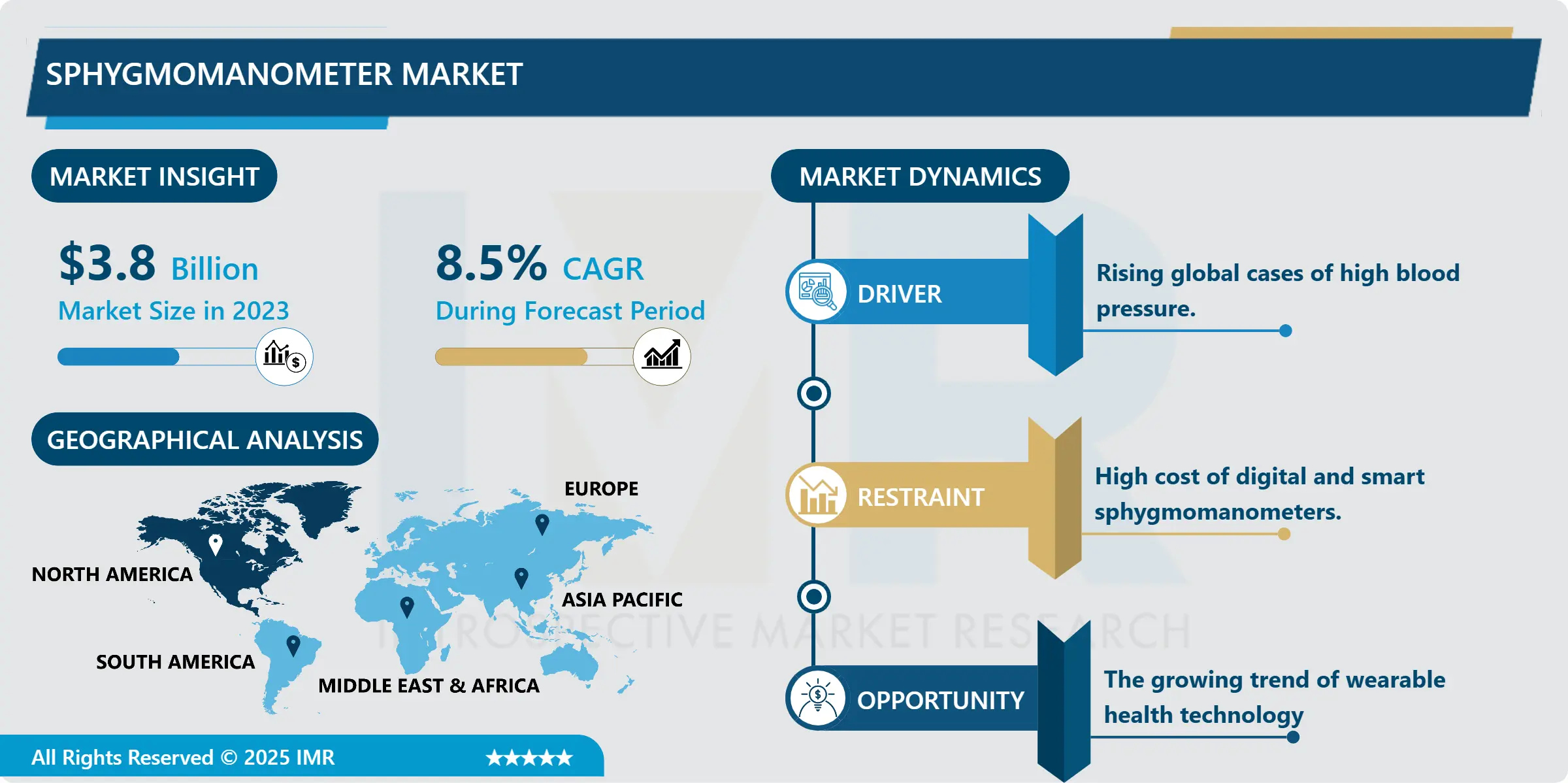
Sphygmomanometer Market Size Was Valued at USD 3.80 Billion in 2023, and is Projected to Reach USD 7.50 Billion by 2032, Growing at a CAGR of 8.5% From 2024-2032.
A sphygmomanometer is a piece of medical equipment used to read blood pressure; usually it comes with a cuff attached to a pressure gauge and an inflation bulb. It has particularly been found to be useful in hypertension and all cardiovascular disorders. The market for sphygmomanometers has expanded because of rising incidences of life-style diseases for example hypertension that demands regular measurement of blood pressure. Customers also require sphygmomanometers due to increased knowledge of heart conditions, a global population aging process, and the transition to preventive medicine.
The sphygmomanometer market has been growing fairly or steadily in the past few years because conditions such as hypertension and other cardiovascular diseases needless to say necessitate the use of blood pressure monitoring devices. Since hypertension is the silent killer and is considered being one of the main causes of heart diseases, as well as strokes, there is a high demand for blood pressure measuring instruments for healthcare facilities as well as homecare use. These include awareness of consumers about health complications related to high blood pressures, coupled with the ageing population across the world, and thus increasing need for sphygmomanometers.
Consumers are increasingly becoming conscious about managing their own health and the trend indicates that home blood pressure monitoring devices will gain popularity going forward. This can be further evidenced by government plans for general wellbeing through early detection of hypertension and cardiovascular diseases. With healthcare delivery systems shifting focus on Pre-symptomatic diagnosis to minimize complications associated with chronic illnesses, Sphygmomanometers has become indispensable equipment for medical and home use. The market is also observing the sales from the developing counties as the healthcare facilities there are developing and the consciousness about health is also increasing.
Sphygmomanometer Market Trend Analysis:
Digital Sphygmomanometers Gain Popularity for Home Healthcare Use
-
The home healthcare industry is quick to embrace digital sphygmomanometers given the need for easy to use, accurate and convenient blood pressure measurement equipment. Digital sphygmomanometers on the other hand are easy to use with have special features like automatic inflation and memory storage, digital display and readings. These devices are easy to use and do not demand special knowledge; therefore, they would be suitable for home usage by patients who have no professional health experience. Plus, the awareness on issues of prevention and more cases of hypertension and other cardiovascular diseases have encouraged more such people to engage in active monitoring of their health. The fact that hypertension can be recorded from home allows patient and healthcare professional see signs of hypertension early enough eliminating risks of severe conditions such as stroke or heart diseases.
- An ability to incorporate Bluetooth technology and smartphone apps to the digital sphygmomanometers was also an added boost. These enhancements facilitate the users to read the results in mobile devices and easily calculate long term health developments, and share information with health care professionals. The integration of the devices with the apps improves the efficiency of the services by providing better statistics of the variations in blood pressure and it is a useful tool for those with constant NAFLD conditions. The continuous advancement of technology has makes medical devices accessible to anyone; this has positioned the digital sphygmomanometers as vital in managing home health care hence enhancing their usage.
Digital and Smart Sphygmomanometers: The Future of Blood Pressure Monitoring
-
The modern blood pressure Digital and smart sphygmomanometers are gradually becoming the new generation of blood pressure measurement tools largely due to the growing need for better, easier and more efficient self-monitoring tools. Compared to typical analogy non-automatic sphygmomanometers, blood pressure measuring devices are completely automatic and easy to use because they return measurements almost instantly. These devices do not require the user to blow air into them and to read the pressure gauges which makes these suitable even for those people with only basic medical knowledge. With the increase in awareness of hypertension and other cardiovascular ailments, conjunctionally, with the increasing acceptance of home healthcare solutions the global demand for digital sphygmomanometers has gone up.
- Besides, smart sphygmomanometers are expanding digital monitoring to new directions by equipping them with additional functionalities like Bluetooth interface, compatibility with a smartphone application, uptake to the cloud storage. They enable the individuals to manage their blood pressure records in almost real time and gain useful information about their trends. Information will also be retrievable to mobile applications to allow clients transfer of their health standards to doctors without physical contact. Such remote monitoring option is particularly beneficial for clients with such conditions that require constant attention. The collection of history data and real-time feedback help patients and doctors to have better sight on hypertension and other possibilities of cardiovascular diseases.
Sphygmomanometer Market Segment Analysis:
Sphygmomanometer Market Segmented on the basis of type, application, end user and Region
By Type, Digital Sphygmomanometers segment is expected to dominate the market during the forecast period
-
The digital sphygmomanometers market segment will continue to lead the sphygmomanometer market in the present forecast period because of the many advantages that they have over their manual counterparts. They have become popular in the market due to the fact that most of them provide automated measurements thus eliminating the need for a highly skilled and driven user. For this reason, they are commonly recommended for lay consumers for home care since they are easy to use. Compared to manual sphygmomanometers which require the use of a stethoscope and allows only people with special training to read the result, the digital devices are electronic and have an LCD result display that cannot be read wrongly. Digital sphygmomanometers are favored in both health care clinica and home healthcare where the speed and reliability of measurements is highly valued.
By Application, Hypertension Diagnosis and Monitoring segment expected to held the largest share
-
The segment occupied by Hypertension Diagnosis and Monitoring is predicted to provide the major market share for sphygmomanometers in the forthcoming years due to increased instances of hypertension and its relation with cardiovascular ailments. : Hypertension commonly known as the “silent killer” is one of the widely experienced health complications and is a global magnitude-complicated ailment affecting millions of individuals across this generation. This is because the condition if left unchecked leads to major health hazards that include stroke, heart disease and kidney failure. Blood pressure measuring gadgets mainly the sphygmomanometers are in the inexcusable part of the management of hypertension as they are used for both diagnosis and monitoring of blood pressure levels by healthcare providers. There has been concern in the use of blood pressure monitoring tools for preventive health care, early detection and early management of hypertension hence its widespread in clinical and home use.
Sphygmomanometer Market Regional Insights:
North America is Expected to Dominate the Market Over the Forecast period
-
North America region is anticipated to rule the sphygmomanometer market during the forecast period due to the increased rate of hypertension, enhanced healthcare facilities, and increasing economic importance of preventive care. There is particularly a large ageing population in the United States and this population is most vulnerable to hypertension and cardiovascular diseases, two primary reasons for the use of BP monitoring equipment. Furthermore, North America primarily comprises countries with developed healthcare infrastructure and fast-growing penetration rates for innovative digital and smart sphygmomanometers that tend to be equipped with improved accuracy and functionality, such a real-time monitoring. High emphasis on the healthcare facilities and the properly established distribution channels of the region make it easier to access the blood pressure monitoring devices in both clinic and homecare and therefore conducive to the manufactures of sphygmomanometer.
Active Key Players in the Sphygmomanometer Market
-
A&D Medical (Japan)
- American Diagnostic Corporation (USA)
- Beurer GmbH (Germany)
- Boso (Bosch + Sohn GmbH) (Germany)
- Cozmedics (Australia)
- Dymedix Diagnostic, Inc. (USA)
- HEM Electronics Co., Ltd. (Japan)
- Kenza Technologies (UK)
- Microlife Corporation (Switzerland)
- Nihon Kohden Corporation (Japan)
- Omron Healthcare, Inc. (Japan)
- Riester (Germany)
- Rossmax International Ltd. (Taiwan)
- Schiller AG (Switzerland)
- SunTech Medical, Inc. (USA)
- TaiDoc Technology Corporation (Taiwan)
- Welch Allyn (USA)
- Withings (France)
- Other Active Players
|
Global Sphygmomanometer Market |
|||
|
Base Year: |
2023 |
Forecast Period: |
2024-2032 |
|
Historical Data: |
2017 to 2023 |
Market Size in 2023: |
USD 3.80 Billion |
|
Forecast Period 2024-32 CAGR: |
8.5 % |
Market Size in 2032: |
USD 7.50 Billion |
|
Segments Covered: |
By Type |
|
|
|
By Application |
|
||
|
By End-User |
|
||
|
By Region |
|
||
|
Key Market Drivers: |
|
||
|
Key Market Restraints: |
|
||
|
Key Opportunities: |
|
||
|
Companies Covered in the report: |
|
||
Chapter 1: Introduction
1.1 Scope and Coverage
Chapter 2:Executive Summary
Chapter 3: Market Landscape
3.1 Market Dynamics
3.1.1 Drivers
3.1.2 Restraints
3.1.3 Opportunities
3.1.4 Challenges
3.2 Market Trend Analysis
3.3 PESTLE Analysis
3.4 Porter's Five Forces Analysis
3.5 Industry Value Chain Analysis
3.6 Ecosystem
3.7 Regulatory Landscape
3.8 Price Trend Analysis
3.9 Patent Analysis
3.10 Technology Evolution
3.11 Investment Pockets
3.12 Import-Export Analysis
Chapter 4: Sphygmomanometer Market by Type
4.1 Sphygmomanometer Market Snapshot and Growth Engine
4.2 Sphygmomanometer Market Overview
4.3 Manual Sphygmomanometers
4.3.1 Introduction and Market Overview
4.3.2 Historic and Forecasted Market Size in Value USD and Volume Units (2017-2032F)
4.3.3 Key Market Trends, Growth Factors and Opportunities
4.3.4 Manual Sphygmomanometers: Geographic Segmentation Analysis
4.4 Digital Sphygmomanometers
4.4.1 Introduction and Market Overview
4.4.2 Historic and Forecasted Market Size in Value USD and Volume Units (2017-2032F)
4.4.3 Key Market Trends, Growth Factors and Opportunities
4.4.4 Digital Sphygmomanometers: Geographic Segmentation Analysis
4.5 Ambulatory Sphygmomanometers)
4.5.1 Introduction and Market Overview
4.5.2 Historic and Forecasted Market Size in Value USD and Volume Units (2017-2032F)
4.5.3 Key Market Trends, Growth Factors and Opportunities
4.5.4 Ambulatory Sphygmomanometers): Geographic Segmentation Analysis
4.6
4.6.1 Introduction and Market Overview
4.6.2 Historic and Forecasted Market Size in Value USD and Volume Units (2017-2032F)
4.6.3 Key Market Trends, Growth Factors and Opportunities
4.6.4 : Geographic Segmentation Analysis
Chapter 5: Sphygmomanometer Market by Application
5.1 Sphygmomanometer Market Snapshot and Growth Engine
5.2 Sphygmomanometer Market Overview
5.3 Hypertension Diagnosis and Monitoring
5.3.1 Introduction and Market Overview
5.3.2 Historic and Forecasted Market Size in Value USD and Volume Units (2017-2032F)
5.3.3 Key Market Trends, Growth Factors and Opportunities
5.3.4 Hypertension Diagnosis and Monitoring: Geographic Segmentation Analysis
5.4 General Health Monitoring
5.4.1 Introduction and Market Overview
5.4.2 Historic and Forecasted Market Size in Value USD and Volume Units (2017-2032F)
5.4.3 Key Market Trends, Growth Factors and Opportunities
5.4.4 General Health Monitoring: Geographic Segmentation Analysis
5.5 Post-Surgical Monitoring)
5.5.1 Introduction and Market Overview
5.5.2 Historic and Forecasted Market Size in Value USD and Volume Units (2017-2032F)
5.5.3 Key Market Trends, Growth Factors and Opportunities
5.5.4 Post-Surgical Monitoring): Geographic Segmentation Analysis
5.6
5.6.1 Introduction and Market Overview
5.6.2 Historic and Forecasted Market Size in Value USD and Volume Units (2017-2032F)
5.6.3 Key Market Trends, Growth Factors and Opportunities
5.6.4 : Geographic Segmentation Analysis
Chapter 6: Sphygmomanometer Market by End User
6.1 Sphygmomanometer Market Snapshot and Growth Engine
6.2 Sphygmomanometer Market Overview
6.3 Hospitals & Clinics
6.3.1 Introduction and Market Overview
6.3.2 Historic and Forecasted Market Size in Value USD and Volume Units (2017-2032F)
6.3.3 Key Market Trends, Growth Factors and Opportunities
6.3.4 Hospitals & Clinics: Geographic Segmentation Analysis
6.4 Home Care Settings
6.4.1 Introduction and Market Overview
6.4.2 Historic and Forecasted Market Size in Value USD and Volume Units (2017-2032F)
6.4.3 Key Market Trends, Growth Factors and Opportunities
6.4.4 Home Care Settings: Geographic Segmentation Analysis
6.5 Ambulatory Surgical Centers
6.5.1 Introduction and Market Overview
6.5.2 Historic and Forecasted Market Size in Value USD and Volume Units (2017-2032F)
6.5.3 Key Market Trends, Growth Factors and Opportunities
6.5.4 Ambulatory Surgical Centers: Geographic Segmentation Analysis
6.6 Other End-Users
6.6.1 Introduction and Market Overview
6.6.2 Historic and Forecasted Market Size in Value USD and Volume Units (2017-2032F)
6.6.3 Key Market Trends, Growth Factors and Opportunities
6.6.4 Other End-Users: Geographic Segmentation Analysis
Chapter 7: Company Profiles and Competitive Analysis
7.1 Competitive Landscape
7.1.1 Competitive Benchmarking
7.1.2 Sphygmomanometer Market Share by Manufacturer (2023)
7.1.3 Industry BCG Matrix
7.1.4 Heat Map Analysis
7.1.5 Mergers and Acquisitions
7.2 OMRON HEALTHCARE INC. (JAPAN)
7.2.1 Company Overview
7.2.2 Key Executives
7.2.3 Company Snapshot
7.2.4 Role of the Company in the Market
7.2.5 Sustainability and Social Responsibility
7.2.6 Operating Business Segments
7.2.7 Product Portfolio
7.2.8 Business Performance
7.2.9 Key Strategic Moves and Recent Developments
7.2.10 SWOT Analysis
7.3 A&D MEDICAL (JAPAN)
7.4 WELCH ALLYN (USA)
7.5 RIESTER (GERMANY)
7.6 SCHILLER AG (SWITZERLAND)
7.7 AMERICAN DIAGNOSTIC CORPORATION (USA)
7.8 MICROLIFE CORPORATION (SWITZERLAND)
7.9 BOSO (BOSCH + SOHN GMBH) (GERMANY)
7.10 BEURER GMBH (GERMANY)
7.11 HEM ELECTRONICS CO. LTD. (JAPAN)
7.12 SUNTECH MEDICAL INC. (USA)
7.13 DYMEDIX DIAGNOSTIC INC. (USA)
7.14 OTHER ACTIVE PLAYERS
Chapter 8: Global Sphygmomanometer Market By Region
8.1 Overview
8.2. North America Sphygmomanometer Market
8.2.1 Key Market Trends, Growth Factors and Opportunities
8.2.2 Top Key Companies
8.2.3 Historic and Forecasted Market Size by Segments
8.2.4 Historic and Forecasted Market Size By Type
8.2.4.1 Manual Sphygmomanometers
8.2.4.2 Digital Sphygmomanometers
8.2.4.3 Ambulatory Sphygmomanometers)
8.2.4.4
8.2.5 Historic and Forecasted Market Size By Application
8.2.5.1 Hypertension Diagnosis and Monitoring
8.2.5.2 General Health Monitoring
8.2.5.3 Post-Surgical Monitoring)
8.2.5.4
8.2.6 Historic and Forecasted Market Size By End User
8.2.6.1 Hospitals & Clinics
8.2.6.2 Home Care Settings
8.2.6.3 Ambulatory Surgical Centers
8.2.6.4 Other End-Users
8.2.7 Historic and Forecast Market Size by Country
8.2.7.1 US
8.2.7.2 Canada
8.2.7.3 Mexico
8.3. Eastern Europe Sphygmomanometer Market
8.3.1 Key Market Trends, Growth Factors and Opportunities
8.3.2 Top Key Companies
8.3.3 Historic and Forecasted Market Size by Segments
8.3.4 Historic and Forecasted Market Size By Type
8.3.4.1 Manual Sphygmomanometers
8.3.4.2 Digital Sphygmomanometers
8.3.4.3 Ambulatory Sphygmomanometers)
8.3.4.4
8.3.5 Historic and Forecasted Market Size By Application
8.3.5.1 Hypertension Diagnosis and Monitoring
8.3.5.2 General Health Monitoring
8.3.5.3 Post-Surgical Monitoring)
8.3.5.4
8.3.6 Historic and Forecasted Market Size By End User
8.3.6.1 Hospitals & Clinics
8.3.6.2 Home Care Settings
8.3.6.3 Ambulatory Surgical Centers
8.3.6.4 Other End-Users
8.3.7 Historic and Forecast Market Size by Country
8.3.7.1 Russia
8.3.7.2 Bulgaria
8.3.7.3 The Czech Republic
8.3.7.4 Hungary
8.3.7.5 Poland
8.3.7.6 Romania
8.3.7.7 Rest of Eastern Europe
8.4. Western Europe Sphygmomanometer Market
8.4.1 Key Market Trends, Growth Factors and Opportunities
8.4.2 Top Key Companies
8.4.3 Historic and Forecasted Market Size by Segments
8.4.4 Historic and Forecasted Market Size By Type
8.4.4.1 Manual Sphygmomanometers
8.4.4.2 Digital Sphygmomanometers
8.4.4.3 Ambulatory Sphygmomanometers)
8.4.4.4
8.4.5 Historic and Forecasted Market Size By Application
8.4.5.1 Hypertension Diagnosis and Monitoring
8.4.5.2 General Health Monitoring
8.4.5.3 Post-Surgical Monitoring)
8.4.5.4
8.4.6 Historic and Forecasted Market Size By End User
8.4.6.1 Hospitals & Clinics
8.4.6.2 Home Care Settings
8.4.6.3 Ambulatory Surgical Centers
8.4.6.4 Other End-Users
8.4.7 Historic and Forecast Market Size by Country
8.4.7.1 Germany
8.4.7.2 UK
8.4.7.3 France
8.4.7.4 The Netherlands
8.4.7.5 Italy
8.4.7.6 Spain
8.4.7.7 Rest of Western Europe
8.5. Asia Pacific Sphygmomanometer Market
8.5.1 Key Market Trends, Growth Factors and Opportunities
8.5.2 Top Key Companies
8.5.3 Historic and Forecasted Market Size by Segments
8.5.4 Historic and Forecasted Market Size By Type
8.5.4.1 Manual Sphygmomanometers
8.5.4.2 Digital Sphygmomanometers
8.5.4.3 Ambulatory Sphygmomanometers)
8.5.4.4
8.5.5 Historic and Forecasted Market Size By Application
8.5.5.1 Hypertension Diagnosis and Monitoring
8.5.5.2 General Health Monitoring
8.5.5.3 Post-Surgical Monitoring)
8.5.5.4
8.5.6 Historic and Forecasted Market Size By End User
8.5.6.1 Hospitals & Clinics
8.5.6.2 Home Care Settings
8.5.6.3 Ambulatory Surgical Centers
8.5.6.4 Other End-Users
8.5.7 Historic and Forecast Market Size by Country
8.5.7.1 China
8.5.7.2 India
8.5.7.3 Japan
8.5.7.4 South Korea
8.5.7.5 Malaysia
8.5.7.6 Thailand
8.5.7.7 Vietnam
8.5.7.8 The Philippines
8.5.7.9 Australia
8.5.7.10 New Zealand
8.5.7.11 Rest of APAC
8.6. Middle East & Africa Sphygmomanometer Market
8.6.1 Key Market Trends, Growth Factors and Opportunities
8.6.2 Top Key Companies
8.6.3 Historic and Forecasted Market Size by Segments
8.6.4 Historic and Forecasted Market Size By Type
8.6.4.1 Manual Sphygmomanometers
8.6.4.2 Digital Sphygmomanometers
8.6.4.3 Ambulatory Sphygmomanometers)
8.6.4.4
8.6.5 Historic and Forecasted Market Size By Application
8.6.5.1 Hypertension Diagnosis and Monitoring
8.6.5.2 General Health Monitoring
8.6.5.3 Post-Surgical Monitoring)
8.6.5.4
8.6.6 Historic and Forecasted Market Size By End User
8.6.6.1 Hospitals & Clinics
8.6.6.2 Home Care Settings
8.6.6.3 Ambulatory Surgical Centers
8.6.6.4 Other End-Users
8.6.7 Historic and Forecast Market Size by Country
8.6.7.1 Turkiye
8.6.7.2 Bahrain
8.6.7.3 Kuwait
8.6.7.4 Saudi Arabia
8.6.7.5 Qatar
8.6.7.6 UAE
8.6.7.7 Israel
8.6.7.8 South Africa
8.7. South America Sphygmomanometer Market
8.7.1 Key Market Trends, Growth Factors and Opportunities
8.7.2 Top Key Companies
8.7.3 Historic and Forecasted Market Size by Segments
8.7.4 Historic and Forecasted Market Size By Type
8.7.4.1 Manual Sphygmomanometers
8.7.4.2 Digital Sphygmomanometers
8.7.4.3 Ambulatory Sphygmomanometers)
8.7.4.4
8.7.5 Historic and Forecasted Market Size By Application
8.7.5.1 Hypertension Diagnosis and Monitoring
8.7.5.2 General Health Monitoring
8.7.5.3 Post-Surgical Monitoring)
8.7.5.4
8.7.6 Historic and Forecasted Market Size By End User
8.7.6.1 Hospitals & Clinics
8.7.6.2 Home Care Settings
8.7.6.3 Ambulatory Surgical Centers
8.7.6.4 Other End-Users
8.7.7 Historic and Forecast Market Size by Country
8.7.7.1 Brazil
8.7.7.2 Argentina
8.7.7.3 Rest of SA
Chapter 9 Analyst Viewpoint and Conclusion
9.1 Recommendations and Concluding Analysis
9.2 Potential Market Strategies
Chapter 10 Research Methodology
10.1 Research Process
10.2 Primary Research
10.3 Secondary Research
|
Global Sphygmomanometer Market |
|||
|
Base Year: |
2023 |
Forecast Period: |
2024-2032 |
|
Historical Data: |
2017 to 2023 |
Market Size in 2023: |
USD 3.80 Billion |
|
Forecast Period 2024-32 CAGR: |
8.5 % |
Market Size in 2032: |
USD 7.50 Billion |
|
Segments Covered: |
By Type |
|
|
|
By Application |
|
||
|
By End-User |
|
||
|
By Region |
|
||
|
Key Market Drivers: |
|
||
|
Key Market Restraints: |
|
||
|
Key Opportunities: |
|
||
|
Companies Covered in the report: |
|
||


