




Sound Therapy Market Overview
Sound Therapy Market Size Was Valued at USD 1.12 Billion in 2023 and is Projected to Reach USD 2.26 Billion by 2032, Growing at a CAGR of 8.1% From 2024-2032.
Sound therapy is a holistic treatment that utilizes the vibrational frequencies of sound to promote healing and well-being. Rooted in ancient traditions, this practice employs a variety of tools such as tuning forks, singing bowls, gongs, and even the human voice to create sound waves that resonate with the body. These sound waves are believed to help balance the body’s energy centers, known as chakras, reduce stress, and alleviate physical and emotional pain.
Research suggests that sound therapy can have numerous benefits, including improved mood, enhanced concentration, and reduced anxiety. The sound waves help induce a meditative state, facilitating deep relaxation and the release of tension. This therapy is also used to improve sleep quality and support overall mental health by promoting mindfulness and emotional clarity.
The sound therapy market is experiencing significant growth due to increasing awareness of its therapeutic benefits and rising demand for non-invasive treatment methods. Sound therapy, which utilizes sound waves and vibrations to treat various physical and mental health conditions, is gaining traction among individuals seeking alternative and holistic healing practices. The market encompasses a range of products and services, including tuning forks, singing bowls, gongs, and digital sound therapy applications.
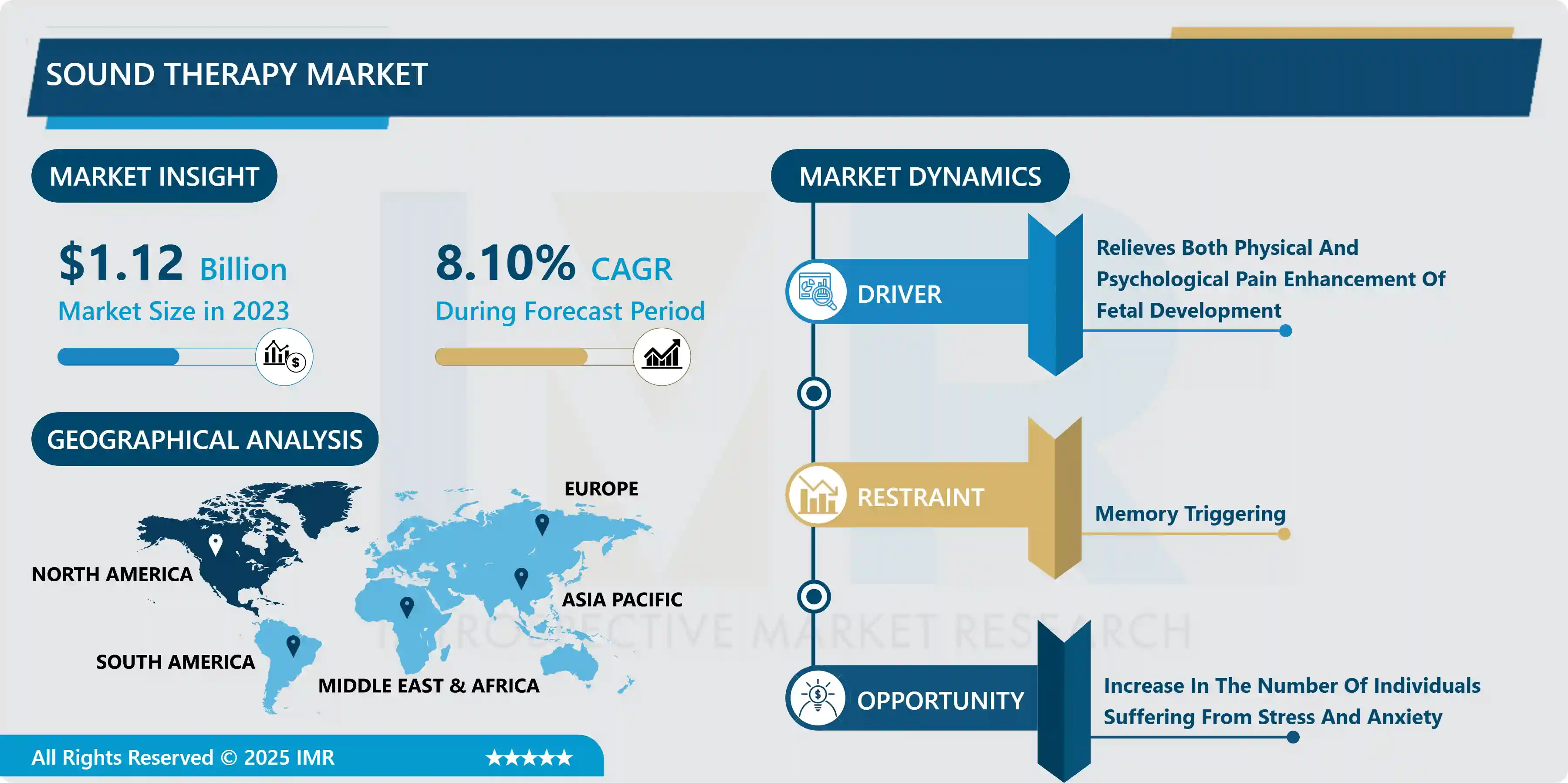

Market Dynamics and Key Factors of Sound Therapy
Drivers:
Relieves both Physical and Psychological Pain
The primary goal of sound therapy is relaxation. The best sounds for relaxing are those with depth and slow melodies, as well as songs with lower frequencies and slow transitions. A study conducted by University of California researchers discovered that meditation accompanied by Tibetan bowls significantly reduced stress and anger, particularly among persons new to this kind of practice. Another study, focusing on fibromyalgia patients, revealed that low-frequency sound therapy significantly increased the number of times participants could sit and stand pain-free. According to the American Institute of Stress (2021), 77% of Americans experience stress that affects their physical health. Moreover, Gallup stated that about one-third of people around the world reported feeling stressed, worried, and/or angry in 2019. This large number of individuals suffering psychological pain is expected to propel the development of the sound therapy market during the projected timeframe.
Getting relief from common ailments
- Many modern-day disorders are stress-related, and sound therapy can help to alleviate these symptoms. High blood pressure, stomach pain, sadness, and joint pains are all symptoms of stress and anxiety. The sounds create a healing atmosphere in which the body and mind can heal together. Better sleep, less chronic pain and blood pressure, lower cholesterol levels, and a lower chance of heart disease are all benefits of sound therapy.
Enhancement of Fetal Development
- After birth, music helps the child become more responsive. Music can also help to reduce and maintain a constant heart rate, enhance feeding rates, aid in fetal weight gain, and induce a deeper sleep. Positive neonatal behavior is influenced by music. Furthermore, high-stress levels in expectant mothers can harm fetal growth. Music and singing have a soothing effect on both the pregnant mother and the unborn baby, contributing to a healthy and happy baby later in life. Because music stimulates neuron connections in the brain, listening to all types of music promotes early brain development in the fetus. Music stimulates the brain of the fetus and aids in the development of brain structures thus, driving the growth of the sound therapy market over the projected timeframe.
Restraints:
Memory Triggering
- In terms of evoking unwanted memories, music is second only to smell. This can be linked to an evolutionary need to process sound quickly as a survival strategy. While memory triggering can occasionally produce moments of clarity in individuals with dementia, it can be damaging to patients with PTSD who do not want to revisit certain memories, thus hampering the development of the sound therapy market during the analysis timespan.
Unwanted Anxiety
- While music can help with anxiety problems in certain cases, it can also cause or increase anxiety in others. In Alzheimer's patients, the wrong music can cause distress and anxiety. The lyrics can have a significant impact on the mental state of the client being treated by the therapist. Certain lyrics can convey a negative perspective and can ultimately enhance a person's sadness. This is especially difficult for people who are depressed thus, hindering the growth of the sound therapy market over the forecasted period.
Opportunities:
- The growing global population has created competition among individuals for social hierarchy, lifestyle, and job position. To achieve certain standards in life, people undergo hardships which in turn result in anxiety and stress. Moreover, stress can also increase a person’s risk of type 2 diabetes, high blood pressure, and heart disease. When stress becomes chronic, depression, anxiety, and other mental health issues, such as post-traumatic stress disorder (PTSD), can develop. Furthermore, individuals are becoming aware of the benefits of sound therapeutics and many are opting for these innovative therapies to reduce their anxiety and stress levels. These sound therapies are also applicable for other disorders such as blood pressure, cholesterol, body aches, and insomnia.
Segmentation of Sound Therapy Market
- By therapy type, the brain wave entrainment segment is anticipated to develop at the highest CAGR over the forecasted timespan. Brain wave entrainment is a technique for synchronizing brain waves with a specific stimulus. This stimulus is usually in the form of an audio or visual pattern. Isochronic tones are used to entrain brain waves. Isochronic tones and other forms of brain wave entrainment are thought to promote specific mental states. This may be beneficial for a variety of purposes including promoting healthy sleep, alleviating stress and anxiety, perception of pain, memory, meditation, mood enhancement, and attention.
- By application, the tinnitus segment is expected to lead the growth of the sound therapy market during the analysis period. Tinnitus is a medical disorder characterized by ringing or other noises in one or both ears. The noise is not created by an external sound, and most people cannot hear it. Tinnitus is a common issue. It affects 15% to 20% of the population and is most prevalent among older adults. The American Tinnitus Association reported that more than 50 million Americans experience tinnitus, and nearly 20 million of those cases are considered chronic. Sound therapies have proven their effectiveness in treating tinnitus, and many individuals are opting for it thus, supporting the development of the sound therapy market.
Regional Analysis of Sound Therapy Market
- The North American region is anticipated to have the highest share of the sound therapy market over the analysis period attributed to the growing awareness of the beneficial effects of sound therapy. Several studious in the US have started offering sound therapies. For instance, In New York City, studios like Maha Rose and Woom Center boast audio healing sessions. In Los Angeles, The Soundbath Center and LA Sound Healing generate at least enough interest to keep the competing locations in business. At wellness destinations like the Four Seasons Resort Orlando and Miraval in Tucson, sound therapy is a growing trend. The rise in the number of studious is pointing toward the growing demand for sound therapy in the wellness industry thus, driving the growth of the market in this region.
- The European region is expected to have the second-highest share of the sound therapy market during the projected timeframe. Research institutes in this region are conducting studies to analyze the effectiveness of sound therapies on individuals. For instance, researchers at the University of Bonn in Germany discovered evidence to support the use of binaural beats as a way to alleviate anxiety in 30 distinct investigations. According to Lancet (2021), tinnitus affects more than one in every seven persons in the EU. In the EU28 as a whole, roughly 65 million adults have tinnitus, 26 million have bothersome tinnitus, and 4 million have severe tinnitus. In addition, several people in this region are suffering from anxiety, stress, and other medical disorders that can be relieved via sound therapies thus, strengthening the growth of the market in this region.
- The sound therapy market in the APAC region is anticipated to develop at a substantial growth rate during the forecasted period. Individuals in this region are acknowledging the beneficial effects of sound therapies. India, China, Japan, Tibet, and Indonesia are the major countries propelling the development of the sound therapy market in this region. These countries are highly populated and the methods of sound therapies were practiced here for ages. The rise in the number of reporting of stress, anxiety, tinnitus, and other disorders is expected to support the growth of the sound therapy market in this region.
Players Covered in Sound Therapy market are
- Alfred A. Tomatis
- Don Campbell
- Jonathan Goldman
- Fabien Maman
- Joshua Leeds
- Mitchell L. Gaynor
- John Beaulieu
- Eileen McKusick
- Barry Goldstein
- David Gibson
- Silvia Nakkach
- Acama
- Steven Halpern
- Susan Alexjander
- Marjorie de Muynck
- Wayne Perry
- Anne H. Heywood
- Christine Stevens
- Jill Mattson
- Jeffrey Thompson
Key Industry Developments in the Sound Therapy Market:
- In April 2024, Adaptive Sound Technologies, Inc. launched SOUND+THERAPY, a natural sleep solution that replicates ancient sound therapy techniques. The company claims that SOUND+THERAPY can help users fall asleep faster, sleep more soundly, and wake up feeling more refreshed.
- In March 2024, the American Academy of Sleep Medicine recognized the effectiveness of sound therapy in improving sleep quality. This recognition is expected to further boost the adoption of sound therapy as a sleep aid.
|
Global Sound Therapy Market |
|||
|
Base Year: |
2023 |
Forecast Period: |
2024-2032 |
|
Historical Data: |
2017 to 2023 |
Market Size in 2023: |
USD 1.12 Bn. |
|
Forecast Period 2024-32 CAGR: |
8.1% |
Market Size in 2032: |
USD 2.26 Bn. |
|
Segments Covered: |
By Therapy Type |
|
|
|
By Application |
|
||
|
By Region |
|
||
|
Key Market Drivers: |
|
||
|
Key Market Restraints: |
|
||
|
Key Opportunities: |
|
||
|
Companies Covered in the report: |
|
||
Chapter 1: Introduction
1.1 Scope and Coverage
Chapter 2:Executive Summary
Chapter 3: Market Landscape
3.1 Market Dynamics
3.1.1 Drivers
3.1.2 Restraints
3.1.3 Opportunities
3.1.4 Challenges
3.2 Market Trend Analysis
3.3 PESTLE Analysis
3.4 Porter's Five Forces Analysis
3.5 Industry Value Chain Analysis
3.6 Ecosystem
3.7 Regulatory Landscape
3.8 Price Trend Analysis
3.9 Patent Analysis
3.10 Technology Evolution
3.11 Investment Pockets
3.12 Import-Export Analysis
Chapter 4: Sound Therapy Market by Therapy Type (2018-2032)
4.1 Sound Therapy Market Snapshot and Growth Engine
4.2 Market Overview
4.3 Guided meditation
4.3.1 Introduction and Market Overview
4.3.2 Historic and Forecasted Market Size in Value USD and Volume Units
4.3.3 Key Market Trends, Growth Factors, and Opportunities
4.3.4 Geographic Segmentation Analysis
4.4 Neurologic music therapy
4.5 Bonny Method
4.6 Nordoff-Robbins
4.7 Tuning fork
4.8 Brainwave entrainment
Chapter 5: Sound Therapy Market by Application (2018-2032)
5.1 Sound Therapy Market Snapshot and Growth Engine
5.2 Market Overview
5.3 Tinnitus & Hearing
5.3.1 Introduction and Market Overview
5.3.2 Historic and Forecasted Market Size in Value USD and Volume Units
5.3.3 Key Market Trends, Growth Factors, and Opportunities
5.3.4 Geographic Segmentation Analysis
5.4 Children & Learning
5.5 Emotional & Stress Relief
5.6 Others
Chapter 6: Company Profiles and Competitive Analysis
6.1 Competitive Landscape
6.1.1 Competitive Benchmarking
6.1.2 Sound Therapy Market Share by Manufacturer (2024)
6.1.3 Industry BCG Matrix
6.1.4 Heat Map Analysis
6.1.5 Mergers and Acquisitions
6.2 ATLAS FILTRI
6.2.1 Company Overview
6.2.2 Key Executives
6.2.3 Company Snapshot
6.2.4 Role of the Company in the Market
6.2.5 Sustainability and Social Responsibility
6.2.6 Operating Business Segments
6.2.7 Product Portfolio
6.2.8 Business Performance
6.2.9 Key Strategic Moves and Recent Developments
6.2.10 SWOT Analysis
6.3 A.O. SMITH WATER TECHNOLOGIES
6.4 CULLIGAN ITALIANA S.P.A
6.5 3M
6.6 EURAQUA EUROPE
6.7 WATER2BUY
6.8 VIESSMANN CLIMATE SOLUTIONS SE
6.9 CILLIT
6.10 DEPURCHEM
6.11 BWT HOLDING GMBH
6.12 WHIRLPOOL CORPORATION
6.13 GENERAL ELECTRIC
6.14 ECOWATER SYSTEMS LLC
6.15 KINETICO INCORPORATED
6.16 HARVEY WATER SOFTENERS LIMITED
Chapter 7: Global Sound Therapy Market By Region
7.1 Overview
7.2. North America Sound Therapy Market
7.2.1 Key Market Trends, Growth Factors and Opportunities
7.2.2 Top Key Companies
7.2.3 Historic and Forecasted Market Size by Segments
7.2.4 Historic and Forecasted Market Size by Therapy Type
7.2.4.1 Guided meditation
7.2.4.2 Neurologic music therapy
7.2.4.3 Bonny Method
7.2.4.4 Nordoff-Robbins
7.2.4.5 Tuning fork
7.2.4.6 Brainwave entrainment
7.2.5 Historic and Forecasted Market Size by Application
7.2.5.1 Tinnitus & Hearing
7.2.5.2 Children & Learning
7.2.5.3 Emotional & Stress Relief
7.2.5.4 Others
7.2.6 Historic and Forecast Market Size by Country
7.2.6.1 US
7.2.6.2 Canada
7.2.6.3 Mexico
7.3. Eastern Europe Sound Therapy Market
7.3.1 Key Market Trends, Growth Factors and Opportunities
7.3.2 Top Key Companies
7.3.3 Historic and Forecasted Market Size by Segments
7.3.4 Historic and Forecasted Market Size by Therapy Type
7.3.4.1 Guided meditation
7.3.4.2 Neurologic music therapy
7.3.4.3 Bonny Method
7.3.4.4 Nordoff-Robbins
7.3.4.5 Tuning fork
7.3.4.6 Brainwave entrainment
7.3.5 Historic and Forecasted Market Size by Application
7.3.5.1 Tinnitus & Hearing
7.3.5.2 Children & Learning
7.3.5.3 Emotional & Stress Relief
7.3.5.4 Others
7.3.6 Historic and Forecast Market Size by Country
7.3.6.1 Russia
7.3.6.2 Bulgaria
7.3.6.3 The Czech Republic
7.3.6.4 Hungary
7.3.6.5 Poland
7.3.6.6 Romania
7.3.6.7 Rest of Eastern Europe
7.4. Western Europe Sound Therapy Market
7.4.1 Key Market Trends, Growth Factors and Opportunities
7.4.2 Top Key Companies
7.4.3 Historic and Forecasted Market Size by Segments
7.4.4 Historic and Forecasted Market Size by Therapy Type
7.4.4.1 Guided meditation
7.4.4.2 Neurologic music therapy
7.4.4.3 Bonny Method
7.4.4.4 Nordoff-Robbins
7.4.4.5 Tuning fork
7.4.4.6 Brainwave entrainment
7.4.5 Historic and Forecasted Market Size by Application
7.4.5.1 Tinnitus & Hearing
7.4.5.2 Children & Learning
7.4.5.3 Emotional & Stress Relief
7.4.5.4 Others
7.4.6 Historic and Forecast Market Size by Country
7.4.6.1 Germany
7.4.6.2 UK
7.4.6.3 France
7.4.6.4 The Netherlands
7.4.6.5 Italy
7.4.6.6 Spain
7.4.6.7 Rest of Western Europe
7.5. Asia Pacific Sound Therapy Market
7.5.1 Key Market Trends, Growth Factors and Opportunities
7.5.2 Top Key Companies
7.5.3 Historic and Forecasted Market Size by Segments
7.5.4 Historic and Forecasted Market Size by Therapy Type
7.5.4.1 Guided meditation
7.5.4.2 Neurologic music therapy
7.5.4.3 Bonny Method
7.5.4.4 Nordoff-Robbins
7.5.4.5 Tuning fork
7.5.4.6 Brainwave entrainment
7.5.5 Historic and Forecasted Market Size by Application
7.5.5.1 Tinnitus & Hearing
7.5.5.2 Children & Learning
7.5.5.3 Emotional & Stress Relief
7.5.5.4 Others
7.5.6 Historic and Forecast Market Size by Country
7.5.6.1 China
7.5.6.2 India
7.5.6.3 Japan
7.5.6.4 South Korea
7.5.6.5 Malaysia
7.5.6.6 Thailand
7.5.6.7 Vietnam
7.5.6.8 The Philippines
7.5.6.9 Australia
7.5.6.10 New Zealand
7.5.6.11 Rest of APAC
7.6. Middle East & Africa Sound Therapy Market
7.6.1 Key Market Trends, Growth Factors and Opportunities
7.6.2 Top Key Companies
7.6.3 Historic and Forecasted Market Size by Segments
7.6.4 Historic and Forecasted Market Size by Therapy Type
7.6.4.1 Guided meditation
7.6.4.2 Neurologic music therapy
7.6.4.3 Bonny Method
7.6.4.4 Nordoff-Robbins
7.6.4.5 Tuning fork
7.6.4.6 Brainwave entrainment
7.6.5 Historic and Forecasted Market Size by Application
7.6.5.1 Tinnitus & Hearing
7.6.5.2 Children & Learning
7.6.5.3 Emotional & Stress Relief
7.6.5.4 Others
7.6.6 Historic and Forecast Market Size by Country
7.6.6.1 Turkiye
7.6.6.2 Bahrain
7.6.6.3 Kuwait
7.6.6.4 Saudi Arabia
7.6.6.5 Qatar
7.6.6.6 UAE
7.6.6.7 Israel
7.6.6.8 South Africa
7.7. South America Sound Therapy Market
7.7.1 Key Market Trends, Growth Factors and Opportunities
7.7.2 Top Key Companies
7.7.3 Historic and Forecasted Market Size by Segments
7.7.4 Historic and Forecasted Market Size by Therapy Type
7.7.4.1 Guided meditation
7.7.4.2 Neurologic music therapy
7.7.4.3 Bonny Method
7.7.4.4 Nordoff-Robbins
7.7.4.5 Tuning fork
7.7.4.6 Brainwave entrainment
7.7.5 Historic and Forecasted Market Size by Application
7.7.5.1 Tinnitus & Hearing
7.7.5.2 Children & Learning
7.7.5.3 Emotional & Stress Relief
7.7.5.4 Others
7.7.6 Historic and Forecast Market Size by Country
7.7.6.1 Brazil
7.7.6.2 Argentina
7.7.6.3 Rest of SA
Chapter 8 Analyst Viewpoint and Conclusion
8.1 Recommendations and Concluding Analysis
8.2 Potential Market Strategies
Chapter 9 Research Methodology
9.1 Research Process
9.2 Primary Research
9.3 Secondary Research
|
Global Sound Therapy Market |
|||
|
Base Year: |
2023 |
Forecast Period: |
2024-2032 |
|
Historical Data: |
2017 to 2023 |
Market Size in 2023: |
USD 1.12 Bn. |
|
Forecast Period 2024-32 CAGR: |
8.1% |
Market Size in 2032: |
USD 2.26 Bn. |
|
Segments Covered: |
By Therapy Type |
|
|
|
By Application |
|
||
|
By Region |
|
||
|
Key Market Drivers: |
|
||
|
Key Market Restraints: |
|
||
|
Key Opportunities: |
|
||
|
Companies Covered in the report: |
|
||


