




Solar Thermal Panel Market Synopsis:
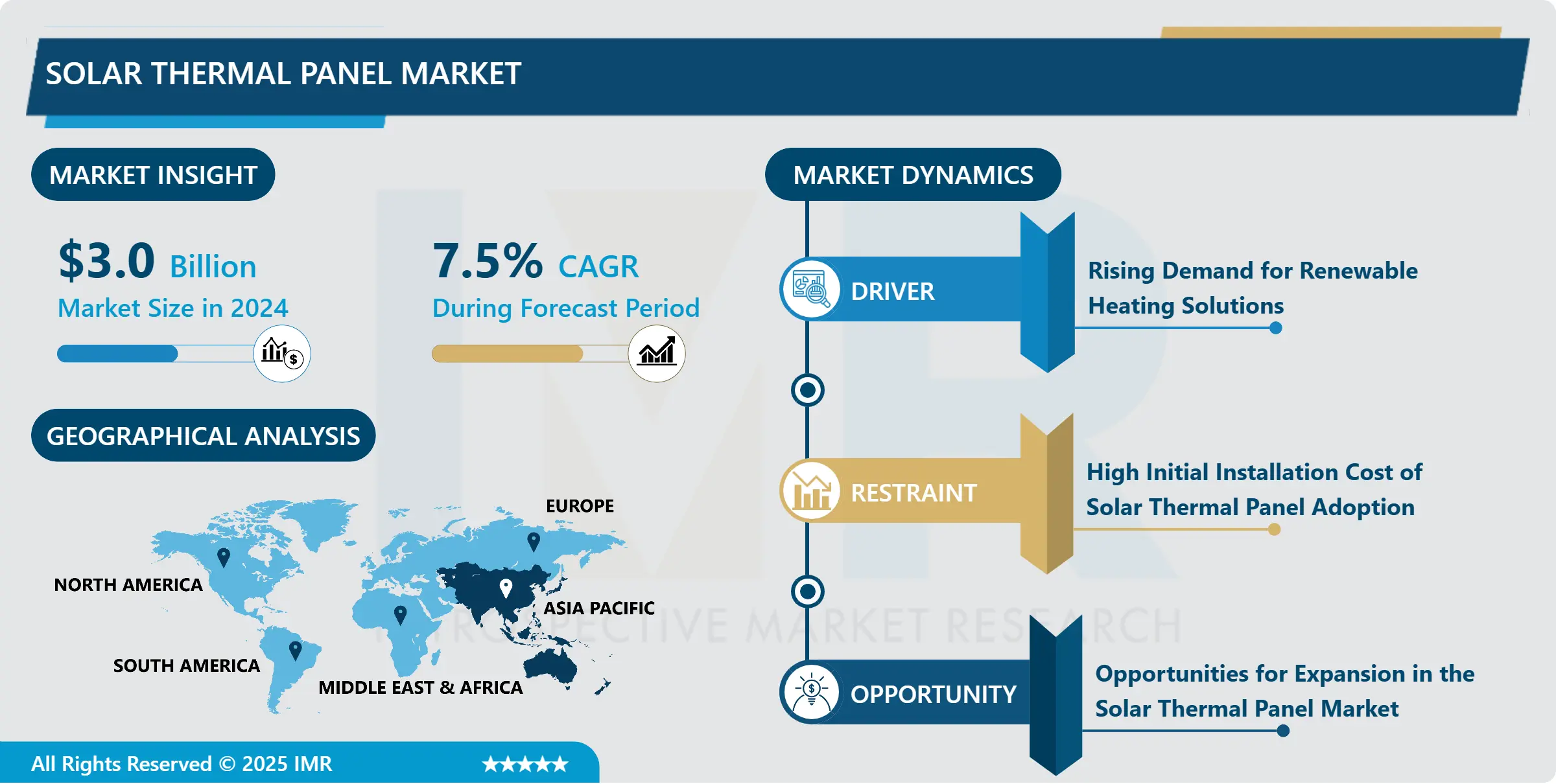
Solar Thermal Panel Market Size Was Valued at USD 3.0 Billion in 2024, and is Projected to Reach USD 6.65 Billion by 2035, Growing at a CAGR of 7.5% from 2025-2035.
The Solar Thermal Panel Market represents a vital segment of the renewable energy industry, centred on technologies that harness sunlight to generate heat for various applications. These systems are used across residential, commercial, and industrial sectors to provide sustainable solutions for water heating, space heating, and industrial process heat.
Growth in this market is driven by rising global concerns over climate change, increasing energy costs, and the urgent need to transition away from fossil fuels. Governments worldwide are supporting solar thermal adoption through subsidies, tax incentives, and clean energy mandates, especially in regions with high solar insolation and energy demand.
Technological advancements such as higher-efficiency collectors, hybrid systems, and integration with energy storage are improving the performance and appeal of solar thermal solutions. The market is also expanding beyond traditional residential uses, with growing adoption in large-scale industrial applications where thermal energy represents a significant portion of energy consumption.
Challenges include high upfront installation costs, seasonal variability in sunlight, and competition from alternative technologies like photovoltaic (PV) systems and heat pumps. However, the long-term economic and environmental benefits of solar thermal systems are expected to sustain market momentum. Overall, the Solar Thermal Panel Market is poised for continued expansion, supported by innovation, policy support, and increasing awareness of sustainable heating solutions.
Solar Thermal Panel Market Growth and Trend Analysis:
Solar Thermal Panel Market Growth Driver - Rising Demand for Renewable Heating Solutions
- As the world works toward cleaner energy and lower carbon emissions, the need for renewable heating solutions is growing rapidly. One major area of focus is solar thermal panels, which use sunlight to produce heat rather than electricity. These systems are especially useful for water heating and space heating in homes, offices, and factories. Traditional heating methods often rely on fossil fuels like gas or coal, which release carbon dioxide and contribute to global warming. In contrast, solar thermal panels are clean and do not produce emissions, making them an eco-friendly choice. They are also highly efficient, as they convert a large portion of sunlight directly into usable heat.
- Many countries are supporting this shift through government incentives, including subsidies and tax benefits, which make it easier and more affordable for people and businesses to install solar thermal systems. As energy prices continue to rise, more consumers are turning to these systems to save money in the long run.
- Solar thermal technology is also improving. New designs, such as evacuated tube collectors and hybrid systems, allow for better performance in different climates and uses, including in industries that need large amounts of heat. In summary, the demand for renewable heating is on the rise, and solar thermal panels offer a practical, sustainable solution. With global efforts to fight climate change, their role in homes, businesses, and industries is expected to grow significantly in the coming years.?
Solar Thermal Panel Market Limiting Factor - High Initial Installation Cost of Solar Thermal Panel Adoption
- One of the main challenges facing the solar thermal panel market is the high initial installation cost. While these systems are designed to save money in the long term by reducing energy bills, the upfront cost of buying and installing them can be too much for many people especially homeowners, small businesses, or those in developing countries.
- A solar thermal system includes not just the panels but also pipes, tanks, pumps, and control units. Hiring trained professionals for installation also adds to the total cost. For many, this large investment is hard to afford without government help, loans, or incentives. As a result, even people who want to go green and save energy may delay or avoid installing a solar thermal system because of the high starting price.
- This cost barrier slows down the wider use of solar thermal technology. In contrast, other options like electric heaters or solar PV panels may seem more affordable or easier to install, even if they are not as energy-efficient for heating purposes.
- To overcome this challenge, more financial support from governments, such as subsidies, tax breaks, or low-interest loans, is needed. As technology improves and demand grows, prices may come down over time. But until then, the high upfront cost remains a major limiting factor in the growth of the solar thermal panel market.
Solar Thermal Panel Market Expansion Opportunity – Opportunities for Expansion in the Solar Thermal Panel Market
- The solar thermal panel market holds significant opportunities for expansion, especially as the world shifts toward clean and sustainable energy solutions. One of the biggest opportunities lies in the growing demand for renewable heating in both developed and developing countries.
- Another major opportunity is in the industrial sector. Many industries, such as food processing, textiles, and chemicals, use large amounts of heat in their operations. Solar thermal panels can supply process heat, helping companies reduce energy costs and carbon emissions. As industries seek cleaner alternatives, solar thermal solutions are becoming more attractive.
- The integration of solar thermal systems in green building projects is also gaining popularity. With stricter energy efficiency regulations and growing interest in sustainable construction, builders and developers are turning to solar thermal technologies for water and space heating. The technological improvements such as better heat storage, hybrid PV-T systems, and more efficient collectors are making solar thermal systems more effective and affordable. In summary, the solar thermal panel market has strong expansion potential, especially in emerging markets, industrial applications, and sustainable construction driven by energy needs, climate goals, and technological progress.
Solar Thermal Panel Market Challenge and Risk – Weather Dependence
- One of the main challenges for solar thermal panels is their strong dependence on weather conditions. These systems work by using sunlight to heat water or air, so they perform best in places with plenty of direct sunlight. However, in areas that often have cloudy skies, heavy rain, snow, or long winters, solar thermal panels may not produce enough heat to meet daily needs.
- For example, in countries with cold or rainy climates, sunlight can be weak or blocked for days or even weeks. During such times, solar thermal systems may not work effectively without a backup heating system, like a gas or electric heater. This makes the system less reliable in those regions and can increase costs for users who need extra equipment.
- Also, during the winter, the angle and intensity of sunlight are lower, which further reduces the efficiency of solar thermal panels. In very cold areas, there’s also a risk of pipes freezing, which may cause damage if systems are not well insulated.
- Because of this weather dependence, solar thermal panels are more commonly used in sun-rich regions, such as parts of Africa, Asia, and southern Europe. To expand use in colder areas, better system designs, thermal storage solutions, and hybrid setups are needed to improve reliability throughout the year.
Solar Thermal Panel Market Segment Analysis:
Solar Thermal Panel Market is segmented based on Type, Application, End-Users, and Region
By Type, Solar Thermal Panel Segment is Expected to Dominate the Market During the Forecast Period
- Flat plate collectors are usually used in warmer climates. They have a simple design, with a dark, flat surface that absorbs sunlight and heats the water inside. These collectors work well when there is a lot of sunshine and are often used in homes, hotels, and schools for water heating.
- On the other hand, evacuated tube collectors are better for colder regions or places with less sunshine. They are made of glass tubes with a vacuum inside that helps reduce heat loss. Because of this, they can still collect and hold heat even on cold or cloudy days. This makes them more efficient and reliable in changing weather.
- Both types of collectors have been tested over time and are known for their durability and high performance. They can last for many years with little maintenance, which makes them a smart investment for people looking to save energy and reduce costs in the long run.
- Thanks to their flexibility, reliability, and efficiency, flat plate and evacuated tube collectors are key drivers of growth in the solar thermal panel market.
By Application, Solar Thermal Panel Segment Held the Largest Share in 2024
- Domestic Hot Water (DHW) systems are the most common and widely used application of solar thermal panels. These systems are designed to heat water for everyday household tasks such as bathing, washing clothes, cleaning dishes, and cooking. Instead of using electricity or gas, they use sunlight to heat water, which helps reduce energy bills and lower carbon emissions.
- The system works by collecting solar energy through panels, which is then transferred to a water tank. The heated water can be stored and used whenever needed. This makes it a reliable and cost-effective solution for homes, especially in areas with plenty of sunshine.
- DHW systems are simple to install and maintain, which adds to their popularity. In many sunny regions around the world like parts of Asia, Africa, southern Europe, and the Middle East households use these systems to meet most of their hot water needs.
- As energy prices continue to rise and people look for cleaner energy options, more families are turning to domestic solar hot water systems. Government support through subsidies and rebates also makes these systems more affordable. Because of these benefits, DHW systems are the leading application for solar thermal panels globally.
Solar Thermal Panel Market Regional Insights:
Asia Pacific is Expected to Dominate the Market Over the Forecast Period
- The Asia-Pacific region holds the largest share in the global solar thermal panel market. This strong position is mainly because countries like China, India, and Australia are making major investments in renewable energy to meet growing energy needs and reduce environmental pollution.
- As the region's population increases and urban areas expand, the demand for energy especially for hot water and heating is rising quickly. More homes, apartments, offices, and factories are being built, and all of them need efficient and reliable heating systems. Solar thermal panels provide a clean, affordable, and sustainable solution for these energy needs.
- The Asia-Pacific region is also rich in sunlight, which makes solar thermal technology very effective. In countries like China and India, solar thermal systems can operate almost year-round, making them a smart and practical choice. In sunny places like Australia, these systems are especially popular for heating water in homes.
- Overall, the market in Asia-Pacific is growing because of high energy demand, rapid development, and strong sunlight. Combined with government support and public awareness about clean energy, the region is expected to remain the global leader in solar thermal panel adoption for years to come.
Solar Thermal Panel Market Active Players:
- A.O. Smith Corporation (United States)
- Alternate Energy Technologies (AET) (United States)
- Apricus Solar Co., Ltd. (China/Australia)
- Ariston Thermo Group (Italy)
- Bosch Thermotechnology (Germany)
- BTE Solar Co., Ltd. (China)
- Chromagen (Israel)
- Greenonetec Solarindustrie GmbH (Austria)
- Heliodyne Inc. (United States)
- Himin Solar Co., Ltd. (China)
- Jiaxing Jinyi Solar Energy Technology Co., Ltd. (China)
- Jinlong Solar Technology (China)
- Kingspan Environmental Ltd. (United Kingdom)
- Megasun (Greece)
- Modi Solar (India)
- Narva Solar (India)
- Nobel International (Greece)
- Rheem Manufacturing Company (United States)
- Ritter Energie- und Umwelttechnik GmbH & Co. KG (Germany)
- Solahart Industries Pty Ltd. (Australia)
- Sole S.A. (Greece)
- Solimpeks (Turkey)
- Stiebel Eltron (Germany)
- SunEarth Inc. (United States)
- SunMaxx Solar (United States)
- Tata Power Solar (India)
- Thermomax (United Kingdom)
- Tisun GmbH (Austria)
- Viessmann Group (Germany)
- Zhejiang Shentai Solar Energy Co., Ltd. (China)
- Other Active Players
Key Industry Developments in the Solar Thermal Panel Market:
- In December 2024, Serbia received USD?112.3?million from the European Bank for Reconstruction and Development (EBRD) to construct a solar thermal facility in Novi Sad. The installation includes a 38,600?m² collector field and heat storage elements, aimed at reducing gas use by 29% and cutting CO? emissions by 17,350 tons annually
- On July 3, 2024, SECI announced plans to issue a 500?MW solar thermal tender by FY 2025. This will be India’s first large-scale solar thermal project, aiming to generate steam for power turbines. The goal is to offer round-the-clock clean energy at competitive costs
|
Solar Thermal Panel Market |
|||
|
Base Year: |
2024 |
Forecast Period: |
2025-2035 |
|
Historical Data: |
2018 to 2023 |
Market Size in 2024: |
USD 3.0 Billion |
|
Forecast Period 2025-35 CAGR: |
7.5 % |
Market Size in 2035: |
USD 6.65 Billion |
|
Segments Covered: |
By Type |
|
|
|
By Application |
|
||
|
by Type of System |
|
||
|
By Region |
|
||
|
Growth Driver: |
|
||
|
Limiting Factor |
|
||
|
Expansion Opportunity |
|
||
|
Challenge and Risk |
|
||
|
Companies Covered in the Report: |
|
||
Chapter 1: Introduction
1.1 Scope and Coverage
Chapter 2:Executive Summary
Chapter 3: Market Landscape
3.1 Market Dynamics and Opportunity Analysis
3.1.1 Growth Drivers
3.1.2 Limiting Factors
3.1.3 Growth Opportunities
3.1.4 Challenges and Risks
3.2 Market Trend Analysis
3.3 Industry Ecosystem
3.4 Industry Value Chain Mapping
3.5 Strategic PESTLE Overview
3.6 Porter's Five Forces Framework
3.7 Regulatory Framework
3.8 Pricing Trend Analysis
3.9 Intellectual Property Review
3.10 Technology Evolution
3.11 Import-Export Analysis
3.12 Consumer Behavior Analysis
3.13 Investment Pocket Analysis
3.14 Go-To Market Strategy
Chapter 4: Solar Thermal Panel Market by Type (2018-2035)
4.1 Solar Thermal Panel Market Snapshot and Growth Engine
4.2 Market Overview
4.3 Evacuated Tube Collectors
4.3.1 Introduction and Market Overview
4.3.2 Historic and Forecasted Market Size in Value USD and Volume Units
4.3.3 Key Market Trends, Growth Factors, and Opportunities
4.3.4 Geographic Segmentation Analysis
4.4 Flat Plate Collectors
4.5 Unglazed Water Collectors
4.6 Air Collectors
4.7 Others
Chapter 5: Solar Thermal Panel Market by Application (2018-2035)
5.1 Solar Thermal Panel Market Snapshot and Growth Engine
5.2 Market Overview
5.3 Domestic Hot Water Systems
5.3.1 Introduction and Market Overview
5.3.2 Historic and Forecasted Market Size in Value USD and Volume Units
5.3.3 Key Market Trends, Growth Factors, and Opportunities
5.3.4 Geographic Segmentation Analysis
5.4 Large DHW (Domestic Hot Water) Systems
5.5 Solar Combi Systems
5.6 Swimming Pool Heating
5.7 Other Applications
Chapter 6: Solar Thermal Panel Market by Type of System (2018-2035)
6.1 Solar Thermal Panel Market Snapshot and Growth Engine
6.2 Market Overview
6.3 Thermosiphon Solar Heating Systems
6.3.1 Introduction and Market Overview
6.3.2 Historic and Forecasted Market Size in Value USD and Volume Units
6.3.3 Key Market Trends, Growth Factors, and Opportunities
6.3.4 Geographic Segmentation Analysis
6.4 Pumped Solar Heating Systems
Chapter 7: Company Profiles and Competitive Analysis
7.1 Competitive Landscape
7.1.1 Competitive Benchmarking
7.1.2 Solar Thermal Panel Market Share by Manufacturer/Service Provider(2024)
7.1.3 Industry BCG Matrix
7.1.4 PArtnerships, Mergers & Acquisitions
7.2 A.O. SMITH CORPORATION (UNITED STATES)
7.2.1 Company Overview
7.2.2 Key Executives
7.2.3 Company Snapshot
7.2.4 Role of the Company in the Market
7.2.5 Sustainability and Social Responsibility
7.2.6 Operating Business Segments
7.2.7 Product Portfolio
7.2.8 Business Performance
7.2.9 Recent News & Developments
7.2.10 SWOT Analysis
7.3 ALTERNATE ENERGY TECHNOLOGIES (AET) (UNITED STATES)
7.4 APRICUS SOLAR CO.
7.5 LTD. (CHINA/AUSTRALIA)
7.6 ARISTON THERMO GROUP (ITALY)
7.7 BOSCH THERMOTECHNOLOGY (GERMANY)
7.8 BTE SOLAR CO.
7.9 LTD. (CHINA)
7.10 CHROMAGEN (ISRAEL)
7.11 GREENONETEC SOLARINDUSTRIE GMBH (AUSTRIA)
7.12 HELIODYNE INC. (UNITED STATES)
7.13 HIMIN SOLAR CO.
7.14 LTD. (CHINA)
7.15 JIAXING JINYI SOLAR ENERGY TECHNOLOGY CO.
7.16 LTD. (CHINA)
7.17 JINLONG SOLAR TECHNOLOGY (CHINA)
7.18 KINGSPAN ENVIRONMENTAL LTD. (UNITED KINGDOM)
7.19 MEGASUN (GREECE)
7.20 MODI SOLAR (INDIA)
7.21 NARVA SOLAR (INDIA)
7.22 NOBEL INTERNATIONAL (GREECE)
7.23 RHEEM MANUFACTURING COMPANY (UNITED STATES)
7.24 RITTER ENERGIE- UND UMWELTTECHNIK GMBH & CO. KG (GERMANY)
7.25 SOLAHART INDUSTRIES PTY LTD. (AUSTRALIA)
7.26 SOLE S.A. (GREECE)
7.27 SOLIMPEKS (TURKEY)
7.28 STIEBEL ELTRON (GERMANY)
7.29 SUNEARTH INC. (UNITED STATES)
7.30 SUNMAXX SOLAR (UNITED STATES)
7.31 TATA POWER SOLAR (INDIA)
7.32 THERMOMAX (UNITED KINGDOM)
7.33 TISUN GMBH (AUSTRIA)
7.34 VIESSMANN GROUP (GERMANY)
7.35 ZHEJIANG SHENTAI SOLAR ENERGY CO.
7.36 LTD. (CHINA)
7.37 AND OTHER ACTIVE PLAYERS.
Chapter 8: Global Solar Thermal Panel Market By Region
8.1 Overview
8.2. North America Solar Thermal Panel Market
8.2.1 Key Market Trends, Growth Factors and Opportunities
8.2.2 Top Key Companies
8.2.3 Historic and Forecasted Market Size by Segments
8.2.4 Historic and Forecast Market Size by Country
8.2.4.1 US
8.2.4.2 Canada
8.2.4.3 Mexico
8.3. Eastern Europe Solar Thermal Panel Market
8.3.1 Key Market Trends, Growth Factors and Opportunities
8.3.2 Top Key Companies
8.3.3 Historic and Forecasted Market Size by Segments
8.3.4 Historic and Forecast Market Size by Country
8.3.4.1 Russia
8.3.4.2 Bulgaria
8.3.4.3 The Czech Republic
8.3.4.4 Hungary
8.3.4.5 Poland
8.3.4.6 Romania
8.3.4.7 Rest of Eastern Europe
8.4. Western Europe Solar Thermal Panel Market
8.4.1 Key Market Trends, Growth Factors and Opportunities
8.4.2 Top Key Companies
8.4.3 Historic and Forecasted Market Size by Segments
8.4.4 Historic and Forecast Market Size by Country
8.4.4.1 Germany
8.4.4.2 UK
8.4.4.3 France
8.4.4.4 The Netherlands
8.4.4.5 Italy
8.4.4.6 Spain
8.4.4.7 Rest of Western Europe
8.5. Asia Pacific Solar Thermal Panel Market
8.5.1 Key Market Trends, Growth Factors and Opportunities
8.5.2 Top Key Companies
8.5.3 Historic and Forecasted Market Size by Segments
8.5.4 Historic and Forecast Market Size by Country
8.5.4.1 China
8.5.4.2 India
8.5.4.3 Japan
8.5.4.4 South Korea
8.5.4.5 Malaysia
8.5.4.6 Thailand
8.5.4.7 Vietnam
8.5.4.8 The Philippines
8.5.4.9 Australia
8.5.4.10 New Zealand
8.5.4.11 Rest of APAC
8.6. Middle East & Africa Solar Thermal Panel Market
8.6.1 Key Market Trends, Growth Factors and Opportunities
8.6.2 Top Key Companies
8.6.3 Historic and Forecasted Market Size by Segments
8.6.4 Historic and Forecast Market Size by Country
8.6.4.1 Turkiye
8.6.4.2 Bahrain
8.6.4.3 Kuwait
8.6.4.4 Saudi Arabia
8.6.4.5 Qatar
8.6.4.6 UAE
8.6.4.7 Israel
8.6.4.8 South Africa
8.7. South America Solar Thermal Panel Market
8.7.1 Key Market Trends, Growth Factors and Opportunities
8.7.2 Top Key Companies
8.7.3 Historic and Forecasted Market Size by Segments
8.7.4 Historic and Forecast Market Size by Country
8.7.4.1 Brazil
8.7.4.2 Argentina
8.7.4.3 Rest of SA
Chapter 9 Analyst Viewpoint and Conclusion
Chapter 10 Our Thematic Research Methodology
10.1 Research Process
10.2 Primary Research
10.3 Secondary Research
Chapter 11 Case Study
Chapter 12 Appendix
12.1 Sources
12.2 List of Tables and figures
12.3 Short Forms and Citations
12.4 Assumption and Conversion
12.5 Disclaimer
|
Solar Thermal Panel Market |
|||
|
Base Year: |
2024 |
Forecast Period: |
2025-2035 |
|
Historical Data: |
2018 to 2023 |
Market Size in 2024: |
USD 3.0 Billion |
|
Forecast Period 2025-35 CAGR: |
7.5 % |
Market Size in 2035: |
USD 6.65 Billion |
|
Segments Covered: |
By Type |
|
|
|
By Application |
|
||
|
by Type of System |
|
||
|
By Region |
|
||
|
Growth Driver: |
|
||
|
Limiting Factor |
|
||
|
Expansion Opportunity |
|
||
|
Challenge and Risk |
|
||
|
Companies Covered in the Report: |
|
||


