




Sleep App Market Synopsis:
Sleep App Market Size Was Valued at USD 2,084.10 Million in 2023, and is Projected to Reach USD 7,429.73 Million by 2032, Growing at a CAGR of 15.17% From 2024-2032.
Sleep App Market refers to apps made to assist users in tracking, enhancing, and regulating their sleep patterns by tracking their stats, providing noises, and practical directions. All these applications utilize information technology and data analytical tools to help users manage their sleep and lifestyle effectively.
The Sleep App Market has increased over the last few years due to growing consciousness of Sleep Disorders and Health Importance of Sleep. The increased number of smartphone and wearable devices make consumers more willing to adopt convenient solutions for sleep control. A significant number of these apps can also synchronise with wearable devices so that users can monitor sleep quality, heart rate, and similar. Also, the pandemic situation has become a critical factor in raising awareness of people’s mental health contributing to a higher demand to have sleep-related applications needed to reduce stress and anxiety increases.
It seems that key market participants are trying to remain innovative by adding new functions and features to their apps. This includes, the user specific sleep recommendations, features of analytic and intelligence sleep solutions that are based on artificial intelligence. This oligopolistic competition is made of large legacy players and new entrants, all trying to increase their market slice by improving the value proposition and the value needed. Additionally, increasing utilization of telehealth care has prompted app developers to engage healthcare providers to elaborate clinical values into consumer-centric applications. This is expected to fuel the growth of the market, because consumers require targeted and efficient solutions for sleep.
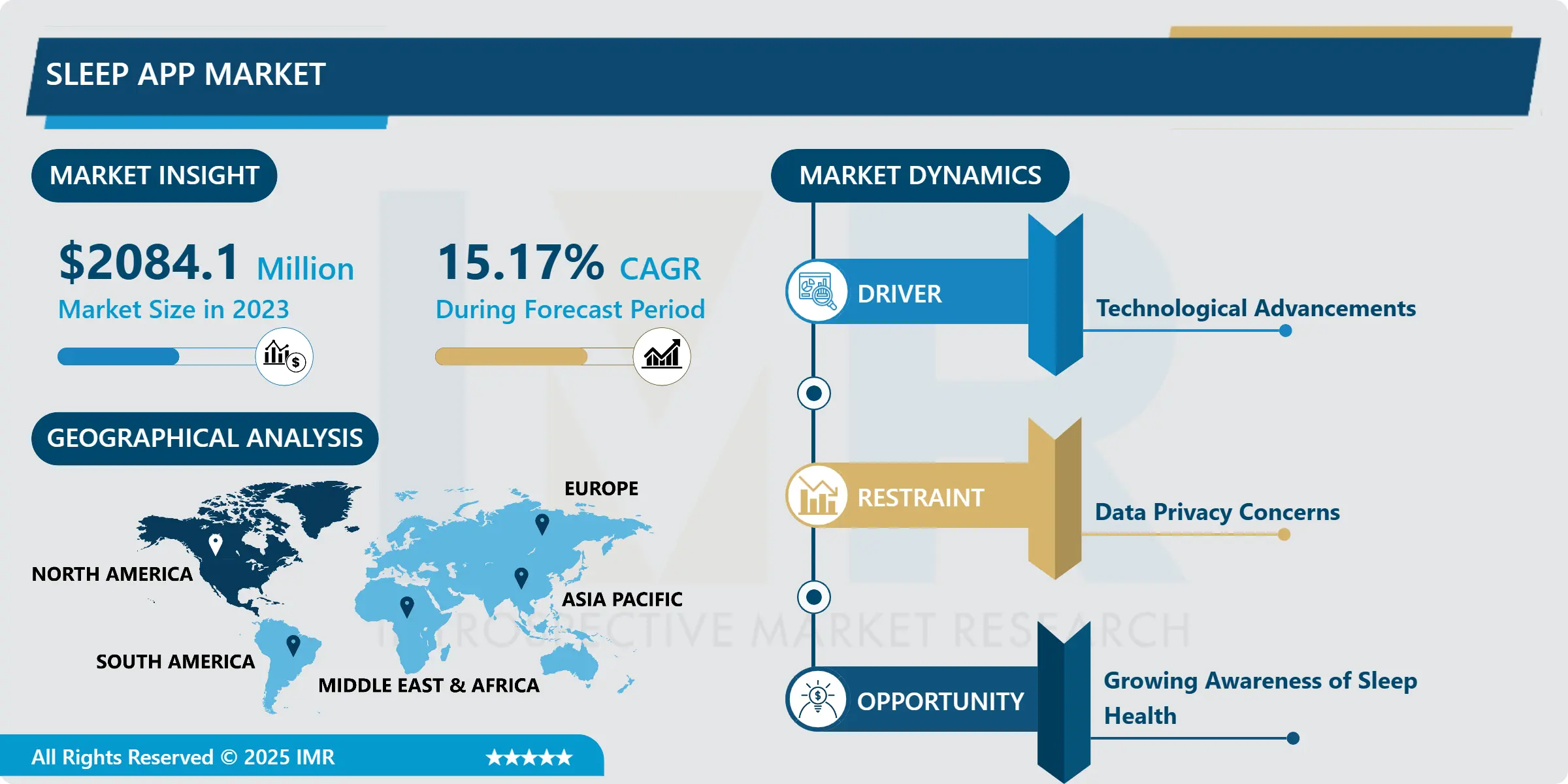
Sleep App Market Trend Analysis:
Integration of AI and Machine Learning
- AI and machine learning have become commonplace for sleep apps giving users the ability to monitor and enhance sleep quality. These technologies allow apps to process massive amounts of data that users input giving insights that human analysis might not pick. In turn, the users get suggestions that will help with their individual problems, which makes the application even more effective. Not only does this make users spend more time in the application but also makes them return to the application because they have evidence of improved sleep quality as supported by the application.
- Also, exclusive capabilities like artificial intelligence for prediction and feedback help define new changes to the experience of the users. Applications are thus able to give suggestions every time new signals indicate that the user will need to change their behaviour. For instance, if an app identifies fluctuating patterns in the client’s sleeping schedule, then the app is able to recommend new sleep habits or changes in external conditions that might have an impact on the quality of sleeps. Such a level of personalization improves satisfaction, and hence AI incorporated sleep applications should be a necessity to anyone seeking these improved sleep applications.
Growing Awareness of Sleep Health
- As awareness of sleep health continues to rise, there is a significant opportunity for sleep apps to expand their user base. Health organizations and experts increasingly emphasize the connection between sleep quality and overall health, including mental health, productivity, and chronic disease management. This growing recognition creates a market for apps that not only track sleep but also educate users on best practices for achieving restorative sleep. It is thus helpful for the developers to take this perception and improve on the marketing plan so as to portray their apps as vital resources on wellness.
- Also, the growing amount of people suffering from insomnia or sleep apnea opens up a great potential for application for better sleep. These applications can provide solutions to particular users struggling with some conditions. This depicts that developers who get closer to healthcare professionals and incorporate clinical domain knowledge into their products gain the confidence of their customers. Apart from that, it increases the users’ satisfaction and allows the application to become an essential part of other healthcare-oriented organizations and institutions.
Sleep App Market Segment Analysis:
Sleep App Market is Segmented on the basis of Device Type, Feature, Age Group, End user and Region.
By Feature, Basic Sleep Tracking segment is expected to dominate the market during the forecast period
- By feature, the Basic Sleep Tracking segment is expected to dominate the market during the forecast period. Growing consumer awareness about the importance of sleep health, combined with the rising adoption of wearable technology, is driving demand for devices offering essential sleep monitoring functions.
- Basic sleep tracking features, such as monitoring sleep duration, patterns, and quality, are increasingly preferred for their affordability, ease of use, and accessibility across a wide range of devices. These solutions cater to a broad consumer base seeking simple yet effective ways to improve their sleep habits without the complexity of advanced diagnostics. As more individuals prioritize preventive health and wellness, the Basic Sleep Tracking segment is poised for strong and sustained growth.
By End User, Home Care Settings segment expected to held the largest share
- The Home Care Settings segment is expected to hold the largest share of the Sleep App Market during the forecast period. While hospitals, sleep centers, and diagnostic laboratories use sleep apps for monitoring and enhancing patient care, the demand for home-based solutions is rising rapidly. Increasing interest in self-monitoring and managing sleep health independently is driving consumers to adopt sleep apps for personal use. These applications allow individuals to track their sleep patterns conveniently from home, providing valuable insights to improve their sleep quality and overall well-being. Furthermore, sleep apps offer flexibility for diagnostic laboratories to monitor patients remotely. The growing adoption across multiple settings highlights the expanding role and future potential of sleep apps in healthcare.
Sleep App Market Regional Insights:
North America is Expected to Dominate the Market Over the Forecast period
- North America is dominating in the Sleep App Market presently due to high smart phone usage rate and increased focus on health and fitness. A rising incidences of sleep disorders in particular region makes the consumers look for better solutions in the form of sleep apps hence, higher adoption. Further, the high concentration of important players and emerging competitors in the United States has propelled the area to higher levels of application development and technology.
- Similarly, those in the healthcare field of North America have started to realize the need to introduce sleep health into the wellbeing-oriented frameworks. The market has received increased credibility and trust from consumers, owing to alliances between healthcare organizations and app developers. Indeed, as the consciousness of sleep health is increasing progressively, North America is predicted to remain dominant in the Sleep App Market continuing to dictate trends that may shape the global market.
Active Key Players in the Sleep App Market:
- Calm (USA)
- DreamWell (USA)
- F.lux (USA)
- Hatch (USA)
- Headspace (USA)
- Noisli (Germany)
- Pillow (USA)
- Pzizz (USA)
- Sleep Cycle (Sweden)
- Sleepio (UK)
- Sleepio (UK)
- SnoreLab (USA)
- Other Active Players
Key Industry Developments in the Sleep App Market:
- In October 2023, Samsung Electronics, one of the technology leaders, announced that the new sleep apnea feature1 on the Samsung Health Monitor app2 has been approved by Korea’s Ministry of Food and Drug Safety (MFDS), and will be integrated with the Galaxy Watch series in Korea early next year. The new feature is expected to enable more people to spot obstructive sleep apnea symptoms in early stages which often goes undiagnosed and untreated.
- In May 2023, Aqara, one of the leading smart home and internet-of-things (IoT) device manufacturer, announced that the company launched Aqara Presence Sensor FP2 and is getting three significant new features that could make it more useful and more effective as a smart home sensor. The small device can be set to monitor and analyze “sleep status, real-time heart rate, and respiratory data,”
|
Sleep App Market |
|||
|
Base Year: |
2023 |
Forecast Period: |
2024-2032 |
|
Historical Data: |
2017 to 2023 |
Market Size in 2023: |
USD 2,084.10 Million |
|
Forecast Period 2024-32 CAGR: |
15.17% |
Market Size in 2032: |
USD 7,429.73 Million |
|
Segments Covered: |
By Device Type |
|
|
|
By Feature |
|
||
|
By Age Group |
|
||
|
By End User |
|
||
|
By Region |
|
||
|
Key Market Drivers: |
|
||
|
Key Market Restraints: |
|
||
|
Key Opportunities: |
|
||
|
Companies Covered in the report: |
|
||
Chapter 1: Introduction
1.1 Scope and Coverage
Chapter 2:Executive Summary
Chapter 3: Market Landscape
3.1 Industry Dynamics and Opportunity Analysis
3.1.1 Growth Drivers
3.1.2 Limiting Factors
3.1.3 Growth Opportunities
3.1.4 Challenges and Risks
3.2 Market Trend Analysis
3.3 Strategic Pestle Overview
3.4 Porter's Five Forces Analysis
3.5 Industry Value Chain Mapping
3.6 Regulatory Framework
3.7 Princing Trend Analysis
3.8 Patent Analysis
3.9 Technology Evolution
3.10 Investment Pockets
3.11 Import-Export Analysis
Chapter 4: Sleep App Market by Device Type
4.1 Sleep App Market Snapshot and Growth Engine
4.2 Sleep App Market Overview
4.3 Wearable Devices
4.3.1 Introduction and Market Overview
4.3.2 Historic and Forecasted Market Size in Value USD and Volume Units (2017-2032F)
4.3.3 Wearable Devices: Geographic Segmentation Analysis
4.4 Non-wearable Devices
4.4.1 Introduction and Market Overview
4.4.2 Historic and Forecasted Market Size in Value USD and Volume Units (2017-2032F)
4.4.3 Non-wearable Devices: Geographic Segmentation Analysis
Chapter 5: Sleep App Market by Features
5.1 Sleep App Market Snapshot and Growth Engine
5.2 Sleep App Market Overview
5.3 Basic Sleep Tracking
5.3.1 Introduction and Market Overview
5.3.2 Historic and Forecasted Market Size in Value USD and Volume Units (2017-2032F)
5.3.3 Basic Sleep Tracking: Geographic Segmentation Analysis
5.4 Sleep Staging
5.4.1 Introduction and Market Overview
5.4.2 Historic and Forecasted Market Size in Value USD and Volume Units (2017-2032F)
5.4.3 Sleep Staging: Geographic Segmentation Analysis
5.5 Heart Rate Monitoring
5.5.1 Introduction and Market Overview
5.5.2 Historic and Forecasted Market Size in Value USD and Volume Units (2017-2032F)
5.5.3 Heart Rate Monitoring: Geographic Segmentation Analysis
5.6 Respiratory Monitoring
5.6.1 Introduction and Market Overview
5.6.2 Historic and Forecasted Market Size in Value USD and Volume Units (2017-2032F)
5.6.3 Respiratory Monitoring : Geographic Segmentation Analysis
5.7 Others
5.7.1 Introduction and Market Overview
5.7.2 Historic and Forecasted Market Size in Value USD and Volume Units (2017-2032F)
5.7.3 Others: Geographic Segmentation Analysis
Chapter 6: Sleep App Market by Age Group
6.1 Sleep App Market Snapshot and Growth Engine
6.2 Sleep App Market Overview
6.3 Adults
6.3.1 Introduction and Market Overview
6.3.2 Historic and Forecasted Market Size in Value USD and Volume Units (2017-2032F)
6.3.3 Adults: Geographic Segmentation Analysis
6.4 Geriatric
6.4.1 Introduction and Market Overview
6.4.2 Historic and Forecasted Market Size in Value USD and Volume Units (2017-2032F)
6.4.3 Geriatric: Geographic Segmentation Analysis
Chapter 7: Sleep App Market by End Users
7.1 Sleep App Market Snapshot and Growth Engine
7.2 Sleep App Market Overview
7.3 Hospitals
7.3.1 Introduction and Market Overview
7.3.2 Historic and Forecasted Market Size in Value USD and Volume Units (2017-2032F)
7.3.3 Hospitals: Geographic Segmentation Analysis
7.4 Sleep Centres
7.4.1 Introduction and Market Overview
7.4.2 Historic and Forecasted Market Size in Value USD and Volume Units (2017-2032F)
7.4.3 Sleep Centres: Geographic Segmentation Analysis
7.5 Home Care Settings
7.5.1 Introduction and Market Overview
7.5.2 Historic and Forecasted Market Size in Value USD and Volume Units (2017-2032F)
7.5.3 Home Care Settings: Geographic Segmentation Analysis
7.6 Diagnostic Laboratories
7.6.1 Introduction and Market Overview
7.6.2 Historic and Forecasted Market Size in Value USD and Volume Units (2017-2032F)
7.6.3 Diagnostic Laboratories: Geographic Segmentation Analysis
Chapter 8: Company Profiles and Competitive Analysis
8.1 Competitive Landscape
8.1.1 Competitive Benchmarking
8.1.2 Sleep App Market Share by Manufacturer (2023)
8.1.3 Concentration Ratio(CR5)
8.1.4 Heat Map Analysis
8.1.5 Mergers and Acquisitions
8.2 CALM (USA)
8.2.1 Company Overview
8.2.2 Key Executives
8.2.3 Company Snapshot
8.2.4 Operating Business Segments
8.2.5 Product Portfolio
8.2.6 Business Performance
8.2.7 Key Strategic Moves and Recent Developments
8.3 SLEEP CYCLE (SWEDEN)
8.4 HEADSPACE (USA)
8.5 PILLOW (USA)
8.6 NOISLI (GERMANY)
8.7 SLEEPIO (UK)
8.8 HATCH (USA)
8.9 PZIZZ (USA)
8.10 OTHER ACTIVE PLAYERS
Chapter 9: Global Sleep App Market By Region
9.1 Overview
9.2. North America Sleep App Market
9.2.1 Historic and Forecasted Market Size by Segments
9.2.2 Historic and Forecasted Market Size By Device Type
9.2.2.1 Wearable Devices
9.2.2.2 Non-wearable Devices
9.2.3 Historic and Forecasted Market Size By Features
9.2.3.1 Basic Sleep Tracking
9.2.3.2 Sleep Staging
9.2.3.3 Heart Rate Monitoring
9.2.3.4 Respiratory Monitoring
9.2.3.5 Others
9.2.4 Historic and Forecasted Market Size By Age Group
9.2.4.1 Adults
9.2.4.2 Geriatric
9.2.5 Historic and Forecasted Market Size By End Users
9.2.5.1 Hospitals
9.2.5.2 Sleep Centres
9.2.5.3 Home Care Settings
9.2.5.4 Diagnostic Laboratories
9.2.6 Historic and Forecast Market Size by Country
9.2.6.1 US
9.2.6.2 Canada
9.2.6.3 Mexico
9.3. Eastern Europe Sleep App Market
9.3.1 Historic and Forecasted Market Size by Segments
9.3.2 Historic and Forecasted Market Size By Device Type
9.3.2.1 Wearable Devices
9.3.2.2 Non-wearable Devices
9.3.3 Historic and Forecasted Market Size By Features
9.3.3.1 Basic Sleep Tracking
9.3.3.2 Sleep Staging
9.3.3.3 Heart Rate Monitoring
9.3.3.4 Respiratory Monitoring
9.3.3.5 Others
9.3.4 Historic and Forecasted Market Size By Age Group
9.3.4.1 Adults
9.3.4.2 Geriatric
9.3.5 Historic and Forecasted Market Size By End Users
9.3.5.1 Hospitals
9.3.5.2 Sleep Centres
9.3.5.3 Home Care Settings
9.3.5.4 Diagnostic Laboratories
9.3.6 Historic and Forecast Market Size by Country
9.3.6.1 Bulgaria
9.3.6.2 The Czech Republic
9.3.6.3 Hungary
9.3.6.4 Poland
9.3.6.5 Romania
9.3.6.6 Rest of Eastern Europe
9.4. Western Europe Sleep App Market
9.4.1 Historic and Forecasted Market Size by Segments
9.4.2 Historic and Forecasted Market Size By Device Type
9.4.2.1 Wearable Devices
9.4.2.2 Non-wearable Devices
9.4.3 Historic and Forecasted Market Size By Features
9.4.3.1 Basic Sleep Tracking
9.4.3.2 Sleep Staging
9.4.3.3 Heart Rate Monitoring
9.4.3.4 Respiratory Monitoring
9.4.3.5 Others
9.4.4 Historic and Forecasted Market Size By Age Group
9.4.4.1 Adults
9.4.4.2 Geriatric
9.4.5 Historic and Forecasted Market Size By End Users
9.4.5.1 Hospitals
9.4.5.2 Sleep Centres
9.4.5.3 Home Care Settings
9.4.5.4 Diagnostic Laboratories
9.4.6 Historic and Forecast Market Size by Country
9.4.6.1 Germany
9.4.6.2 UK
9.4.6.3 France
9.4.6.4 Netherlands
9.4.6.5 Italy
9.4.6.6 Russia
9.4.6.7 Spain
9.4.6.8 Rest of Western Europe
9.5. Asia Pacific Sleep App Market
9.5.1 Historic and Forecasted Market Size by Segments
9.5.2 Historic and Forecasted Market Size By Device Type
9.5.2.1 Wearable Devices
9.5.2.2 Non-wearable Devices
9.5.3 Historic and Forecasted Market Size By Features
9.5.3.1 Basic Sleep Tracking
9.5.3.2 Sleep Staging
9.5.3.3 Heart Rate Monitoring
9.5.3.4 Respiratory Monitoring
9.5.3.5 Others
9.5.4 Historic and Forecasted Market Size By Age Group
9.5.4.1 Adults
9.5.4.2 Geriatric
9.5.5 Historic and Forecasted Market Size By End Users
9.5.5.1 Hospitals
9.5.5.2 Sleep Centres
9.5.5.3 Home Care Settings
9.5.5.4 Diagnostic Laboratories
9.5.6 Historic and Forecast Market Size by Country
9.5.6.1 China
9.5.6.2 India
9.5.6.3 Japan
9.5.6.4 South Korea
9.5.6.5 Malaysia
9.5.6.6 Thailand
9.5.6.7 Vietnam
9.5.6.8 The Philippines
9.5.6.9 Australia
9.5.6.10 New Zealand
9.5.6.11 Rest of APAC
9.6. Middle East & Africa Sleep App Market
9.6.1 Historic and Forecasted Market Size by Segments
9.6.2 Historic and Forecasted Market Size By Device Type
9.6.2.1 Wearable Devices
9.6.2.2 Non-wearable Devices
9.6.3 Historic and Forecasted Market Size By Features
9.6.3.1 Basic Sleep Tracking
9.6.3.2 Sleep Staging
9.6.3.3 Heart Rate Monitoring
9.6.3.4 Respiratory Monitoring
9.6.3.5 Others
9.6.4 Historic and Forecasted Market Size By Age Group
9.6.4.1 Adults
9.6.4.2 Geriatric
9.6.5 Historic and Forecasted Market Size By End Users
9.6.5.1 Hospitals
9.6.5.2 Sleep Centres
9.6.5.3 Home Care Settings
9.6.5.4 Diagnostic Laboratories
9.6.6 Historic and Forecast Market Size by Country
9.6.6.1 Turkey
9.6.6.2 Bahrain
9.6.6.3 Kuwait
9.6.6.4 Saudi Arabia
9.6.6.5 Qatar
9.6.6.6 UAE
9.6.6.7 Israel
9.6.6.8 South Africa
9.7. South America Sleep App Market
9.7.1 Historic and Forecasted Market Size by Segments
9.7.2 Historic and Forecasted Market Size By Device Type
9.7.2.1 Wearable Devices
9.7.2.2 Non-wearable Devices
9.7.3 Historic and Forecasted Market Size By Features
9.7.3.1 Basic Sleep Tracking
9.7.3.2 Sleep Staging
9.7.3.3 Heart Rate Monitoring
9.7.3.4 Respiratory Monitoring
9.7.3.5 Others
9.7.4 Historic and Forecasted Market Size By Age Group
9.7.4.1 Adults
9.7.4.2 Geriatric
9.7.5 Historic and Forecasted Market Size By End Users
9.7.5.1 Hospitals
9.7.5.2 Sleep Centres
9.7.5.3 Home Care Settings
9.7.5.4 Diagnostic Laboratories
9.7.6 Historic and Forecast Market Size by Country
9.7.6.1 Brazil
9.7.6.2 Argentina
9.7.6.3 Rest of SA
Chapter 10 Analyst Viewpoint and Conclusion
10.1 Recommendations and Concluding Analysis
10.2 Potential Market Strategies
Chapter 11 Research Methodology
11.1 Research Process
11.2 Primary Research
11.3 Secondary Research
|
Sleep App Market |
|||
|
Base Year: |
2023 |
Forecast Period: |
2024-2032 |
|
Historical Data: |
2017 to 2023 |
Market Size in 2023: |
USD 2,084.10 Million |
|
Forecast Period 2024-32 CAGR: |
15.17% |
Market Size in 2032: |
USD 7,429.73 Million |
|
Segments Covered: |
By Device Type |
|
|
|
By Feature |
|
||
|
By Age Group |
|
||
|
By End User |
|
||
|
By Region |
|
||
|
Key Market Drivers: |
|
||
|
Key Market Restraints: |
|
||
|
Key Opportunities: |
|
||
|
Companies Covered in the report: |
|
||


