




Sleep Apnea Implants Market Synopsis:
Sleep Apnea Implants Market Size Was Valued at USD 318.3 Million in 2023, and is Projected to Reach USD 1,009.24 Million by 2032, Growing at a CAGR of 13.68% From 2024-2032.
The Sleep Apnea Implants Market comprises equipment that treats Obstructive Sleep Apnea (OSA) a disorder in which a person pauses breathing during sleep because of airway obstruction. These implants allow the airway to remain open in patients who cannot endure other forms of treatment such as CPAP therapy. The market encompasses devices such as phrenic nerve stimulators, hypoglossal neurostimulation devices and palatal implants, which are designed in order address those patients with moderate to severe sleep apnea in an attempt to boost their overall health and minimize their health risks when suffering from untreated sleep apnea.
The Sleep Apnea Implants has expanded because sleep apnea is more prevalent worldwide and impacts millions while leading to significant health problems such as heart disease, stroke, or diabetes. Due to the shortcomings of traditional remedies that have been in practice like the CPAP devices which have problems when it comes to patient comfort and adherence and as such have an interest in the implant. These implants are usually used for surgical treatment to solve the obstructive problems that are causing OSA and can be slightly more preferable for long-time wearing in contrast to such external equipment.
Key drivers for growth are technologies in implant technology and increased public awareness towards the risks associated with OSA. This has created a competitive environment where many different companies are looking for ways to make sleep apnea implants work even better and feel better to the patient. Also, these devices are prescribed by healthcare providers to patients who cannot use a CPAP and this have helped boosted this market.
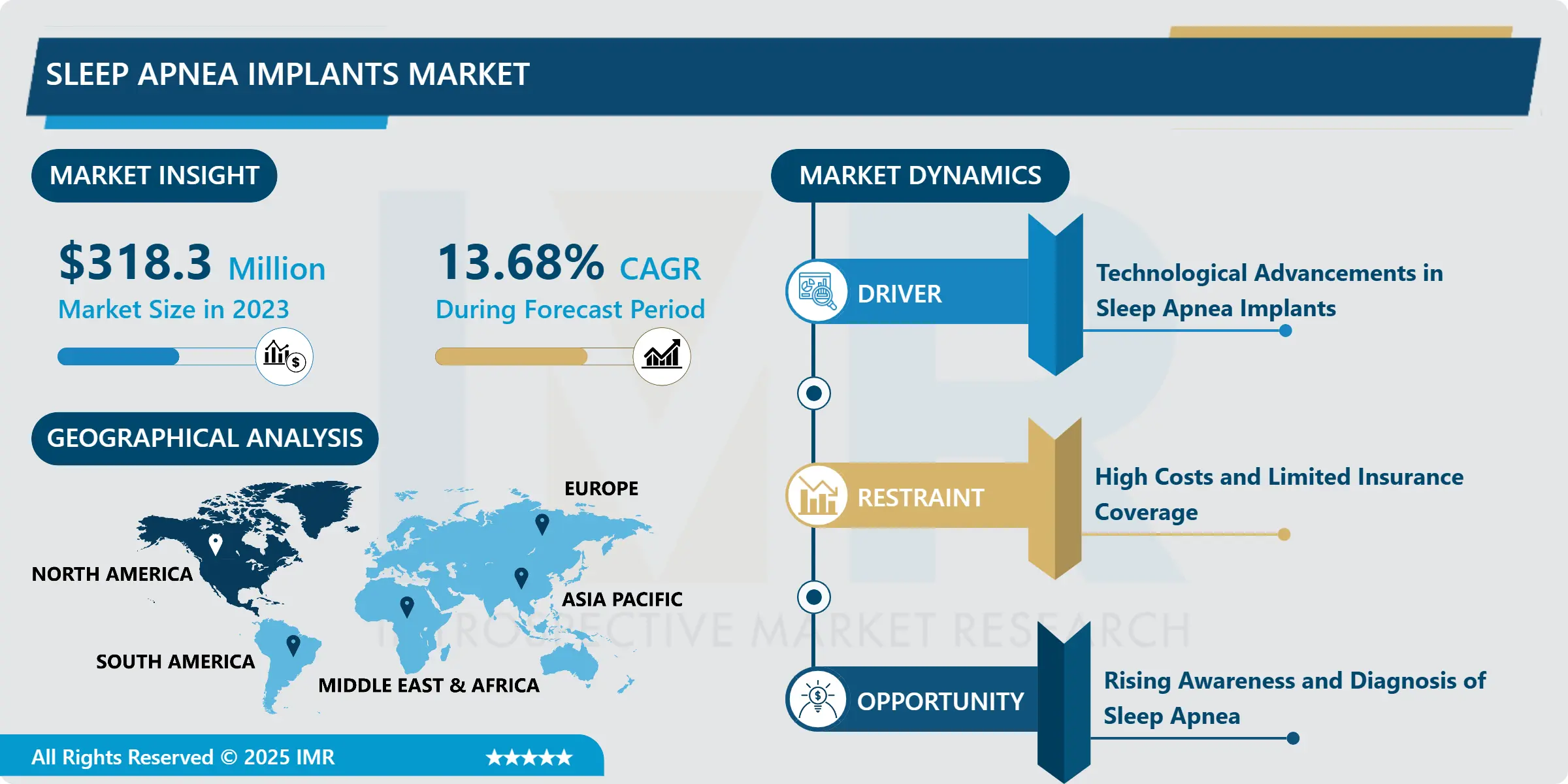
Sleep Apnea Implants Market Trend Analysis:
Increasing Demand for Minimally Invasive Sleep Apnea Treatments
- There is an ever-increasing number of patients that seek conservative intervention in the management of obstructive sleep apnea, there is also developing market on sleep apnea implants. For example, CPAP devices are an effective treatment, although they have low compliance due in part to their invasive design and uncomfortable fitting, thus there is more interest in implant-based methods. Of these the minimally invasive devices as are the hypoglossal neurostimulation implants are far more discreet, less invasive, and therefore provide the patient with more comfort and less limitation in their lifestyle.
- Due to this shift towards minimally invasive procedures more focus is placed onto the manufacturing of even smaller and efficient implants that blend with the lifestyle of the patient. Surgical procedures are becoming less invasive and therefore minimize recovery time and procedure risk, which make implants appealing to patients who may have otherwise wanted no dealing with surgery in the past. Such improvements are sustaining the market need for less invasive sleep apnea therapies, altering the market dynamics over time, as patients’ preferences change.
Rising Awareness and Diagnosis of Sleep Apnea
- Lack of awareness of sleep apnea and the consequences of untreated diseases open substantial opportunities in the Sleep Apnea Implants Market. Patient awareness programs and various health related awareness programs conducted by the American Sleep Apnea Association and many other such organizations, society’s general awareness about its symptoms, health consequences and treatments of sleep disorders especially sleep apnea is needed. Much of these has enhanced the diagnosis rates since more people are aware of the symptoms of OSA and seek treatment thus diversifying the implantable market pool.
- The healthcare professionals are also promoting early identification and treatment to minimize other health consequences of sleep apnea promising that the sleep apnea implant is a suitable option for those who cannot use CPAP. This market opportunity, in contrast with the current decline in fertility rates around the world, corresponds to an aging population and increased awareness of the disease in developed countries with the infrastructure and technology for diagnostics. With persistence in awareness creation and diagnosis instances, the Sleep Apnea Implants Market is expected to capture a rising patients’ population.
Sleep Apnea Implants Market Segment Analysis:
Sleep Apnea Implants Market is Segmented on the basis of Product, Indication, End user and Region.
By Product, Phrenic Nerve Stimulator segment is expected to dominate the market during the forecast period
- By product, the Phrenic Nerve Stimulator segment is expected to dominate the market during the forecast period. This growth is driven by the increasing demand for advanced respiratory support solutions, particularly for patients suffering from central sleep apnea, diaphragmatic paralysis, and other respiratory disorders. Phrenic nerve stimulators offer a minimally invasive, effective alternative to traditional ventilation therapies, leading to improved patient outcomes and quality of life. Rising awareness among healthcare providers about the benefits of nerve stimulation technology, along with ongoing advancements in device design and functionality, further fuel the segment's expansion. Additionally, supportive regulatory approvals and a growing focus on innovative neuromodulation therapies will continue to position the Phrenic Nerve Stimulator segment at the forefront of market growth.
By End User, Hospitals segment expected to held the largest share
- By end user, the hospitals segment is expected to hold the largest share of the Sleep Apnea Implants Market. Hospitals are the key purchasers of sleep apnea implants due to their ability to manage complex procedures requiring specialized equipment and skilled medical personnel. They are well-equipped to handle complicated cases, providing comprehensive care that spans from accurate diagnosis to implant surgery and post-operative follow-up. Hospitals also cater to patients with severe sleep apnea, offering advanced monitoring and tailored treatment plans. Their capacity to deliver a full spectrum of services, combined with increasing patient referrals and the rising prevalence of sleep disorders, positions hospitals as the leading end users driving consistent demand for sleep apnea implants during the forecast period.
Sleep Apnea Implants Market Regional Insights:
North America is Expected to Dominate the Market Over the Forecast period
- North America holds the largest share in Sleep Apnea Implants Market due to increasing awareness, advanced healthcare facilities and presence of positive reimbursement policies mainly in North America particularly United States and Canada. Primary care is highly developed in the region, and the focus on diagnosing and treating the condition also helps explain the higher rate of implant-use. North American patients and healthcare providers are equipped with sophisticated diagnostic technology to facilitate identification of OSA and give attention to implantable treatment solutions where other approaches have failed.
- Moreover, governmental actions and public health interventions in the U.S. concern people with sleep health which contributes to the receipt of diagnosis and treatment of sleep apnea. Therefore, North America continues to be in a strong market position by constant research funding for the disease and focusing on combating the negative impacts of sleep apnea.
Active Key Players in the Sleep Apnea Implants Market:
- Apnex Medical (USA)
- ImThera Medical (USA)
- Inspire Medical Systems (USA)
- LivaNova (UK)
- Medtronic (Ireland)
- Nyxoah (Belgium)
- Philips Respironics (Netherlands)
- Pillar Palatal (USA)
- Respicardia (USA)
- ReVENT Medical (USA)
- Siesta Medical (USA)
- SomnoMed (Australia)
- Other Active Players
Key Industry Developments in the Sleep Apnea Implants Market:
- In August 2024, Inspire Medical Systems announced that it received Food and Drug Administration (FDA) approval for its Inspire V obstructive sleep apnea (OSA) neurostimulator therapy. The latest version of the device, Inspire V, has the same mechanism of action as its predecessor. Inspire has tried to improve the product by incorporating the sensing function into the implant and providing a software-based platform for adding new features. This product launch may help the company to increase its product offerings and acquire an enhanced customer base.
- In January 2023, NHS doctors launched a new treatment approach for sleep disorders using an innovative implant inserted into the chest of patients with sleep apnea. This implant aims to prevent the interruption of breathing during sleep, a common issue in sleep apnea, and was first implemented by Guy's and St Thomas' Health Trust (GSTT) in London.
|
Sleep Apnea Implants Market |
|||
|
Base Year: |
2023 |
Forecast Period: |
2024-2032 |
|
Historical Data: |
2017 to 2023 |
Market Size in 2023: |
USD 318.3 Million |
|
Forecast Period 2024-32 CAGR: |
13.68% |
Market Size in 2032: |
USD 1,009.24 Million |
|
Segments Covered: |
By Product |
|
|
|
By Indication |
|
||
|
By End User |
|
||
|
By Region |
|
||
|
Key Market Drivers: |
|
||
|
Key Market Restraints: |
|
||
|
Key Opportunities: |
|
||
|
Companies Covered in the report: |
|
||
1.1 Scope and Coverage
Chapter 2:Executive Summary
Chapter 3: Market Landscape
3.1 Industry Dynamics and Opportunity Analysis
3.1.1 Growth Drivers
3.1.2 Limiting Factors
3.1.3 Growth Opportunities
3.1.4 Challenges and Risks
3.2 Market Trend Analysis
3.3 Strategic Pestle Overview
3.4 Porter's Five Forces Analysis
3.5 Industry Value Chain Mapping
3.6 Regulatory Framework
3.7 Princing Trend Analysis
3.8 Patent Analysis
3.9 Technology Evolution
3.10 Investment Pockets
3.11 Import-Export Analysis
Chapter 4: Skin Rash Treatment Market by Treatement Type
4.1 Skin Rash Treatment Market Snapshot and Growth Engine
4.2 Skin Rash Treatment Market Overview
4.3 Corticosteroids
4.3.1 Introduction and Market Overview
4.3.2 Historic and Forecasted Market Size in Value USD and Volume Units (2017-2032F)
4.3.3 Corticosteroids: Geographic Segmentation Analysis
4.4 Immunosuppressants
4.4.1 Introduction and Market Overview
4.4.2 Historic and Forecasted Market Size in Value USD and Volume Units (2017-2032F)
4.4.3 Immunosuppressants: Geographic Segmentation Analysis
4.5 Antihistamines
4.5.1 Introduction and Market Overview
4.5.2 Historic and Forecasted Market Size in Value USD and Volume Units (2017-2032F)
4.5.3 Antihistamines: Geographic Segmentation Analysis
4.6 Antifungals
4.6.1 Introduction and Market Overview
4.6.2 Historic and Forecasted Market Size in Value USD and Volume Units (2017-2032F)
4.6.3 Antifungals: Geographic Segmentation Analysis
4.7 and Others
4.7.1 Introduction and Market Overview
4.7.2 Historic and Forecasted Market Size in Value USD and Volume Units (2017-2032F)
4.7.3 and Others: Geographic Segmentation Analysis
Chapter 5: Skin Rash Treatment Market by Skin Rash Type
5.1 Skin Rash Treatment Market Snapshot and Growth Engine
5.2 Skin Rash Treatment Market Overview
5.3 Contact Dermatitis
5.3.1 Introduction and Market Overview
5.3.2 Historic and Forecasted Market Size in Value USD and Volume Units (2017-2032F)
5.3.3 Contact Dermatitis: Geographic Segmentation Analysis
5.4 Atopic Dermatitis (Eczema
5.4.1 Introduction and Market Overview
5.4.2 Historic and Forecasted Market Size in Value USD and Volume Units (2017-2032F)
5.4.3 Atopic Dermatitis (Eczema: Geographic Segmentation Analysis
5.5 Psoriasis
5.5.1 Introduction and Market Overview
5.5.2 Historic and Forecasted Market Size in Value USD and Volume Units (2017-2032F)
5.5.3 Psoriasis: Geographic Segmentation Analysis
5.6 Seborrheic Dermatitis
5.6.1 Introduction and Market Overview
5.6.2 Historic and Forecasted Market Size in Value USD and Volume Units (2017-2032F)
5.6.3 Seborrheic Dermatitis: Geographic Segmentation Analysis
5.7 and Others)
5.7.1 Introduction and Market Overview
5.7.2 Historic and Forecasted Market Size in Value USD and Volume Units (2017-2032F)
5.7.3 and Others): Geographic Segmentation Analysis
Chapter 6: Skin Rash Treatment Market by Distribution Channel
6.1 Skin Rash Treatment Market Snapshot and Growth Engine
6.2 Skin Rash Treatment Market Overview
6.3 Pharmacies
6.3.1 Introduction and Market Overview
6.3.2 Historic and Forecasted Market Size in Value USD and Volume Units (2017-2032F)
6.3.3 Pharmacies: Geographic Segmentation Analysis
6.4 Retail Stores
6.4.1 Introduction and Market Overview
6.4.2 Historic and Forecasted Market Size in Value USD and Volume Units (2017-2032F)
6.4.3 Retail Stores: Geographic Segmentation Analysis
6.5 and Other )
6.5.1 Introduction and Market Overview
6.5.2 Historic and Forecasted Market Size in Value USD and Volume Units (2017-2032F)
6.5.3 and Other ): Geographic Segmentation Analysis
Chapter 7: Company Profiles and Competitive Analysis
7.1 Competitive Landscape
7.1.1 Competitive Benchmarking
7.1.2 Skin Rash Treatment Market Share by Manufacturer (2023)
7.1.3 Concentration Ratio(CR5)
7.1.4 Heat Map Analysis
7.1.5 Mergers and Acquisitions
7.2 ABBVIE (USA)
7.2.1 Company Overview
7.2.2 Key Executives
7.2.3 Company Snapshot
7.2.4 Operating Business Segments
7.2.5 Product Portfolio
7.2.6 Business Performance
7.2.7 Key Strategic Moves and Recent Developments
7.3 ASTRAZENECA (UK)
7.4 AUROBINDO PHARMA (INDIA)
7.5 BAYER AG (GERMANY)
7.6 BRISTOL-MYERS SQUIBB (USA)
7.7 DERMIRA INC. (USA)
7.8 DR. REDDY'S LABORATORIES (INDIA)
7.9 ELI LILLY AND COMPANY (USA)
7.10 FRESENIUS KABI (GERMANY)
7.11 OTHER ACTIVE PLAYERS
Chapter 8: Global Skin Rash Treatment Market By Region
8.1 Overview
8.2. North America Skin Rash Treatment Market
8.2.1 Historic and Forecasted Market Size by Segments
8.2.2 Historic and Forecasted Market Size By Treatement Type
8.2.2.1 Corticosteroids
8.2.2.2 Immunosuppressants
8.2.2.3 Antihistamines
8.2.2.4 Antifungals
8.2.2.5 and Others
8.2.3 Historic and Forecasted Market Size By Skin Rash Type
8.2.3.1 Contact Dermatitis
8.2.3.2 Atopic Dermatitis (Eczema
8.2.3.3 Psoriasis
8.2.3.4 Seborrheic Dermatitis
8.2.3.5 and Others)
8.2.4 Historic and Forecasted Market Size By Distribution Channel
8.2.4.1 Pharmacies
8.2.4.2 Retail Stores
8.2.4.3 and Other )
8.2.5 Historic and Forecast Market Size by Country
8.2.5.1 US
8.2.5.2 Canada
8.2.5.3 Mexico
8.3. Eastern Europe Skin Rash Treatment Market
8.3.1 Historic and Forecasted Market Size by Segments
8.3.2 Historic and Forecasted Market Size By Treatement Type
8.3.2.1 Corticosteroids
8.3.2.2 Immunosuppressants
8.3.2.3 Antihistamines
8.3.2.4 Antifungals
8.3.2.5 and Others
8.3.3 Historic and Forecasted Market Size By Skin Rash Type
8.3.3.1 Contact Dermatitis
8.3.3.2 Atopic Dermatitis (Eczema
8.3.3.3 Psoriasis
8.3.3.4 Seborrheic Dermatitis
8.3.3.5 and Others)
8.3.4 Historic and Forecasted Market Size By Distribution Channel
8.3.4.1 Pharmacies
8.3.4.2 Retail Stores
8.3.4.3 and Other )
8.3.5 Historic and Forecast Market Size by Country
8.3.5.1 Bulgaria
8.3.5.2 The Czech Republic
8.3.5.3 Hungary
8.3.5.4 Poland
8.3.5.5 Romania
8.3.5.6 Rest of Eastern Europe
8.4. Western Europe Skin Rash Treatment Market
8.4.1 Historic and Forecasted Market Size by Segments
8.4.2 Historic and Forecasted Market Size By Treatement Type
8.4.2.1 Corticosteroids
8.4.2.2 Immunosuppressants
8.4.2.3 Antihistamines
8.4.2.4 Antifungals
8.4.2.5 and Others
8.4.3 Historic and Forecasted Market Size By Skin Rash Type
8.4.3.1 Contact Dermatitis
8.4.3.2 Atopic Dermatitis (Eczema
8.4.3.3 Psoriasis
8.4.3.4 Seborrheic Dermatitis
8.4.3.5 and Others)
8.4.4 Historic and Forecasted Market Size By Distribution Channel
8.4.4.1 Pharmacies
8.4.4.2 Retail Stores
8.4.4.3 and Other )
8.4.5 Historic and Forecast Market Size by Country
8.4.5.1 Germany
8.4.5.2 UK
8.4.5.3 France
8.4.5.4 Netherlands
8.4.5.5 Italy
8.4.5.6 Russia
8.4.5.7 Spain
8.4.5.8 Rest of Western Europe
8.5. Asia Pacific Skin Rash Treatment Market
8.5.1 Historic and Forecasted Market Size by Segments
8.5.2 Historic and Forecasted Market Size By Treatement Type
8.5.2.1 Corticosteroids
8.5.2.2 Immunosuppressants
8.5.2.3 Antihistamines
8.5.2.4 Antifungals
8.5.2.5 and Others
8.5.3 Historic and Forecasted Market Size By Skin Rash Type
8.5.3.1 Contact Dermatitis
8.5.3.2 Atopic Dermatitis (Eczema
8.5.3.3 Psoriasis
8.5.3.4 Seborrheic Dermatitis
8.5.3.5 and Others)
8.5.4 Historic and Forecasted Market Size By Distribution Channel
8.5.4.1 Pharmacies
8.5.4.2 Retail Stores
8.5.4.3 and Other )
8.5.5 Historic and Forecast Market Size by Country
8.5.5.1 China
8.5.5.2 India
8.5.5.3 Japan
8.5.5.4 South Korea
8.5.5.5 Malaysia
8.5.5.6 Thailand
8.5.5.7 Vietnam
8.5.5.8 The Philippines
8.5.5.9 Australia
8.5.5.10 New Zealand
8.5.5.11 Rest of APAC
8.6. Middle East & Africa Skin Rash Treatment Market
8.6.1 Historic and Forecasted Market Size by Segments
8.6.2 Historic and Forecasted Market Size By Treatement Type
8.6.2.1 Corticosteroids
8.6.2.2 Immunosuppressants
8.6.2.3 Antihistamines
8.6.2.4 Antifungals
8.6.2.5 and Others
8.6.3 Historic and Forecasted Market Size By Skin Rash Type
8.6.3.1 Contact Dermatitis
8.6.3.2 Atopic Dermatitis (Eczema
8.6.3.3 Psoriasis
8.6.3.4 Seborrheic Dermatitis
8.6.3.5 and Others)
8.6.4 Historic and Forecasted Market Size By Distribution Channel
8.6.4.1 Pharmacies
8.6.4.2 Retail Stores
8.6.4.3 and Other )
8.6.5 Historic and Forecast Market Size by Country
8.6.5.1 Turkey
8.6.5.2 Bahrain
8.6.5.3 Kuwait
8.6.5.4 Saudi Arabia
8.6.5.5 Qatar
8.6.5.6 UAE
8.6.5.7 Israel
8.6.5.8 South Africa
8.7. South America Skin Rash Treatment Market
8.7.1 Historic and Forecasted Market Size by Segments
8.7.2 Historic and Forecasted Market Size By Treatement Type
8.7.2.1 Corticosteroids
8.7.2.2 Immunosuppressants
8.7.2.3 Antihistamines
8.7.2.4 Antifungals
8.7.2.5 and Others
8.7.3 Historic and Forecasted Market Size By Skin Rash Type
8.7.3.1 Contact Dermatitis
8.7.3.2 Atopic Dermatitis (Eczema
8.7.3.3 Psoriasis
8.7.3.4 Seborrheic Dermatitis
8.7.3.5 and Others)
8.7.4 Historic and Forecasted Market Size By Distribution Channel
8.7.4.1 Pharmacies
8.7.4.2 Retail Stores
8.7.4.3 and Other )
8.7.5 Historic and Forecast Market Size by Country
8.7.5.1 Brazil
8.7.5.2 Argentina
8.7.5.3 Rest of SA
Chapter 9 Analyst Viewpoint and Conclusion
9.1 Recommendations and Concluding Analysis
9.2 Potential Market Strategies
Chapter 10 Research Methodology
10.1 Research Process
10.2 Primary Research
10.3 Secondary Research
|
Sleep Apnea Implants Market |
|||
|
Base Year: |
2023 |
Forecast Period: |
2024-2032 |
|
Historical Data: |
2017 to 2023 |
Market Size in 2023: |
USD 318.3 Million |
|
Forecast Period 2024-32 CAGR: |
13.68% |
Market Size in 2032: |
USD 1,009.24 Million |
|
Segments Covered: |
By Product |
|
|
|
By Indication |
|
||
|
By End User |
|
||
|
By Region |
|
||
|
Key Market Drivers: |
|
||
|
Key Market Restraints: |
|
||
|
Key Opportunities: |
|
||
|
Companies Covered in the report: |
|
||


