Scar Treatment Market Synopsis:
Scar Treatment Market Size Was Valued at USD 17 Billion in 2023, and is Projected to Reach USD 53.2 Billion by 2032, Growing at a CAGR of 13.5% From 2024-2032.
Scar treatment market deals with products and services targeting to lessen or eradicate the occurrence of scar from surgeries, injuries, acne and burns. This market encompasses topical creams, gels, hydrogel sheets, silicone, injections and laser for treatment of various types of scar. Because of the improved dermatology technology, advancing aesthetics, and the boosting self-consciousness level, the market for the scar removal product is growing. It covers the counter and prescription drugs together with the procedures that the dermatologists or aesthetic specialists perform.
The scar treatment market has been emerging in the recent past due to high awareness of scar care and also many individuals using products that help to minimize the scars. Both young and old individuals are becoming self-aware about how they look and seek ways by which they can reduce chances of being scarred by an accident, after surgery, and by acne among other skin conditions. Readily available techniques like laser and micropigmentation have enabled the dermatological and plastic surgeon to enhance the quality of the lasers and the treatment to reduce scars considerably. Such procedural treatments are.GetHashCode() popular as they offer faster and more pronounced outcome than most traditional topical treatments.
The market is also growing because several scar types, hypertrophic, keloid, and atrophic, have new innovative and invasive treatment options. Most of the generic drug and skincare manufacturers are putting more focus and cash into the research and development of unique scar type and skin sensitivity solutions. Also due to development in internet business activity and marketing of consumer goods such as scar treatment products, are now easily accessible to consumers across the globe. This coupled with, the rising world population’s purchasing power has also added to market growth.
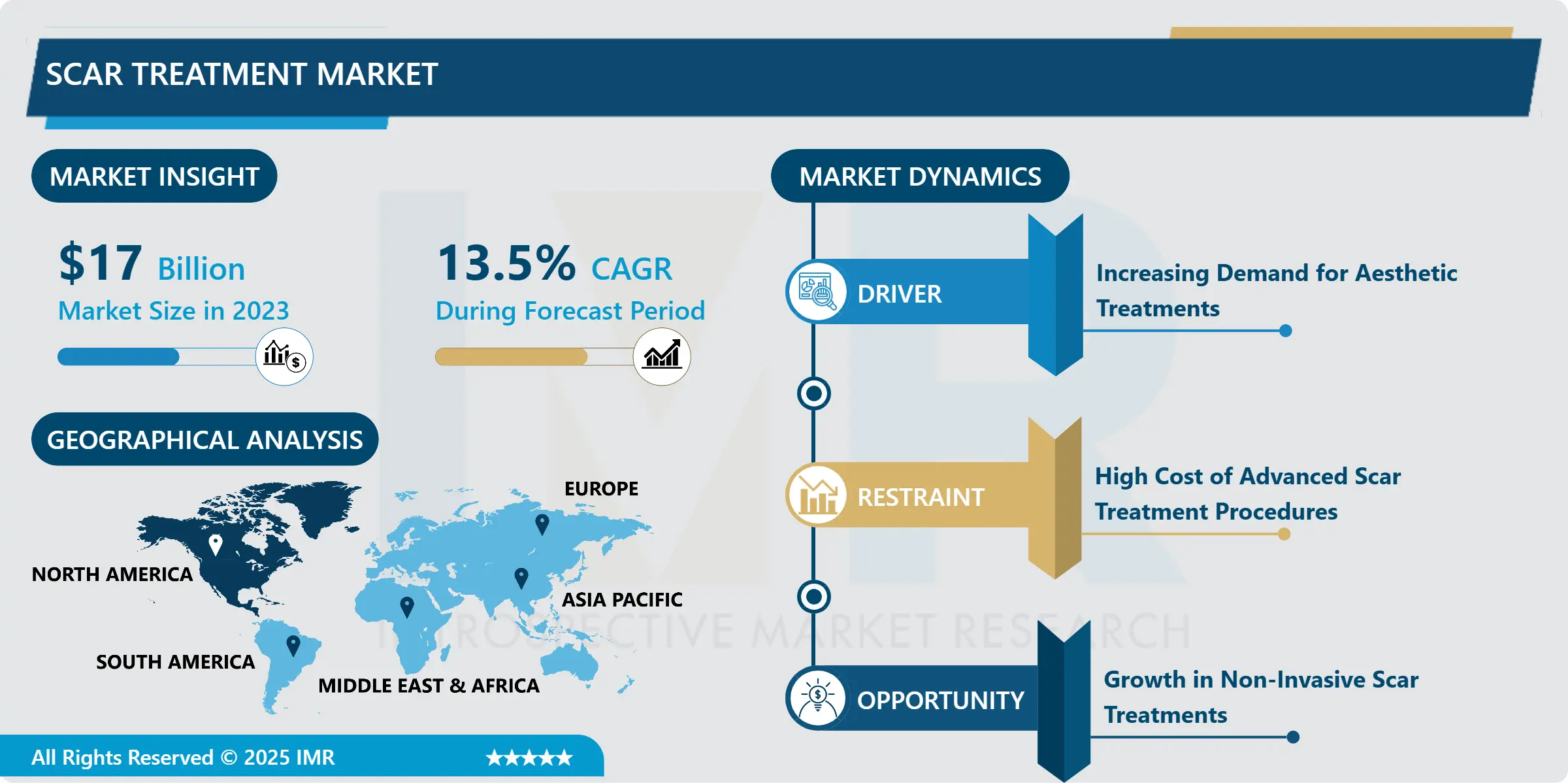
Scar Treatment Market Trend Analysis:
Demand for Non-Invasive Treatments
- One of the emerging trends in the current scar treatment market is the increasing preference for procedure that are less invasive and can be done from the comfort of one’s home or require very little time off work. Read more: Consumers are shifting to non-invasive procedures including silicone based apparels, gels that can be applied externally and low intensity lasers which can be self administered at home. The lure of these non-surgical alternatives is the ease, cost, and effectiveness in producing significant alteration without the hazards of surgery. However, more recently portable laser devices and at-home microneedling kits have become available for use and provided the patient with more control in the process of scar treatment. These figures are expected to rise, thanks to innovations in medical-grade skincare with improved performance for home use devices.
Expansion of Cosmetic Dermatology Clinics
- Thus, the unique focus of new specialized clinics to dermatology and Plastic /Aesthetic medicine is a unique opportunity for the market of scar treatment. With the ever-growing trend toward non-surgical scar reduction procedures, these clinics are leveraging new and special scar treatment services such as lasers, platelet-rich plasma injections, and fillers, which are complex. The growth of cosmetic dermatology practices especially in growing markets, means that more people can be reached with appealing and efficient scar treatments by well qualified professionals. The ability to incorporate sophisticated scar care into these environments in addition to consultation services positioned dermatology clinics as major actors in this market development possibility.
Scar Treatment Market Segment Analysis:
Scar Treatment Market is Segmented on the basis of Product Type, Scar Type, End Use, and Region.
By Product Type, Topical Products segment is expected to dominate the market during the forecast period
- Scar treatment is expected to remain a topical product market driven by creams, gels, and silicone sheets due to high availability, reasonable prices, and wide customer preference. They can be a primary self-care treatment to those who wish to avoid the dermatologist and still get rid of scars. Topical agents may be purchased without a prescription or by prescription and are appropriate for several types of marks and various scar classifications. However, companies are paying even more attention to enhancing the actual efficiency of these products through the addition of better proteins, retinoids, and antioxidants that help in skin regeneration and scar formation.
- An increasing trend toward the use of topical products is also a key factor for growth in the scar management sector because consumers seek non-surgical treatments for their scars. Building on this thinking, the shampoo and lip balm can be viewed as more popular among customers ready to experiment before choosing more aggressive treatment options like laser treatments or injections. Moreover, the topical format makes these products easily improvable as a part of daily care and is the reason for the consumers’ success. Such popularity is expected to increase in the future, particularly as there is now a chance to create new products for different skin types and intolerances.
By Scar Type, Atrophic Scars segment expected to held the largest share
- Atrophic type of scars are those that result in a loss of tissue beneath the skin; they are perhaps the most widespread types of scars that people develop, specially those that have had acne or injuries. This segment is expected to remain dominant in the market mainly because acne scarring is one of the most widespread issues experienced by the population of the Earth and there are established treatments for atrophic scar types only. This kind of scar is a bit difficult to manage and needs delicate treatments including laser facelift, Microneedle, and dermal fillers to help in the management of skin texture. The need for products focusing on atrophic scars is high for clients who are now looking for remedies which would enhance skin surface and texture.
- The increase in circulated treatments has also boosted the atrophic scars segment because consumers will pay for products whose use will give visible results. This segment has received enormous support from major players in the pharmaceutical and skincare industries due to its focus on producing products to target structural defects tied to atrophic scars, thereby significantly propelling this segment in the scar treatment market.
Scar Treatment Market Regional Insights:
North America is Expected to Dominate the Market Over the Forecast period
- According to the study, North America dominated the scar treatment market in 2023 mainly because of awareness of scar treatment, Availability of enhanced skin treatment services, and the higher spending on aesthetic healthcare. This is due to high establishment of clinics in the region, high use of laser and microneedling procedures, and high demand for treatment of scars by the North America consumers. Also, the availability of significant market participants and the steady technological developments in this area contribute to the region’s market growth.
Active Key Players in the Scar Treatment Market:
- AbbVie Inc. (USA)
- Alliance Pharma (UK)
- Bausch Health Companies Inc. (Canada)
- Beiersdorf AG (Germany)
- Birken AG (Germany)
- Candela Corporation (USA)
- CCA Industries (USA)
- Cutera, Inc. (USA)
- Enaltus LLC (USA)
- Hologic Inc. (USA)
- Merz Pharma GmbH & Co. KGaA (Germany)
- Mölnlycke Health Care (Sweden)
- Perrigo Company (Ireland)
- Scarguard Labs LLC (USA)
- Smith & Nephew plc (UK)
- Other Active Players
|
Scar Treatment Market |
|||
|
Base Year: |
2023 |
Forecast Period: |
2024-2032 |
|
Historical Data: |
2017 to 2023 |
Market Size in 2023: |
USD 17 Billion |
|
Forecast Period 2024-32 CAGR: |
13.5% |
Market Size in 2032: |
USD 53.2 Billion |
|
Segments Covered: |
By Product Type |
|
|
|
By Scar Type |
|
||
|
By End User |
|
||
|
By Region |
|
||
|
Key Market Drivers: |
|
||
|
Key Market Restraints: |
|
||
|
Key Opportunities: |
|
||
|
Companies Covered in the report: |
|
||
Chapter 1: Introduction
1.1 Scope and Coverage
Chapter 2:Executive Summary
Chapter 3: Market Landscape
3.1 Market Dynamics
3.1.1 Drivers
3.1.2 Restraints
3.1.3 Opportunities
3.1.4 Challenges
3.2 Market Trend Analysis
3.3 PESTLE Analysis
3.4 Porter's Five Forces Analysis
3.5 Industry Value Chain Analysis
3.6 Ecosystem
3.7 Regulatory Landscape
3.8 Price Trend Analysis
3.9 Patent Analysis
3.10 Technology Evolution
3.11 Investment Pockets
3.12 Import-Export Analysis
Chapter 4: Scar Treatment Market by Product Type
4.1 Scar Treatment Market Snapshot and Growth Engine
4.2 Scar Treatment Market Overview
4.3 Topical Products
4.3.1 Introduction and Market Overview
4.3.2 Historic and Forecasted Market Size in Value USD and Volume Units (2017-2032F)
4.3.3 Key Market Trends, Growth Factors and Opportunities
4.3.4 Topical Products: Geographic Segmentation Analysis
4.4 Laser Products
4.4.1 Introduction and Market Overview
4.4.2 Historic and Forecasted Market Size in Value USD and Volume Units (2017-2032F)
4.4.3 Key Market Trends, Growth Factors and Opportunities
4.4.4 Laser Products: Geographic Segmentation Analysis
4.5 Injectables)
4.5.1 Introduction and Market Overview
4.5.2 Historic and Forecasted Market Size in Value USD and Volume Units (2017-2032F)
4.5.3 Key Market Trends, Growth Factors and Opportunities
4.5.4 Injectables): Geographic Segmentation Analysis
4.6 Scar Type
4.6.1 Introduction and Market Overview
4.6.2 Historic and Forecasted Market Size in Value USD and Volume Units (2017-2032F)
4.6.3 Key Market Trends, Growth Factors and Opportunities
4.6.4 Scar Type: Geographic Segmentation Analysis
Chapter 5: Company Profiles and Competitive Analysis
5.1 Competitive Landscape
5.1.1 Competitive Benchmarking
5.1.2 Scar Treatment Market Share by Manufacturer (2023)
5.1.3 Industry BCG Matrix
5.1.4 Heat Map Analysis
5.1.5 Mergers and Acquisitions
5.2 ABBVIE INC.
5.2.1 Company Overview
5.2.2 Key Executives
5.2.3 Company Snapshot
5.2.4 Role of the Company in the Market
5.2.5 Sustainability and Social Responsibility
5.2.6 Operating Business Segments
5.2.7 Product Portfolio
5.2.8 Business Performance
5.2.9 Key Strategic Moves and Recent Developments
5.2.10 SWOT Analysis
5.3 ALLIANCE PHARMA
5.4 BEIERSDORF AG
5.5 MERZ PHARMA GMBH & CO.
5.6 MÖLNLYCKE HEALTH CARE
5.7 OTHER ACTIVE PLAYERS
Chapter 6: Global Scar Treatment Market By Region
6.1 Overview
6.2. North America Scar Treatment Market
6.2.1 Key Market Trends, Growth Factors and Opportunities
6.2.2 Top Key Companies
6.2.3 Historic and Forecasted Market Size by Segments
6.2.4 Historic and Forecasted Market Size By Product Type
6.2.4.1 Topical Products
6.2.4.2 Laser Products
6.2.4.3 Injectables)
6.2.4.4 Scar Type
6.2.5 Historic and Forecast Market Size by Country
6.2.5.1 US
6.2.5.2 Canada
6.2.5.3 Mexico
6.3. Eastern Europe Scar Treatment Market
6.3.1 Key Market Trends, Growth Factors and Opportunities
6.3.2 Top Key Companies
6.3.3 Historic and Forecasted Market Size by Segments
6.3.4 Historic and Forecasted Market Size By Product Type
6.3.4.1 Topical Products
6.3.4.2 Laser Products
6.3.4.3 Injectables)
6.3.4.4 Scar Type
6.3.5 Historic and Forecast Market Size by Country
6.3.5.1 Russia
6.3.5.2 Bulgaria
6.3.5.3 The Czech Republic
6.3.5.4 Hungary
6.3.5.5 Poland
6.3.5.6 Romania
6.3.5.7 Rest of Eastern Europe
6.4. Western Europe Scar Treatment Market
6.4.1 Key Market Trends, Growth Factors and Opportunities
6.4.2 Top Key Companies
6.4.3 Historic and Forecasted Market Size by Segments
6.4.4 Historic and Forecasted Market Size By Product Type
6.4.4.1 Topical Products
6.4.4.2 Laser Products
6.4.4.3 Injectables)
6.4.4.4 Scar Type
6.4.5 Historic and Forecast Market Size by Country
6.4.5.1 Germany
6.4.5.2 UK
6.4.5.3 France
6.4.5.4 The Netherlands
6.4.5.5 Italy
6.4.5.6 Spain
6.4.5.7 Rest of Western Europe
6.5. Asia Pacific Scar Treatment Market
6.5.1 Key Market Trends, Growth Factors and Opportunities
6.5.2 Top Key Companies
6.5.3 Historic and Forecasted Market Size by Segments
6.5.4 Historic and Forecasted Market Size By Product Type
6.5.4.1 Topical Products
6.5.4.2 Laser Products
6.5.4.3 Injectables)
6.5.4.4 Scar Type
6.5.5 Historic and Forecast Market Size by Country
6.5.5.1 China
6.5.5.2 India
6.5.5.3 Japan
6.5.5.4 South Korea
6.5.5.5 Malaysia
6.5.5.6 Thailand
6.5.5.7 Vietnam
6.5.5.8 The Philippines
6.5.5.9 Australia
6.5.5.10 New Zealand
6.5.5.11 Rest of APAC
6.6. Middle East & Africa Scar Treatment Market
6.6.1 Key Market Trends, Growth Factors and Opportunities
6.6.2 Top Key Companies
6.6.3 Historic and Forecasted Market Size by Segments
6.6.4 Historic and Forecasted Market Size By Product Type
6.6.4.1 Topical Products
6.6.4.2 Laser Products
6.6.4.3 Injectables)
6.6.4.4 Scar Type
6.6.5 Historic and Forecast Market Size by Country
6.6.5.1 Turkiye
6.6.5.2 Bahrain
6.6.5.3 Kuwait
6.6.5.4 Saudi Arabia
6.6.5.5 Qatar
6.6.5.6 UAE
6.6.5.7 Israel
6.6.5.8 South Africa
6.7. South America Scar Treatment Market
6.7.1 Key Market Trends, Growth Factors and Opportunities
6.7.2 Top Key Companies
6.7.3 Historic and Forecasted Market Size by Segments
6.7.4 Historic and Forecasted Market Size By Product Type
6.7.4.1 Topical Products
6.7.4.2 Laser Products
6.7.4.3 Injectables)
6.7.4.4 Scar Type
6.7.5 Historic and Forecast Market Size by Country
6.7.5.1 Brazil
6.7.5.2 Argentina
6.7.5.3 Rest of SA
Chapter 7 Analyst Viewpoint and Conclusion
7.1 Recommendations and Concluding Analysis
7.2 Potential Market Strategies
Chapter 8 Research Methodology
8.1 Research Process
8.2 Primary Research
8.3 Secondary Research
|
Scar Treatment Market |
|||
|
Base Year: |
2023 |
Forecast Period: |
2024-2032 |
|
Historical Data: |
2017 to 2023 |
Market Size in 2023: |
USD 17 Billion |
|
Forecast Period 2024-32 CAGR: |
13.5% |
Market Size in 2032: |
USD 53.2 Billion |
|
Segments Covered: |
By Product Type |
|
|
|
By Scar Type |
|
||
|
By End User |
|
||
|
By Region |
|
||
|
Key Market Drivers: |
|
||
|
Key Market Restraints: |
|
||
|
Key Opportunities: |
|
||
|
Companies Covered in the report: |
|
||