




Rescue Inhaler Market Synopsis:
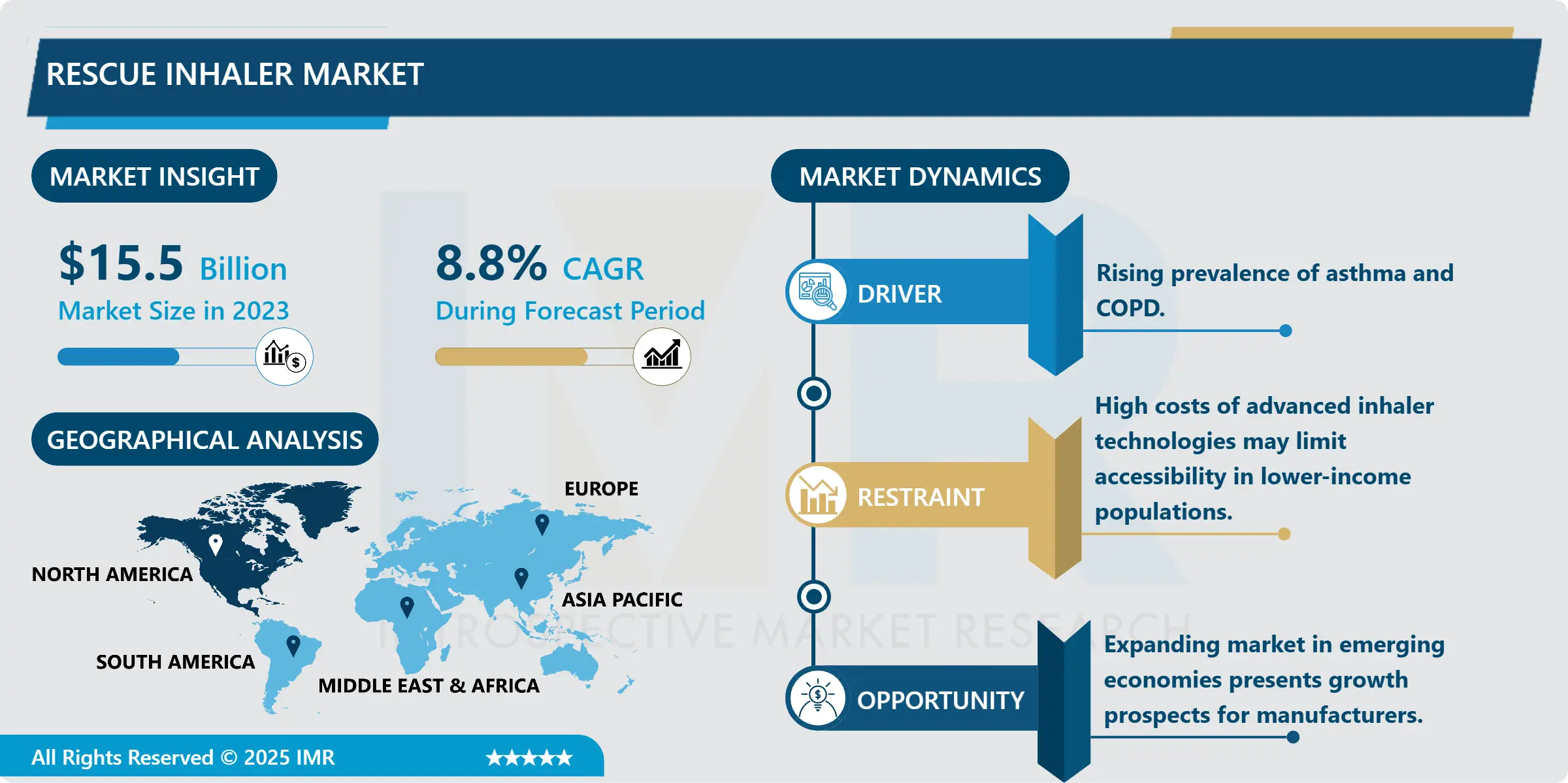
Rescue Inhaler Market Size Was Valued at USD 15.5 Billion in 2023, and is Projected to Reach USD 33.05 Billion by 2032, Growing at a CAGR of 8.8% From 2024-2032.
This market involves products used to deliver instant asthma and chronic obstructive pulmonary disease (COPD) relievers. These inhalers administer bronchodilating agents that make the interiors of the air passages dilate and relieve sudden onset of A/R. In general, rescue inhalers are taken for the relief of asthma symptoms during asthma episodes of wheezing or shortness of breath and can be an important part of asthma management plans. MDIs, DPIs, and nebulisers are part of the market and available to suit different patients’ needs and preferences based on gender, age and status among others.
The market for rescue inhalers has expanded over the years mainly because of the rising incidence of asthma and COPD illness around the globe. Such causes as urbanization, air pollution and other alterations of lifestyle that have made people more prone to respiratory diseases. Additionally, the growing prevalence of the chronic respiratory diseases primarily due to an aging population that is more vulnerable to these diseases is also a factor that is quickly promoting the need for good inhalation treatments. Newer formulations, including combination inhalers are also helping increase the range of benefits to patients, thereby contributing to market growth.
Apart from the rising patient pool, the rescue inhaler market is defined by progressions in inhaler innovation. Smart inhalers with digital connectivity options to help patients remember to take the medicine are becoming popular with healthcare practitioners and consumers. Besides positively contributing to the outcome of the treatments, this technology also increases the level of attentiveness regarding respiratory disorders. Moreover, present patents and regulatory approvals for the new rescue inhaler formulations and delivery systems extend a scope of market opportunity and improve the competition and choice options for consumers.
Rescue Inhaler Market Trend Analysis:
Increased Adoption of Smart Inhalers
- A major shift to digital health solutions is being seen in the rescue inhaler market the world over. Connected and sensorised inhalers helps physicians to monitor patient’s medication use and their inhaling methods in real-time, for asthma for instance. It also serves as a tool that allows the patients the freedom of the management of their health care regime as well as improving communication between the physicians and the patient. With this data, the healthcare professionals will be better placed to track the adherence and come up with further specific measures that have a positive impact on health.
- Telemedicine, remote patient monitoring, overall telehealth technologies, boosted by the COVID-19 crisis, have also advanced the acceptance of smart inhalers. For these solutions, patients are now more willing to embrace, given that the overall trend towards integration of care services is now widespread. With the increasing recognition of improper inhaler usage, and nonadherence to the regular agreed medication regimens, there is likely to be compounded demand for smart inhalers thus fuelling future innovation in the rescue inhaler market.
Expanding Market in Emerging Economies
- The market of rescue inhalers is a promising market due to high growth rates of the number of patients with asthma and COPD in the emerging economies resulted from the process of urbanization and changes of the population’s way of life. There is a rising prevalence of respiratory disease coupled with rising levels of air pollution in several Asian-Pacific, Latin American, and African nations requiring effective management intervention. Since infrastructure of the health care facilities is becoming better and availability of medicines is increasing, the need of the rescure inhalers is set to rise in these areas.
Rescue Inhaler Market Segment Analysis:
Rescue Inhaler Market is Segmented on the basis of Product type, Indication, Patient Type, End User, and Region.
By Type, Metered Dose Inhalers segment is expected to dominate the market during the forecast period
- Based on type, the Metered Dose Inhalers (MDIs) segment is anticipated to represent the largest growth in the rescue inhaler market by owing to the fact that they are used most commonly and effectively in treating acute asthmatic and COPD episodes. As MDIs are simple in their construction and small in size plus, they offer convenient and quick and relief to the patients, they are often used by the patient when on the move. Furthermore, there has been advancement in the production of germany oracht of mdis and the new formulations include things like dose counters and better actuator systems that help in their use. Because the healthcare providers are prescribing the MDIs due to high reliability and fast acting as the segment coupled with growing concern among the patients regarding asthmatic disorders, the segment is expected to continue to dominate the global market.
By Indication, Asthma segment expected to held the largest share
- It was found that the asthma segment would continue to dominate the market for rescue inhalers because asthma is a common ailment worldwide. Asthma is a common illness that enforces an immense need for controlling the disease through readily available treatments which can increase severity of the living that has quick relief during an asthmatic attack. With increased patient education about the causes of asthma and the ideal time to seek medical intervention, treatment is moving toward involving the use of rescue inhalers. Further, improvement in the inhaler technology like combination inhalers for immediate and long acting are also adding to the demand of this segment. As primary care practitioners as well as asthma specialists encourage better maintenance of asthma, the necessity for rescue inhaler, which has a special formulation for asthma, is expected to increase.
Rescue Inhaler Market Regional Insights:
North America is Expected to Dominate the Market Over the Forecast period
- The rescue inhaler market of North America retains its leading position by maintaining a high market share of approximately 40%. This dominance can therefore be attributed to a high incidence of Asthma and COPD diseases, the developed healthcare facilities, and emphasis on R & D. The United States remains as the most progressive in blowing novel inhaler technologies, smart inhalers in particular, which appears to elicit favorable responses from patients and practitioners.
- Another extremely significant factor therefore is this regions market regulation. The Food and Drug Administration acts to maintain the medicines’ safety and effectiveness for inhalation products in the United States, promoting fair competition and constant innovation on inhalation devices.
Active Key Players in the Rescue Inhaler Market:
- AstraZeneca (UK)
- Boehringer Ingelheim (Germany)
- Chiesi Farmaceutici S.p.A. (Italy)
- Eli Lilly and Company (USA)
- GlaxoSmithKline (GSK) (UK)
- Hikma Pharmaceuticals (Jordan)
- Merck & Co., Inc. (USA)
- Mylan N.V. (USA)
- Novartis International AG (Switzerland)
- Pfizer Inc. (USA)
- Roche Holding AG (Switzerland)
- Sandoz (a division of Novartis) (Switzerland)
- Sun Pharmaceutical Industries Ltd. (India)
- Teva Pharmaceutical Industries Ltd. (Israel)
- Viatris Inc. (USA), and Other Active Players
|
Rescue Inhaler Market |
|||
|
Base Year: |
2023 |
Forecast Period: |
2024-2032 |
|
Historical Data: |
2017 to 2023 |
Market Size in 2023: |
USD 15.5 Billion |
|
Forecast Period 2024-32 CAGR: |
8.8 % |
Market Size in 2032: |
USD 33.05 Billion |
|
Segments Covered: |
By Product Type |
|
|
|
By Indication |
|
||
|
By Patient Type |
|
||
|
End Users |
|
||
|
By Region |
|
||
|
Key Market Drivers: |
|
||
|
Key Market Restraints: |
|
||
|
Key Opportunities: |
|
||
|
Companies Covered in the report: |
|
||
Chapter 1: Introduction
1.1 Scope and Coverage
Chapter 2:Executive Summary
Chapter 3: Market Landscape
3.1 Market Dynamics
3.1.1 Drivers
3.1.2 Restraints
3.1.3 Opportunities
3.1.4 Challenges
3.2 Market Trend Analysis
3.3 PESTLE Analysis
3.4 Porter's Five Forces Analysis
3.5 Industry Value Chain Analysis
3.6 Ecosystem
3.7 Regulatory Landscape
3.8 Price Trend Analysis
3.9 Patent Analysis
3.10 Technology Evolution
3.11 Investment Pockets
3.12 Import-Export Analysis
Chapter 4: Rescue Inhaler Market by Product Type
4.1 Rescue Inhaler Market Snapshot and Growth Engine
4.2 Rescue Inhaler Market Overview
4.3 Metered Dose Inhalers
4.3.1 Introduction and Market Overview
4.3.2 Historic and Forecasted Market Size in Value USD and Volume Units (2017-2032F)
4.3.3 Key Market Trends, Growth Factors and Opportunities
4.3.4 Metered Dose Inhalers: Geographic Segmentation Analysis
4.4 Dry Powder Inhalers
4.4.1 Introduction and Market Overview
4.4.2 Historic and Forecasted Market Size in Value USD and Volume Units (2017-2032F)
4.4.3 Key Market Trends, Growth Factors and Opportunities
4.4.4 Dry Powder Inhalers: Geographic Segmentation Analysis
4.5 Nebulizers
4.5.1 Introduction and Market Overview
4.5.2 Historic and Forecasted Market Size in Value USD and Volume Units (2017-2032F)
4.5.3 Key Market Trends, Growth Factors and Opportunities
4.5.4 Nebulizers: Geographic Segmentation Analysis
4.6 Soft Mist Inhalers
4.6.1 Introduction and Market Overview
4.6.2 Historic and Forecasted Market Size in Value USD and Volume Units (2017-2032F)
4.6.3 Key Market Trends, Growth Factors and Opportunities
4.6.4 Soft Mist Inhalers: Geographic Segmentation Analysis
4.7 and Others
4.7.1 Introduction and Market Overview
4.7.2 Historic and Forecasted Market Size in Value USD and Volume Units (2017-2032F)
4.7.3 Key Market Trends, Growth Factors and Opportunities
4.7.4 and Others: Geographic Segmentation Analysis
Chapter 5: Rescue Inhaler Market by Indication
5.1 Rescue Inhaler Market Snapshot and Growth Engine
5.2 Rescue Inhaler Market Overview
5.3 Asthma
5.3.1 Introduction and Market Overview
5.3.2 Historic and Forecasted Market Size in Value USD and Volume Units (2017-2032F)
5.3.3 Key Market Trends, Growth Factors and Opportunities
5.3.4 Asthma: Geographic Segmentation Analysis
5.4 COPD
5.4.1 Introduction and Market Overview
5.4.2 Historic and Forecasted Market Size in Value USD and Volume Units (2017-2032F)
5.4.3 Key Market Trends, Growth Factors and Opportunities
5.4.4 COPD: Geographic Segmentation Analysis
5.5 Allergic Rhinitis
5.5.1 Introduction and Market Overview
5.5.2 Historic and Forecasted Market Size in Value USD and Volume Units (2017-2032F)
5.5.3 Key Market Trends, Growth Factors and Opportunities
5.5.4 Allergic Rhinitis: Geographic Segmentation Analysis
5.6 Pulmonary Arterial Hypertension
5.6.1 Introduction and Market Overview
5.6.2 Historic and Forecasted Market Size in Value USD and Volume Units (2017-2032F)
5.6.3 Key Market Trends, Growth Factors and Opportunities
5.6.4 Pulmonary Arterial Hypertension: Geographic Segmentation Analysis
5.7 and Others
5.7.1 Introduction and Market Overview
5.7.2 Historic and Forecasted Market Size in Value USD and Volume Units (2017-2032F)
5.7.3 Key Market Trends, Growth Factors and Opportunities
5.7.4 and Others: Geographic Segmentation Analysis
Chapter 6: Rescue Inhaler Market by Patient Type
6.1 Rescue Inhaler Market Snapshot and Growth Engine
6.2 Rescue Inhaler Market Overview
6.3 Adult and Pediatric
6.3.1 Introduction and Market Overview
6.3.2 Historic and Forecasted Market Size in Value USD and Volume Units (2017-2032F)
6.3.3 Key Market Trends, Growth Factors and Opportunities
6.3.4 Adult and Pediatric: Geographic Segmentation Analysis
Chapter 7: Rescue Inhaler Market by End User
7.1 Rescue Inhaler Market Snapshot and Growth Engine
7.2 Rescue Inhaler Market Overview
7.3 Home Care Settings and Hospitals and Clinics
7.3.1 Introduction and Market Overview
7.3.2 Historic and Forecasted Market Size in Value USD and Volume Units (2017-2032F)
7.3.3 Key Market Trends, Growth Factors and Opportunities
7.3.4 Home Care Settings and Hospitals and Clinics: Geographic Segmentation Analysis
Chapter 8: Company Profiles and Competitive Analysis
8.1 Competitive Landscape
8.1.1 Competitive Benchmarking
8.1.2 Rescue Inhaler Market Share by Manufacturer (2023)
8.1.3 Industry BCG Matrix
8.1.4 Heat Map Analysis
8.1.5 Mergers and Acquisitions
8.2 GLAXOSMITHKLINE (UK)
8.2.1 Company Overview
8.2.2 Key Executives
8.2.3 Company Snapshot
8.2.4 Role of the Company in the Market
8.2.5 Sustainability and Social Responsibility
8.2.6 Operating Business Segments
8.2.7 Product Portfolio
8.2.8 Business Performance
8.2.9 Key Strategic Moves and Recent Developments
8.2.10 SWOT Analysis
8.3 PFIZER INC. (USA)
8.4 BOEHRINGER INGELHEIM (GERMANY)
8.5 ASTRAZENECA (UK)
8.6 OTHER ACTIVE PLAYERS
Chapter 9: Global Rescue Inhaler Market By Region
9.1 Overview
9.2. North America Rescue Inhaler Market
9.2.1 Key Market Trends, Growth Factors and Opportunities
9.2.2 Top Key Companies
9.2.3 Historic and Forecasted Market Size by Segments
9.2.4 Historic and Forecasted Market Size By Product Type
9.2.4.1 Metered Dose Inhalers
9.2.4.2 Dry Powder Inhalers
9.2.4.3 Nebulizers
9.2.4.4 Soft Mist Inhalers
9.2.4.5 and Others
9.2.5 Historic and Forecasted Market Size By Indication
9.2.5.1 Asthma
9.2.5.2 COPD
9.2.5.3 Allergic Rhinitis
9.2.5.4 Pulmonary Arterial Hypertension
9.2.5.5 and Others
9.2.6 Historic and Forecasted Market Size By Patient Type
9.2.6.1 Adult and Pediatric
9.2.7 Historic and Forecasted Market Size By End User
9.2.7.1 Home Care Settings and Hospitals and Clinics
9.2.8 Historic and Forecast Market Size by Country
9.2.8.1 US
9.2.8.2 Canada
9.2.8.3 Mexico
9.3. Eastern Europe Rescue Inhaler Market
9.3.1 Key Market Trends, Growth Factors and Opportunities
9.3.2 Top Key Companies
9.3.3 Historic and Forecasted Market Size by Segments
9.3.4 Historic and Forecasted Market Size By Product Type
9.3.4.1 Metered Dose Inhalers
9.3.4.2 Dry Powder Inhalers
9.3.4.3 Nebulizers
9.3.4.4 Soft Mist Inhalers
9.3.4.5 and Others
9.3.5 Historic and Forecasted Market Size By Indication
9.3.5.1 Asthma
9.3.5.2 COPD
9.3.5.3 Allergic Rhinitis
9.3.5.4 Pulmonary Arterial Hypertension
9.3.5.5 and Others
9.3.6 Historic and Forecasted Market Size By Patient Type
9.3.6.1 Adult and Pediatric
9.3.7 Historic and Forecasted Market Size By End User
9.3.7.1 Home Care Settings and Hospitals and Clinics
9.3.8 Historic and Forecast Market Size by Country
9.3.8.1 Russia
9.3.8.2 Bulgaria
9.3.8.3 The Czech Republic
9.3.8.4 Hungary
9.3.8.5 Poland
9.3.8.6 Romania
9.3.8.7 Rest of Eastern Europe
9.4. Western Europe Rescue Inhaler Market
9.4.1 Key Market Trends, Growth Factors and Opportunities
9.4.2 Top Key Companies
9.4.3 Historic and Forecasted Market Size by Segments
9.4.4 Historic and Forecasted Market Size By Product Type
9.4.4.1 Metered Dose Inhalers
9.4.4.2 Dry Powder Inhalers
9.4.4.3 Nebulizers
9.4.4.4 Soft Mist Inhalers
9.4.4.5 and Others
9.4.5 Historic and Forecasted Market Size By Indication
9.4.5.1 Asthma
9.4.5.2 COPD
9.4.5.3 Allergic Rhinitis
9.4.5.4 Pulmonary Arterial Hypertension
9.4.5.5 and Others
9.4.6 Historic and Forecasted Market Size By Patient Type
9.4.6.1 Adult and Pediatric
9.4.7 Historic and Forecasted Market Size By End User
9.4.7.1 Home Care Settings and Hospitals and Clinics
9.4.8 Historic and Forecast Market Size by Country
9.4.8.1 Germany
9.4.8.2 UK
9.4.8.3 France
9.4.8.4 The Netherlands
9.4.8.5 Italy
9.4.8.6 Spain
9.4.8.7 Rest of Western Europe
9.5. Asia Pacific Rescue Inhaler Market
9.5.1 Key Market Trends, Growth Factors and Opportunities
9.5.2 Top Key Companies
9.5.3 Historic and Forecasted Market Size by Segments
9.5.4 Historic and Forecasted Market Size By Product Type
9.5.4.1 Metered Dose Inhalers
9.5.4.2 Dry Powder Inhalers
9.5.4.3 Nebulizers
9.5.4.4 Soft Mist Inhalers
9.5.4.5 and Others
9.5.5 Historic and Forecasted Market Size By Indication
9.5.5.1 Asthma
9.5.5.2 COPD
9.5.5.3 Allergic Rhinitis
9.5.5.4 Pulmonary Arterial Hypertension
9.5.5.5 and Others
9.5.6 Historic and Forecasted Market Size By Patient Type
9.5.6.1 Adult and Pediatric
9.5.7 Historic and Forecasted Market Size By End User
9.5.7.1 Home Care Settings and Hospitals and Clinics
9.5.8 Historic and Forecast Market Size by Country
9.5.8.1 China
9.5.8.2 India
9.5.8.3 Japan
9.5.8.4 South Korea
9.5.8.5 Malaysia
9.5.8.6 Thailand
9.5.8.7 Vietnam
9.5.8.8 The Philippines
9.5.8.9 Australia
9.5.8.10 New Zealand
9.5.8.11 Rest of APAC
9.6. Middle East & Africa Rescue Inhaler Market
9.6.1 Key Market Trends, Growth Factors and Opportunities
9.6.2 Top Key Companies
9.6.3 Historic and Forecasted Market Size by Segments
9.6.4 Historic and Forecasted Market Size By Product Type
9.6.4.1 Metered Dose Inhalers
9.6.4.2 Dry Powder Inhalers
9.6.4.3 Nebulizers
9.6.4.4 Soft Mist Inhalers
9.6.4.5 and Others
9.6.5 Historic and Forecasted Market Size By Indication
9.6.5.1 Asthma
9.6.5.2 COPD
9.6.5.3 Allergic Rhinitis
9.6.5.4 Pulmonary Arterial Hypertension
9.6.5.5 and Others
9.6.6 Historic and Forecasted Market Size By Patient Type
9.6.6.1 Adult and Pediatric
9.6.7 Historic and Forecasted Market Size By End User
9.6.7.1 Home Care Settings and Hospitals and Clinics
9.6.8 Historic and Forecast Market Size by Country
9.6.8.1 Turkiye
9.6.8.2 Bahrain
9.6.8.3 Kuwait
9.6.8.4 Saudi Arabia
9.6.8.5 Qatar
9.6.8.6 UAE
9.6.8.7 Israel
9.6.8.8 South Africa
9.7. South America Rescue Inhaler Market
9.7.1 Key Market Trends, Growth Factors and Opportunities
9.7.2 Top Key Companies
9.7.3 Historic and Forecasted Market Size by Segments
9.7.4 Historic and Forecasted Market Size By Product Type
9.7.4.1 Metered Dose Inhalers
9.7.4.2 Dry Powder Inhalers
9.7.4.3 Nebulizers
9.7.4.4 Soft Mist Inhalers
9.7.4.5 and Others
9.7.5 Historic and Forecasted Market Size By Indication
9.7.5.1 Asthma
9.7.5.2 COPD
9.7.5.3 Allergic Rhinitis
9.7.5.4 Pulmonary Arterial Hypertension
9.7.5.5 and Others
9.7.6 Historic and Forecasted Market Size By Patient Type
9.7.6.1 Adult and Pediatric
9.7.7 Historic and Forecasted Market Size By End User
9.7.7.1 Home Care Settings and Hospitals and Clinics
9.7.8 Historic and Forecast Market Size by Country
9.7.8.1 Brazil
9.7.8.2 Argentina
9.7.8.3 Rest of SA
Chapter 10 Analyst Viewpoint and Conclusion
10.1 Recommendations and Concluding Analysis
10.2 Potential Market Strategies
Chapter 11 Research Methodology
11.1 Research Process
11.2 Primary Research
11.3 Secondary Research
|
Rescue Inhaler Market |
|||
|
Base Year: |
2023 |
Forecast Period: |
2024-2032 |
|
Historical Data: |
2017 to 2023 |
Market Size in 2023: |
USD 15.5 Billion |
|
Forecast Period 2024-32 CAGR: |
8.8 % |
Market Size in 2032: |
USD 33.05 Billion |
|
Segments Covered: |
By Product Type |
|
|
|
By Indication |
|
||
|
By Patient Type |
|
||
|
End Users |
|
||
|
By Region |
|
||
|
Key Market Drivers: |
|
||
|
Key Market Restraints: |
|
||
|
Key Opportunities: |
|
||
|
Companies Covered in the report: |
|
||


