Renal Biomarkers Market Synopsis:
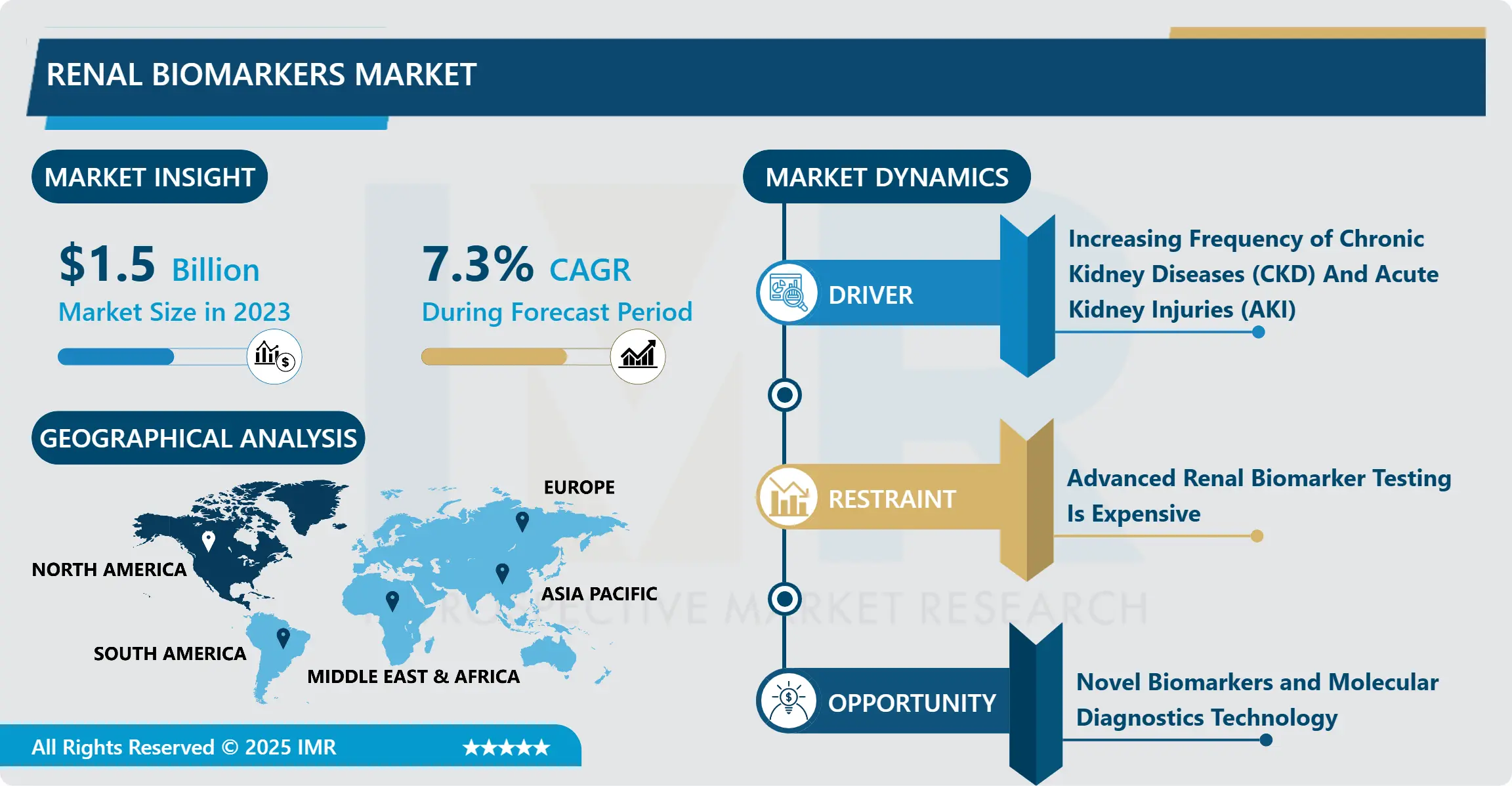
Renal Biomarkers Market Size Was Valued at USD 1.5 Billion in 2023, and is Projected to Reach USD 2.83 Billion by 2032, Growing at a CAGR of 7.3% From 2024-2032.
The renal biomarkers market is witnessing significant growth due to the increasing prevalence of chronic kidney diseases (CKD), diabetes, hypertension, and the rising demand for early detection and monitoring of kidney function. Renal biomarkers, which include proteins, enzymes, and other molecules found in urine or blood, are essential tools for diagnosing kidney-related diseases, assessing disease progression, and guiding therapeutic interventions. The adoption of renal biomarkers in routine clinical practice is expected to improve patient outcomes by enabling timely interventions and personalized treatment plans.
The market is also driven by technological advancements in biomarker discovery and the development of more efficient diagnostic tools. Research and development in proteomics, genomics, and molecular diagnostics are leading to the identification of new biomarkers that can help in the early diagnosis of kidney diseases, which is crucial for effective management and treatment. Additionally, the increasing focus on point-of-care testing and home-based monitoring devices is expanding the accessibility and convenience of renal biomarker tests.
Challenges such as the high cost of renal biomarker-based diagnostics and the need for standardized testing protocols remain. Despite these challenges, the market holds significant opportunities, particularly in emerging economies where healthcare infrastructure is improving and awareness of kidney disease is increasing. The growing trend towards personalized medicine and the need for more precise diagnostic tools are expected to further propel the demand for renal biomarkers in the coming years.
Renal Biomarkers Market Trend Analysis:
Increasing Demand for Early Detection and Personalized Treatment in Renal Biomarkers Market
-
The renal biomarkers market is experiencing significant growth as there is an increasing focus on early detection of kidney diseases and personalized treatment. Advances in molecular diagnostics and biomarker discovery have led to the development of tests that can identify kidney diseases at earlier stages, allowing for timely intervention and better patient outcomes. With the growing prevalence of chronic kidney disease (CKD) and diabetes, the demand for effective biomarkers to assess kidney function and monitor disease progression is expected to continue rising. Personalized treatment based on renal biomarker results is enhancing the effectiveness of therapeutic interventions, driving further adoption in clinical settings.
Shift Toward Point-of-Care Testing and Home Monitoring
-
Another emerging trend in the renal biomarkers market is the shift toward point-of-care (POC) testing and home monitoring solutions. As healthcare becomes more patient-centric, there is an increasing demand for convenient, accessible, and cost-effective diagnostic tools. Point-of-care tests allow patients to monitor their kidney function at home, reducing the need for frequent visits to healthcare facilities and providing real-time data to healthcare providers for better management. This trend is particularly beneficial for managing chronic kidney diseases, where continuous monitoring can help adjust treatments and prevent complications. The development of portable, easy-to-use devices for renal biomarker testing is expected to boost the market growth in the coming years.
Renal Biomarkers Market Segment Analysis:
Renal Biomarkers Market is Segmented on the basis of Biomarker Type, Technique, End User, and Region.
By Biomarker Type, Functional Biomarker segment is expected to dominate the market during the forecast period
-
The renal biomarkers market is segmented by biomarker type, with key categories including functional biomarkers, up-regulated proteins, and others. Functional biomarkers, such as serum creatinine, serum cystatin C, and urine albumin, are widely used in assessing kidney function and detecting diseases like chronic kidney disease (CKD). Up-regulated proteins like neutrophil gelatinase-associated lipocalin (NGAL), kidney injury molecule 1 (KIM-1), and interleukin 18 (IL-18) are gaining prominence due to their ability to indicate early kidney injury and improve diagnostic accuracy. Other biomarkers, including genetic markers and newer molecular diagnostics, continue to emerge as research advances, offering more targeted and personalized approaches to kidney disease management. The growth in biomarker-based diagnostics is fueling the demand for these diverse biomarker types in clinical practice.
By End User, Diagnostic Labs segment expected to held the largest share
-
The renal biomarkers market is segmented by end user into diagnostic labs, outpatient clinics, research centers, and hospitals. Diagnostic labs are expected to hold a significant share of the market due to their widespread use in performing specialized tests for kidney function, enabling early diagnosis of renal diseases. Outpatient clinics are increasingly adopting renal biomarkers for routine screenings and monitoring of chronic kidney disease (CKD) patients, offering cost-effective and efficient testing solutions. Research centers play a crucial role in advancing biomarker discovery and validation, contributing to the development of new diagnostic tools. Hospitals, being the primary healthcare setting, utilize renal biomarkers for both diagnostic and therapeutic purposes, especially for inpatients requiring continuous monitoring of kidney health. The growing adoption of these biomarkers across these end-user categories is driving the overall market growth.
Renal Biomarkers Market Regional Insights:
North America is Expected to Dominate the Market Over the Forecast period
-
North America is expected to dominate the renal biomarkers market over the forecast period due to the region's advanced healthcare infrastructure, high healthcare expenditure, and growing prevalence of chronic kidney diseases (CKD) and diabetes. The increasing adoption of molecular diagnostic technologies, along with strong research and development activities, has fostered the growth of the renal biomarkers market in North America. Furthermore, the rising awareness of kidney health and the increasing demand for early detection and personalized treatment options are contributing to the market's expansion. The presence of key market players, along with favorable government initiatives for healthcare advancements, is also expected to drive the dominance of North America in the renal biomarkers market.
Active Key Players in the Renal Biomarkers Market:
-
Beckman Coulter, Inc. (USA)
- Thermo Fisher Scientific Inc. (USA)
- Abbott Laboratories (USA)
- Bioporto Diagnostics A/S (Denmark)
- Astute Medical, Inc. (USA)
- Randox Laboratories (UK)
- Sphingo Tec GmbH (Germany)
- Siemens Healthineers AG (Germany)
- Eli Lilly and Company (USA)
- Novartis AG (Switzerland), Other Active Players.
|
Renal Biomarkers Market |
|||
|
Base Year: |
2023 |
Forecast Period: |
2024-2032 |
|
Historical Data: |
2017 to 2023 |
Market Size in 2023: |
USD 1.5 Billion |
|
Forecast Period 2024-32 CAGR: |
7.3% |
Market Size in 2032: |
USD 2.83 Billion |
|
Segments Covered: |
By Biomarker Type |
|
|
|
By Technique |
|
||
|
By End User |
|
||
|
By Region |
|
||
|
Key Market Drivers: |
|
||
|
Key Market Restraints: |
|
||
|
Key Opportunities: |
|
||
|
Companies Covered in the report: |
|
||
Chapter 1: Introduction
1.1 Scope and Coverage
Chapter 2:Executive Summary
Chapter 3: Market Landscape
3.1 Market Dynamics
3.1.1 Drivers
3.1.2 Restraints
3.1.3 Opportunities
3.1.4 Challenges
3.2 Market Trend Analysis
3.3 PESTLE Analysis
3.4 Porter's Five Forces Analysis
3.5 Industry Value Chain Analysis
3.6 Ecosystem
3.7 Regulatory Landscape
3.8 Price Trend Analysis
3.9 Patent Analysis
3.10 Technology Evolution
3.11 Investment Pockets
3.12 Import-Export Analysis
Chapter 4: Renal Biomarkers Market by Biomarker Type
4.1 Renal Biomarkers Market Snapshot and Growth Engine
4.2 Renal Biomarkers Market Overview
4.3 Functional Biomarker
4.3.1 Introduction and Market Overview
4.3.2 Historic and Forecasted Market Size in Value USD and Volume Units (2017-2032F)
4.3.3 Key Market Trends, Growth Factors and Opportunities
4.3.4 Functional Biomarker : Geographic Segmentation Analysis
Chapter 5: Renal Biomarkers Market by Up-Regulated Proteins
5.1 Renal Biomarkers Market Snapshot and Growth Engine
5.2 Renal Biomarkers Market Overview
5.3 Neutrophil gelatinase-associated lipocalin
5.3.1 Introduction and Market Overview
5.3.2 Historic and Forecasted Market Size in Value USD and Volume Units (2017-2032F)
5.3.3 Key Market Trends, Growth Factors and Opportunities
5.3.4 Neutrophil gelatinase-associated lipocalin: Geographic Segmentation Analysis
5.4 Kidney injury molecule 1
5.4.1 Introduction and Market Overview
5.4.2 Historic and Forecasted Market Size in Value USD and Volume Units (2017-2032F)
5.4.3 Key Market Trends, Growth Factors and Opportunities
5.4.4 Kidney injury molecule 1: Geographic Segmentation Analysis
5.5 Interleukin 18
5.5.1 Introduction and Market Overview
5.5.2 Historic and Forecasted Market Size in Value USD and Volume Units (2017-2032F)
5.5.3 Key Market Trends, Growth Factors and Opportunities
5.5.4 Interleukin 18: Geographic Segmentation Analysis
5.6 Others
5.6.1 Introduction and Market Overview
5.6.2 Historic and Forecasted Market Size in Value USD and Volume Units (2017-2032F)
5.6.3 Key Market Trends, Growth Factors and Opportunities
5.6.4 Others: Geographic Segmentation Analysis
5.7 Technique
5.7.1 Introduction and Market Overview
5.7.2 Historic and Forecasted Market Size in Value USD and Volume Units (2017-2032F)
5.7.3 Key Market Trends, Growth Factors and Opportunities
5.7.4 Technique : Geographic Segmentation Analysis
Chapter 6: Renal Biomarkers Market by End User
6.1 Renal Biomarkers Market Snapshot and Growth Engine
6.2 Renal Biomarkers Market Overview
6.3 Diagnostic Labs
6.3.1 Introduction and Market Overview
6.3.2 Historic and Forecasted Market Size in Value USD and Volume Units (2017-2032F)
6.3.3 Key Market Trends, Growth Factors and Opportunities
6.3.4 Diagnostic Labs: Geographic Segmentation Analysis
6.4 Outpatient Clinics
6.4.1 Introduction and Market Overview
6.4.2 Historic and Forecasted Market Size in Value USD and Volume Units (2017-2032F)
6.4.3 Key Market Trends, Growth Factors and Opportunities
6.4.4 Outpatient Clinics: Geographic Segmentation Analysis
6.5 Research Centers
6.5.1 Introduction and Market Overview
6.5.2 Historic and Forecasted Market Size in Value USD and Volume Units (2017-2032F)
6.5.3 Key Market Trends, Growth Factors and Opportunities
6.5.4 Research Centers: Geographic Segmentation Analysis
6.6 Hospitals
6.6.1 Introduction and Market Overview
6.6.2 Historic and Forecasted Market Size in Value USD and Volume Units (2017-2032F)
6.6.3 Key Market Trends, Growth Factors and Opportunities
6.6.4 Hospitals: Geographic Segmentation Analysis
Chapter 7: Company Profiles and Competitive Analysis
7.1 Competitive Landscape
7.1.1 Competitive Benchmarking
7.1.2 Renal Biomarkers Market Share by Manufacturer (2023)
7.1.3 Industry BCG Matrix
7.1.4 Heat Map Analysis
7.1.5 Mergers and Acquisitions
7.2 BECKMAN COULTER INC. (USA)
7.2.1 Company Overview
7.2.2 Key Executives
7.2.3 Company Snapshot
7.2.4 Role of the Company in the Market
7.2.5 Sustainability and Social Responsibility
7.2.6 Operating Business Segments
7.2.7 Product Portfolio
7.2.8 Business Performance
7.2.9 Key Strategic Moves and Recent Developments
7.2.10 SWOT Analysis
7.3 THERMO FISHER SCIENTIFIC INC. (USA)
7.4 ABBOTT LABORATORIES (USA)
7.5 BIOPORTO DIAGNOSTICS A/S (DENMARK)
7.6 ASTUTE MEDICAL INC. (USA)
7.7 RANDOX LABORATORIES (UK)
7.8 SPHINGO TEC GMBH (GERMANY)
7.9 SIEMENS HEALTHINEERS AG (GERMANY)
7.10 ELI LILLY AND COMPANY (USA)
7.11 AND NOVARTIS AG (SWITZERLAND) AND OTHER ACTIVE PLAYERS
Chapter 8: Global Renal Biomarkers Market By Region
8.1 Overview
8.2. North America Renal Biomarkers Market
8.2.1 Key Market Trends, Growth Factors and Opportunities
8.2.2 Top Key Companies
8.2.3 Historic and Forecasted Market Size by Segments
8.2.4 Historic and Forecasted Market Size By Biomarker Type
8.2.4.1 Functional Biomarker
8.2.5 Historic and Forecasted Market Size By Up-Regulated Proteins
8.2.5.1 Neutrophil gelatinase-associated lipocalin
8.2.5.2 Kidney injury molecule 1
8.2.5.3 Interleukin 18
8.2.5.4 Others
8.2.5.5 Technique
8.2.6 Historic and Forecasted Market Size By End User
8.2.6.1 Diagnostic Labs
8.2.6.2 Outpatient Clinics
8.2.6.3 Research Centers
8.2.6.4 Hospitals
8.2.7 Historic and Forecast Market Size by Country
8.2.7.1 US
8.2.7.2 Canada
8.2.7.3 Mexico
8.3. Eastern Europe Renal Biomarkers Market
8.3.1 Key Market Trends, Growth Factors and Opportunities
8.3.2 Top Key Companies
8.3.3 Historic and Forecasted Market Size by Segments
8.3.4 Historic and Forecasted Market Size By Biomarker Type
8.3.4.1 Functional Biomarker
8.3.5 Historic and Forecasted Market Size By Up-Regulated Proteins
8.3.5.1 Neutrophil gelatinase-associated lipocalin
8.3.5.2 Kidney injury molecule 1
8.3.5.3 Interleukin 18
8.3.5.4 Others
8.3.5.5 Technique
8.3.6 Historic and Forecasted Market Size By End User
8.3.6.1 Diagnostic Labs
8.3.6.2 Outpatient Clinics
8.3.6.3 Research Centers
8.3.6.4 Hospitals
8.3.7 Historic and Forecast Market Size by Country
8.3.7.1 Russia
8.3.7.2 Bulgaria
8.3.7.3 The Czech Republic
8.3.7.4 Hungary
8.3.7.5 Poland
8.3.7.6 Romania
8.3.7.7 Rest of Eastern Europe
8.4. Western Europe Renal Biomarkers Market
8.4.1 Key Market Trends, Growth Factors and Opportunities
8.4.2 Top Key Companies
8.4.3 Historic and Forecasted Market Size by Segments
8.4.4 Historic and Forecasted Market Size By Biomarker Type
8.4.4.1 Functional Biomarker
8.4.5 Historic and Forecasted Market Size By Up-Regulated Proteins
8.4.5.1 Neutrophil gelatinase-associated lipocalin
8.4.5.2 Kidney injury molecule 1
8.4.5.3 Interleukin 18
8.4.5.4 Others
8.4.5.5 Technique
8.4.6 Historic and Forecasted Market Size By End User
8.4.6.1 Diagnostic Labs
8.4.6.2 Outpatient Clinics
8.4.6.3 Research Centers
8.4.6.4 Hospitals
8.4.7 Historic and Forecast Market Size by Country
8.4.7.1 Germany
8.4.7.2 UK
8.4.7.3 France
8.4.7.4 The Netherlands
8.4.7.5 Italy
8.4.7.6 Spain
8.4.7.7 Rest of Western Europe
8.5. Asia Pacific Renal Biomarkers Market
8.5.1 Key Market Trends, Growth Factors and Opportunities
8.5.2 Top Key Companies
8.5.3 Historic and Forecasted Market Size by Segments
8.5.4 Historic and Forecasted Market Size By Biomarker Type
8.5.4.1 Functional Biomarker
8.5.5 Historic and Forecasted Market Size By Up-Regulated Proteins
8.5.5.1 Neutrophil gelatinase-associated lipocalin
8.5.5.2 Kidney injury molecule 1
8.5.5.3 Interleukin 18
8.5.5.4 Others
8.5.5.5 Technique
8.5.6 Historic and Forecasted Market Size By End User
8.5.6.1 Diagnostic Labs
8.5.6.2 Outpatient Clinics
8.5.6.3 Research Centers
8.5.6.4 Hospitals
8.5.7 Historic and Forecast Market Size by Country
8.5.7.1 China
8.5.7.2 India
8.5.7.3 Japan
8.5.7.4 South Korea
8.5.7.5 Malaysia
8.5.7.6 Thailand
8.5.7.7 Vietnam
8.5.7.8 The Philippines
8.5.7.9 Australia
8.5.7.10 New Zealand
8.5.7.11 Rest of APAC
8.6. Middle East & Africa Renal Biomarkers Market
8.6.1 Key Market Trends, Growth Factors and Opportunities
8.6.2 Top Key Companies
8.6.3 Historic and Forecasted Market Size by Segments
8.6.4 Historic and Forecasted Market Size By Biomarker Type
8.6.4.1 Functional Biomarker
8.6.5 Historic and Forecasted Market Size By Up-Regulated Proteins
8.6.5.1 Neutrophil gelatinase-associated lipocalin
8.6.5.2 Kidney injury molecule 1
8.6.5.3 Interleukin 18
8.6.5.4 Others
8.6.5.5 Technique
8.6.6 Historic and Forecasted Market Size By End User
8.6.6.1 Diagnostic Labs
8.6.6.2 Outpatient Clinics
8.6.6.3 Research Centers
8.6.6.4 Hospitals
8.6.7 Historic and Forecast Market Size by Country
8.6.7.1 Turkiye
8.6.7.2 Bahrain
8.6.7.3 Kuwait
8.6.7.4 Saudi Arabia
8.6.7.5 Qatar
8.6.7.6 UAE
8.6.7.7 Israel
8.6.7.8 South Africa
8.7. South America Renal Biomarkers Market
8.7.1 Key Market Trends, Growth Factors and Opportunities
8.7.2 Top Key Companies
8.7.3 Historic and Forecasted Market Size by Segments
8.7.4 Historic and Forecasted Market Size By Biomarker Type
8.7.4.1 Functional Biomarker
8.7.5 Historic and Forecasted Market Size By Up-Regulated Proteins
8.7.5.1 Neutrophil gelatinase-associated lipocalin
8.7.5.2 Kidney injury molecule 1
8.7.5.3 Interleukin 18
8.7.5.4 Others
8.7.5.5 Technique
8.7.6 Historic and Forecasted Market Size By End User
8.7.6.1 Diagnostic Labs
8.7.6.2 Outpatient Clinics
8.7.6.3 Research Centers
8.7.6.4 Hospitals
8.7.7 Historic and Forecast Market Size by Country
8.7.7.1 Brazil
8.7.7.2 Argentina
8.7.7.3 Rest of SA
Chapter 9 Analyst Viewpoint and Conclusion
9.1 Recommendations and Concluding Analysis
9.2 Potential Market Strategies
Chapter 10 Research Methodology
10.1 Research Process
10.2 Primary Research
10.3 Secondary Research
|
Renal Biomarkers Market |
|||
|
Base Year: |
2023 |
Forecast Period: |
2024-2032 |
|
Historical Data: |
2017 to 2023 |
Market Size in 2023: |
USD 1.5 Billion |
|
Forecast Period 2024-32 CAGR: |
7.3% |
Market Size in 2032: |
USD 2.83 Billion |
|
Segments Covered: |
By Biomarker Type |
|
|
|
By Technique |
|
||
|
By End User |
|
||
|
By Region |
|
||
|
Key Market Drivers: |
|
||
|
Key Market Restraints: |
|
||
|
Key Opportunities: |
|
||
|
Companies Covered in the report: |
|
||