




Recombinant Protein Market Synopsis:
Recombinant Protein Market Size Was Valued at USD 3.89 Billion in 2023, and is Projected to Reach USD 9.12 Billion by 2032, Growing at a CAGR of 10.2 % from 2024-2032.
The recombinant protein market is the trade of proteins that are produced through biotechnology by incorporation of genes responsible for proteins formation, and their marketing after synthesizing them in other organisms. These proteins are used in drugs and medicines, in research analysis of drugs, in diagnostic tests and assays, and in other industrial applications such as food production and bio-energy production. New biologic drugs, development of biotechnology and higher research and development investments have made the market grow at a fast pace in the recent years and the market is expected to grow at a much faster pace in the future, with a special focus on increasing production capacity and reducing costs.
The recombinant protein market has grown large due to progress in advanced Biotechnology and the need for innovative bio therapies. Recombinant proteins have important applications in human therapies and medicine through recombinant protein-based therapies such as monoclonal antibodies, insulin, enzymes; as well as in the broad spectrum of scientific use, research and diagnostics, and in a variety of industries including food processing and bio fuels. Due to increased incidence of chronic diseases, cancers and autoimmune diseases, the use of recombinant proteins in pharmaceuticals will go on rising.
The market also derives some degree of growth from the technological advancements that affect production processes in cell culture systems, bioreactors and purification techniques. Further, modern requirements towards individualized treatment and new biologic based therapies promote the development of new recombinant protein. High cost of production can still be cited as a strong weakness to recombinant protein production despite current research and Technologies aiding in cutting cost and thus growth of the market in all the world regions.
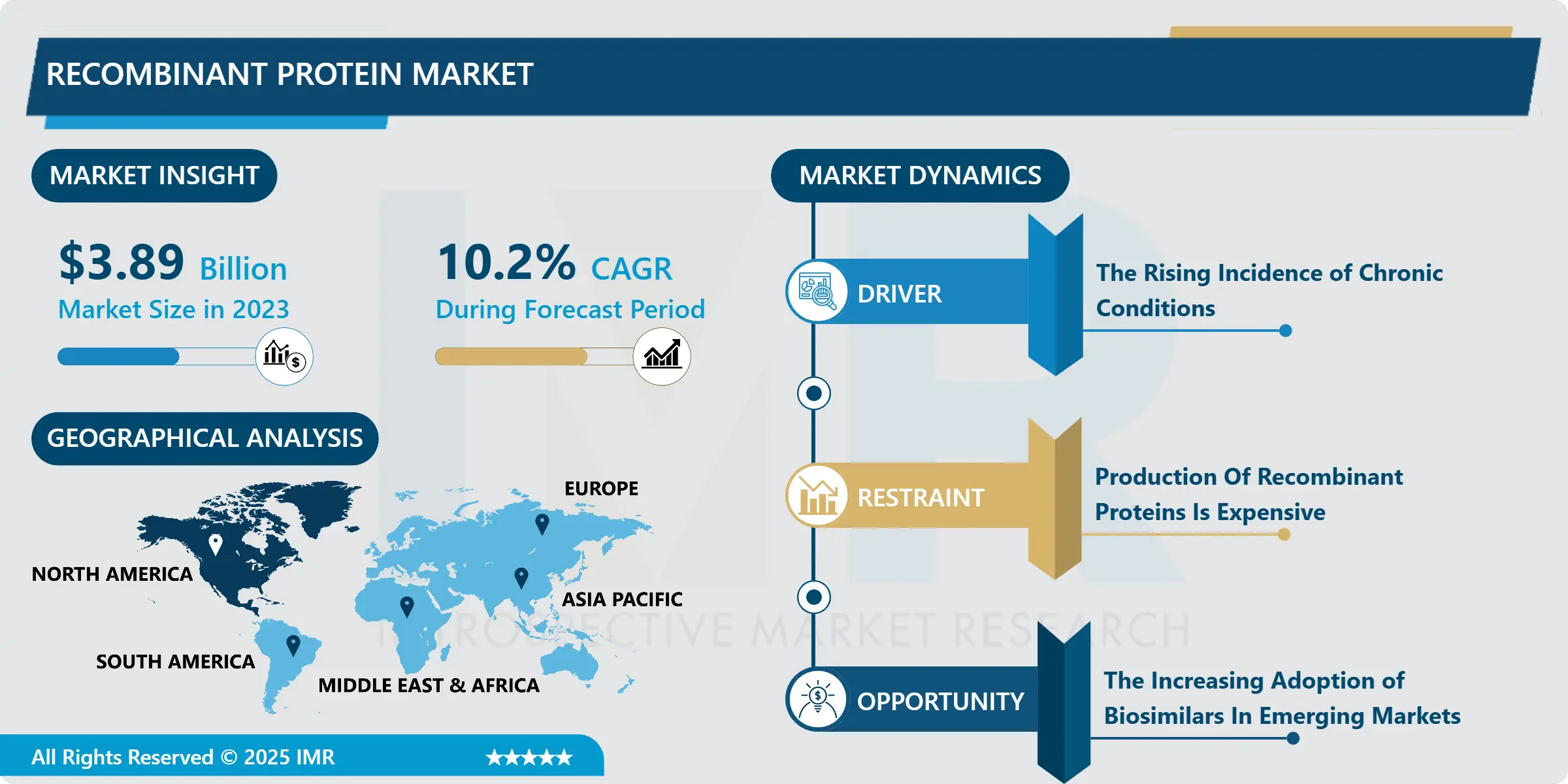
Recombinant Protein Market Trend Analysis:
Advancements in Protein Expression Systems
- Improvements in the technology used to express and produce proteins are also a major factor fuelling exponential expansion of the recombinant protein market. Many applications still use older systems like bacterial expression often using Escolar because of the ease in handling the system and low costs involved but newer high-complex systems such as yeast, insect and mammalian cells (like CHO cells) are being favoured for their ability to produce proteins that undergo post-translational process like glycosylation. These systems are gradually being developed for increasing the productivity and quality of the secreted recombinant proteins particularly for biopharmaceutical applications. New advances in cell-free expression systems have taken protein manufacturing a step further, making the synthesis of proteins more rapid, functional, and scalable and of high purity without the need for cell bodies, which makes it easier to prototype, produce vaccines and drugs among other uses.
- More efficient host optimization with the help of CRISPR based gene editing technology has been useful to enhance the protein yields, stability and activity of the desired protein. This trend is supported by the increasing adoption of continuous bio manufacturing systems that offer better cycle efficiency and reduced cycle time, and consequently lower costs. Updated AI and machine learning implementation in protein production improve the chances for future protein folding prediction and the process regulation. Given these enhancements, recombinant protein manufacturing becomes cheaper, faster and flexible enough to meet the increasing need for bio pharmaceuticals, vaccines, and diagnostic tests.
Emerging Applications in Personalized Medicines
- The demand of recombinant proteins in near future is going to increase due to the recent applications in personalized medicine which calls for more profound diagnosis of the disease for the patient being treated. Recombinant proteins are currently used in cancer treatments like monoclonal antibodies which are molecules that identify select biomarkers of cancer cells to reduce the effect of other healthy cells in the body. Furthermore, recombinant proteins are very important in immunotherapy which entails modifying a patient’s T cells to attack cancerous cells – CAR-T cell therapies. As the development of individualized cancer care increases, the necessity of recombinant proteins in this area will increase considerably. Recombinant proteins also play a role in designing immune checkpoint inhibitors and gene therapies especially in inherited diseases such as haemophilia and muscular dystrophy in which gene substitutive or gene augmenting therapies are now beginning to be personalised.
- Besides cancer and genetic treatment, recombinant proteins are useful in vaccines that are based on the antigens of given strains of the pathogen likely to be transferring a disease, given an individual’s genotype and phenotype. Recombinant proteins are also used in biomarker identification that can help produce more accurate diagnosis and, correspondingly, better treatment strategies. In addition, recombinant proteins are providing new hope of treatments for rare diseases through the use of enzyme replacement, a specialized therapy for diseases that can only be treated in this way. Such developments in the area of targeted treatments are actually making recombinant proteins open new opportunities in the direction of more targeted, better and more effective treatments, which presents good potential for growth in the recombinant protein market.
Recombinant Protein Market Segment Analysis:
Recombinant Protein Market is Segmented on the basis of Type, Application, End User, and Region.
By Type, Recombinant Therapeutic Proteins segment is expected to dominate the market during the forecast period
- The Recombinant Therapeutic Proteins segment is likely to remain the largest in recombinant protein market as the usage in biologic therapies increases significantly in treating conditions including chronic illnesses, cancers, autoimmune diseases and metabolic disorders. Therapeutic proteins that include recombinant product like mAbs, insulin, growth hormone, clotting factors and therapeutic enzymes form the mainstay of treatments various diseases. It is key factor to increase the demand for this segment due to an increased incidence of chronic diseases such as diabetes, cancer and autoimmune diseases among the population. Similarly, continued progress in targeted therapies especially mAbs in cancer IMMUNOTHERAPY and raise BIOSimilar drugs more often for cost-efficient treatments are the key drivers that drive this heading.
- The continually growing global elderly population is experiencing a higher prevalence of age-related diseases, which has consequently, raised demand for recombinant proteins primarily for metabolic and endocrine diseases. The effectiveness and safety of recombinant proteins, as well as positive attitudes from agencies as the FDA and EMA, are improving the applicability of recombinant proteins to cure both rare and common diseases. Owing to the efficiency of therapeutic recombinant proteins to provide treatments for chronic ailments, this segment is predicted to continue its strong foothold in the global market during the forecast period.
By Application, Therapeutic Applications segment expected to held the largest share
- The largest application of recombinant protein is projected to come from the therapeutic applications of recombinant protein during the forecast period under the effect of rising incidence of chronic diseases that require biologic treatments. Recombinant proteins find divided application in cancer therapies, autoimmune diseases, endocrine disorders, and infection control diseases. The high growth rate is attributed to increasing applications of monoclonal antibodies in cancer immunotherapy, the usage of targeted therapy for autoimmune diseases, and the highly prevalent use of recombinant insulin for diabetes. Moreover, the growth of biologic drugs and biosimilars-which are cheaper versions of the initial biologic drugs, has stepped up the use of recombinant proteins in the treatment facilities.
- This coupled with increase in prevalence of diseases such as diabetes, cardiovascular diseases, and cancers due to advanced aging, awoke the world demand for recombinant therapeutic proteins. Recombinant proteins, or enzymes, hormones including growth hormones, and active blood clotting fractions represent yardsticks as complex diseases are treated through novel therapeutic approaches. This segment is also fueled by progress in the field of personalized medicine in which use of recombinant proteins in tailoring therapy to the particular patient yields better and less risky results. Consequently, the Therapeutic Applications segment will remain as the key growth area in the recombinant protein market through the forecast period.
Recombinant Protein Market Regional Insights:
North America is Expected to Dominate the Market Over the Forecast period
- The North American region is characterized to show the highest demand for the recombinant protein market in the forecast period due to the availability of a well-developed healthcare sector, high adoption of technological advancements in biotechnology, and the major focus on the research and development of the pharmaceutical industry. The United States and Canada feature prominently in this dominance: the United States in particular given the dominance of world-class research institutions, a booming biotechnology industry, and large biopharmaceutical businesses. This Commissioned Article on Recombinant therapeutic proteins has further analyzed the FDA’s regulatory framework related to ITS and the Three-Year Anniversary Rapid Approval Process for Biologics.
- Increasing prevalence of chronic diseases like diabetes, cancer, auto immune disorders as well as an aging population is increasing the need for recombinant products including monoclonal antibodies, insulin, and growth hormones. The North American market is also driven by growth of personalized medicine where recombinant protein plays a crucial role for targeting therapies. The availability of biosimilars (logic, affordable substitutes for costlier biologic products) is another factor behind growth, given a growing emphasis on cost-containment measures such as biosimilars in healthcare in North America. High end pharmaceutical industries coupled with favorable regulation North America remains the largest market for recombinant proteins even throughout the forecast period.Besides this, there is steady rise in investment in genetic research in North American region along with the production of biopharmaceuticals, focused interest on immunotherapy and gene therapy is strengthening the market for recombinant proteins. North America is already leading the recombinant protein market and the emphasis of the region on R&D innovation of recombinant vaccines, gene therapies and the Biological products is further strengthening North America’s position in the marketplace.
Active Key Players in the Recombinant Protein Market:
- AbbVie Inc. (United States)
- Amgen Inc. (United States)
- Bayer AG (Germany)
- Biogen Inc. (United States)
- Boehringer Ingelheim GmbH (Germany)
- Bristol Myers Squibb (United States)
- Celltrion, Inc. (South Korea)
- Eli Lilly and Co. (United States)
- Genentech, Inc. (United States)
- Johnson & Johnson (United States)
- Lonza Group (Switzerland)
- Merck & Co., Inc. (United States)
- Novartis International AG (Switzerland)
- Novo Nordisk A/S (Denmark)
- Pfizer Inc. (United States)
- Roche Holding AG (Switzerland)
- Samsung Biologics (South Korea)
- Sanofi S.A. (France), and Other Active Players
|
Recombinant Protein Market |
|||
|
Base Year: |
2023 |
Forecast Period: |
2024-2032 |
|
Historical Data: |
2017 to 2023 |
Market Size in 2023: |
USD 3.89 Billion |
|
Forecast Period 2024-32 CAGR: |
10.2% |
Market Size in 2032: |
USD 9.12 Billion |
|
Segments Covered: |
By Type |
|
|
|
By Application |
|
||
|
By End User |
|
||
|
By Region |
|
||
|
Key Market Drivers: |
|
||
|
Key Market Restraints: |
|
||
|
Key Opportunities: |
|
||
|
Companies Covered in the report: |
|
||
Chapter 1: Introduction
1.1 Scope and Coverage
Chapter 2:Executive Summary
Chapter 3: Market Landscape
3.1 Market Dynamics
3.1.1 Drivers
3.1.2 Restraints
3.1.3 Opportunities
3.1.4 Challenges
3.2 Market Trend Analysis
3.3 PESTLE Analysis
3.4 Porter's Five Forces Analysis
3.5 Industry Value Chain Analysis
3.6 Ecosystem
3.7 Regulatory Landscape
3.8 Price Trend Analysis
3.9 Patent Analysis
3.10 Technology Evolution
3.11 Investment Pockets
3.12 Import-Export Analysis
Chapter 4: Recombinant Protein Market by Type
4.1 Recombinant Protein Market Snapshot and Growth Engine
4.2 Recombinant Protein Market Overview
4.3 Recombinant Therapeutic Proteins
4.3.1 Introduction and Market Overview
4.3.2 Historic and Forecasted Market Size in Value USD and Volume Units (2017-2032F)
4.3.3 Key Market Trends, Growth Factors and Opportunities
4.3.4 Recombinant Therapeutic Proteins: Geographic Segmentation Analysis
4.4 Recombinant Research Proteins
4.4.1 Introduction and Market Overview
4.4.2 Historic and Forecasted Market Size in Value USD and Volume Units (2017-2032F)
4.4.3 Key Market Trends, Growth Factors and Opportunities
4.4.4 Recombinant Research Proteins: Geographic Segmentation Analysis
4.5 Recombinant Vaccines
4.5.1 Introduction and Market Overview
4.5.2 Historic and Forecasted Market Size in Value USD and Volume Units (2017-2032F)
4.5.3 Key Market Trends, Growth Factors and Opportunities
4.5.4 Recombinant Vaccines: Geographic Segmentation Analysis
Chapter 5: Recombinant Protein Market by Application
5.1 Recombinant Protein Market Snapshot and Growth Engine
5.2 Recombinant Protein Market Overview
5.3 Therapeutic Application
5.3.1 Introduction and Market Overview
5.3.2 Historic and Forecasted Market Size in Value USD and Volume Units (2017-2032F)
5.3.3 Key Market Trends, Growth Factors and Opportunities
5.3.4 Therapeutic Application: Geographic Segmentation Analysis
5.4 Research & Development
5.4.1 Introduction and Market Overview
5.4.2 Historic and Forecasted Market Size in Value USD and Volume Units (2017-2032F)
5.4.3 Key Market Trends, Growth Factors and Opportunities
5.4.4 Research & Development: Geographic Segmentation Analysis
5.5 Diagnostic Application
5.5.1 Introduction and Market Overview
5.5.2 Historic and Forecasted Market Size in Value USD and Volume Units (2017-2032F)
5.5.3 Key Market Trends, Growth Factors and Opportunities
5.5.4 Diagnostic Application: Geographic Segmentation Analysis
5.6 Industrial Application
5.6.1 Introduction and Market Overview
5.6.2 Historic and Forecasted Market Size in Value USD and Volume Units (2017-2032F)
5.6.3 Key Market Trends, Growth Factors and Opportunities
5.6.4 Industrial Application: Geographic Segmentation Analysis
Chapter 6: Recombinant Protein Market by End User
6.1 Recombinant Protein Market Snapshot and Growth Engine
6.2 Recombinant Protein Market Overview
6.3 Pharmaceutical & Biotechnology Companies
6.3.1 Introduction and Market Overview
6.3.2 Historic and Forecasted Market Size in Value USD and Volume Units (2017-2032F)
6.3.3 Key Market Trends, Growth Factors and Opportunities
6.3.4 Pharmaceutical & Biotechnology Companies: Geographic Segmentation Analysis
6.4 Research Laboratories and Academic Institutions
6.4.1 Introduction and Market Overview
6.4.2 Historic and Forecasted Market Size in Value USD and Volume Units (2017-2032F)
6.4.3 Key Market Trends, Growth Factors and Opportunities
6.4.4 Research Laboratories and Academic Institutions: Geographic Segmentation Analysis
6.5 DiagnosticLaboratories
6.5.1 Introduction and Market Overview
6.5.2 Historic and Forecasted Market Size in Value USD and Volume Units (2017-2032F)
6.5.3 Key Market Trends, Growth Factors and Opportunities
6.5.4 DiagnosticLaboratories: Geographic Segmentation Analysis
6.6 Contract Manufacturing Organizations
6.6.1 Introduction and Market Overview
6.6.2 Historic and Forecasted Market Size in Value USD and Volume Units (2017-2032F)
6.6.3 Key Market Trends, Growth Factors and Opportunities
6.6.4 Contract Manufacturing Organizations: Geographic Segmentation Analysis
Chapter 7: Company Profiles and Competitive Analysis
7.1 Competitive Landscape
7.1.1 Competitive Benchmarking
7.1.2 Recombinant Protein Market Share by Manufacturer (2023)
7.1.3 Industry BCG Matrix
7.1.4 Heat Map Analysis
7.1.5 Mergers and Acquisitions
7.2 ABBVIE INC. (UNITED STATES)
7.2.1 Company Overview
7.2.2 Key Executives
7.2.3 Company Snapshot
7.2.4 Role of the Company in the Market
7.2.5 Sustainability and Social Responsibility
7.2.6 Operating Business Segments
7.2.7 Product Portfolio
7.2.8 Business Performance
7.2.9 Key Strategic Moves and Recent Developments
7.2.10 SWOT Analysis
7.3 AMGEN INC. (UNITED STATES)
7.4 BAYER AG (GERMANY)
7.5 BIOGEN INC. (UNITED STATES)
7.6 BOEHRINGER INGELHEIM GMBH (GERMANY)
7.7 BRISTOL MYERS SQUIBB (UNITED STATES)
7.8 CELLTRION INC. (SOUTH KOREA)
7.9 ELI LILLY AND CO. (UNITED STATES)
7.10 GENENTECH INC. (UNITED STATES)
7.11 JOHNSON & JOHNSON (UNITED STATES)
7.12 LONZA GROUP (SWITZERLAND)
7.13 MERCK & CO. INC. (UNITED STATES)
7.14 NOVARTIS INTERNATIONAL AG (SWITZERLAND)
7.15 NOVO NORDISK A/S (DENMARK)
7.16 PFIZER INC. (UNITED STATES)
7.17 ROCHE HOLDING AG (SWITZERLAND)
7.18 SAMSUNG BIOLOGICS (SOUTH KOREA)
7.19 SANOFI S.A. (FRANCE)
7.20 OTHER ACTIVE PLAYERS
Chapter 8: Global Recombinant Protein Market By Region
8.1 Overview
8.2. North America Recombinant Protein Market
8.2.1 Key Market Trends, Growth Factors and Opportunities
8.2.2 Top Key Companies
8.2.3 Historic and Forecasted Market Size by Segments
8.2.4 Historic and Forecasted Market Size By Type
8.2.4.1 Recombinant Therapeutic Proteins
8.2.4.2 Recombinant Research Proteins
8.2.4.3 Recombinant Vaccines
8.2.5 Historic and Forecasted Market Size By Application
8.2.5.1 Therapeutic Application
8.2.5.2 Research & Development
8.2.5.3 Diagnostic Application
8.2.5.4 Industrial Application
8.2.6 Historic and Forecasted Market Size By End User
8.2.6.1 Pharmaceutical & Biotechnology Companies
8.2.6.2 Research Laboratories and Academic Institutions
8.2.6.3 DiagnosticLaboratories
8.2.6.4 Contract Manufacturing Organizations
8.2.7 Historic and Forecast Market Size by Country
8.2.7.1 US
8.2.7.2 Canada
8.2.7.3 Mexico
8.3. Eastern Europe Recombinant Protein Market
8.3.1 Key Market Trends, Growth Factors and Opportunities
8.3.2 Top Key Companies
8.3.3 Historic and Forecasted Market Size by Segments
8.3.4 Historic and Forecasted Market Size By Type
8.3.4.1 Recombinant Therapeutic Proteins
8.3.4.2 Recombinant Research Proteins
8.3.4.3 Recombinant Vaccines
8.3.5 Historic and Forecasted Market Size By Application
8.3.5.1 Therapeutic Application
8.3.5.2 Research & Development
8.3.5.3 Diagnostic Application
8.3.5.4 Industrial Application
8.3.6 Historic and Forecasted Market Size By End User
8.3.6.1 Pharmaceutical & Biotechnology Companies
8.3.6.2 Research Laboratories and Academic Institutions
8.3.6.3 DiagnosticLaboratories
8.3.6.4 Contract Manufacturing Organizations
8.3.7 Historic and Forecast Market Size by Country
8.3.7.1 Russia
8.3.7.2 Bulgaria
8.3.7.3 The Czech Republic
8.3.7.4 Hungary
8.3.7.5 Poland
8.3.7.6 Romania
8.3.7.7 Rest of Eastern Europe
8.4. Western Europe Recombinant Protein Market
8.4.1 Key Market Trends, Growth Factors and Opportunities
8.4.2 Top Key Companies
8.4.3 Historic and Forecasted Market Size by Segments
8.4.4 Historic and Forecasted Market Size By Type
8.4.4.1 Recombinant Therapeutic Proteins
8.4.4.2 Recombinant Research Proteins
8.4.4.3 Recombinant Vaccines
8.4.5 Historic and Forecasted Market Size By Application
8.4.5.1 Therapeutic Application
8.4.5.2 Research & Development
8.4.5.3 Diagnostic Application
8.4.5.4 Industrial Application
8.4.6 Historic and Forecasted Market Size By End User
8.4.6.1 Pharmaceutical & Biotechnology Companies
8.4.6.2 Research Laboratories and Academic Institutions
8.4.6.3 DiagnosticLaboratories
8.4.6.4 Contract Manufacturing Organizations
8.4.7 Historic and Forecast Market Size by Country
8.4.7.1 Germany
8.4.7.2 UK
8.4.7.3 France
8.4.7.4 The Netherlands
8.4.7.5 Italy
8.4.7.6 Spain
8.4.7.7 Rest of Western Europe
8.5. Asia Pacific Recombinant Protein Market
8.5.1 Key Market Trends, Growth Factors and Opportunities
8.5.2 Top Key Companies
8.5.3 Historic and Forecasted Market Size by Segments
8.5.4 Historic and Forecasted Market Size By Type
8.5.4.1 Recombinant Therapeutic Proteins
8.5.4.2 Recombinant Research Proteins
8.5.4.3 Recombinant Vaccines
8.5.5 Historic and Forecasted Market Size By Application
8.5.5.1 Therapeutic Application
8.5.5.2 Research & Development
8.5.5.3 Diagnostic Application
8.5.5.4 Industrial Application
8.5.6 Historic and Forecasted Market Size By End User
8.5.6.1 Pharmaceutical & Biotechnology Companies
8.5.6.2 Research Laboratories and Academic Institutions
8.5.6.3 DiagnosticLaboratories
8.5.6.4 Contract Manufacturing Organizations
8.5.7 Historic and Forecast Market Size by Country
8.5.7.1 China
8.5.7.2 India
8.5.7.3 Japan
8.5.7.4 South Korea
8.5.7.5 Malaysia
8.5.7.6 Thailand
8.5.7.7 Vietnam
8.5.7.8 The Philippines
8.5.7.9 Australia
8.5.7.10 New Zealand
8.5.7.11 Rest of APAC
8.6. Middle East & Africa Recombinant Protein Market
8.6.1 Key Market Trends, Growth Factors and Opportunities
8.6.2 Top Key Companies
8.6.3 Historic and Forecasted Market Size by Segments
8.6.4 Historic and Forecasted Market Size By Type
8.6.4.1 Recombinant Therapeutic Proteins
8.6.4.2 Recombinant Research Proteins
8.6.4.3 Recombinant Vaccines
8.6.5 Historic and Forecasted Market Size By Application
8.6.5.1 Therapeutic Application
8.6.5.2 Research & Development
8.6.5.3 Diagnostic Application
8.6.5.4 Industrial Application
8.6.6 Historic and Forecasted Market Size By End User
8.6.6.1 Pharmaceutical & Biotechnology Companies
8.6.6.2 Research Laboratories and Academic Institutions
8.6.6.3 DiagnosticLaboratories
8.6.6.4 Contract Manufacturing Organizations
8.6.7 Historic and Forecast Market Size by Country
8.6.7.1 Turkiye
8.6.7.2 Bahrain
8.6.7.3 Kuwait
8.6.7.4 Saudi Arabia
8.6.7.5 Qatar
8.6.7.6 UAE
8.6.7.7 Israel
8.6.7.8 South Africa
8.7. South America Recombinant Protein Market
8.7.1 Key Market Trends, Growth Factors and Opportunities
8.7.2 Top Key Companies
8.7.3 Historic and Forecasted Market Size by Segments
8.7.4 Historic and Forecasted Market Size By Type
8.7.4.1 Recombinant Therapeutic Proteins
8.7.4.2 Recombinant Research Proteins
8.7.4.3 Recombinant Vaccines
8.7.5 Historic and Forecasted Market Size By Application
8.7.5.1 Therapeutic Application
8.7.5.2 Research & Development
8.7.5.3 Diagnostic Application
8.7.5.4 Industrial Application
8.7.6 Historic and Forecasted Market Size By End User
8.7.6.1 Pharmaceutical & Biotechnology Companies
8.7.6.2 Research Laboratories and Academic Institutions
8.7.6.3 DiagnosticLaboratories
8.7.6.4 Contract Manufacturing Organizations
8.7.7 Historic and Forecast Market Size by Country
8.7.7.1 Brazil
8.7.7.2 Argentina
8.7.7.3 Rest of SA
Chapter 9 Analyst Viewpoint and Conclusion
9.1 Recommendations and Concluding Analysis
9.2 Potential Market Strategies
Chapter 10 Research Methodology
10.1 Research Process
10.2 Primary Research
10.3 Secondary Research
|
Recombinant Protein Market |
|||
|
Base Year: |
2023 |
Forecast Period: |
2024-2032 |
|
Historical Data: |
2017 to 2023 |
Market Size in 2023: |
USD 3.89 Billion |
|
Forecast Period 2024-32 CAGR: |
10.2% |
Market Size in 2032: |
USD 9.12 Billion |
|
Segments Covered: |
By Type |
|
|
|
By Application |
|
||
|
By End User |
|
||
|
By Region |
|
||
|
Key Market Drivers: |
|
||
|
Key Market Restraints: |
|
||
|
Key Opportunities: |
|
||
|
Companies Covered in the report: |
|
||


