




PTA Balloon Catheter Market Synopsis:
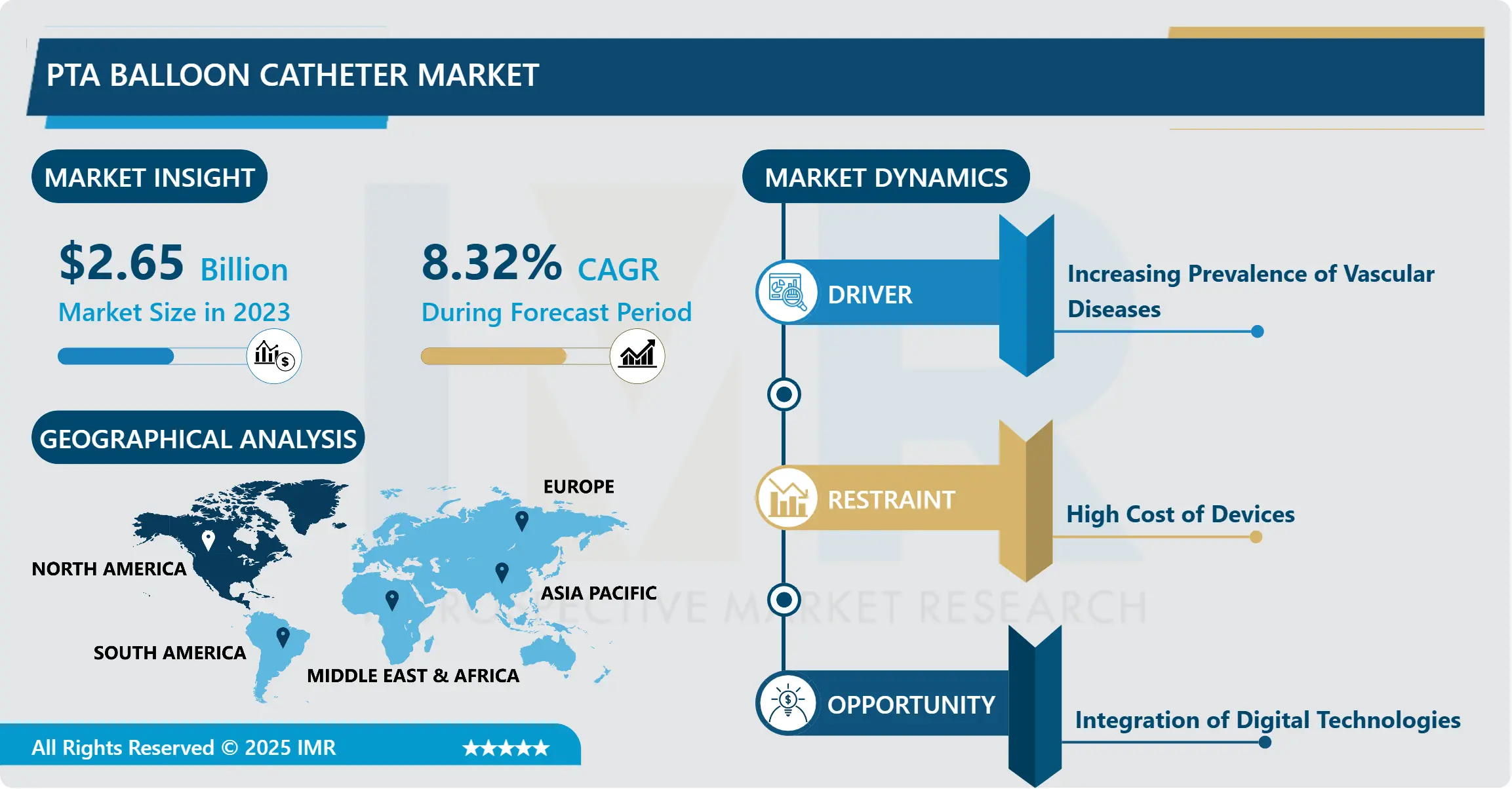
PTA Balloon Catheter Market Size Was Valued at USD 2.65 Billion in 2023, and is Projected to Reach USD 5.44 Billion by 2032, Growing at a CAGR of 8.32% From 2024-2032.
PTA (Percutaneous Transluminal Angioplasty ) balloon catheter market can be described as the niche concerned with the manufacture, sales, and supply of balloon catheters that is used for angioplasty within the medical devices industry. These catheters are applied in treating constricted or occluded blood vessels and more commonly in treatment of atherosclerosis patients. The PTA balloon catheter is introduced through an inflated incision andPossession it is passed to the blockage site to inflate the vessel for enhanced blood circulation. This market is comprised of different product, drug coated balloon catheters and normal balloon catheters from which the hospitals, outpatient surgical centers and specialize clinics are the major users due to increasing cardiovascular diseases and development of minimal invasive surgeries.
Percutaneous Transluminal Angioplasty (PTA) balloon catheter is widely being used for medical applications and is expected to have a strong growth since the number of patients suffering from peripheral vascular diseases (PVD) & coronary artery diseases (CAD).. These conditions are on a further increase because of factors like increased life span, increasing incidences of obesity and alteration of life styles. PTA balloon catheters are useful tools in the management of these diseases since they provide the Interventional cardiologist with less intrusive means of recanalizing blocked or narrowed arteries. Thanks to the ongoing drive to develop and modernise healthcare systems across the world, and the consequent need to get better results from these technologies, the global demand for these complex medical devices continues to rise. Such technology improvement in PTA balloon catheters has also been instrumental in the growth of the market.h, driven by the increasing prevalence of peripheral vascular diseases (PVD) and coronary artery diseases (CAD). These conditions have become more common due to factors such as an aging population, rising incidences of obesity, and lifestyle changes. PTA balloon catheters are essential in the treatment of these diseases, offering minimally invasive options for restoring blood flow in narrowed or blocked arteries. The global focus on improving healthcare infrastructure and enhancing treatment outcomes has further accelerated the demand for these advanced medical devices.
Technological advancements in PTA balloon catheters have also played a pivotal role in market expansion. New technologies and modifications of balloon appearance and its coating by drugs or other preparations have improved treatment’s effectiveness for different cases and lesions of the vessels’ walls, contributing to the patients’ improved health and minimized complications. Additionally, the increase in the knowledge of the public as well as of practitioners in early diagnosis and intervention of vascular diseases has boosted the use of PTA balloon catheters procedures. This trend is pinned on continuing research and development that produces new technologies of catheters and better treatment regimens.By regions of the world, North America, with a significant market share, is expected to grow due to the higher level of health literacy, better tearDown/sbin health care systems, and a higher rate of ‘embrace’ advanced medical technologies.AD). These conditions have become more common due to factors such as an aging population, rising incidences of obesity, and lifestyle changes. PTA balloon catheters are essential in the treatment of these diseases, offering minimally invasive options for restoring blood flow in narrowed or blocked arteries. The global focus on improving healthcare infrastructure and enhancing treatment outcomes has further accelerated the demand for these advanced medical devices.
Technological advancements in PTA balloon catheters have also played a pivotal role in market expansion. Innovations such as drug-coated balloons and specialized designs for various anatomical challenges have enhanced the efficacy of treatments, resulting in better patient outcomes and reduced complications. Furthermore, the growing awareness of early diagnosis and treatment of vascular diseases among both healthcare professionals and patients has contributed to a surge in procedures involving PTA balloon catheters. This trend is supported by ongoing research and development activities, leading to the introduction of novel catheter technologies and treatment protocols.
Geographically, North America holds a substantial share of the PTA balloon catheter market, attributed to its well-established healthcare systems, high patient awareness, and advanced medical technology adoption. On the other hand nevertheless, the Asia-Pacific region is proving to be a promising owing to the escalating healthcare infrastructures, rising expenditure, and the growing population of patients suffering from cardiovascular diseases. The PTA balloon catheter market is expected to grow steadily in the future and will certainly be well-favored in the coming years since the healthcare providers remain most concerned with their patient care and the optimization of the treatment activity.
PTA Balloon Catheter Market Trend Analysis:
Driving Growth in the PTA Balloon Catheter Market
- A major driving force of the PTA (Percutaneous Transluminal Angioplasty) balloon catheter market is the increasing rate of cardiovascular diseases especially of coronary artery diseases and peripheral artery diseases.. More and more people are developing these diseases due to the changes in their lifestyles which include; eating unhealthy, leading a sedentary lifestyle as well as experiencing high levels of stress. It seems that cardiovascular diseases are on the increase, and with them the need for advertised treatments such as angioplasties, less invasive procedures, which require much lesser time in comparison to fully medical operations. PTA balloon catheters are essential tools in such operations since they are manufactured to ensure that blocked arteries are opened to ensure correct blood circulation hence an overall improvement of the patients’ conditions.• Due to such patient population increase and the need for quality treatment, there is a trend that presents a high demand for catheter innovations in the PTA Balloon Catheter market.ry disease and peripheral artery disease. As lifestyle changes—such as poor diet, sedentary behaviour, and increased stress—become more common, the incidence of these conditions continues to escalate. This increase in cardiovascular issues has led to a heightened demand for minimally invasive procedures like angioplasty, which allow for effective treatment with reduced recovery times compared to traditional surgical methods. PTA balloon catheters are critical components of these procedures, designed specifically to dilate narrowed or obstructed blood vessels, thereby restoring normal blood flow and improving patient outcomes.
- In response to the growing patient population and their need for effective treatment options, there is a surge in demand for innovative catheter solutions within the PTA balloon catheter market. Subsequently, technologies that are being looked at by manufacturers are drug-coated balloons, these are catheter-based devices that offer localized drug delivery in order to reduce restenosis. Further, advancement in the catheter portfolio through properties like better flexibility and deliverability increases the usage of the catheters in structures like variations in vessels. Consequently, as more healthcare providers consider these innovative technologies to improve efficacy and safety of treatment, the PTA balloon catheter market will likely experience tremendous growth in meeting the major need for better intervention in cardiovascular diseases.
Growing Demand for PTA Balloon Catheters Amid Rising Cardiovascular Diseases
- Rising cases of peripheral artery disease (PAD) and coronary artery disease (CAD) are adding to the growth of the PTA balloon catheter market at a rapid rate.. Common conditions associated with aging are also on the increase in the global population, therefore calling for better treatment techniques. Clinicians are now more informed of these diseases and they are encouraging appropriate early treatment, which have nowadays increased demand of PTA balloon catheters. The changing demographic implies increased focus on development of new generation medical instruments for elderly with different diseases thus increasing the market for PTA balloon catheters.• There is a shifting demographic pattern and an increased interest in early disease detection and treatment procedures.nt driver of growth in the PTA balloon catheter market. As the global population ages, the incidence of these conditions is on the rise, necessitating more effective and accessible treatment options. Healthcare providers are becoming more aware of the need for timely intervention to manage these diseases, which is contributing to a surge in demand for PTA balloon catheters. This demographic shift underscores the importance of investing in advanced medical technologies that cater to the needs of an aging population, ultimately expanding the market landscape for PTA balloon catheters.
- In addition to the aging population, there is a growing emphasis on preventive healthcare measures that focus on early diagnosis and intervention. Since access to advanced medical technologies is critical for treating certain diseases, their application is becoming essential as global healthcare services shift their attention to the prevention of diseases and conditions. This concept is as a result of new innovation in designing the catheters and type of material used in conducting procedures with these devices in order to increase success rate of the procedures while at the same time shortening the duration that the patient takes to recover. It is widely believed that the increasing demand for better treating CVDs along with the increasing average age of the population is paving way for the growth of PTA balloon catheters in the world market as many healthcare providers are now aiming at adopting such technologies to improve health care delivery systems for patients with CVDs.
PTA Balloon Catheter Market Segment Analysis:
PTA Balloon Catheter Market is Segmented on the basis of Material Type, Application, End-use, and Region.
By Material Type, Polyurethane segment is expected to dominate the market during the forecast period
- Over several decades now, polyurethane has become one of the most preferred and frequently used materials especially in the medical devices for vascular applications.. Outstanding characteristics of the polymer are flexibility and biocompatibility, which makes it ideal for the manufacture of vital health care products like stent and vascular graft. Another of the very many benefits of polyurethane is that it is easily manufactured to be hard or soft in varying degrees. The fact that this feature allows the manufacturers to make products that will meet certain clinical specifications means that all the products will be fit for purpose in various clinical settings. In addition, the inherent capability of polyurethane in terms of chemical and moisture resistance will greatly improve its applicability for internal application inside the human body and thus ensures long-lasting efficiency and durability in stressing situations.
- As the field of medicine shifts more experience to employing invasive devices the adoption of polyurethane based products in the health sector is expected to grow significantly.eptional properties, including flexibility, durability, and biocompatibility, position it as an ideal choice for the production of critical medical devices such as stents and vascular grafts. One of the notable advantages of polyurethane is its ability to be engineered to exhibit varying levels of hardness and elasticity. This feature enables manufacturers to customize products to meet specific clinical requirements, ensuring optimal performance in diverse medical scenarios. Furthermore, polyurethane’s inherent resistance to chemicals and moisture significantly enhances its suitability for internal use within the human body, thereby promoting long-term performance and reliability in challenging environments.
- As the healthcare industry increasingly emphasizes minimally invasive procedures, the demand for polyurethane-based medical devices is anticipated to rise substantially. It is primarily due to reduced recovery time, patient discomfort and overall health care cost preferable to less invasive surgical procedures. Therefore, polyurethane versatility and essential characteristic ensures its importance as an element of creating new medical products that meet these requirements. Manufacturers are consistently working to delve into newer polyurethane formulations and processing to improve device performance and thus widen the realms of possible application and more etch the position of polyurethane in the medical device market.
By Material Type, Polyurethane segment expected to held the largest share
- Hospitals stand as the largest end-use category of medical devices used exclusively in vascular intervention, as these are the settings where patients with Peripheral Artery Disease (PAD) and coronary artery disease (CAD) are diagnosed and treated.. These are health care facilities that need a wide range and variety of medical, hardware and equipment that are crucial in nursing the patients. There is a stronger demand for these smartphones as they have to be dependable and of high value especially for delivering healthcare solutions in hospitals. Hospitals are technologically enhanced, and are manned by personnel able and willing to treat complex conditions which in turn fuels the necessity for specialized and sophisticated materials and devices in the course of treatment. As the models of healthcare delivery progress, there is growing orientation towards better patient satisfaction thus putting pressure on hospitals to procure modern medical technologies.reating conditions such as Peripheral Artery Disease (PAD) and coronary artery disease (CAD). These healthcare facilities require a diverse and comprehensive array of medical devices that are essential for effective patient care. The critical need for high-quality and reliable devices is underscored in hospital settings, where patient safety and treatment efficacy take precedence. Hospitals are equipped with advanced technology and staffed by trained professionals who are capable of performing intricate procedures, which, in turn, drives the demand for innovative materials and devices tailored to meet complex clinical needs.
- As healthcare systems continue to evolve, the focus is increasingly directed towards enhancing patient outcomes, prompting hospitals to invest in cutting-edge medical devices. This trend indicates that the stakeholders across the states appreciate the need to avail the latest technology that will enhance the achievement of better results and decrease the rate of complications among patients during the interventions. The perpetual expenditure on the medical devices not only enables the hospitals in their task of providing appropriate and effective healthcare services but also drives market development in the vascular intervention segment. Here, the role of hospitals will continue to play a critical role for the growth and direction of demand and innovations correspondingly for the segment of vascular diseases and its requirements on the development in the sphere of medical devices.
PTA Balloon Catheter Market Regional Insights:
North America is Expected to Dominate the Market Over the Forecast period
- At present, the United States is one of the fastest-growing markets for the PTA balloon catheter, mainly due to the availability of developed health care facilities in the region.. Ionomalike medical facilities that are available coupled with highly trained surgeons readily enable the offering of minimally invasive procedures. Increasing usage of such techniques by the healthcare practitioners not only improves the patient’s condition, but also meets the increasing trend of outpatient procedures, thus creating the need for PTA balloon catheters. Furthermore, increased funding in the research and development fronts by both the government and private firms, interlace the initiation of new catheter designs, increases in the product performance in vascular interventions.• Moreover, the favourable reimbursement policies are counted as the key driver to enhance the market size in North America.rowth, largely due to the region's advanced healthcare infrastructure. The availability of state-of-the-art medical facilities and highly trained healthcare professionals facilitates the effective delivery of minimally invasive procedures. The rising adoption of such techniques among healthcare providers not only enhances patient outcomes but also aligns with the growing preference for outpatient care, which further drives the demand for PTA balloon catheters. Additionally, substantial investments in research and development by both public and private sectors are fostering innovation, leading to the introduction of advanced catheter designs that improve efficacy and safety in vascular interventions.
- Furthermore, a favorable reimbursement landscape plays a crucial role in propelling market growth in North America. New insurance plans started adopting minimally invasive treatments and those involving PTA balloon catheters to reach out to more number of patients successfully. Manufacturer and supplier maturity is evidenced by development of strong key players, which cause market competitiveness thus encouraging innovations and enhancements of the offered products. These elements in unison help in raising the growth prospects of the PTA balloon catheter market in the United States, making it a global leader for growth.
Active Key Players in the PTA Balloon Catheter Market:
- Medtronic
- Tuermo Corporation
- Cardinal Health
- Boston Scientific Corporation.
- Natec Medical
- Cook Medical
- Biotronik
- Surmodics, Inc.
- Andratec, and Other Active Players
Key Industry Developments in the PTA Balloon Catheter Market:
- In January 2024, Cook Medical declared that its Slip-Cath Beacon Tip hydrophilic selective catheter is accessible for utilization in both the U.S. and Canada.
|
PTA Balloon Catheter Market |
|||
|
Base Year: |
2023 |
Forecast Period: |
2024-2032 |
|
Historical Data: |
2017 to 2023 |
Market Size in 2023: |
USD 2.65 Billion |
|
Forecast Period 2024-32 CAGR: |
8.32% |
Market Size in 2032: |
USD 5.44 Billion |
|
Segments Covered: |
By Material Type |
|
|
|
By Application |
|
||
|
By End-use |
|
||
|
By Region |
|
||
|
Key Market Drivers: |
|
||
|
Key Market Restraints: |
|
||
|
Key Opportunities: |
|
||
|
Companies Covered in the report: |
|
||
Chapter 1: Introduction
1.1 Scope and Coverage
Chapter 2:Executive Summary
Chapter 3: Market Landscape
3.1 Market Dynamics
3.1.1 Drivers
3.1.2 Restraints
3.1.3 Opportunities
3.1.4 Challenges
3.2 Market Trend Analysis
3.3 PESTLE Analysis
3.4 Porter's Five Forces Analysis
3.5 Industry Value Chain Analysis
3.6 Ecosystem
3.7 Regulatory Landscape
3.8 Price Trend Analysis
3.9 Patent Analysis
3.10 Technology Evolution
3.11 Investment Pockets
3.12 Import-Export Analysis
Chapter 4: PTA Balloon Catheter Market by Material Type
4.1 PTA Balloon Catheter Market Snapshot and Growth Engine
4.2 PTA Balloon Catheter Market Overview
4.3 Polyurethane
4.3.1 Introduction and Market Overview
4.3.2 Historic and Forecasted Market Size in Value USD and Volume Units (2017-2032F)
4.3.3 Key Market Trends, Growth Factors and Opportunities
4.3.4 Polyurethane: Geographic Segmentation Analysis
4.4 Nylon and Others
4.4.1 Introduction and Market Overview
4.4.2 Historic and Forecasted Market Size in Value USD and Volume Units (2017-2032F)
4.4.3 Key Market Trends, Growth Factors and Opportunities
4.4.4 Nylon and Others: Geographic Segmentation Analysis
Chapter 5: PTA Balloon Catheter Market by Application
5.1 PTA Balloon Catheter Market Snapshot and Growth Engine
5.2 PTA Balloon Catheter Market Overview
5.3 Peripheral Artery Disease and Coronary Artery Disease
5.3.1 Introduction and Market Overview
5.3.2 Historic and Forecasted Market Size in Value USD and Volume Units (2017-2032F)
5.3.3 Key Market Trends, Growth Factors and Opportunities
5.3.4 Peripheral Artery Disease and Coronary Artery Disease: Geographic Segmentation Analysis
Chapter 6: PTA Balloon Catheter Market by End-use
6.1 PTA Balloon Catheter Market Snapshot and Growth Engine
6.2 PTA Balloon Catheter Market Overview
6.3 Hospital
6.3.1 Introduction and Market Overview
6.3.2 Historic and Forecasted Market Size in Value USD and Volume Units (2017-2032F)
6.3.3 Key Market Trends, Growth Factors and Opportunities
6.3.4 Hospital: Geographic Segmentation Analysis
6.4 Ambulatory Surgical Centers and Others
6.4.1 Introduction and Market Overview
6.4.2 Historic and Forecasted Market Size in Value USD and Volume Units (2017-2032F)
6.4.3 Key Market Trends, Growth Factors and Opportunities
6.4.4 Ambulatory Surgical Centers and Others: Geographic Segmentation Analysis
Chapter 7: Company Profiles and Competitive Analysis
7.1 Competitive Landscape
7.1.1 Competitive Benchmarking
7.1.2 PTA Balloon Catheter Market Share by Manufacturer (2023)
7.1.3 Industry BCG Matrix
7.1.4 Heat Map Analysis
7.1.5 Mergers and Acquisitions
7.2 MEDTRONIC
7.2.1 Company Overview
7.2.2 Key Executives
7.2.3 Company Snapshot
7.2.4 Role of the Company in the Market
7.2.5 Sustainability and Social Responsibility
7.2.6 Operating Business Segments
7.2.7 Product Portfolio
7.2.8 Business Performance
7.2.9 Key Strategic Moves and Recent Developments
7.2.10 SWOT Analysis
7.3 TUERMO CORPORATION
7.4 CARDINAL HEALTH
7.5 BOSTON SCIENTIFIC CORPORATION
7.6 NATEC MEDICAL
7.7 COOK MEDICAL
7.8 BIOTRONIK
7.9 SURMODICS INC.
7.10 ANDRATEC
7.11 OTHER ACTIVE PLAYERS
Chapter 8: Global PTA Balloon Catheter Market By Region
8.1 Overview
8.2. North America PTA Balloon Catheter Market
8.2.1 Key Market Trends, Growth Factors and Opportunities
8.2.2 Top Key Companies
8.2.3 Historic and Forecasted Market Size by Segments
8.2.4 Historic and Forecasted Market Size By Material Type
8.2.4.1 Polyurethane
8.2.4.2 Nylon and Others
8.2.5 Historic and Forecasted Market Size By Application
8.2.5.1 Peripheral Artery Disease and Coronary Artery Disease
8.2.6 Historic and Forecasted Market Size By End-use
8.2.6.1 Hospital
8.2.6.2 Ambulatory Surgical Centers and Others
8.2.7 Historic and Forecast Market Size by Country
8.2.7.1 US
8.2.7.2 Canada
8.2.7.3 Mexico
8.3. Eastern Europe PTA Balloon Catheter Market
8.3.1 Key Market Trends, Growth Factors and Opportunities
8.3.2 Top Key Companies
8.3.3 Historic and Forecasted Market Size by Segments
8.3.4 Historic and Forecasted Market Size By Material Type
8.3.4.1 Polyurethane
8.3.4.2 Nylon and Others
8.3.5 Historic and Forecasted Market Size By Application
8.3.5.1 Peripheral Artery Disease and Coronary Artery Disease
8.3.6 Historic and Forecasted Market Size By End-use
8.3.6.1 Hospital
8.3.6.2 Ambulatory Surgical Centers and Others
8.3.7 Historic and Forecast Market Size by Country
8.3.7.1 Russia
8.3.7.2 Bulgaria
8.3.7.3 The Czech Republic
8.3.7.4 Hungary
8.3.7.5 Poland
8.3.7.6 Romania
8.3.7.7 Rest of Eastern Europe
8.4. Western Europe PTA Balloon Catheter Market
8.4.1 Key Market Trends, Growth Factors and Opportunities
8.4.2 Top Key Companies
8.4.3 Historic and Forecasted Market Size by Segments
8.4.4 Historic and Forecasted Market Size By Material Type
8.4.4.1 Polyurethane
8.4.4.2 Nylon and Others
8.4.5 Historic and Forecasted Market Size By Application
8.4.5.1 Peripheral Artery Disease and Coronary Artery Disease
8.4.6 Historic and Forecasted Market Size By End-use
8.4.6.1 Hospital
8.4.6.2 Ambulatory Surgical Centers and Others
8.4.7 Historic and Forecast Market Size by Country
8.4.7.1 Germany
8.4.7.2 UK
8.4.7.3 France
8.4.7.4 The Netherlands
8.4.7.5 Italy
8.4.7.6 Spain
8.4.7.7 Rest of Western Europe
8.5. Asia Pacific PTA Balloon Catheter Market
8.5.1 Key Market Trends, Growth Factors and Opportunities
8.5.2 Top Key Companies
8.5.3 Historic and Forecasted Market Size by Segments
8.5.4 Historic and Forecasted Market Size By Material Type
8.5.4.1 Polyurethane
8.5.4.2 Nylon and Others
8.5.5 Historic and Forecasted Market Size By Application
8.5.5.1 Peripheral Artery Disease and Coronary Artery Disease
8.5.6 Historic and Forecasted Market Size By End-use
8.5.6.1 Hospital
8.5.6.2 Ambulatory Surgical Centers and Others
8.5.7 Historic and Forecast Market Size by Country
8.5.7.1 China
8.5.7.2 India
8.5.7.3 Japan
8.5.7.4 South Korea
8.5.7.5 Malaysia
8.5.7.6 Thailand
8.5.7.7 Vietnam
8.5.7.8 The Philippines
8.5.7.9 Australia
8.5.7.10 New Zealand
8.5.7.11 Rest of APAC
8.6. Middle East & Africa PTA Balloon Catheter Market
8.6.1 Key Market Trends, Growth Factors and Opportunities
8.6.2 Top Key Companies
8.6.3 Historic and Forecasted Market Size by Segments
8.6.4 Historic and Forecasted Market Size By Material Type
8.6.4.1 Polyurethane
8.6.4.2 Nylon and Others
8.6.5 Historic and Forecasted Market Size By Application
8.6.5.1 Peripheral Artery Disease and Coronary Artery Disease
8.6.6 Historic and Forecasted Market Size By End-use
8.6.6.1 Hospital
8.6.6.2 Ambulatory Surgical Centers and Others
8.6.7 Historic and Forecast Market Size by Country
8.6.7.1 Turkiye
8.6.7.2 Bahrain
8.6.7.3 Kuwait
8.6.7.4 Saudi Arabia
8.6.7.5 Qatar
8.6.7.6 UAE
8.6.7.7 Israel
8.6.7.8 South Africa
8.7. South America PTA Balloon Catheter Market
8.7.1 Key Market Trends, Growth Factors and Opportunities
8.7.2 Top Key Companies
8.7.3 Historic and Forecasted Market Size by Segments
8.7.4 Historic and Forecasted Market Size By Material Type
8.7.4.1 Polyurethane
8.7.4.2 Nylon and Others
8.7.5 Historic and Forecasted Market Size By Application
8.7.5.1 Peripheral Artery Disease and Coronary Artery Disease
8.7.6 Historic and Forecasted Market Size By End-use
8.7.6.1 Hospital
8.7.6.2 Ambulatory Surgical Centers and Others
8.7.7 Historic and Forecast Market Size by Country
8.7.7.1 Brazil
8.7.7.2 Argentina
8.7.7.3 Rest of SA
Chapter 9 Analyst Viewpoint and Conclusion
9.1 Recommendations and Concluding Analysis
9.2 Potential Market Strategies
Chapter 10 Research Methodology
10.1 Research Process
10.2 Primary Research
10.3 Secondary Research
|
PTA Balloon Catheter Market |
|||
|
Base Year: |
2023 |
Forecast Period: |
2024-2032 |
|
Historical Data: |
2017 to 2023 |
Market Size in 2023: |
USD 2.65 Billion |
|
Forecast Period 2024-32 CAGR: |
8.32% |
Market Size in 2032: |
USD 5.44 Billion |
|
Segments Covered: |
By Material Type |
|
|
|
By Application |
|
||
|
By End-use |
|
||
|
By Region |
|
||
|
Key Market Drivers: |
|
||
|
Key Market Restraints: |
|
||
|
Key Opportunities: |
|
||
|
Companies Covered in the report: |
|
||


