




Psoriatic Arthritis Treatment Market Synopsis:
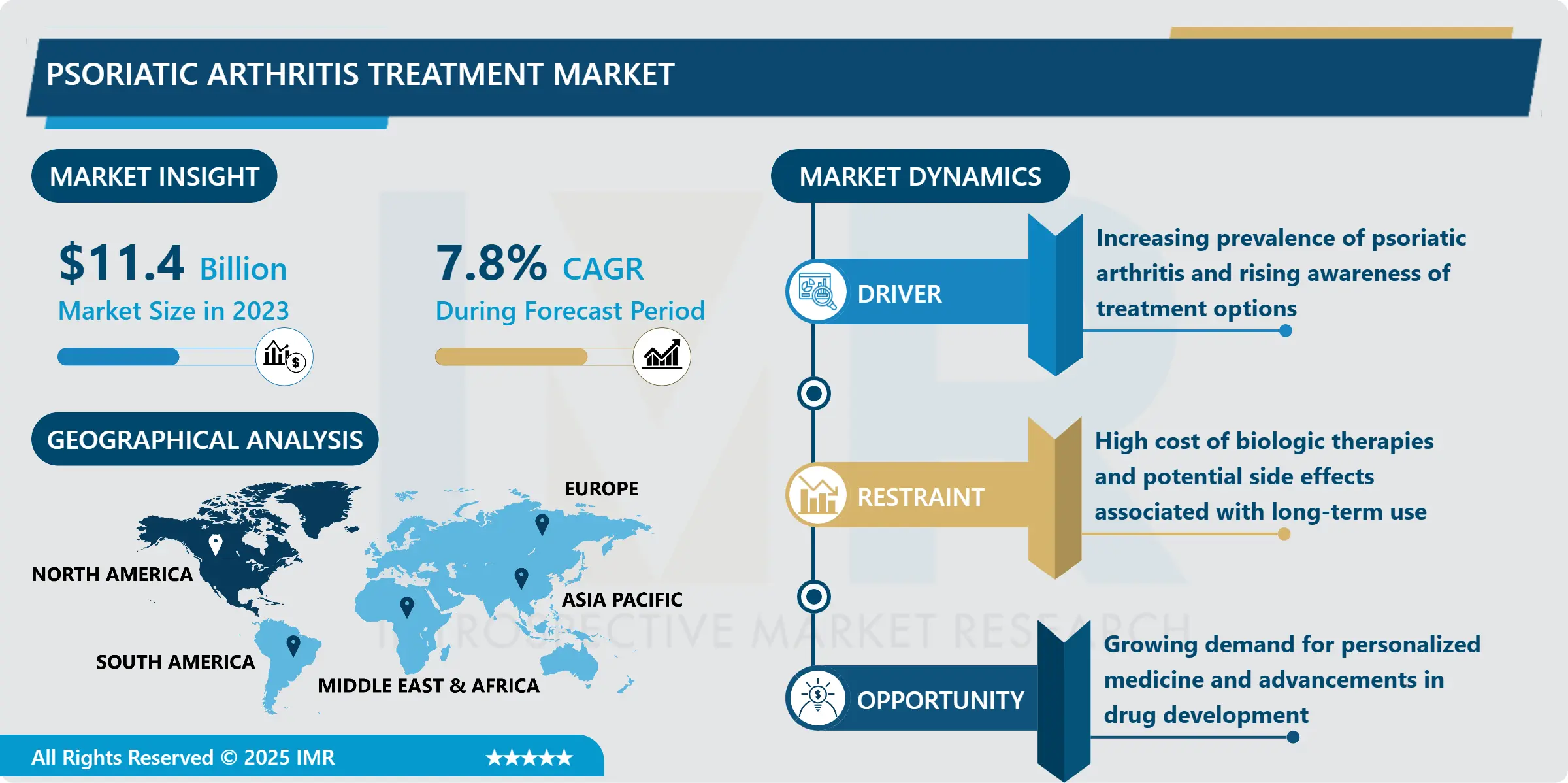
Psoriatic Arthritis Treatment Market Size Was Valued at USD 11.4 Billion in 2023, and is Projected to Reach USD 22.4 Billion by 2032, Growing at a CAGR of 7.8% From 2024-2032.
Psoriatic arthritis is a long-standing illness that causes joint inflammation and is often related to psoriasis, a skin disease that produces ruddy plaques. The Psoriatic Arthritis Treatment Market includes several types of approaches intended to treat the disease and alter the course of the pathology. These treatments include non-steroidal anti-inflammatory drugs (NSAIDs); disease-modifying antirheumatic drugs (DMARDs); biologics; and targeted therapies that seek to alleviate inflammation, pain and enhance the quality of life in persons living with the respective diseases.
The market for Psoriatic Arthritis Treatment is growing at a significant pace because of the rising incidence of the psoriatic arthritis globally. Recent research reveals that about thirty percent of psoriasis patients are likely to suffer from psoriatic arthritis demanding adequate treatment plans. The market is defined by the wide availability of any treatment needed for the disease, depending on its stage and possible symptoms. The escalating market is due to rising consciousness of psoriatic arthritis and major improvement in drug delivery systems. Also, the increased incidence of autoimmune disease and the need for personalized medicines have driven the market steadily.
Recent progress in the conceptualisation of new biologic agents has given patients with psoriatic arthritis better treatment options which are more effective. Market expansion has also been pegged on such developments as the biosimilars that act as cheaper options to pricey biologic treatments. Also, it has been easier for pharmaceutical firms and research institutions to actively partner to develop new therapies and care outperforms and drives the competition within the sector. Primarily, changes in healthcare service delivery that shift the emphasis from diseases and processes to patients and their needs have top motivated market growth owing to further expansion of telemedicine for remote consultations.
Psoriatic Arthritis Treatment Market Trend Analysis:
Increasing Use of Biologics in Psoriatic Arthritis Treatment
- The future of the biologic therapies in treating the psoriatic arthritis is increasing as evident in the current market. Biologic drugs are produced from living organisms which makes them to have unique action plans as far as the inflammatory features of PsA is concerned. Over the past ten years, many more biologic agents have been introduced and evidence in literature shows that aetiology of the disease has been managed, instead giving patients highly effective symptomatic relief. This aspect is well underpinned by increasing numbers of clinical trials, which demonstrate the safety and effectiveness of biologics, and increased trust from physicians and patients. In addition, application of Biosimilars is also expected to improve patient access to these innovative medicines and hence their application due to cheap prices. Inevitably, biologics are expected to remain at the heart of the continuous transformation of the Psoriatic Arthritis Treatment Market.
Rising Demand for Personalized Medicine
- Personalised medicine is the new trend in the healthcare industry which poses a major threat to the Psoriatic Arthritis Treatment Market. This therefore involves the formulation of treatment plan and therapeutic management that are specific to the genetic endowment, life style and the manifestation of the disease of the patient in question. With better advances in the understanding the biological processes associated with PsA, another chance to enhance PsA treatment and abate the side effects are made apparent. This phenomenon for patient-centred treatment is anticipated to improve the outcomes and patient satisfaction which will in turn increase demand of innovative treatments.
- Furthermore, the use of biomarkers to complement treatment choices may help in the detection of the disease, as well as the tracking of disease progression, both of which drive the market forward. This means that some pharmaceutical firms that would embark on research and developments of such drugs would likely enjoy greater market share since such patients are willing to pay for any personalized solutions.
Psoriatic Arthritis Treatment Market Segment Analysis:
Psoriatic Arthritis Treatment Market is Segmented on the basis of Drug Class, Product Type, Route of Administration, and Region.
By Drug Class, Non-steroidal Anti-inflammatory Drugs (NSAIDs) segment is expected to dominate the market during the forecast period
- Out of all the various types of treatment available, the Non-steroidal Anti-inflammatory Drugs (NSAIDs) segment is expected to control the Psoriatic Arthritis Treatment Market throughout the forecast period. Non-steroidal anti-inflammatory drugs are widely used because they possess a role in pain relief and inflammation elimination. Available in both prescription and over the counter forms, direct access to NSAIDs by both health care providers and patients plays to the drugs’ popularity.
- Since the costs of NSAIDs are comparatively much lower than other treatment procedures, these drugs are easily accessible, and hence preferable for anyone suffering from psoriatic arthritis. While healthcare managers aim at improving the quality of life of their patients, through symptom control, NSAIDs are likely to sustain their large market share. This segment is expected to regain its momentum in the future years owing to the constant innovation and advancement in formulation and delivery systems.
By Product Type, Prescriptions segment expected to held the largest share
- In this particular Psoriatic Arthritis Treatment Market the prescriptions segment is expected to take the biggest share. The modern pharmacotherapy of PA significantly involves prescription drugs including biologic and disease-modifying antirheumatic drugs because of their role in moderate to severe PA. Given the increasing customership incidence of psoriatic arthritis, it is imperative that prescription medication with ability to treat inflammatory processes and offer long-term symptom relief is developed.
- The assigned health care providers grew more aware of how treatments contribute to disease management and the subsequent patient outcomes. The strong velocity of new prescription drugs targeting PsA, coupled with growing R&D spending by pharmaceutical companies, maintains the leadership of this segment. Thus, the prescriptions segment is anticipated to remain a market leader as the number of cases of early and stringent treatments increases.
Psoriatic Arthritis Treatment Market Regional Insights:
North America is Expected to Dominate the Market Over the Forecast period
- According to the research, North America will lead the Psoriatic Arthritis Treatment Market in 2023 with a market share of about 45%. These factors include increased incidence of psoriatic arthritis in the region as well as higher levels of awareness of the disease and quality health care facilities. Most significantly, having established pharmaceutical markets such as the United States, there are numerous pharmaceutical firms that are involved in researching for and marketing of new therapies for psoriatic arthritis. Besides, increased establishment of clinical trials and research activities in the area ensures the offer of latest treatment solutions to patients. The dominance of Research and development, presence of effective biologics as well as prescription drugs has placed North America in a leading position in the Psoriatic Arthritis Treatment Market.
Active Key Players in the Psoriatic Arthritis Treatment Market:
- AbbVie (USA)
- Amgen (USA)
- Biogen (USA)
- Bristol-Myers Squibb (USA)
- Celgene (USA)
- Eli Lilly (USA)
- Gilead Sciences (USA)
- Janssen Pharmaceuticals (USA)
- Merck & Co. (USA)
- Novartis (Switzerland)
- Regeneron Pharmaceuticals (USA)
- Sanofi (France)
- Takeda Pharmaceutical Company (Japan)
- UCB (Belgium), and Other Active Players
|
Psoriatic Arthritis Treatment Market |
|||
|
Base Year: |
2023 |
Forecast Period: |
2024-2032 |
|
Historical Data: |
2017 to 2023 |
Market Size in 2023: |
USD 11.4 Billion |
|
Forecast Period 2024-32 CAGR: |
7.8% |
Market Size in 2032: |
USD 22.4 Billion |
|
Segments Covered: |
By Drug Class |
|
|
|
By Product Type |
|
||
|
By Route of Administration |
|
||
|
By Region |
|
||
|
Key Market Drivers: |
|
||
|
Key Market Restraints: |
|
||
|
Key Opportunities: |
|
||
|
Companies Covered in the report: |
|
||
Chapter 1: Introduction
1.1 Scope and Coverage
Chapter 2:Executive Summary
Chapter 3: Market Landscape
3.1 Market Dynamics
3.1.1 Drivers
3.1.2 Restraints
3.1.3 Opportunities
3.1.4 Challenges
3.2 Market Trend Analysis
3.3 PESTLE Analysis
3.4 Porter's Five Forces Analysis
3.5 Industry Value Chain Analysis
3.6 Ecosystem
3.7 Regulatory Landscape
3.8 Price Trend Analysis
3.9 Patent Analysis
3.10 Technology Evolution
3.11 Investment Pockets
3.12 Import-Export Analysis
Chapter 4: Psoriatic Arthritis Treatment Market by Drug Class
4.1 Psoriatic Arthritis Treatment Market Snapshot and Growth Engine
4.2 Psoriatic Arthritis Treatment Market Overview
4.3 Non-steroidal Anti-inflammatory Drugs (NSAIDs)
4.3.1 Introduction and Market Overview
4.3.2 Historic and Forecasted Market Size in Value USD and Volume Units (2017-2032F)
4.3.3 Key Market Trends, Growth Factors and Opportunities
4.3.4 Non-steroidal Anti-inflammatory Drugs (NSAIDs): Geographic Segmentation Analysis
4.4 Non-biologics Disease-modifying Anti-rheumatic Drugs (DMARDs)
4.4.1 Introduction and Market Overview
4.4.2 Historic and Forecasted Market Size in Value USD and Volume Units (2017-2032F)
4.4.3 Key Market Trends, Growth Factors and Opportunities
4.4.4 Non-biologics Disease-modifying Anti-rheumatic Drugs (DMARDs): Geographic Segmentation Analysis
4.5 Biologics Disease-modifying Anti-rheumatic Drugs
4.5.1 Introduction and Market Overview
4.5.2 Historic and Forecasted Market Size in Value USD and Volume Units (2017-2032F)
4.5.3 Key Market Trends, Growth Factors and Opportunities
4.5.4 Biologics Disease-modifying Anti-rheumatic Drugs: Geographic Segmentation Analysis
4.6 Others
4.6.1 Introduction and Market Overview
4.6.2 Historic and Forecasted Market Size in Value USD and Volume Units (2017-2032F)
4.6.3 Key Market Trends, Growth Factors and Opportunities
4.6.4 Others: Geographic Segmentation Analysis
Chapter 5: Psoriatic Arthritis Treatment Market by Product Type
5.1 Psoriatic Arthritis Treatment Market Snapshot and Growth Engine
5.2 Psoriatic Arthritis Treatment Market Overview
5.3 Prescriptions
5.3.1 Introduction and Market Overview
5.3.2 Historic and Forecasted Market Size in Value USD and Volume Units (2017-2032F)
5.3.3 Key Market Trends, Growth Factors and Opportunities
5.3.4 Prescriptions: Geographic Segmentation Analysis
5.4 OTC
5.4.1 Introduction and Market Overview
5.4.2 Historic and Forecasted Market Size in Value USD and Volume Units (2017-2032F)
5.4.3 Key Market Trends, Growth Factors and Opportunities
5.4.4 OTC: Geographic Segmentation Analysis
Chapter 6: Psoriatic Arthritis Treatment Market by Route of Administration
6.1 Psoriatic Arthritis Treatment Market Snapshot and Growth Engine
6.2 Psoriatic Arthritis Treatment Market Overview
6.3 Topical
6.3.1 Introduction and Market Overview
6.3.2 Historic and Forecasted Market Size in Value USD and Volume Units (2017-2032F)
6.3.3 Key Market Trends, Growth Factors and Opportunities
6.3.4 Topical: Geographic Segmentation Analysis
6.4 Oral
6.4.1 Introduction and Market Overview
6.4.2 Historic and Forecasted Market Size in Value USD and Volume Units (2017-2032F)
6.4.3 Key Market Trends, Growth Factors and Opportunities
6.4.4 Oral: Geographic Segmentation Analysis
6.5 Injectable
6.5.1 Introduction and Market Overview
6.5.2 Historic and Forecasted Market Size in Value USD and Volume Units (2017-2032F)
6.5.3 Key Market Trends, Growth Factors and Opportunities
6.5.4 Injectable: Geographic Segmentation Analysis
Chapter 7: Company Profiles and Competitive Analysis
7.1 Competitive Landscape
7.1.1 Competitive Benchmarking
7.1.2 Psoriatic Arthritis Treatment Market Share by Manufacturer (2023)
7.1.3 Industry BCG Matrix
7.1.4 Heat Map Analysis
7.1.5 Mergers and Acquisitions
7.2 ABBVIE (USA)
7.2.1 Company Overview
7.2.2 Key Executives
7.2.3 Company Snapshot
7.2.4 Role of the Company in the Market
7.2.5 Sustainability and Social Responsibility
7.2.6 Operating Business Segments
7.2.7 Product Portfolio
7.2.8 Business Performance
7.2.9 Key Strategic Moves and Recent Developments
7.2.10 SWOT Analysis
7.3 AMGEN (USA)
7.4 BIOGEN (USA)
7.5 BRISTOL-MYERS SQUIBB (USA)
7.6 CELGENE (USA)
7.7 ELI LILLY (USA)
7.8 GILEAD SCIENCES (USA)
7.9 JANSSEN PHARMACEUTICALS (USA)
7.10 MERCK & CO. (USA)
7.11 NOVARTIS (SWITZERLAND)
7.12 REGENERON PHARMACEUTICALS (USA)
7.13 SANOFI (FRANCE)
7.14 TAKEDA PHARMACEUTICAL COMPANY (JAPAN)
7.15 UCB (BELGIUM)
7.16
7.17 OTHER ACTIVE PLAYERS
Chapter 8: Global Psoriatic Arthritis Treatment Market By Region
8.1 Overview
8.2. North America Psoriatic Arthritis Treatment Market
8.2.1 Key Market Trends, Growth Factors and Opportunities
8.2.2 Top Key Companies
8.2.3 Historic and Forecasted Market Size by Segments
8.2.4 Historic and Forecasted Market Size By Drug Class
8.2.4.1 Non-steroidal Anti-inflammatory Drugs (NSAIDs)
8.2.4.2 Non-biologics Disease-modifying Anti-rheumatic Drugs (DMARDs)
8.2.4.3 Biologics Disease-modifying Anti-rheumatic Drugs
8.2.4.4 Others
8.2.5 Historic and Forecasted Market Size By Product Type
8.2.5.1 Prescriptions
8.2.5.2 OTC
8.2.6 Historic and Forecasted Market Size By Route of Administration
8.2.6.1 Topical
8.2.6.2 Oral
8.2.6.3 Injectable
8.2.7 Historic and Forecast Market Size by Country
8.2.7.1 US
8.2.7.2 Canada
8.2.7.3 Mexico
8.3. Eastern Europe Psoriatic Arthritis Treatment Market
8.3.1 Key Market Trends, Growth Factors and Opportunities
8.3.2 Top Key Companies
8.3.3 Historic and Forecasted Market Size by Segments
8.3.4 Historic and Forecasted Market Size By Drug Class
8.3.4.1 Non-steroidal Anti-inflammatory Drugs (NSAIDs)
8.3.4.2 Non-biologics Disease-modifying Anti-rheumatic Drugs (DMARDs)
8.3.4.3 Biologics Disease-modifying Anti-rheumatic Drugs
8.3.4.4 Others
8.3.5 Historic and Forecasted Market Size By Product Type
8.3.5.1 Prescriptions
8.3.5.2 OTC
8.3.6 Historic and Forecasted Market Size By Route of Administration
8.3.6.1 Topical
8.3.6.2 Oral
8.3.6.3 Injectable
8.3.7 Historic and Forecast Market Size by Country
8.3.7.1 Russia
8.3.7.2 Bulgaria
8.3.7.3 The Czech Republic
8.3.7.4 Hungary
8.3.7.5 Poland
8.3.7.6 Romania
8.3.7.7 Rest of Eastern Europe
8.4. Western Europe Psoriatic Arthritis Treatment Market
8.4.1 Key Market Trends, Growth Factors and Opportunities
8.4.2 Top Key Companies
8.4.3 Historic and Forecasted Market Size by Segments
8.4.4 Historic and Forecasted Market Size By Drug Class
8.4.4.1 Non-steroidal Anti-inflammatory Drugs (NSAIDs)
8.4.4.2 Non-biologics Disease-modifying Anti-rheumatic Drugs (DMARDs)
8.4.4.3 Biologics Disease-modifying Anti-rheumatic Drugs
8.4.4.4 Others
8.4.5 Historic and Forecasted Market Size By Product Type
8.4.5.1 Prescriptions
8.4.5.2 OTC
8.4.6 Historic and Forecasted Market Size By Route of Administration
8.4.6.1 Topical
8.4.6.2 Oral
8.4.6.3 Injectable
8.4.7 Historic and Forecast Market Size by Country
8.4.7.1 Germany
8.4.7.2 UK
8.4.7.3 France
8.4.7.4 The Netherlands
8.4.7.5 Italy
8.4.7.6 Spain
8.4.7.7 Rest of Western Europe
8.5. Asia Pacific Psoriatic Arthritis Treatment Market
8.5.1 Key Market Trends, Growth Factors and Opportunities
8.5.2 Top Key Companies
8.5.3 Historic and Forecasted Market Size by Segments
8.5.4 Historic and Forecasted Market Size By Drug Class
8.5.4.1 Non-steroidal Anti-inflammatory Drugs (NSAIDs)
8.5.4.2 Non-biologics Disease-modifying Anti-rheumatic Drugs (DMARDs)
8.5.4.3 Biologics Disease-modifying Anti-rheumatic Drugs
8.5.4.4 Others
8.5.5 Historic and Forecasted Market Size By Product Type
8.5.5.1 Prescriptions
8.5.5.2 OTC
8.5.6 Historic and Forecasted Market Size By Route of Administration
8.5.6.1 Topical
8.5.6.2 Oral
8.5.6.3 Injectable
8.5.7 Historic and Forecast Market Size by Country
8.5.7.1 China
8.5.7.2 India
8.5.7.3 Japan
8.5.7.4 South Korea
8.5.7.5 Malaysia
8.5.7.6 Thailand
8.5.7.7 Vietnam
8.5.7.8 The Philippines
8.5.7.9 Australia
8.5.7.10 New Zealand
8.5.7.11 Rest of APAC
8.6. Middle East & Africa Psoriatic Arthritis Treatment Market
8.6.1 Key Market Trends, Growth Factors and Opportunities
8.6.2 Top Key Companies
8.6.3 Historic and Forecasted Market Size by Segments
8.6.4 Historic and Forecasted Market Size By Drug Class
8.6.4.1 Non-steroidal Anti-inflammatory Drugs (NSAIDs)
8.6.4.2 Non-biologics Disease-modifying Anti-rheumatic Drugs (DMARDs)
8.6.4.3 Biologics Disease-modifying Anti-rheumatic Drugs
8.6.4.4 Others
8.6.5 Historic and Forecasted Market Size By Product Type
8.6.5.1 Prescriptions
8.6.5.2 OTC
8.6.6 Historic and Forecasted Market Size By Route of Administration
8.6.6.1 Topical
8.6.6.2 Oral
8.6.6.3 Injectable
8.6.7 Historic and Forecast Market Size by Country
8.6.7.1 Turkiye
8.6.7.2 Bahrain
8.6.7.3 Kuwait
8.6.7.4 Saudi Arabia
8.6.7.5 Qatar
8.6.7.6 UAE
8.6.7.7 Israel
8.6.7.8 South Africa
8.7. South America Psoriatic Arthritis Treatment Market
8.7.1 Key Market Trends, Growth Factors and Opportunities
8.7.2 Top Key Companies
8.7.3 Historic and Forecasted Market Size by Segments
8.7.4 Historic and Forecasted Market Size By Drug Class
8.7.4.1 Non-steroidal Anti-inflammatory Drugs (NSAIDs)
8.7.4.2 Non-biologics Disease-modifying Anti-rheumatic Drugs (DMARDs)
8.7.4.3 Biologics Disease-modifying Anti-rheumatic Drugs
8.7.4.4 Others
8.7.5 Historic and Forecasted Market Size By Product Type
8.7.5.1 Prescriptions
8.7.5.2 OTC
8.7.6 Historic and Forecasted Market Size By Route of Administration
8.7.6.1 Topical
8.7.6.2 Oral
8.7.6.3 Injectable
8.7.7 Historic and Forecast Market Size by Country
8.7.7.1 Brazil
8.7.7.2 Argentina
8.7.7.3 Rest of SA
Chapter 9 Analyst Viewpoint and Conclusion
9.1 Recommendations and Concluding Analysis
9.2 Potential Market Strategies
Chapter 10 Research Methodology
10.1 Research Process
10.2 Primary Research
10.3 Secondary Research
|
Psoriatic Arthritis Treatment Market |
|||
|
Base Year: |
2023 |
Forecast Period: |
2024-2032 |
|
Historical Data: |
2017 to 2023 |
Market Size in 2023: |
USD 11.4 Billion |
|
Forecast Period 2024-32 CAGR: |
7.8% |
Market Size in 2032: |
USD 22.4 Billion |
|
Segments Covered: |
By Drug Class |
|
|
|
By Product Type |
|
||
|
By Route of Administration |
|
||
|
By Region |
|
||
|
Key Market Drivers: |
|
||
|
Key Market Restraints: |
|
||
|
Key Opportunities: |
|
||
|
Companies Covered in the report: |
|
||


