




Pruritus Treatment Market Synopsis:
Pruritus Treatment Market Size Was Valued at USD 1.79 Billion in 2023, and is Projected to Reach USD 2.72 Billion by 2032, Growing at a CAGR of 4.80% From 2024-2032.
Pruritus treatment is the practice of alleviating itch or skin rash secondary to diseases like dermatitis, renal failure or psoriasis among others. Management goals are to reduce the symptom through conventional medicines and topical regimen that addresses the etiologies and alleviation of itching which helps enhance the life experience of affected people with the chronic itch analsex.
Growing cases of skin diseases like atopic dermatitis, psoriasis, and xerosis are the main factors influencing the pruritus treatment market. Because more people are being diagnosed with such diseases, there is increased call for treatment to be made for itching that comes with such diseases. Moreover, the increasing average age of population across the world is more vulnerable to disease causing pruritus thereby driving the market.
Constant technology improvement and innovative formation of drugs are creating market opportunities. The biologics and new antihistamines present better efficiency in comparison to standard drugs and fewer adverse effects. The growing knowledge of pruritus as related to healthcare professionals and patients is also driving the demand for new and efficient treatments.
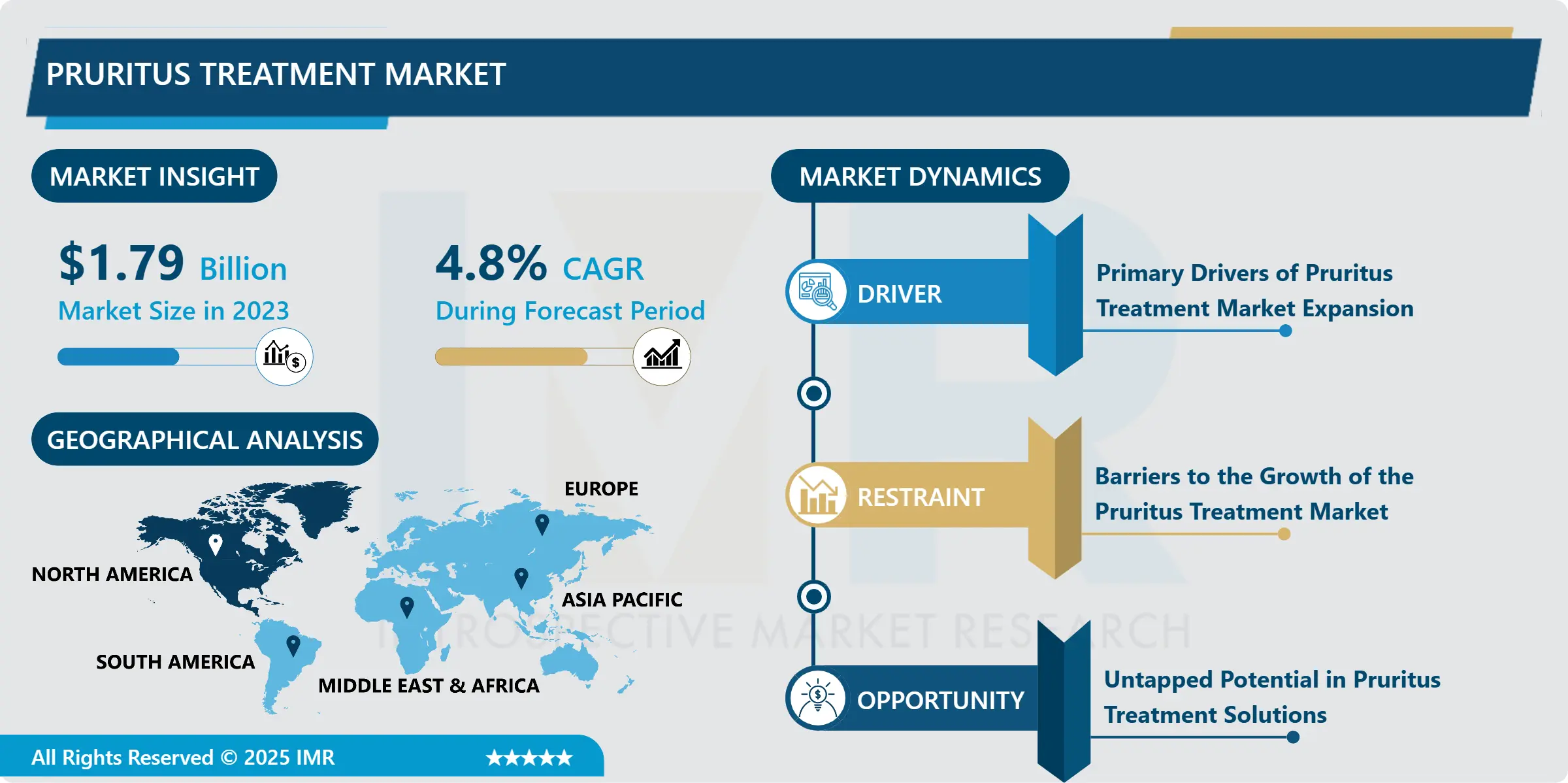
Pruritus Treatment Market Trend Analysis;
Shift towards biologic drugs and immune-modulating therapies
-
This market trend is particularly evident for patients with pruritus associated with various internal diseases or tolerant to standard therapeutic methods. These treatments allow a localized effect and therefore positively influences pruritus without the side effects of conventional corticosteroids or antihistamines. As more chronic diseases are being diagnosed, patient use of biologics for the long-term is more desirable.
-
The other trend, which is rapidly manifesting itself, concerns the use of external preparations bought without prescription, for example, emollients and anti-itch lotions. These products give quick relief, and they can be bought off the counter, meaning that you do not need a prescription to buy them, making them a go-to product for mild pruritus. Because people today are inclined towards such treatments due to the need for convenience, the market for those treatments is growing.
Growing demand for personalized medicine
-
Personalization is one such direction in the treatment needs of pruritus that creates a market opportunity. While new information is being discovered about the genetic and molecular basis of pruritus future treatments can be more specifically targeted to patients needs thereby increasing effectiveness while minimizing side effects; Evidence based; The trend of aiming for personalized therapies can therefore be harnessed by companies aiming at the safe and effective provision of the therapies.
-
There is also large opportunity in covering pruritus treatment in emerging market. As the facilities in healthcare are developed and enhanced and as individuals worldwide are becoming much more conscious about their health in developed regions such as Asia Pacific, Latin America, there is growing need for an efficient as well as cheap pruritus treatment. Organizations that strive to penetrate these areas can be guaranteed of increased market share.
Pruritus Treatment Market Segment Analysis:
Pruritus Treatment Market is Segmented on the basis of Type, Indication, Route of Administration, and Region.
By Type, Topical Treatments segment is expected to dominate the market during the forecast period
-
The pruritus treatment market is divided into two primary categories: topical and systemic treatments. Topical treatments, such as creams, ointments, and lotions, are applied directly to the skin, targeting localized itching and inflammation. These treatments are most commonly used for mild conditions like eczema, psoriasis, or allergic reactions. Topical agents provide quick relief for less severe cases by soothing and moisturizing the skin, helping to reduce irritation.
- On the other hand, systemic treatments are typically reserved for more severe or chronic cases of pruritus, such as uremic pruritus linked to kidney disease or other internal conditions. These treatments include oral medications, like antihistamines, steroids, and immunosuppressive drugs, or injections that address the underlying causes of intense and persistent itching, offering broader, more systemic relief.
By Indication, Atopic Dermatitis segment expected to held the largest share
-
The pruritus treatment market has been divided based on the indication for pruritus treatment which includes Atopic Dermatitis, Chronic Kidney Disease, Uremic Pruritus, Psoriasis, Xerosis and Other. Chronic inflammatory skin disease, atopic dermatitis, is one of the most common causes of itching.
- Kidney failure patients experience pruritus in their terminal stage of the disease, known as uremic pruritus. Other common indications are psoriasis which is an autoimmune skin disease and xerosis, skin dryness. There are other less common problems which may lead to pruritus such as allergy, infection and systemic illnesses.
Pruritus Treatment Market Regional Insights:
North America is Expected to Dominate the Market Over the Forecast period
-
The pruritus treatment market is region wise currently led by North America with the highest market share. The region is inclined towards a high incidence of conditions associated with pruritus such as atopic dermatitis and psoriasis, coupled with a strong hospital base infrastructure and better access to newer treatments. Pharmaceutical industry in North America also has strategic advantages such as having several leading pharmaceutical companies operation and continuous research on new therapies.
- Secondly, the above areas expenditure on health care and insurance, availability of prescription as well as over the counter available pruritus treatments categories the regions as market leaders. With the number of customers suffering from chronic skin disease increasing constantly, the appeal for pruritus therapies should persist in dictating the continued strength of North America.
Active Key Players in the Pruritus Treatment Market:
- AbbVie (USA)
- Amgen (USA)
- Bayer (Germany)
- Bristol-Myers Squibb (USA)
- Eli Lilly and Co. (USA)
- Johnson & Johnson (USA)
- Mylan (USA)
- Novartis (Switzerland)
- Pfizer (USA)
- Sanofi (France), and Other Active Players
|
Global Pruritus Treatment Market |
|||
|
Base Year: |
2023 |
Forecast Period: |
2024-2032 |
|
Historical Data: |
2017 to 2023 |
Market Size in 2023: |
USD 1.79 Billion |
|
Forecast Period 2024-32 CAGR: |
4.80% |
Market Size in 2032: |
USD 2.72 Billion |
|
Segments Covered: |
By Type |
|
|
|
By Indication |
|
||
|
By Route of Administration |
|
||
|
By Region |
|
||
|
Key Market Drivers: |
|
||
|
Key Market Restraints: |
|
||
|
Key Opportunities: |
|
||
|
Companies Covered in the report: |
|
||
Chapter 1: Introduction
1.1 Scope and Coverage
Chapter 2:Executive Summary
Chapter 3: Market Landscape
3.1 Market Dynamics
3.1.1 Drivers
3.1.2 Restraints
3.1.3 Opportunities
3.1.4 Challenges
3.2 Market Trend Analysis
3.3 PESTLE Analysis
3.4 Porter's Five Forces Analysis
3.5 Industry Value Chain Analysis
3.6 Ecosystem
3.7 Regulatory Landscape
3.8 Price Trend Analysis
3.9 Patent Analysis
3.10 Technology Evolution
3.11 Investment Pockets
3.12 Import-Export Analysis
Chapter 4: Pruritus Treatment Market by Drug Type
4.1 Pruritus Treatment Market Snapshot and Growth Engine
4.2 Pruritus Treatment Market Overview
4.3 Prostacyclin Analogs
4.3.1 Introduction and Market Overview
4.3.2 Historic and Forecasted Market Size in Value USD and Volume Units (2017-2032F)
4.3.3 Key Market Trends, Growth Factors and Opportunities
4.3.4 Prostacyclin Analogs: Geographic Segmentation Analysis
4.4 Endothelin Receptor Antagonists
4.4.1 Introduction and Market Overview
4.4.2 Historic and Forecasted Market Size in Value USD and Volume Units (2017-2032F)
4.4.3 Key Market Trends, Growth Factors and Opportunities
4.4.4 Endothelin Receptor Antagonists: Geographic Segmentation Analysis
4.5 Phosphodiesterase-5 Inhibitors
4.5.1 Introduction and Market Overview
4.5.2 Historic and Forecasted Market Size in Value USD and Volume Units (2017-2032F)
4.5.3 Key Market Trends, Growth Factors and Opportunities
4.5.4 Phosphodiesterase-5 Inhibitors: Geographic Segmentation Analysis
4.6 Soluble Guanylate Cyclase Stimulators
4.6.1 Introduction and Market Overview
4.6.2 Historic and Forecasted Market Size in Value USD and Volume Units (2017-2032F)
4.6.3 Key Market Trends, Growth Factors and Opportunities
4.6.4 Soluble Guanylate Cyclase Stimulators: Geographic Segmentation Analysis
4.7 Prostacyclin Receptor Agonists
4.7.1 Introduction and Market Overview
4.7.2 Historic and Forecasted Market Size in Value USD and Volume Units (2017-2032F)
4.7.3 Key Market Trends, Growth Factors and Opportunities
4.7.4 Prostacyclin Receptor Agonists: Geographic Segmentation Analysis
4.8 Others
4.8.1 Introduction and Market Overview
4.8.2 Historic and Forecasted Market Size in Value USD and Volume Units (2017-2032F)
4.8.3 Key Market Trends, Growth Factors and Opportunities
4.8.4 Others: Geographic Segmentation Analysis
Chapter 5: Pruritus Treatment Market by Disease Type
5.1 Pruritus Treatment Market Snapshot and Growth Engine
5.2 Pruritus Treatment Market Overview
5.3 Idiopathic Pulmonary Arterial Hypertension
5.3.1 Introduction and Market Overview
5.3.2 Historic and Forecasted Market Size in Value USD and Volume Units (2017-2032F)
5.3.3 Key Market Trends, Growth Factors and Opportunities
5.3.4 Idiopathic Pulmonary Arterial Hypertension: Geographic Segmentation Analysis
5.4 Heritable Pulmonary Arterial Hypertension
5.4.1 Introduction and Market Overview
5.4.2 Historic and Forecasted Market Size in Value USD and Volume Units (2017-2032F)
5.4.3 Key Market Trends, Growth Factors and Opportunities
5.4.4 Heritable Pulmonary Arterial Hypertension: Geographic Segmentation Analysis
5.5 Drug-Induced Pulmonary Arterial Hypertension
5.5.1 Introduction and Market Overview
5.5.2 Historic and Forecasted Market Size in Value USD and Volume Units (2017-2032F)
5.5.3 Key Market Trends, Growth Factors and Opportunities
5.5.4 Drug-Induced Pulmonary Arterial Hypertension: Geographic Segmentation Analysis
5.6 Other Types
5.6.1 Introduction and Market Overview
5.6.2 Historic and Forecasted Market Size in Value USD and Volume Units (2017-2032F)
5.6.3 Key Market Trends, Growth Factors and Opportunities
5.6.4 Other Types: Geographic Segmentation Analysis
Chapter 6: Pruritus Treatment Market by End User
6.1 Pruritus Treatment Market Snapshot and Growth Engine
6.2 Pruritus Treatment Market Overview
6.3 Hospitals
6.3.1 Introduction and Market Overview
6.3.2 Historic and Forecasted Market Size in Value USD and Volume Units (2017-2032F)
6.3.3 Key Market Trends, Growth Factors and Opportunities
6.3.4 Hospitals: Geographic Segmentation Analysis
6.4 Homecare
6.4.1 Introduction and Market Overview
6.4.2 Historic and Forecasted Market Size in Value USD and Volume Units (2017-2032F)
6.4.3 Key Market Trends, Growth Factors and Opportunities
6.4.4 Homecare: Geographic Segmentation Analysis
6.5 Clinics
6.5.1 Introduction and Market Overview
6.5.2 Historic and Forecasted Market Size in Value USD and Volume Units (2017-2032F)
6.5.3 Key Market Trends, Growth Factors and Opportunities
6.5.4 Clinics: Geographic Segmentation Analysis
Chapter 7: Company Profiles and Competitive Analysis
7.1 Competitive Landscape
7.1.1 Competitive Benchmarking
7.1.2 Pruritus Treatment Market Share by Manufacturer (2023)
7.1.3 Industry BCG Matrix
7.1.4 Heat Map Analysis
7.1.5 Mergers and Acquisitions
7.2 PFIZER (USA)
7.2.1 Company Overview
7.2.2 Key Executives
7.2.3 Company Snapshot
7.2.4 Role of the Company in the Market
7.2.5 Sustainability and Social Responsibility
7.2.6 Operating Business Segments
7.2.7 Product Portfolio
7.2.8 Business Performance
7.2.9 Key Strategic Moves and Recent Developments
7.2.10 SWOT Analysis
7.3 JOHNSON & JOHNSON (USA)
7.4 NOVARTIS (SWITZERLAND)
7.5 ELI LILLY AND CO. (USA)
7.6 MYLAN (USA)
7.7 SANOFI (FRANCE)
7.8 AMGEN (USA)
7.9 ABBVIE (USA)
7.10 BRISTOL-MYERS SQUIBB (USA)
7.11 BAYER (GERMANY)
7.12 OTHER ACTIVE PLAYERS
Chapter 8: Global Pruritus Treatment Market By Region
8.1 Overview
8.2. North America Pruritus Treatment Market
8.2.1 Key Market Trends, Growth Factors and Opportunities
8.2.2 Top Key Companies
8.2.3 Historic and Forecasted Market Size by Segments
8.2.4 Historic and Forecasted Market Size By Drug Type
8.2.4.1 Prostacyclin Analogs
8.2.4.2 Endothelin Receptor Antagonists
8.2.4.3 Phosphodiesterase-5 Inhibitors
8.2.4.4 Soluble Guanylate Cyclase Stimulators
8.2.4.5 Prostacyclin Receptor Agonists
8.2.4.6 Others
8.2.5 Historic and Forecasted Market Size By Disease Type
8.2.5.1 Idiopathic Pulmonary Arterial Hypertension
8.2.5.2 Heritable Pulmonary Arterial Hypertension
8.2.5.3 Drug-Induced Pulmonary Arterial Hypertension
8.2.5.4 Other Types
8.2.6 Historic and Forecasted Market Size By End User
8.2.6.1 Hospitals
8.2.6.2 Homecare
8.2.6.3 Clinics
8.2.7 Historic and Forecast Market Size by Country
8.2.7.1 US
8.2.7.2 Canada
8.2.7.3 Mexico
8.3. Eastern Europe Pruritus Treatment Market
8.3.1 Key Market Trends, Growth Factors and Opportunities
8.3.2 Top Key Companies
8.3.3 Historic and Forecasted Market Size by Segments
8.3.4 Historic and Forecasted Market Size By Drug Type
8.3.4.1 Prostacyclin Analogs
8.3.4.2 Endothelin Receptor Antagonists
8.3.4.3 Phosphodiesterase-5 Inhibitors
8.3.4.4 Soluble Guanylate Cyclase Stimulators
8.3.4.5 Prostacyclin Receptor Agonists
8.3.4.6 Others
8.3.5 Historic and Forecasted Market Size By Disease Type
8.3.5.1 Idiopathic Pulmonary Arterial Hypertension
8.3.5.2 Heritable Pulmonary Arterial Hypertension
8.3.5.3 Drug-Induced Pulmonary Arterial Hypertension
8.3.5.4 Other Types
8.3.6 Historic and Forecasted Market Size By End User
8.3.6.1 Hospitals
8.3.6.2 Homecare
8.3.6.3 Clinics
8.3.7 Historic and Forecast Market Size by Country
8.3.7.1 Russia
8.3.7.2 Bulgaria
8.3.7.3 The Czech Republic
8.3.7.4 Hungary
8.3.7.5 Poland
8.3.7.6 Romania
8.3.7.7 Rest of Eastern Europe
8.4. Western Europe Pruritus Treatment Market
8.4.1 Key Market Trends, Growth Factors and Opportunities
8.4.2 Top Key Companies
8.4.3 Historic and Forecasted Market Size by Segments
8.4.4 Historic and Forecasted Market Size By Drug Type
8.4.4.1 Prostacyclin Analogs
8.4.4.2 Endothelin Receptor Antagonists
8.4.4.3 Phosphodiesterase-5 Inhibitors
8.4.4.4 Soluble Guanylate Cyclase Stimulators
8.4.4.5 Prostacyclin Receptor Agonists
8.4.4.6 Others
8.4.5 Historic and Forecasted Market Size By Disease Type
8.4.5.1 Idiopathic Pulmonary Arterial Hypertension
8.4.5.2 Heritable Pulmonary Arterial Hypertension
8.4.5.3 Drug-Induced Pulmonary Arterial Hypertension
8.4.5.4 Other Types
8.4.6 Historic and Forecasted Market Size By End User
8.4.6.1 Hospitals
8.4.6.2 Homecare
8.4.6.3 Clinics
8.4.7 Historic and Forecast Market Size by Country
8.4.7.1 Germany
8.4.7.2 UK
8.4.7.3 France
8.4.7.4 The Netherlands
8.4.7.5 Italy
8.4.7.6 Spain
8.4.7.7 Rest of Western Europe
8.5. Asia Pacific Pruritus Treatment Market
8.5.1 Key Market Trends, Growth Factors and Opportunities
8.5.2 Top Key Companies
8.5.3 Historic and Forecasted Market Size by Segments
8.5.4 Historic and Forecasted Market Size By Drug Type
8.5.4.1 Prostacyclin Analogs
8.5.4.2 Endothelin Receptor Antagonists
8.5.4.3 Phosphodiesterase-5 Inhibitors
8.5.4.4 Soluble Guanylate Cyclase Stimulators
8.5.4.5 Prostacyclin Receptor Agonists
8.5.4.6 Others
8.5.5 Historic and Forecasted Market Size By Disease Type
8.5.5.1 Idiopathic Pulmonary Arterial Hypertension
8.5.5.2 Heritable Pulmonary Arterial Hypertension
8.5.5.3 Drug-Induced Pulmonary Arterial Hypertension
8.5.5.4 Other Types
8.5.6 Historic and Forecasted Market Size By End User
8.5.6.1 Hospitals
8.5.6.2 Homecare
8.5.6.3 Clinics
8.5.7 Historic and Forecast Market Size by Country
8.5.7.1 China
8.5.7.2 India
8.5.7.3 Japan
8.5.7.4 South Korea
8.5.7.5 Malaysia
8.5.7.6 Thailand
8.5.7.7 Vietnam
8.5.7.8 The Philippines
8.5.7.9 Australia
8.5.7.10 New Zealand
8.5.7.11 Rest of APAC
8.6. Middle East & Africa Pruritus Treatment Market
8.6.1 Key Market Trends, Growth Factors and Opportunities
8.6.2 Top Key Companies
8.6.3 Historic and Forecasted Market Size by Segments
8.6.4 Historic and Forecasted Market Size By Drug Type
8.6.4.1 Prostacyclin Analogs
8.6.4.2 Endothelin Receptor Antagonists
8.6.4.3 Phosphodiesterase-5 Inhibitors
8.6.4.4 Soluble Guanylate Cyclase Stimulators
8.6.4.5 Prostacyclin Receptor Agonists
8.6.4.6 Others
8.6.5 Historic and Forecasted Market Size By Disease Type
8.6.5.1 Idiopathic Pulmonary Arterial Hypertension
8.6.5.2 Heritable Pulmonary Arterial Hypertension
8.6.5.3 Drug-Induced Pulmonary Arterial Hypertension
8.6.5.4 Other Types
8.6.6 Historic and Forecasted Market Size By End User
8.6.6.1 Hospitals
8.6.6.2 Homecare
8.6.6.3 Clinics
8.6.7 Historic and Forecast Market Size by Country
8.6.7.1 Turkiye
8.6.7.2 Bahrain
8.6.7.3 Kuwait
8.6.7.4 Saudi Arabia
8.6.7.5 Qatar
8.6.7.6 UAE
8.6.7.7 Israel
8.6.7.8 South Africa
8.7. South America Pruritus Treatment Market
8.7.1 Key Market Trends, Growth Factors and Opportunities
8.7.2 Top Key Companies
8.7.3 Historic and Forecasted Market Size by Segments
8.7.4 Historic and Forecasted Market Size By Drug Type
8.7.4.1 Prostacyclin Analogs
8.7.4.2 Endothelin Receptor Antagonists
8.7.4.3 Phosphodiesterase-5 Inhibitors
8.7.4.4 Soluble Guanylate Cyclase Stimulators
8.7.4.5 Prostacyclin Receptor Agonists
8.7.4.6 Others
8.7.5 Historic and Forecasted Market Size By Disease Type
8.7.5.1 Idiopathic Pulmonary Arterial Hypertension
8.7.5.2 Heritable Pulmonary Arterial Hypertension
8.7.5.3 Drug-Induced Pulmonary Arterial Hypertension
8.7.5.4 Other Types
8.7.6 Historic and Forecasted Market Size By End User
8.7.6.1 Hospitals
8.7.6.2 Homecare
8.7.6.3 Clinics
8.7.7 Historic and Forecast Market Size by Country
8.7.7.1 Brazil
8.7.7.2 Argentina
8.7.7.3 Rest of SA
Chapter 9 Analyst Viewpoint and Conclusion
9.1 Recommendations and Concluding Analysis
9.2 Potential Market Strategies
Chapter 10 Research Methodology
10.1 Research Process
10.2 Primary Research
10.3 Secondary Research
|
Global Pruritus Treatment Market |
|||
|
Base Year: |
2023 |
Forecast Period: |
2024-2032 |
|
Historical Data: |
2017 to 2023 |
Market Size in 2023: |
USD 1.79 Billion |
|
Forecast Period 2024-32 CAGR: |
4.80% |
Market Size in 2032: |
USD 2.72 Billion |
|
Segments Covered: |
By Type |
|
|
|
By Indication |
|
||
|
By Route of Administration |
|
||
|
By Region |
|
||
|
Key Market Drivers: |
|
||
|
Key Market Restraints: |
|
||
|
Key Opportunities: |
|
||
|
Companies Covered in the report: |
|
||


