




Proteinase K Market Synopsis:
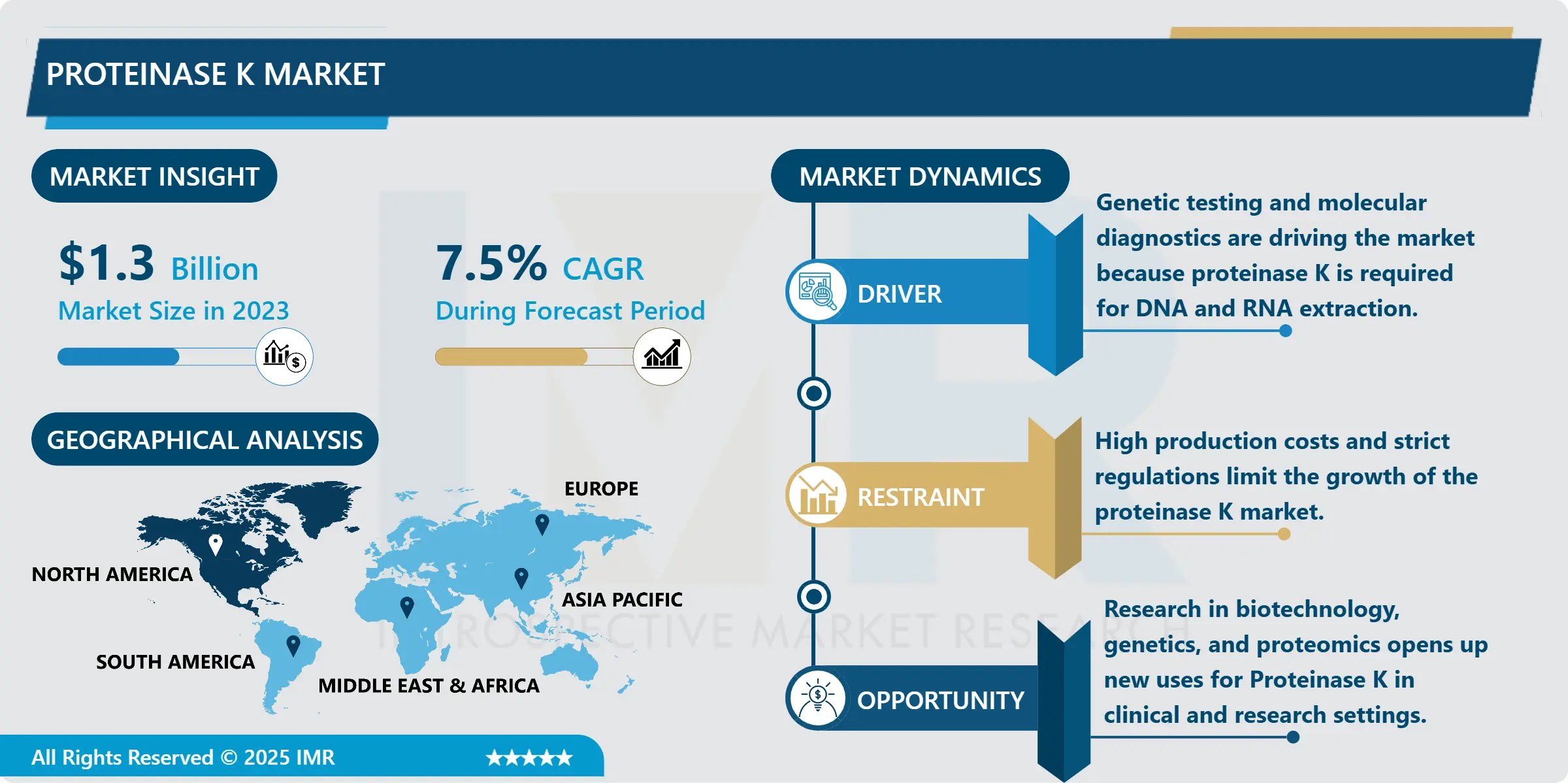
Proteinase K Market Size Was Valued at USD 1.3 Billion in 2023, and is Projected to Reach USD 2.5 Billion by 2032, Growing at a CAGR of 7.5% From 2024-2032.
The market of the Proteinase K is expanding very rapidly due to its importance in molecular biology and biotechnology sectors in DNA and RNA isolation, protein degradation, and enzyme resolution. Tritirachium album serine protease recombinant popularly known as Proteinase K is a well-established enzyme used routinely to denature proteins and dissolve them rather effectively at high and low temperatures as well as high and low pH. Such usage makes it widely used in research laboratories, diagnosis processes, and drug production processes. More importantly, Proteinase K is used widely in next-generation sequencing, polymerase chain reaction testing and other molecular diagnostics.
Proteinase K is the most demanded enzyme, primarily due to molecular diagnostics which has become the primary focus in genetic testing and infectious condition diagnostics. This demand has risen significantly in the past years especially during the COVID-19 continue to use pandemic, where Proteinase K was extensively used during RNA extraction for COVID-19 test. The super growth in the fields of genomics, proteomics and personalized medicines will also drive the Proteinase K market even further. On the same note, the ever-growing market on biopharmaceutical is also another motivating factor, because high purity enzymes such as Proteinase K is used in drug manufacturing to degrade other proteins in the preparation, before the main biopharmaceutical is produced.
But the Proteinase K market has some drawbacks for example, relatively high costs of enzyme production and difficulties in obtaining pure enzyme raw materials. The market is also constrained by factors such as the presence of other protein digesting enzymes and the continuous requirement for effective regulatory approval. However, the Proteinase K market is expected to grow significantly due to the increasing demand for protein degradation, particularly in North America and Europe because of highly developed biotechnology and pharmaceutical industries, while Asian-Pacific region as a growing market with investment on biotech research and development.
Proteinase K Market Trend Analysis:
Rising Demand in Molecular Diagnostics
- One major movement which can be identified in the field of Proteinase K is the growing incorporation of the molecule to molecular diagnostics targeted towards genetic analysis, forensic sciences, and the detection of infectious diseases. This is important for high precision processes like PCR and next generation sequencing (NGS), because the enzyme can easily break down proteins and extract DNA and RNA. This trend has been even further exacerbated by the COVID-19 pandemic, during which Proteinase K was used in RNA extraction procedures. Due to the continuous emergence and development of potential molecular diagnostic tests especially with improvements in the point of care diagnosis, Proteinase K is expected demand in the future years.
Expansion in Biopharmaceutical Applications
- The advancement of the biopharmaceutical industry has opened new market segments for application of Proteinase K, used in purity enhancement of drugs. Biopharmaceuticals needed to be purified in such a manner that even a single protein molecule of the wrong kind should not come into the packaged productucky so Proteinase K has distinct advantage as enzyme that can breakdown unwanted proteins. With the increase in biologics and gene therapy the requirements of contamination free environment has led to Proteinase K becoming the first choice for many of the companies. It is anticipated that with an increasing number of biopharmaceutical companies developing their enzyme-based solutions, this trend will also continue.
Proteinase K Market Segment Analysis:
Proteinase K Market is Segmented on the basis of Form, Therapeutic Area, End-use, By Application, and Regoin.
By Form, Liquid segment is expected to dominate the market during the forecast period
- The Proteinase K Market is most broadly segmented by its form – which mainly includes the powder/liquid split. Compared to liquid enzymes, the powdered form of Proteinase K is preferred due to its stability, easy preservation, and flexibility of portioning The improved shelf stability, ease of handling, and accurate dosing of the powdered form makes it particularly valuable in molecular biology processes such as, DNA and RNA extraction where specific enzyme activity is(d) essential. On the other hand, liquid products have a high level of adoption due to flexible and ease-of-use application nature and reduced preparation time compared to standard solid formulations. The availability of bothGæ inst and recombinant forms of Proteinase K benefits the suppliers in that it provides a product to meet a wide range of consumer preference and applications needss, and strengthens Proteinase K’s position in the research, clinical, and industrial markets. As we look forward to advancements in the fields of genomics and proteomics, the market for Proteinase K, both in the powdered form and in the liquid form we have seen, is only set to increase and the distinct competitive pressures come into play.
By Application, Contract Research Organization segment expected to held the largest share
- The Proteinase K market, segmented by application into contract research organizations (CROs), academic institutes, biotechnology companies, and diagnostic laboratories, is seeing substantial growth due to the enzyme’s critical role in molecular biology and diagnostics. CROs and biotechnology companies utilize Proteinase K extensively for its ability to digest proteins, which is essential in DNA and RNA extraction processes, making it highly valuable for research and development in genomics and proteomics. In academic institutes, the enzyme supports diverse studies in genetics and protein analysis, while diagnostic laboratories rely on Proteinase K in molecular diagnostics, especially for detecting infectious diseases and genetic disorders. The increasing adoption of precision medicine and advanced molecular diagnostics is expected to drive demand further, as the enzyme plays a pivotal role in sample preparation and analytical procedures across these varied applications.
Proteinase K Market Regional Insights:
North America is Expected to Dominate the Market Over the Forecast period
- North America is anticipated to lead the Proteinase K market throughout the forecast period, driven by significant advancements in biotechnology and molecular research within the region. High investment in life sciences, coupled with a strong presence of key industry players, supports market growth. The increasing prevalence of genetic disorders and infectious diseases is further boosting demand for Proteinase K, as it plays a crucial role in DNA and RNA extraction processes for diagnostics and research. Additionally, the region’s favourable regulatory landscape and well-established research infrastructure contribute to its dominance in the Proteinase K market.
Active Key Players in the Proteinase K Market:
- Merck KGaA (Germany)
- QIAGEN (Germany)
- Thermo Fisher Scientific Inc. (USA)
- F. Hoffmann-La Roche Ltd (Switzerland)
- Abcam plc. (Cambridge, United Kingdom)
- Agilent Technologies Inc. (USA)
- Biocatalysts (United Kingdom)
- Minerva Biolabs GmbH (Germany)
- Promega Corporation (USA)
- Takara Bio Inc. (Japan)
- New England Biolabs (USA)
- MP BIOMEDICALS (USA), and Other Active Players
|
Proteinase K Market |
|||
|
Base Year: |
2023 |
Forecast Period: |
2024-2032 |
|
Historical Data: |
2017 to 2023 |
Market Size in 2023: |
USD 1.3 Billion |
|
Forecast Period 2024-32 CAGR: |
7.5% |
Market Size in 2032: |
USD 2.5 Billion |
|
Segments Covered: |
By Form |
|
|
|
By Therapeutic Area |
|
||
|
By End-use |
|
||
|
By Application |
|
||
|
By Region |
|
||
|
Key Market Drivers: |
|
||
|
Key Market Restraints: |
|
||
|
Key Opportunities: |
|
||
|
Companies Covered in the report: |
|
||
Chapter 1: Introduction
1.1 Scope and Coverage
Chapter 2:Executive Summary
Chapter 3: Market Landscape
3.1 Market Dynamics
3.1.1 Drivers
3.1.2 Restraints
3.1.3 Opportunities
3.1.4 Challenges
3.2 Market Trend Analysis
3.3 PESTLE Analysis
3.4 Porter's Five Forces Analysis
3.5 Industry Value Chain Analysis
3.6 Ecosystem
3.7 Regulatory Landscape
3.8 Price Trend Analysis
3.9 Patent Analysis
3.10 Technology Evolution
3.11 Investment Pockets
3.12 Import-Export Analysis
Chapter 4: Proteinase K Market by Form
4.1 Proteinase K Market Snapshot and Growth Engine
4.2 Proteinase K Market Overview
4.3 Powder
4.3.1 Introduction and Market Overview
4.3.2 Historic and Forecasted Market Size in Value USD and Volume Units (2017-2032F)
4.3.3 Key Market Trends, Growth Factors and Opportunities
4.3.4 Powder: Geographic Segmentation Analysis
4.4 Liquid
4.4.1 Introduction and Market Overview
4.4.2 Historic and Forecasted Market Size in Value USD and Volume Units (2017-2032F)
4.4.3 Key Market Trends, Growth Factors and Opportunities
4.4.4 Liquid: Geographic Segmentation Analysis
Chapter 5: Proteinase K Market by Therapeutic Area
5.1 Proteinase K Market Snapshot and Growth Engine
5.2 Proteinase K Market Overview
5.3 Infectious Diseases
5.3.1 Introduction and Market Overview
5.3.2 Historic and Forecasted Market Size in Value USD and Volume Units (2017-2032F)
5.3.3 Key Market Trends, Growth Factors and Opportunities
5.3.4 Infectious Diseases: Geographic Segmentation Analysis
5.4 Diabetes
5.4.1 Introduction and Market Overview
5.4.2 Historic and Forecasted Market Size in Value USD and Volume Units (2017-2032F)
5.4.3 Key Market Trends, Growth Factors and Opportunities
5.4.4 Diabetes: Geographic Segmentation Analysis
5.5 Oncology
5.5.1 Introduction and Market Overview
5.5.2 Historic and Forecasted Market Size in Value USD and Volume Units (2017-2032F)
5.5.3 Key Market Trends, Growth Factors and Opportunities
5.5.4 Oncology: Geographic Segmentation Analysis
5.6 Cardiology
5.6.1 Introduction and Market Overview
5.6.2 Historic and Forecasted Market Size in Value USD and Volume Units (2017-2032F)
5.6.3 Key Market Trends, Growth Factors and Opportunities
5.6.4 Cardiology: Geographic Segmentation Analysis
5.7 Nephrology
5.7.1 Introduction and Market Overview
5.7.2 Historic and Forecasted Market Size in Value USD and Volume Units (2017-2032F)
5.7.3 Key Market Trends, Growth Factors and Opportunities
5.7.4 Nephrology: Geographic Segmentation Analysis
5.8 Autoimmune Diseases
5.8.1 Introduction and Market Overview
5.8.2 Historic and Forecasted Market Size in Value USD and Volume Units (2017-2032F)
5.8.3 Key Market Trends, Growth Factors and Opportunities
5.8.4 Autoimmune Diseases: Geographic Segmentation Analysis
5.9 Neurology
5.9.1 Introduction and Market Overview
5.9.2 Historic and Forecasted Market Size in Value USD and Volume Units (2017-2032F)
5.9.3 Key Market Trends, Growth Factors and Opportunities
5.9.4 Neurology: Geographic Segmentation Analysis
5.10 Others
5.10.1 Introduction and Market Overview
5.10.2 Historic and Forecasted Market Size in Value USD and Volume Units (2017-2032F)
5.10.3 Key Market Trends, Growth Factors and Opportunities
5.10.4 Others: Geographic Segmentation Analysis
Chapter 6: Proteinase K Market by End-use
6.1 Proteinase K Market Snapshot and Growth Engine
6.2 Proteinase K Market Overview
6.3 Isolation and Purification of Genomic DNA & RNA
6.3.1 Introduction and Market Overview
6.3.2 Historic and Forecasted Market Size in Value USD and Volume Units (2017-2032F)
6.3.3 Key Market Trends, Growth Factors and Opportunities
6.3.4 Isolation and Purification of Genomic DNA & RNA: Geographic Segmentation Analysis
6.4 In Situ Hybridization
6.4.1 Introduction and Market Overview
6.4.2 Historic and Forecasted Market Size in Value USD and Volume Units (2017-2032F)
6.4.3 Key Market Trends, Growth Factors and Opportunities
6.4.4 In Situ Hybridization: Geographic Segmentation Analysis
6.5 Mitochondria Isolation
6.5.1 Introduction and Market Overview
6.5.2 Historic and Forecasted Market Size in Value USD and Volume Units (2017-2032F)
6.5.3 Key Market Trends, Growth Factors and Opportunities
6.5.4 Mitochondria Isolation: Geographic Segmentation Analysis
Chapter 7: Proteinase K Market by Application
7.1 Proteinase K Market Snapshot and Growth Engine
7.2 Proteinase K Market Overview
7.3 Contract Research Organization
7.3.1 Introduction and Market Overview
7.3.2 Historic and Forecasted Market Size in Value USD and Volume Units (2017-2032F)
7.3.3 Key Market Trends, Growth Factors and Opportunities
7.3.4 Contract Research Organization: Geographic Segmentation Analysis
7.4 Academic Institutes
7.4.1 Introduction and Market Overview
7.4.2 Historic and Forecasted Market Size in Value USD and Volume Units (2017-2032F)
7.4.3 Key Market Trends, Growth Factors and Opportunities
7.4.4 Academic Institutes: Geographic Segmentation Analysis
7.5 Biotechnology Companies
7.5.1 Introduction and Market Overview
7.5.2 Historic and Forecasted Market Size in Value USD and Volume Units (2017-2032F)
7.5.3 Key Market Trends, Growth Factors and Opportunities
7.5.4 Biotechnology Companies: Geographic Segmentation Analysis
7.6 Diagnostic Laboratories
7.6.1 Introduction and Market Overview
7.6.2 Historic and Forecasted Market Size in Value USD and Volume Units (2017-2032F)
7.6.3 Key Market Trends, Growth Factors and Opportunities
7.6.4 Diagnostic Laboratories: Geographic Segmentation Analysis
Chapter 8: Company Profiles and Competitive Analysis
8.1 Competitive Landscape
8.1.1 Competitive Benchmarking
8.1.2 Proteinase K Market Share by Manufacturer (2023)
8.1.3 Industry BCG Matrix
8.1.4 Heat Map Analysis
8.1.5 Mergers and Acquisitions
8.2 MERCK KGAA (GERMANY)
8.2.1 Company Overview
8.2.2 Key Executives
8.2.3 Company Snapshot
8.2.4 Role of the Company in the Market
8.2.5 Sustainability and Social Responsibility
8.2.6 Operating Business Segments
8.2.7 Product Portfolio
8.2.8 Business Performance
8.2.9 Key Strategic Moves and Recent Developments
8.2.10 SWOT Analysis
8.3 QIAGEN (GERMANY)
8.4 THERMO FISHER SCIENTIFIC INC. (USA)
8.5 F. HOFFMANN-LA ROCHE LTD (SWITZERLAND)
8.6 ABCAM PLC. (CAMBRIDGE
8.7 UNITED KINGDOM)
8.8 AGILENT TECHNOLOGIES INC. (USA)
8.9 BIOCATALYSTS (UNITED KINGDOM)
8.10 MINERVA BIOLABS GMBH (GERMANY)
8.11 PROMEGA CORPORATION (USA)
8.12 TAKARA BIO INC. (JAPAN)
8.13 NEW ENGLAND BIOLABS (USA)
8.14 MP BIOMEDICALS (USA)
8.15 OTHER ACTIVE PLAYERS
Chapter 9: Global Proteinase K Market By Region
9.1 Overview
9.2. North America Proteinase K Market
9.2.1 Key Market Trends, Growth Factors and Opportunities
9.2.2 Top Key Companies
9.2.3 Historic and Forecasted Market Size by Segments
9.2.4 Historic and Forecasted Market Size By Form
9.2.4.1 Powder
9.2.4.2 Liquid
9.2.5 Historic and Forecasted Market Size By Therapeutic Area
9.2.5.1 Infectious Diseases
9.2.5.2 Diabetes
9.2.5.3 Oncology
9.2.5.4 Cardiology
9.2.5.5 Nephrology
9.2.5.6 Autoimmune Diseases
9.2.5.7 Neurology
9.2.5.8 Others
9.2.6 Historic and Forecasted Market Size By End-use
9.2.6.1 Isolation and Purification of Genomic DNA & RNA
9.2.6.2 In Situ Hybridization
9.2.6.3 Mitochondria Isolation
9.2.7 Historic and Forecasted Market Size By Application
9.2.7.1 Contract Research Organization
9.2.7.2 Academic Institutes
9.2.7.3 Biotechnology Companies
9.2.7.4 Diagnostic Laboratories
9.2.8 Historic and Forecast Market Size by Country
9.2.8.1 US
9.2.8.2 Canada
9.2.8.3 Mexico
9.3. Eastern Europe Proteinase K Market
9.3.1 Key Market Trends, Growth Factors and Opportunities
9.3.2 Top Key Companies
9.3.3 Historic and Forecasted Market Size by Segments
9.3.4 Historic and Forecasted Market Size By Form
9.3.4.1 Powder
9.3.4.2 Liquid
9.3.5 Historic and Forecasted Market Size By Therapeutic Area
9.3.5.1 Infectious Diseases
9.3.5.2 Diabetes
9.3.5.3 Oncology
9.3.5.4 Cardiology
9.3.5.5 Nephrology
9.3.5.6 Autoimmune Diseases
9.3.5.7 Neurology
9.3.5.8 Others
9.3.6 Historic and Forecasted Market Size By End-use
9.3.6.1 Isolation and Purification of Genomic DNA & RNA
9.3.6.2 In Situ Hybridization
9.3.6.3 Mitochondria Isolation
9.3.7 Historic and Forecasted Market Size By Application
9.3.7.1 Contract Research Organization
9.3.7.2 Academic Institutes
9.3.7.3 Biotechnology Companies
9.3.7.4 Diagnostic Laboratories
9.3.8 Historic and Forecast Market Size by Country
9.3.8.1 Russia
9.3.8.2 Bulgaria
9.3.8.3 The Czech Republic
9.3.8.4 Hungary
9.3.8.5 Poland
9.3.8.6 Romania
9.3.8.7 Rest of Eastern Europe
9.4. Western Europe Proteinase K Market
9.4.1 Key Market Trends, Growth Factors and Opportunities
9.4.2 Top Key Companies
9.4.3 Historic and Forecasted Market Size by Segments
9.4.4 Historic and Forecasted Market Size By Form
9.4.4.1 Powder
9.4.4.2 Liquid
9.4.5 Historic and Forecasted Market Size By Therapeutic Area
9.4.5.1 Infectious Diseases
9.4.5.2 Diabetes
9.4.5.3 Oncology
9.4.5.4 Cardiology
9.4.5.5 Nephrology
9.4.5.6 Autoimmune Diseases
9.4.5.7 Neurology
9.4.5.8 Others
9.4.6 Historic and Forecasted Market Size By End-use
9.4.6.1 Isolation and Purification of Genomic DNA & RNA
9.4.6.2 In Situ Hybridization
9.4.6.3 Mitochondria Isolation
9.4.7 Historic and Forecasted Market Size By Application
9.4.7.1 Contract Research Organization
9.4.7.2 Academic Institutes
9.4.7.3 Biotechnology Companies
9.4.7.4 Diagnostic Laboratories
9.4.8 Historic and Forecast Market Size by Country
9.4.8.1 Germany
9.4.8.2 UK
9.4.8.3 France
9.4.8.4 The Netherlands
9.4.8.5 Italy
9.4.8.6 Spain
9.4.8.7 Rest of Western Europe
9.5. Asia Pacific Proteinase K Market
9.5.1 Key Market Trends, Growth Factors and Opportunities
9.5.2 Top Key Companies
9.5.3 Historic and Forecasted Market Size by Segments
9.5.4 Historic and Forecasted Market Size By Form
9.5.4.1 Powder
9.5.4.2 Liquid
9.5.5 Historic and Forecasted Market Size By Therapeutic Area
9.5.5.1 Infectious Diseases
9.5.5.2 Diabetes
9.5.5.3 Oncology
9.5.5.4 Cardiology
9.5.5.5 Nephrology
9.5.5.6 Autoimmune Diseases
9.5.5.7 Neurology
9.5.5.8 Others
9.5.6 Historic and Forecasted Market Size By End-use
9.5.6.1 Isolation and Purification of Genomic DNA & RNA
9.5.6.2 In Situ Hybridization
9.5.6.3 Mitochondria Isolation
9.5.7 Historic and Forecasted Market Size By Application
9.5.7.1 Contract Research Organization
9.5.7.2 Academic Institutes
9.5.7.3 Biotechnology Companies
9.5.7.4 Diagnostic Laboratories
9.5.8 Historic and Forecast Market Size by Country
9.5.8.1 China
9.5.8.2 India
9.5.8.3 Japan
9.5.8.4 South Korea
9.5.8.5 Malaysia
9.5.8.6 Thailand
9.5.8.7 Vietnam
9.5.8.8 The Philippines
9.5.8.9 Australia
9.5.8.10 New Zealand
9.5.8.11 Rest of APAC
9.6. Middle East & Africa Proteinase K Market
9.6.1 Key Market Trends, Growth Factors and Opportunities
9.6.2 Top Key Companies
9.6.3 Historic and Forecasted Market Size by Segments
9.6.4 Historic and Forecasted Market Size By Form
9.6.4.1 Powder
9.6.4.2 Liquid
9.6.5 Historic and Forecasted Market Size By Therapeutic Area
9.6.5.1 Infectious Diseases
9.6.5.2 Diabetes
9.6.5.3 Oncology
9.6.5.4 Cardiology
9.6.5.5 Nephrology
9.6.5.6 Autoimmune Diseases
9.6.5.7 Neurology
9.6.5.8 Others
9.6.6 Historic and Forecasted Market Size By End-use
9.6.6.1 Isolation and Purification of Genomic DNA & RNA
9.6.6.2 In Situ Hybridization
9.6.6.3 Mitochondria Isolation
9.6.7 Historic and Forecasted Market Size By Application
9.6.7.1 Contract Research Organization
9.6.7.2 Academic Institutes
9.6.7.3 Biotechnology Companies
9.6.7.4 Diagnostic Laboratories
9.6.8 Historic and Forecast Market Size by Country
9.6.8.1 Turkiye
9.6.8.2 Bahrain
9.6.8.3 Kuwait
9.6.8.4 Saudi Arabia
9.6.8.5 Qatar
9.6.8.6 UAE
9.6.8.7 Israel
9.6.8.8 South Africa
9.7. South America Proteinase K Market
9.7.1 Key Market Trends, Growth Factors and Opportunities
9.7.2 Top Key Companies
9.7.3 Historic and Forecasted Market Size by Segments
9.7.4 Historic and Forecasted Market Size By Form
9.7.4.1 Powder
9.7.4.2 Liquid
9.7.5 Historic and Forecasted Market Size By Therapeutic Area
9.7.5.1 Infectious Diseases
9.7.5.2 Diabetes
9.7.5.3 Oncology
9.7.5.4 Cardiology
9.7.5.5 Nephrology
9.7.5.6 Autoimmune Diseases
9.7.5.7 Neurology
9.7.5.8 Others
9.7.6 Historic and Forecasted Market Size By End-use
9.7.6.1 Isolation and Purification of Genomic DNA & RNA
9.7.6.2 In Situ Hybridization
9.7.6.3 Mitochondria Isolation
9.7.7 Historic and Forecasted Market Size By Application
9.7.7.1 Contract Research Organization
9.7.7.2 Academic Institutes
9.7.7.3 Biotechnology Companies
9.7.7.4 Diagnostic Laboratories
9.7.8 Historic and Forecast Market Size by Country
9.7.8.1 Brazil
9.7.8.2 Argentina
9.7.8.3 Rest of SA
Chapter 10 Analyst Viewpoint and Conclusion
10.1 Recommendations and Concluding Analysis
10.2 Potential Market Strategies
Chapter 11 Research Methodology
11.1 Research Process
11.2 Primary Research
11.3 Secondary Research
|
Proteinase K Market |
|||
|
Base Year: |
2023 |
Forecast Period: |
2024-2032 |
|
Historical Data: |
2017 to 2023 |
Market Size in 2023: |
USD 1.3 Billion |
|
Forecast Period 2024-32 CAGR: |
7.5% |
Market Size in 2032: |
USD 2.5 Billion |
|
Segments Covered: |
By Form |
|
|
|
By Therapeutic Area |
|
||
|
By End-use |
|
||
|
By Application |
|
||
|
By Region |
|
||
|
Key Market Drivers: |
|
||
|
Key Market Restraints: |
|
||
|
Key Opportunities: |
|
||
|
Companies Covered in the report: |
|
||


