




Prosthetic Heart Valve Market Synopsis:
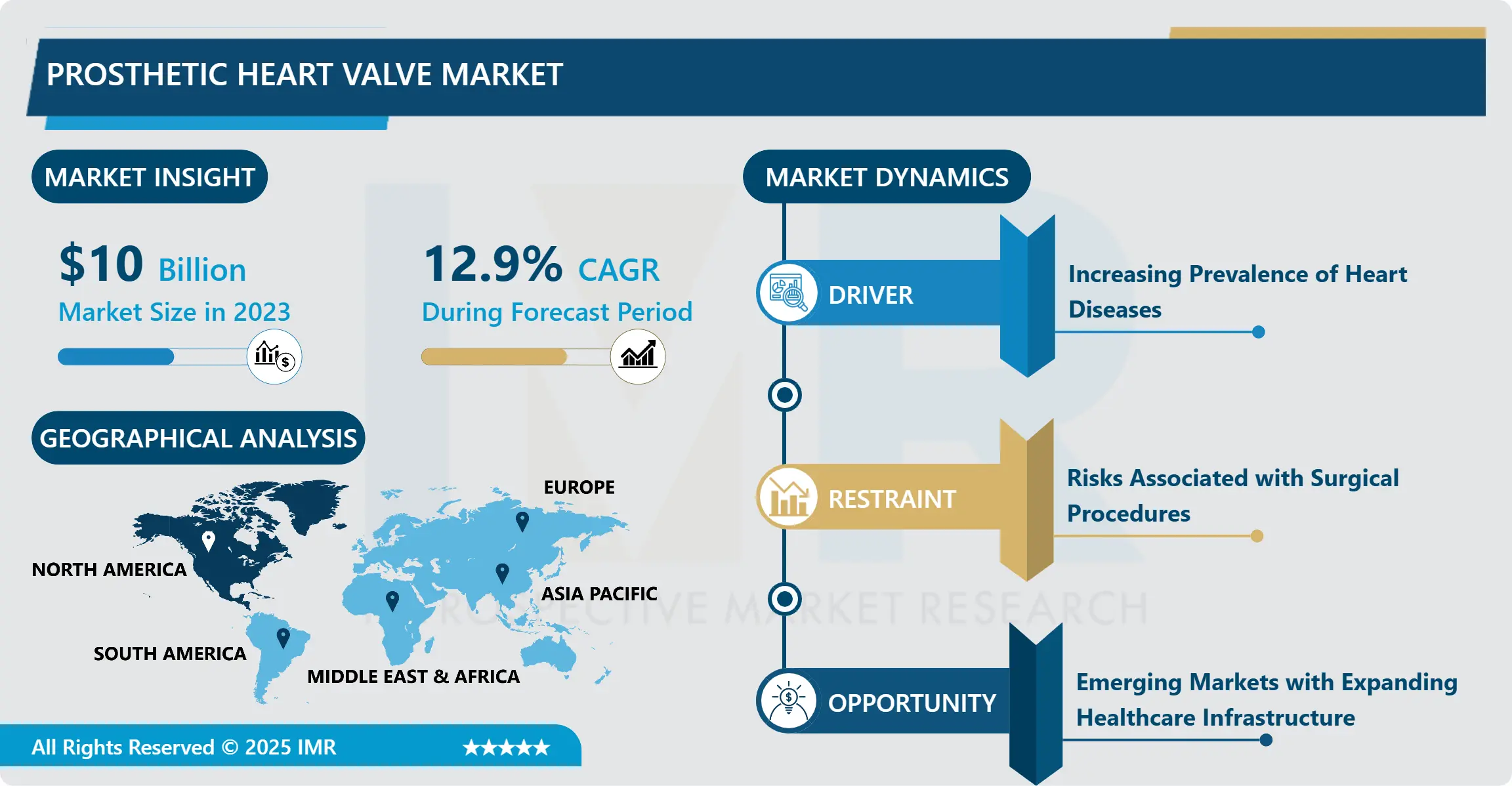
Prosthetic Heart Valve Market Size Was Valued at USD 10.00 Billion in 2023, and is Projected to Reach USD 29.81 Billion by 2032, Growing at a CAGR of 12.90% From 2024-2032.
The Prosthetic Heart Valve Market means the segment of an economy that deals with the production and distribution of man-made valves to restore the functionality of non-functional human heart valves for valvular heart disease patients. Such prosthetic devices are significant tools in the provision of normal circulation to the heart; hence iproving the life of the patients. The market includes different kinds of valve such as mechanical and bioprosthetic valve that satisfies the various need and demand of the patients.
The Prosthetic Heart Valve Market is mainly spurred due to the ever-rising cases of heart diseases throughout the world. Lack of physical activity, increased number of aging people, and increased obesity rates are some of the reasons for increased frequency of valvular heart diseases. Further, new technologies in the market offer advanced prosthetic heart valves with enhanced durability and fewer complications rates together with minimally invasive surgical options also drive the market.
Furthermore, the rising incidence of inevitable heart valve replacement surgery, driven by higher reimbursement policies coupled with high healthcare care expenses globally, also contributes to market expansion. This is especially because patients are better informed on their possible treatment procedures, and therefore are inclined more to surgical procedures. This trend, together with a growing number of operations for cardiovascular diseases every year, speaks of the growing need for prosthetic heart valves.
Prosthetic Heart Valve Market Trend Analysis:
Increasing adoption of transcatheter aortic valve replacement (TAVR) procedures.
-
Thirdly, the transcatheter aortic valve replacement (TAVR) procedures have also been observed in the Prosthetic Heart Valve Market. This procedure does not involve an opening of the chest or heart; instead, the valves are inserted through a catheter making recovery time and hospital stays considerably shorter than with other valve surgeries. This means that more patients are being recommended for this procedure as more advancements in technology occur, this includes even the high-risk open-heart surgery population thus fueling the market growth of LVADs.
- Other new directions include using materials advancing science to create bioprosthetic heart valves that increase in the valve performance and durability. Bright ideas at the moment include the tissue-engineered valves and the integration of anticoagulation properties into the valves. Such is the case with advancements in prosthetic technology where not only optimal operations that bring better patients’ outcomes are considered but also problems associated with the durability and thrombogenicity of existing prosthetic options are solved, making them the top choice in healthcare organizations.
Healthcare infrastructure improves and disposable incomes rise in regions
-
The world prosthetic heart valve market has many opportunities specifically for the development of newborn economies. With enhancements in the health care provision and upliftment in per capita income in developing markets such as Asia-Pacific and Latin America; there is a greater market need for innovative and sophisticated prosthetic heart valves. Healthcare organizations interested in grown their market share in those regions can benefit from steadily growing patient demand for cardiac procedures.
- In addition, a synergy of efforts between the manufacturers of medical devices and healthcare service delivery organizations can act as an avenue to embrace local patients’ solutions based on areas of the globe. Increased and appropriate valve availability hence improved market coverage and unit utilization is likely to benefit patients while; Fieldname: Manufacturers.
Prosthetic Heart Valve Market Segment Analysis:
Prosthetic Heart Valve Market is Segmented on the basis of Heart type, Valve Type, End User, and Region.
By Heart Type, Mechanical Heart Valves segment is expected to dominate the market during the forecast period
-
The prosthetic heart valve market is segmented by heart type into three main categories: Currently there are three types of valves they include mechanical heart valves, bioprosthetic heart valves and transcatheter heart valves. Mechanical heart valves are produced from stainless or titanium or carbon and can be used for a long time; it is often prescribed to young patients with heart valve disease; these valves need the use of anticoagulation therapy for a lifetime to avoid the formation of blood clots. Biological valves are those sourced from animal tissues or cadavers are also more natural and carry little need to be anticoagulated besides post-surgery for sometimes indefinitely and are appropriate for elderly patients who may not tolerate the anticoagulations or those who cannot undergo the associated risks, but they may wear out more than mechanical ones. THVs are intended for minimal invasiveness, which means that they can be implanted using transcatheter techniques that eliminate the need for open heart surgery and are associated with much shorter recovery time and hospitalization, thereby increasing their use, particularly in increasingly prevalent populations of high-risk patients who cannot undergo surgery.
By Valve Type, Aortic Valve segment expected to held the largest share
-
The prosthetic heart valve market is also divided according to the valve kind that comprises of aortic valves, mitral valves, and other valves. The aortic valve is replaced most frequently because of diseases such as aortic stenosis or regurgitation in which the valve either will not open, or closing, allowing inadequate blood flow through the heart and increased amount of work for the heart muscle. Mitral valves are replaced in cases of mitral regurgitation or stenosis which leads to faulty shutting of blood ???? which leads to weakness, shortness of breath etc. Other types of valves that could be used are the pulmonary valve and the tricuspid valve, necessary though less often used in operations concerning the heart. These segments of valves involve differences with regards to surgical management, patient selection and long-term follow up; thus knowledge of these segments is important both for those in the healthcare profession and prosthetic heart valve market.
Prosthetic Heart Valve Market Regional Insights:
North America is Expected to Dominate the Market Over the Forecast period
-
North America is holding the largest market share for the Prosthetic Heart Valve Market in the current scenario because of the well-developed healthcare industry and a relatively higher per capita healthcare expenditure coupled with leading market players. The region has strong emphasis on emphases on research and development, and the development of products that continue to adapt to the requirements of patient and healthcare consumers. In the same regard, clear and favorable requisite guidelines for the approval of new devices has ensured that North America proves to be an industry leader in the market.
- Furthermore, the rate of incidents of heart diseases in North America region is high and people are in need of surgeries and prosthetic limbs. They observed that the population is aging leading to the need for cardiovascular diseases treatment due to broader risk factors. Hence, the constant flow of investments in healthcare structures and improvement of technologies in the region makes North America one of the leaders of the Prosthetic Heart Valve Market.
Active Key Players in the Prosthetic Heart Valve Market:
-
Medtronic (USA)
- Edwards Lifesciences (USA)
- Abbott Laboratories (USA)
- Boston Scientific Corporation (USA)
- St. Jude Medical (USA)
- Sorin Group (Italy)
- CryoLife, Inc. (USA)
- JenaValve Technology (Germany)
- SYMPLICITY (USA)
- AtriCure, Inc. (USA)
- Other Active Players
|
Prosthetic Heart Valve Market |
|||
|
Base Year: |
2023 |
Forecast Period: |
2024-2032 |
|
Historical Data: |
2017 to 2023 |
Market Size in 2023: |
USD 10.00 Billion |
|
Forecast Period 2024-32 CAGR: |
12.90% |
Market Size in 2032: |
USD 29.81 Billion |
|
Segments Covered: |
By Heart Type |
|
|
|
By Valve Type |
|
||
|
By End User |
|
||
|
By Region |
|
||
|
Key Market Drivers: |
|
||
|
Key Market Restraints: |
|
||
|
Key Opportunities: |
|
||
|
Companies Covered in the report: |
|
||
Chapter 1: Introduction
1.1 Scope and Coverage
Chapter 2:Executive Summary
Chapter 3: Market Landscape
3.1 Market Dynamics
3.1.1 Drivers
3.1.2 Restraints
3.1.3 Opportunities
3.1.4 Challenges
3.2 Market Trend Analysis
3.3 PESTLE Analysis
3.4 Porter's Five Forces Analysis
3.5 Industry Value Chain Analysis
3.6 Ecosystem
3.7 Regulatory Landscape
3.8 Price Trend Analysis
3.9 Patent Analysis
3.10 Technology Evolution
3.11 Investment Pockets
3.12 Import-Export Analysis
Chapter 4: Prosthetic Heart Valve Market by Heart Type
4.1 Prosthetic Heart Valve Market Snapshot and Growth Engine
4.2 Prosthetic Heart Valve Market Overview
4.3 Mechanical Heart Valves
4.3.1 Introduction and Market Overview
4.3.2 Historic and Forecasted Market Size in Value USD and Volume Units (2017-2032F)
4.3.3 Key Market Trends, Growth Factors and Opportunities
4.3.4 Mechanical Heart Valves: Geographic Segmentation Analysis
4.4 Bioprosthetic Heart Valves
4.4.1 Introduction and Market Overview
4.4.2 Historic and Forecasted Market Size in Value USD and Volume Units (2017-2032F)
4.4.3 Key Market Trends, Growth Factors and Opportunities
4.4.4 Bioprosthetic Heart Valves: Geographic Segmentation Analysis
4.5 Transcatheter Heart Valves
4.5.1 Introduction and Market Overview
4.5.2 Historic and Forecasted Market Size in Value USD and Volume Units (2017-2032F)
4.5.3 Key Market Trends, Growth Factors and Opportunities
4.5.4 Transcatheter Heart Valves: Geographic Segmentation Analysis
Chapter 5: Prosthetic Heart Valve Market by Valve Type
5.1 Prosthetic Heart Valve Market Snapshot and Growth Engine
5.2 Prosthetic Heart Valve Market Overview
5.3 Aortic Valve
5.3.1 Introduction and Market Overview
5.3.2 Historic and Forecasted Market Size in Value USD and Volume Units (2017-2032F)
5.3.3 Key Market Trends, Growth Factors and Opportunities
5.3.4 Aortic Valve: Geographic Segmentation Analysis
5.4 Mitral Valve
5.4.1 Introduction and Market Overview
5.4.2 Historic and Forecasted Market Size in Value USD and Volume Units (2017-2032F)
5.4.3 Key Market Trends, Growth Factors and Opportunities
5.4.4 Mitral Valve: Geographic Segmentation Analysis
5.5 Others
5.5.1 Introduction and Market Overview
5.5.2 Historic and Forecasted Market Size in Value USD and Volume Units (2017-2032F)
5.5.3 Key Market Trends, Growth Factors and Opportunities
5.5.4 Others: Geographic Segmentation Analysis
Chapter 6: Prosthetic Heart Valve Market by End User
6.1 Prosthetic Heart Valve Market Snapshot and Growth Engine
6.2 Prosthetic Heart Valve Market Overview
6.3 Hospitals
6.3.1 Introduction and Market Overview
6.3.2 Historic and Forecasted Market Size in Value USD and Volume Units (2017-2032F)
6.3.3 Key Market Trends, Growth Factors and Opportunities
6.3.4 Hospitals: Geographic Segmentation Analysis
6.4 Ambulatory Surgical Centers
6.4.1 Introduction and Market Overview
6.4.2 Historic and Forecasted Market Size in Value USD and Volume Units (2017-2032F)
6.4.3 Key Market Trends, Growth Factors and Opportunities
6.4.4 Ambulatory Surgical Centers: Geographic Segmentation Analysis
6.5 Specialty Clinics
6.5.1 Introduction and Market Overview
6.5.2 Historic and Forecasted Market Size in Value USD and Volume Units (2017-2032F)
6.5.3 Key Market Trends, Growth Factors and Opportunities
6.5.4 Specialty Clinics: Geographic Segmentation Analysis
Chapter 7: Company Profiles and Competitive Analysis
7.1 Competitive Landscape
7.1.1 Competitive Benchmarking
7.1.2 Prosthetic Heart Valve Market Share by Manufacturer (2023)
7.1.3 Industry BCG Matrix
7.1.4 Heat Map Analysis
7.1.5 Mergers and Acquisitions
7.2 MEDTRONIC (USA)
7.2.1 Company Overview
7.2.2 Key Executives
7.2.3 Company Snapshot
7.2.4 Role of the Company in the Market
7.2.5 Sustainability and Social Responsibility
7.2.6 Operating Business Segments
7.2.7 Product Portfolio
7.2.8 Business Performance
7.2.9 Key Strategic Moves and Recent Developments
7.2.10 SWOT Analysis
7.3 EDWARDS LIFESCIENCES (USA)
7.4 ABBOTT LABORATORIES (USA)
7.5 BOSTON SCIENTIFIC CORPORATION (USA)
7.6 ST. JUDE MEDICAL (USA)
7.7 SORIN GROUP (ITALY)
7.8 CRYOLIFE INC. (USA)
7.9 JENAVALVE TECHNOLOGY (GERMANY)
7.10 SYMPLICITY (USA)
7.11 ATRICURE INC. (USA)
7.12 OTHER ACTIVE PLAYERS
Chapter 8: Global Prosthetic Heart Valve Market By Region
8.1 Overview
8.2. North America Prosthetic Heart Valve Market
8.2.1 Key Market Trends, Growth Factors and Opportunities
8.2.2 Top Key Companies
8.2.3 Historic and Forecasted Market Size by Segments
8.2.4 Historic and Forecasted Market Size By Heart Type
8.2.4.1 Mechanical Heart Valves
8.2.4.2 Bioprosthetic Heart Valves
8.2.4.3 Transcatheter Heart Valves
8.2.5 Historic and Forecasted Market Size By Valve Type
8.2.5.1 Aortic Valve
8.2.5.2 Mitral Valve
8.2.5.3 Others
8.2.6 Historic and Forecasted Market Size By End User
8.2.6.1 Hospitals
8.2.6.2 Ambulatory Surgical Centers
8.2.6.3 Specialty Clinics
8.2.7 Historic and Forecast Market Size by Country
8.2.7.1 US
8.2.7.2 Canada
8.2.7.3 Mexico
8.3. Eastern Europe Prosthetic Heart Valve Market
8.3.1 Key Market Trends, Growth Factors and Opportunities
8.3.2 Top Key Companies
8.3.3 Historic and Forecasted Market Size by Segments
8.3.4 Historic and Forecasted Market Size By Heart Type
8.3.4.1 Mechanical Heart Valves
8.3.4.2 Bioprosthetic Heart Valves
8.3.4.3 Transcatheter Heart Valves
8.3.5 Historic and Forecasted Market Size By Valve Type
8.3.5.1 Aortic Valve
8.3.5.2 Mitral Valve
8.3.5.3 Others
8.3.6 Historic and Forecasted Market Size By End User
8.3.6.1 Hospitals
8.3.6.2 Ambulatory Surgical Centers
8.3.6.3 Specialty Clinics
8.3.7 Historic and Forecast Market Size by Country
8.3.7.1 Russia
8.3.7.2 Bulgaria
8.3.7.3 The Czech Republic
8.3.7.4 Hungary
8.3.7.5 Poland
8.3.7.6 Romania
8.3.7.7 Rest of Eastern Europe
8.4. Western Europe Prosthetic Heart Valve Market
8.4.1 Key Market Trends, Growth Factors and Opportunities
8.4.2 Top Key Companies
8.4.3 Historic and Forecasted Market Size by Segments
8.4.4 Historic and Forecasted Market Size By Heart Type
8.4.4.1 Mechanical Heart Valves
8.4.4.2 Bioprosthetic Heart Valves
8.4.4.3 Transcatheter Heart Valves
8.4.5 Historic and Forecasted Market Size By Valve Type
8.4.5.1 Aortic Valve
8.4.5.2 Mitral Valve
8.4.5.3 Others
8.4.6 Historic and Forecasted Market Size By End User
8.4.6.1 Hospitals
8.4.6.2 Ambulatory Surgical Centers
8.4.6.3 Specialty Clinics
8.4.7 Historic and Forecast Market Size by Country
8.4.7.1 Germany
8.4.7.2 UK
8.4.7.3 France
8.4.7.4 The Netherlands
8.4.7.5 Italy
8.4.7.6 Spain
8.4.7.7 Rest of Western Europe
8.5. Asia Pacific Prosthetic Heart Valve Market
8.5.1 Key Market Trends, Growth Factors and Opportunities
8.5.2 Top Key Companies
8.5.3 Historic and Forecasted Market Size by Segments
8.5.4 Historic and Forecasted Market Size By Heart Type
8.5.4.1 Mechanical Heart Valves
8.5.4.2 Bioprosthetic Heart Valves
8.5.4.3 Transcatheter Heart Valves
8.5.5 Historic and Forecasted Market Size By Valve Type
8.5.5.1 Aortic Valve
8.5.5.2 Mitral Valve
8.5.5.3 Others
8.5.6 Historic and Forecasted Market Size By End User
8.5.6.1 Hospitals
8.5.6.2 Ambulatory Surgical Centers
8.5.6.3 Specialty Clinics
8.5.7 Historic and Forecast Market Size by Country
8.5.7.1 China
8.5.7.2 India
8.5.7.3 Japan
8.5.7.4 South Korea
8.5.7.5 Malaysia
8.5.7.6 Thailand
8.5.7.7 Vietnam
8.5.7.8 The Philippines
8.5.7.9 Australia
8.5.7.10 New Zealand
8.5.7.11 Rest of APAC
8.6. Middle East & Africa Prosthetic Heart Valve Market
8.6.1 Key Market Trends, Growth Factors and Opportunities
8.6.2 Top Key Companies
8.6.3 Historic and Forecasted Market Size by Segments
8.6.4 Historic and Forecasted Market Size By Heart Type
8.6.4.1 Mechanical Heart Valves
8.6.4.2 Bioprosthetic Heart Valves
8.6.4.3 Transcatheter Heart Valves
8.6.5 Historic and Forecasted Market Size By Valve Type
8.6.5.1 Aortic Valve
8.6.5.2 Mitral Valve
8.6.5.3 Others
8.6.6 Historic and Forecasted Market Size By End User
8.6.6.1 Hospitals
8.6.6.2 Ambulatory Surgical Centers
8.6.6.3 Specialty Clinics
8.6.7 Historic and Forecast Market Size by Country
8.6.7.1 Turkiye
8.6.7.2 Bahrain
8.6.7.3 Kuwait
8.6.7.4 Saudi Arabia
8.6.7.5 Qatar
8.6.7.6 UAE
8.6.7.7 Israel
8.6.7.8 South Africa
8.7. South America Prosthetic Heart Valve Market
8.7.1 Key Market Trends, Growth Factors and Opportunities
8.7.2 Top Key Companies
8.7.3 Historic and Forecasted Market Size by Segments
8.7.4 Historic and Forecasted Market Size By Heart Type
8.7.4.1 Mechanical Heart Valves
8.7.4.2 Bioprosthetic Heart Valves
8.7.4.3 Transcatheter Heart Valves
8.7.5 Historic and Forecasted Market Size By Valve Type
8.7.5.1 Aortic Valve
8.7.5.2 Mitral Valve
8.7.5.3 Others
8.7.6 Historic and Forecasted Market Size By End User
8.7.6.1 Hospitals
8.7.6.2 Ambulatory Surgical Centers
8.7.6.3 Specialty Clinics
8.7.7 Historic and Forecast Market Size by Country
8.7.7.1 Brazil
8.7.7.2 Argentina
8.7.7.3 Rest of SA
Chapter 9 Analyst Viewpoint and Conclusion
9.1 Recommendations and Concluding Analysis
9.2 Potential Market Strategies
Chapter 10 Research Methodology
10.1 Research Process
10.2 Primary Research
10.3 Secondary Research
|
Prosthetic Heart Valve Market |
|||
|
Base Year: |
2023 |
Forecast Period: |
2024-2032 |
|
Historical Data: |
2017 to 2023 |
Market Size in 2023: |
USD 10.00 Billion |
|
Forecast Period 2024-32 CAGR: |
12.90% |
Market Size in 2032: |
USD 29.81 Billion |
|
Segments Covered: |
By Heart Type |
|
|
|
By Valve Type |
|
||
|
By End User |
|
||
|
By Region |
|
||
|
Key Market Drivers: |
|
||
|
Key Market Restraints: |
|
||
|
Key Opportunities: |
|
||
|
Companies Covered in the report: |
|
||


