




Pressure Ulcers Treatment Market Synopsis:
Pressure Ulcers Treatment Market Size Was Valued at USD 5.69 Billion in 2023, and is Projected to Reach USD 9.42 Billion by 2032, Growing at a CAGR of 5.76% From 2024-2032.
The Pressure Ulcers Treatment Market is mainly concerned with healthcare related to caring for patients suffering from pressure ulcers, also commonly known as bedsores or decubitus ulcers. These are painful abnormal thickening of skin which occurs as a result of prolonged pressure usually in patients with restricted movements. They refer to wound care products, surgeries and pressure relieving equipment that is magnetic or electrical, to help in treatment of these ulcers which are prevalent among people who cannot move around, often in hospitals.
Pressure ulcers or what are commonly referred to as bedsores or pressure injuries are non-inflammatory injuries of the skin and underlying tissue that occur commonly over bony areas because of unrelieved pressure. They are most often used in populations with reduced physical movement which includes; elderly, patients who are bedridden or people with certain form of disability. Pressure ulcers can be a source of pain and discomfort, especially in the later stages when they are not treated, they can become infected and cause sepsis and greatly reduce the quality of life. The management of these ulcers entails use of numerous approaches that are aimed at healing, offloading pressure and preventing infection.
The market for pressure ulcers treatment across the world is growing steadily due to rising number of people many of whom are ageing, heightened incidences of chronic ailments and a progressive focus on pressure ulcer care. It also takes into account growth in medical technology personnel due to such issues as new methods of wound care, better surgical procedures, and increased utilization of pressure relieve technology. Pressure ulcer treatment products and services find their application in hospitals, nursing homes, and home care services. Also, as MNT and clinicians involved are getting more sensitive to the consequent of these ulcers there is increased focus on responding early and preventing incidences of such ulcers further enlarging the market for preventive as well as curative treatments.
The therapies for pressure ulcers are numerous and they range from a bandage, surgical and topical products, pressure relief devices and systems. Prescription dressings, topical agents used over non-urgent surgical site wounds and some other topical numerous ointment and antimicrobial agents are used for the wound care. There are different surgical procedures that might be needed, especially if a patient fails nonsurgical approaches to heal ulcers. Current Pressure relieving devices like mattresses and cushions, help prevent excessive pressure on those areas that contribute to pressure ulcers, or help treat ulcers by reducing the pressure. The market is also fueled by the trend of Hospital Acquired Pressure Ulcers so as to focus on appropriate attention in hospitals.
Pressure ulcer treatment demanded by the healthcare organization is subjected to these dynamics: shifting of focus towards preventive care and employing latest technologies in wound healing. future growth of the market: The growth of all kinds of healthcare plans more focused on the patients’ care given in hospitals and nursing homes also signifies that the market will continue on its path further. However, there is high treatment cost, there is adequate healthcare facilities in a number of regions, and low health consciousness in most of the developing world countries. However, the market remains a growing an attractive one, especially for those countries where healthcare continues to develop, including the emerging economies.
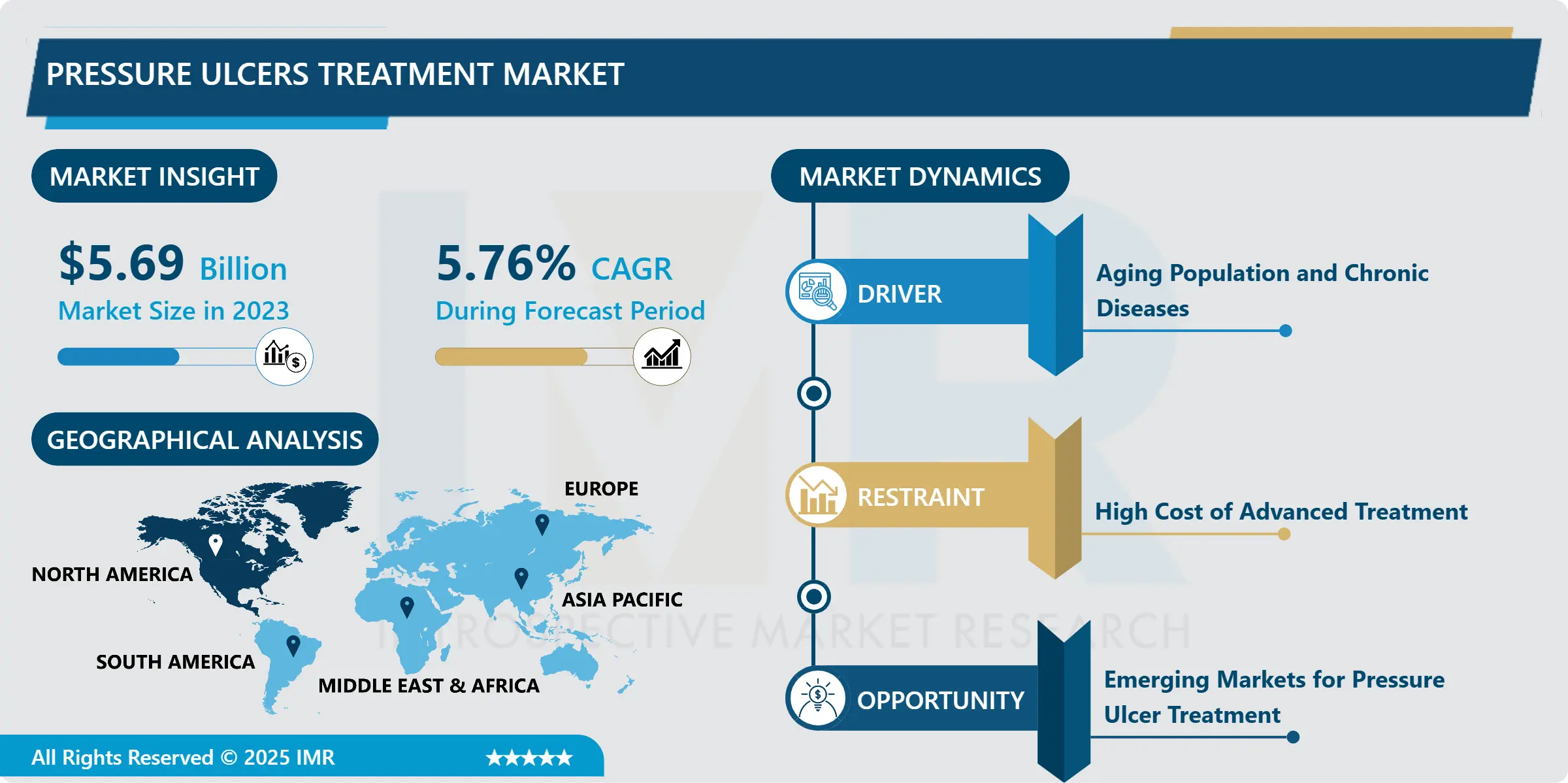
Pressure Ulcers Treatment Market Trend Analysis:
Technological Advancements in Wound Care
-
Another factor that will affect growth of pressure ulcers treatment market is an increased incorporation of advanced technology in the management of wounds. Hydrocolloids, bioactive materials and antimicrobial coated products are enabling better healing and being less aggressive to the patients. The technology in newer wound care products like smart dressings that measure infections or dispense drugs is making the application of treatment more precise and less problematic for caregivers. At the same time, the use of artificial intelligence and machine learning in the control and diagnosis of pressure ulcers is becoming increasingly effective in terms of developing individual treatment programs.
- Technological improvement is also experienced through the use of electronic health record systems EHRs, and telemedicine in pressure ulcers. These form of technologies assist healthcare providers in the monitoring of patient’s progress in real time so that appropriate corrective measures can be taken in a shorter time than required. This is embracing remote patient monitoring especially those at home since it reduces hospital readmission due to ulcers’ complications. Increasing adoption in the pressure ulcers treatment market means that such technologies are set to play an even more important role in enhancing patient care and the efficiency of treatment options.
Emerging Markets for Pressure Ulcer Treatment
-
An obvious and promising area in the pressure ulcers treatment market is represented by Asia-Pacific, Latin America, and African countries. As more patients gain healthcare coverage, hospitals develop more sophisticated health care systems, illnesses such as diabetes, cancer and obesity result in increased need for pressure ulcer treatments in these regions. The governments and non-governmental organizations are also focusing on the health care service delivery, which energetic demands the manufacture of wound care products, surgical treatment, pressure relief devices etc. In some of the countries these are the new markets which have yet to reach their full potential, especially the countries where the population is aging and the health care systems are growing.
- In addition, the increase in pressure ulcer incidence is attributed to increase incidence of non-communicable diseases like diabetes and cardiovascular diseases in these regions. As a result of such factors, healthcare providers in these areas are more receptive to the desire to increase patient care and use the best practice in treating pressure ulcers. These are also strategic areas which have huge market potential for global players to extend their market reach to these regions to offer affordable, specialized treatment technologies more specifically in the hospital, nursing homes and home health care markets.
Pressure Ulcers Treatment Market Segment Analysis:
Pressure Ulcers Treatment Market is Segmented on the basis of treatment type, application. end user, and region.
By Treatment Type, Wound Care Products segment is expected to dominate the market during the forecast period
-
The various pressure ulcers treatment options comprised the therapeutic market in broad categories that target the various forms of ulcer treatment. Dressings, gels and creams are the most extensively prescribed products being involved in the management of the wound and contribute a lot towards the process of healing by covering the wound to prevent chances of infection, besides regulating water loss or gain. These products are available in diverse forms that are intended to meet consumers’ needs depending on the level of ulcer. This category of pressure ulcers usually does not respond to conventional treatments and therefore usually necessitates surgical intervention. Debridement, skin grafting and flap surgery is done to remove necrotic tissue and improve the rate of healing.
- Another major treatment approach is the pressure relieving devices; which are the mattresses, cushions and the pads that are used in relieving pressure on the target area. These devices are useful in avoiding additional data on tissue injury and in lessening pain. They are especially appropriate in the prevention of pressure ulcers for patients belonging to the high risk group that are either bed bound or have extremely low mobility. Some of the treatments mentioned earlier are in their experimental stage, but advanced treatments like stem cell therapies and bio-engineering products showcased lot of potential for wound care in future.
By Application, Hospital-acquired Pressure Ulcers segment expected to held the largest share
-
The pressure ulcers treatment market is also divided into two main application segments: HAPUs and CAPUs can both be described as pressure ulcers that develop in an acutely ill individual after admission to a hospital and outside the hospital respectively. The complications related to pressure ulcers bring a wide concern on healthcare facilities since patients admitted in hospitals, career intensive units or those receiving long term treatments run high risk of developing pressure ulcers. These ulcers may result in longer periods of hospitalization, higher cost of medical care and added mortality in patients. Hospitals are paying a great deal of attention to preventing pressure ulcers and incorporating better technology in treating a HAPU at OPC.
- Finally, community-acquired pressure ulcers are those which appear in a non-hospitalized health facilities but rather in home care settings or nursing homes. These ulcers are seen most often in persons of advanced age, patients with limited physical activity and discrete chronic pathologies. As the world’s population ages and more elderly patients are treated at home, pressure ulcer care in community settings is becoming more prevalent. Self-care products are rapidly entering home care settings to treat and prevent pressure ulcers with the help of appropriate wound care products and pressure relief devices.
Pressure Ulcers Treatment Market Regional Insights:
North America is Expected to Dominate the Market Over the Forecast period
-
North America again becomes the most significant market within the pressure ulcers treatment market, especially with reference to the United States market. This can be explained by first, credible and well-developed health care systems in the region, second, increased rates of chronic diseases and third, improved technologies in wound care. Due to the increased concern North American healthcare providers have toward the outcomes of patients from the treatment, a high usage of innovative treatments in pressure ulcer has been seen. Technological development in preventive and curative modern pressure ulcer treatment products has been enabled by the growing number of the elderly population within the United States and Canada, and an ever-increasing concern for pressure ulcer prevention.
- The fact that many key players are located in North America and great attention is paid to healthcare technology and research backing this position. Positive initiatives taken by the governments of different countries for improving the standards of the healthcare and rising prevalence for home care services are the other key factor that further fuels the growth of the market in this region. With North America spearheading investment in healthcare in addition to utilizing the most sophisticated technologies in the treatment of Pressure Ulcers, it is likely that the Pressure Ulcers treatment market within this region will continue to grow in size.
Active Key Players in the Pressure Ulcers Treatment Market:
- Smith & Nephew (UK)
- Mölnlycke Health Care (Sweden)
- ConvaTec (UK)
- 3M (USA)
- Medtronic (Ireland)
- Hill-Rom Holdings (USA)
- Baxter International (USA)
- KCI Medical (USA)
- Coloplast (Denmark)
- Acelity (USA)
- DermaRite Industries (USA)
- Invacare Corporation (USA)
- Other Active Players
|
Pressure Ulcers Treatment Market |
|||
|
Base Year: |
2023 |
Forecast Period: |
2024-2032 |
|
Historical Data: |
2017 to 2023 |
Market Size in 2023: |
USD 5.69 Billion |
|
Forecast Period 2024-32 CAGR: |
5.76% |
Market Size in 2032: |
USD 9.42 Billion |
|
Segments Covered: |
By Treatment Type |
|
|
|
By Application |
|
||
|
By End User |
|
||
|
By Region |
|
||
|
Key Market Drivers: |
|
||
|
Key Market Restraints: |
|
||
|
Key Opportunities: |
|
||
|
Companies Covered in the report: |
|
||
Chapter 1: Introduction
1.1 Scope and Coverage
Chapter 2:Executive Summary
Chapter 3: Market Landscape
3.1 Industry Dynamics and Opportunity Analysis
3.1.1 Growth Drivers
3.1.2 Limiting Factors
3.1.3 Growth Opportunities
3.1.4 Challenges and Risks
3.2 Market Trend Analysis
3.3 Strategic Pestle Overview
3.4 Porter's Five Forces Analysis
3.5 Industry Value Chain Mapping
3.6 Regulatory Framework
3.7 Princing Trend Analysis
3.8 Patent Analysis
3.9 Technology Evolution
3.10 Investment Pockets
3.11 Import-Export Analysis
Chapter 4: Pressure Ulcers Treatment Market by Treatment Type
4.1 Pressure Ulcers Treatment Market Snapshot and Growth Engine
4.2 Pressure Ulcers Treatment Market Overview
4.3 Wound Care Products
4.3.1 Introduction and Market Overview
4.3.2 Historic and Forecasted Market Size in Value USD and Volume Units (2017-2032F)
4.3.3 Wound Care Products: Geographic Segmentation Analysis
4.4 Surgical Treatment
4.4.1 Introduction and Market Overview
4.4.2 Historic and Forecasted Market Size in Value USD and Volume Units (2017-2032F)
4.4.3 Surgical Treatment: Geographic Segmentation Analysis
4.5 Pressure Relief Devices
4.5.1 Introduction and Market Overview
4.5.2 Historic and Forecasted Market Size in Value USD and Volume Units (2017-2032F)
4.5.3 Pressure Relief Devices: Geographic Segmentation Analysis
4.6 Others
4.6.1 Introduction and Market Overview
4.6.2 Historic and Forecasted Market Size in Value USD and Volume Units (2017-2032F)
4.6.3 Others: Geographic Segmentation Analysis
Chapter 5: Pressure Ulcers Treatment Market by End User
5.1 Pressure Ulcers Treatment Market Snapshot and Growth Engine
5.2 Pressure Ulcers Treatment Market Overview
5.3 Hospitals
5.3.1 Introduction and Market Overview
5.3.2 Historic and Forecasted Market Size in Value USD and Volume Units (2017-2032F)
5.3.3 Hospitals: Geographic Segmentation Analysis
5.4 Nursing Homes
5.4.1 Introduction and Market Overview
5.4.2 Historic and Forecasted Market Size in Value USD and Volume Units (2017-2032F)
5.4.3 Nursing Homes: Geographic Segmentation Analysis
5.5 Homecare
5.5.1 Introduction and Market Overview
5.5.2 Historic and Forecasted Market Size in Value USD and Volume Units (2017-2032F)
5.5.3 Homecare: Geographic Segmentation Analysis
5.6 Clinics
5.6.1 Introduction and Market Overview
5.6.2 Historic and Forecasted Market Size in Value USD and Volume Units (2017-2032F)
5.6.3 Clinics: Geographic Segmentation Analysis
5.7 Others
5.7.1 Introduction and Market Overview
5.7.2 Historic and Forecasted Market Size in Value USD and Volume Units (2017-2032F)
5.7.3 Others: Geographic Segmentation Analysis
Chapter 6: Pressure Ulcers Treatment Market by Application
6.1 Pressure Ulcers Treatment Market Snapshot and Growth Engine
6.2 Pressure Ulcers Treatment Market Overview
6.3 Hospital-acquired Pressure Ulcers
6.3.1 Introduction and Market Overview
6.3.2 Historic and Forecasted Market Size in Value USD and Volume Units (2017-2032F)
6.3.3 Hospital-acquired Pressure Ulcers: Geographic Segmentation Analysis
6.4 Community-acquired Pressure Ulcers
6.4.1 Introduction and Market Overview
6.4.2 Historic and Forecasted Market Size in Value USD and Volume Units (2017-2032F)
6.4.3 Community-acquired Pressure Ulcers: Geographic Segmentation Analysis
Chapter 7: Company Profiles and Competitive Analysis
7.1 Competitive Landscape
7.1.1 Competitive Benchmarking
7.1.2 Pressure Ulcers Treatment Market Share by Manufacturer (2023)
7.1.3 Concentration Ratio(CR5)
7.1.4 Heat Map Analysis
7.1.5 Mergers and Acquisitions
7.2 SMITH & NEPHEW (UK)
7.2.1 Company Overview
7.2.2 Key Executives
7.2.3 Company Snapshot
7.2.4 Operating Business Segments
7.2.5 Product Portfolio
7.2.6 Business Performance
7.2.7 Key Strategic Moves and Recent Developments
7.3 MÖLNLYCKE HEALTH CARE (SWEDEN)
7.4 CONVATEC (UK)
7.5 3M (USA)
7.6 MEDTRONIC (IRELAND)
7.7 HILL-ROM HOLDINGS (USA)
7.8 BAXTER INTERNATIONAL (USA)
7.9 KCI MEDICAL (USA)
7.10 COLOPLAST (DENMARK)
7.11 ACELITY (USA)
7.12 DERMARITE INDUSTRIES (USA)
7.13 INVACARE CORPORATION (USA)
7.14 OTHER ACTIVE PLAYERS
Chapter 8: Global Pressure Ulcers Treatment Market By Region
8.1 Overview
8.2. North America Pressure Ulcers Treatment Market
8.2.1 Historic and Forecasted Market Size by Segments
8.2.2 Historic and Forecasted Market Size By Treatment Type
8.2.2.1 Wound Care Products
8.2.2.2 Surgical Treatment
8.2.2.3 Pressure Relief Devices
8.2.2.4 Others
8.2.3 Historic and Forecasted Market Size By End User
8.2.3.1 Hospitals
8.2.3.2 Nursing Homes
8.2.3.3 Homecare
8.2.3.4 Clinics
8.2.3.5 Others
8.2.4 Historic and Forecasted Market Size By Application
8.2.4.1 Hospital-acquired Pressure Ulcers
8.2.4.2 Community-acquired Pressure Ulcers
8.2.5 Historic and Forecast Market Size by Country
8.2.5.1 US
8.2.5.2 Canada
8.2.5.3 Mexico
8.3. Eastern Europe Pressure Ulcers Treatment Market
8.3.1 Historic and Forecasted Market Size by Segments
8.3.2 Historic and Forecasted Market Size By Treatment Type
8.3.2.1 Wound Care Products
8.3.2.2 Surgical Treatment
8.3.2.3 Pressure Relief Devices
8.3.2.4 Others
8.3.3 Historic and Forecasted Market Size By End User
8.3.3.1 Hospitals
8.3.3.2 Nursing Homes
8.3.3.3 Homecare
8.3.3.4 Clinics
8.3.3.5 Others
8.3.4 Historic and Forecasted Market Size By Application
8.3.4.1 Hospital-acquired Pressure Ulcers
8.3.4.2 Community-acquired Pressure Ulcers
8.3.5 Historic and Forecast Market Size by Country
8.3.5.1 Bulgaria
8.3.5.2 The Czech Republic
8.3.5.3 Hungary
8.3.5.4 Poland
8.3.5.5 Romania
8.3.5.6 Rest of Eastern Europe
8.4. Western Europe Pressure Ulcers Treatment Market
8.4.1 Historic and Forecasted Market Size by Segments
8.4.2 Historic and Forecasted Market Size By Treatment Type
8.4.2.1 Wound Care Products
8.4.2.2 Surgical Treatment
8.4.2.3 Pressure Relief Devices
8.4.2.4 Others
8.4.3 Historic and Forecasted Market Size By End User
8.4.3.1 Hospitals
8.4.3.2 Nursing Homes
8.4.3.3 Homecare
8.4.3.4 Clinics
8.4.3.5 Others
8.4.4 Historic and Forecasted Market Size By Application
8.4.4.1 Hospital-acquired Pressure Ulcers
8.4.4.2 Community-acquired Pressure Ulcers
8.4.5 Historic and Forecast Market Size by Country
8.4.5.1 Germany
8.4.5.2 UK
8.4.5.3 France
8.4.5.4 Netherlands
8.4.5.5 Italy
8.4.5.6 Russia
8.4.5.7 Spain
8.4.5.8 Rest of Western Europe
8.5. Asia Pacific Pressure Ulcers Treatment Market
8.5.1 Historic and Forecasted Market Size by Segments
8.5.2 Historic and Forecasted Market Size By Treatment Type
8.5.2.1 Wound Care Products
8.5.2.2 Surgical Treatment
8.5.2.3 Pressure Relief Devices
8.5.2.4 Others
8.5.3 Historic and Forecasted Market Size By End User
8.5.3.1 Hospitals
8.5.3.2 Nursing Homes
8.5.3.3 Homecare
8.5.3.4 Clinics
8.5.3.5 Others
8.5.4 Historic and Forecasted Market Size By Application
8.5.4.1 Hospital-acquired Pressure Ulcers
8.5.4.2 Community-acquired Pressure Ulcers
8.5.5 Historic and Forecast Market Size by Country
8.5.5.1 China
8.5.5.2 India
8.5.5.3 Japan
8.5.5.4 South Korea
8.5.5.5 Malaysia
8.5.5.6 Thailand
8.5.5.7 Vietnam
8.5.5.8 The Philippines
8.5.5.9 Australia
8.5.5.10 New Zealand
8.5.5.11 Rest of APAC
8.6. Middle East & Africa Pressure Ulcers Treatment Market
8.6.1 Historic and Forecasted Market Size by Segments
8.6.2 Historic and Forecasted Market Size By Treatment Type
8.6.2.1 Wound Care Products
8.6.2.2 Surgical Treatment
8.6.2.3 Pressure Relief Devices
8.6.2.4 Others
8.6.3 Historic and Forecasted Market Size By End User
8.6.3.1 Hospitals
8.6.3.2 Nursing Homes
8.6.3.3 Homecare
8.6.3.4 Clinics
8.6.3.5 Others
8.6.4 Historic and Forecasted Market Size By Application
8.6.4.1 Hospital-acquired Pressure Ulcers
8.6.4.2 Community-acquired Pressure Ulcers
8.6.5 Historic and Forecast Market Size by Country
8.6.5.1 Turkey
8.6.5.2 Bahrain
8.6.5.3 Kuwait
8.6.5.4 Saudi Arabia
8.6.5.5 Qatar
8.6.5.6 UAE
8.6.5.7 Israel
8.6.5.8 South Africa
8.7. South America Pressure Ulcers Treatment Market
8.7.1 Historic and Forecasted Market Size by Segments
8.7.2 Historic and Forecasted Market Size By Treatment Type
8.7.2.1 Wound Care Products
8.7.2.2 Surgical Treatment
8.7.2.3 Pressure Relief Devices
8.7.2.4 Others
8.7.3 Historic and Forecasted Market Size By End User
8.7.3.1 Hospitals
8.7.3.2 Nursing Homes
8.7.3.3 Homecare
8.7.3.4 Clinics
8.7.3.5 Others
8.7.4 Historic and Forecasted Market Size By Application
8.7.4.1 Hospital-acquired Pressure Ulcers
8.7.4.2 Community-acquired Pressure Ulcers
8.7.5 Historic and Forecast Market Size by Country
8.7.5.1 Brazil
8.7.5.2 Argentina
8.7.5.3 Rest of SA
Chapter 9 Analyst Viewpoint and Conclusion
9.1 Recommendations and Concluding Analysis
9.2 Potential Market Strategies
Chapter 10 Research Methodology
10.1 Research Process
10.2 Primary Research
10.3 Secondary Research
|
Pressure Ulcers Treatment Market |
|||
|
Base Year: |
2023 |
Forecast Period: |
2024-2032 |
|
Historical Data: |
2017 to 2023 |
Market Size in 2023: |
USD 5.69 Billion |
|
Forecast Period 2024-32 CAGR: |
5.76% |
Market Size in 2032: |
USD 9.42 Billion |
|
Segments Covered: |
By Treatment Type |
|
|
|
By Application |
|
||
|
By End User |
|
||
|
By Region |
|
||
|
Key Market Drivers: |
|
||
|
Key Market Restraints: |
|
||
|
Key Opportunities: |
|
||
|
Companies Covered in the report: |
|
||


