Peripheral Intravenous Catheter Market Synopsis:
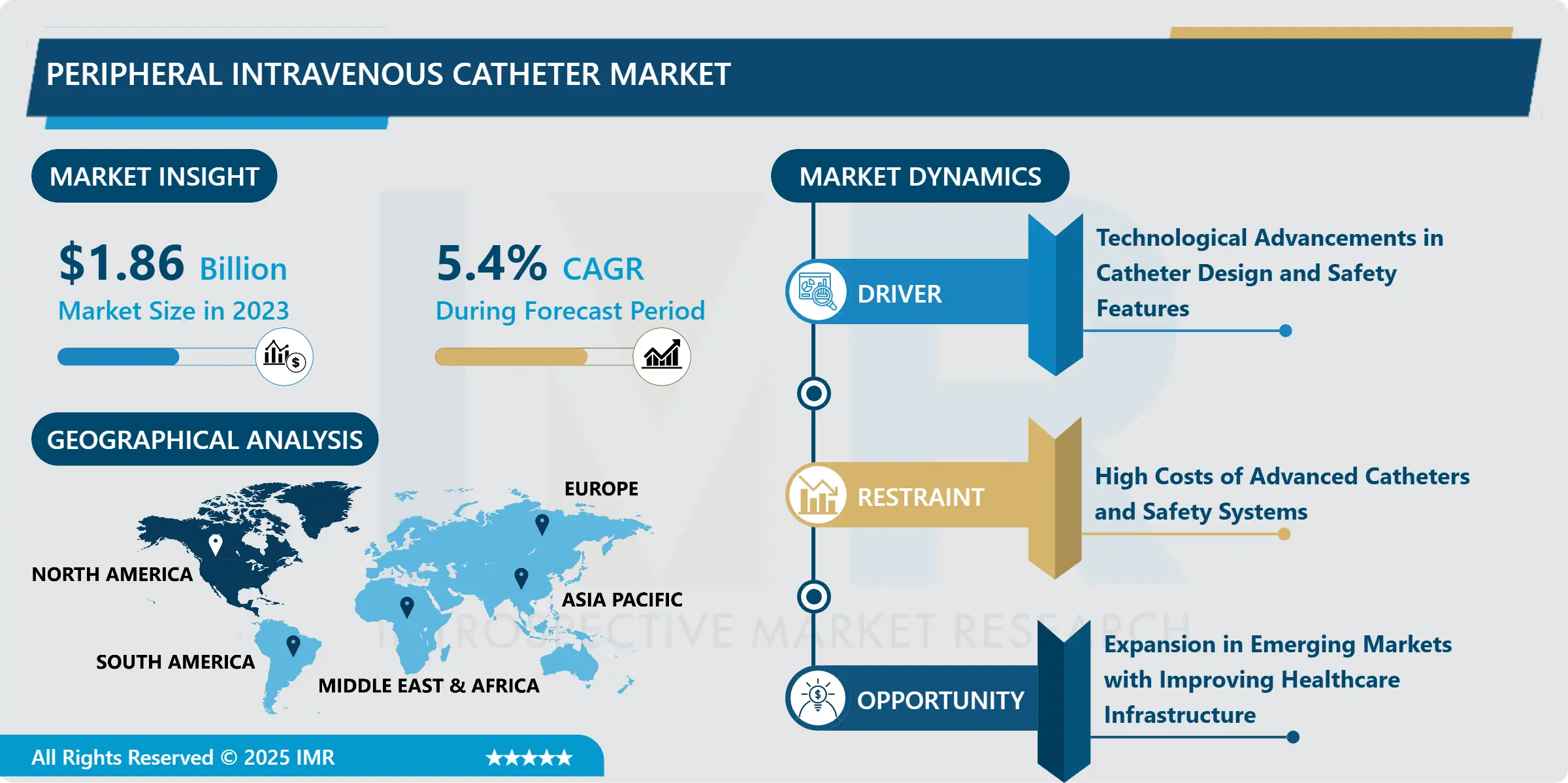
Peripheral Intravenous Catheter Market Size Was Valued at USD 1.86 Billion in 2023, and is Projected to Reach USD 2.98 Billion by 2032, Growing at a CAGR of 5.40% From 2024-2032.
Peripheral Intravenous Catheter (PIVC) market is associated with the placement of thin and bendable tubes into a peripheral vein initiating therapies, fluids, and meds. These catheters play an important role in healthcare, especially in hospitals, clinic and ambulatory surgical centers for delivering intra venous therapies which include medicines, nutrition and fluids. PIVCs are popular because of its simple insertion process, cost effectiveness as well as ability to administer treatment to patients who require short term IV therapy.
-
The high growth rate of the Peripheral Intravenous Catheter market is due to the rising incidence of chronic diseases across the globe such as cancers, diabetes and cardiovascular diseases. These conditions invariably lead to long-term intravenous therapies which in turn creates the need for PIVCs in care delivery settings. Also, the increasing worldwide population’s average age contributes to a larger need for medical procedures such as drug and nutrient IV therapy. With growing elderly population patient’s need more frequent peripheral veins to give therapies, fuelling more the job for PIVCs.
-
It was also found that advances in the design of PIVC systems, coupled with better materials are contributing to the growth of this market. Health care technology advances in the form of safety-engineered and closed catheter system technologies that provide for improved safety and durability relative to traditional catheters has been the driver for this ongoing adoption. New age developments in catheter that help in decreasing the risks of needle stick injuries, in providing comfort to the patients and in getting better clinical results are driving the market. This is because as the heath care providers integrate APE measures to improve patient safety, and offer focusing on infection prevention, these innovative PIVC technologies are expected to receive a major momentum.
Peripheral Intravenous Catheter Market Trend Analysis:
Shift toward safety and closed PIVC systems.
-
An emerging usage pattern for Peripheral Intravenous Catheter is the safety as well as closed PIVC systems. Main concern of healthcare associated infection and the danger presented by the occurrence of needle stick injuries have consequently led to improvement of usage of safety engineered catheters within the course of health provision within health facilities. These devices are meant to minimize risks of needle stick accidents and subsequent infections making both, the patient and the healthcare worker, safer. Moreover, shifting to closed systems reduces efforts to challenge the catheter, thus enhancing its resistance against infections.
-
Another is the increase in the number of customers preferring home healthcare services hampering the use of PIVCs in non-hospital facilities. Since an appropriate and increasing number of patients wants to be treated at home, there is a need for safe, efficient, and easy to use PIVCs. It is also facilitated by modern technologies of telemedicine and telemonitoring, that allow patients to continue administrating Intravenous therapies while at home with medical assistance. Consequently, home use PIVCs are slowly making themselves irreplaceable parts of the healthcare system.
Continue to improve healthcare infrastructure and invest in medical technologies
-
The major prospects in the Peripheral Intravenous Catheter market that may be found in the current and future are Asia-Pacific and Latin American countries. With the incremental development in health care facilities and adoption of technological intervention the demand for PIVCs will increase significantly. Steady increase in healthcare costs along with theshift in focus of key markets towards enhanced patient care is set to present new market entrants the chance to deliver value-added PIVC innovations to these segments. Further, the rise in the proportion of patients in those regions experiencing chronic diseases is contributing to the demand for more choices for intravenous therapy.
-
In addition, among overarching trends, growth has been noted in patient-centered health care and shift to individualized medicine, which could also be considered as the main favorable factor for development. Due to ongoing updates in technology and higher concern for patient comfort some of the main opportunities that manufacturers can look into to produce PIVCs include the production of PIVCs that suits children, the elderly, and those of fragile health, and modification of ways through which such PIVCs can be easily used by patients and health care providers. This trend of the personalization is going to continue to produce new subsets of catheter systems and, therefore, new niches and new revenues.
Peripheral Intravenous Catheter Market Segment Analysis:
Peripheral Intravenous Catheter Market is Segmented on the basis of type, Material, application, end user, and Region.
By Type, Over-the-Needle Catheters segment is expected to dominate the market during the forecast period
-
The two most common peripheral intravenous are the over-the-needle catheters and through-the-needle catheters. Over-the-needle catheters are those catheters that have a hollow needle with a catheter passing through this needle. Once the needle is removed, what’s left is a catheter in the vein thus offering a reliable IV access. These are mostly preferred because of their basic design, easy to handle and are easily inserted. By contrast, through-the-needle catheters contain a catheter that is placed through a hollow needle, but the needle is removed for long-term IV use. These are typically applied for a longer period or a condition where greater steady state and minimal chances of vein damage are desirable. Both types are used to deliver fluids, medication and any other therapies through the IV process, decision depending on what is appropriate in a given clinical situation, and the need of the patient.
By Application, Hospitals segment expected to held the largest share
-
Peripheral intravenous catheters are employed in many settings such as hospitals, clinics, ASCs, and home- and outpatient settings. On general wards, PIVCs facilitate giving liquids, medications, and intravenous nutritional support including in patients needing intensive care. Outpatients procedures are also done in clinics the reason being that these catheters provide an affordable solution to health facilities and patients for short-term use. PIVCs are used in ambulatory surgical centers to take care of surgeries and minor invasive interventions during a single day and do not require the patient to be admitted to the hospital. In homecare, PIVCs have started to become utilized in patients with conditions such as septicemia, Cancer or chronic severe pain that necessitate intravenous treatments including antibiotics, Chemotherapy or Pain management respectively within the comfort of their homes as against being readmitted to the hospital. All these uses make a positive input towards increasing the use of PIVCs across healthcare settings.
Peripheral Intravenous Catheter Market Regional Insights:
North America is Expected to Dominate the Market Over the Forecast period
-
North America is the largest regional market in the peripheral intravenous catheter market Due to the well-developed healthcare industry, increased healthcare expenditure in the region, and early adoption of new technologies in the field of medicine, the region occupies a favourable position in the global PIVC market. The United States is especially important within this area, as the number of patients requiring IV therapies is high because of the constantly growing incidence of chronic diseases, including diabetes, cardiovascular diseases, and cancer. In addition to the PIVC users and their ever-growing need for safer and more efficient catheter systems, North America enjoys the base of substantial healthcare providers and manufacturers of PIVCs.
-
The market of North America is also driven by favorable government policies, reimbursement policies and well established regulatory frame work. The highly developed patient safety culture in the region means adopting newer safety-engineered and closed systems of PIVCs. Such factors coupled with the increasing ageing population of the population and the prevalence of out patient procedures guarantee the North American region to remain dominant in the global PIVC market.
Active Key Players in the Peripheral Intravenous Catheter Market:
- Argon Medical Devices, Inc. (USA)
- B. Braun Melsungen AG (Germany)
- Becton, Dickinson and Company (USA)
- Medtronic (Ireland)
- NIPRO Medical Corporation (Japan)
- Smiths Group plc (UK)
- Teleflex Incorporated (USA)
- Terumo Corporation (Japan)
- Venner Medical (France)
- Vygon (France)
- Other Active Players
|
Global Peripheral Intravenous Catheter Market |
|||
|
Base Year: |
2023 |
Forecast Period: |
2024-2032 |
|
Historical Data: |
2017 to 2023 |
Market Size in 2023: |
USD 1.86 Billion |
|
Forecast Period 2024-32 CAGR: |
5.40% |
Market Size in 2032: |
USD 2.98 Billion |
|
Segments Covered: |
By Type |
|
|
|
By Material |
|
||
|
By Application |
|
||
|
By End User |
|
||
|
By Region |
|
||
|
Key Market Drivers: |
|
||
|
Key Market Restraints: |
|
||
|
Key Opportunities: |
|
||
|
Companies Covered in the report: |
|
||
Chapter 1: Introduction
1.1 Scope and Coverage
Chapter 2:Executive Summary
Chapter 3: Market Landscape
3.1 Market Dynamics
3.1.1 Drivers
3.1.2 Restraints
3.1.3 Opportunities
3.1.4 Challenges
3.2 Market Trend Analysis
3.3 PESTLE Analysis
3.4 Porter's Five Forces Analysis
3.5 Industry Value Chain Analysis
3.6 Ecosystem
3.7 Regulatory Landscape
3.8 Price Trend Analysis
3.9 Patent Analysis
3.10 Technology Evolution
3.11 Investment Pockets
3.12 Import-Export Analysis
Chapter 4: Peripheral Intravenous Catheter Market by Type
4.1 Peripheral Intravenous Catheter Market Snapshot and Growth Engine
4.2 Peripheral Intravenous Catheter Market Overview
4.3 Over-the-Needle Catheters
4.3.1 Introduction and Market Overview
4.3.2 Historic and Forecasted Market Size in Value USD and Volume Units (2017-2032F)
4.3.3 Key Market Trends, Growth Factors and Opportunities
4.3.4 Over-the-Needle Catheters: Geographic Segmentation Analysis
4.4 Through-the-Needle Catheters
4.4.1 Introduction and Market Overview
4.4.2 Historic and Forecasted Market Size in Value USD and Volume Units (2017-2032F)
4.4.3 Key Market Trends, Growth Factors and Opportunities
4.4.4 Through-the-Needle Catheters: Geographic Segmentation Analysis
Chapter 5: Peripheral Intravenous Catheter Market by Material
5.1 Peripheral Intravenous Catheter Market Snapshot and Growth Engine
5.2 Peripheral Intravenous Catheter Market Overview
5.3 PVC (Polyvinyl Chloride)
5.3.1 Introduction and Market Overview
5.3.2 Historic and Forecasted Market Size in Value USD and Volume Units (2017-2032F)
5.3.3 Key Market Trends, Growth Factors and Opportunities
5.3.4 PVC (Polyvinyl Chloride): Geographic Segmentation Analysis
5.4 Teflon
5.4.1 Introduction and Market Overview
5.4.2 Historic and Forecasted Market Size in Value USD and Volume Units (2017-2032F)
5.4.3 Key Market Trends, Growth Factors and Opportunities
5.4.4 Teflon: Geographic Segmentation Analysis
5.5 Silicone
5.5.1 Introduction and Market Overview
5.5.2 Historic and Forecasted Market Size in Value USD and Volume Units (2017-2032F)
5.5.3 Key Market Trends, Growth Factors and Opportunities
5.5.4 Silicone: Geographic Segmentation Analysis
Chapter 6: Peripheral Intravenous Catheter Market by Application
6.1 Peripheral Intravenous Catheter Market Snapshot and Growth Engine
6.2 Peripheral Intravenous Catheter Market Overview
6.3 Hospitals
6.3.1 Introduction and Market Overview
6.3.2 Historic and Forecasted Market Size in Value USD and Volume Units (2017-2032F)
6.3.3 Key Market Trends, Growth Factors and Opportunities
6.3.4 Hospitals: Geographic Segmentation Analysis
6.4 Clinics
6.4.1 Introduction and Market Overview
6.4.2 Historic and Forecasted Market Size in Value USD and Volume Units (2017-2032F)
6.4.3 Key Market Trends, Growth Factors and Opportunities
6.4.4 Clinics: Geographic Segmentation Analysis
6.5 Ambulatory Surgical Centers
6.5.1 Introduction and Market Overview
6.5.2 Historic and Forecasted Market Size in Value USD and Volume Units (2017-2032F)
6.5.3 Key Market Trends, Growth Factors and Opportunities
6.5.4 Ambulatory Surgical Centers: Geographic Segmentation Analysis
6.6 Homecare
6.6.1 Introduction and Market Overview
6.6.2 Historic and Forecasted Market Size in Value USD and Volume Units (2017-2032F)
6.6.3 Key Market Trends, Growth Factors and Opportunities
6.6.4 Homecare: Geographic Segmentation Analysis
Chapter 7: Peripheral Intravenous Catheter Market by End User
7.1 Peripheral Intravenous Catheter Market Snapshot and Growth Engine
7.2 Peripheral Intravenous Catheter Market Overview
7.3 Healthcare Providers
7.3.1 Introduction and Market Overview
7.3.2 Historic and Forecasted Market Size in Value USD and Volume Units (2017-2032F)
7.3.3 Key Market Trends, Growth Factors and Opportunities
7.3.4 Healthcare Providers: Geographic Segmentation Analysis
7.4 Individuals (Homecare)
7.4.1 Introduction and Market Overview
7.4.2 Historic and Forecasted Market Size in Value USD and Volume Units (2017-2032F)
7.4.3 Key Market Trends, Growth Factors and Opportunities
7.4.4 Individuals (Homecare): Geographic Segmentation Analysis
Chapter 8: Company Profiles and Competitive Analysis
8.1 Competitive Landscape
8.1.1 Competitive Benchmarking
8.1.2 Peripheral Intravenous Catheter Market Share by Manufacturer (2023)
8.1.3 Industry BCG Matrix
8.1.4 Heat Map Analysis
8.1.5 Mergers and Acquisitions
8.2 ARGON MEDICAL DEVICES INC. (USA)
8.2.1 Company Overview
8.2.2 Key Executives
8.2.3 Company Snapshot
8.2.4 Role of the Company in the Market
8.2.5 Sustainability and Social Responsibility
8.2.6 Operating Business Segments
8.2.7 Product Portfolio
8.2.8 Business Performance
8.2.9 Key Strategic Moves and Recent Developments
8.2.10 SWOT Analysis
8.3 B. BRAUN MELSUNGEN AG (GERMANY)
8.4 BECTON
8.5 DICKINSON AND COMPANY (USA)
8.6 MEDTRONIC (IRELAND)
8.7 NIPRO MEDICAL CORPORATION (JAPAN)
8.8 SMITHS GROUP PLC (UK)
8.9 TELEFLEX INCORPORATED (USA)
8.10 TERUMO CORPORATION (JAPAN)
8.11 VENNER MEDICAL (FRANCE)
8.12 VYGON (FRANCE)
8.13 OTHER ACTIVE PLAYERS KEY PLAYERS
8.14 OTHER ACTIVE PLAYERS
Chapter 9: Global Peripheral Intravenous Catheter Market By Region
9.1 Overview
9.2. North America Peripheral Intravenous Catheter Market
9.2.1 Key Market Trends, Growth Factors and Opportunities
9.2.2 Top Key Companies
9.2.3 Historic and Forecasted Market Size by Segments
9.2.4 Historic and Forecasted Market Size By Type
9.2.4.1 Over-the-Needle Catheters
9.2.4.2 Through-the-Needle Catheters
9.2.5 Historic and Forecasted Market Size By Material
9.2.5.1 PVC (Polyvinyl Chloride)
9.2.5.2 Teflon
9.2.5.3 Silicone
9.2.6 Historic and Forecasted Market Size By Application
9.2.6.1 Hospitals
9.2.6.2 Clinics
9.2.6.3 Ambulatory Surgical Centers
9.2.6.4 Homecare
9.2.7 Historic and Forecasted Market Size By End User
9.2.7.1 Healthcare Providers
9.2.7.2 Individuals (Homecare)
9.2.8 Historic and Forecast Market Size by Country
9.2.8.1 US
9.2.8.2 Canada
9.2.8.3 Mexico
9.3. Eastern Europe Peripheral Intravenous Catheter Market
9.3.1 Key Market Trends, Growth Factors and Opportunities
9.3.2 Top Key Companies
9.3.3 Historic and Forecasted Market Size by Segments
9.3.4 Historic and Forecasted Market Size By Type
9.3.4.1 Over-the-Needle Catheters
9.3.4.2 Through-the-Needle Catheters
9.3.5 Historic and Forecasted Market Size By Material
9.3.5.1 PVC (Polyvinyl Chloride)
9.3.5.2 Teflon
9.3.5.3 Silicone
9.3.6 Historic and Forecasted Market Size By Application
9.3.6.1 Hospitals
9.3.6.2 Clinics
9.3.6.3 Ambulatory Surgical Centers
9.3.6.4 Homecare
9.3.7 Historic and Forecasted Market Size By End User
9.3.7.1 Healthcare Providers
9.3.7.2 Individuals (Homecare)
9.3.8 Historic and Forecast Market Size by Country
9.3.8.1 Russia
9.3.8.2 Bulgaria
9.3.8.3 The Czech Republic
9.3.8.4 Hungary
9.3.8.5 Poland
9.3.8.6 Romania
9.3.8.7 Rest of Eastern Europe
9.4. Western Europe Peripheral Intravenous Catheter Market
9.4.1 Key Market Trends, Growth Factors and Opportunities
9.4.2 Top Key Companies
9.4.3 Historic and Forecasted Market Size by Segments
9.4.4 Historic and Forecasted Market Size By Type
9.4.4.1 Over-the-Needle Catheters
9.4.4.2 Through-the-Needle Catheters
9.4.5 Historic and Forecasted Market Size By Material
9.4.5.1 PVC (Polyvinyl Chloride)
9.4.5.2 Teflon
9.4.5.3 Silicone
9.4.6 Historic and Forecasted Market Size By Application
9.4.6.1 Hospitals
9.4.6.2 Clinics
9.4.6.3 Ambulatory Surgical Centers
9.4.6.4 Homecare
9.4.7 Historic and Forecasted Market Size By End User
9.4.7.1 Healthcare Providers
9.4.7.2 Individuals (Homecare)
9.4.8 Historic and Forecast Market Size by Country
9.4.8.1 Germany
9.4.8.2 UK
9.4.8.3 France
9.4.8.4 The Netherlands
9.4.8.5 Italy
9.4.8.6 Spain
9.4.8.7 Rest of Western Europe
9.5. Asia Pacific Peripheral Intravenous Catheter Market
9.5.1 Key Market Trends, Growth Factors and Opportunities
9.5.2 Top Key Companies
9.5.3 Historic and Forecasted Market Size by Segments
9.5.4 Historic and Forecasted Market Size By Type
9.5.4.1 Over-the-Needle Catheters
9.5.4.2 Through-the-Needle Catheters
9.5.5 Historic and Forecasted Market Size By Material
9.5.5.1 PVC (Polyvinyl Chloride)
9.5.5.2 Teflon
9.5.5.3 Silicone
9.5.6 Historic and Forecasted Market Size By Application
9.5.6.1 Hospitals
9.5.6.2 Clinics
9.5.6.3 Ambulatory Surgical Centers
9.5.6.4 Homecare
9.5.7 Historic and Forecasted Market Size By End User
9.5.7.1 Healthcare Providers
9.5.7.2 Individuals (Homecare)
9.5.8 Historic and Forecast Market Size by Country
9.5.8.1 China
9.5.8.2 India
9.5.8.3 Japan
9.5.8.4 South Korea
9.5.8.5 Malaysia
9.5.8.6 Thailand
9.5.8.7 Vietnam
9.5.8.8 The Philippines
9.5.8.9 Australia
9.5.8.10 New Zealand
9.5.8.11 Rest of APAC
9.6. Middle East & Africa Peripheral Intravenous Catheter Market
9.6.1 Key Market Trends, Growth Factors and Opportunities
9.6.2 Top Key Companies
9.6.3 Historic and Forecasted Market Size by Segments
9.6.4 Historic and Forecasted Market Size By Type
9.6.4.1 Over-the-Needle Catheters
9.6.4.2 Through-the-Needle Catheters
9.6.5 Historic and Forecasted Market Size By Material
9.6.5.1 PVC (Polyvinyl Chloride)
9.6.5.2 Teflon
9.6.5.3 Silicone
9.6.6 Historic and Forecasted Market Size By Application
9.6.6.1 Hospitals
9.6.6.2 Clinics
9.6.6.3 Ambulatory Surgical Centers
9.6.6.4 Homecare
9.6.7 Historic and Forecasted Market Size By End User
9.6.7.1 Healthcare Providers
9.6.7.2 Individuals (Homecare)
9.6.8 Historic and Forecast Market Size by Country
9.6.8.1 Turkiye
9.6.8.2 Bahrain
9.6.8.3 Kuwait
9.6.8.4 Saudi Arabia
9.6.8.5 Qatar
9.6.8.6 UAE
9.6.8.7 Israel
9.6.8.8 South Africa
9.7. South America Peripheral Intravenous Catheter Market
9.7.1 Key Market Trends, Growth Factors and Opportunities
9.7.2 Top Key Companies
9.7.3 Historic and Forecasted Market Size by Segments
9.7.4 Historic and Forecasted Market Size By Type
9.7.4.1 Over-the-Needle Catheters
9.7.4.2 Through-the-Needle Catheters
9.7.5 Historic and Forecasted Market Size By Material
9.7.5.1 PVC (Polyvinyl Chloride)
9.7.5.2 Teflon
9.7.5.3 Silicone
9.7.6 Historic and Forecasted Market Size By Application
9.7.6.1 Hospitals
9.7.6.2 Clinics
9.7.6.3 Ambulatory Surgical Centers
9.7.6.4 Homecare
9.7.7 Historic and Forecasted Market Size By End User
9.7.7.1 Healthcare Providers
9.7.7.2 Individuals (Homecare)
9.7.8 Historic and Forecast Market Size by Country
9.7.8.1 Brazil
9.7.8.2 Argentina
9.7.8.3 Rest of SA
Chapter 10 Analyst Viewpoint and Conclusion
10.1 Recommendations and Concluding Analysis
10.2 Potential Market Strategies
Chapter 11 Research Methodology
11.1 Research Process
11.2 Primary Research
11.3 Secondary Research
|
Global Peripheral Intravenous Catheter Market |
|||
|
Base Year: |
2023 |
Forecast Period: |
2024-2032 |
|
Historical Data: |
2017 to 2023 |
Market Size in 2023: |
USD 1.86 Billion |
|
Forecast Period 2024-32 CAGR: |
5.40% |
Market Size in 2032: |
USD 2.98 Billion |
|
Segments Covered: |
By Type |
|
|
|
By Material |
|
||
|
By Application |
|
||
|
By End User |
|
||
|
By Region |
|
||
|
Key Market Drivers: |
|
||
|
Key Market Restraints: |
|
||
|
Key Opportunities: |
|
||
|
Companies Covered in the report: |
|
||