Pedestrian Bridge Market Synopsis:
Pedestrian Bridge Market Size Was Valued at USD 101 Billion in 2023, and is Projected to Reach USD 181 Billion by 2032, Growing at a CAGR of 6.7% From 2024-2032.
The pedestrian bridge market is primarily driven by the construction and design of bridges dedicated to pedestrian use, offering safe and efficient crossing over roads, railways, and waterways in both urban and rural settings. These bridges vary in size and structure from small crossings to large suspension and arch designs tailored to specific site needs and user volumes. The market has experienced notable growth in recent years, propelled by increasing urbanization, the rising demand for pedestrian safety, and advancements in bridge engineering technologies.
Governments and municipalities are increasingly investing in pedestrian infrastructure to promote walkability, sustainability, and accessibility, especially in densely populated areas. Pedestrian bridges reduce traffic congestion, particularly near transport hubs, schools, and recreational centers. Technological progress, including the use of lightweight, durable materials and automated construction techniques, has further accelerated market expansion by enabling faster, more cost-effective, and aesthetically pleasing designs.
Moreover, heightened public awareness regarding environmentally friendly construction has encouraged the adoption of sustainable building practices in pedestrian bridge projects. Despite growth, the market faces challenges such as limited funding, environmental constraints, and design integration issues with existing infrastructure. However, ongoing investments, especially through public-private partnerships (PPP) and smart city development initiatives, are expected to sustain and boost market growth in the foreseeable future.
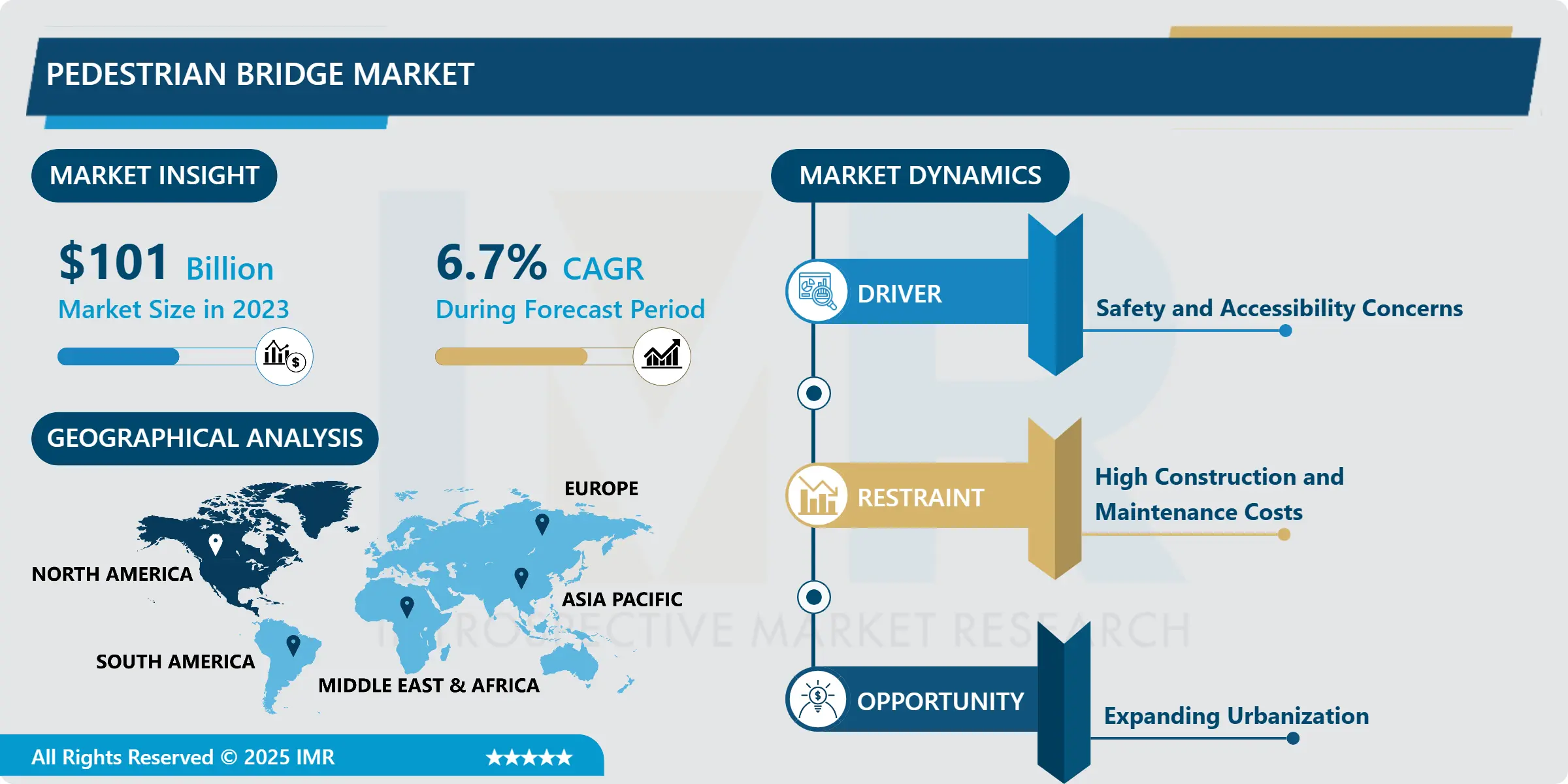
Pedestrian Bridge Market Trend Analysis:
Smart and Sustainable Pedestrian Bridges
- Global market trends currently are heavily based on smart devices and make use of pedestrian bridges and sustainable components. Contemporary pedestrian bridges are being commissioned not only for their utilities but for their bearing on the environment and society. Those types of prerequisites are: Smart attributes; Traffic/Structural/Environment Sensors that are being integrated into the bridge design. These sensors offer information in real-time, which is very useful for the purpose of maintenance, minimized expense as well as enhanced safety. Furthermore, those bridges are being fitted with solar panels, LED lights and energy-saving mechanisms in a bid to act sensibly to the environment in the use of energy.
- With sustainability slowly but surely incorporated in to infrastructure projects, pedestrian bridges are being made out of materials that are strong and as eco-friendly as possible. It is possible to have reduced carbon structures by utilizing recycled material, low carbon concrete and steel alloys. Just as a few others are being constructed to support habitat, bridges are even designed with spaces for greens and plants affixed to them. Thus, these innovations make positive contributions towards the establishment of urban environments that are not only useful but also resource efficient to the achievement of the set sustainability objectives.
Expanding Urbanization
- This is because pedestrians face an opportunity through intend to build bridges at larger urban areas. With the population growing urban, getting more people to walk safely and conveniently around and across cities has become a crucial issue. Large congested urban buildings characterized by constant traffic jam create some challenges for those on foot thus the importance of pedestrian bridges. This means that there is a vast potential for incorporating pedestrian bridges into new construction of even better higher standard cities, or for adapting the existing cities to contain such bridges that would enhance safety in transit for strolling on foot.
- Governments are also under pressure to develop effective and safe pedestrian environment as now it has also become a part of overall urban growth strategies and delivery of sustainable cities. Smart city projects, pedestrianism, and green infrastructure are fuelling the growth in the pedestrian bridge segment. Technological advancement in the construction has encouraged funding through public private partnerships to advance the construction of large pedestrian bridges. This trend will persist because city planners make efforts aimed at creating the environment that people will feel comfortable walking or cycling instead of driving.
Pedestrian Bridge Market Segment Analysis:
Pedestrian Bridge Market is Segmented on the basis of Type, Material, Application, End User, and Region.
By Type, Arch Bridges segment is expected to dominate the market during the forecast period
- Arch bridge is defined by the use of an arch that offers a good weight bearing capacity and stability. These bridges are ornamental and finding their application where the sites have great scenic or historical value. Still, they may be costlier and more intricate in their design as related to other classes of buildings.
- Beam Bridges, the most basic type of true bridges is the beam bridge which consist of horizontal beams supported on vertical pedestals. They are cheap to install, easy to design in construction and ideal for bridging relatively small distances. Beam bridges are used much in civil engineering layouts, personnel and animal traffic crossing over minor roads or streams in both urban and rural areas. Suspension Bridges, Cable suspension bridges are used where the span between the anchorages is large or where the construction of the bridge has to avoid important facilities such as rivers or highways. These bridges provide flexibility and stability and at the same time they are expensive to construct because of the complicated nature of the structures.
By Application, Urban Areas segment expected to held the largest share
- Urban Areas, Crossover systems in urban areas are normally employed to enable pedestrians to cross over roads, railway lines and rivers. They reduce congestion in public space for pedestrians, increase safety, and bring value in designing walkable cities. These are bearings especially constructed with architectural and instrumental perspectives making the city more beautiful.
Pedestrian Bridge Market Regional Insights:
North America is Expected to Dominate the Market Over the Forecast period
- North America occupies the largest share of the pedestrian bridge market space due to its improved infrastructure and works on urbanization. Many cities in the USA and Canada are gradually featuring pedestrian bridges as part of a smartcity development strategy with an aim of making these cities safer for pedestrians. North America has also expanded considerably on investments with public transport many of which deemed it proper to have pedestrian bridges. The escalating concern of sustainable and green infrastructure has seen the place an environmentally sensitive bridge with smart technology solutions within urban central of the region.
- The rising trend for pedestrian safety and flexibility in walkways in North America is also creating a market demand for pedestrian bridge. New York, San Francisco, and Toronto among other cities, which receive intensive pedestrian activities, have embarked on developing pedestrian bridges with the aim of easing traffic, minimizing occurrence of accidents, and improving the standards of living. Other factors the region has include well developed regulatory frameworks, government funding and sound urban planning, which attest to the increasing need for pedestrian bridges in North America.
Active Key Players in the Pedestrian Bridge Market
- AECOM (USA)
- Balfour Beatty (UK)
- Bechtel Corporation (USA)
- China State Construction Engineering Corporation (China)
- Fluor Corporation (USA)
- Freyssinet Ltd (France)
- Granite Construction Incorporated (USA)
- Kiewit Corporation (USA)
- Skanska AB (Sweden)
- Strabag SE (Austria)
- Tata Steel Limited (India)
- Vinci Construction (France)
- Other Active Players.
Key Industry Developments in the Pedestrian Bridge Market:
- In January 2023, the city of Bhopal, Madhya Pradesh, India, opened its most expensive pedestrian bridge, costing USD 13 million, in the city's Aishbagh area. The bridge connects the main road to the Aishbagh Hockey Stadium Colony, which was cut off for nearly four years as the railway crossing was closed to pedestrians.
|
Pedestrian Bridge Market |
|||
|
Base Year: |
2023 |
Forecast Period: |
2024-2032 |
|
Historical Data: |
2017 to 2023 |
Market Size in 2023: |
USD 101 Billion |
|
Forecast Period 2024-32 CAGR: |
6.7% |
Market Size in 2032: |
USD 181 Billion |
|
Segments Covered: |
By Type |
|
|
|
By Application |
|
||
|
By Region |
|
||
|
Key Market Drivers: |
|
||
|
Key Market Restraints: |
|
||
|
Key Opportunities: |
|
||
|
Companies Covered in the report: |
|
||
Chapter 1: Introduction
1.1 Scope and Coverage
Chapter 2:Executive Summary
Chapter 3: Market Landscape
3.1 Market Dynamics
3.1.1 Drivers
3.1.2 Restraints
3.1.3 Opportunities
3.1.4 Challenges
3.2 Market Trend Analysis
3.3 PESTLE Analysis
3.4 Porter's Five Forces Analysis
3.5 Industry Value Chain Analysis
3.6 Ecosystem
3.7 Regulatory Landscape
3.8 Price Trend Analysis
3.9 Patent Analysis
3.10 Technology Evolution
3.11 Investment Pockets
3.12 Import-Export Analysis
Chapter 4: Pedestrian Bridge Market by Type
4.1 Pedestrian Bridge Market Snapshot and Growth Engine
4.2 Pedestrian Bridge Market Overview
4.3 Arch Bridges
4.3.1 Introduction and Market Overview
4.3.2 Historic and Forecasted Market Size in Value USD and Volume Units (2017-2032F)
4.3.3 Key Market Trends, Growth Factors and Opportunities
4.3.4 Arch Bridges: Geographic Segmentation Analysis
4.4 Beam Bridges
4.4.1 Introduction and Market Overview
4.4.2 Historic and Forecasted Market Size in Value USD and Volume Units (2017-2032F)
4.4.3 Key Market Trends, Growth Factors and Opportunities
4.4.4 Beam Bridges: Geographic Segmentation Analysis
4.5 Suspension Bridges
4.5.1 Introduction and Market Overview
4.5.2 Historic and Forecasted Market Size in Value USD and Volume Units (2017-2032F)
4.5.3 Key Market Trends, Growth Factors and Opportunities
4.5.4 Suspension Bridges: Geographic Segmentation Analysis
4.6 Truss Bridges
4.6.1 Introduction and Market Overview
4.6.2 Historic and Forecasted Market Size in Value USD and Volume Units (2017-2032F)
4.6.3 Key Market Trends, Growth Factors and Opportunities
4.6.4 Truss Bridges: Geographic Segmentation Analysis
4.7 Cantilever Bridges
4.7.1 Introduction and Market Overview
4.7.2 Historic and Forecasted Market Size in Value USD and Volume Units (2017-2032F)
4.7.3 Key Market Trends, Growth Factors and Opportunities
4.7.4 Cantilever Bridges: Geographic Segmentation Analysis
4.8 Others
4.8.1 Introduction and Market Overview
4.8.2 Historic and Forecasted Market Size in Value USD and Volume Units (2017-2032F)
4.8.3 Key Market Trends, Growth Factors and Opportunities
4.8.4 Others: Geographic Segmentation Analysis
Chapter 5: Pedestrian Bridge Market by Material
5.1 Pedestrian Bridge Market Snapshot and Growth Engine
5.2 Pedestrian Bridge Market Overview
5.3 Concrete
5.3.1 Introduction and Market Overview
5.3.2 Historic and Forecasted Market Size in Value USD and Volume Units (2017-2032F)
5.3.3 Key Market Trends, Growth Factors and Opportunities
5.3.4 Concrete: Geographic Segmentation Analysis
5.4 Steel
5.4.1 Introduction and Market Overview
5.4.2 Historic and Forecasted Market Size in Value USD and Volume Units (2017-2032F)
5.4.3 Key Market Trends, Growth Factors and Opportunities
5.4.4 Steel: Geographic Segmentation Analysis
5.5 Wood
5.5.1 Introduction and Market Overview
5.5.2 Historic and Forecasted Market Size in Value USD and Volume Units (2017-2032F)
5.5.3 Key Market Trends, Growth Factors and Opportunities
5.5.4 Wood: Geographic Segmentation Analysis
5.6 Composite
5.6.1 Introduction and Market Overview
5.6.2 Historic and Forecasted Market Size in Value USD and Volume Units (2017-2032F)
5.6.3 Key Market Trends, Growth Factors and Opportunities
5.6.4 Composite: Geographic Segmentation Analysis
5.7 Others
5.7.1 Introduction and Market Overview
5.7.2 Historic and Forecasted Market Size in Value USD and Volume Units (2017-2032F)
5.7.3 Key Market Trends, Growth Factors and Opportunities
5.7.4 Others: Geographic Segmentation Analysis
Chapter 6: Pedestrian Bridge Market by End User
6.1 Pedestrian Bridge Market Snapshot and Growth Engine
6.2 Pedestrian Bridge Market Overview
6.3 Government
6.3.1 Introduction and Market Overview
6.3.2 Historic and Forecasted Market Size in Value USD and Volume Units (2017-2032F)
6.3.3 Key Market Trends, Growth Factors and Opportunities
6.3.4 Government: Geographic Segmentation Analysis
6.4 Commercial
6.4.1 Introduction and Market Overview
6.4.2 Historic and Forecasted Market Size in Value USD and Volume Units (2017-2032F)
6.4.3 Key Market Trends, Growth Factors and Opportunities
6.4.4 Commercial: Geographic Segmentation Analysis
6.5 Residential
6.5.1 Introduction and Market Overview
6.5.2 Historic and Forecasted Market Size in Value USD and Volume Units (2017-2032F)
6.5.3 Key Market Trends, Growth Factors and Opportunities
6.5.4 Residential: Geographic Segmentation Analysis
6.6 Others
6.6.1 Introduction and Market Overview
6.6.2 Historic and Forecasted Market Size in Value USD and Volume Units (2017-2032F)
6.6.3 Key Market Trends, Growth Factors and Opportunities
6.6.4 Others: Geographic Segmentation Analysis
Chapter 7: Pedestrian Bridge Market by Application
7.1 Pedestrian Bridge Market Snapshot and Growth Engine
7.2 Pedestrian Bridge Market Overview
7.3 Urban Areas
7.3.1 Introduction and Market Overview
7.3.2 Historic and Forecasted Market Size in Value USD and Volume Units (2017-2032F)
7.3.3 Key Market Trends, Growth Factors and Opportunities
7.3.4 Urban Areas: Geographic Segmentation Analysis
7.4 Rural Areas
7.4.1 Introduction and Market Overview
7.4.2 Historic and Forecasted Market Size in Value USD and Volume Units (2017-2032F)
7.4.3 Key Market Trends, Growth Factors and Opportunities
7.4.4 Rural Areas: Geographic Segmentation Analysis
7.5 Highway Crossings
7.5.1 Introduction and Market Overview
7.5.2 Historic and Forecasted Market Size in Value USD and Volume Units (2017-2032F)
7.5.3 Key Market Trends, Growth Factors and Opportunities
7.5.4 Highway Crossings: Geographic Segmentation Analysis
7.6 Parks and Recreational Areas
7.6.1 Introduction and Market Overview
7.6.2 Historic and Forecasted Market Size in Value USD and Volume Units (2017-2032F)
7.6.3 Key Market Trends, Growth Factors and Opportunities
7.6.4 Parks and Recreational Areas: Geographic Segmentation Analysis
7.7 Others
7.7.1 Introduction and Market Overview
7.7.2 Historic and Forecasted Market Size in Value USD and Volume Units (2017-2032F)
7.7.3 Key Market Trends, Growth Factors and Opportunities
7.7.4 Others: Geographic Segmentation Analysis
Chapter 8: Company Profiles and Competitive Analysis
8.1 Competitive Landscape
8.1.1 Competitive Benchmarking
8.1.2 Pedestrian Bridge Market Share by Manufacturer (2023)
8.1.3 Industry BCG Matrix
8.1.4 Heat Map Analysis
8.1.5 Mergers and Acquisitions
8.2 AECOM (USA)
8.2.1 Company Overview
8.2.2 Key Executives
8.2.3 Company Snapshot
8.2.4 Role of the Company in the Market
8.2.5 Sustainability and Social Responsibility
8.2.6 Operating Business Segments
8.2.7 Product Portfolio
8.2.8 Business Performance
8.2.9 Key Strategic Moves and Recent Developments
8.2.10 SWOT Analysis
8.3 CHINA STATE CONSTRUCTION ENGINEERING CORPORATION (CHINA)
8.4 FLUOR CORPORATION (USA)
8.5 KIEWIT CORPORATION (USA)
8.6 TATA STEEL LIMITED (INDIA)
8.7 VINCI CONSTRUCTION (FRANCE)
8.8 SKANSKA AB (SWEDEN)
8.9 BALFOUR BEATTY (UK)
8.10 BECHTEL CORPORATION (USA)
8.11 FREYSSINET LTD (FRANCE)
8.12 GRANITE CONSTRUCTION INCORPORATED (USA)
8.13 STRABAG SE (AUSTRIA)
8.14 OTHER ACTIVE PLAYERS
Chapter 9: Global Pedestrian Bridge Market By Region
9.1 Overview
9.2. North America Pedestrian Bridge Market
9.2.1 Key Market Trends, Growth Factors and Opportunities
9.2.2 Top Key Companies
9.2.3 Historic and Forecasted Market Size by Segments
9.2.4 Historic and Forecasted Market Size By Type
9.2.4.1 Arch Bridges
9.2.4.2 Beam Bridges
9.2.4.3 Suspension Bridges
9.2.4.4 Truss Bridges
9.2.4.5 Cantilever Bridges
9.2.4.6 Others
9.2.5 Historic and Forecasted Market Size By Material
9.2.5.1 Concrete
9.2.5.2 Steel
9.2.5.3 Wood
9.2.5.4 Composite
9.2.5.5 Others
9.2.6 Historic and Forecasted Market Size By End User
9.2.6.1 Government
9.2.6.2 Commercial
9.2.6.3 Residential
9.2.6.4 Others
9.2.7 Historic and Forecasted Market Size By Application
9.2.7.1 Urban Areas
9.2.7.2 Rural Areas
9.2.7.3 Highway Crossings
9.2.7.4 Parks and Recreational Areas
9.2.7.5 Others
9.2.8 Historic and Forecast Market Size by Country
9.2.8.1 US
9.2.8.2 Canada
9.2.8.3 Mexico
9.3. Eastern Europe Pedestrian Bridge Market
9.3.1 Key Market Trends, Growth Factors and Opportunities
9.3.2 Top Key Companies
9.3.3 Historic and Forecasted Market Size by Segments
9.3.4 Historic and Forecasted Market Size By Type
9.3.4.1 Arch Bridges
9.3.4.2 Beam Bridges
9.3.4.3 Suspension Bridges
9.3.4.4 Truss Bridges
9.3.4.5 Cantilever Bridges
9.3.4.6 Others
9.3.5 Historic and Forecasted Market Size By Material
9.3.5.1 Concrete
9.3.5.2 Steel
9.3.5.3 Wood
9.3.5.4 Composite
9.3.5.5 Others
9.3.6 Historic and Forecasted Market Size By End User
9.3.6.1 Government
9.3.6.2 Commercial
9.3.6.3 Residential
9.3.6.4 Others
9.3.7 Historic and Forecasted Market Size By Application
9.3.7.1 Urban Areas
9.3.7.2 Rural Areas
9.3.7.3 Highway Crossings
9.3.7.4 Parks and Recreational Areas
9.3.7.5 Others
9.3.8 Historic and Forecast Market Size by Country
9.3.8.1 Bulgaria
9.3.8.2 The Czech Republic
9.3.8.3 Hungary
9.3.8.4 Poland
9.3.8.5 Romania
9.3.8.6 Rest of Eastern Europe
9.4. Western Europe Pedestrian Bridge Market
9.4.1 Key Market Trends, Growth Factors and Opportunities
9.4.2 Top Key Companies
9.4.3 Historic and Forecasted Market Size by Segments
9.4.4 Historic and Forecasted Market Size By Type
9.4.4.1 Arch Bridges
9.4.4.2 Beam Bridges
9.4.4.3 Suspension Bridges
9.4.4.4 Truss Bridges
9.4.4.5 Cantilever Bridges
9.4.4.6 Others
9.4.5 Historic and Forecasted Market Size By Material
9.4.5.1 Concrete
9.4.5.2 Steel
9.4.5.3 Wood
9.4.5.4 Composite
9.4.5.5 Others
9.4.6 Historic and Forecasted Market Size By End User
9.4.6.1 Government
9.4.6.2 Commercial
9.4.6.3 Residential
9.4.6.4 Others
9.4.7 Historic and Forecasted Market Size By Application
9.4.7.1 Urban Areas
9.4.7.2 Rural Areas
9.4.7.3 Highway Crossings
9.4.7.4 Parks and Recreational Areas
9.4.7.5 Others
9.4.8 Historic and Forecast Market Size by Country
9.4.8.1 Germany
9.4.8.2 UK
9.4.8.3 France
9.4.8.4 Netherlands
9.4.8.5 Italy
9.4.8.6 Russia
9.4.8.7 Spain
9.4.8.8 Rest of Western Europe
9.5. Asia Pacific Pedestrian Bridge Market
9.5.1 Key Market Trends, Growth Factors and Opportunities
9.5.2 Top Key Companies
9.5.3 Historic and Forecasted Market Size by Segments
9.5.4 Historic and Forecasted Market Size By Type
9.5.4.1 Arch Bridges
9.5.4.2 Beam Bridges
9.5.4.3 Suspension Bridges
9.5.4.4 Truss Bridges
9.5.4.5 Cantilever Bridges
9.5.4.6 Others
9.5.5 Historic and Forecasted Market Size By Material
9.5.5.1 Concrete
9.5.5.2 Steel
9.5.5.3 Wood
9.5.5.4 Composite
9.5.5.5 Others
9.5.6 Historic and Forecasted Market Size By End User
9.5.6.1 Government
9.5.6.2 Commercial
9.5.6.3 Residential
9.5.6.4 Others
9.5.7 Historic and Forecasted Market Size By Application
9.5.7.1 Urban Areas
9.5.7.2 Rural Areas
9.5.7.3 Highway Crossings
9.5.7.4 Parks and Recreational Areas
9.5.7.5 Others
9.5.8 Historic and Forecast Market Size by Country
9.5.8.1 China
9.5.8.2 India
9.5.8.3 Japan
9.5.8.4 South Korea
9.5.8.5 Malaysia
9.5.8.6 Thailand
9.5.8.7 Vietnam
9.5.8.8 The Philippines
9.5.8.9 Australia
9.5.8.10 New Zealand
9.5.8.11 Rest of APAC
9.6. Middle East & Africa Pedestrian Bridge Market
9.6.1 Key Market Trends, Growth Factors and Opportunities
9.6.2 Top Key Companies
9.6.3 Historic and Forecasted Market Size by Segments
9.6.4 Historic and Forecasted Market Size By Type
9.6.4.1 Arch Bridges
9.6.4.2 Beam Bridges
9.6.4.3 Suspension Bridges
9.6.4.4 Truss Bridges
9.6.4.5 Cantilever Bridges
9.6.4.6 Others
9.6.5 Historic and Forecasted Market Size By Material
9.6.5.1 Concrete
9.6.5.2 Steel
9.6.5.3 Wood
9.6.5.4 Composite
9.6.5.5 Others
9.6.6 Historic and Forecasted Market Size By End User
9.6.6.1 Government
9.6.6.2 Commercial
9.6.6.3 Residential
9.6.6.4 Others
9.6.7 Historic and Forecasted Market Size By Application
9.6.7.1 Urban Areas
9.6.7.2 Rural Areas
9.6.7.3 Highway Crossings
9.6.7.4 Parks and Recreational Areas
9.6.7.5 Others
9.6.8 Historic and Forecast Market Size by Country
9.6.8.1 Turkey
9.6.8.2 Bahrain
9.6.8.3 Kuwait
9.6.8.4 Saudi Arabia
9.6.8.5 Qatar
9.6.8.6 UAE
9.6.8.7 Israel
9.6.8.8 South Africa
9.7. South America Pedestrian Bridge Market
9.7.1 Key Market Trends, Growth Factors and Opportunities
9.7.2 Top Key Companies
9.7.3 Historic and Forecasted Market Size by Segments
9.7.4 Historic and Forecasted Market Size By Type
9.7.4.1 Arch Bridges
9.7.4.2 Beam Bridges
9.7.4.3 Suspension Bridges
9.7.4.4 Truss Bridges
9.7.4.5 Cantilever Bridges
9.7.4.6 Others
9.7.5 Historic and Forecasted Market Size By Material
9.7.5.1 Concrete
9.7.5.2 Steel
9.7.5.3 Wood
9.7.5.4 Composite
9.7.5.5 Others
9.7.6 Historic and Forecasted Market Size By End User
9.7.6.1 Government
9.7.6.2 Commercial
9.7.6.3 Residential
9.7.6.4 Others
9.7.7 Historic and Forecasted Market Size By Application
9.7.7.1 Urban Areas
9.7.7.2 Rural Areas
9.7.7.3 Highway Crossings
9.7.7.4 Parks and Recreational Areas
9.7.7.5 Others
9.7.8 Historic and Forecast Market Size by Country
9.7.8.1 Brazil
9.7.8.2 Argentina
9.7.8.3 Rest of SA
Chapter 10 Analyst Viewpoint and Conclusion
10.1 Recommendations and Concluding Analysis
10.2 Potential Market Strategies
Chapter 11 Research Methodology
11.1 Research Process
11.2 Primary Research
11.3 Secondary Research
|
Pedestrian Bridge Market |
|||
|
Base Year: |
2023 |
Forecast Period: |
2024-2032 |
|
Historical Data: |
2017 to 2023 |
Market Size in 2023: |
USD 101 Billion |
|
Forecast Period 2024-32 CAGR: |
6.7% |
Market Size in 2032: |
USD 181 Billion |
|
Segments Covered: |
By Type |
|
|
|
By Application |
|
||
|
By Region |
|
||
|
Key Market Drivers: |
|
||
|
Key Market Restraints: |
|
||
|
Key Opportunities: |
|
||
|
Companies Covered in the report: |
|
||