




Oxygenators Market Synopsis:
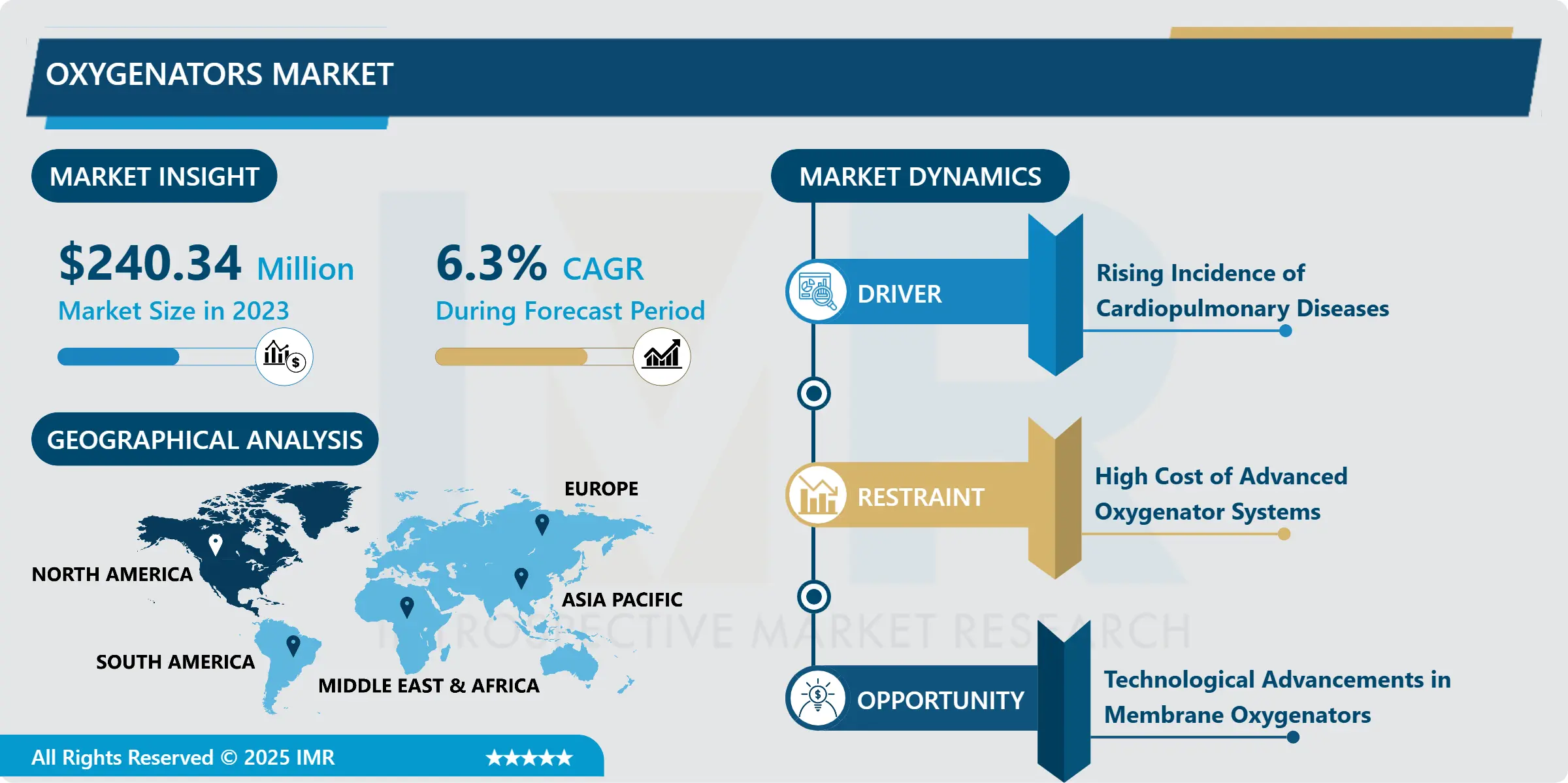
Oxygenators Market Size Was Valued at USD 240.34 Million in 2023, and is Projected to Reach USD 416.51 Million by 2032, Growing at a CAGR of 6.3% From 2024-2032.
Oxygenators are medical devices that add oxygen to and remove carbon dioxide from the blood, functioning as an artificial lung. They are commonly employed in heart-lung machines during cardiac surgery and in ECMO therapy for patients with severe respiratory or cardiac failure. These devices are critical in life-saving procedures and are used across multiple healthcare settings, including hospitals, emergency medical services, and specialty clinics. The global oxygenators market encompasses a wide range of device types, including membrane oxygenators, bubble oxygenators, and centrifugal variants, catering to different patient demographics and clinical applications.
The global oxygenators market is a crucial segment of the medical device industry, serving essential functions in surgical and critical care settings, particularly in cardiopulmonary procedures and respiratory support. Oxygenators are devices designed to facilitate external oxygenation of blood, primarily used during open-heart surgeries and in extracorporeal membrane oxygenation (ECMO) systems. The demand for oxygenators has surged due to increasing incidences of respiratory and cardiovascular diseases, advancements in critical care infrastructure, and a growing aging population across the globe.
The market is driven by the rising global burden of cardiovascular diseases and chronic respiratory conditions such as chronic obstructive pulmonary disease (COPD) and acute respiratory distress syndrome (ARDS). The increasing use of ECMO systems, particularly during the COVID-19 pandemic, has heightened awareness and demand for advanced oxygenation devices. Additionally, the aging global population, which is more susceptible to cardiac and pulmonary complications, further fuels the need for reliable oxygenator systems in surgical and intensive care settings.
Technological advancements are reshaping the oxygenators market. Newer devices offer improved biocompatibility, longer functional durations, reduced hemolysis, and enhanced oxygen transfer efficiency. Innovations such as portable ECMO machines and minimally invasive integration into cardiopulmonary bypass circuits are expanding the scope of oxygenator applications. Furthermore, digital monitoring and integration with hospital IT systems are making oxygenator-based therapies more efficient and safer, contributing to broader adoption in both developed and emerging markets.
Oxygenators Market Trend Analysis:
Rising Incidence of Cardiopulmonary Diseases
-
The increasing global prevalence of cardiovascular and respiratory diseases is one of the primary drivers of the oxygenators market. Conditions such as chronic obstructive pulmonary disease (COPD), coronary artery disease, congenital heart defects, and acute respiratory distress syndrome (ARDS) require advanced oxygenation support during surgical interventions or in critical care settings. With the aging population, sedentary lifestyles, pollution, and tobacco use on the rise, the demand for devices that support respiratory and cardiac functions has significantly grown. This has led to a notable increase in the adoption of oxygenators, especially membrane oxygenators, in both developed and emerging markets.
- Moreover, the demand is further amplified by the increasing number of cardiopulmonary bypass surgeries and the use of ECMO systems in ICUs. Particularly during the COVID-19 pandemic, ECMO therapy became a lifesaving solution for patients experiencing severe respiratory failure, showcasing the critical role oxygenators play in modern healthcare. As healthcare systems expand ICU capacities and surgical infrastructure, especially in developing nations, oxygenator usage is expected to see sustained long-term growth.
Technological Advancements in Membrane Oxygenators
-
A major trend shaping the market is the rapid technological innovation in oxygenator design, particularly in membrane oxygenators. Manufacturers are focusing on improving efficiency, biocompatibility, and durability of devices to meet the complex needs of critical care and cardiac surgery. Innovations such as polymethylpentene (PMP) fiber membranes, heparin-coated surfaces, and low-resistance flow dynamics have significantly enhanced gas exchange efficiency while reducing complications like thrombosis and hemolysis. These advancements contribute to improved patient outcomes and reduce the risks associated with long-term extracorporeal support.
- In addition to performance improvements, modern oxygenators are also becoming more compact, portable, and easier to integrate with extracorporeal life support systems. This enables their use in emergency transport, mobile ICUs, and smaller healthcare facilities. Integration with real-time monitoring technologies and AI-driven alerts is also enhancing the operational safety and management of oxygenation procedures. As healthcare providers increasingly prioritize precision medicine and patient-specific care, high-performance and smart oxygenators are becoming essential tools in the cardiopulmonary support arsenal.
Oxygenators Market Segment Analysis:
Oxygenators Market Segmented based on Product Type, Age Group, Application, End-User, and Region.
By Product Type, the Membrane Oxygenators segment is expected to dominate the market during the forecast period
-
Among the three primary product types—Membrane Oxygenators, Bubble Oxygenators, and Centrifugal & Rotational Oxygenators—the Membrane Oxygenators segment dominates the global market. This dominance is primarily attributed to the superior efficiency, safety profile, and biocompatibility of membrane-based systems compared to bubble oxygenators, which are considered outdated and associated with higher risks of gas embolism and blood trauma. Membrane oxygenators offer controlled gas exchange using semipermeable membranes, significantly reducing complications and making them the gold standard in cardiac surgeries and extracorporeal membrane oxygenation (ECMO) procedures.
- From a clinical perspective, membrane oxygenators are highly preferred in long-duration cardiac and respiratory support applications due to their ability to function for extended periods without substantial degradation in performance. Their use has expanded beyond traditional cardiopulmonary bypass surgeries to encompass critical care scenarios, such as during the treatment of acute respiratory distress syndrome (ARDS) and severe cases of COVID-19. Hospitals and healthcare systems around the world are increasingly adopting membrane oxygenators as the standard device, leading to their higher market share and consistent demand.
- From a third-person industry outlook, stakeholders recognize membrane oxygenators as a strategic focus for innovation and investment. Leading manufacturers are prioritizing R&D in this segment to develop next-generation oxygenators with enhanced surface coatings, lower priming volumes, and integrated monitoring capabilities. With rising healthcare expenditures, the shift toward minimally invasive and safer cardiopulmonary interventions, and the growing prevalence of chronic diseases, the membrane oxygenators segment is expected to maintain its dominant position in the global market over the foreseeable future.
By Application, the Cardiac Surgery segment expected to held the largest share
-
Among the key application segments—Respiratory Support, Cardiac Surgery, Extracorporeal Membrane Oxygenation (ECMO), and Extracorporeal Cardiopulmonary Resuscitation (ECPR)—the Cardiac Surgery segment holds the dominant share in the global oxygenators market. Oxygenators are essential components in cardiopulmonary bypass (CPB) machines, which are used during a wide range of open-heart surgeries, including valve replacements, coronary artery bypass grafting (CABG), and congenital heart defect repairs. Given the high global burden of cardiovascular diseases, there is a consistent volume of surgical interventions requiring the use of oxygenators.
- Cardiac surgery procedures demand high-performance and highly reliable oxygenators to maintain adequate oxygenation and carbon dioxide removal while the heart and lungs are temporarily nonfunctional. Membrane oxygenators, in particular, are extensively used in these surgeries due to their stability over prolonged periods and lower risk of blood damage. Developed regions such as North America and Europe have seen stable procedural volumes due to their aging populations and advanced cardiac care infrastructure. Meanwhile, emerging economies are witnessing rising surgery rates due to increasing access to cardiac care, further fueling demand in this segment.
- From an industry perspective, the cardiac surgery application segment continues to anchor the oxygenators market’s revenue and technological progress. Medical device companies are consistently refining their product offerings for this use case, focusing on reducing priming volume, improving hemodynamic performance, and enhancing biocompatibility. As the global cardiovascular disease burden escalates and surgical techniques become more advanced, cardiac surgery is expected to remain the primary application driving demand for oxygenators worldwide.
Oxygenators Market Regional Insights:
North America is expected to dominate the Market Over the Forecast period
-
North America dominates the global oxygenators market, accounting for the largest share in terms of revenue and technological adoption. This dominance is driven by the region's highly developed healthcare infrastructure, high per capita healthcare expenditure, and widespread access to advanced surgical and critical care facilities. The United States, in particular, conducts a significant volume of cardiac surgeries annually and has a high number of ECMO centers across the country. Furthermore, the presence of major medical device manufacturers and ongoing clinical research contributes to the region’s technological edge in oxygenator development and deployment.
- In addition, the rising prevalence of cardiovascular and respiratory disorders in the region, exacerbated by aging populations, lifestyle-related diseases, and higher rates of obesity and diabetes, has fueled the demand for oxygenators in both elective and emergency care settings. The region also experienced heightened use of ECMO and oxygenator systems during the COVID-19 pandemic, which further strengthened healthcare investments in respiratory and cardiac life support technologies. With continued innovation, government support for healthcare modernization, and strong reimbursement frameworks, North America is expected to maintain its leadership position in the oxygenators market in the coming years.
Active Key Players in the Oxygenators Market:
- Abbott Laboratories (USA)
- Alung Technologies, Inc. (USA)
- Braile Biomedica (Brazil)
- Carmeda (Sweden)
- Ebsar Medical Technology Co., Ltd. (China)
- Edwards Lifesciences Corporation (USA)
- Eurosets S.r.l. (Italy)
- Fresenius Medical Care AG & Co. KGaA (Germany)
- Getinge AB (Sweden)
- Hemovent GmbH (Germany)
- Lifeline Scientific (USA)
- LivaNova PLC (UK/Italy)
- Medcaptain Medical Technology Co., Ltd. (China)
- Medos Medizintechnik AG (Germany)
- Medtronic (USA)
- MicroPort Scientific Corporation (China)
- Nipro Corporation (Japan)
- Nova Biomedical (USA)
- Senko Medical Instrument Mfg. Co., Ltd. (Japan)
- Shenzhen Bluedove Medical Device Co., Ltd. (China)
- Shenzhen Mindray Bio-Medical Electronics Co., Ltd. (China)
- Sinomed (China)
- Stryker Corporation (USA)
- Terumo Corporation (Japan)
- XENIOS AG (Germany)
- Other Active Players.
|
Global Oxygenators Market |
|||
|
Base Year: |
2023 |
Forecast Period: |
2024-2032 |
|
Historical Data: |
2017 to 2023 |
Market Size in 2023: |
USD 240.34 Million |
|
Forecast Period 2024-32 CAGR: |
6.3% |
Market Size in 2032: |
USD 416.51 Million |
|
Segments Covered: |
By Product Type |
|
|
|
By Age Group |
|
||
|
By Application |
|
||
|
By Region |
|
||
|
Key Market Drivers: |
|
||
|
Key Market Restraints: |
|
||
|
Key Opportunities: |
|
||
|
Companies Covered in the report: |
|
||
Chapter 1: Introduction
1.1 Scope and Coverage
Chapter 2:Executive Summary
Chapter 3: Market Landscape
3.1 Market Dynamics
3.1.1 Drivers
3.1.2 Restraints
3.1.3 Opportunities
3.1.4 Challenges
3.2 Market Trend Analysis
3.3 PESTLE Analysis
3.4 Porter's Five Forces Analysis
3.5 Industry Value Chain Analysis
3.6 Ecosystem
3.7 Regulatory Landscape
3.8 Price Trend Analysis
3.9 Patent Analysis
3.10 Technology Evolution
3.11 Investment Pockets
3.12 Import-Export Analysis
Chapter 4: Oxygenators Market by Type
4.1 Oxygenators Market Snapshot and Growth Engine
4.2 Oxygenators Market Overview
4.3 Cardiopulmonary Bypass (CPB) Oxygenators
4.3.1 Introduction and Market Overview
4.3.2 Historic and Forecasted Market Size in Value USD and Volume Units (2017-2032F)
4.3.3 Key Market Trends, Growth Factors and Opportunities
4.3.4 Cardiopulmonary Bypass (CPB) Oxygenators: Geographic Segmentation Analysis
4.4 Extracorporeal Membrane Oxygenators (ECMO)
4.4.1 Introduction and Market Overview
4.4.2 Historic and Forecasted Market Size in Value USD and Volume Units (2017-2032F)
4.4.3 Key Market Trends, Growth Factors and Opportunities
4.4.4 Extracorporeal Membrane Oxygenators (ECMO): Geographic Segmentation Analysis
4.5 Disposable Oxygenators
4.5.1 Introduction and Market Overview
4.5.2 Historic and Forecasted Market Size in Value USD and Volume Units (2017-2032F)
4.5.3 Key Market Trends, Growth Factors and Opportunities
4.5.4 Disposable Oxygenators: Geographic Segmentation Analysis
4.6 Other Specialized Oxygenators
4.6.1 Introduction and Market Overview
4.6.2 Historic and Forecasted Market Size in Value USD and Volume Units (2017-2032F)
4.6.3 Key Market Trends, Growth Factors and Opportunities
4.6.4 Other Specialized Oxygenators: Geographic Segmentation Analysis
Chapter 5: Oxygenators Market by Application
5.1 Oxygenators Market Snapshot and Growth Engine
5.2 Oxygenators Market Overview
5.3 Medical Device Sterilization
5.3.1 Introduction and Market Overview
5.3.2 Historic and Forecasted Market Size in Value USD and Volume Units (2017-2032F)
5.3.3 Key Market Trends, Growth Factors and Opportunities
5.3.4 Medical Device Sterilization: Geographic Segmentation Analysis
5.4 Extracorporeal Membrane Oxygenation (ECMO) Treatment
5.4.1 Introduction and Market Overview
5.4.2 Historic and Forecasted Market Size in Value USD and Volume Units (2017-2032F)
5.4.3 Key Market Trends, Growth Factors and Opportunities
5.4.4 Extracorporeal Membrane Oxygenation (ECMO) Treatment: Geographic Segmentation Analysis
5.5 Cardiopulmonary Bypass (CPB) Procedures
5.5.1 Introduction and Market Overview
5.5.2 Historic and Forecasted Market Size in Value USD and Volume Units (2017-2032F)
5.5.3 Key Market Trends, Growth Factors and Opportunities
5.5.4 Cardiopulmonary Bypass (CPB) Procedures: Geographic Segmentation Analysis
5.6 Emergency & Critical Care
5.6.1 Introduction and Market Overview
5.6.2 Historic and Forecasted Market Size in Value USD and Volume Units (2017-2032F)
5.6.3 Key Market Trends, Growth Factors and Opportunities
5.6.4 Emergency & Critical Care: Geographic Segmentation Analysis
Chapter 6: Oxygenators Market by End User
6.1 Oxygenators Market Snapshot and Growth Engine
6.2 Oxygenators Market Overview
6.3 Hospitals & Clinics
6.3.1 Introduction and Market Overview
6.3.2 Historic and Forecasted Market Size in Value USD and Volume Units (2017-2032F)
6.3.3 Key Market Trends, Growth Factors and Opportunities
6.3.4 Hospitals & Clinics: Geographic Segmentation Analysis
6.4 Ambulatory Surgical Centers (ASCs)
6.4.1 Introduction and Market Overview
6.4.2 Historic and Forecasted Market Size in Value USD and Volume Units (2017-2032F)
6.4.3 Key Market Trends, Growth Factors and Opportunities
6.4.4 Ambulatory Surgical Centers (ASCs): Geographic Segmentation Analysis
6.5 Pharmaceutical & Biotechnology Companies
6.5.1 Introduction and Market Overview
6.5.2 Historic and Forecasted Market Size in Value USD and Volume Units (2017-2032F)
6.5.3 Key Market Trends, Growth Factors and Opportunities
6.5.4 Pharmaceutical & Biotechnology Companies: Geographic Segmentation Analysis
6.6 Contract Sterilization
6.6.1 Introduction and Market Overview
6.6.2 Historic and Forecasted Market Size in Value USD and Volume Units (2017-2032F)
6.6.3 Key Market Trends, Growth Factors and Opportunities
6.6.4 Contract Sterilization: Geographic Segmentation Analysis
Chapter 7: Company Profiles and Competitive Analysis
7.1 Competitive Landscape
7.1.1 Competitive Benchmarking
7.1.2 Oxygenators Market Share by Manufacturer (2023)
7.1.3 Industry BCG Matrix
7.1.4 Heat Map Analysis
7.1.5 Mergers and Acquisitions
7.2 ASAHI KASEI MEDICAL CO. LTD. (JAPAN)
7.2.1 Company Overview
7.2.2 Key Executives
7.2.3 Company Snapshot
7.2.4 Role of the Company in the Market
7.2.5 Sustainability and Social Responsibility
7.2.6 Operating Business Segments
7.2.7 Product Portfolio
7.2.8 Business Performance
7.2.9 Key Strategic Moves and Recent Developments
7.2.10 SWOT Analysis
7.3 B. BRAUN MELSUNGEN AG (GERMANY)
7.4 BIO-MED DEVICES INC. (UNITED STATES)
7.5 C.R. BARD INC. (A PART OF BD) (UNITED STATES)
7.6 CARDIOMEDICS INC. (UNITED STATES)
7.7 ECMO SYSTEMS INC. (UNITED STATES)
7.8 FRESENIUS MEDICAL CARE AG & CO. KGAA (GERMANY)
7.9 GETINGE AB (SWEDEN)
7.10 JOSTRA (A PART OF MAQUET) (GERMANY)
7.11 LIVANOVA PLC (UNITED KINGDOM)
7.12 MAQUET CARDIOPULMONARY GMBH (GERMANY)
7.13 MEDELA AG (SWITZERLAND)
7.14 MEDTRONIC PLC (IRELAND)
7.15 NIPRO CORPORATION (JAPAN)
7.16 SORIN GROUP (ITALY)
7.17 TERUMO CORPORATION (JAPAN)
7.18 VYGON SA (FRANCE)
7.19 XENIOS AG (GERMANY)
7.20 OTHER ACTIVE PLAYERS
Chapter 8: Global Oxygenators Market By Region
8.1 Overview
8.2. North America Oxygenators Market
8.2.1 Key Market Trends, Growth Factors and Opportunities
8.2.2 Top Key Companies
8.2.3 Historic and Forecasted Market Size by Segments
8.2.4 Historic and Forecasted Market Size By Type
8.2.4.1 Cardiopulmonary Bypass (CPB) Oxygenators
8.2.4.2 Extracorporeal Membrane Oxygenators (ECMO)
8.2.4.3 Disposable Oxygenators
8.2.4.4 Other Specialized Oxygenators
8.2.5 Historic and Forecasted Market Size By Application
8.2.5.1 Medical Device Sterilization
8.2.5.2 Extracorporeal Membrane Oxygenation (ECMO) Treatment
8.2.5.3 Cardiopulmonary Bypass (CPB) Procedures
8.2.5.4 Emergency & Critical Care
8.2.6 Historic and Forecasted Market Size By End User
8.2.6.1 Hospitals & Clinics
8.2.6.2 Ambulatory Surgical Centers (ASCs)
8.2.6.3 Pharmaceutical & Biotechnology Companies
8.2.6.4 Contract Sterilization
8.2.7 Historic and Forecast Market Size by Country
8.2.7.1 US
8.2.7.2 Canada
8.2.7.3 Mexico
8.3. Eastern Europe Oxygenators Market
8.3.1 Key Market Trends, Growth Factors and Opportunities
8.3.2 Top Key Companies
8.3.3 Historic and Forecasted Market Size by Segments
8.3.4 Historic and Forecasted Market Size By Type
8.3.4.1 Cardiopulmonary Bypass (CPB) Oxygenators
8.3.4.2 Extracorporeal Membrane Oxygenators (ECMO)
8.3.4.3 Disposable Oxygenators
8.3.4.4 Other Specialized Oxygenators
8.3.5 Historic and Forecasted Market Size By Application
8.3.5.1 Medical Device Sterilization
8.3.5.2 Extracorporeal Membrane Oxygenation (ECMO) Treatment
8.3.5.3 Cardiopulmonary Bypass (CPB) Procedures
8.3.5.4 Emergency & Critical Care
8.3.6 Historic and Forecasted Market Size By End User
8.3.6.1 Hospitals & Clinics
8.3.6.2 Ambulatory Surgical Centers (ASCs)
8.3.6.3 Pharmaceutical & Biotechnology Companies
8.3.6.4 Contract Sterilization
8.3.7 Historic and Forecast Market Size by Country
8.3.7.1 Russia
8.3.7.2 Bulgaria
8.3.7.3 The Czech Republic
8.3.7.4 Hungary
8.3.7.5 Poland
8.3.7.6 Romania
8.3.7.7 Rest of Eastern Europe
8.4. Western Europe Oxygenators Market
8.4.1 Key Market Trends, Growth Factors and Opportunities
8.4.2 Top Key Companies
8.4.3 Historic and Forecasted Market Size by Segments
8.4.4 Historic and Forecasted Market Size By Type
8.4.4.1 Cardiopulmonary Bypass (CPB) Oxygenators
8.4.4.2 Extracorporeal Membrane Oxygenators (ECMO)
8.4.4.3 Disposable Oxygenators
8.4.4.4 Other Specialized Oxygenators
8.4.5 Historic and Forecasted Market Size By Application
8.4.5.1 Medical Device Sterilization
8.4.5.2 Extracorporeal Membrane Oxygenation (ECMO) Treatment
8.4.5.3 Cardiopulmonary Bypass (CPB) Procedures
8.4.5.4 Emergency & Critical Care
8.4.6 Historic and Forecasted Market Size By End User
8.4.6.1 Hospitals & Clinics
8.4.6.2 Ambulatory Surgical Centers (ASCs)
8.4.6.3 Pharmaceutical & Biotechnology Companies
8.4.6.4 Contract Sterilization
8.4.7 Historic and Forecast Market Size by Country
8.4.7.1 Germany
8.4.7.2 UK
8.4.7.3 France
8.4.7.4 The Netherlands
8.4.7.5 Italy
8.4.7.6 Spain
8.4.7.7 Rest of Western Europe
8.5. Asia Pacific Oxygenators Market
8.5.1 Key Market Trends, Growth Factors and Opportunities
8.5.2 Top Key Companies
8.5.3 Historic and Forecasted Market Size by Segments
8.5.4 Historic and Forecasted Market Size By Type
8.5.4.1 Cardiopulmonary Bypass (CPB) Oxygenators
8.5.4.2 Extracorporeal Membrane Oxygenators (ECMO)
8.5.4.3 Disposable Oxygenators
8.5.4.4 Other Specialized Oxygenators
8.5.5 Historic and Forecasted Market Size By Application
8.5.5.1 Medical Device Sterilization
8.5.5.2 Extracorporeal Membrane Oxygenation (ECMO) Treatment
8.5.5.3 Cardiopulmonary Bypass (CPB) Procedures
8.5.5.4 Emergency & Critical Care
8.5.6 Historic and Forecasted Market Size By End User
8.5.6.1 Hospitals & Clinics
8.5.6.2 Ambulatory Surgical Centers (ASCs)
8.5.6.3 Pharmaceutical & Biotechnology Companies
8.5.6.4 Contract Sterilization
8.5.7 Historic and Forecast Market Size by Country
8.5.7.1 China
8.5.7.2 India
8.5.7.3 Japan
8.5.7.4 South Korea
8.5.7.5 Malaysia
8.5.7.6 Thailand
8.5.7.7 Vietnam
8.5.7.8 The Philippines
8.5.7.9 Australia
8.5.7.10 New Zealand
8.5.7.11 Rest of APAC
8.6. Middle East & Africa Oxygenators Market
8.6.1 Key Market Trends, Growth Factors and Opportunities
8.6.2 Top Key Companies
8.6.3 Historic and Forecasted Market Size by Segments
8.6.4 Historic and Forecasted Market Size By Type
8.6.4.1 Cardiopulmonary Bypass (CPB) Oxygenators
8.6.4.2 Extracorporeal Membrane Oxygenators (ECMO)
8.6.4.3 Disposable Oxygenators
8.6.4.4 Other Specialized Oxygenators
8.6.5 Historic and Forecasted Market Size By Application
8.6.5.1 Medical Device Sterilization
8.6.5.2 Extracorporeal Membrane Oxygenation (ECMO) Treatment
8.6.5.3 Cardiopulmonary Bypass (CPB) Procedures
8.6.5.4 Emergency & Critical Care
8.6.6 Historic and Forecasted Market Size By End User
8.6.6.1 Hospitals & Clinics
8.6.6.2 Ambulatory Surgical Centers (ASCs)
8.6.6.3 Pharmaceutical & Biotechnology Companies
8.6.6.4 Contract Sterilization
8.6.7 Historic and Forecast Market Size by Country
8.6.7.1 Turkiye
8.6.7.2 Bahrain
8.6.7.3 Kuwait
8.6.7.4 Saudi Arabia
8.6.7.5 Qatar
8.6.7.6 UAE
8.6.7.7 Israel
8.6.7.8 South Africa
8.7. South America Oxygenators Market
8.7.1 Key Market Trends, Growth Factors and Opportunities
8.7.2 Top Key Companies
8.7.3 Historic and Forecasted Market Size by Segments
8.7.4 Historic and Forecasted Market Size By Type
8.7.4.1 Cardiopulmonary Bypass (CPB) Oxygenators
8.7.4.2 Extracorporeal Membrane Oxygenators (ECMO)
8.7.4.3 Disposable Oxygenators
8.7.4.4 Other Specialized Oxygenators
8.7.5 Historic and Forecasted Market Size By Application
8.7.5.1 Medical Device Sterilization
8.7.5.2 Extracorporeal Membrane Oxygenation (ECMO) Treatment
8.7.5.3 Cardiopulmonary Bypass (CPB) Procedures
8.7.5.4 Emergency & Critical Care
8.7.6 Historic and Forecasted Market Size By End User
8.7.6.1 Hospitals & Clinics
8.7.6.2 Ambulatory Surgical Centers (ASCs)
8.7.6.3 Pharmaceutical & Biotechnology Companies
8.7.6.4 Contract Sterilization
8.7.7 Historic and Forecast Market Size by Country
8.7.7.1 Brazil
8.7.7.2 Argentina
8.7.7.3 Rest of SA
Chapter 9 Analyst Viewpoint and Conclusion
9.1 Recommendations and Concluding Analysis
9.2 Potential Market Strategies
Chapter 10 Research Methodology
10.1 Research Process
10.2 Primary Research
10.3 Secondary Research
|
Global Oxygenators Market |
|||
|
Base Year: |
2023 |
Forecast Period: |
2024-2032 |
|
Historical Data: |
2017 to 2023 |
Market Size in 2023: |
USD 240.34 Million |
|
Forecast Period 2024-32 CAGR: |
6.3% |
Market Size in 2032: |
USD 416.51 Million |
|
Segments Covered: |
By Product Type |
|
|
|
By Age Group |
|
||
|
By Application |
|
||
|
By Region |
|
||
|
Key Market Drivers: |
|
||
|
Key Market Restraints: |
|
||
|
Key Opportunities: |
|
||
|
Companies Covered in the report: |
|
||


