Online Therapy Services Market Synopsis:
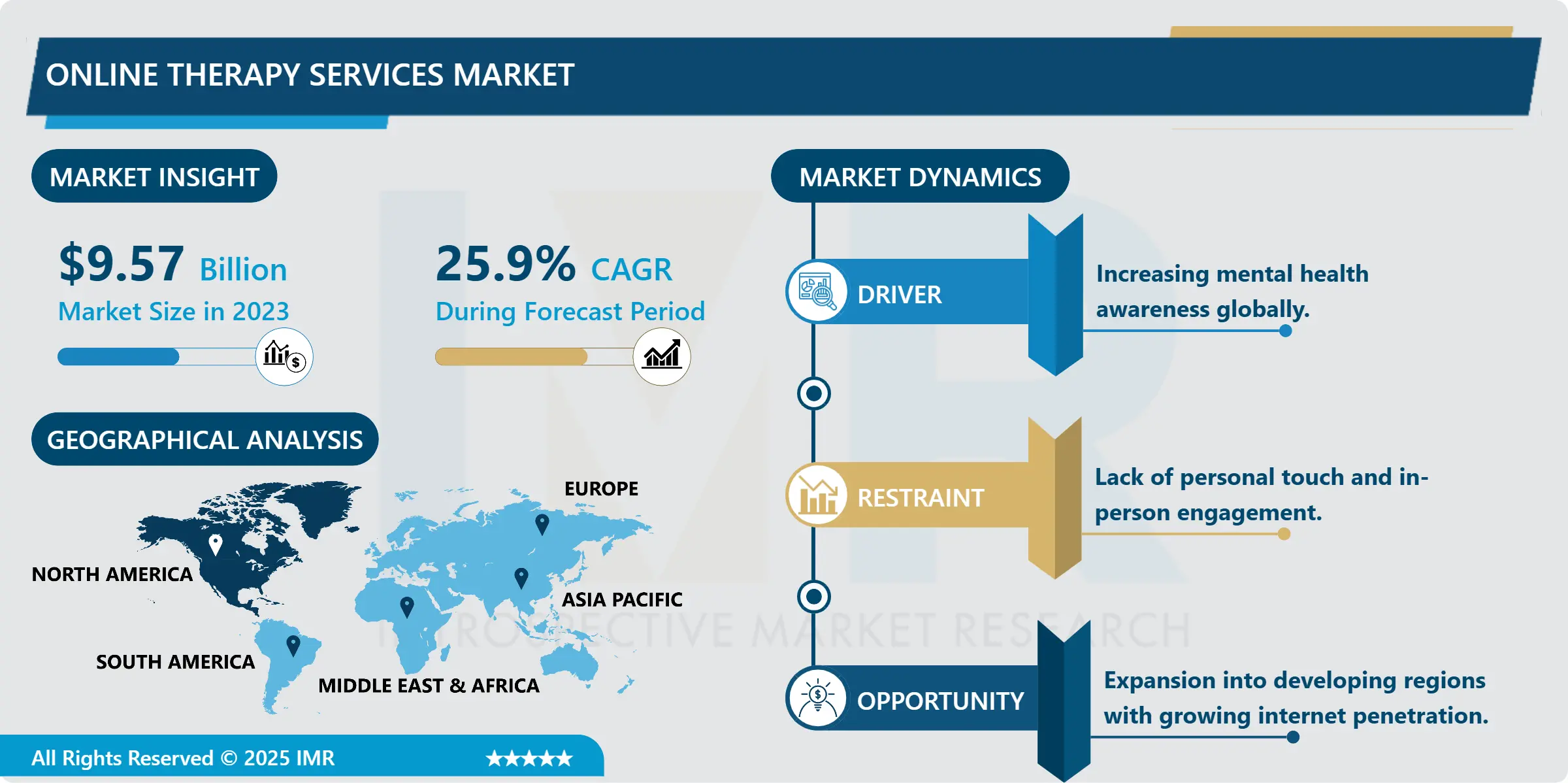
Online Therapy Services Market Size Was Valued at USD 9.57 Billion in 2023, and is Projected to Reach USD 76.06 Billion by 2032, Growing at a CAGR of 25.9% From 2024-2032.
The online therapy services market has witnessed rapid growth over the past few years, driven by the increasing demand for accessible and affordable mental health services. With the advent of digital technologies, therapy sessions that were once conducted exclusively in-person have now shifted to online platforms, providing a convenient and effective alternative for individuals seeking support for various mental health issues such as anxiety, depression, stress, and relationship problems. This shift has significantly expanded access to therapy, particularly in remote or underserved areas.
The growth of online therapy services is further fueled by the ongoing societal focus on mental health awareness. As stigma surrounding mental health reduces and people become more comfortable seeking help, the demand for professional therapy through online platforms continues to rise. The COVID-19 pandemic accelerated this trend, as lockdowns and social distancing measures prompted a shift to virtual consultations, making online therapy services a mainstream solution.
The key factors driving the market is the increasing prevalence of mental health disorders globally. According to the World Health Organization (WHO), over 450 million people are affected by mental health conditions worldwide, leading to a greater need for accessible, affordable, and flexible treatment options. Additionally, the convenience of online therapy, which allows patients to connect with licensed therapists from the comfort of their homes, has contributed to its rapid adoption. Teletherapy platforms are often more affordable than in-person sessions, making mental health care more accessible for a wider population.
The rise of digital mental health solutions presents numerous opportunities for innovation, particularly in integrating artificial intelligence (AI) and machine learning (ML) technologies. These advancements can enhance the personalization of therapy sessions and improve patient outcomes by offering tailored treatments and real-time support. Additionally, the market has seen increased investment in mobile applications and platforms that make therapy more accessible, user-friendly, and flexible.
Online Therapy Services Market Trend Analysis:
Increasing Prevalence of Mental Health Disorders
-
The rising global prevalence of mental health issues is a significant driver for the online therapy services market. According to the World Health Organization (WHO), mental health disorders affect millions of individuals worldwide, with conditions like anxiety, depression, and stress becoming more common in various age groups. As societal awareness around mental health continues to increase, individuals are seeking ways to manage their conditions, with many turning to online therapy for its convenience and accessibility. The stigma surrounding mental health is gradually diminishing, leading more people to seek help earlier and more regularly.
- As mental health issues become more recognized and prioritized, the demand for accessible therapy services continues to grow. Online therapy offers an effective solution to this problem, particularly in remote areas where in-person services are scarce or in locations where stigma remains a barrier. The flexibility and anonymity of virtual therapy encourage individuals to seek the help they need without the pressure of traditional face-to-face appointments, further driving the adoption of online mental health services.
Integration of Artificial Intelligence and Technology
-
The integration of artificial intelligence (AI) and other advanced technologies presents a significant opportunity for the online therapy services market. AI can enhance the personalization of therapy sessions, allowing for more tailored treatments based on individual needs. Machine learning algorithms can analyze patient data, monitor progress, and provide insights to therapists, thereby improving the overall treatment experience and outcomes. Additionally, AI-driven platforms can offer real-time support and recommendations, helping users manage mental health issues in between therapy sessions.
- The growing role of technology in healthcare provides a platform for online therapy services to innovate further. By incorporating AI and other emerging technologies, companies can create more engaging and user-friendly platforms that appeal to a wider demographic. This technological evolution can help streamline the therapy process, making it more efficient, cost-effective, and accessible, ultimately expanding the market reach and improving patient care across diverse populations.
Online Therapy Services Market Segment Analysis:
Online Therapy Services Market Segmented on the basis of type, application, end user, and region.
By Type, Cognitive Behavioural Therapy segment is expected to dominate the market during the forecast period
-
The Cognitive Behavioral Therapy (CBT) segment is expected to dominate the online therapy services market during the forecast period due to its proven effectiveness in treating a wide range of mental health conditions, including anxiety, depression, and stress. CBT is a structured, goal-oriented approach that helps individuals identify and challenge negative thought patterns and behaviors. The adaptability of CBT to online platforms has contributed significantly to its popularity, as it can be effectively delivered through virtual sessions without compromising the quality of treatment. This method’s structured approach and evidence-based success in addressing common mental health issues make it a preferred choice for online therapy services.
- The increasing acceptance of CBT, supported by scientific research and clinical trials, has boosted its demand in the digital therapy space. Online platforms offering CBT provide users with a flexible and convenient way to access therapy, making it easier for people to fit mental health support into their busy lifestyles. The growth of mobile apps and telehealth services that specialize in CBT further contributes to its dominance in the market. As more individuals seek accessible and effective treatment options, CBT is positioned to lead the online therapy services market, especially with growing investments in technology that enhance the delivery of this therapy.
By Application, Commercial segment expected to held the largest share
-
The commercial segment of the online therapy services market is expected to hold the largest share during the forecast period due to the increasing adoption of digital mental health services by businesses and organizations. Employers are increasingly recognizing the importance of mental health in the workplace and the positive impact that employee well-being can have on productivity and overall job satisfaction. Many companies are now offering online therapy services as part of their employee assistance programs (EAPs), providing accessible mental health support to their workforce. This shift not only helps employees manage stress, anxiety, and other mental health concerns but also promotes a healthier work environment, making it a key factor driving the growth of the commercial segment.
- Furthermore, the rise in remote work and the expansion of digital workplaces have further amplified the need for accessible and flexible therapy solutions. Commercial platforms that offer online therapy services allow businesses to cater to a diverse, often dispersed, workforce, ensuring that employees receive timely and confidential mental health support, regardless of their location. The scalability and cost-effectiveness of online therapy solutions make them an attractive option for businesses looking to prioritize mental health while managing overhead costs. This growing demand for corporate mental health solutions is expected to contribute significantly to the commercial segment's dominance in the market.
Online Therapy Services Market Regional Insights:
North America is Expected to Dominate the Market Over the Forecast period
-
North America is expected to dominate the online therapy services market over the forecast period due to several key factors, including the region's advanced healthcare infrastructure, high internet penetration, and a strong focus on mental health awareness. The United States, in particular, has seen significant growth in the adoption of telehealth services, including online therapy, driven by the increasing recognition of mental health issues and a growing demand for accessible mental health care. Additionally, mental health initiatives by the government and private organizations have supported the widespread use of digital platforms to provide therapy services, further boosting market growth in the region.
- Furthermore, North America benefits from the presence of numerous well-established companies offering online therapy services, which has contributed to a competitive and innovative market landscape. These platforms leverage advanced technologies, such as AI and mobile applications, to improve user experience and therapy outcomes. The high level of investment in digital health solutions and the increasing acceptance of online therapy among both consumers and healthcare providers are key drivers of market growth in the region. As a result, North America is poised to maintain a leading position in the online therapy services market throughout the forecast period.
Active Key Players in the Online Therapy Services Market:
- 7 Cups (USA)
- Amwell (USA)
- BetterHelp (USA)
- BetterUp (USA)
- Calm (USA)
- Cerebral (USA)
- Doctor on Demand (USA)
- Headspace (USA)
- LifeStance Health (USA)
- Lyra Health (USA)
- MDLive (USA)
- MyTherapist (USA)
- Online-Therapy.com (UK)
- Pride Counseling (USA)
- ReGain (USA)
- Sanvello (USA)
- Talkspace (USA)
- TherapyChat (Spain)
- Tiatros (USA)
- Welldoing (UK)
- Other Active Playes.
|
Global Online Therapy Services Market |
|||
|
Base Year: |
2023 |
Forecast Period: |
2024-2032 |
|
Historical Data: |
2017 to 2023 |
Market Size in 2023: |
USD 9.57 Billion |
|
Forecast Period 2024-32 CAGR: |
25.9% |
Market Size in 2032: |
USD 76.06 Billion |
|
Segments Covered: |
By Type |
|
|
|
By Application |
|
||
|
By End User |
|
||
|
By Region |
|
||
|
Key Market Drivers: |
|
||
|
Key Market Restraints: |
|
||
|
Key Opportunities: |
|
||
|
Companies Covered in the report: |
|
||
Chapter 1: Introduction
1.1 Scope and Coverage
Chapter 2:Executive Summary
Chapter 3: Market Landscape
3.1 Market Dynamics
3.1.1 Drivers
3.1.2 Restraints
3.1.3 Opportunities
3.1.4 Challenges
3.2 Market Trend Analysis
3.3 PESTLE Analysis
3.4 Porter's Five Forces Analysis
3.5 Industry Value Chain Analysis
3.6 Ecosystem
3.7 Regulatory Landscape
3.8 Price Trend Analysis
3.9 Patent Analysis
3.10 Technology Evolution
3.11 Investment Pockets
3.12 Import-Export Analysis
Chapter 4: Online Therapy Services Market by Type
4.1 Online Therapy Services Market Snapshot and Growth Engine
4.2 Online Therapy Services Market Overview
4.3 Psychodynamic Therapy
4.3.1 Introduction and Market Overview
4.3.2 Historic and Forecasted Market Size in Value USD and Volume Units (2017-2032F)
4.3.3 Key Market Trends, Growth Factors and Opportunities
4.3.4 Psychodynamic Therapy: Geographic Segmentation Analysis
4.4 Cognitive Behavioural Therapy and
4.4.1 Introduction and Market Overview
4.4.2 Historic and Forecasted Market Size in Value USD and Volume Units (2017-2032F)
4.4.3 Key Market Trends, Growth Factors and Opportunities
4.4.4 Cognitive Behavioural Therapy and: Geographic Segmentation Analysis
4.5 Personal Centered Therapy
4.5.1 Introduction and Market Overview
4.5.2 Historic and Forecasted Market Size in Value USD and Volume Units (2017-2032F)
4.5.3 Key Market Trends, Growth Factors and Opportunities
4.5.4 Personal Centered Therapy: Geographic Segmentation Analysis
Chapter 5: Online Therapy Services Market by Application
5.1 Online Therapy Services Market Snapshot and Growth Engine
5.2 Online Therapy Services Market Overview
5.3 Commercial and Residential Use
5.3.1 Introduction and Market Overview
5.3.2 Historic and Forecasted Market Size in Value USD and Volume Units (2017-2032F)
5.3.3 Key Market Trends, Growth Factors and Opportunities
5.3.4 Commercial and Residential Use: Geographic Segmentation Analysis
Chapter 6: Online Therapy Services Market by End User
6.1 Online Therapy Services Market Snapshot and Growth Engine
6.2 Online Therapy Services Market Overview
6.3 Clinics
6.3.1 Introduction and Market Overview
6.3.2 Historic and Forecasted Market Size in Value USD and Volume Units (2017-2032F)
6.3.3 Key Market Trends, Growth Factors and Opportunities
6.3.4 Clinics: Geographic Segmentation Analysis
6.4 Hospitals
6.4.1 Introduction and Market Overview
6.4.2 Historic and Forecasted Market Size in Value USD and Volume Units (2017-2032F)
6.4.3 Key Market Trends, Growth Factors and Opportunities
6.4.4 Hospitals: Geographic Segmentation Analysis
6.5 Ambulatory Centers
6.5.1 Introduction and Market Overview
6.5.2 Historic and Forecasted Market Size in Value USD and Volume Units (2017-2032F)
6.5.3 Key Market Trends, Growth Factors and Opportunities
6.5.4 Ambulatory Centers: Geographic Segmentation Analysis
6.6 and Others
6.6.1 Introduction and Market Overview
6.6.2 Historic and Forecasted Market Size in Value USD and Volume Units (2017-2032F)
6.6.3 Key Market Trends, Growth Factors and Opportunities
6.6.4 and Others: Geographic Segmentation Analysis
Chapter 7: Company Profiles and Competitive Analysis
7.1 Competitive Landscape
7.1.1 Competitive Benchmarking
7.1.2 Online Therapy Services Market Share by Manufacturer (2023)
7.1.3 Industry BCG Matrix
7.1.4 Heat Map Analysis
7.1.5 Mergers and Acquisitions
7.2 7 CUPS (USA)
7.2.1 Company Overview
7.2.2 Key Executives
7.2.3 Company Snapshot
7.2.4 Role of the Company in the Market
7.2.5 Sustainability and Social Responsibility
7.2.6 Operating Business Segments
7.2.7 Product Portfolio
7.2.8 Business Performance
7.2.9 Key Strategic Moves and Recent Developments
7.2.10 SWOT Analysis
7.3 AMWELL (USA)
7.4 BETTERHELP (USA)
7.5 BREAKTHROUGH (USA)
7.6 CALMERRY (USA)
7.7 DOCTOR ON DEMAND (USA)
7.8 GINGER (USA)
7.9 LARK HEALTH (USA)
7.10 MDLIVE (USA)
7.11 MYONLINETHERAPY (UK)
7.12 REGAIN (USA)
7.13 SONDERMIND (USA)
7.14 TALKSPACE (USA)
7.15 TELADOC HEALTH (USA)
7.16 THRIVETALK (USA)
7.17
7.18 OTHER ACTIVE PLAYERS
Chapter 8: Global Online Therapy Services Market By Region
8.1 Overview
8.2. North America Online Therapy Services Market
8.2.1 Key Market Trends, Growth Factors and Opportunities
8.2.2 Top Key Companies
8.2.3 Historic and Forecasted Market Size by Segments
8.2.4 Historic and Forecasted Market Size By Type
8.2.4.1 Psychodynamic Therapy
8.2.4.2 Cognitive Behavioural Therapy and
8.2.4.3 Personal Centered Therapy
8.2.5 Historic and Forecasted Market Size By Application
8.2.5.1 Commercial and Residential Use
8.2.6 Historic and Forecasted Market Size By End User
8.2.6.1 Clinics
8.2.6.2 Hospitals
8.2.6.3 Ambulatory Centers
8.2.6.4 and Others
8.2.7 Historic and Forecast Market Size by Country
8.2.7.1 US
8.2.7.2 Canada
8.2.7.3 Mexico
8.3. Eastern Europe Online Therapy Services Market
8.3.1 Key Market Trends, Growth Factors and Opportunities
8.3.2 Top Key Companies
8.3.3 Historic and Forecasted Market Size by Segments
8.3.4 Historic and Forecasted Market Size By Type
8.3.4.1 Psychodynamic Therapy
8.3.4.2 Cognitive Behavioural Therapy and
8.3.4.3 Personal Centered Therapy
8.3.5 Historic and Forecasted Market Size By Application
8.3.5.1 Commercial and Residential Use
8.3.6 Historic and Forecasted Market Size By End User
8.3.6.1 Clinics
8.3.6.2 Hospitals
8.3.6.3 Ambulatory Centers
8.3.6.4 and Others
8.3.7 Historic and Forecast Market Size by Country
8.3.7.1 Russia
8.3.7.2 Bulgaria
8.3.7.3 The Czech Republic
8.3.7.4 Hungary
8.3.7.5 Poland
8.3.7.6 Romania
8.3.7.7 Rest of Eastern Europe
8.4. Western Europe Online Therapy Services Market
8.4.1 Key Market Trends, Growth Factors and Opportunities
8.4.2 Top Key Companies
8.4.3 Historic and Forecasted Market Size by Segments
8.4.4 Historic and Forecasted Market Size By Type
8.4.4.1 Psychodynamic Therapy
8.4.4.2 Cognitive Behavioural Therapy and
8.4.4.3 Personal Centered Therapy
8.4.5 Historic and Forecasted Market Size By Application
8.4.5.1 Commercial and Residential Use
8.4.6 Historic and Forecasted Market Size By End User
8.4.6.1 Clinics
8.4.6.2 Hospitals
8.4.6.3 Ambulatory Centers
8.4.6.4 and Others
8.4.7 Historic and Forecast Market Size by Country
8.4.7.1 Germany
8.4.7.2 UK
8.4.7.3 France
8.4.7.4 The Netherlands
8.4.7.5 Italy
8.4.7.6 Spain
8.4.7.7 Rest of Western Europe
8.5. Asia Pacific Online Therapy Services Market
8.5.1 Key Market Trends, Growth Factors and Opportunities
8.5.2 Top Key Companies
8.5.3 Historic and Forecasted Market Size by Segments
8.5.4 Historic and Forecasted Market Size By Type
8.5.4.1 Psychodynamic Therapy
8.5.4.2 Cognitive Behavioural Therapy and
8.5.4.3 Personal Centered Therapy
8.5.5 Historic and Forecasted Market Size By Application
8.5.5.1 Commercial and Residential Use
8.5.6 Historic and Forecasted Market Size By End User
8.5.6.1 Clinics
8.5.6.2 Hospitals
8.5.6.3 Ambulatory Centers
8.5.6.4 and Others
8.5.7 Historic and Forecast Market Size by Country
8.5.7.1 China
8.5.7.2 India
8.5.7.3 Japan
8.5.7.4 South Korea
8.5.7.5 Malaysia
8.5.7.6 Thailand
8.5.7.7 Vietnam
8.5.7.8 The Philippines
8.5.7.9 Australia
8.5.7.10 New Zealand
8.5.7.11 Rest of APAC
8.6. Middle East & Africa Online Therapy Services Market
8.6.1 Key Market Trends, Growth Factors and Opportunities
8.6.2 Top Key Companies
8.6.3 Historic and Forecasted Market Size by Segments
8.6.4 Historic and Forecasted Market Size By Type
8.6.4.1 Psychodynamic Therapy
8.6.4.2 Cognitive Behavioural Therapy and
8.6.4.3 Personal Centered Therapy
8.6.5 Historic and Forecasted Market Size By Application
8.6.5.1 Commercial and Residential Use
8.6.6 Historic and Forecasted Market Size By End User
8.6.6.1 Clinics
8.6.6.2 Hospitals
8.6.6.3 Ambulatory Centers
8.6.6.4 and Others
8.6.7 Historic and Forecast Market Size by Country
8.6.7.1 Turkiye
8.6.7.2 Bahrain
8.6.7.3 Kuwait
8.6.7.4 Saudi Arabia
8.6.7.5 Qatar
8.6.7.6 UAE
8.6.7.7 Israel
8.6.7.8 South Africa
8.7. South America Online Therapy Services Market
8.7.1 Key Market Trends, Growth Factors and Opportunities
8.7.2 Top Key Companies
8.7.3 Historic and Forecasted Market Size by Segments
8.7.4 Historic and Forecasted Market Size By Type
8.7.4.1 Psychodynamic Therapy
8.7.4.2 Cognitive Behavioural Therapy and
8.7.4.3 Personal Centered Therapy
8.7.5 Historic and Forecasted Market Size By Application
8.7.5.1 Commercial and Residential Use
8.7.6 Historic and Forecasted Market Size By End User
8.7.6.1 Clinics
8.7.6.2 Hospitals
8.7.6.3 Ambulatory Centers
8.7.6.4 and Others
8.7.7 Historic and Forecast Market Size by Country
8.7.7.1 Brazil
8.7.7.2 Argentina
8.7.7.3 Rest of SA
Chapter 9 Analyst Viewpoint and Conclusion
9.1 Recommendations and Concluding Analysis
9.2 Potential Market Strategies
Chapter 10 Research Methodology
10.1 Research Process
10.2 Primary Research
10.3 Secondary Research
|
Global Online Therapy Services Market |
|||
|
Base Year: |
2023 |
Forecast Period: |
2024-2032 |
|
Historical Data: |
2017 to 2023 |
Market Size in 2023: |
USD 9.57 Billion |
|
Forecast Period 2024-32 CAGR: |
25.9% |
Market Size in 2032: |
USD 76.06 Billion |
|
Segments Covered: |
By Type |
|
|
|
By Application |
|
||
|
By End User |
|
||
|
By Region |
|
||
|
Key Market Drivers: |
|
||
|
Key Market Restraints: |
|
||
|
Key Opportunities: |
|
||
|
Companies Covered in the report: |
|
||