




Nutricosmetics Market Synopsis:
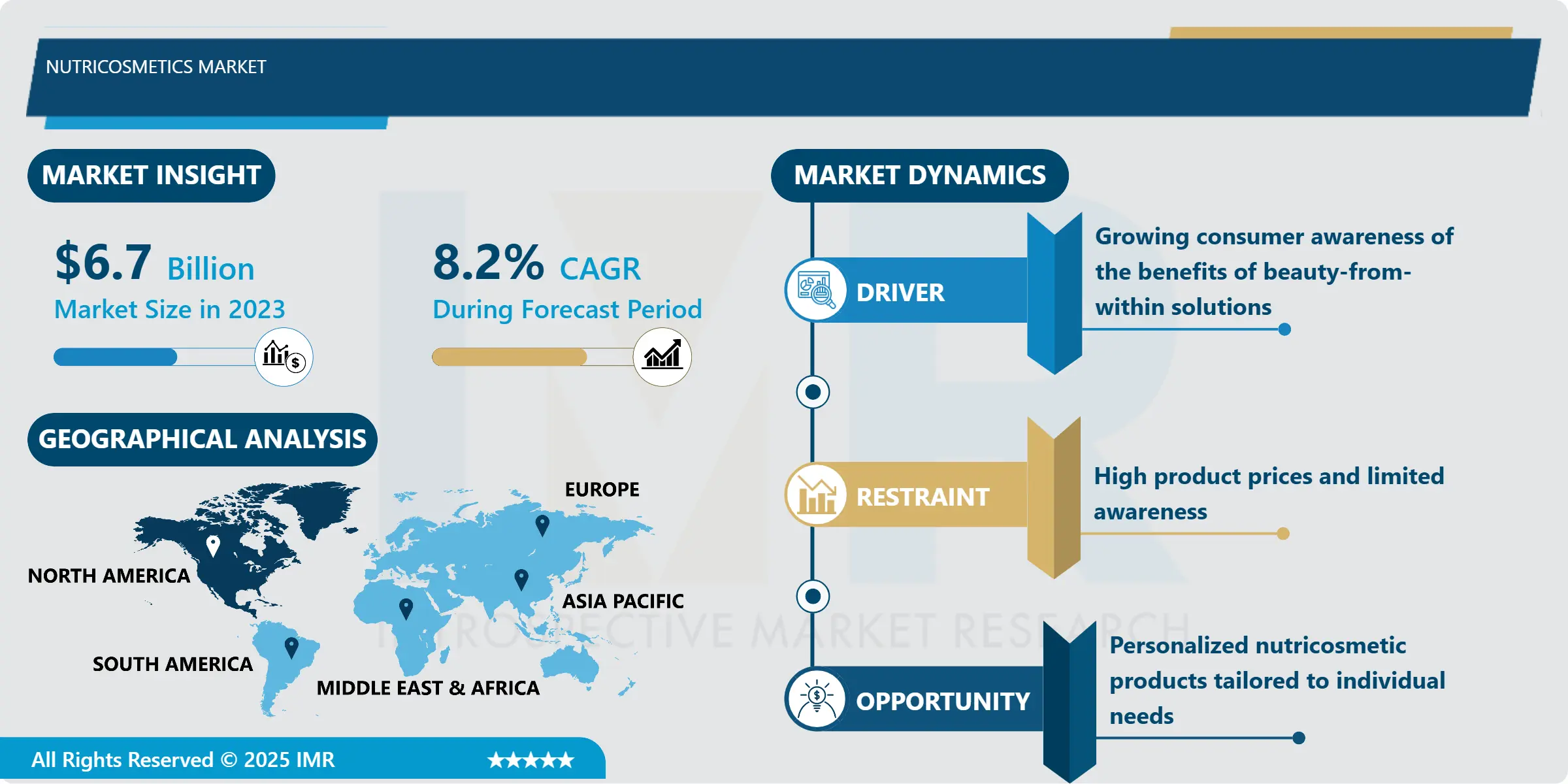
Nutricosmetics Market Size Was Valued at USD 6.7 Billion in 2023, and is Projected to Reach USD 13.6 Billion by 2032, Growing at a CAGR of 8.2% From 2024-2032.
The global nutricosmetics market is experiencing robust growth, driven by rising consumer awareness of the link between nutrition and aesthetic health. Nutricosmetics, ingestible beauty products that combine nutrition and cosmetic benefits, have become an integral part of the wellness and beauty ecosystem. These products, often formulated as capsules, tablets, powders, or drinks, offer targeted benefits for skin radiance, anti-aging, hair and nail strength, and overall beauty from within. The increasing adoption of holistic beauty regimens and the growing popularity of preventative skincare are key contributors to market expansion.
Technological advancements in formulation science, along with increased R&D investments by cosmetic and nutraceutical companies, have led to innovative product launches. The demand is particularly strong among urban populations in North America, Europe, and Asia-Pacific, where consumers are highly aware of clean-label, functional beauty supplements. Furthermore, the trend toward plant-based, vegan, and collagen-enriched products is gaining traction, with manufacturers diversifying offerings to cater to evolving consumer preferences. Online channels, influencer marketing, and personalized wellness solutions are further accelerating market visibility and penetration.
The market dynamics are shaped by a mix of growth drivers and emerging challenges. Key drivers include the rise in self-care trends, aging populations seeking anti-aging solutions, and increasing disposable incomes across emerging economies. Strategic collaborations between cosmetic and food science companies are also driving innovation and market entry. Moreover, the shift toward sustainability and natural ingredients is creating new opportunities for players focused on clean beauty.
On the flip side, regulatory complexity and the lack of standardization in claims and efficacy can restrain growth. Consumer skepticism toward product effectiveness and high product costs in some segments pose challenges. However, as scientific backing strengthens and awareness improves, the nutricosmetics market is poised for continued expansion globally over the 2024–2032 forecast period.
Nutricosmetics Market Trend Analysis:
Rise of Personalized Nutricosmetics
-
Personalized nutrition is emerging as a transformative trend in the nutricosmetics market. As consumers become more health-conscious and technologically empowered, the demand for personalized beauty solutions that cater to individual skin types, genetics, and lifestyle choices is rising. Nutricosmetic brands are leveraging AI, DNA analysis, and microbiome testing to offer customized supplements that target specific concerns like acne, pigmentation, aging, or hair thinning. This trend enhances customer engagement and product efficacy, aligning with the broader movement toward individualized healthcare and wellness.
- Companies are investing in direct-to-consumer (DTC) models and data-driven platforms to enable personalized product recommendations. This not only improves the consumer experience but also supports premium pricing models and higher customer loyalty. The integration of diagnostic tools, mobile apps, and subscription-based models is creating an ecosystem where consumers can monitor their inner health and see visible results externally, strengthening trust in nutricosmetics. This trend is expected to shape future product development and marketing strategies across global markets.
Expansion into Emerging Markets
-
Emerging economies present a significant growth opportunity for nutricosmetics, especially in Asia-Pacific, Latin America, and parts of the Middle East & Africa. Rising disposable incomes, urbanization, and growing beauty consciousness among younger demographics are key enablers. Countries like India, Brazil, and Indonesia are witnessing a surge in demand for beauty-from-within products, especially among women aged 20–40 who are looking for holistic skincare and wellness solutions.
- The strong cultural association with herbal and natural remedies in these regions creates an ideal environment for nutricosmetic products based on Ayurveda, traditional Chinese medicine, or plant-based formulations. Localized product offerings, affordable pricing strategies, and increased digital penetration can help brands tap into these untapped markets. Establishing partnerships with regional distributors and leveraging e-commerce platforms will be crucial to capturing market share and building brand recognition in these high-growth areas.
Nutricosmetics Market Segment Analysis:
Nutricosmetics Market is Segmented on the basis of type and Primary Function, and Region.
By Type, Beauty Beverages / Drinks segment is expected to dominate the market during the forecast period
-
The Beauty Beverages/Drinks segment is anticipated to lead the nutricosmetics market during the forecast period due to its convenience, rapid absorption, and growing consumer preference for functional drinks. These products are often enriched with collagen, vitamins, antioxidants, and botanical extracts that promote skin hydration, elasticity, and anti-aging effects from within. As consumers increasingly seek on-the-go wellness solutions, beauty drinks are becoming a popular choice over traditional tablets and capsules. Their palatable formats, often combined with flavored options and health benefits, appeal strongly to millennials and Gen Z demographics, particularly in urban areas.
- The rise of lifestyle-focused branding and influencer-driven marketing has played a key role in elevating beauty drinks into mainstream wellness routines. The segment is witnessing innovations such as sparkling collagen water, protein-based skin enhancers, and adaptogen-infused drinks targeting specific beauty concerns. Asia-Pacific, especially countries like Japan and South Korea, has been at the forefront of this trend, with Western markets rapidly catching up. As manufacturers continue to focus on clean-label formulations, plant-based collagen alternatives, and sustainable packaging, the beauty beverage category is expected to expand its global footprint significantly over years.
By Primary Function, Skin Care segment expected to held the largest share
-
The Skin Care segment is projected to dominate the nutricosmetics market throughout the forecast period, driven by rising consumer demand for solutions that offer internal nourishment to improve skin health and appearance. Consumers are becoming increasingly aware that topical products alone may not be sufficient to address concerns like dryness, dullness, wrinkles, or inflammation. Nutricosmetics formulated for skin health—rich in collagen peptides, hyaluronic acid, antioxidants, vitamins (A, C, E), and omega-3 fatty acids—are gaining popularity due to their ability to work from within and provide long-term benefits.
- Anti-aging and skin-brightening are among the most sought-after benefits, particularly among aging populations and younger consumers looking for preventive care. The convenience of ingestible skincare solutions that support hydration, elasticity, and protection against UV damage and pollution is fueling the segment’s growth. In addition, clinical studies supporting the efficacy of ingredients like marine collagen, ceramides, and astaxanthin have boosted consumer confidence and brand credibility in this category. As a result, skin-focused nutricosmetics have become a staple in wellness routines, particularly in regions like North America, Europe, and Asia-Pacific.
Nutricosmetics Market Regional Insights:
North America is Expected to Dominate the Market Over the Forecast period
-
North America is expected to lead the global nutricosmetics market during the forecast period due to high consumer awareness regarding health, wellness, and beauty. People in countries like the United States and Canada are increasingly adopting beauty-from-within products as part of their daily routines. This includes supplements and functional beverages aimed at improving skin, hair, and overall appearance. The demand is especially strong among women aged 25 to 50 who are focused on anti-aging and preventive care. Strong retail presence, the popularity of online wellness platforms, and the influence of health-conscious trends are helping drive the market forward in the region.
- In addition to consumer demand, North America benefits from the presence of several leading nutraceutical and skincare companies that are continuously launching new and innovative products. The region has well-established distribution networks, both online and offline, making it easier for products to reach a wide audience. Moreover, the availability of premium and scientifically backed products supports brand trust and consumer confidence. With growing investments in research and marketing, North America is likely to maintain its dominant position in the nutricosmetics market over the next several years.
Active Key Players in the Nutricosmetics Market
-
Amway (USA)
- Bayer AG (Germany)
- Collagen Solutions PLC (UK)
- Elysium Health, Inc. (USA)
- GNC Holdings, Inc. (USA)
- Herbalife Nutrition Ltd. (USA)
- HUM Nutrition (USA)
- Isagenix International LLC (USA)
- Nestlé S.A. (Switzerland)
- New Chapter, Inc. (USA)
- Nutrafol (USA)
- Rejuvenated Ltd. (UK)
- Rousselot (France)
- SkinCeuticals (USA)
- Vitasoy International Holdings Ltd. (Hong Kong), and Other Active Players
|
Global Nutricosmetics Market |
|||
|
Base Year: |
2023 |
Forecast Period: |
2024-2032 |
|
Historical Data: |
2017 to 2023 |
Market Size in 2023: |
USD 6.7 Billion |
|
Forecast Period 2024-32 CAGR: |
8.2% |
Market Size in 2032: |
USD 13.6 Billion |
|
Segments Covered: |
By Type |
|
|
|
By Primary Function |
|
||
|
By Region |
|
||
|
Key Market Drivers: |
|
||
|
Key Market Restraints: |
|
||
|
Key Opportunities: |
|
||
|
Companies Covered in the report: |
|
||
Chapter 1: Introduction
1.1 Scope and Coverage
Chapter 2:Executive Summary
Chapter 3: Market Landscape
3.1 Market Dynamics
3.1.1 Drivers
3.1.2 Restraints
3.1.3 Opportunities
3.1.4 Challenges
3.2 Market Trend Analysis
3.3 PESTLE Analysis
3.4 Porter's Five Forces Analysis
3.5 Industry Value Chain Analysis
3.6 Ecosystem
3.7 Regulatory Landscape
3.8 Price Trend Analysis
3.9 Patent Analysis
3.10 Technology Evolution
3.11 Investment Pockets
3.12 Import-Export Analysis
Chapter 4: Nutricosmetics Market by Type
4.1 Nutricosmetics Market Snapshot and Growth Engine
4.2 Nutricosmetics Market Overview
4.3 Beauty Berages/ Drinks
4.3.1 Introduction and Market Overview
4.3.2 Historic and Forecasted Market Size in Value USD and Volume Units (2017-2032F)
4.3.3 Key Market Trends, Growth Factors and Opportunities
4.3.4 Beauty Berages/ Drinks: Geographic Segmentation Analysis
4.4 Supplements
4.4.1 Introduction and Market Overview
4.4.2 Historic and Forecasted Market Size in Value USD and Volume Units (2017-2032F)
4.4.3 Key Market Trends, Growth Factors and Opportunities
4.4.4 Supplements: Geographic Segmentation Analysis
4.5 Tablets
4.5.1 Introduction and Market Overview
4.5.2 Historic and Forecasted Market Size in Value USD and Volume Units (2017-2032F)
4.5.3 Key Market Trends, Growth Factors and Opportunities
4.5.4 Tablets: Geographic Segmentation Analysis
4.6 Capsules
4.6.1 Introduction and Market Overview
4.6.2 Historic and Forecasted Market Size in Value USD and Volume Units (2017-2032F)
4.6.3 Key Market Trends, Growth Factors and Opportunities
4.6.4 Capsules: Geographic Segmentation Analysis
4.7 Powder
4.7.1 Introduction and Market Overview
4.7.2 Historic and Forecasted Market Size in Value USD and Volume Units (2017-2032F)
4.7.3 Key Market Trends, Growth Factors and Opportunities
4.7.4 Powder: Geographic Segmentation Analysis
4.8 Liquid
4.8.1 Introduction and Market Overview
4.8.2 Historic and Forecasted Market Size in Value USD and Volume Units (2017-2032F)
4.8.3 Key Market Trends, Growth Factors and Opportunities
4.8.4 Liquid: Geographic Segmentation Analysis
Chapter 5: Nutricosmetics Market by Primary Function
5.1 Nutricosmetics Market Snapshot and Growth Engine
5.2 Nutricosmetics Market Overview
5.3 Skin Care
5.3.1 Introduction and Market Overview
5.3.2 Historic and Forecasted Market Size in Value USD and Volume Units (2017-2032F)
5.3.3 Key Market Trends, Growth Factors and Opportunities
5.3.4 Skin Care: Geographic Segmentation Analysis
5.4 Sun Care
5.4.1 Introduction and Market Overview
5.4.2 Historic and Forecasted Market Size in Value USD and Volume Units (2017-2032F)
5.4.3 Key Market Trends, Growth Factors and Opportunities
5.4.4 Sun Care: Geographic Segmentation Analysis
5.5 Anti-Aging
5.5.1 Introduction and Market Overview
5.5.2 Historic and Forecasted Market Size in Value USD and Volume Units (2017-2032F)
5.5.3 Key Market Trends, Growth Factors and Opportunities
5.5.4 Anti-Aging: Geographic Segmentation Analysis
5.6 Radiance & Glow
5.6.1 Introduction and Market Overview
5.6.2 Historic and Forecasted Market Size in Value USD and Volume Units (2017-2032F)
5.6.3 Key Market Trends, Growth Factors and Opportunities
5.6.4 Radiance & Glow: Geographic Segmentation Analysis
5.7 Anti-acne/pimple
5.7.1 Introduction and Market Overview
5.7.2 Historic and Forecasted Market Size in Value USD and Volume Units (2017-2032F)
5.7.3 Key Market Trends, Growth Factors and Opportunities
5.7.4 Anti-acne/pimple: Geographic Segmentation Analysis
5.8 Hair & Nail Care
5.8.1 Introduction and Market Overview
5.8.2 Historic and Forecasted Market Size in Value USD and Volume Units (2017-2032F)
5.8.3 Key Market Trends, Growth Factors and Opportunities
5.8.4 Hair & Nail Care: Geographic Segmentation Analysis
5.9 Weight management
5.9.1 Introduction and Market Overview
5.9.2 Historic and Forecasted Market Size in Value USD and Volume Units (2017-2032F)
5.9.3 Key Market Trends, Growth Factors and Opportunities
5.9.4 Weight management: Geographic Segmentation Analysis
5.10 Multi-Functional
5.10.1 Introduction and Market Overview
5.10.2 Historic and Forecasted Market Size in Value USD and Volume Units (2017-2032F)
5.10.3 Key Market Trends, Growth Factors and Opportunities
5.10.4 Multi-Functional: Geographic Segmentation Analysis
Chapter 6: Company Profiles and Competitive Analysis
6.1 Competitive Landscape
6.1.1 Competitive Benchmarking
6.1.2 Nutricosmetics Market Share by Manufacturer (2023)
6.1.3 Industry BCG Matrix
6.1.4 Heat Map Analysis
6.1.5 Mergers and Acquisitions
6.2 AMWAY (USA)
6.2.1 Company Overview
6.2.2 Key Executives
6.2.3 Company Snapshot
6.2.4 Role of the Company in the Market
6.2.5 Sustainability and Social Responsibility
6.2.6 Operating Business Segments
6.2.7 Product Portfolio
6.2.8 Business Performance
6.2.9 Key Strategic Moves and Recent Developments
6.2.10 SWOT Analysis
6.3 BAYER AG (GERMANY)
6.4 COLLAGEN SOLUTIONS PLC (UK)
6.5 ELYSIUM HEALTH INC. (USA)
6.6 GNC HOLDINGS INC. (USA)
6.7 HERBALIFE NUTRITION LTD. (USA)
6.8 HUM NUTRITION (USA)
6.9 ISAGENIX INTERNATIONAL LLC (USA)
6.10 NESTLÉ S.A. (SWITZERLAND)
6.11 NEW CHAPTER INC. (USA)
6.12 NUTRAFOL (USA)
6.13 REJUVENATED LTD. (UK)
6.14 ROUSSELOT (FRANCE)
6.15 SKINCEUTICALS (USA)
6.16 VITASOY INTERNATIONAL HOLDINGS LTD. (HONG KONG)
6.17 OTHER ACTIVE PLAYERS
Chapter 7: Global Nutricosmetics Market By Region
7.1 Overview
7.2. North America Nutricosmetics Market
7.2.1 Key Market Trends, Growth Factors and Opportunities
7.2.2 Top Key Companies
7.2.3 Historic and Forecasted Market Size by Segments
7.2.4 Historic and Forecasted Market Size By Type
7.2.4.1 Beauty Berages/ Drinks
7.2.4.2 Supplements
7.2.4.3 Tablets
7.2.4.4 Capsules
7.2.4.5 Powder
7.2.4.6 Liquid
7.2.5 Historic and Forecasted Market Size By Primary Function
7.2.5.1 Skin Care
7.2.5.2 Sun Care
7.2.5.3 Anti-Aging
7.2.5.4 Radiance & Glow
7.2.5.5 Anti-acne/pimple
7.2.5.6 Hair & Nail Care
7.2.5.7 Weight management
7.2.5.8 Multi-Functional
7.2.6 Historic and Forecast Market Size by Country
7.2.6.1 US
7.2.6.2 Canada
7.2.6.3 Mexico
7.3. Eastern Europe Nutricosmetics Market
7.3.1 Key Market Trends, Growth Factors and Opportunities
7.3.2 Top Key Companies
7.3.3 Historic and Forecasted Market Size by Segments
7.3.4 Historic and Forecasted Market Size By Type
7.3.4.1 Beauty Berages/ Drinks
7.3.4.2 Supplements
7.3.4.3 Tablets
7.3.4.4 Capsules
7.3.4.5 Powder
7.3.4.6 Liquid
7.3.5 Historic and Forecasted Market Size By Primary Function
7.3.5.1 Skin Care
7.3.5.2 Sun Care
7.3.5.3 Anti-Aging
7.3.5.4 Radiance & Glow
7.3.5.5 Anti-acne/pimple
7.3.5.6 Hair & Nail Care
7.3.5.7 Weight management
7.3.5.8 Multi-Functional
7.3.6 Historic and Forecast Market Size by Country
7.3.6.1 Russia
7.3.6.2 Bulgaria
7.3.6.3 The Czech Republic
7.3.6.4 Hungary
7.3.6.5 Poland
7.3.6.6 Romania
7.3.6.7 Rest of Eastern Europe
7.4. Western Europe Nutricosmetics Market
7.4.1 Key Market Trends, Growth Factors and Opportunities
7.4.2 Top Key Companies
7.4.3 Historic and Forecasted Market Size by Segments
7.4.4 Historic and Forecasted Market Size By Type
7.4.4.1 Beauty Berages/ Drinks
7.4.4.2 Supplements
7.4.4.3 Tablets
7.4.4.4 Capsules
7.4.4.5 Powder
7.4.4.6 Liquid
7.4.5 Historic and Forecasted Market Size By Primary Function
7.4.5.1 Skin Care
7.4.5.2 Sun Care
7.4.5.3 Anti-Aging
7.4.5.4 Radiance & Glow
7.4.5.5 Anti-acne/pimple
7.4.5.6 Hair & Nail Care
7.4.5.7 Weight management
7.4.5.8 Multi-Functional
7.4.6 Historic and Forecast Market Size by Country
7.4.6.1 Germany
7.4.6.2 UK
7.4.6.3 France
7.4.6.4 The Netherlands
7.4.6.5 Italy
7.4.6.6 Spain
7.4.6.7 Rest of Western Europe
7.5. Asia Pacific Nutricosmetics Market
7.5.1 Key Market Trends, Growth Factors and Opportunities
7.5.2 Top Key Companies
7.5.3 Historic and Forecasted Market Size by Segments
7.5.4 Historic and Forecasted Market Size By Type
7.5.4.1 Beauty Berages/ Drinks
7.5.4.2 Supplements
7.5.4.3 Tablets
7.5.4.4 Capsules
7.5.4.5 Powder
7.5.4.6 Liquid
7.5.5 Historic and Forecasted Market Size By Primary Function
7.5.5.1 Skin Care
7.5.5.2 Sun Care
7.5.5.3 Anti-Aging
7.5.5.4 Radiance & Glow
7.5.5.5 Anti-acne/pimple
7.5.5.6 Hair & Nail Care
7.5.5.7 Weight management
7.5.5.8 Multi-Functional
7.5.6 Historic and Forecast Market Size by Country
7.5.6.1 China
7.5.6.2 India
7.5.6.3 Japan
7.5.6.4 South Korea
7.5.6.5 Malaysia
7.5.6.6 Thailand
7.5.6.7 Vietnam
7.5.6.8 The Philippines
7.5.6.9 Australia
7.5.6.10 New Zealand
7.5.6.11 Rest of APAC
7.6. Middle East & Africa Nutricosmetics Market
7.6.1 Key Market Trends, Growth Factors and Opportunities
7.6.2 Top Key Companies
7.6.3 Historic and Forecasted Market Size by Segments
7.6.4 Historic and Forecasted Market Size By Type
7.6.4.1 Beauty Berages/ Drinks
7.6.4.2 Supplements
7.6.4.3 Tablets
7.6.4.4 Capsules
7.6.4.5 Powder
7.6.4.6 Liquid
7.6.5 Historic and Forecasted Market Size By Primary Function
7.6.5.1 Skin Care
7.6.5.2 Sun Care
7.6.5.3 Anti-Aging
7.6.5.4 Radiance & Glow
7.6.5.5 Anti-acne/pimple
7.6.5.6 Hair & Nail Care
7.6.5.7 Weight management
7.6.5.8 Multi-Functional
7.6.6 Historic and Forecast Market Size by Country
7.6.6.1 Turkiye
7.6.6.2 Bahrain
7.6.6.3 Kuwait
7.6.6.4 Saudi Arabia
7.6.6.5 Qatar
7.6.6.6 UAE
7.6.6.7 Israel
7.6.6.8 South Africa
7.7. South America Nutricosmetics Market
7.7.1 Key Market Trends, Growth Factors and Opportunities
7.7.2 Top Key Companies
7.7.3 Historic and Forecasted Market Size by Segments
7.7.4 Historic and Forecasted Market Size By Type
7.7.4.1 Beauty Berages/ Drinks
7.7.4.2 Supplements
7.7.4.3 Tablets
7.7.4.4 Capsules
7.7.4.5 Powder
7.7.4.6 Liquid
7.7.5 Historic and Forecasted Market Size By Primary Function
7.7.5.1 Skin Care
7.7.5.2 Sun Care
7.7.5.3 Anti-Aging
7.7.5.4 Radiance & Glow
7.7.5.5 Anti-acne/pimple
7.7.5.6 Hair & Nail Care
7.7.5.7 Weight management
7.7.5.8 Multi-Functional
7.7.6 Historic and Forecast Market Size by Country
7.7.6.1 Brazil
7.7.6.2 Argentina
7.7.6.3 Rest of SA
Chapter 8 Analyst Viewpoint and Conclusion
8.1 Recommendations and Concluding Analysis
8.2 Potential Market Strategies
Chapter 9 Research Methodology
9.1 Research Process
9.2 Primary Research
9.3 Secondary Research
|
Global Nutricosmetics Market |
|||
|
Base Year: |
2023 |
Forecast Period: |
2024-2032 |
|
Historical Data: |
2017 to 2023 |
Market Size in 2023: |
USD 6.7 Billion |
|
Forecast Period 2024-32 CAGR: |
8.2% |
Market Size in 2032: |
USD 13.6 Billion |
|
Segments Covered: |
By Type |
|
|
|
By Primary Function |
|
||
|
By Region |
|
||
|
Key Market Drivers: |
|
||
|
Key Market Restraints: |
|
||
|
Key Opportunities: |
|
||
|
Companies Covered in the report: |
|
||


