




Nuclear Imaging Equipment Market Synopsis:
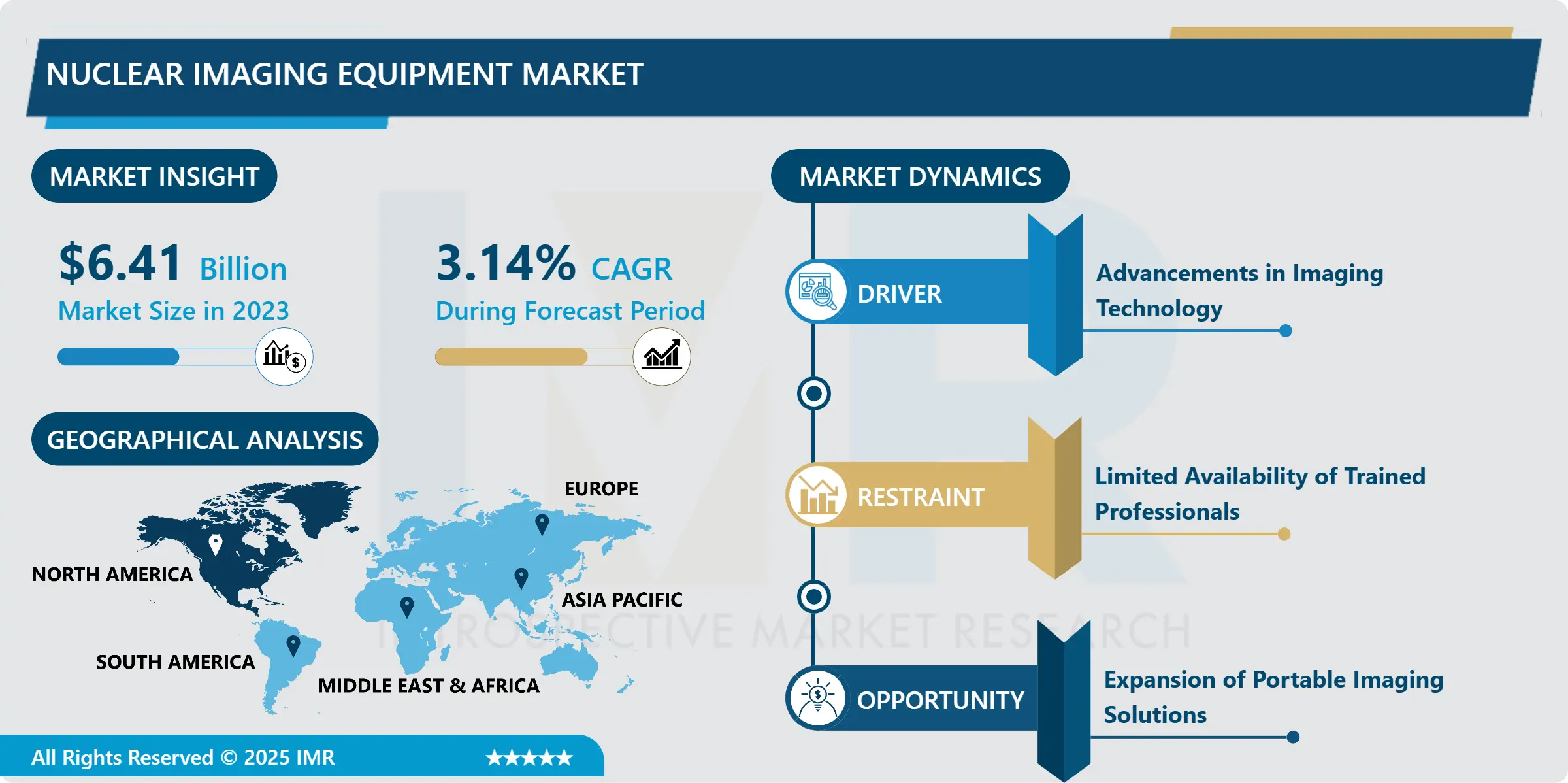
Nuclear Imaging Equipment Market Size Was Valued at USD 6.41 Billion in 2023, and is Projected to Reach USD 8.46 Billion by 2032, Growing at a CAGR of 3.14% From 2024-2032.
The global nuclear imaging equipment market is experiencing significant growth, driven by rising prevalence of chronic diseases and increasing demand for accurate, early-stage diagnostics. Nuclear imaging techniques such as PET (Positron Emission Tomography) and SPECT (Single Photon Emission Computed Tomography) offer high sensitivity and specificity for detecting abnormalities in tissues and organs. These imaging modalities are essential in oncology, cardiology, and neurology, enabling physicians to make informed clinical decisions. Advancements in hybrid systems like PET/CT and SPECT/CT are further expanding the applications of nuclear imaging.
The market is witnessing a technological shift, with increasing integration of artificial intelligence (AI), improved imaging software, and development of portable imaging systems. North America currently dominates the market due to well-established healthcare infrastructure and high adoption of advanced imaging modalities. However, Asia-Pacific is emerging as a key growth region due to rising healthcare investments, growing medical tourism, and increasing awareness about early disease diagnosis.
Market dynamics are largely influenced by growing global demand for non-invasive diagnostic procedures and the aging population, which is more prone to chronic conditions such as cancer and cardiovascular diseases. The need for more precise disease detection is pushing hospitals and diagnostic centers to adopt nuclear imaging equipment. Additionally, government funding for cancer and neurological research, and initiatives promoting early disease detection, are creating a conducive environment for market growth.
However, the market also faces certain challenges. High installation and maintenance costs, shortage of trained professionals, and limited accessibility in developing regions can restrain market expansion. Regulatory concerns and the need for radiopharmaceuticals with short half-lives demand a robust supply chain. Despite these hurdles, innovations in imaging technology and growing collaborations between public and private sectors are expected to fuel long-term growth in the global nuclear imaging equipment market.
Nuclear Imaging Equipment Market Trend Analysis:
The integration of artificial intelligence (AI) and machine learning into imaging processes.
-
The integration of artificial intelligence (AI) and machine learning (ML) into nuclear imaging is revolutionizing diagnostic capabilities by enhancing image quality, automating image interpretation, and improving workflow efficiency. AI algorithms are increasingly being used for noise reduction, motion correction, and accurate reconstruction of imaging data, allowing for clearer and faster image acquisition with lower doses of radiotracers. This not only improves patient safety but also enhances diagnostic precision, especially in detecting subtle or early-stage abnormalities. Machine learning models can also identify patterns in large datasets, assisting clinicians in diagnosing complex conditions such as neurodegenerative diseases or early-stage cancers with greater confidence.
- Furthermore, AI-driven predictive analytics are enabling personalized imaging protocols, optimizing scan parameters based on patient-specific factors. Radiologists benefit from AI-assisted interpretation tools that can flag anomalies, suggest probable diagnoses, and prioritize urgent cases, thereby reducing human error and diagnostic turnaround times. In hybrid imaging systems like PET/CT and SPECT/CT, AI is also improving image fusion and quantification accuracy. As healthcare systems globally move toward value-based care, the integration of AI and ML is set to become a cornerstone of modern nuclear imaging, driving better clinical outcomes and more efficient use of imaging resources.
Technological advancements and increasing applications in various fields
-
Technological advancements in nuclear imaging equipment have significantly enhanced the accuracy, functionality, and versatility of diagnostic systems. Innovations such as digital detectors, time-of-flight PET scanners, and high-resolution SPECT cameras have greatly improved image clarity and acquisition speed. The emergence of hybrid imaging modalities like PET/CT, SPECT/CT, and PET/MRI has enabled comprehensive anatomical and functional analysis in a single scan, making diagnostics faster and more precise. These advances are also reducing patient exposure to radiation and enabling more compact, cost-efficient systems suitable for smaller clinics and mobile units.
- Beyond traditional applications in oncology, nuclear imaging is gaining ground in cardiology, neurology, orthopedics, and infectious disease monitoring. For instance, cardiac PET imaging is being used to assess myocardial perfusion and viability, aiding in the diagnosis of coronary artery disease. In neurology, PET and SPECT scans help in early detection of Alzheimer’s, Parkinson’s, and epilepsy by mapping brain function and metabolic activity. Furthermore, the ability to track disease progression and response to therapy in real-time is expanding nuclear imaging's role in personalized medicine and targeted therapies. As the technology continues to evolve, its adoption across diverse medical specialties is expected to rise, broadening its clinical and commercial value.
Nuclear Imaging Equipment Market Segment Analysis:
Nuclear Imaging Equipment Market is segmented on the basis of type, application, end user, and region.
By Type, SPECT segment is expected to dominate the market during the forecast period
-
SPECT (Single Photon Emission Computed Tomography) segment is expected to dominate the nuclear imaging equipment market during the forecast period. SPECT systems are widely adopted due to their cost-effectiveness, availability of diverse radiotracers, and utility in diagnosing a broad range of conditions, particularly in cardiology and neurology. The ability to perform functional imaging of organs, detect blood flow irregularities, and monitor metabolic processes makes SPECT a versatile diagnostic tool. Additionally, advancements in SPECT/CT hybrid systems have significantly enhanced image resolution and anatomical localization, driving higher adoption across hospitals and diagnostic centers globally.
- SPECT technology benefits from a well-established infrastructure and existing reimbursement frameworks in many countries, especially in North America and Europe. The increasing prevalence of cardiovascular diseases—where SPECT is heavily utilized for myocardial perfusion imaging—is a key factor fueling segment growth. Ongoing improvements in detector materials, image processing software, and the development of new radiopharmaceuticals are further expanding its clinical utility. While PET systems are gaining traction for their higher resolution, SPECT remains the dominant choice due to its affordability, clinical versatility, and growing use in emerging economies with constrained healthcare budgets.
By Application, Oncology segment expected to held the largest share
-
The oncology segment is expected to hold the largest share of the nuclear imaging equipment market during the forecast period. Nuclear imaging techniques such as PET and SPECT play a vital role in cancer diagnosis, staging, treatment planning, and therapy monitoring. These modalities enable the visualization of metabolic and molecular activity in tumors, often detecting malignancies earlier than traditional anatomical imaging methods. PET/CT and SPECT/CT hybrid systems are particularly valuable in oncology, providing precise localization of tumors and enabling clinicians to assess treatment response in real time, thus supporting personalized treatment approaches.
- The rising global cancer burden is a major driver for this segment's growth. According to WHO, cancer is among the leading causes of death worldwide, and the demand for early and accurate diagnosis is higher than ever. Government initiatives and funding for cancer screening programs, as well as the growing adoption of targeted therapies that require precise imaging follow-up, are boosting the demand for advanced nuclear imaging technologies in oncology. As radiopharmaceutical development progresses—introducing tracers that target specific cancer types—the application of nuclear imaging in oncology is expected to deepen, reinforcing its position as the leading segment in this market.
Nuclear Imaging Equipment Market Regional Insights:
North America is Expected to Dominate the Market Over the Forecast period
-
North America is expected to dominate the nuclear imaging equipment market during the forecast period, primarily due to the region's advanced healthcare infrastructure, high healthcare expenditure, and early adoption of cutting-edge medical technologies. The United States, in particular, is home to numerous leading medical device manufacturers, research institutions, and hospitals that invest heavily in the latest imaging technologies. The availability of well-established reimbursement policies for nuclear imaging procedures and strong government support for healthcare innovations further fuels the market growth in the region. Additionally, the high prevalence of chronic diseases such as cancer and cardiovascular disorders increases the demand for nuclear imaging modalities like PET and SPECT, particularly for early diagnosis and monitoring treatment efficacy.
- The increasing focus on personalized medicine and precision diagnostics is also contributing to North America’s dominant position in the nuclear imaging market. Advancements in hybrid imaging systems, integration of artificial intelligence (AI) for image interpretation, and ongoing research into novel radiotracers are positioning North America as a key hub for nuclear imaging technology adoption. Moreover, North American countries have some of the highest rates of medical tourism, attracting patients from across the globe seeking advanced diagnostic services. This trend, combined with rising investments in healthcare from both public and private sectors, ensures North America's continued leadership in the nuclear imaging equipment market over the forecast period.
Active Key Players in the Nuclear Imaging Equipment Market:
- Bracco Imaging S.p.A. (Italy)
- Canon Medical Systems (Japan)
- Elekta AB (Sweden)
- GE Healthcare (United States)
- Hologic, Inc. (United States)
- Lantheus Medical Imaging, Inc. (United States)
- MedeAnalytics (United States)
- Philips Healthcare (Netherlands)
- Siemens Healthineers (Germany)
- Toshiba Medical Systems (Japan), and Other Active Players.
|
Global Nuclear Imaging Equipment Market |
|||
|
Base Year: |
2023 |
Forecast Period: |
2024-2032 |
|
Historical Data: |
2017 to 2023 |
Market Size in 2023: |
USD 6.41 Billion |
|
Forecast Period 2024-32 CAGR: |
3.14% |
Market Size in 2032: |
USD 8.46 Billion |
|
Segments Covered: |
By Type |
|
|
|
By Application |
|
||
|
End User |
|
||
|
By Region |
|
||
|
Key Market Drivers: |
|
||
|
Key Market Restraints: |
|
||
|
Key Opportunities: |
|
||
|
Companies Covered in the report: |
|
||
Chapter 1: Introduction
1.1 Scope and Coverage
Chapter 2:Executive Summary
Chapter 3: Market Landscape
3.1 Market Dynamics
3.1.1 Drivers
3.1.2 Restraints
3.1.3 Opportunities
3.1.4 Challenges
3.2 Market Trend Analysis
3.3 PESTLE Analysis
3.4 Porter's Five Forces Analysis
3.5 Industry Value Chain Analysis
3.6 Ecosystem
3.7 Regulatory Landscape
3.8 Price Trend Analysis
3.9 Patent Analysis
3.10 Technology Evolution
3.11 Investment Pockets
3.12 Import-Export Analysis
Chapter 4: Nuclear Imaging Equipment Market by Product Type
4.1 Nuclear Imaging Equipment Market Snapshot and Growth Engine
4.2 Nuclear Imaging Equipment Market Overview
4.3 Single Photon Emission Computed Tomography (SPECT)
4.3.1 Introduction and Market Overview
4.3.2 Historic and Forecasted Market Size in Value USD and Volume Units (2017-2032F)
4.3.3 Key Market Trends, Growth Factors and Opportunities
4.3.4 Single Photon Emission Computed Tomography (SPECT): Geographic Segmentation Analysis
4.4 Positron Emission Tomography (PET)
4.4.1 Introduction and Market Overview
4.4.2 Historic and Forecasted Market Size in Value USD and Volume Units (2017-2032F)
4.4.3 Key Market Trends, Growth Factors and Opportunities
4.4.4 Positron Emission Tomography (PET): Geographic Segmentation Analysis
4.5 Hybrid Imaging Systems (PET/CT
4.5.1 Introduction and Market Overview
4.5.2 Historic and Forecasted Market Size in Value USD and Volume Units (2017-2032F)
4.5.3 Key Market Trends, Growth Factors and Opportunities
4.5.4 Hybrid Imaging Systems (PET/CT: Geographic Segmentation Analysis
4.6 SPECT/CT)
4.6.1 Introduction and Market Overview
4.6.2 Historic and Forecasted Market Size in Value USD and Volume Units (2017-2032F)
4.6.3 Key Market Trends, Growth Factors and Opportunities
4.6.4 SPECT/CT): Geographic Segmentation Analysis
4.7 Radioisotope Generators
4.7.1 Introduction and Market Overview
4.7.2 Historic and Forecasted Market Size in Value USD and Volume Units (2017-2032F)
4.7.3 Key Market Trends, Growth Factors and Opportunities
4.7.4 Radioisotope Generators: Geographic Segmentation Analysis
Chapter 5: Nuclear Imaging Equipment Market by Application
5.1 Nuclear Imaging Equipment Market Snapshot and Growth Engine
5.2 Nuclear Imaging Equipment Market Overview
5.3 Oncology
5.3.1 Introduction and Market Overview
5.3.2 Historic and Forecasted Market Size in Value USD and Volume Units (2017-2032F)
5.3.3 Key Market Trends, Growth Factors and Opportunities
5.3.4 Oncology: Geographic Segmentation Analysis
5.4 Cardiology
5.4.1 Introduction and Market Overview
5.4.2 Historic and Forecasted Market Size in Value USD and Volume Units (2017-2032F)
5.4.3 Key Market Trends, Growth Factors and Opportunities
5.4.4 Cardiology: Geographic Segmentation Analysis
5.5 Neurology
5.5.1 Introduction and Market Overview
5.5.2 Historic and Forecasted Market Size in Value USD and Volume Units (2017-2032F)
5.5.3 Key Market Trends, Growth Factors and Opportunities
5.5.4 Neurology: Geographic Segmentation Analysis
5.6 Other
5.6.1 Introduction and Market Overview
5.6.2 Historic and Forecasted Market Size in Value USD and Volume Units (2017-2032F)
5.6.3 Key Market Trends, Growth Factors and Opportunities
5.6.4 Other: Geographic Segmentation Analysis
Chapter 6: Nuclear Imaging Equipment Market by End User
6.1 Nuclear Imaging Equipment Market Snapshot and Growth Engine
6.2 Nuclear Imaging Equipment Market Overview
6.3 Hospitals
6.3.1 Introduction and Market Overview
6.3.2 Historic and Forecasted Market Size in Value USD and Volume Units (2017-2032F)
6.3.3 Key Market Trends, Growth Factors and Opportunities
6.3.4 Hospitals: Geographic Segmentation Analysis
6.4 Diagnostic Imaging Centers
6.4.1 Introduction and Market Overview
6.4.2 Historic and Forecasted Market Size in Value USD and Volume Units (2017-2032F)
6.4.3 Key Market Trends, Growth Factors and Opportunities
6.4.4 Diagnostic Imaging Centers: Geographic Segmentation Analysis
6.5 Research Institutions
6.5.1 Introduction and Market Overview
6.5.2 Historic and Forecasted Market Size in Value USD and Volume Units (2017-2032F)
6.5.3 Key Market Trends, Growth Factors and Opportunities
6.5.4 Research Institutions: Geographic Segmentation Analysis
Chapter 7: Company Profiles and Competitive Analysis
7.1 Competitive Landscape
7.1.1 Competitive Benchmarking
7.1.2 Nuclear Imaging Equipment Market Share by Manufacturer (2023)
7.1.3 Industry BCG Matrix
7.1.4 Heat Map Analysis
7.1.5 Mergers and Acquisitions
7.2 GE HEALTHCARE (UNITED STATES)
7.2.1 Company Overview
7.2.2 Key Executives
7.2.3 Company Snapshot
7.2.4 Role of the Company in the Market
7.2.5 Sustainability and Social Responsibility
7.2.6 Operating Business Segments
7.2.7 Product Portfolio
7.2.8 Business Performance
7.2.9 Key Strategic Moves and Recent Developments
7.2.10 SWOT Analysis
7.3 SIEMENS HEALTHINEERS (GERMANY)
7.4 PHILIPS HEALTHCARE (NETHERLANDS)
7.5 TOSHIBA MEDICAL SYSTEMS (JAPAN)
7.6 CANON MEDICAL SYSTEMS (JAPAN)
7.7 HOLOGIC INC. (UNITED STATES)
7.8 BRACCO IMAGING S.P.A. (ITALY)
7.9 ELEKTA AB (SWEDEN)
7.10 LANTHEUS MEDICAL IMAGING INC. (UNITED STATES)
7.11 MEDEANALYTICS (UNITED STATES)
7.12
7.13 OTHER ACTIVE PLAYERS
Chapter 8: Global Nuclear Imaging Equipment Market By Region
8.1 Overview
8.2. North America Nuclear Imaging Equipment Market
8.2.1 Key Market Trends, Growth Factors and Opportunities
8.2.2 Top Key Companies
8.2.3 Historic and Forecasted Market Size by Segments
8.2.4 Historic and Forecasted Market Size By Product Type
8.2.4.1 Single Photon Emission Computed Tomography (SPECT)
8.2.4.2 Positron Emission Tomography (PET)
8.2.4.3 Hybrid Imaging Systems (PET/CT
8.2.4.4 SPECT/CT)
8.2.4.5 Radioisotope Generators
8.2.5 Historic and Forecasted Market Size By Application
8.2.5.1 Oncology
8.2.5.2 Cardiology
8.2.5.3 Neurology
8.2.5.4 Other
8.2.6 Historic and Forecasted Market Size By End User
8.2.6.1 Hospitals
8.2.6.2 Diagnostic Imaging Centers
8.2.6.3 Research Institutions
8.2.7 Historic and Forecast Market Size by Country
8.2.7.1 US
8.2.7.2 Canada
8.2.7.3 Mexico
8.3. Eastern Europe Nuclear Imaging Equipment Market
8.3.1 Key Market Trends, Growth Factors and Opportunities
8.3.2 Top Key Companies
8.3.3 Historic and Forecasted Market Size by Segments
8.3.4 Historic and Forecasted Market Size By Product Type
8.3.4.1 Single Photon Emission Computed Tomography (SPECT)
8.3.4.2 Positron Emission Tomography (PET)
8.3.4.3 Hybrid Imaging Systems (PET/CT
8.3.4.4 SPECT/CT)
8.3.4.5 Radioisotope Generators
8.3.5 Historic and Forecasted Market Size By Application
8.3.5.1 Oncology
8.3.5.2 Cardiology
8.3.5.3 Neurology
8.3.5.4 Other
8.3.6 Historic and Forecasted Market Size By End User
8.3.6.1 Hospitals
8.3.6.2 Diagnostic Imaging Centers
8.3.6.3 Research Institutions
8.3.7 Historic and Forecast Market Size by Country
8.3.7.1 Russia
8.3.7.2 Bulgaria
8.3.7.3 The Czech Republic
8.3.7.4 Hungary
8.3.7.5 Poland
8.3.7.6 Romania
8.3.7.7 Rest of Eastern Europe
8.4. Western Europe Nuclear Imaging Equipment Market
8.4.1 Key Market Trends, Growth Factors and Opportunities
8.4.2 Top Key Companies
8.4.3 Historic and Forecasted Market Size by Segments
8.4.4 Historic and Forecasted Market Size By Product Type
8.4.4.1 Single Photon Emission Computed Tomography (SPECT)
8.4.4.2 Positron Emission Tomography (PET)
8.4.4.3 Hybrid Imaging Systems (PET/CT
8.4.4.4 SPECT/CT)
8.4.4.5 Radioisotope Generators
8.4.5 Historic and Forecasted Market Size By Application
8.4.5.1 Oncology
8.4.5.2 Cardiology
8.4.5.3 Neurology
8.4.5.4 Other
8.4.6 Historic and Forecasted Market Size By End User
8.4.6.1 Hospitals
8.4.6.2 Diagnostic Imaging Centers
8.4.6.3 Research Institutions
8.4.7 Historic and Forecast Market Size by Country
8.4.7.1 Germany
8.4.7.2 UK
8.4.7.3 France
8.4.7.4 The Netherlands
8.4.7.5 Italy
8.4.7.6 Spain
8.4.7.7 Rest of Western Europe
8.5. Asia Pacific Nuclear Imaging Equipment Market
8.5.1 Key Market Trends, Growth Factors and Opportunities
8.5.2 Top Key Companies
8.5.3 Historic and Forecasted Market Size by Segments
8.5.4 Historic and Forecasted Market Size By Product Type
8.5.4.1 Single Photon Emission Computed Tomography (SPECT)
8.5.4.2 Positron Emission Tomography (PET)
8.5.4.3 Hybrid Imaging Systems (PET/CT
8.5.4.4 SPECT/CT)
8.5.4.5 Radioisotope Generators
8.5.5 Historic and Forecasted Market Size By Application
8.5.5.1 Oncology
8.5.5.2 Cardiology
8.5.5.3 Neurology
8.5.5.4 Other
8.5.6 Historic and Forecasted Market Size By End User
8.5.6.1 Hospitals
8.5.6.2 Diagnostic Imaging Centers
8.5.6.3 Research Institutions
8.5.7 Historic and Forecast Market Size by Country
8.5.7.1 China
8.5.7.2 India
8.5.7.3 Japan
8.5.7.4 South Korea
8.5.7.5 Malaysia
8.5.7.6 Thailand
8.5.7.7 Vietnam
8.5.7.8 The Philippines
8.5.7.9 Australia
8.5.7.10 New Zealand
8.5.7.11 Rest of APAC
8.6. Middle East & Africa Nuclear Imaging Equipment Market
8.6.1 Key Market Trends, Growth Factors and Opportunities
8.6.2 Top Key Companies
8.6.3 Historic and Forecasted Market Size by Segments
8.6.4 Historic and Forecasted Market Size By Product Type
8.6.4.1 Single Photon Emission Computed Tomography (SPECT)
8.6.4.2 Positron Emission Tomography (PET)
8.6.4.3 Hybrid Imaging Systems (PET/CT
8.6.4.4 SPECT/CT)
8.6.4.5 Radioisotope Generators
8.6.5 Historic and Forecasted Market Size By Application
8.6.5.1 Oncology
8.6.5.2 Cardiology
8.6.5.3 Neurology
8.6.5.4 Other
8.6.6 Historic and Forecasted Market Size By End User
8.6.6.1 Hospitals
8.6.6.2 Diagnostic Imaging Centers
8.6.6.3 Research Institutions
8.6.7 Historic and Forecast Market Size by Country
8.6.7.1 Turkiye
8.6.7.2 Bahrain
8.6.7.3 Kuwait
8.6.7.4 Saudi Arabia
8.6.7.5 Qatar
8.6.7.6 UAE
8.6.7.7 Israel
8.6.7.8 South Africa
8.7. South America Nuclear Imaging Equipment Market
8.7.1 Key Market Trends, Growth Factors and Opportunities
8.7.2 Top Key Companies
8.7.3 Historic and Forecasted Market Size by Segments
8.7.4 Historic and Forecasted Market Size By Product Type
8.7.4.1 Single Photon Emission Computed Tomography (SPECT)
8.7.4.2 Positron Emission Tomography (PET)
8.7.4.3 Hybrid Imaging Systems (PET/CT
8.7.4.4 SPECT/CT)
8.7.4.5 Radioisotope Generators
8.7.5 Historic and Forecasted Market Size By Application
8.7.5.1 Oncology
8.7.5.2 Cardiology
8.7.5.3 Neurology
8.7.5.4 Other
8.7.6 Historic and Forecasted Market Size By End User
8.7.6.1 Hospitals
8.7.6.2 Diagnostic Imaging Centers
8.7.6.3 Research Institutions
8.7.7 Historic and Forecast Market Size by Country
8.7.7.1 Brazil
8.7.7.2 Argentina
8.7.7.3 Rest of SA
Chapter 9 Analyst Viewpoint and Conclusion
9.1 Recommendations and Concluding Analysis
9.2 Potential Market Strategies
Chapter 10 Research Methodology
10.1 Research Process
10.2 Primary Research
10.3 Secondary Research
|
Global Nuclear Imaging Equipment Market |
|||
|
Base Year: |
2023 |
Forecast Period: |
2024-2032 |
|
Historical Data: |
2017 to 2023 |
Market Size in 2023: |
USD 6.41 Billion |
|
Forecast Period 2024-32 CAGR: |
3.14% |
Market Size in 2032: |
USD 8.46 Billion |
|
Segments Covered: |
By Type |
|
|
|
By Application |
|
||
|
End User |
|
||
|
By Region |
|
||
|
Key Market Drivers: |
|
||
|
Key Market Restraints: |
|
||
|
Key Opportunities: |
|
||
|
Companies Covered in the report: |
|
||


