Non-invasive Biosensors Market Synopsis:
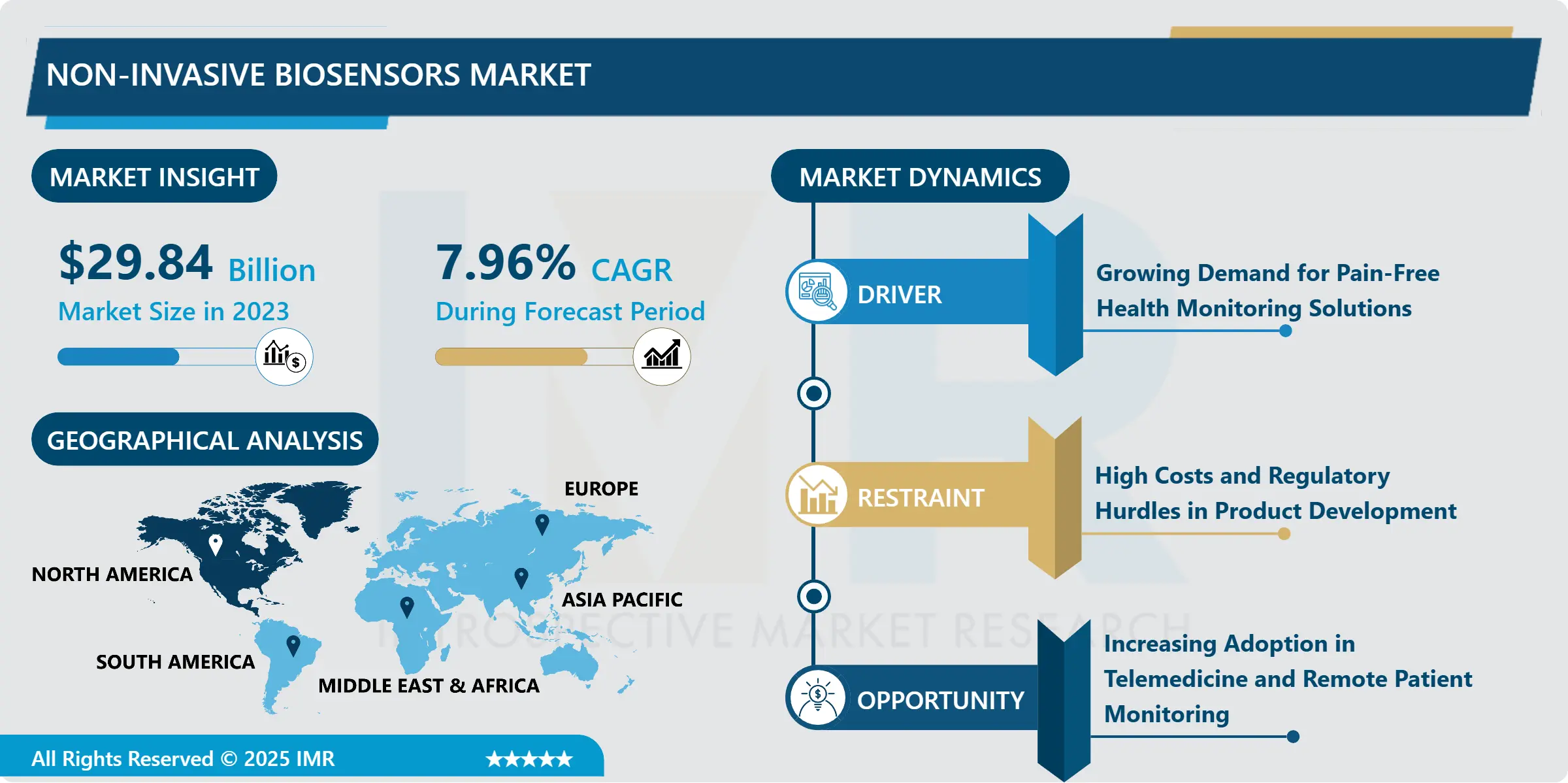
Non-invasive Biosensors Market Size Was Valued at USD 29.84 Billion in 2023, and is Projected to Reach USD 59.45 Billion by 2032, Growing at a CAGR of 7.96% From 2024-2032.
The non-invasive biosensors market, involved sensors that are used in the assessment of biological functions without having to perform invasive procedures such as blood sampling or biopsy. These sensors operate based on the identification of biomarkers on skin or in perspiration, saliva or breath relying on constant, real-time surveillance of health status. Self-contained, implantable biosensors have multiple uses in sensor-based medicine including monitoring blood glucose levels for diabetes, wearable biosensors for fitness activities or health conscious people, and for other patients needing strict health surveillance.
The market of non-invasive biosensors is growing faster with the continuous rise in demand for convenient and painless biosensors for health monitoring. While normal sensors are invasive in nature and demand a sample of blood, biosensors are non-invasive and rely on unique methods of detection to measure vital signs and the concentration of biomolecules. This is due to the ease of use, attractive features such as improvements in sensor technology, miniaturization and wireless connectivity to make the devices important instruments in today’s health care delivery systems. The clients, care givers, and the health-conscious individuals are now embracing non-invasive biosensors to monitor bio signals for early intervention or to manage the diseases.
The market is further driven by the increasing ageing population Coupled with increased occurrences of conditions such as diabetes and cardiovascular diseases across the world. This has indeed encouraged the demand for biosensors that give round the clock monitoring without the use of needles or other intrusive techniques. In parallel with the popularization of wearable devices, non-invasive biosensors are rapidly becoming a part of the IoMT environment where people’s health data is collected and analysed for telemedicine and remote monitoring. This connectivity with digital health solutions is expanding the application of non-invasive biosensors in preventive as well as healthcare.
Non-invasive Biosensors Market Trend Analysis:
Miniaturization and Wearable Integration
- Miniaturisation of biosensors is another rapidly growing tendency in the non-invasive biosensors market along with the integration of biosensors into wearable devices. In the past decade improvements in nanotechnology and microelectronics have enabled the miniaturization of biosensors to a level where they can be integrated into HHP devices such as smartwatches, fitness bands and skin patches. Many of these sensors are capable of tracking various vital body indices on a constant basis, including glucose levels, hydration, and blood oxygen saturation so the customers can vigilantly follow their statuses. These non-invasive biosensors also look and feel considerably different from conventional monitoring methods, thus bringing a comfortable, needleless approach to health tracking into the lives of users.
- This is made even more attractive by the ability to connect to Bluetooth that enables the transmission of health information from biosensor devices to mobile applications and clouds for evaluation. This capability has taken the use of the non-invasive biosensors from the clinical practice to the fitness and health monitoring consumer space. These products are slowly becoming popular not only for medical related requirements but also for achieving the best physical wellbeing of individuals, leading to a concept of preventive health care. Consequently, the non-invasive biosensor market is expanding from a sundry of clients who consider real time monitoring and data analysis as an integral part of their activities.
Opportunities in the Non-Invasive Biosensors Market
- The global non-invasive biosensors market presents significant growth opportunities, particularly in the areas of chronic disease management, remote patient monitoring, and personalized healthcare. With the rising global burden of conditions such as diabetes, cardiovascular diseases, and respiratory disorders, there is an increasing demand for continuous, real-time health monitoring that is both patient-friendly and cost-effective. Non-invasive biosensors, especially when integrated into wearable devices, offer a seamless way to track key biomarkers without discomfort or clinical intervention. This opens avenues for their adoption not only in hospitals and clinics but also in-home care and wellness settings, enhancing accessibility to proactive healthcare.
- Technological advancements in nanotechnology, AI, and IoT are unlocking new frontiers for non-invasive biosensors across diagnostic, therapeutic, and preventive care applications. Emerging markets in Asia-Pacific, Latin America, and the Middle East offer untapped potential due to improving healthcare infrastructure and increasing awareness of digital health tools. Furthermore, collaborations between tech companies and healthcare providers are fostering innovation in multi-analyte biosensors, smart wearables, and mobile health platforms. These developments are expected to expand the market's reach, creating lucrative opportunities for device manufacturers, startups, and investors looking to capitalize on the shift toward non-invasive, connected, and patient-centered healthcare solutions.
Non-invasive Biosensors Market Segment Analysis:
Non-invasive Biosensors Market is Segmented on the basis of technology, application, end user, and region.
By Technology, Optical Biosensors segment is expected to dominate the market during the forecast period
- The optical biosensors segment is expected to dominate the global non-invasive biosensors market during the forecast period, owing to its high sensitivity, real-time analysis capabilities, and non-contact measurement advantages. Optical biosensors use light-based detection methods, such as fluorescence, surface plasmon resonance, and interferometry, to analyze biological samples with minimal or no physical intrusion. These sensors are widely used in detecting biomarkers for diseases, monitoring glucose levels, and tracking vital physiological parameters without requiring skin penetration. Their precision and versatility make them ideal for both clinical diagnostics and consumer wearable applications, especially in managing chronic illnesses and tracking general wellness.
- Globally, the increasing integration of optical biosensors in wearable health tech and medical imaging systems is driving significant market growth. Continuous innovation in photonics, miniaturization of components, and the development of compact, user-friendly devices are making optical biosensors more accessible across healthcare settings. Furthermore, the growing demand for non-invasive solutions in diagnostics, coupled with rising healthcare awareness and investment in point-of-care technologies, supports the rapid adoption of this technology. As healthcare providers and patients seek safer, faster, and more accurate monitoring tools, optical biosensors are set to lead technological advancements in the non-invasive biosensor space.
By Application, Medical diagnostics segment expected to held the largest share
- The medical diagnostics segment is expected to hold the largest share of the global non-invasive biosensors market, driven by the growing demand for early, accurate, and real-time health monitoring solutions. Non-invasive biosensors enable painless, rapid diagnostics without the need for blood draws or invasive procedures, significantly improving patient compliance and comfort. These biosensors are increasingly integrated into wearable devices such as smartwatches, fitness trackers, and skin patches, offering continuous monitoring of vital signs such as glucose levels, heart rate, blood oxygen, and more. The prevalence of chronic conditions like diabetes, cardiovascular diseases, and respiratory disorders is further fueling the need for reliable, non-invasive diagnostic tools to manage long-term health effectively.
- Globally, advancements in nanotechnology, microfluidics, and wireless communication are accelerating the adoption of non-invasive biosensors in clinical and at-home settings. The push towards personalized medicine, along with supportive regulatory frameworks and healthcare digitization, is also contributing to the growth of this segment. Moreover, the integration of AI and data analytics with non-invasive biosensors enhances diagnostic accuracy and predictive capabilities, making them a cornerstone in the shift towards preventive and remote healthcare models. As healthcare systems prioritize cost-effective and patient-centric technologies, the medical diagnostics application segment is poised to dominate the market in the coming years.
Non-invasive Biosensors Market Regional Insights:
North America is Expected to Dominate the Market Over the Forecast period
- North America is expected to dominate the non-invasive biosensors market over the forecast period, driven by advanced healthcare infrastructure, strong research and development capabilities, and high adoption of innovative medical technologies. The region's growing geriatric population, coupled with an increasing prevalence of chronic diseases such as diabetes, cardiovascular disorders, and respiratory conditions, is creating a sustained demand for non-invasive diagnostic and monitoring solutions. The presence of key market players, coupled with frequent product launches and robust clinical trials, also supports the region’s leadership position. Moreover, the rising popularity of wearable health tech and digital health platforms among consumers further fuels the market.
- Government initiatives supporting digital health transformation, along with favorable reimbursement frameworks and regulatory approvals by agencies like the FDA, contribute to accelerating the adoption of non-invasive biosensors across the U.S. and Canada. The region also benefits from strong collaboration between technology firms and healthcare providers, leading to rapid commercialization of cutting-edge biosensor technologies. With continuous innovation in AI-integrated diagnostics, mobile health applications, and personalized medicine, North America is expected to remain at the forefront of the non-invasive biosensors market throughout the forecast period.
Active Key Players in the Non-invasive Biosensors Market:
- Abbott Laboratories (USA)
- Apple Inc. (USA)
- Biovotion AG (Switzerland)
- DexCom Inc. (USA)
- GE Healthcare (USA)
- GlucoTrack Inc. (Israel)
- Honeywell International Inc. (USA)
- Integrity Applications Ltd. (Israel)
- Koninklijke Philips N.V. (Netherlands)
- Medtronic plc (Ireland)
- Nemaura Medical Inc. (UK)
- Oura Health Ltd. (Finland)
- Rockley Photonics Holdings Ltd. (UK)
- Senseonics Holdings Inc. (USA)
- VitalConnect Inc. (USA), Other Active key Players.
|
Global Non-invasive Biosensors Market |
|||
|
Base Year: |
2023 |
Forecast Period: |
2024-2032 |
|
Historical Data: |
2017 to 2023 |
Market Size in 2023: |
USD 29.84 Billion |
|
Forecast Period 2024-32 CAGR: |
7.96 % |
Market Size in 2032: |
USD 59.45 Billion |
|
Segments Covered: |
By Technology |
|
|
|
By Application |
|
||
|
By End User |
|
||
|
By Region |
|
||
|
Key Market Drivers: |
|
||
|
Key Market Restraints: |
|
||
|
Key Opportunities: |
|
||
|
Companies Covered in the report: |
|
||
Chapter 1: Introduction
1.1 Scope and Coverage
Chapter 2:Executive Summary
Chapter 3: Market Landscape
3.1 Market Dynamics
3.1.1 Drivers
3.1.2 Restraints
3.1.3 Opportunities
3.1.4 Challenges
3.2 Market Trend Analysis
3.3 PESTLE Analysis
3.4 Porter's Five Forces Analysis
3.5 Industry Value Chain Analysis
3.6 Ecosystem
3.7 Regulatory Landscape
3.8 Price Trend Analysis
3.9 Patent Analysis
3.10 Technology Evolution
3.11 Investment Pockets
3.12 Import-Export Analysis
Chapter 4: Non-invasive Biosensors Market by Technology
4.1 Non-invasive Biosensors Market Snapshot and Growth Engine
4.2 Non-invasive Biosensors Market Overview
4.3 Optical Biosensors
4.3.1 Introduction and Market Overview
4.3.2 Historic and Forecasted Market Size in Value USD and Volume Units (2017-2032F)
4.3.3 Key Market Trends, Growth Factors and Opportunities
4.3.4 Optical Biosensors: Geographic Segmentation Analysis
4.4 Electrochemical Biosensors
4.4.1 Introduction and Market Overview
4.4.2 Historic and Forecasted Market Size in Value USD and Volume Units (2017-2032F)
4.4.3 Key Market Trends, Growth Factors and Opportunities
4.4.4 Electrochemical Biosensors: Geographic Segmentation Analysis
4.5 Piezoelectric Biosensors
4.5.1 Introduction and Market Overview
4.5.2 Historic and Forecasted Market Size in Value USD and Volume Units (2017-2032F)
4.5.3 Key Market Trends, Growth Factors and Opportunities
4.5.4 Piezoelectric Biosensors: Geographic Segmentation Analysis
4.6 Thermal Biosensors
4.6.1 Introduction and Market Overview
4.6.2 Historic and Forecasted Market Size in Value USD and Volume Units (2017-2032F)
4.6.3 Key Market Trends, Growth Factors and Opportunities
4.6.4 Thermal Biosensors: Geographic Segmentation Analysis
Chapter 5: Non-invasive Biosensors Market by Application
5.1 Non-invasive Biosensors Market Snapshot and Growth Engine
5.2 Non-invasive Biosensors Market Overview
5.3 Medical Diagnostics
5.3.1 Introduction and Market Overview
5.3.2 Historic and Forecasted Market Size in Value USD and Volume Units (2017-2032F)
5.3.3 Key Market Trends, Growth Factors and Opportunities
5.3.4 Medical Diagnostics: Geographic Segmentation Analysis
5.4 Food & Beverage
5.4.1 Introduction and Market Overview
5.4.2 Historic and Forecasted Market Size in Value USD and Volume Units (2017-2032F)
5.4.3 Key Market Trends, Growth Factors and Opportunities
5.4.4 Food & Beverage: Geographic Segmentation Analysis
5.5 Environmental Monitoring
5.5.1 Introduction and Market Overview
5.5.2 Historic and Forecasted Market Size in Value USD and Volume Units (2017-2032F)
5.5.3 Key Market Trends, Growth Factors and Opportunities
5.5.4 Environmental Monitoring: Geographic Segmentation Analysis
5.6 Defense and Security
5.6.1 Introduction and Market Overview
5.6.2 Historic and Forecasted Market Size in Value USD and Volume Units (2017-2032F)
5.6.3 Key Market Trends, Growth Factors and Opportunities
5.6.4 Defense and Security: Geographic Segmentation Analysis
5.7 Others
5.7.1 Introduction and Market Overview
5.7.2 Historic and Forecasted Market Size in Value USD and Volume Units (2017-2032F)
5.7.3 Key Market Trends, Growth Factors and Opportunities
5.7.4 Others: Geographic Segmentation Analysis
Chapter 6: Non-invasive Biosensors Market by End User
6.1 Non-invasive Biosensors Market Snapshot and Growth Engine
6.2 Non-invasive Biosensors Market Overview
6.3 Hospitals & Clinics
6.3.1 Introduction and Market Overview
6.3.2 Historic and Forecasted Market Size in Value USD and Volume Units (2017-2032F)
6.3.3 Key Market Trends, Growth Factors and Opportunities
6.3.4 Hospitals & Clinics: Geographic Segmentation Analysis
6.4 Home Healthcare
6.4.1 Introduction and Market Overview
6.4.2 Historic and Forecasted Market Size in Value USD and Volume Units (2017-2032F)
6.4.3 Key Market Trends, Growth Factors and Opportunities
6.4.4 Home Healthcare: Geographic Segmentation Analysis
6.5 Research Laboratories
6.5.1 Introduction and Market Overview
6.5.2 Historic and Forecasted Market Size in Value USD and Volume Units (2017-2032F)
6.5.3 Key Market Trends, Growth Factors and Opportunities
6.5.4 Research Laboratories: Geographic Segmentation Analysis
6.6 Fitness and Wellness Centers
6.6.1 Introduction and Market Overview
6.6.2 Historic and Forecasted Market Size in Value USD and Volume Units (2017-2032F)
6.6.3 Key Market Trends, Growth Factors and Opportunities
6.6.4 Fitness and Wellness Centers: Geographic Segmentation Analysis
6.7 Others
6.7.1 Introduction and Market Overview
6.7.2 Historic and Forecasted Market Size in Value USD and Volume Units (2017-2032F)
6.7.3 Key Market Trends, Growth Factors and Opportunities
6.7.4 Others: Geographic Segmentation Analysis
Chapter 7: Company Profiles and Competitive Analysis
7.1 Competitive Landscape
7.1.1 Competitive Benchmarking
7.1.2 Non-invasive Biosensors Market Share by Manufacturer (2023)
7.1.3 Industry BCG Matrix
7.1.4 Heat Map Analysis
7.1.5 Mergers and Acquisitions
7.2 ABBOTT LABORATORIES (USA)
7.2.1 Company Overview
7.2.2 Key Executives
7.2.3 Company Snapshot
7.2.4 Role of the Company in the Market
7.2.5 Sustainability and Social Responsibility
7.2.6 Operating Business Segments
7.2.7 Product Portfolio
7.2.8 Business Performance
7.2.9 Key Strategic Moves and Recent Developments
7.2.10 SWOT Analysis
7.3 APPLE INC. (USA)
7.4 BIOVOTION AG (SWITZERLAND)
7.5 DEXCOM INC. (USA)
7.6 GE HEALTHCARE (USA)
7.7 GLUCOTRACK INC. (ISRAEL)
7.8 HONEYWELL INTERNATIONAL INC. (USA)
7.9 INTEGRITY APPLICATIONS LTD. (ISRAEL)
7.10 KONINKLIJKE PHILIPS N.V. (NETHERLANDS)
7.11 MEDTRONIC PLC (IRELAND)
7.12 NEMAURA MEDICAL INC. (UK)
7.13 OURA HEALTH LTD. (FINLAND)
7.14 ROCKLEY PHOTONICS HOLDINGS LTD. (UK)
7.15 SENSEONICS HOLDINGS INC. (USA)
7.16 VITALCONNECT INC. (USA)
7.17 OTHER ACTIVE PLAYERS
Chapter 8: Global Non-invasive Biosensors Market By Region
8.1 Overview
8.2. North America Non-invasive Biosensors Market
8.2.1 Key Market Trends, Growth Factors and Opportunities
8.2.2 Top Key Companies
8.2.3 Historic and Forecasted Market Size by Segments
8.2.4 Historic and Forecasted Market Size By Technology
8.2.4.1 Optical Biosensors
8.2.4.2 Electrochemical Biosensors
8.2.4.3 Piezoelectric Biosensors
8.2.4.4 Thermal Biosensors
8.2.5 Historic and Forecasted Market Size By Application
8.2.5.1 Medical Diagnostics
8.2.5.2 Food & Beverage
8.2.5.3 Environmental Monitoring
8.2.5.4 Defense and Security
8.2.5.5 Others
8.2.6 Historic and Forecasted Market Size By End User
8.2.6.1 Hospitals & Clinics
8.2.6.2 Home Healthcare
8.2.6.3 Research Laboratories
8.2.6.4 Fitness and Wellness Centers
8.2.6.5 Others
8.2.7 Historic and Forecast Market Size by Country
8.2.7.1 US
8.2.7.2 Canada
8.2.7.3 Mexico
8.3. Eastern Europe Non-invasive Biosensors Market
8.3.1 Key Market Trends, Growth Factors and Opportunities
8.3.2 Top Key Companies
8.3.3 Historic and Forecasted Market Size by Segments
8.3.4 Historic and Forecasted Market Size By Technology
8.3.4.1 Optical Biosensors
8.3.4.2 Electrochemical Biosensors
8.3.4.3 Piezoelectric Biosensors
8.3.4.4 Thermal Biosensors
8.3.5 Historic and Forecasted Market Size By Application
8.3.5.1 Medical Diagnostics
8.3.5.2 Food & Beverage
8.3.5.3 Environmental Monitoring
8.3.5.4 Defense and Security
8.3.5.5 Others
8.3.6 Historic and Forecasted Market Size By End User
8.3.6.1 Hospitals & Clinics
8.3.6.2 Home Healthcare
8.3.6.3 Research Laboratories
8.3.6.4 Fitness and Wellness Centers
8.3.6.5 Others
8.3.7 Historic and Forecast Market Size by Country
8.3.7.1 Russia
8.3.7.2 Bulgaria
8.3.7.3 The Czech Republic
8.3.7.4 Hungary
8.3.7.5 Poland
8.3.7.6 Romania
8.3.7.7 Rest of Eastern Europe
8.4. Western Europe Non-invasive Biosensors Market
8.4.1 Key Market Trends, Growth Factors and Opportunities
8.4.2 Top Key Companies
8.4.3 Historic and Forecasted Market Size by Segments
8.4.4 Historic and Forecasted Market Size By Technology
8.4.4.1 Optical Biosensors
8.4.4.2 Electrochemical Biosensors
8.4.4.3 Piezoelectric Biosensors
8.4.4.4 Thermal Biosensors
8.4.5 Historic and Forecasted Market Size By Application
8.4.5.1 Medical Diagnostics
8.4.5.2 Food & Beverage
8.4.5.3 Environmental Monitoring
8.4.5.4 Defense and Security
8.4.5.5 Others
8.4.6 Historic and Forecasted Market Size By End User
8.4.6.1 Hospitals & Clinics
8.4.6.2 Home Healthcare
8.4.6.3 Research Laboratories
8.4.6.4 Fitness and Wellness Centers
8.4.6.5 Others
8.4.7 Historic and Forecast Market Size by Country
8.4.7.1 Germany
8.4.7.2 UK
8.4.7.3 France
8.4.7.4 The Netherlands
8.4.7.5 Italy
8.4.7.6 Spain
8.4.7.7 Rest of Western Europe
8.5. Asia Pacific Non-invasive Biosensors Market
8.5.1 Key Market Trends, Growth Factors and Opportunities
8.5.2 Top Key Companies
8.5.3 Historic and Forecasted Market Size by Segments
8.5.4 Historic and Forecasted Market Size By Technology
8.5.4.1 Optical Biosensors
8.5.4.2 Electrochemical Biosensors
8.5.4.3 Piezoelectric Biosensors
8.5.4.4 Thermal Biosensors
8.5.5 Historic and Forecasted Market Size By Application
8.5.5.1 Medical Diagnostics
8.5.5.2 Food & Beverage
8.5.5.3 Environmental Monitoring
8.5.5.4 Defense and Security
8.5.5.5 Others
8.5.6 Historic and Forecasted Market Size By End User
8.5.6.1 Hospitals & Clinics
8.5.6.2 Home Healthcare
8.5.6.3 Research Laboratories
8.5.6.4 Fitness and Wellness Centers
8.5.6.5 Others
8.5.7 Historic and Forecast Market Size by Country
8.5.7.1 China
8.5.7.2 India
8.5.7.3 Japan
8.5.7.4 South Korea
8.5.7.5 Malaysia
8.5.7.6 Thailand
8.5.7.7 Vietnam
8.5.7.8 The Philippines
8.5.7.9 Australia
8.5.7.10 New Zealand
8.5.7.11 Rest of APAC
8.6. Middle East & Africa Non-invasive Biosensors Market
8.6.1 Key Market Trends, Growth Factors and Opportunities
8.6.2 Top Key Companies
8.6.3 Historic and Forecasted Market Size by Segments
8.6.4 Historic and Forecasted Market Size By Technology
8.6.4.1 Optical Biosensors
8.6.4.2 Electrochemical Biosensors
8.6.4.3 Piezoelectric Biosensors
8.6.4.4 Thermal Biosensors
8.6.5 Historic and Forecasted Market Size By Application
8.6.5.1 Medical Diagnostics
8.6.5.2 Food & Beverage
8.6.5.3 Environmental Monitoring
8.6.5.4 Defense and Security
8.6.5.5 Others
8.6.6 Historic and Forecasted Market Size By End User
8.6.6.1 Hospitals & Clinics
8.6.6.2 Home Healthcare
8.6.6.3 Research Laboratories
8.6.6.4 Fitness and Wellness Centers
8.6.6.5 Others
8.6.7 Historic and Forecast Market Size by Country
8.6.7.1 Turkiye
8.6.7.2 Bahrain
8.6.7.3 Kuwait
8.6.7.4 Saudi Arabia
8.6.7.5 Qatar
8.6.7.6 UAE
8.6.7.7 Israel
8.6.7.8 South Africa
8.7. South America Non-invasive Biosensors Market
8.7.1 Key Market Trends, Growth Factors and Opportunities
8.7.2 Top Key Companies
8.7.3 Historic and Forecasted Market Size by Segments
8.7.4 Historic and Forecasted Market Size By Technology
8.7.4.1 Optical Biosensors
8.7.4.2 Electrochemical Biosensors
8.7.4.3 Piezoelectric Biosensors
8.7.4.4 Thermal Biosensors
8.7.5 Historic and Forecasted Market Size By Application
8.7.5.1 Medical Diagnostics
8.7.5.2 Food & Beverage
8.7.5.3 Environmental Monitoring
8.7.5.4 Defense and Security
8.7.5.5 Others
8.7.6 Historic and Forecasted Market Size By End User
8.7.6.1 Hospitals & Clinics
8.7.6.2 Home Healthcare
8.7.6.3 Research Laboratories
8.7.6.4 Fitness and Wellness Centers
8.7.6.5 Others
8.7.7 Historic and Forecast Market Size by Country
8.7.7.1 Brazil
8.7.7.2 Argentina
8.7.7.3 Rest of SA
Chapter 9 Analyst Viewpoint and Conclusion
9.1 Recommendations and Concluding Analysis
9.2 Potential Market Strategies
Chapter 10 Research Methodology
10.1 Research Process
10.2 Primary Research
10.3 Secondary Research
|
Global Non-invasive Biosensors Market |
|||
|
Base Year: |
2023 |
Forecast Period: |
2024-2032 |
|
Historical Data: |
2017 to 2023 |
Market Size in 2023: |
USD 29.84 Billion |
|
Forecast Period 2024-32 CAGR: |
7.96 % |
Market Size in 2032: |
USD 59.45 Billion |
|
Segments Covered: |
By Technology |
|
|
|
By Application |
|
||
|
By End User |
|
||
|
By Region |
|
||
|
Key Market Drivers: |
|
||
|
Key Market Restraints: |
|
||
|
Key Opportunities: |
|
||
|
Companies Covered in the report: |
|
||