




Newborn Screening Market Synopsis:
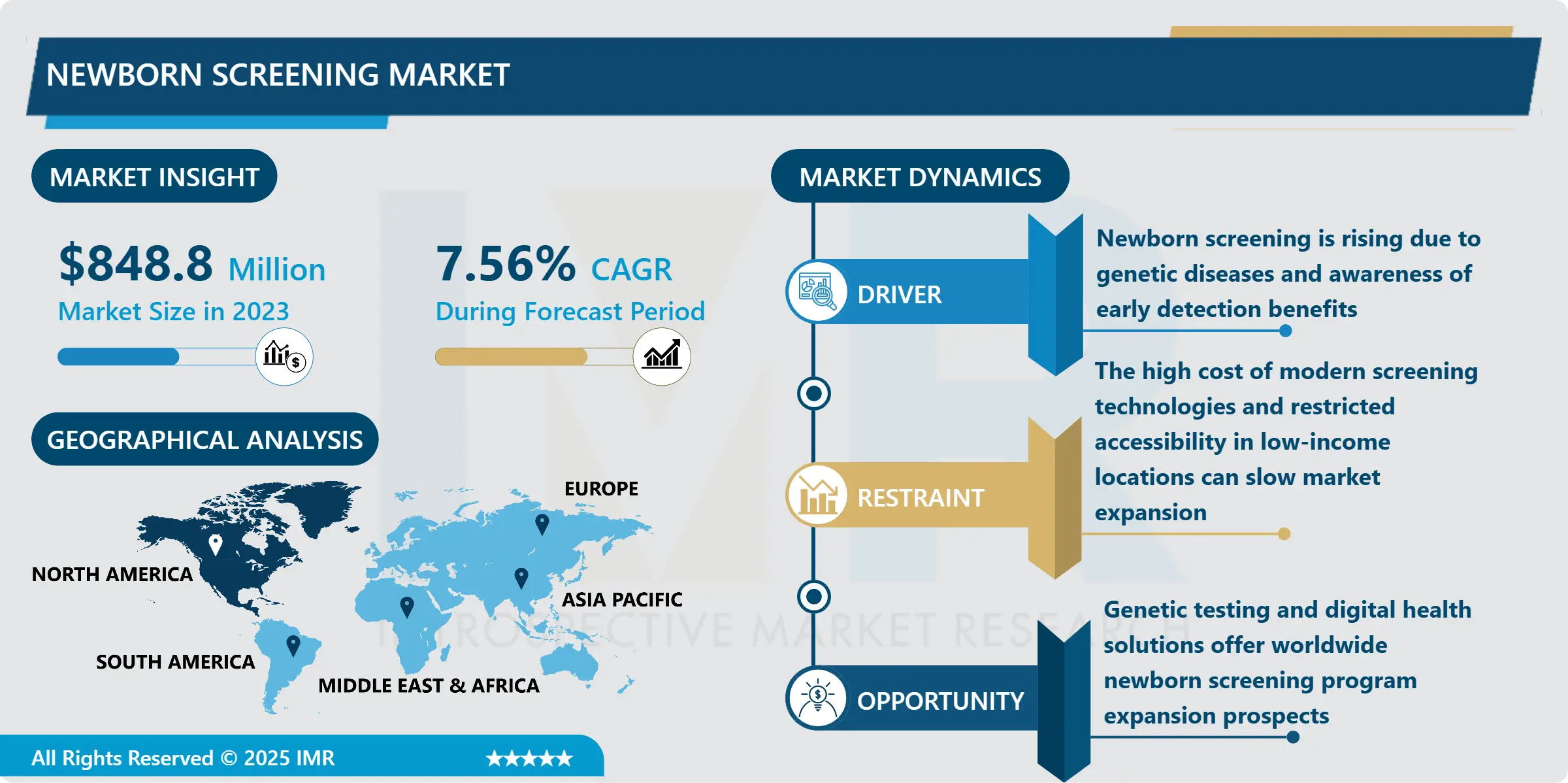
Newborn Screening Market Size Was Valued at USD 848.8 Million in 2023 and is Projected to Reach USD 1635.6 Million by 2032, Growing at a CAGR of 7.56% From 2024-2032.
The newborn screening market is expanding rapidly as early detection of genetic, metabolic, and developmental disorders becomes a global healthcare priority. Newborn screening involves testing infants shortly after birth to identify potentially serious health conditions that can benefit from early intervention. The increasing awareness among parents and healthcare providers about the importance of early diagnosis, coupled with the rising prevalence of congenital disorders, is driving demand for advanced screening solutions. Government initiatives in many regions further support newborn screening programs by mandating testing for a range of treatable conditions, thereby enhancing market growth.
Technological advancements in screening methodologies have transformed the newborn screening market, enabling the detection of a broader spectrum of conditions with higher accuracy and efficiency. Mass spectrometry and DNA-based tests, for instance, are gaining popularity as they allow for rapid and precise identification of disorders. These technologies have helped expand the range of detectable conditions, from metabolic and endocrine disorders to hearing impairments and critical congenital heart defects. In addition, innovations in sample collection methods, such as dried blood spot (DBS) testing, have improved the convenience and accuracy of these screenings.
The newborn screening market is also driven by increasing investments in research and development from both government bodies and private companies. North America and Europe currently dominate the market due to strong healthcare infrastructure and widespread adoption of screening programs. However, emerging markets in Asia-Pacific and Latin America show significant growth potential as awareness and healthcare spending in these regions rise. With the ongoing focus on early diagnosis and preventive healthcare, the newborn screening market is poised for continued growth, as it plays a critical role in improving long-term health outcomes for infants globally.
Newborn Screening Market Trend Analysis:
Expansion of Screening Panels to Include Genetic and Rare Disorders
-
A major trend in the newborn screening market is the expansion of screening panels to detect a wider array of genetic and rare disorders. Advances in genetic testing technology now allow healthcare providers to screen newborns for complex conditions such as spinal muscular atrophy (SMA) and severe combined immunodeficiency (SCID), among others. This broader scope improves early diagnosis and treatment options for rare conditions, significantly impacting the quality of life for affected infants and supporting market growth.
Rise of Digital Health Solutions and Data Integration
-
The adoption of digital health solutions and data integration platforms in newborn screening programs is another significant trend. These technologies streamline the management and tracking of screening results, enabling healthcare providers to deliver timely follow-up care. Additionally, data integration allows for better collaboration among healthcare facilities, labs, and public health organizations, improving the efficiency and accuracy of screening programs. This trend is particularly prominent in developed regions but is increasingly spreading to emerging markets as digital infrastructure expands.
Newborn Screening Market Segment Analysis:
Newborn Screening Market is Segmented on the basis of Test Type, Product Type, Technology, Disease Type, End User, and Region.
By Test Type, Dried Blood Spot Test segment is expected to dominate the market during the forecast period
-
The newborn screening market offers various test types, including the dried blood spot (DBS) test, hearing screen test, and critical congenital heart diseases (CCHD) test, each playing a vital role in early infant health assessment. The dried blood spot test is widely used to screen for metabolic, genetic, and endocrine disorders by analyzing a small blood sample from a newborn's heel. Hearing screening tests are essential for identifying congenital hearing loss, allowing for timely intervention that can aid in language development. Meanwhile, the CCHD test uses pulse oximetry to detect heart defects that might not be apparent at birth, facilitating immediate treatment if necessary. Together, these screening methods ensure a comprehensive assessment of newborn health, supporting early detection and improved health outcomes.
By End User, Hospital segment expected to held the largest share
-
In the newborn screening market, key end users include hospitals, pediatric clinics, and specialized clinics, each playing a vital role in ensuring early detection and intervention for various congenital and metabolic disorders. Hospitals are often the primary setting for newborn screening, given their access to advanced equipment and specialized staff needed for initial testing shortly after birth. Pediatric clinics follow up on screening results, providing ongoing monitoring and care to manage any detected conditions, while smaller clinics may serve as additional screening sites in certain regions, expanding accessibility to screening services. Together, these end users form a comprehensive network that supports early diagnosis, timely intervention, and effective management of newborn health conditions, enhancing overall care quality.
Newborn Screening Market Regional Insights:
North America is Expected to Dominate the Market Over the Forecast period
-
North America is expected to dominate the newborn screening market over the forecast period, driven by strong healthcare infrastructure, high awareness of early diagnosis benefits, and supportive government policies. The United States, in particular, has well-established newborn screening programs that mandate testing for various congenital disorders, supported by federal and state-level funding. Additionally, advancements in screening technologies, such as genetic testing and mass spectrometry, are widely adopted in this region, contributing to the market’s growth. Increased investments in research and development, along with a high rate of adoption among hospitals and healthcare facilities, further strengthen North America’s leading position in the newborn screening market.
Active Key Players in the Newborn Screening Market:
- PerkinElmer Inc., (U.S)
- Demant A/S (Denmark)
- Natus Medical Incorporated (U.S)
- Bio-Rad Laboratories (U.S)
- Luminex Corporation (US)
- F. Hoffmann-La Roche Ltd., (Switzerland)
- Thermo Fisher Scientific Inc., (U.S)
- Bruker (US), Danaher (US)
- Medtronic (Ireland)
- Chromsystems Instruments & Chemicals GmbH (Germany)
- Trivitron Healthcare (India)
- Baebies Inc., (U.S)
- RECIPE Chemicals + Instruments GmbH (Germany)
- Other Active Players
|
Global Newborn Screening Market |
|||
|
Base Year: |
2023 |
Forecast Period: |
2024-2032 |
|
Historical Data: |
2017 to 2023 |
Market Size in 2023: |
USD 848.8 Billion |
|
Forecast Period 2024-32 CAGR: |
7.56% |
Market Size in 2032: |
USD 1635.6 Billion |
|
Segments Covered: |
By Test Type |
|
|
|
By Product Type |
|
||
|
By Technology |
|
||
|
By Disease Type |
|
||
|
By End User |
|
||
|
By Region |
|
||
|
Key Market Drivers: |
|
||
|
Key Market Restraints: |
|
||
|
Key Opportunities: |
|
||
|
Companies Covered in the report: |
|
||
Chapter 1: Introduction
1.1 Scope and Coverage
Chapter 2:Executive Summary
Chapter 3: Market Landscape
3.1 Market Dynamics
3.1.1 Drivers
3.1.2 Restraints
3.1.3 Opportunities
3.1.4 Challenges
3.2 Market Trend Analysis
3.3 PESTLE Analysis
3.4 Porter's Five Forces Analysis
3.5 Industry Value Chain Analysis
3.6 Ecosystem
3.7 Regulatory Landscape
3.8 Price Trend Analysis
3.9 Patent Analysis
3.10 Technology Evolution
3.11 Investment Pockets
3.12 Import-Export Analysis
Chapter 4: Newborn Screening Market by Test Type
4.1 Newborn Screening Market Snapshot and Growth Engine
4.2 Newborn Screening Market Overview
4.3 Dried Blood Spot Test
4.3.1 Introduction and Market Overview
4.3.2 Historic and Forecasted Market Size in Value USD and Volume Units (2017-2032F)
4.3.3 Key Market Trends, Growth Factors and Opportunities
4.3.4 Dried Blood Spot Test: Geographic Segmentation Analysis
4.4 Hearing Screen Test
4.4.1 Introduction and Market Overview
4.4.2 Historic and Forecasted Market Size in Value USD and Volume Units (2017-2032F)
4.4.3 Key Market Trends, Growth Factors and Opportunities
4.4.4 Hearing Screen Test: Geographic Segmentation Analysis
4.5 Critical Congenital Heart Diseases (CCHD) Test
4.5.1 Introduction and Market Overview
4.5.2 Historic and Forecasted Market Size in Value USD and Volume Units (2017-2032F)
4.5.3 Key Market Trends, Growth Factors and Opportunities
4.5.4 Critical Congenital Heart Diseases (CCHD) Test: Geographic Segmentation Analysis
Chapter 5: Newborn Screening Market by Product Type
5.1 Newborn Screening Market Snapshot and Growth Engine
5.2 Newborn Screening Market Overview
5.3 Instruments
5.3.1 Introduction and Market Overview
5.3.2 Historic and Forecasted Market Size in Value USD and Volume Units (2017-2032F)
5.3.3 Key Market Trends, Growth Factors and Opportunities
5.3.4 Instruments: Geographic Segmentation Analysis
5.4 Reagents
5.4.1 Introduction and Market Overview
5.4.2 Historic and Forecasted Market Size in Value USD and Volume Units (2017-2032F)
5.4.3 Key Market Trends, Growth Factors and Opportunities
5.4.4 Reagents: Geographic Segmentation Analysis
5.5 Assay Kits
5.5.1 Introduction and Market Overview
5.5.2 Historic and Forecasted Market Size in Value USD and Volume Units (2017-2032F)
5.5.3 Key Market Trends, Growth Factors and Opportunities
5.5.4 Assay Kits: Geographic Segmentation Analysis
Chapter 6: Newborn Screening Market by Technology
6.1 Newborn Screening Market Snapshot and Growth Engine
6.2 Newborn Screening Market Overview
6.3 Tandem Mass Spectrometry
6.3.1 Introduction and Market Overview
6.3.2 Historic and Forecasted Market Size in Value USD and Volume Units (2017-2032F)
6.3.3 Key Market Trends, Growth Factors and Opportunities
6.3.4 Tandem Mass Spectrometry: Geographic Segmentation Analysis
6.4 Hearing Screen Technology
6.4.1 Introduction and Market Overview
6.4.2 Historic and Forecasted Market Size in Value USD and Volume Units (2017-2032F)
6.4.3 Key Market Trends, Growth Factors and Opportunities
6.4.4 Hearing Screen Technology: Geographic Segmentation Analysis
6.5 Pulse Oximetry Screening Technology
6.5.1 Introduction and Market Overview
6.5.2 Historic and Forecasted Market Size in Value USD and Volume Units (2017-2032F)
6.5.3 Key Market Trends, Growth Factors and Opportunities
6.5.4 Pulse Oximetry Screening Technology: Geographic Segmentation Analysis
6.6 Immunoassays and Enzymatic Assays
6.6.1 Introduction and Market Overview
6.6.2 Historic and Forecasted Market Size in Value USD and Volume Units (2017-2032F)
6.6.3 Key Market Trends, Growth Factors and Opportunities
6.6.4 Immunoassays and Enzymatic Assays: Geographic Segmentation Analysis
6.7 Electrophoresis
6.7.1 Introduction and Market Overview
6.7.2 Historic and Forecasted Market Size in Value USD and Volume Units (2017-2032F)
6.7.3 Key Market Trends, Growth Factors and Opportunities
6.7.4 Electrophoresis: Geographic Segmentation Analysis
6.8 DNA-Based Assays
6.8.1 Introduction and Market Overview
6.8.2 Historic and Forecasted Market Size in Value USD and Volume Units (2017-2032F)
6.8.3 Key Market Trends, Growth Factors and Opportunities
6.8.4 DNA-Based Assays: Geographic Segmentation Analysis
Chapter 7: Newborn Screening Market by Disease Type
7.1 Newborn Screening Market Snapshot and Growth Engine
7.2 Newborn Screening Market Overview
7.3 Critical Congenital Heart Diseases
7.3.1 Introduction and Market Overview
7.3.2 Historic and Forecasted Market Size in Value USD and Volume Units (2017-2032F)
7.3.3 Key Market Trends, Growth Factors and Opportunities
7.3.4 Critical Congenital Heart Diseases: Geographic Segmentation Analysis
7.4 Newborn Hearing Loss
7.4.1 Introduction and Market Overview
7.4.2 Historic and Forecasted Market Size in Value USD and Volume Units (2017-2032F)
7.4.3 Key Market Trends, Growth Factors and Opportunities
7.4.4 Newborn Hearing Loss: Geographic Segmentation Analysis
7.5 Sickle Cell Disease
7.5.1 Introduction and Market Overview
7.5.2 Historic and Forecasted Market Size in Value USD and Volume Units (2017-2032F)
7.5.3 Key Market Trends, Growth Factors and Opportunities
7.5.4 Sickle Cell Disease: Geographic Segmentation Analysis
7.6 Phenylketonuria (PKU)
7.6.1 Introduction and Market Overview
7.6.2 Historic and Forecasted Market Size in Value USD and Volume Units (2017-2032F)
7.6.3 Key Market Trends, Growth Factors and Opportunities
7.6.4 Phenylketonuria (PKU): Geographic Segmentation Analysis
7.7 Cystic Fibrosis (CF)
7.7.1 Introduction and Market Overview
7.7.2 Historic and Forecasted Market Size in Value USD and Volume Units (2017-2032F)
7.7.3 Key Market Trends, Growth Factors and Opportunities
7.7.4 Cystic Fibrosis (CF): Geographic Segmentation Analysis
7.8 Maple Syrup Urine Disease
7.8.1 Introduction and Market Overview
7.8.2 Historic and Forecasted Market Size in Value USD and Volume Units (2017-2032F)
7.8.3 Key Market Trends, Growth Factors and Opportunities
7.8.4 Maple Syrup Urine Disease: Geographic Segmentation Analysis
7.9 Others
7.9.1 Introduction and Market Overview
7.9.2 Historic and Forecasted Market Size in Value USD and Volume Units (2017-2032F)
7.9.3 Key Market Trends, Growth Factors and Opportunities
7.9.4 Others: Geographic Segmentation Analysis
Chapter 8: Newborn Screening Market by End User
8.1 Newborn Screening Market Snapshot and Growth Engine
8.2 Newborn Screening Market Overview
8.3 Hospital
8.3.1 Introduction and Market Overview
8.3.2 Historic and Forecasted Market Size in Value USD and Volume Units (2017-2032F)
8.3.3 Key Market Trends, Growth Factors and Opportunities
8.3.4 Hospital: Geographic Segmentation Analysis
8.4 Paediatric Clinics
8.4.1 Introduction and Market Overview
8.4.2 Historic and Forecasted Market Size in Value USD and Volume Units (2017-2032F)
8.4.3 Key Market Trends, Growth Factors and Opportunities
8.4.4 Paediatric Clinics: Geographic Segmentation Analysis
8.5 Clinics
8.5.1 Introduction and Market Overview
8.5.2 Historic and Forecasted Market Size in Value USD and Volume Units (2017-2032F)
8.5.3 Key Market Trends, Growth Factors and Opportunities
8.5.4 Clinics: Geographic Segmentation Analysis
Chapter 9: Company Profiles and Competitive Analysis
9.1 Competitive Landscape
9.1.1 Competitive Benchmarking
9.1.2 Newborn Screening Market Share by Manufacturer (2023)
9.1.3 Industry BCG Matrix
9.1.4 Heat Map Analysis
9.1.5 Mergers and Acquisitions
9.2 PERKINELMER INC.
9.2.1 Company Overview
9.2.2 Key Executives
9.2.3 Company Snapshot
9.2.4 Role of the Company in the Market
9.2.5 Sustainability and Social Responsibility
9.2.6 Operating Business Segments
9.2.7 Product Portfolio
9.2.8 Business Performance
9.2.9 Key Strategic Moves and Recent Developments
9.2.10 SWOT Analysis
9.3 (U.S)
9.4 DEMANT A/S (DENMARK)
9.5 NATUS MEDICAL INCORPORATED (U.S)
9.6 BIO-RAD LABORATORIES (U.S)
9.7 LUMINEX CORPORATION (US)
9.8 F. HOFFMANN-LA ROCHE LTD.
9.9 (SWITZERLAND)
9.10 THERMO FISHER SCIENTIFIC INC.
9.11 (U.S)
9.12 BRUKER (US)
9.13 DANAHER (US)
9.14 MEDTRONIC (IRELAND)
9.15 CHROMSYSTEMS INSTRUMENTS & CHEMICALS GMBH (GERMANY)
9.16 TRIVITRON HEALTHCARE (INDIA)
9.17 BAEBIES INC.
9.18 (U.S)
9.19 RECIPE CHEMICALS + INSTRUMENTS GMBH (GERMANY)
9.20 OTHER ACTIVE PLAYERS
9.21 OTHER ACTIVE PLAYERS
Chapter 10: Global Newborn Screening Market By Region
10.1 Overview
10.2. North America Newborn Screening Market
10.2.1 Key Market Trends, Growth Factors and Opportunities
10.2.2 Top Key Companies
10.2.3 Historic and Forecasted Market Size by Segments
10.2.4 Historic and Forecasted Market Size By Test Type
10.2.4.1 Dried Blood Spot Test
10.2.4.2 Hearing Screen Test
10.2.4.3 Critical Congenital Heart Diseases (CCHD) Test
10.2.5 Historic and Forecasted Market Size By Product Type
10.2.5.1 Instruments
10.2.5.2 Reagents
10.2.5.3 Assay Kits
10.2.6 Historic and Forecasted Market Size By Technology
10.2.6.1 Tandem Mass Spectrometry
10.2.6.2 Hearing Screen Technology
10.2.6.3 Pulse Oximetry Screening Technology
10.2.6.4 Immunoassays and Enzymatic Assays
10.2.6.5 Electrophoresis
10.2.6.6 DNA-Based Assays
10.2.7 Historic and Forecasted Market Size By Disease Type
10.2.7.1 Critical Congenital Heart Diseases
10.2.7.2 Newborn Hearing Loss
10.2.7.3 Sickle Cell Disease
10.2.7.4 Phenylketonuria (PKU)
10.2.7.5 Cystic Fibrosis (CF)
10.2.7.6 Maple Syrup Urine Disease
10.2.7.7 Others
10.2.8 Historic and Forecasted Market Size By End User
10.2.8.1 Hospital
10.2.8.2 Paediatric Clinics
10.2.8.3 Clinics
10.2.9 Historic and Forecast Market Size by Country
10.2.9.1 US
10.2.9.2 Canada
10.2.9.3 Mexico
10.3. Eastern Europe Newborn Screening Market
10.3.1 Key Market Trends, Growth Factors and Opportunities
10.3.2 Top Key Companies
10.3.3 Historic and Forecasted Market Size by Segments
10.3.4 Historic and Forecasted Market Size By Test Type
10.3.4.1 Dried Blood Spot Test
10.3.4.2 Hearing Screen Test
10.3.4.3 Critical Congenital Heart Diseases (CCHD) Test
10.3.5 Historic and Forecasted Market Size By Product Type
10.3.5.1 Instruments
10.3.5.2 Reagents
10.3.5.3 Assay Kits
10.3.6 Historic and Forecasted Market Size By Technology
10.3.6.1 Tandem Mass Spectrometry
10.3.6.2 Hearing Screen Technology
10.3.6.3 Pulse Oximetry Screening Technology
10.3.6.4 Immunoassays and Enzymatic Assays
10.3.6.5 Electrophoresis
10.3.6.6 DNA-Based Assays
10.3.7 Historic and Forecasted Market Size By Disease Type
10.3.7.1 Critical Congenital Heart Diseases
10.3.7.2 Newborn Hearing Loss
10.3.7.3 Sickle Cell Disease
10.3.7.4 Phenylketonuria (PKU)
10.3.7.5 Cystic Fibrosis (CF)
10.3.7.6 Maple Syrup Urine Disease
10.3.7.7 Others
10.3.8 Historic and Forecasted Market Size By End User
10.3.8.1 Hospital
10.3.8.2 Paediatric Clinics
10.3.8.3 Clinics
10.3.9 Historic and Forecast Market Size by Country
10.3.9.1 Russia
10.3.9.2 Bulgaria
10.3.9.3 The Czech Republic
10.3.9.4 Hungary
10.3.9.5 Poland
10.3.9.6 Romania
10.3.9.7 Rest of Eastern Europe
10.4. Western Europe Newborn Screening Market
10.4.1 Key Market Trends, Growth Factors and Opportunities
10.4.2 Top Key Companies
10.4.3 Historic and Forecasted Market Size by Segments
10.4.4 Historic and Forecasted Market Size By Test Type
10.4.4.1 Dried Blood Spot Test
10.4.4.2 Hearing Screen Test
10.4.4.3 Critical Congenital Heart Diseases (CCHD) Test
10.4.5 Historic and Forecasted Market Size By Product Type
10.4.5.1 Instruments
10.4.5.2 Reagents
10.4.5.3 Assay Kits
10.4.6 Historic and Forecasted Market Size By Technology
10.4.6.1 Tandem Mass Spectrometry
10.4.6.2 Hearing Screen Technology
10.4.6.3 Pulse Oximetry Screening Technology
10.4.6.4 Immunoassays and Enzymatic Assays
10.4.6.5 Electrophoresis
10.4.6.6 DNA-Based Assays
10.4.7 Historic and Forecasted Market Size By Disease Type
10.4.7.1 Critical Congenital Heart Diseases
10.4.7.2 Newborn Hearing Loss
10.4.7.3 Sickle Cell Disease
10.4.7.4 Phenylketonuria (PKU)
10.4.7.5 Cystic Fibrosis (CF)
10.4.7.6 Maple Syrup Urine Disease
10.4.7.7 Others
10.4.8 Historic and Forecasted Market Size By End User
10.4.8.1 Hospital
10.4.8.2 Paediatric Clinics
10.4.8.3 Clinics
10.4.9 Historic and Forecast Market Size by Country
10.4.9.1 Germany
10.4.9.2 UK
10.4.9.3 France
10.4.9.4 The Netherlands
10.4.9.5 Italy
10.4.9.6 Spain
10.4.9.7 Rest of Western Europe
10.5. Asia Pacific Newborn Screening Market
10.5.1 Key Market Trends, Growth Factors and Opportunities
10.5.2 Top Key Companies
10.5.3 Historic and Forecasted Market Size by Segments
10.5.4 Historic and Forecasted Market Size By Test Type
10.5.4.1 Dried Blood Spot Test
10.5.4.2 Hearing Screen Test
10.5.4.3 Critical Congenital Heart Diseases (CCHD) Test
10.5.5 Historic and Forecasted Market Size By Product Type
10.5.5.1 Instruments
10.5.5.2 Reagents
10.5.5.3 Assay Kits
10.5.6 Historic and Forecasted Market Size By Technology
10.5.6.1 Tandem Mass Spectrometry
10.5.6.2 Hearing Screen Technology
10.5.6.3 Pulse Oximetry Screening Technology
10.5.6.4 Immunoassays and Enzymatic Assays
10.5.6.5 Electrophoresis
10.5.6.6 DNA-Based Assays
10.5.7 Historic and Forecasted Market Size By Disease Type
10.5.7.1 Critical Congenital Heart Diseases
10.5.7.2 Newborn Hearing Loss
10.5.7.3 Sickle Cell Disease
10.5.7.4 Phenylketonuria (PKU)
10.5.7.5 Cystic Fibrosis (CF)
10.5.7.6 Maple Syrup Urine Disease
10.5.7.7 Others
10.5.8 Historic and Forecasted Market Size By End User
10.5.8.1 Hospital
10.5.8.2 Paediatric Clinics
10.5.8.3 Clinics
10.5.9 Historic and Forecast Market Size by Country
10.5.9.1 China
10.5.9.2 India
10.5.9.3 Japan
10.5.9.4 South Korea
10.5.9.5 Malaysia
10.5.9.6 Thailand
10.5.9.7 Vietnam
10.5.9.8 The Philippines
10.5.9.9 Australia
10.5.9.10 New Zealand
10.5.9.11 Rest of APAC
10.6. Middle East & Africa Newborn Screening Market
10.6.1 Key Market Trends, Growth Factors and Opportunities
10.6.2 Top Key Companies
10.6.3 Historic and Forecasted Market Size by Segments
10.6.4 Historic and Forecasted Market Size By Test Type
10.6.4.1 Dried Blood Spot Test
10.6.4.2 Hearing Screen Test
10.6.4.3 Critical Congenital Heart Diseases (CCHD) Test
10.6.5 Historic and Forecasted Market Size By Product Type
10.6.5.1 Instruments
10.6.5.2 Reagents
10.6.5.3 Assay Kits
10.6.6 Historic and Forecasted Market Size By Technology
10.6.6.1 Tandem Mass Spectrometry
10.6.6.2 Hearing Screen Technology
10.6.6.3 Pulse Oximetry Screening Technology
10.6.6.4 Immunoassays and Enzymatic Assays
10.6.6.5 Electrophoresis
10.6.6.6 DNA-Based Assays
10.6.7 Historic and Forecasted Market Size By Disease Type
10.6.7.1 Critical Congenital Heart Diseases
10.6.7.2 Newborn Hearing Loss
10.6.7.3 Sickle Cell Disease
10.6.7.4 Phenylketonuria (PKU)
10.6.7.5 Cystic Fibrosis (CF)
10.6.7.6 Maple Syrup Urine Disease
10.6.7.7 Others
10.6.8 Historic and Forecasted Market Size By End User
10.6.8.1 Hospital
10.6.8.2 Paediatric Clinics
10.6.8.3 Clinics
10.6.9 Historic and Forecast Market Size by Country
10.6.9.1 Turkiye
10.6.9.2 Bahrain
10.6.9.3 Kuwait
10.6.9.4 Saudi Arabia
10.6.9.5 Qatar
10.6.9.6 UAE
10.6.9.7 Israel
10.6.9.8 South Africa
10.7. South America Newborn Screening Market
10.7.1 Key Market Trends, Growth Factors and Opportunities
10.7.2 Top Key Companies
10.7.3 Historic and Forecasted Market Size by Segments
10.7.4 Historic and Forecasted Market Size By Test Type
10.7.4.1 Dried Blood Spot Test
10.7.4.2 Hearing Screen Test
10.7.4.3 Critical Congenital Heart Diseases (CCHD) Test
10.7.5 Historic and Forecasted Market Size By Product Type
10.7.5.1 Instruments
10.7.5.2 Reagents
10.7.5.3 Assay Kits
10.7.6 Historic and Forecasted Market Size By Technology
10.7.6.1 Tandem Mass Spectrometry
10.7.6.2 Hearing Screen Technology
10.7.6.3 Pulse Oximetry Screening Technology
10.7.6.4 Immunoassays and Enzymatic Assays
10.7.6.5 Electrophoresis
10.7.6.6 DNA-Based Assays
10.7.7 Historic and Forecasted Market Size By Disease Type
10.7.7.1 Critical Congenital Heart Diseases
10.7.7.2 Newborn Hearing Loss
10.7.7.3 Sickle Cell Disease
10.7.7.4 Phenylketonuria (PKU)
10.7.7.5 Cystic Fibrosis (CF)
10.7.7.6 Maple Syrup Urine Disease
10.7.7.7 Others
10.7.8 Historic and Forecasted Market Size By End User
10.7.8.1 Hospital
10.7.8.2 Paediatric Clinics
10.7.8.3 Clinics
10.7.9 Historic and Forecast Market Size by Country
10.7.9.1 Brazil
10.7.9.2 Argentina
10.7.9.3 Rest of SA
Chapter 11 Analyst Viewpoint and Conclusion
11.1 Recommendations and Concluding Analysis
11.2 Potential Market Strategies
Chapter 12 Research Methodology
12.1 Research Process
12.2 Primary Research
12.3 Secondary Research
|
Global Newborn Screening Market |
|||
|
Base Year: |
2023 |
Forecast Period: |
2024-2032 |
|
Historical Data: |
2017 to 2023 |
Market Size in 2023: |
USD 848.8 Billion |
|
Forecast Period 2024-32 CAGR: |
7.56% |
Market Size in 2032: |
USD 1635.6 Billion |
|
Segments Covered: |
By Test Type |
|
|
|
By Product Type |
|
||
|
By Technology |
|
||
|
By Disease Type |
|
||
|
By End User |
|
||
|
By Region |
|
||
|
Key Market Drivers: |
|
||
|
Key Market Restraints: |
|
||
|
Key Opportunities: |
|
||
|
Companies Covered in the report: |
|
||


