




Neuromorphic Chip Market Synopsis
Neuromorphic Chip Market Size Was Valued at USD 26.82 Million in 2023, and is Projected to Reach USD 2,768.58 Million by 2032, Growing at a CAGR of 67.4 % From 2024-2032.
The Neuromorphic Chip Market refers to the development and deployment of the semiconductor chips that are used as the neural network of the human brain. These chips provide such facilities as the computational potential for patterns and actual data and learning and development potentiality with much lower amounts of power than the regular designs. Neuromorphic chips are used in all domains, such as consumer electronics, healthcare, automotive, aerospace, etc because of the necessity of AI capability, and the integration of hardware compute and learning.
Neuromorphic chip has been in high demand mainly due to the growing awareness of AI and Machine learning across all the fields. These chips are believed to operate and analyse high volumes of data in real time with minimal power requirement which will make these devices ideal for edge computing. The continuing advancements in cognitive computing affording development and increasing use of neural processing technology in electronics, automotive, and healthcare has also impacted on the positive growth of the market. Moreover, the growth of related IoT equipment is bringing about a demand for accelerated data computation and transmission, which will also facilitate the market of neuromorphic chips.
Neuromorphic chips are gradually finding their way into the automotive industry to be used in autonomous driving where real-time analysis is key for safety and operation. Likewise, the healthcare field gets these chips helpful in other sectors like predictive digital diagnosis, and wearable devices. Despite being at a relatively nascent stage of commercialization, further improvements in fabrication methods and partnerships among major technology companies and research universities have been steadily pushing forward improvements in the product. However, factors like high costs of developing products and services, and relatively low levels of homogenization in design, are considerations that may hinder expansion into a particular market.
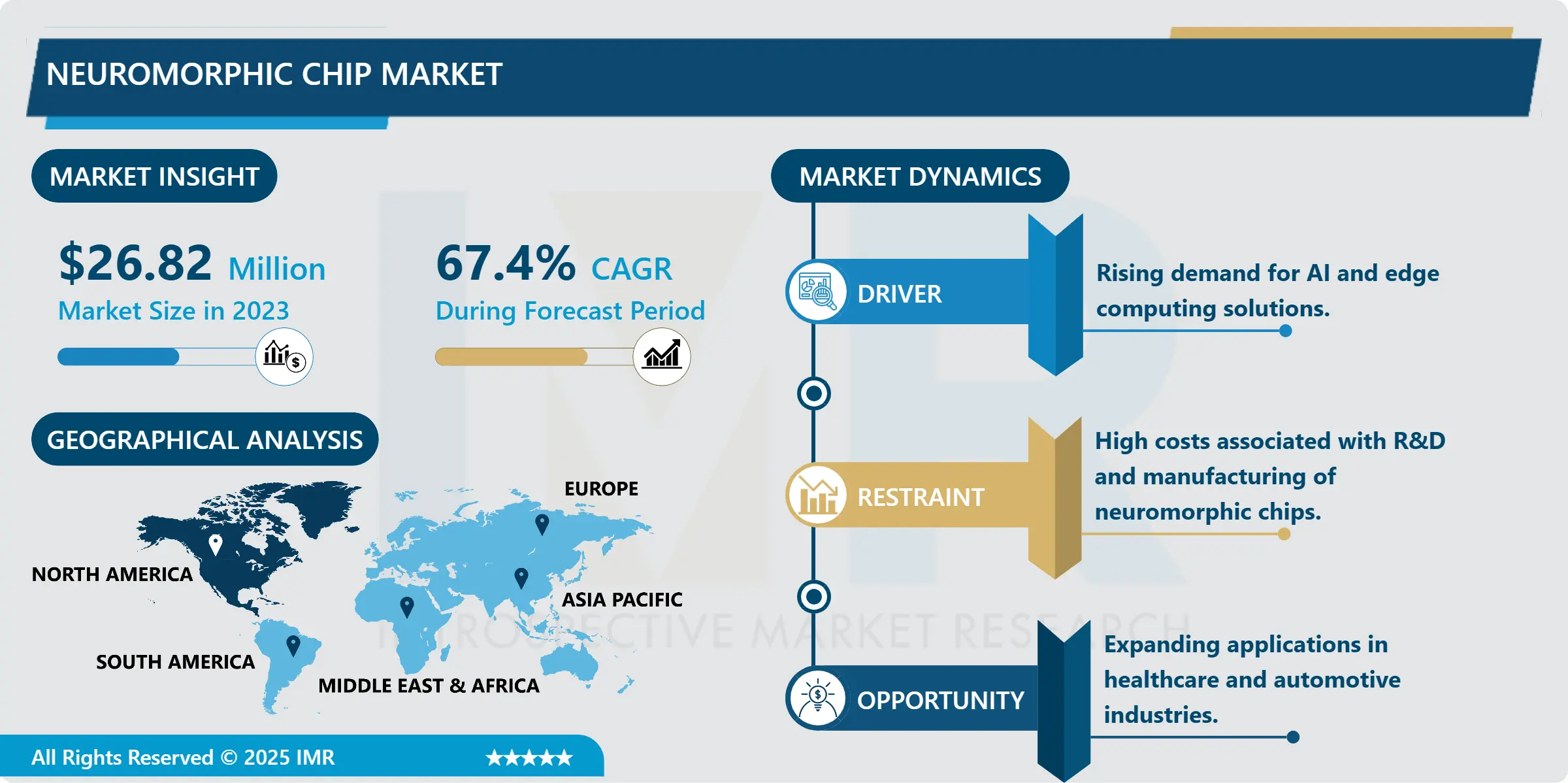
Neuromorphic Chip Market Trend Analysis:
Rising Adoption of Edge Computing
-
Edge computing is increasingly becoming a driving force behind the growth of neuromorphic chips, offering solutions that reduce latency and improve real-time decision-making. By enabling computation to occur closer to the data source, these chips allow for the execution of AI tasks with minimal reliance on cloud infrastructure. This is particularly advantageous for applications in areas like smart home devices, industrial automation, and self-driving drones, where real-time processing is critical for ensuring safety and efficiency.
-
Neuromorphic chips, known for their low power consumption and real-time capabilities, make it possible for AI systems to operate offline for extended periods. As new generations of neural networks and hardware architectures emerge, neuromorphic technology is poised to play a key role in shaping the future of edge computing, providing more localized, faster, and energy-efficient solutions across various industries.
Growing Demand in Healthcare
- The healthcare sector is projected to be the largest growth driver for the neuromorphic chip market, particularly in applications such as diagnostic imaging systems, wearable health monitoring devices, and surgical robots. These chips, designed to process data similarly to the human brain, enable earlier disease detection and more accurate anticipatory treatments. This results in optimized therapeutic interventions that improve patient outcomes.
- The incorporation of neuromorphic chips enhances the capabilities of neuroprosthetics and brain-machine interface systems, enabling breakthroughs in medical AI. As investments in healthcare and AI technology continue to rise, the demand for neuromorphic chips will see significant growth. This trend presents an immense opportunity for industry participants to innovate and lead in the evolving medical technology landscape.
Neuromorphic Chip Market Segment Analysis:
Neuromorphic Chip Market is Segmented on the basis of Application, Vertical, End User, and Region.
By Application, Recognition Signal segment is expected to dominate the market during the forecast period
- The Recognition Signal segment is projected to continue its dominance in the neuromorphic chip market until 2024, due to its exceptional capability in processing signals like speech, image, and voice recognition. These tasks are crucial for AI-powered applications, and neuromorphic chips offer the advantage of performing them efficiently while consuming minimal power. This makes them highly relevant in industries such as automotive, healthcare, and consumer electronics.
-
The rapid growth of voice-controlled devices, the widespread adoption of smart assistants, and the increasing demand for real-time translation tools have further fueled the demand for recognition signal processing. The ability to perform these complex functions on edge devices, such as smartphones and wearables, without relying heavily on cloud computing is another significant factor driving this segment's growth.
By Vertical, Consumer Electronics segment expected to held the largest share
-
The growing demand for consumer electronics powered by integrated AI technologies is a key factor driving the neuromorphic chip market, with the consumer electronics segment poised to dominate in the near future. These chips, which enable real-time data processing and adaptive learning capabilities, are revolutionizing devices such as smartphones, wearables, and smart home devices.
-
By enhancing functionalities like voice command recognition, facial security systems, and personalized content recommendations, neuromorphic chips significantly improve user experiences. As more consumers seek out devices that feature AI-driven features, manufacturers are increasingly adopting neuromorphic chip technology to meet market expectations. This continuous innovation ensures that the consumer electronics segment will remain a dominant force in the growth of the neuromorphic chip market, reshaping how we interact with our technology daily.
Neuromorphic Chip Market Regional Insights:
North America is Expected to Dominate the Market Over the Forecast period
-
North America will showcase the major market share and will dominate the neuromorphic chip market. This domination can be explained by well-developed technological support in the hi-tech region and relatively early adoption of AI in almost all sectors of the economy. Thus, the North American market has been strengthened through the presence of key semiconductor players and through continuous investment in research and development of associated projects. In the United States, for instance, the two sectors of the government and industry have given their support to the development of AI and machine learning. Moreover, the academic-industrial connections have helped progress neuromorphic systems further by filling capabilities gaps faster.
-
The efforts toward advancing AI technologies in defence and aerospace in this region have spurred higher chip uptake of neuromorphic chips. Self-driving cars and other smart healthcare uses also help drive the need. Shrine towards AI research supported by the government and favourable regulatory backdrop of the region, North America has become the leading market for neuromorphic chips. However, although the market is inexhaustible worldwide, North America?s well-developed ecosystem, technological progress, and strong commercial bonds guarantee its dominance in this industry today.
Active Key Players in the Neuromorphic Chip Market:
- BrainChip Holdings Ltd. (Australia)
- General Vision Inc. (United States)
- Hewlett Packard Enterprise (United States)
- IBM Corporation (United States)
- Intel Corporation (United States)
- Knowm Inc. (United States)
- MemComputing Inc. (United States)
- Numenta Inc. (United States)
- Qualcomm Incorporated (United States)
- Samsung Electronics (South Korea)
- Sony Corporation (Japan)
- SynSense AG (Switzerland)
- TDK Corporation (Japan)
- Thinci Inc. (United States)
- Vicarious AI (United States), and Other Active Players
|
Global Neuromorphic Chip Market |
|||
|
Base Year: |
2023 |
Forecast Period: |
2024-2032 |
|
Historical Data: |
2017 to 2023 |
Market Size in 2023: |
USD 26.82 Million |
|
Forecast Period 2024-32 CAGR: |
67.4 % |
Market Size in 2032: |
USD 2,768.58 Million |
|
Segments Covered: |
By Application |
|
|
|
By Vertical |
|
||
|
By End User |
|
||
|
By Region |
|
||
|
Key Market Drivers: |
|
||
|
Key Market Restraints: |
|
||
|
Key Opportunities: |
|
||
|
Companies Covered in the report: |
|
||
Chapter 1: Introduction
1.1 Scope and Coverage
Chapter 2:Executive Summary
Chapter 3: Market Landscape
3.1 Market Dynamics
3.1.1 Drivers
3.1.2 Restraints
3.1.3 Opportunities
3.1.4 Challenges
3.2 Market Trend Analysis
3.3 PESTLE Analysis
3.4 Porter's Five Forces Analysis
3.5 Industry Value Chain Analysis
3.6 Ecosystem
3.7 Regulatory Landscape
3.8 Price Trend Analysis
3.9 Patent Analysis
3.10 Technology Evolution
3.11 Investment Pockets
3.12 Import-Export Analysis
Chapter 4: Neuromorphic Chip Market by Application
4.1 Neuromorphic Chip Market Snapshot and Growth Engine
4.2 Neuromorphic Chip Market Overview
4.3 Image Recognition Single Recognition Data Mining Other
4.3.1 Introduction and Market Overview
4.3.2 Historic and Forecasted Market Size in Value USD and Volume Units (2017-2032F)
4.3.3 Key Market Trends, Growth Factors and Opportunities
4.3.4 Image Recognition Single Recognition Data Mining Other: Geographic Segmentation Analysis
Chapter 5: Neuromorphic Chip Market by Vertical
5.1 Neuromorphic Chip Market Snapshot and Growth Engine
5.2 Neuromorphic Chip Market Overview
5.3 Aerospace & Defence Automotive Consumer Electronics Healthcare Industrial Other
5.3.1 Introduction and Market Overview
5.3.2 Historic and Forecasted Market Size in Value USD and Volume Units (2017-2032F)
5.3.3 Key Market Trends, Growth Factors and Opportunities
5.3.4 Aerospace & Defence Automotive Consumer Electronics Healthcare Industrial Other: Geographic Segmentation Analysis
Chapter 6: Neuromorphic Chip Market by End User
6.1 Neuromorphic Chip Market Snapshot and Growth Engine
6.2 Neuromorphic Chip Market Overview
6.3 Consumer
6.3.1 Introduction and Market Overview
6.3.2 Historic and Forecasted Market Size in Value USD and Volume Units (2017-2032F)
6.3.3 Key Market Trends, Growth Factors and Opportunities
6.3.4 Consumer: Geographic Segmentation Analysis
6.4 Electronics
6.4.1 Introduction and Market Overview
6.4.2 Historic and Forecasted Market Size in Value USD and Volume Units (2017-2032F)
6.4.3 Key Market Trends, Growth Factors and Opportunities
6.4.4 Electronics: Geographic Segmentation Analysis
6.5 Healthcare
6.5.1 Introduction and Market Overview
6.5.2 Historic and Forecasted Market Size in Value USD and Volume Units (2017-2032F)
6.5.3 Key Market Trends, Growth Factors and Opportunities
6.5.4 Healthcare: Geographic Segmentation Analysis
6.6 Automotive
6.6.1 Introduction and Market Overview
6.6.2 Historic and Forecasted Market Size in Value USD and Volume Units (2017-2032F)
6.6.3 Key Market Trends, Growth Factors and Opportunities
6.6.4 Automotive: Geographic Segmentation Analysis
6.7 Industrial
6.7.1 Introduction and Market Overview
6.7.2 Historic and Forecasted Market Size in Value USD and Volume Units (2017-2032F)
6.7.3 Key Market Trends, Growth Factors and Opportunities
6.7.4 Industrial: Geographic Segmentation Analysis
6.8 Aerospace and Defense
6.8.1 Introduction and Market Overview
6.8.2 Historic and Forecasted Market Size in Value USD and Volume Units (2017-2032F)
6.8.3 Key Market Trends, Growth Factors and Opportunities
6.8.4 Aerospace and Defense: Geographic Segmentation Analysis
6.9 IT Telecommunications
6.9.1 Introduction and Market Overview
6.9.2 Historic and Forecasted Market Size in Value USD and Volume Units (2017-2032F)
6.9.3 Key Market Trends, Growth Factors and Opportunities
6.9.4 IT Telecommunications: Geographic Segmentation Analysis
Chapter 7: Company Profiles and Competitive Analysis
7.1 Competitive Landscape
7.1.1 Competitive Benchmarking
7.1.2 Neuromorphic Chip Market Share by Manufacturer (2023)
7.1.3 Industry BCG Matrix
7.1.4 Heat Map Analysis
7.1.5 Mergers and Acquisitions
7.2 BRAINCHIP HOLDINGS LTD. (AUSTRALIA)
7.2.1 Company Overview
7.2.2 Key Executives
7.2.3 Company Snapshot
7.2.4 Role of the Company in the Market
7.2.5 Sustainability and Social Responsibility
7.2.6 Operating Business Segments
7.2.7 Product Portfolio
7.2.8 Business Performance
7.2.9 Key Strategic Moves and Recent Developments
7.2.10 SWOT Analysis
7.3 GENERAL VISION INC. (UNITED STATES)
7.4 HEWLETT PACKARD ENTERPRISE (UNITED STATES)
7.5 IBM CORPORATION (UNITED STATES)
7.6 INTEL CORPORATION (UNITED STATES)
7.7 KNOWM INC. (UNITED STATES)
7.8 MEMCOMPUTING INC. (UNITED STATES)
7.9 NUMENTA INC. (UNITED STATES)
7.10 QUALCOMM INCORPORATED (UNITED STATES)
7.11 SAMSUNG ELECTRONICS (SOUTH KOREA)
7.12 SONY CORPORATION (JAPAN)
7.13 SYNSENSE AG (SWITZERLAND)
7.14 TDK CORPORATION (JAPAN)
7.15 THINCI INC. (UNITED STATES)
7.16 VICARIOUS AI (UNITED STATES)
7.17 OTHER ACTIVE PLAYERS
Chapter 8: Global Neuromorphic Chip Market By Region
8.1 Overview
8.2. North America Neuromorphic Chip Market
8.2.1 Key Market Trends, Growth Factors and Opportunities
8.2.2 Top Key Companies
8.2.3 Historic and Forecasted Market Size by Segments
8.2.4 Historic and Forecasted Market Size By Application
8.2.4.1 Image Recognition Single Recognition Data Mining Other
8.2.5 Historic and Forecasted Market Size By Vertical
8.2.5.1 Aerospace & Defence Automotive Consumer Electronics Healthcare Industrial Other
8.2.6 Historic and Forecasted Market Size By End User
8.2.6.1 Consumer
8.2.6.2 Electronics
8.2.6.3 Healthcare
8.2.6.4 Automotive
8.2.6.5 Industrial
8.2.6.6 Aerospace and Defense
8.2.6.7 IT Telecommunications
8.2.7 Historic and Forecast Market Size by Country
8.2.7.1 US
8.2.7.2 Canada
8.2.7.3 Mexico
8.3. Eastern Europe Neuromorphic Chip Market
8.3.1 Key Market Trends, Growth Factors and Opportunities
8.3.2 Top Key Companies
8.3.3 Historic and Forecasted Market Size by Segments
8.3.4 Historic and Forecasted Market Size By Application
8.3.4.1 Image Recognition Single Recognition Data Mining Other
8.3.5 Historic and Forecasted Market Size By Vertical
8.3.5.1 Aerospace & Defence Automotive Consumer Electronics Healthcare Industrial Other
8.3.6 Historic and Forecasted Market Size By End User
8.3.6.1 Consumer
8.3.6.2 Electronics
8.3.6.3 Healthcare
8.3.6.4 Automotive
8.3.6.5 Industrial
8.3.6.6 Aerospace and Defense
8.3.6.7 IT Telecommunications
8.3.7 Historic and Forecast Market Size by Country
8.3.7.1 Russia
8.3.7.2 Bulgaria
8.3.7.3 The Czech Republic
8.3.7.4 Hungary
8.3.7.5 Poland
8.3.7.6 Romania
8.3.7.7 Rest of Eastern Europe
8.4. Western Europe Neuromorphic Chip Market
8.4.1 Key Market Trends, Growth Factors and Opportunities
8.4.2 Top Key Companies
8.4.3 Historic and Forecasted Market Size by Segments
8.4.4 Historic and Forecasted Market Size By Application
8.4.4.1 Image Recognition Single Recognition Data Mining Other
8.4.5 Historic and Forecasted Market Size By Vertical
8.4.5.1 Aerospace & Defence Automotive Consumer Electronics Healthcare Industrial Other
8.4.6 Historic and Forecasted Market Size By End User
8.4.6.1 Consumer
8.4.6.2 Electronics
8.4.6.3 Healthcare
8.4.6.4 Automotive
8.4.6.5 Industrial
8.4.6.6 Aerospace and Defense
8.4.6.7 IT Telecommunications
8.4.7 Historic and Forecast Market Size by Country
8.4.7.1 Germany
8.4.7.2 UK
8.4.7.3 France
8.4.7.4 The Netherlands
8.4.7.5 Italy
8.4.7.6 Spain
8.4.7.7 Rest of Western Europe
8.5. Asia Pacific Neuromorphic Chip Market
8.5.1 Key Market Trends, Growth Factors and Opportunities
8.5.2 Top Key Companies
8.5.3 Historic and Forecasted Market Size by Segments
8.5.4 Historic and Forecasted Market Size By Application
8.5.4.1 Image Recognition Single Recognition Data Mining Other
8.5.5 Historic and Forecasted Market Size By Vertical
8.5.5.1 Aerospace & Defence Automotive Consumer Electronics Healthcare Industrial Other
8.5.6 Historic and Forecasted Market Size By End User
8.5.6.1 Consumer
8.5.6.2 Electronics
8.5.6.3 Healthcare
8.5.6.4 Automotive
8.5.6.5 Industrial
8.5.6.6 Aerospace and Defense
8.5.6.7 IT Telecommunications
8.5.7 Historic and Forecast Market Size by Country
8.5.7.1 China
8.5.7.2 India
8.5.7.3 Japan
8.5.7.4 South Korea
8.5.7.5 Malaysia
8.5.7.6 Thailand
8.5.7.7 Vietnam
8.5.7.8 The Philippines
8.5.7.9 Australia
8.5.7.10 New Zealand
8.5.7.11 Rest of APAC
8.6. Middle East & Africa Neuromorphic Chip Market
8.6.1 Key Market Trends, Growth Factors and Opportunities
8.6.2 Top Key Companies
8.6.3 Historic and Forecasted Market Size by Segments
8.6.4 Historic and Forecasted Market Size By Application
8.6.4.1 Image Recognition Single Recognition Data Mining Other
8.6.5 Historic and Forecasted Market Size By Vertical
8.6.5.1 Aerospace & Defence Automotive Consumer Electronics Healthcare Industrial Other
8.6.6 Historic and Forecasted Market Size By End User
8.6.6.1 Consumer
8.6.6.2 Electronics
8.6.6.3 Healthcare
8.6.6.4 Automotive
8.6.6.5 Industrial
8.6.6.6 Aerospace and Defense
8.6.6.7 IT Telecommunications
8.6.7 Historic and Forecast Market Size by Country
8.6.7.1 Turkiye
8.6.7.2 Bahrain
8.6.7.3 Kuwait
8.6.7.4 Saudi Arabia
8.6.7.5 Qatar
8.6.7.6 UAE
8.6.7.7 Israel
8.6.7.8 South Africa
8.7. South America Neuromorphic Chip Market
8.7.1 Key Market Trends, Growth Factors and Opportunities
8.7.2 Top Key Companies
8.7.3 Historic and Forecasted Market Size by Segments
8.7.4 Historic and Forecasted Market Size By Application
8.7.4.1 Image Recognition Single Recognition Data Mining Other
8.7.5 Historic and Forecasted Market Size By Vertical
8.7.5.1 Aerospace & Defence Automotive Consumer Electronics Healthcare Industrial Other
8.7.6 Historic and Forecasted Market Size By End User
8.7.6.1 Consumer
8.7.6.2 Electronics
8.7.6.3 Healthcare
8.7.6.4 Automotive
8.7.6.5 Industrial
8.7.6.6 Aerospace and Defense
8.7.6.7 IT Telecommunications
8.7.7 Historic and Forecast Market Size by Country
8.7.7.1 Brazil
8.7.7.2 Argentina
8.7.7.3 Rest of SA
Chapter 9 Analyst Viewpoint and Conclusion
9.1 Recommendations and Concluding Analysis
9.2 Potential Market Strategies
Chapter 10 Research Methodology
10.1 Research Process
10.2 Primary Research
10.3 Secondary Research
|
Global Neuromorphic Chip Market |
|||
|
Base Year: |
2023 |
Forecast Period: |
2024-2032 |
|
Historical Data: |
2017 to 2023 |
Market Size in 2023: |
USD 26.82 Million |
|
Forecast Period 2024-32 CAGR: |
67.4 % |
Market Size in 2032: |
USD 2,768.58 Million |
|
Segments Covered: |
By Application |
|
|
|
By Vertical |
|
||
|
By End User |
|
||
|
By Region |
|
||
|
Key Market Drivers: |
|
||
|
Key Market Restraints: |
|
||
|
Key Opportunities: |
|
||
|
Companies Covered in the report: |
|
||


