




Myomectomy Market Synopsis
Myomectomy Market Size Was Valued at USD 1.90 Billion in 2023 and is Projected to Reach USD 4.09 Billion by 2032, Growing at a CAGR of 8.89 % From 2024-2032.
The myomectomy market is the economic market of the surgical operation which involves the excision of the fibroids from the uterus retaining the uterus in the process, the market is growing as more women of reproductive age develop fibroids. Products in this market include surgical instruments, medical devices, anaesthetics, and Post-operative care product and the market has been classified by procedures like Abdominal Myomectomy, Laparoscopic Myomectomy, and Hysteroscopic Myomectomy and by End users; Hospitals, Clinics, and Surgical Centres; and geographies: North America, Europe, Asia-Pacific, Latin America, and Middle East & Africa. Propellers of growth consist of growing rate of uterine fibroid disorders with age, improvement in minimally invasive surgical procedures, and increased global healthcare spending to embrace surgical solutions. However, there are choices like expensive procedures, possible complications associated with surgery, and other treatment options that can deter a patient.
The target market of a myomectomy consequently makes up a large portion of the growing well-being sector oriented toward the surgical treatment of uterine fibroids, benign tumours that can manifest a spectrum of symptoms from excessive bleeding during menstruation and pelvic pain to infertility. As the number of cases of women with uterine fibroids continues to grow, myomectomy surgeries have become more popular. Surgical equipment and materials, MRI, surgical devices, anaesthesia, and post-surgery products and services as well as relevant products necessary for myomectomy are part of this market. The surgery can be exercised in four manners including abdominal, laparoscopic, and hysteroscopic myomectomy although they differ in several aspects depending on different aspects of the patient.
Based on geographic analysis, the market is global and growing at unprecedented rates; however, the North American and European markets retain the highest level of development in terms of myomectomy procedures and technological worlds. However, the Asia-Pacific region is still in its nascent stages of growth because of escalating investments on care and rising gynaecological conditions among women such as fibroid. Market segmentation also looks at potential growth prospects of the market from different end-user perspectives including hospitals, outpatient surgical centres, and specialty clinics.
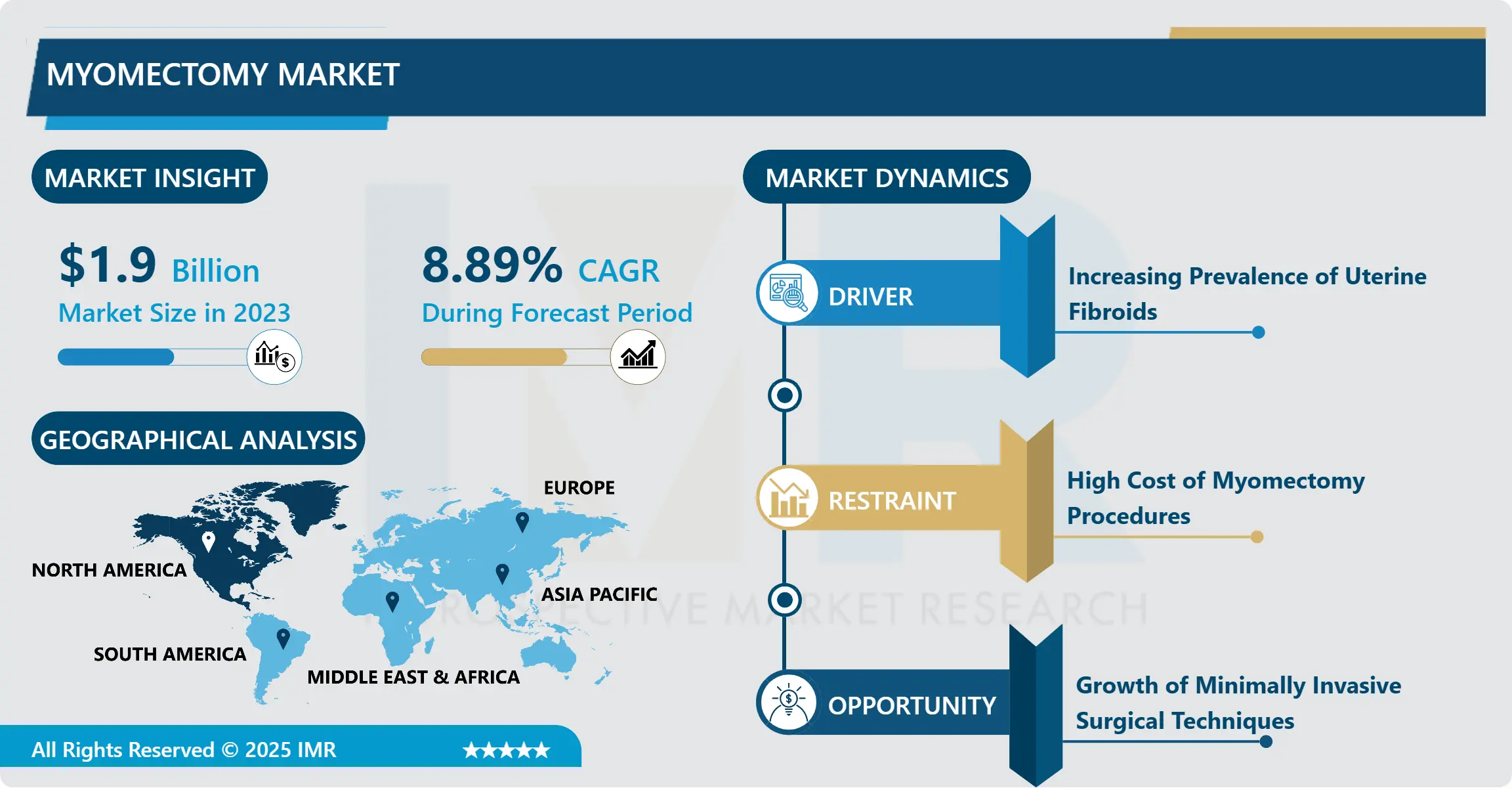
Myomectomy Market Trend Analysis:
Rising Demand for Minimally Invasive Myomectomy Techniques
Another factor that defines the overall picture of the myomectomy market is the trend of minimally invasive surgeries, to which market participants link medical technological progress and changes in patients’ preferences for shorter recovery time with less pain and fewer complications. Laparoscopic and hysteroscopic myomectomies are increasingly being performed because they offer shorter recovery time and little scarring than open procedures. This shift is facilitated through better surgical devices, robotics systems adopted in surgeries, to give surgeons more control over the procedures to enable better patients results and satisfaction levels. Furthermore, implementers of health care in this country are incorporating these techniques as they enhance the capacity utilization of meeting more patients since most are out-patient procedures.
Expanding Access to Myomectomy in Emerging Markets
A major opportunity therefore, for players offering myomectomy services or products is to increase the rate of myomectomy surgeries in these regions where women are demanding medical services for uterine fibroids as awareness for improved health and better medical facilities unfold. With more awareness campaigns being started and diagnosis facilities being made more available, the need for myomectomy as well other fibroid surgeries is gradually on the increase in the Asia-Pacific, Latin America, and some part of Africa. This is supported by increased availability of cheaper minimally invasive equipment and light weight portable surgical instruments that makes the performance of these procedures in different levels of care including rural or semi urban centers feasible.
Myomectomy Market Segment Analysis:
Myomectomy Market is Segmented on the basis of type, product, and region.
By Type, Abdominal myomectomy segment is expected to dominate the market during the forecast period
- The myomectomy market is expected to be dominated by the segment of abdominal myomectomy during the forecast period because abdominal myomectomy is an appropriate treatment for large or multiple fibroids, which are not suitable for minimally invasive surgical intervention. The open myomectomy or also known as the minimally invasive procedure involves making an incision directly through the abdomen and comes with several clear advantages to surgeons; firstly, the uterus can be accessed directly and secondly, the fibroid can be removed irrespective of its size or shape. Despite the increase in the use of minimally invasive surgery, abdominal myomectomy is still the most recommended by healthcare providers, particularly where fibroids are bulky or extends deeply into the uterine wall or, where located far from instruments’ reach.
By Product, the?Laparoscopic Power Morcellators segment expected to held the largest share
- On the basis of Product segments in myomectomy market, Laparoscopic Power Morcellators will capture largest market share by forecasted period owing the features of essential tools in minimally invasive myomectomy procedures. Laparoscopic power morcellators are surgical tools which are used to slice large fibroids into smaller pieces that can be easily removed through small incisions during a laparoscopic procedure. This capability is especially important in terms of the duration of patient’s stay in the hospital and the amount of scarring as well as the rate of complications in comparison with the open operation. Laparoscopic power morcellators market is on the rise due to the inclining trend towards minimally invasive surgical procedures, improved safety features in the device, andark in adoption from outpatient surgery centres.
Myomectomy Market Regional Insights:
North America is Expected to Dominate the Market Over the Forecast period
-
North America is expected to maintain its largest market share in myomectomy during the coming years due to several factors, including high incidences of uterine fibroids, a well-developed healthcare system, and increased availability of technological surgical procedures. The region enjoys increased awareness and early detection of fibroids hence a higher rate of surgery on the fibroids such as myomectomy. The USA is especially instrumental in this regional dominance given even higher expenditure on healthcare, favourable attitude towards LMIs, and an extensive network of the hospital and specialized surgical centres. Laparoscopic devices including the power morcellator, harmonic scalpel, and laparoscopic sealer, are already commonly used
- North America, as the healthcare providers proceed to embrace innovations within the healthcare system that enhance benefits for the patient and shorten the period of healing. In addition, the government and the private sector fund healthcare research and development to improve myomectomy approaches and instruments making North America a strategic market of the?growth and development of techniques to treat uterine fibroids. It is anticipated that this favorable environment shall continue to support North America dominant market position in the myomectomy market attracting medical device developers and healthcare organizations seeking new market opportunities.
Active Key Players in the Myomectomy Market:
- AbbVie Inc. (United States)
- B. Braun Melsungen AG (Germany)
- Boston Scientific Corporation (United States)
- CONMED Corporation (United States)
- Hologic, Inc. (United States)
- Johnson & Johnson (Ethicon) (United States)
- Karl Storz SE & Co. KG (Germany)
- Lumenis Ltd. (Israel)
- Medtronic plc (Ireland)
- Olympus Corporation (Japan)
- Richard Wolf GmbH (Germany)
- Stryker Corporation (United States)
- Teleflex Incorporated (United States)
- Zimmer Biomet Holdings, Inc. (United States)
- Zydus Lifesciences Ltd. (India)
- Other Active Players
Key Industry Developments in the Myomectomy Market
-
In November 2023, Gyn sonics launched a transcervical treatment for symptomatic uterine fibroids and a diagnostic intrauterine imaging equipment that has FDA approval. Using the new technology, it can treat up to 80% of adult females who have developed this illness.
|
Global Myomectomy Market |
|||
|
Base Year: |
2023 |
Forecast Period: |
2024-2032 |
|
Historical Data: |
2017 to 2023 |
Market Size in 2023: |
USD 1.90 Billion |
|
Forecast Period 2024-32 CAGR: |
8.89 % |
Market Size in 2032: |
USD 4.09 Billion |
|
Segments Covered: |
By Type |
|
|
|
By Product |
|
||
|
By Region |
|
||
|
Key Market Drivers: |
|
||
|
Key Market Restraints: |
|
||
|
Key Opportunities: |
|
||
|
Companies Covered in the report: |
|
||
Chapter 1: Introduction
1.1 Scope and Coverage
Chapter 2:Executive Summary
Chapter 3: Market Landscape
3.1 Market Dynamics
3.1.1 Drivers
3.1.2 Restraints
3.1.3 Opportunities
3.1.4 Challenges
3.2 Market Trend Analysis
3.3 PESTLE Analysis
3.4 Porter's Five Forces Analysis
3.5 Industry Value Chain Analysis
3.6 Ecosystem
3.7 Regulatory Landscape
3.8 Price Trend Analysis
3.9 Patent Analysis
3.10 Technology Evolution
3.11 Investment Pockets
3.12 Import-Export Analysis
Chapter 4: Myomectomy Market by Type
4.1 Myomectomy Market Snapshot and Growth Engine
4.2 Myomectomy Market Overview
4.3 Abdominal
4.3.1 Introduction and Market Overview
4.3.2 Historic and Forecasted Market Size in Value USD and Volume Units (2017-2032F)
4.3.3 Key Market Trends, Growth Factors and Opportunities
4.3.4 Abdominal: Geographic Segmentation Analysis
4.4 Hysteroscopic
4.4.1 Introduction and Market Overview
4.4.2 Historic and Forecasted Market Size in Value USD and Volume Units (2017-2032F)
4.4.3 Key Market Trends, Growth Factors and Opportunities
4.4.4 Hysteroscopic: Geographic Segmentation Analysis
4.5 Laparoscopic
4.5.1 Introduction and Market Overview
4.5.2 Historic and Forecasted Market Size in Value USD and Volume Units (2017-2032F)
4.5.3 Key Market Trends, Growth Factors and Opportunities
4.5.4 Laparoscopic: Geographic Segmentation Analysis
Chapter 5: Myomectomy Market by Product
5.1 Myomectomy Market Snapshot and Growth Engine
5.2 Myomectomy Market Overview
5.3 Laparoscopic Power Morcellators
5.3.1 Introduction and Market Overview
5.3.2 Historic and Forecasted Market Size in Value USD and Volume Units (2017-2032F)
5.3.3 Key Market Trends, Growth Factors and Opportunities
5.3.4 Laparoscopic Power Morcellators: Geographic Segmentation Analysis
5.4 Harmonic Scalpel
5.4.1 Introduction and Market Overview
5.4.2 Historic and Forecasted Market Size in Value USD and Volume Units (2017-2032F)
5.4.3 Key Market Trends, Growth Factors and Opportunities
5.4.4 Harmonic Scalpel: Geographic Segmentation Analysis
5.5 Laparoscopic Sealer
5.5.1 Introduction and Market Overview
5.5.2 Historic and Forecasted Market Size in Value USD and Volume Units (2017-2032F)
5.5.3 Key Market Trends, Growth Factors and Opportunities
5.5.4 Laparoscopic Sealer: Geographic Segmentation Analysis
Chapter 6: Company Profiles and Competitive Analysis
6.1 Competitive Landscape
6.1.1 Competitive Benchmarking
6.1.2 Myomectomy Market Share by Manufacturer (2023)
6.1.3 Industry BCG Matrix
6.1.4 Heat Map Analysis
6.1.5 Mergers and Acquisitions
6.2 ABBVIE INC. (UNITED STATES)
6.2.1 Company Overview
6.2.2 Key Executives
6.2.3 Company Snapshot
6.2.4 Role of the Company in the Market
6.2.5 Sustainability and Social Responsibility
6.2.6 Operating Business Segments
6.2.7 Product Portfolio
6.2.8 Business Performance
6.2.9 Key Strategic Moves and Recent Developments
6.2.10 SWOT Analysis
6.3 B. BRAUN MELSUNGEN AG (GERMANY)
6.4 BOSTON SCIENTIFIC CORPORATION (UNITED STATES)
6.5 CONMED CORPORATION (UNITED STATES)
6.6 HOLOGIC INC. (UNITED STATES)
6.7 JOHNSON & JOHNSON (ETHICON) (UNITED STATES)
6.8 KARL STORZ SE & CO. KG (GERMANY)
6.9 LUMENIS LTD. (ISRAEL)
6.10 MEDTRONIC PLC (IRELAND)
6.11 OLYMPUS CORPORATION (JAPAN)
6.12 RICHARD WOLF GMBH (GERMANY)
6.13 STRYKER CORPORATION (UNITED STATES)
6.14 TELEFLEX INCORPORATED (UNITED STATES)
6.15 ZIMMER BIOMET HOLDINGS INC. (UNITED STATES)
6.16 ZYDUS LIFESCIENCES LTD. (INDIA)
6.17 OTHER ACTIVE PLAYERS
Chapter 7: Global Myomectomy Market By Region
7.1 Overview
7.2. North America Myomectomy Market
7.2.1 Key Market Trends, Growth Factors and Opportunities
7.2.2 Top Key Companies
7.2.3 Historic and Forecasted Market Size by Segments
7.2.4 Historic and Forecasted Market Size By Type
7.2.4.1 Abdominal
7.2.4.2 Hysteroscopic
7.2.4.3 Laparoscopic
7.2.5 Historic and Forecasted Market Size By Product
7.2.5.1 Laparoscopic Power Morcellators
7.2.5.2 Harmonic Scalpel
7.2.5.3 Laparoscopic Sealer
7.2.6 Historic and Forecast Market Size by Country
7.2.6.1 US
7.2.6.2 Canada
7.2.6.3 Mexico
7.3. Eastern Europe Myomectomy Market
7.3.1 Key Market Trends, Growth Factors and Opportunities
7.3.2 Top Key Companies
7.3.3 Historic and Forecasted Market Size by Segments
7.3.4 Historic and Forecasted Market Size By Type
7.3.4.1 Abdominal
7.3.4.2 Hysteroscopic
7.3.4.3 Laparoscopic
7.3.5 Historic and Forecasted Market Size By Product
7.3.5.1 Laparoscopic Power Morcellators
7.3.5.2 Harmonic Scalpel
7.3.5.3 Laparoscopic Sealer
7.3.6 Historic and Forecast Market Size by Country
7.3.6.1 Russia
7.3.6.2 Bulgaria
7.3.6.3 The Czech Republic
7.3.6.4 Hungary
7.3.6.5 Poland
7.3.6.6 Romania
7.3.6.7 Rest of Eastern Europe
7.4. Western Europe Myomectomy Market
7.4.1 Key Market Trends, Growth Factors and Opportunities
7.4.2 Top Key Companies
7.4.3 Historic and Forecasted Market Size by Segments
7.4.4 Historic and Forecasted Market Size By Type
7.4.4.1 Abdominal
7.4.4.2 Hysteroscopic
7.4.4.3 Laparoscopic
7.4.5 Historic and Forecasted Market Size By Product
7.4.5.1 Laparoscopic Power Morcellators
7.4.5.2 Harmonic Scalpel
7.4.5.3 Laparoscopic Sealer
7.4.6 Historic and Forecast Market Size by Country
7.4.6.1 Germany
7.4.6.2 UK
7.4.6.3 France
7.4.6.4 The Netherlands
7.4.6.5 Italy
7.4.6.6 Spain
7.4.6.7 Rest of Western Europe
7.5. Asia Pacific Myomectomy Market
7.5.1 Key Market Trends, Growth Factors and Opportunities
7.5.2 Top Key Companies
7.5.3 Historic and Forecasted Market Size by Segments
7.5.4 Historic and Forecasted Market Size By Type
7.5.4.1 Abdominal
7.5.4.2 Hysteroscopic
7.5.4.3 Laparoscopic
7.5.5 Historic and Forecasted Market Size By Product
7.5.5.1 Laparoscopic Power Morcellators
7.5.5.2 Harmonic Scalpel
7.5.5.3 Laparoscopic Sealer
7.5.6 Historic and Forecast Market Size by Country
7.5.6.1 China
7.5.6.2 India
7.5.6.3 Japan
7.5.6.4 South Korea
7.5.6.5 Malaysia
7.5.6.6 Thailand
7.5.6.7 Vietnam
7.5.6.8 The Philippines
7.5.6.9 Australia
7.5.6.10 New Zealand
7.5.6.11 Rest of APAC
7.6. Middle East & Africa Myomectomy Market
7.6.1 Key Market Trends, Growth Factors and Opportunities
7.6.2 Top Key Companies
7.6.3 Historic and Forecasted Market Size by Segments
7.6.4 Historic and Forecasted Market Size By Type
7.6.4.1 Abdominal
7.6.4.2 Hysteroscopic
7.6.4.3 Laparoscopic
7.6.5 Historic and Forecasted Market Size By Product
7.6.5.1 Laparoscopic Power Morcellators
7.6.5.2 Harmonic Scalpel
7.6.5.3 Laparoscopic Sealer
7.6.6 Historic and Forecast Market Size by Country
7.6.6.1 Turkiye
7.6.6.2 Bahrain
7.6.6.3 Kuwait
7.6.6.4 Saudi Arabia
7.6.6.5 Qatar
7.6.6.6 UAE
7.6.6.7 Israel
7.6.6.8 South Africa
7.7. South America Myomectomy Market
7.7.1 Key Market Trends, Growth Factors and Opportunities
7.7.2 Top Key Companies
7.7.3 Historic and Forecasted Market Size by Segments
7.7.4 Historic and Forecasted Market Size By Type
7.7.4.1 Abdominal
7.7.4.2 Hysteroscopic
7.7.4.3 Laparoscopic
7.7.5 Historic and Forecasted Market Size By Product
7.7.5.1 Laparoscopic Power Morcellators
7.7.5.2 Harmonic Scalpel
7.7.5.3 Laparoscopic Sealer
7.7.6 Historic and Forecast Market Size by Country
7.7.6.1 Brazil
7.7.6.2 Argentina
7.7.6.3 Rest of SA
Chapter 8 Analyst Viewpoint and Conclusion
8.1 Recommendations and Concluding Analysis
8.2 Potential Market Strategies
Chapter 9 Research Methodology
9.1 Research Process
9.2 Primary Research
9.3 Secondary Research
|
Global Myomectomy Market |
|||
|
Base Year: |
2023 |
Forecast Period: |
2024-2032 |
|
Historical Data: |
2017 to 2023 |
Market Size in 2023: |
USD 1.90 Billion |
|
Forecast Period 2024-32 CAGR: |
8.89 % |
Market Size in 2032: |
USD 4.09 Billion |
|
Segments Covered: |
By Type |
|
|
|
By Product |
|
||
|
By Region |
|
||
|
Key Market Drivers: |
|
||
|
Key Market Restraints: |
|
||
|
Key Opportunities: |
|
||
|
Companies Covered in the report: |
|
||


