




Myocardial Infarction Market Synopsis:
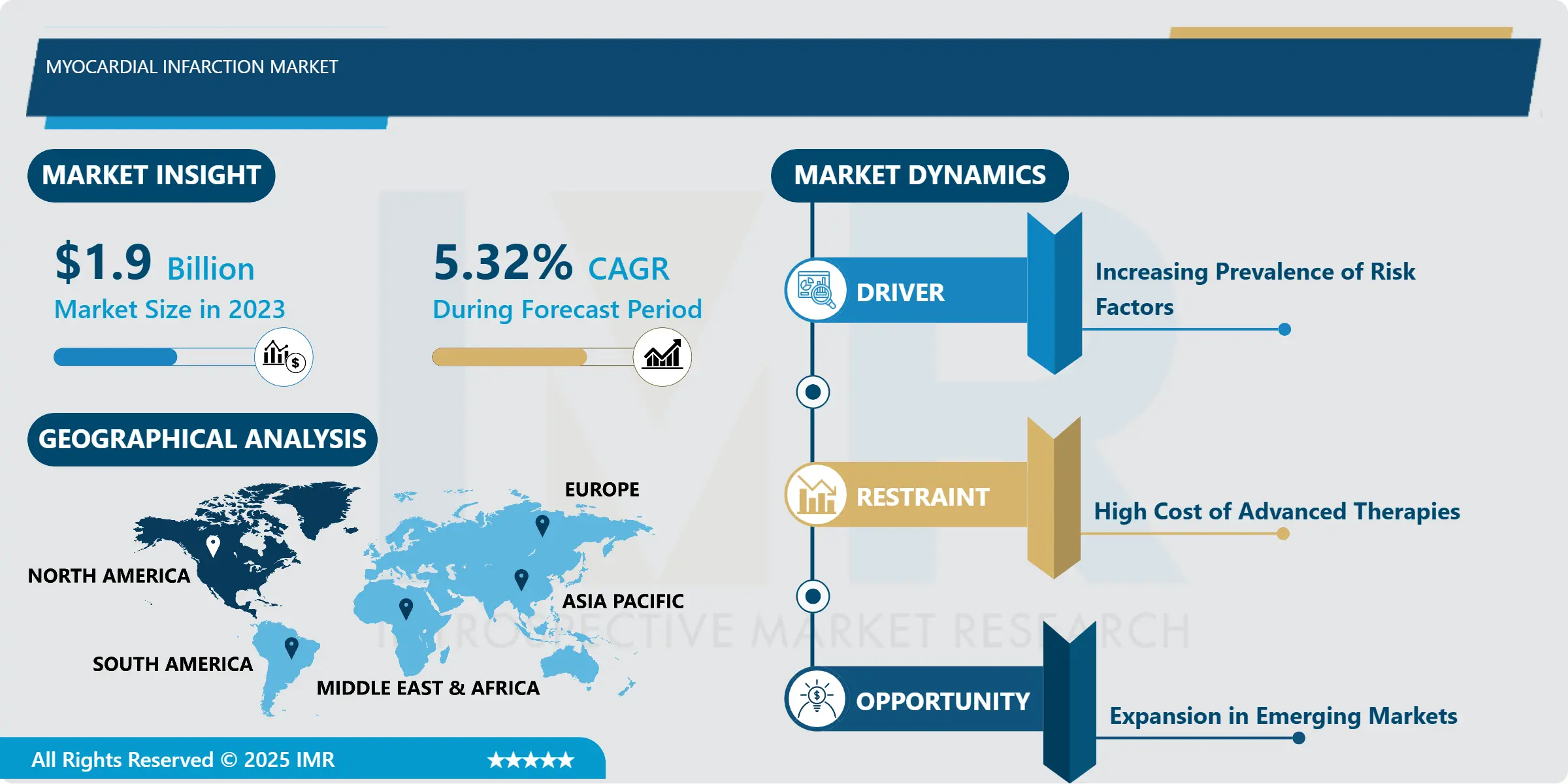
Myocardial Infarction Market Size Was Valued at USD 1.9 Billion in 2023, and is Projected to Reach USD 3.0 Billion by 2032, Growing at a CAGR of 5.32% From 2024-2032.
The Myocardial Infarction (MI) Market will also be known as the heart attack market and will include diagnosis, treatment and management of MI due to blockage of blood supply to heart. This market encompasses everything from medications to surgeries and hi-tech diagnostic equipment that doctors and nurses prescribe for patients who are inevitably improving survival rates and recovery periods after acute or chronic cardiac events.
This disease called myocardial infarction takes one of the leading positions in the list of main causes of death present in the world today due to many reasons including unhealthy lifestyle, aging population, and the rising epidemic of the diseases like diabetes and hypertension. The market is presenting a strong demand for new therapies and innovative and less invasive surgical procedures. New thick-kidneyed prescription products that are supplementing the treatment paradigm embody the next-generation antiplatelet agents and thrombolytics.
The recent past has witnessed a major impact of technology factors on the myocardial infarction market. AI has enhanced diagnostic instruments at work and wearable monitoring devices that have helped in early identification and monitoring of patients with risks to their lives. Also, governments and healthcare institutions of the world are also increasingly trying to publicize the issues related to the heart, which offer both possibilities of prevention and cure.
The individualized approach or precision medicine, which is treatment according to the person’s genetic characteristics and clinical history to help develop a treatment plan, is helping the market. However, obstacles like high cost of these innovations for the expensive treatment and poor health facility in the developing world are still relevant and that highlight the more general and accessible systems to implement.
Myocardial Infarction Market Trend Analysis:
Emergence of Digital Health in Cardiac Care
-
The incorporation of digital health solutions is revolutionizing myocardial infarction global market. Wearable devices integrated with mobile health applications and AI analytics algorithms are possible helping to recognize the onset of cardiac events in real-time. These technologies give important information like the disturbances in the normal rhythm of heart beats and fluctuations in the blood pressure require immediate medical attention.
- In the same way, telemedicine platforms have been availing post myocardial infarction management especially for the rural population. Patients can speak with cardiologists, track progress, and get information on diet and exercise from a distance to lower the chances of readmission to the hospital. This trend is expected to increase when there is regular utilization of 5G connections, as well as better developments in the field of remote surveillance.
Expansion in Emerging Markets
-
The myocardial infarction market benefits from favourable projections of growth in the emerging markets as healthcare awareness increases and infrastructure is developed. The incidence of cardiovascular diseases in countries within the Asia-Pacific, Latin America and the Middle East continued to rise due to increased urbanization, change in dietary habits and increased use of tobacco products.
- Autonomous authorities in these territories are inclined to invest in healthcare provision and development and encourage public/private partnership in coping with overloading cardiovascular diseases. Furthermore, the local production of cheap medication and devices also boosts affordability which equals treatment within this populace’s reach. In aggregate, these factors place EMs at the center of growth dynamics for the global myocardial infarction industry.
Myocardial Infarction Market Segment Analysis:
Myocardial Infarction Market is Segmented on the basis of Treatment Type, Diagnosis, End User, and Region.
By Treatment Type, Medications segment is expected to dominate the market during the forecast period
-
Drugs continue to be an essential feature of care of AMI, which includes antiplatelet agents, beta-adrenergic blocking agents, ACE inhibitors, and statins. These treatments are meant to put the patient in a state of no further progression of course, blood clot formation as well as lowering cholesterol. There are new products at the market and new developments in delivery systems and compounding therapies.
- For the patients with total blockages, angioplasty, along with PCI and CABG are vital procedures. Research has provided new ways of approaching surgeries that cause minimal invasive to patients and has also improved recovery time and chances of complications. The growth of this segment is contributed by factors such as rising population of skilled health care professionals and advancement in surgery instruments.
By End User, Hospitals segment expected to held the largest share
- Hospitals remain the largest site of myocardial infarction since they are the most common centres of emergency and surgical procedures. Most of the cases of acute myocardial infarction are treated under the hospital environment which has sound diagnostic and therapeutic facilities.
- Complex services have been experiencing enhanced popularity through the adoption of Ambulatory surgical centers (ASCs) or specialty clinics that are affordable with a shorter queue. These centres offer specialisation in elective care procedures and subsequent operations that aim at targeting patients with concerns to cost and time. They have continued to penetrate into well-established markets in urban and semi urban areas they are expected to increase the rates of access.
Myocardial Infarction Market Regional Insights:
North America is Expected to Dominate the Market Over the Forecast period
-
North America has captured the largest share in the myocardial infarction market due to well-developed systems of healthcare, high costs on healthcare, and usage of modern treatments. This area is characterized by a relatively large number of well-trained human resources and the presence of highly developed diagnostic and therapeutic technologies.
- Increased support and active roles played by governments and other NGOs in campaigns that aimed at increasing awareness of heart ailments has boosted early detection of the ailments as well as prevention strategies have constantly played their part. Further, the increment is backed by new research and development activities and some market strategic partnerships between professional players in the market.
Active Key Players in the Myocardial Infarction Market:
- AstraZeneca (UK)
- Bayer AG (Germany)
- Boehringer Ingelheim (Germany)
- Bristol-Myers Squibb (USA)
- Daiichi Sankyo (Japan)
- Eli Lilly and Company (USA)
- Johnson & Johnson (USA)
- Medtronic (Ireland)
- Novartis AG (Switzerland)
- Pfizer Inc. (USA)
- Sanofi (France)
- Terumo Corporation (Japan), and Other Active Players
Key Industry Developments in the Myocardial Infarction Market:
- In April 2024, Johnson & Johnson will showcase clinical and real-world evidence from its cardiovascular portfolio at the American College of Cardiology's 73rd Annual Scientific Session & Expo. The presentation will include eleven abstracts, including five oral presentations, featuring the therapeutic benefits of breakthrough medicines such as XARELTO (rivaroxaban) and interventional technologies such as those from Abiomed and Biosense Webster to treat cardiovascular diseases.
- In March 2024, the FDA approved the weight loss drug Wegovy by Novo Nordisk to reduce the risk of serious cardiovascular complications in people with obesity and heart disease.
- In August 2023, Royal Philips, a global leader in health technology, showcased how it integrates AI in cardiac ultrasound and cardiac care to enhance clinical confidence and efficiency.
|
Global Myocardial Infarction Market |
|||
|
Base Year: |
2023 |
Forecast Period: |
2024-2032 |
|
Historical Data: |
2017 to 2023 |
Market Size in 2023: |
USD 1.9 Billion |
|
Forecast Period 2024-32 CAGR: |
5.32% |
Market Size in 2032: |
USD 3.0 Billion |
|
Segments Covered: |
By Treatment Type |
|
|
|
By Diagnosis Type |
|
||
|
By End User |
|
||
|
By Region |
|
||
|
Key Market Drivers: |
|
||
|
Key Market Restraints: |
|
||
|
Key Opportunities: |
|
||
|
Companies Covered in the report: |
|
||
Chapter 1: Introduction
1.1 Scope and Coverage
Chapter 2:Executive Summary
Chapter 3: Market Landscape
3.1 Market Dynamics
3.1.1 Drivers
3.1.2 Restraints
3.1.3 Opportunities
3.1.4 Challenges
3.2 Market Trend Analysis
3.3 PESTLE Analysis
3.4 Porter's Five Forces Analysis
3.5 Industry Value Chain Analysis
3.6 Ecosystem
3.7 Regulatory Landscape
3.8 Price Trend Analysis
3.9 Patent Analysis
3.10 Technology Evolution
3.11 Investment Pockets
3.12 Import-Export Analysis
Chapter 4: Myocardial Infarction Market by Treatment Type
4.1 Myocardial Infarction Market Snapshot and Growth Engine
4.2 Myocardial Infarction Market Overview
4.3 Medications
4.3.1 Introduction and Market Overview
4.3.2 Historic and Forecasted Market Size in Value USD and Volume Units (2017-2032F)
4.3.3 Key Market Trends, Growth Factors and Opportunities
4.3.4 Medications: Geographic Segmentation Analysis
4.4 Surgical Procedures
4.4.1 Introduction and Market Overview
4.4.2 Historic and Forecasted Market Size in Value USD and Volume Units (2017-2032F)
4.4.3 Key Market Trends, Growth Factors and Opportunities
4.4.4 Surgical Procedures: Geographic Segmentation Analysis
4.5 Other
4.5.1 Introduction and Market Overview
4.5.2 Historic and Forecasted Market Size in Value USD and Volume Units (2017-2032F)
4.5.3 Key Market Trends, Growth Factors and Opportunities
4.5.4 Other: Geographic Segmentation Analysis
Chapter 5: Myocardial Infarction Market by End User
5.1 Myocardial Infarction Market Snapshot and Growth Engine
5.2 Myocardial Infarction Market Overview
5.3 Hospitals
5.3.1 Introduction and Market Overview
5.3.2 Historic and Forecasted Market Size in Value USD and Volume Units (2017-2032F)
5.3.3 Key Market Trends, Growth Factors and Opportunities
5.3.4 Hospitals: Geographic Segmentation Analysis
5.4 Ambulatory Surgical Centers
5.4.1 Introduction and Market Overview
5.4.2 Historic and Forecasted Market Size in Value USD and Volume Units (2017-2032F)
5.4.3 Key Market Trends, Growth Factors and Opportunities
5.4.4 Ambulatory Surgical Centers: Geographic Segmentation Analysis
5.5 Specialty Clinics
5.5.1 Introduction and Market Overview
5.5.2 Historic and Forecasted Market Size in Value USD and Volume Units (2017-2032F)
5.5.3 Key Market Trends, Growth Factors and Opportunities
5.5.4 Specialty Clinics: Geographic Segmentation Analysis
5.6 Others
5.6.1 Introduction and Market Overview
5.6.2 Historic and Forecasted Market Size in Value USD and Volume Units (2017-2032F)
5.6.3 Key Market Trends, Growth Factors and Opportunities
5.6.4 Others: Geographic Segmentation Analysis
Chapter 6: Company Profiles and Competitive Analysis
6.1 Competitive Landscape
6.1.1 Competitive Benchmarking
6.1.2 Myocardial Infarction Market Share by Manufacturer (2023)
6.1.3 Industry BCG Matrix
6.1.4 Heat Map Analysis
6.1.5 Mergers and Acquisitions
6.2 ASTRAZENECA (UK)
6.2.1 Company Overview
6.2.2 Key Executives
6.2.3 Company Snapshot
6.2.4 Role of the Company in the Market
6.2.5 Sustainability and Social Responsibility
6.2.6 Operating Business Segments
6.2.7 Product Portfolio
6.2.8 Business Performance
6.2.9 Key Strategic Moves and Recent Developments
6.2.10 SWOT Analysis
6.3 BAYER AG (GERMANY)
6.4 BOEHRINGER INGELHEIM (GERMANY)
6.5 BRISTOL-MYERS SQUIBB (USA)
6.6 DAIICHI SANKYO (JAPAN)
6.7 ELI LILLY AND COMPANY (USA)
6.8 JOHNSON & JOHNSON (USA)
6.9 MEDTRONIC (IRELAND)
6.10 NOVARTIS AG (SWITZERLAND)
6.11 PFIZER INC. (USA)
6.12 SANOFI (FRANCE)
6.13 TERUMO CORPORATION (JAPAN)
6.14 OTHER ACTIVE PLAYERS
Chapter 7: Global Myocardial Infarction Market By Region
7.1 Overview
7.2. North America Myocardial Infarction Market
7.2.1 Key Market Trends, Growth Factors and Opportunities
7.2.2 Top Key Companies
7.2.3 Historic and Forecasted Market Size by Segments
7.2.4 Historic and Forecasted Market Size By Treatment Type
7.2.4.1 Medications
7.2.4.2 Surgical Procedures
7.2.4.3 Other
7.2.5 Historic and Forecasted Market Size By End User
7.2.5.1 Hospitals
7.2.5.2 Ambulatory Surgical Centers
7.2.5.3 Specialty Clinics
7.2.5.4 Others
7.2.6 Historic and Forecast Market Size by Country
7.2.6.1 US
7.2.6.2 Canada
7.2.6.3 Mexico
7.3. Eastern Europe Myocardial Infarction Market
7.3.1 Key Market Trends, Growth Factors and Opportunities
7.3.2 Top Key Companies
7.3.3 Historic and Forecasted Market Size by Segments
7.3.4 Historic and Forecasted Market Size By Treatment Type
7.3.4.1 Medications
7.3.4.2 Surgical Procedures
7.3.4.3 Other
7.3.5 Historic and Forecasted Market Size By End User
7.3.5.1 Hospitals
7.3.5.2 Ambulatory Surgical Centers
7.3.5.3 Specialty Clinics
7.3.5.4 Others
7.3.6 Historic and Forecast Market Size by Country
7.3.6.1 Russia
7.3.6.2 Bulgaria
7.3.6.3 The Czech Republic
7.3.6.4 Hungary
7.3.6.5 Poland
7.3.6.6 Romania
7.3.6.7 Rest of Eastern Europe
7.4. Western Europe Myocardial Infarction Market
7.4.1 Key Market Trends, Growth Factors and Opportunities
7.4.2 Top Key Companies
7.4.3 Historic and Forecasted Market Size by Segments
7.4.4 Historic and Forecasted Market Size By Treatment Type
7.4.4.1 Medications
7.4.4.2 Surgical Procedures
7.4.4.3 Other
7.4.5 Historic and Forecasted Market Size By End User
7.4.5.1 Hospitals
7.4.5.2 Ambulatory Surgical Centers
7.4.5.3 Specialty Clinics
7.4.5.4 Others
7.4.6 Historic and Forecast Market Size by Country
7.4.6.1 Germany
7.4.6.2 UK
7.4.6.3 France
7.4.6.4 The Netherlands
7.4.6.5 Italy
7.4.6.6 Spain
7.4.6.7 Rest of Western Europe
7.5. Asia Pacific Myocardial Infarction Market
7.5.1 Key Market Trends, Growth Factors and Opportunities
7.5.2 Top Key Companies
7.5.3 Historic and Forecasted Market Size by Segments
7.5.4 Historic and Forecasted Market Size By Treatment Type
7.5.4.1 Medications
7.5.4.2 Surgical Procedures
7.5.4.3 Other
7.5.5 Historic and Forecasted Market Size By End User
7.5.5.1 Hospitals
7.5.5.2 Ambulatory Surgical Centers
7.5.5.3 Specialty Clinics
7.5.5.4 Others
7.5.6 Historic and Forecast Market Size by Country
7.5.6.1 China
7.5.6.2 India
7.5.6.3 Japan
7.5.6.4 South Korea
7.5.6.5 Malaysia
7.5.6.6 Thailand
7.5.6.7 Vietnam
7.5.6.8 The Philippines
7.5.6.9 Australia
7.5.6.10 New Zealand
7.5.6.11 Rest of APAC
7.6. Middle East & Africa Myocardial Infarction Market
7.6.1 Key Market Trends, Growth Factors and Opportunities
7.6.2 Top Key Companies
7.6.3 Historic and Forecasted Market Size by Segments
7.6.4 Historic and Forecasted Market Size By Treatment Type
7.6.4.1 Medications
7.6.4.2 Surgical Procedures
7.6.4.3 Other
7.6.5 Historic and Forecasted Market Size By End User
7.6.5.1 Hospitals
7.6.5.2 Ambulatory Surgical Centers
7.6.5.3 Specialty Clinics
7.6.5.4 Others
7.6.6 Historic and Forecast Market Size by Country
7.6.6.1 Turkiye
7.6.6.2 Bahrain
7.6.6.3 Kuwait
7.6.6.4 Saudi Arabia
7.6.6.5 Qatar
7.6.6.6 UAE
7.6.6.7 Israel
7.6.6.8 South Africa
7.7. South America Myocardial Infarction Market
7.7.1 Key Market Trends, Growth Factors and Opportunities
7.7.2 Top Key Companies
7.7.3 Historic and Forecasted Market Size by Segments
7.7.4 Historic and Forecasted Market Size By Treatment Type
7.7.4.1 Medications
7.7.4.2 Surgical Procedures
7.7.4.3 Other
7.7.5 Historic and Forecasted Market Size By End User
7.7.5.1 Hospitals
7.7.5.2 Ambulatory Surgical Centers
7.7.5.3 Specialty Clinics
7.7.5.4 Others
7.7.6 Historic and Forecast Market Size by Country
7.7.6.1 Brazil
7.7.6.2 Argentina
7.7.6.3 Rest of SA
Chapter 8 Analyst Viewpoint and Conclusion
8.1 Recommendations and Concluding Analysis
8.2 Potential Market Strategies
Chapter 9 Research Methodology
9.1 Research Process
9.2 Primary Research
9.3 Secondary Research
|
Global Myocardial Infarction Market |
|||
|
Base Year: |
2023 |
Forecast Period: |
2024-2032 |
|
Historical Data: |
2017 to 2023 |
Market Size in 2023: |
USD 1.9 Billion |
|
Forecast Period 2024-32 CAGR: |
5.32% |
Market Size in 2032: |
USD 3.0 Billion |
|
Segments Covered: |
By Treatment Type |
|
|
|
By Diagnosis Type |
|
||
|
By End User |
|
||
|
By Region |
|
||
|
Key Market Drivers: |
|
||
|
Key Market Restraints: |
|
||
|
Key Opportunities: |
|
||
|
Companies Covered in the report: |
|
||


