




Key Market Highlights
Microcarriers Market Size Was Valued at USD 2.31 Billion in 2024, and is Projected to Reach USD 5.25 Billion by 2035, Growing at a CAGR of 8.56% from 2025-2035.
- Market Size in 2024: USD 2.31 Billion
- Projected Market Size by 2035: USD 5.25 Billion
- CAGR (2025–2035): 8.56%
- Leading Market in 2024: North America
- Fastest-Growing Market: Asia-Pacific
- By Product Type: The Consumables segment is anticipated to lead the market by accounting for 56.21% of the market share throughout the forecast period.
- By Application: The Biopharmaceutical segment is expected to capture 29.53% of the market share, thereby maintaining its dominance over the forecast period.
- By Region: North America region is projected to hold 31.26% of the market share during the forecast period.
- Active Players: Bio?Rad Laboratories, (United States), Corning Incorporated, (United States), Danaher Corporation, (USA), Denovomatrix Gmbh, (Germany), Eppendorf SE, (Germany), HiMedia Laboratories Pvt. Ltd, (India), Merck?KGaA, (Germany), Sartorius AG, (Germany), and Other Active Players.
Microcarriers Market Synopsis:
The microcarriers market involves small beads used to grow adherent cells in bioreactors, enabling large-scale cell culture for biopharmaceuticals, vaccines, and cell therapies. Driven by rising demand for biologics and regenerative medicine, the market is expanding rapidly, supported by advances in cell culture technologies and growing investments in biomanufacturing worldwide
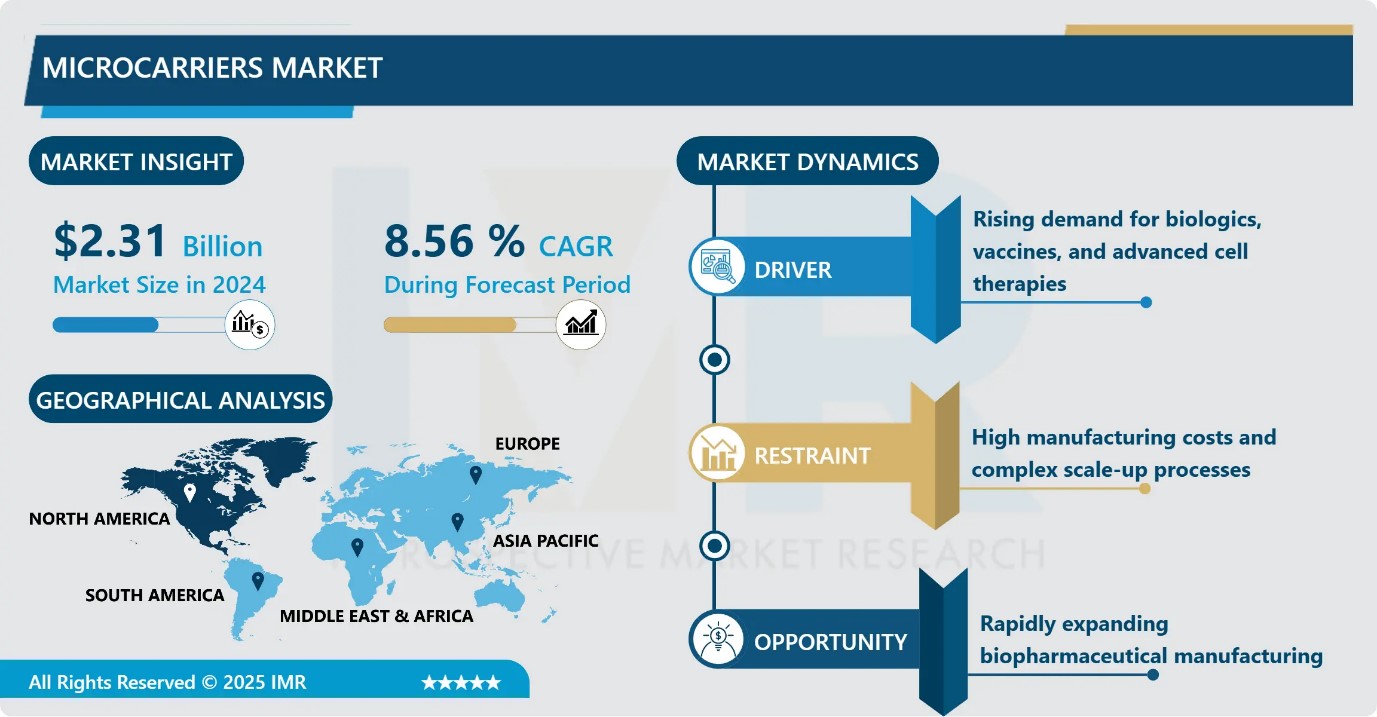
Microcarriers Market Dynamics and Trend Analysis:
Microcarriers Market Growth Driver- Rising demand for biologics, vaccines, and advanced cell therapies
- The microcarriers market is growing rapidly due to rising demand for biologics, vaccines, and advanced cell therapies. Increasing adoption of cell culture techniques for large-scale production of monoclonal antibodies and viral vectors is a major driver. Advances in regenerative medicine and gene therapy also boost the need for efficient cell expansion platforms like microcarriers.
- Additionally, growing investments in biopharmaceutical R&D and manufacturing infrastructure worldwide support market expansion. The ability of microcarriers to enable scalable, cost-effective, and high-density cell cultivation makes them essential in modern bioprocessing. Regulatory encouragement for innovative therapies and increasing focus on personalized medicine further contribute to sustained growth in this market.
Microcarriers Market Limiting Factor- Limited Standardization and Compatibility Issues
- Another important limiting factor in the microcarriers market is the lack of standardization and compatibility across different cell culture systems and bioreactors. Microcarriers often vary in material composition, size, and surface properties, which can affect their performance with specific cell types or equipment. This variability creates challenges for manufacturers and end-users trying to integrate microcarriers seamlessly into existing workflows. Incompatible combinations may lead to inconsistent cell growth, reduced yields, or difficulties in process scale-up.
- Additionally, the absence of universal standards increases the complexity of validation and regulatory approval. These factors can slow down adoption, increase costs, and deter new users from investing in microcarrier-based solutions, limiting broader market penetration despite the technology’s potential benefits.
Microcarriers Market Expansion Opportunity- Rapidly expanding biopharmaceutical manufacturing
- Emerging markets, particularly in the Asia-Pacific region, offer significant growth opportunities for the microcarriers market. Rapidly expanding biopharmaceutical manufacturing, increased healthcare investments, and government initiatives supporting biotechnology innovation are driving demand in countries like China, India, and South Korea. These regions are witnessing rising adoption of advanced cell culture technologies for vaccine production and cell therapies.
- Additionally, growing collaborations between local companies and global players are accelerating technology transfer and market penetration. As infrastructure improves and regulatory frameworks mature, these emerging markets present a promising avenue for microcarrier manufacturers to expand their footprint and tap into new customer bases.
Microcarriers Market Challenge and Risk- High manufacturing costs and complex scale-up processes
- The microcarriers market faces several challenges that could hinder growth. High manufacturing costs and complex scale-up processes create barriers for widespread adoption, especially among smaller companies. Maintaining consistent cell quality and performance during large-scale cultivation is difficult and requires stringent process control.
- Additionally, regulatory hurdles and lengthy approval timelines for new products and technologies add uncertainty and increase development costs. Market players also face risks from competition with alternative cell culture methods, such as single-use bioreactors without microcarriers. Finally, supply chain disruptions and raw material availability can impact production schedules, posing further risks to timely delivery and market stability.
Microcarriers Market Trend- Growing shift toward single-use, disposable microcarriers,
- The microcarriers market is evolving with key trends driving innovation and adoption. There is a growing shift toward single-use, disposable microcarriers, which reduce contamination risks and simplify bioprocessing. Advances in porous and functionalized microcarriers improve cell attachment and nutrient exchange, boosting culture efficiency. Integration of microcarriers with automated and scalable bioreactor systems is enhancing process consistency and throughput.
- Additionally, rising focus on stem cell expansion for regenerative medicine is expanding application areas. Collaborations between biotech firms and research institutes are accelerating the development of customized microcarrier solutions tailored to specific cell types and therapies. These trends collectively support more efficient, flexible, and cost-effective cell culture, fueling market growth
Microcarriers Market Segment Analysis:
Microcarriers Market is segmented based on Type, Application, End-Users, and Region
By Product Type, Consumables segment is expected to dominate the market with around 56.21% share during the forecast period.
- In the microcarriers market, the consumables segment, which includes microcarrier beads, is experiencing the fastest growth. This is because consumables are essential for repeated use in large-scale cell culture processes, especially in biopharmaceutical manufacturing and cell therapy development. Among consumables, porous and macroporous microcarriers are gaining popularity as they provide better surface area and support for cell attachment, growth, and nutrient exchange, improving overall culture efficiency. The rising demand for vaccines, monoclonal antibodies, and regenerative medicine therapies is driving this growth. Additionally, advances in bioprocessing techniques and increasing focus on scalable and cost-effective production methods make consumables the most dynamic product segment in the market.
By Application, Biopharmaceutical is expected to dominate with close to 29.53% market share during the forecast period.
- In the microcarriers market, the biopharmaceutical production segment is the fastest-growing application area. This is driven by the increasing demand for vaccines, monoclonal antibodies, and recombinant proteins, which require large-scale, efficient cell culture systems. Microcarriers enable high-density cell growth in bioreactors, making them essential for scalable bioprocessing.
- Additionally, the rising focus on cell and gene therapies fuels growth, as microcarriers support the expansion of stem cells and other adherent cells used in these advanced treatments. The growing adoption of regenerative medicine and tissue engineering further boosts application diversity. Overall, the need for efficient, scalable, and cost-effective cell culture solutions in these sectors is propelling the microcarriers market forward.
Microcarriers Market Regional Insights:
North America region is estimated to lead the market with around 31.26% share during the forecast period.
- North America is the clear leader in the microcarriers market, accounting for the largest share globally. This dominance is mainly due to the region’s well-established biopharmaceutical industry and advanced research infrastructure. The United States, in particular, drives demand with its strong focus on vaccine production, monoclonal antibodies, and the growing field of cell and gene therapies. Regulatory support from agencies like the FDA encourages innovation and faster adoption of scalable cell culture technologies.
- Additionally, major market players headquartered here invest heavily in R&D and maintain robust supply chains, ensuring consistent product availability. The presence of numerous biotech startups and contract manufacturing organizations also fuels growth, making North America a hotbed for new developments and technological advancements in microcarrier applications.
Microcarriers Market Active Players:
- Bio?Rad Laboratories, (United States)
- Corning Incorporated, (United States)
- Danaher Corporation, (USA)
- Denovomatrix Gmbh, (Germany)
- Eppendorf SE, (Germany)
- HiMedia Laboratories Pvt. Ltd, (India)
- Merck?KGaA, (Germany)
- Sartorius AG, (Germany)
- Other Active Players
Key Industry Developments in the Microcarriers Market:
- In May 2025, Nexture Bio announced a suite of advanced animal?component?free microcarriers and support services for scaling adherent cell culture processes.
- In May 2022, DenovoMATRIX GmbH launched a novel microcarrier product to support mesenchymal stromal cell proliferation and harvest in serum?free media, advancing stem cell therapy manufacturing.
Advancing Scalable Cell Culture
- The microcarriers market plays a critical role in advancing large-scale cell culture technologies essential for biopharmaceutical manufacturing, regenerative medicine, and cell therapy development. Technically, microcarriers are small beads designed to provide an optimal surface for adherent cells to attach, grow, and proliferate in suspension bioreactors. These beads are made from various materials including natural polymers like collagen and synthetic polymers such as polystyrene each offering unique properties tailored to specific cell types and applications.
- Porous and macroporous microcarriers have gained attention for their ability to enhance nutrient and oxygen diffusion, which supports higher cell densities and improved viability. The design of microcarriers focuses on maximizing surface area while maintaining mechanical stability under agitation. Innovations also include surface functionalization techniques that improve cell adhesion and enable controlled detachment, critical for efficient downstream processing.
- Integration with single-use bioreactors and automated systems is transforming the microcarrier landscape, allowing for scalable, reproducible, and cost-effective production processes. However, technical challenges such as scale-up optimization, consistent bead quality, and compatibility with diverse cell lines remain focal points for ongoing research and development. Overall, microcarriers are a cornerstone technology driving the shift towards more efficient and scalable bioprocessing platforms in today’s rapidly evolving life sciences industry.
|
Microcarriers Market |
|||
|
Base Year: |
2024 |
Forecast Period: |
2025-2035 |
|
Historical Data: |
2018 to 2023 |
Market Size in 2024: |
USD 2.31 Bn. |
|
Forecast Period 2025-35 CAGR: |
8.56 % |
Market Size in 2035: |
USD 5.25 Bn. |
|
Segments Covered: |
By Type |
|
|
|
By Application
|
|
||
|
By Region |
|
||
|
Growth Driver: |
|
||
|
Limiting Factor |
|
||
|
Expansion Opportunity |
|
||
|
Challenge and Risk |
|
||
|
Companies Covered in the Report: |
|
||
Chapter 1: Introduction
1.1 Scope and Coverage
Chapter 2:Executive Summary
Chapter 3: Market Landscape
3.1 Market Dynamics and Opportunity Analysis
3.1.1 Growth Drivers
3.1.2 Limiting Factors
3.1.3 Growth Opportunities
3.1.4 Challenges and Risks
3.2 Market Trend Analysis
3.3 Industry Ecosystem
3.4 Industry Value Chain Mapping
3.5 Strategic PESTLE Overview
3.6 Porter's Five Forces Framework
3.7 Regulatory Framework
3.8 Pricing Trend Analysis
3.9 Intellectual Property Review
3.10 Technology Evolution
3.11 Import-Export Analysis
3.12 Consumer Behavior Analysis
3.13 Investment Pocket Analysis
3.14 Go-To Market Strategy
Chapter 4: Microcarriers Market by Product Type (2018-2035)
4.1 Microcarriers Market Snapshot and Growth Engine
4.2 Market Overview
4.3 Consumables and Equipment
4.3.1 Introduction and Market Overview
4.3.2 Historic and Forecasted Market Size in Value USD and Volume Units
4.3.3 Key Market Trends, Growth Factors, and Opportunities
4.3.4 Geographic Segmentation Analysis
Chapter 5: Microcarriers Market by Application (2018-2035)
5.1 Microcarriers Market Snapshot and Growth Engine
5.2 Market Overview
5.3 Biopharmaceutical Production
5.3.1 Introduction and Market Overview
5.3.2 Historic and Forecasted Market Size in Value USD and Volume Units
5.3.3 Key Market Trends, Growth Factors, and Opportunities
5.3.4 Geographic Segmentation Analysis
5.4 Cell & Gene Therapy
5.5 Tissue Engineering & Regenerative Medicine
5.6 Research & Development
Chapter 6: Company Profiles and Competitive Analysis
6.1 Competitive Landscape
6.1.1 Competitive Benchmarking
6.1.2 Microcarriers Market Share by Manufacturer/Service Provider(2024)
6.1.3 Industry BCG Matrix
6.1.4 PArtnerships, Mergers & Acquisitions
6.2 BIO?RAD LABORATORIES (UNITED STATES)
6.2.1 Company Overview
6.2.2 Key Executives
6.2.3 Company Snapshot
6.2.4 Role of the Company in the Market
6.2.5 Sustainability and Social Responsibility
6.2.6 Operating Business Segments
6.2.7 Product Portfolio
6.2.8 Business Performance
6.2.9 Recent News & Developments
6.2.10 SWOT Analysis
6.3 CORNING INCORPORATED (UNITED STATES)
6.4 DANAHER CORPORATION (USA)
6.5 DENOVOMATRIX GMBH (GERMANY)
6.6 EPPENDORF SE (GERMANY)
6.7 HIMEDIA LABORATORIES PVT LTD (INDIA)
6.8 MERCK?KGAA (GERMANY)
6.9 SARTORIUS AG (GERMANY)
6.10 AND OTHER ACTIVE PLAYERS.
Chapter 7: Global Microcarriers Market By Region
7.1 Overview
7.2. North America Microcarriers Market
7.2.1 Key Market Trends, Growth Factors and Opportunities
7.2.2 Top Key Companies
7.2.3 Historic and Forecasted Market Size by Segments
7.2.4 Historic and Forecast Market Size by Country
7.2.4.1 US
7.2.4.2 Canada
7.2.4.3 Mexico
7.3. Eastern Europe Microcarriers Market
7.3.1 Key Market Trends, Growth Factors and Opportunities
7.3.2 Top Key Companies
7.3.3 Historic and Forecasted Market Size by Segments
7.3.4 Historic and Forecast Market Size by Country
7.3.4.1 Russia
7.3.4.2 Bulgaria
7.3.4.3 The Czech Republic
7.3.4.4 Hungary
7.3.4.5 Poland
7.3.4.6 Romania
7.3.4.7 Rest of Eastern Europe
7.4. Western Europe Microcarriers Market
7.4.1 Key Market Trends, Growth Factors and Opportunities
7.4.2 Top Key Companies
7.4.3 Historic and Forecasted Market Size by Segments
7.4.4 Historic and Forecast Market Size by Country
7.4.4.1 Germany
7.4.4.2 UK
7.4.4.3 France
7.4.4.4 The Netherlands
7.4.4.5 Italy
7.4.4.6 Spain
7.4.4.7 Rest of Western Europe
7.5. Asia Pacific Microcarriers Market
7.5.1 Key Market Trends, Growth Factors and Opportunities
7.5.2 Top Key Companies
7.5.3 Historic and Forecasted Market Size by Segments
7.5.4 Historic and Forecast Market Size by Country
7.5.4.1 China
7.5.4.2 India
7.5.4.3 Japan
7.5.4.4 South Korea
7.5.4.5 Malaysia
7.5.4.6 Thailand
7.5.4.7 Vietnam
7.5.4.8 The Philippines
7.5.4.9 Australia
7.5.4.10 New Zealand
7.5.4.11 Rest of APAC
7.6. Middle East & Africa Microcarriers Market
7.6.1 Key Market Trends, Growth Factors and Opportunities
7.6.2 Top Key Companies
7.6.3 Historic and Forecasted Market Size by Segments
7.6.4 Historic and Forecast Market Size by Country
7.6.4.1 Turkiye
7.6.4.2 Bahrain
7.6.4.3 Kuwait
7.6.4.4 Saudi Arabia
7.6.4.5 Qatar
7.6.4.6 UAE
7.6.4.7 Israel
7.6.4.8 South Africa
7.7. South America Microcarriers Market
7.7.1 Key Market Trends, Growth Factors and Opportunities
7.7.2 Top Key Companies
7.7.3 Historic and Forecasted Market Size by Segments
7.7.4 Historic and Forecast Market Size by Country
7.7.4.1 Brazil
7.7.4.2 Argentina
7.7.4.3 Rest of SA
Chapter 8 Analyst Viewpoint and Conclusion
Chapter 9 Our Thematic Research Methodology
9.1 Research Process
9.2 Primary Research
9.3 Secondary Research
Chapter 10 Case Study
Chapter 11 Appendix
11.1 Sources
11.2 List of Tables and figures
11.3 Short Forms and Citations
11.4 Assumption and Conversion
11.5 Disclaimer
|
Microcarriers Market |
|||
|
Base Year: |
2024 |
Forecast Period: |
2025-2035 |
|
Historical Data: |
2018 to 2023 |
Market Size in 2024: |
USD 2.31 Bn. |
|
Forecast Period 2025-35 CAGR: |
8.56 % |
Market Size in 2035: |
USD 5.25 Bn. |
|
Segments Covered: |
By Type |
|
|
|
By Application
|
|
||
|
By Region |
|
||
|
Growth Driver: |
|
||
|
Limiting Factor |
|
||
|
Expansion Opportunity |
|
||
|
Challenge and Risk |
|
||
|
Companies Covered in the Report: |
|
||


