




Key Market Highlights
Microbial Identification Market Size Was Valued at USD 4.20 Billion in 2024, and is Projected to Reach USD 10.62 Billion by 2035, Growing at a CAGR of 8.8% from 2025-2035.
- Market Size in 2024: USD 4.20 Billion
- Projected Market Size by 2035: USD 10.62 Billion
- CAGR (2025–2035): 8.8%
- Leading Market in 2024: North America
- Fastest-Growing Market: Asia-Pacific
- By Technology: The MALDI-TOF segment is anticipated to lead the market by accounting for 26.7% of the market share throughout the forecast period.
- By End User: The Hospitals and Clinical Laboratories segment is expected to capture 32.4% of the market share, thereby maintaining its dominance over the forecast period.
- By Region: North America region is projected to hold 33.2% of the market share during the forecast period.
- Active Players: Avantor, Inc. (United States), BD (Becton, Dickinson and Company) (United States), Biolog Inc. (United States), Bruker Corporation (United States), Charles River Laboratories (United States), and Other Active Players.
Microbial Identification Market Synopsis:
The microbial identification market encompasses technologies and solutions used to detect, classify, and characterize microorganisms across healthcare, pharmaceuticals, food safety, and environmental monitoring. Market growth is driven by increasing regulatory scrutiny, rising infectious disease burden, and the critical need for rapid and accurate pathogen identification to support patient care and product safety. Advanced techniques such as mass spectrometry, genomic sequencing, and automated biochemical testing are increasingly replacing traditional methods due to their higher accuracy, speed, and reliability. Integration with digital platforms, automation, and artificial intelligence is further enhancing laboratory efficiency, data management, and regulatory compliance. The market scenario reflects strong and sustained demand for precise microbial diagnostics, surveillance, and contamination control, positioning microbial identification as a vital component of public health protection and industrial quality assurance worldwide.
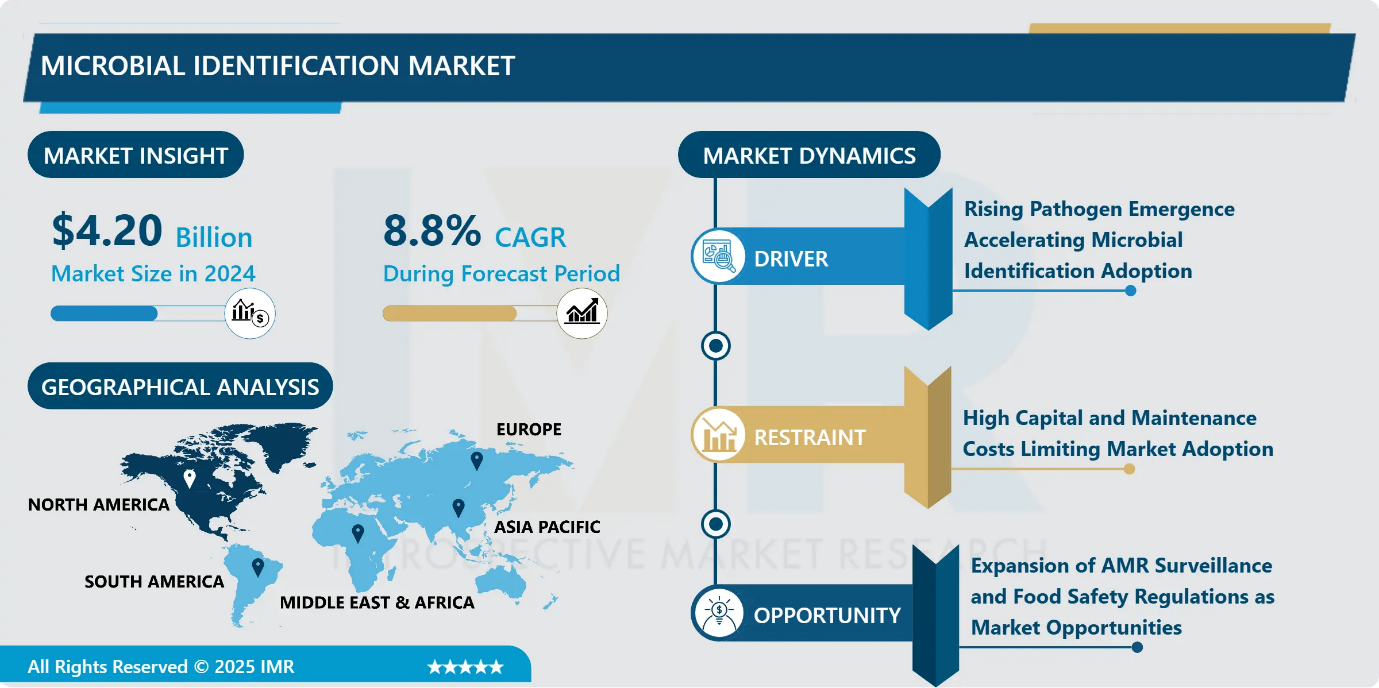
Microbial Identification Market Dynamics and Trend Analysis:
Microbial Identification Market Growth Driver - Rising Pathogen Emergence Accelerating Microbial Identification Adoption
- The rising incidence of infectious diseases is a key growth driver for the microbial identification market. The continuous emergence of new pathogens and evolving microbial strains has increased the need for fast, accurate, and reliable identification methods. In clinical settings, timely pathogen detection is essential for effective treatment decisions, improved patient outcomes, and reduced healthcare costs. The growing burden of hospital-acquired and community infections is accelerating the adoption of advanced microbial identification technologies.
- Additionally, the global increase in antimicrobial resistance has intensified the demand for precise species-level identification, enabling targeted therapies and supporting antimicrobial stewardship programs, thereby reinforcing sustained market expansion.
Microbial Identification Market Limiting Factor - High Capital and Maintenance Costs Limiting Market Adoption
- High instrument acquisition and ongoing maintenance costs represent a key restraint in the microbial identification market. Advanced systems such as MALDI-TOF require substantial upfront capital investment, while annual service and maintenance contracts significantly increase total ownership costs. These financial barriers limit adoption among mid-sized hospitals, diagnostic centers, and resource-constrained laboratories.
- Additionally, evolving laboratory performance and quality compliance standards are compelling laboratories to upgrade or replace existing equipment more frequently, further increasing financial pressure. Smaller facilities often struggle to justify these investments despite clinical benefits, slowing market penetration and creating disparities in access to advanced microbial identification technologies across healthcare and testing environments.
Microbial Identification Market Expansion Opportunity - Expansion of AMR Surveillance and Food Safety Regulations as Market Opportunities
- The growing emphasis on antimicrobial-resistance surveillance presents a major opportunity for the microbial identification market. Healthcare systems worldwide are strengthening surveillance programs to enable rapid organism profiling, support targeted therapy, and reduce hospital stays, driving demand for advanced genomic and molecular identification tools. Simultaneously, tightening food safety regulations in emerging economies are compelling food processors to adopt rapid, traceable microbial testing solutions. Regulatory mandates requiring validation of contamination controls are accelerating the uptake of highly sensitive detection assays and continuous monitoring technologies. Together, expanding AMR surveillance initiatives and stricter food safety compliance are creating sustained growth opportunities for microbial identification providers across healthcare and food industries.
Microbial Identification Market Challenge and Risk - Shortage of Skilled Mass Spectrometry Professionals
- A critical challenge facing the microbial identification market is the shortage of skilled professionals capable of operating and interpreting advanced mass spectrometry systems. Many healthcare and public health laboratories are experiencing high vacancy rates for trained laboratory scientists, limiting their ability to fully deploy sophisticated identification technologies.
- Expertise in mass spectra analysis requires specialized training, yet limited educational capacity and hands-on training opportunities restrict the entry of new professionals into the field. This talent gap creates operational bottlenecks, slows technology adoption, and reduces return on investment for advanced systems. Addressing workforce shortages through training programs and automation remains essential for sustained market growth.
Microbial Identification Market Trend - Integration of AI-Driven Diagnostic Technologies
- The microbial identification market is witnessing a strong trend toward the integration of artificial intelligence and advanced analytical tools. AI-powered spectral libraries and machine-learning algorithms are significantly improving the speed and accuracy of mass spectrometry and genomic analyses, enabling near real-time pathogen identification.
- Deep-learning–based genome analysis is reducing reliance on culture methods and enhancing detection of difficult-to-grow organisms. In parallel, continuous advancements in next-generation sequencing, PCR, and mass spectrometry are expanding detection capabilities across diverse pathogens. The adoption of AI-enabled decision-support systems is streamlining laboratory workflows, optimizing resource utilization, and improving diagnostic precision, thereby accelerating market expansion.
Microbial Identification Market Segment Analysis:
Microbial Identification Market is segmented based on Product & Service, Technology, Application, End User, and Region.
By Technology, MALDI-TOF mass spectrometry segment is expected to dominate the market with around 26.7% share during the forecast period.
- MALDI-TOF mass spectrometry continues to dominate the microbial identification market due to its rapid turnaround time, low cost per test, and broad organism coverage supported by expanding spectral libraries. Its widespread adoption in mature healthcare markets sustains a strong installed base, although growth is stabilizing as penetration increases.
- In contrast, PCR and real-time PCR technologies are gaining momentum through multiplex panels and point-of-care formats, supported by multiple regulatory clearances from the U.S. Food and Drug Administration. Hybrid diagnostic workflows are increasingly common, combining MALDI-TOF for primary screening with PCR or sequencing for resistance profiling. MALDI-TOF remains dominant due to efficiency, scalability, and routine diagnostic suitability.
By End User, Hospitals and clinical laboratories is expected to dominate with close to 32.4% market share during the forecast period.
- Hospitals and clinical laboratories remain the largest end users in the microbial identification market, supported by routine diagnostic demand, infection control requirements, and bundled procurement models favoring automated, high-throughput systems. Their dominance is reinforced by dedicated budgets for antimicrobial stewardship and patient safety. Pharmaceutical and biotechnology companies, however, are emerging as a fast-growing segment, adopting rapid microbial identification for contamination control, quality assurance, and companion diagnostic development. Growth in advanced therapies, including cell and gene treatments with stringent sterility requirements, is accelerating adoption. Hospitals dominate due to volume-driven testing needs and established infrastructure, while pharma accelerates innovation through R&D-driven demand.
Microbial Identification Market Regional Insights:
North America region is estimated to lead the market with around 33.2% share during the forecast period.
- North America represents the leading regional market for microbial identification, driven by strong innovation, advanced healthcare infrastructure, and stringent regulatory oversight. High healthcare spending, rising incidence of infectious diseases, and widespread adoption of advanced diagnostics support sustained growth. Regulatory frameworks enforced by the U.S. Food and Drug Administration mandate rigorous microbial testing across healthcare and food industries, accelerating technology uptake.
- The United States dominates due to the presence of major players such as Thermo Fisher Scientific Inc., Abbott Laboratories, and BD (Becton, Dickinson and Company). Canada further strengthens regional demand through expanding diagnostic investments. North America’s dominance stems from regulatory rigor, technological leadership, strong R&D ecosystems, and high awareness of food safety and public health protection.
Microbial Identification Market Active Players:
- Avantor, Inc. (United States)
- BD (Becton, Dickinson and Company) (United States)
- Biolog Inc. (United States)
- Bruker Corporation (United States)
- Charles River Laboratories (United States)
- Danaher Corporation (United States)
- Eurofins Scientific SE (Luxembourg)
- Merck KGaA (Germany)
- MIDI Inc. (United States)
- QIAGEN N.V. (Netherlands)
- Shimadzu Corporation (Japan)
- Siemens Healthineers (Germany)
- Thermo Fisher Scientific Inc. (United States)
- bioMérieux SA (France)
- Wickham Micro Limited (United Kingdom)
- Other Active Players
Key Industry Developments in the Microbial Identification Market:
- In June 2025, Bruker Corporation introduced the timsMetabo platform at ASMS 2025, expanding its advanced analytical capabilities.
The company also integrated RECIPE assay kits into its EVOQ mass spectrometry portfolio.
This launch strengthens Bruker’s position in high-performance metabolomics and microbial analysis. - In April 2025, bioMérieux SA unveiled WATCHFIRE, a molecular PCR-based solution designed for wastewater pathogen surveillance.
The platform supports early outbreak detection and public health monitoring.
WATCHFIRE enhances environmental surveillance capabilities for emerging and resistant pathogens.
Overview of Core Microbial Identification Technologies
- The microbial identification market is built on a range of analytical technologies designed to detect, classify, and characterize microorganisms with high accuracy and speed. Core techniques include phenotypic methods such as biochemical testing and culture-based analysis, genotypic approaches like polymerase chain reaction (PCR) and next-generation sequencing (NGS), and proteomic methods dominated by MALDI-TOF mass spectrometry. MALDI-TOF enables rapid species-level identification by comparing protein spectral fingerprints against extensive reference libraries, offering low per-test costs and high throughput.
- PCR and real-time PCR provide high sensitivity and specificity for targeted pathogen and resistance-gene detection, while NGS supports comprehensive genomic profiling for outbreak tracking and surveillance. Increasingly, these platforms are integrated with automated sample preparation, laboratory information systems, and AI-driven analytics to enhance workflow efficiency, reduce human error, and improve diagnostic accuracy. This convergence of automation, molecular precision, and data intelligence defines the technical evolution of the microbial identification market.
|
Microbial Identification Market |
|||
|
Base Year: |
2024 |
Forecast Period: |
2025-2035 |
|
Historical Data: |
2018 to 2024 |
Market Size in 2024: |
USD 4.20 Bn. |
|
Forecast Period 2025-32 CAGR: |
8.8 % |
Market Size in 2035: |
USD 10.62 Bn. |
|
Segments Covered: |
By Product & Service |
|
|
|
By Technology |
|
||
|
By Application
|
|
||
|
By End User |
|
||
|
By Region |
|
||
|
Growth Driver: |
|
||
|
Limiting Factor |
|
||
|
Expansion Opportunity |
|
||
|
Challenge and Risk |
|
||
|
Companies Covered in the Report: |
|
||
Chapter 1: Introduction
1.1 Scope and Coverage
Chapter 2:Executive Summary
Chapter 3: Market Landscape
3.1 Market Dynamics and Opportunity Analysis
3.1.1 Growth Drivers
3.1.2 Limiting Factors
3.1.3 Growth Opportunities
3.1.4 Challenges and Risks
3.2 Market Trend Analysis
3.3 Industry Ecosystem
3.4 Industry Value Chain Mapping
3.5 Strategic PESTLE Overview
3.6 Porter's Five Forces Framework
3.7 Regulatory Framework
3.8 Pricing Trend Analysis
3.9 Intellectual Property Review
3.10 Technology Evolution
3.11 Import-Export Analysis
3.12 Consumer Behavior Analysis
3.13 Investment Pocket Analysis
3.14 Go-To Market Strategy
Chapter 4: Microbial Identification Market by Product & Service (2018-2035)
4.1 Microbial Identification Market Snapshot and Growth Engine
4.2 Market Overview
4.3 Instruments
4.3.1 Introduction and Market Overview
4.3.2 Historic and Forecasted Market Size in Value USD and Volume Units
4.3.3 Key Market Trends, Growth Factors, and Opportunities
4.3.4 Geographic Segmentation Analysis
4.4 Consumables including Reagents & Kits and Plates & Media
4.5 Software
4.6 and Services
Chapter 5: Microbial Identification Market by Technology (2018-2035)
5.1 Microbial Identification Market Snapshot and Growth Engine
5.2 Market Overview
5.3 MALDI-TOF
5.3.1 Introduction and Market Overview
5.3.2 Historic and Forecasted Market Size in Value USD and Volume Units
5.3.3 Key Market Trends, Growth Factors, and Opportunities
5.3.4 Geographic Segmentation Analysis
5.4 PCR and Real-Time PCR
5.5 Mass Spectrometry
5.6 Microscopy
5.7 Flow Cytometry
5.8 and Other Technologies
Chapter 6: Microbial Identification Market by Application (2018-2035)
6.1 Microbial Identification Market Snapshot and Growth Engine
6.2 Market Overview
6.3 Clinical Diagnostics
6.3.1 Introduction and Market Overview
6.3.2 Historic and Forecasted Market Size in Value USD and Volume Units
6.3.3 Key Market Trends, Growth Factors, and Opportunities
6.3.4 Geographic Segmentation Analysis
6.4 Pharmaceutical and Biotechnology Manufacturing & Quality Control
6.5 Food and Beverage Testing
6.6 Environmental Applications
6.7 Cosmetics and Personal Care Testing
6.8 Research Applications
6.9 and Others
Chapter 7: Microbial Identification Market by End User (2018-2035)
7.1 Microbial Identification Market Snapshot and Growth Engine
7.2 Market Overview
7.3 Hospitals and Clinical Laboratories
7.3.1 Introduction and Market Overview
7.3.2 Historic and Forecasted Market Size in Value USD and Volume Units
7.3.3 Key Market Trends, Growth Factors, and Opportunities
7.3.4 Geographic Segmentation Analysis
7.4 Pharmaceutical and Biotechnology Companies
7.5 Food Testing Laboratories
7.6 Research Institutions
7.7 and Others
Chapter 8: Company Profiles and Competitive Analysis
8.1 Competitive Landscape
8.1.1 Competitive Benchmarking
8.1.2 Microbial Identification Market Share by Manufacturer/Service Provider(2024)
8.1.3 Industry BCG Matrix
8.1.4 PArtnerships, Mergers & Acquisitions
8.2 AVANTOR
8.2.1 Company Overview
8.2.2 Key Executives
8.2.3 Company Snapshot
8.2.4 Role of the Company in the Market
8.2.5 Sustainability and Social Responsibility
8.2.6 Operating Business Segments
8.2.7 Product Portfolio
8.2.8 Business Performance
8.2.9 Recent News & Developments
8.2.10 SWOT Analysis
8.3 INC. (UNITED STATES)
8.4 BD (BECTON
8.5 DICKINSON AND COMPANY) (UNITED STATES)
8.6 BIOLOG INC. (UNITED STATES)
8.7 BRUKER CORPORATION (UNITED STATES)
8.8 CHARLES RIVER LABORATORIES (UNITED STATES)
8.9 DANAHER CORPORATION (UNITED STATES)
8.10 EUROFINS SCIENTIFIC SE (LUXEMBOURG)
8.11 MERCK KGAA (GERMANY)
8.12 MIDI INC. (UNITED STATES)
8.13 QIAGEN N.V. (NETHERLANDS)
8.14 SHIMADZU CORPORATION (JAPAN)
8.15 SIEMENS HEALTHINEERS (GERMANY)
8.16 THERMO FISHER SCIENTIFIC INC. (UNITED STATES)
8.17 BIOMÉRIEUX SA (FRANCE)
8.18 WICKHAM MICRO LIMITED (UNITED KINGDOM).
8.19 AND OTHER ACTIVE PLAYERS.
Chapter 9: Global Microbial Identification Market By Region
9.1 Overview
9.2. North America Microbial Identification Market
9.2.1 Key Market Trends, Growth Factors and Opportunities
9.2.2 Top Key Companies
9.2.3 Historic and Forecasted Market Size by Segments
9.2.4 Historic and Forecast Market Size by Country
9.2.4.1 US
9.2.4.2 Canada
9.2.4.3 Mexico
9.3. Eastern Europe Microbial Identification Market
9.3.1 Key Market Trends, Growth Factors and Opportunities
9.3.2 Top Key Companies
9.3.3 Historic and Forecasted Market Size by Segments
9.3.4 Historic and Forecast Market Size by Country
9.3.4.1 Russia
9.3.4.2 Bulgaria
9.3.4.3 The Czech Republic
9.3.4.4 Hungary
9.3.4.5 Poland
9.3.4.6 Romania
9.3.4.7 Rest of Eastern Europe
9.4. Western Europe Microbial Identification Market
9.4.1 Key Market Trends, Growth Factors and Opportunities
9.4.2 Top Key Companies
9.4.3 Historic and Forecasted Market Size by Segments
9.4.4 Historic and Forecast Market Size by Country
9.4.4.1 Germany
9.4.4.2 UK
9.4.4.3 France
9.4.4.4 The Netherlands
9.4.4.5 Italy
9.4.4.6 Spain
9.4.4.7 Rest of Western Europe
9.5. Asia Pacific Microbial Identification Market
9.5.1 Key Market Trends, Growth Factors and Opportunities
9.5.2 Top Key Companies
9.5.3 Historic and Forecasted Market Size by Segments
9.5.4 Historic and Forecast Market Size by Country
9.5.4.1 China
9.5.4.2 India
9.5.4.3 Japan
9.5.4.4 South Korea
9.5.4.5 Malaysia
9.5.4.6 Thailand
9.5.4.7 Vietnam
9.5.4.8 The Philippines
9.5.4.9 Australia
9.5.4.10 New Zealand
9.5.4.11 Rest of APAC
9.6. Middle East & Africa Microbial Identification Market
9.6.1 Key Market Trends, Growth Factors and Opportunities
9.6.2 Top Key Companies
9.6.3 Historic and Forecasted Market Size by Segments
9.6.4 Historic and Forecast Market Size by Country
9.6.4.1 Turkiye
9.6.4.2 Bahrain
9.6.4.3 Kuwait
9.6.4.4 Saudi Arabia
9.6.4.5 Qatar
9.6.4.6 UAE
9.6.4.7 Israel
9.6.4.8 South Africa
9.7. South America Microbial Identification Market
9.7.1 Key Market Trends, Growth Factors and Opportunities
9.7.2 Top Key Companies
9.7.3 Historic and Forecasted Market Size by Segments
9.7.4 Historic and Forecast Market Size by Country
9.7.4.1 Brazil
9.7.4.2 Argentina
9.7.4.3 Rest of SA
Chapter 10 Analyst Viewpoint and Conclusion
Chapter 11 Our Thematic Research Methodology
10.1 Research Process
10.2 Primary Research
10.3 Secondary Research
Chapter 12 Case Study
Chapter 13 Appendix
11.1 Sources
11.2 List of Tables and figures
11.3 Short Forms and Citations
11.4 Assumption and Conversion
11.5 Disclaimer
|
Microbial Identification Market |
|||
|
Base Year: |
2024 |
Forecast Period: |
2025-2035 |
|
Historical Data: |
2018 to 2024 |
Market Size in 2024: |
USD 4.20 Bn. |
|
Forecast Period 2025-32 CAGR: |
8.8 % |
Market Size in 2035: |
USD 10.62 Bn. |
|
Segments Covered: |
By Product & Service |
|
|
|
By Technology |
|
||
|
By Application
|
|
||
|
By End User |
|
||
|
By Region |
|
||
|
Growth Driver: |
|
||
|
Limiting Factor |
|
||
|
Expansion Opportunity |
|
||
|
Challenge and Risk |
|
||
|
Companies Covered in the Report: |
|
||


