Micro-pumps Market Synopsis:
Micro-pumps Market Size Was Valued at USD 2.19 Billion in 2023, and is Projected to Reach USD 9.49 Billion by 2032, Growing at a CAGR of 17.70% From 2024-2032.
The market of micro-pumps consists of transportable pumps with restricted capabilities of moving limited volumes of fluids. They are widely used in different applications in metrology instruments, medical facilities, and requisite manufacturing procedures. Depending on a mode of operation, micro-pumps may be classified as positive displacement or peristaltic micro-pumps, and their contribution to the further development of healthcare business, biotechnologies, and automation industries cannot be overestimated.
Micro pumps market is mainly sustained by high demand of the different sophisticated medical instruments. Given present and future conditions in the healthcare industry, current and pending applications demand growing accuracy in fluid delivery devices for drug delivery, IV therapy, and diagnostics. Micro-pumps have the precision needed in these uses; therefore, they are widely used in hospitals and clinics.
Another important factor to bear in mind is miniaturization effect this remains a major factor as we see the increase in the size of technology gadgets and elements being produced in the market. Innovations demand that industries develop smaller and efficient devices and hence micro-pumps enable construction of small items such as portable laboratory equipment and consumer products. It is also has benefits in increasing the functionality of devices while providing novel applications in nearly every industry segment lifting the demand in micro-pumps.
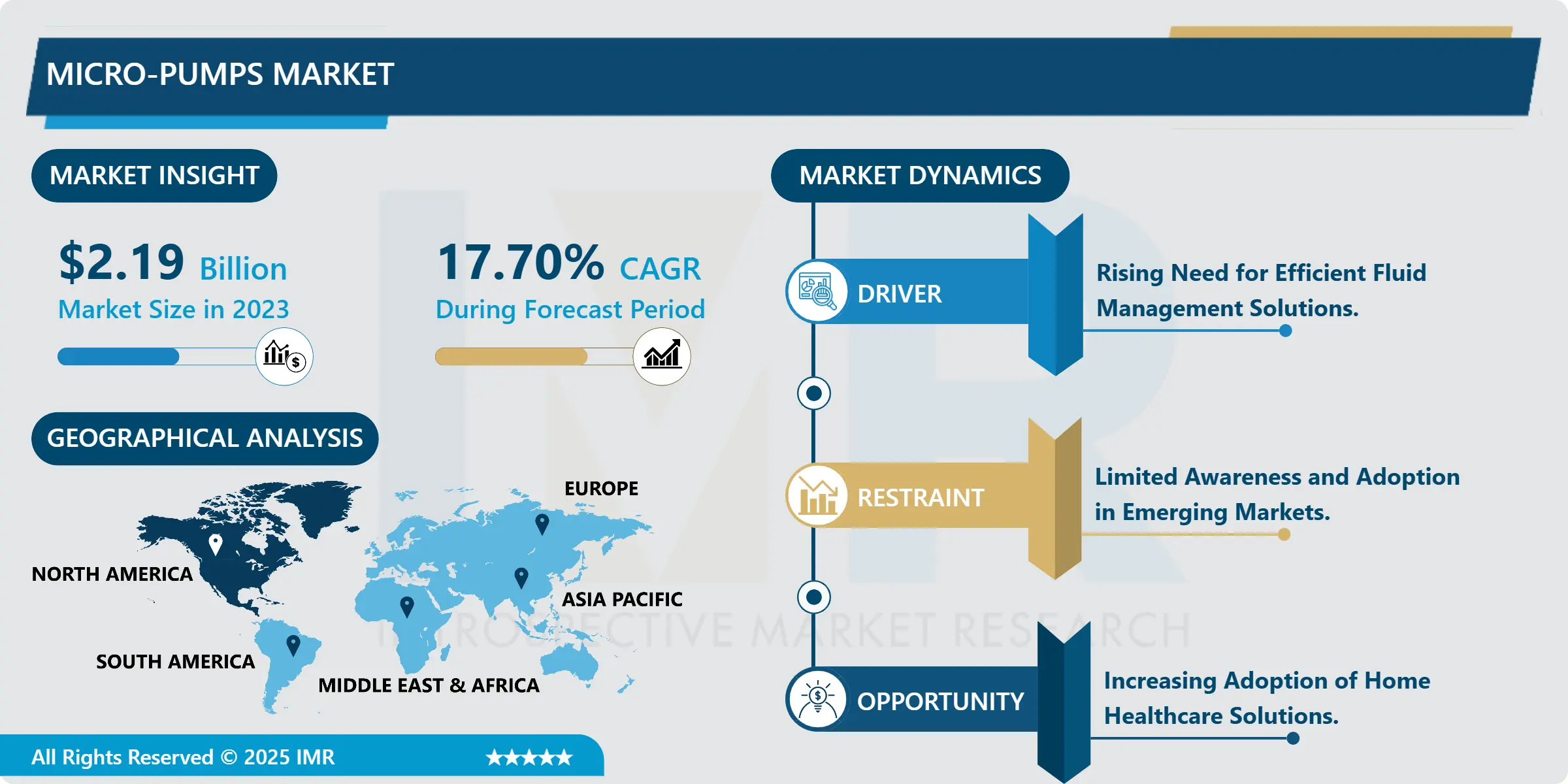
Micro-pumps Market Trend Analysis:
The shift towards integrating smart technologies.
- One of the emerging trends for the micro-pumps market is smart technologies integration. The technologies of IoT and automation are pressing, and manufacturers have been starting to build micro pumps that can be monitored and commanded through remote. This capability increases productivity and reliability in the handling of fluids, particularly in medical and industry uses, so as to provide data feedback and monitoring continuously.
- Furthermore, the sustainability factor is finding its way into the micro-pumps market more and more. Consequently, producers are placing increasing importance on finding environmentally sustainable material and design options. This trend follows the international move towards corporate sustainability since firms want to minimize their environmental impact when doing business.
The expansion of the biotechnology and pharmaceutical sectors
- The access to novel applications resulting from a growing biotechnology and pharmaceutical industries is a key factor that the micro-pumps market. These industries will only get stronger and design newer therapies and treatment procedures and this means that the need for better fluid delivery systems will increase. Micro-pumps shall be very useful for research as well as production activities hence the possibility of the growth of a large market for manufacturers.
- In addition, the rising rate of chronic diseases has put more pressure on home care products and services such as portable drug delivery systems. Such applications are custom-made for micro-pumps because they allow patients to administer medications at home. This market shift to decentralised care opens new opportunities for micro-pump manufacturers targeting this changed sector.
Micro-pumps Market Segment Analysis:
Micro-pumps Market is Segmented on the basis of Type, Technology, Application, End User, and Region.
By Type, Peristaltic Micro-pumps segment is expected to dominate the market during the forecast period
- The micro-pumps market can be categorized by type into four main segments: These include positive displacement micro-pumps such as the PDMS micro-pumps, PDMS/LDPE micro-pumps, as well as peristaltic micro-pumps, rotary micro-pumps among others. Positive displacement micro-pumps function by creating a small cavity and then pressurizing the fluid into the discharge pipe making it ideal for applications that need high pressures. Peristaltic micro-pumps work with a mechanism that rollers squeeze a flexible tube to drive the fluid forward, they are suitable for getting delicate fluids as they are non-destructive and cause minimal contamination. Rotating micropump generate the fluid movement through a rotating structure and are more commonly used in application that require constant pump flow. Others may be specialty or specific designs that incorporate specifics from the two broad types to address operational requirements in different environments.
By Application, Medical Devices segment expected to held the largest share
- The micro-pumps market is segmented by application into five primary categories: medical devices, analytical and laboratory equipment, automotive, consumer electronics and others. Micro pumps find application in drug delivery systems, infusion pump and any device where movement of fluids is critical, and must be controlled accurately. Liquid transfer in analytical labs and laboratory equipment uses micro-pump to transfer small volumes of fluids in experiments and processes for easy measurements. In the car manufacture industry, these pumps are used in fuel injection and cooling and results to better performance of the automobiles. Consumer electronics use micro pumps in places such as portable printers and miniaturized medical devices where size is a limiting factor. The remaining ‘others’ are a broad array of applications that include the processes within industries as well as this makes micro- pumps useful in many sectors.
Micro-pumps Market Regional Insights:
North America is Expected to Dominate the Market Over the Forecast period
- The micro-pumps market is at present especially strong in North America because of its a well-developed healthcare segment and a large focus on medical innovation. This region contains potential customers who includes some of the best manufacturers and research centers of medical devices to this market favors new micro-pump technologies. Also, there are developed health care sectors all over the region and this has accelerated the adoption of micro pump technologies in so many areas such as diagnostic and medical delivery.
- However, the increasing focus in the region of North America on technology solutions in health care is providing further impetus for the market for micro-pumps. The developments in technologies such as telemedicine and home health care have put emphasis on the requirements of better fluid delivery systems. As clients and healthcare professionals demand better solutions for patient care and treatment, micro-pumps market is set to rise in North America.
Active Key Players in the Micro-pumps Market:
- Thermo Fisher Scientific (United States)
- Parker Hannifin Corporation (United States)
- Abbott Laboratories (United States)
- Bürkert Fluid Control Systems (Germany)
- Graham Corporation (United States)
- Celerity (United States)
- Idex Corporation (United States)
- Hirschmann Automation and Control (Germany)
- KNF Neuberger, Inc. (United States)
- Kamoer Fluid Tech Co., Ltd. (China)
- Other Active Players
|
Micro-pumps Market |
|||
|
Base Year: |
2023 |
Forecast Period: |
2024-2032 |
|
Historical Data: |
2017 to 2023 |
Market Size in 2023: |
USD 2.19 Billion |
|
Forecast Period 2024-32 CAGR: |
17.70 % |
Market Size in 2032: |
USD 9.49 Billion |
|
Segments Covered: |
By Type |
|
|
|
By Technology |
|
||
|
By Application |
|
||
|
End User |
|
||
|
By Region |
|
||
|
Key Market Drivers: |
|
||
|
Key Market Restraints: |
|
||
|
Key Opportunities: |
|
||
|
Companies Covered in the report: |
|
||
Chapter 1: Introduction
1.1 Scope and Coverage
Chapter 2:Executive Summary
Chapter 3: Market Landscape
3.1 Market Dynamics
3.1.1 Drivers
3.1.2 Restraints
3.1.3 Opportunities
3.1.4 Challenges
3.2 Market Trend Analysis
3.3 PESTLE Analysis
3.4 Porter's Five Forces Analysis
3.5 Industry Value Chain Analysis
3.6 Ecosystem
3.7 Regulatory Landscape
3.8 Price Trend Analysis
3.9 Patent Analysis
3.10 Technology Evolution
3.11 Investment Pockets
3.12 Import-Export Analysis
Chapter 4: Micro-pumps Market by Type
4.1 Micro-pumps Market Snapshot and Growth Engine
4.2 Micro-pumps Market Overview
4.3 Positive Displacement Micro-pumps
4.3.1 Introduction and Market Overview
4.3.2 Historic and Forecasted Market Size in Value USD and Volume Units (2017-2032F)
4.3.3 Key Market Trends, Growth Factors and Opportunities
4.3.4 Positive Displacement Micro-pumps: Geographic Segmentation Analysis
4.4 Peristaltic Micro-pumps
4.4.1 Introduction and Market Overview
4.4.2 Historic and Forecasted Market Size in Value USD and Volume Units (2017-2032F)
4.4.3 Key Market Trends, Growth Factors and Opportunities
4.4.4 Peristaltic Micro-pumps: Geographic Segmentation Analysis
4.5 Rotary Micro-pumps
4.5.1 Introduction and Market Overview
4.5.2 Historic and Forecasted Market Size in Value USD and Volume Units (2017-2032F)
4.5.3 Key Market Trends, Growth Factors and Opportunities
4.5.4 Rotary Micro-pumps: Geographic Segmentation Analysis
4.6 Other Types
4.6.1 Introduction and Market Overview
4.6.2 Historic and Forecasted Market Size in Value USD and Volume Units (2017-2032F)
4.6.3 Key Market Trends, Growth Factors and Opportunities
4.6.4 Other Types: Geographic Segmentation Analysis
Chapter 5: Micro-pumps Market by Technology
5.1 Micro-pumps Market Snapshot and Growth Engine
5.2 Micro-pumps Market Overview
5.3 Electromechanical
5.3.1 Introduction and Market Overview
5.3.2 Historic and Forecasted Market Size in Value USD and Volume Units (2017-2032F)
5.3.3 Key Market Trends, Growth Factors and Opportunities
5.3.4 Electromechanical: Geographic Segmentation Analysis
5.4 Non-Electromechanical
5.4.1 Introduction and Market Overview
5.4.2 Historic and Forecasted Market Size in Value USD and Volume Units (2017-2032F)
5.4.3 Key Market Trends, Growth Factors and Opportunities
5.4.4 Non-Electromechanical: Geographic Segmentation Analysis
Chapter 6: Micro-pumps Market by Application
6.1 Micro-pumps Market Snapshot and Growth Engine
6.2 Micro-pumps Market Overview
6.3 Medical Devices
6.3.1 Introduction and Market Overview
6.3.2 Historic and Forecasted Market Size in Value USD and Volume Units (2017-2032F)
6.3.3 Key Market Trends, Growth Factors and Opportunities
6.3.4 Medical Devices: Geographic Segmentation Analysis
6.4 Analytical & Laboratory Equipment
6.4.1 Introduction and Market Overview
6.4.2 Historic and Forecasted Market Size in Value USD and Volume Units (2017-2032F)
6.4.3 Key Market Trends, Growth Factors and Opportunities
6.4.4 Analytical & Laboratory Equipment: Geographic Segmentation Analysis
6.5 Automotive
6.5.1 Introduction and Market Overview
6.5.2 Historic and Forecasted Market Size in Value USD and Volume Units (2017-2032F)
6.5.3 Key Market Trends, Growth Factors and Opportunities
6.5.4 Automotive: Geographic Segmentation Analysis
6.6 Consumer Electronics
6.6.1 Introduction and Market Overview
6.6.2 Historic and Forecasted Market Size in Value USD and Volume Units (2017-2032F)
6.6.3 Key Market Trends, Growth Factors and Opportunities
6.6.4 Consumer Electronics: Geographic Segmentation Analysis
6.7 Others
6.7.1 Introduction and Market Overview
6.7.2 Historic and Forecasted Market Size in Value USD and Volume Units (2017-2032F)
6.7.3 Key Market Trends, Growth Factors and Opportunities
6.7.4 Others: Geographic Segmentation Analysis
Chapter 7: Micro-pumps Market by End User
7.1 Micro-pumps Market Snapshot and Growth Engine
7.2 Micro-pumps Market Overview
7.3 Healthcare
7.3.1 Introduction and Market Overview
7.3.2 Historic and Forecasted Market Size in Value USD and Volume Units (2017-2032F)
7.3.3 Key Market Trends, Growth Factors and Opportunities
7.3.4 Healthcare: Geographic Segmentation Analysis
7.4 Industrial
7.4.1 Introduction and Market Overview
7.4.2 Historic and Forecasted Market Size in Value USD and Volume Units (2017-2032F)
7.4.3 Key Market Trends, Growth Factors and Opportunities
7.4.4 Industrial: Geographic Segmentation Analysis
7.5 Research Laboratories
7.5.1 Introduction and Market Overview
7.5.2 Historic and Forecasted Market Size in Value USD and Volume Units (2017-2032F)
7.5.3 Key Market Trends, Growth Factors and Opportunities
7.5.4 Research Laboratories: Geographic Segmentation Analysis
7.6 Others
7.6.1 Introduction and Market Overview
7.6.2 Historic and Forecasted Market Size in Value USD and Volume Units (2017-2032F)
7.6.3 Key Market Trends, Growth Factors and Opportunities
7.6.4 Others: Geographic Segmentation Analysis
Chapter 8: Company Profiles and Competitive Analysis
8.1 Competitive Landscape
8.1.1 Competitive Benchmarking
8.1.2 Micro-pumps Market Share by Manufacturer (2023)
8.1.3 Industry BCG Matrix
8.1.4 Heat Map Analysis
8.1.5 Mergers and Acquisitions
8.2 THERMO FISHER SCIENTIFIC (UNITED STATES)
8.2.1 Company Overview
8.2.2 Key Executives
8.2.3 Company Snapshot
8.2.4 Role of the Company in the Market
8.2.5 Sustainability and Social Responsibility
8.2.6 Operating Business Segments
8.2.7 Product Portfolio
8.2.8 Business Performance
8.2.9 Key Strategic Moves and Recent Developments
8.2.10 SWOT Analysis
8.3 PARKER HANNIFIN CORPORATION (UNITED STATES)
8.4 ABBOTT LABORATORIES (UNITED STATES)
8.5 BÜRKERT FLUID CONTROL SYSTEMS (GERMANY)
8.6 GRAHAM CORPORATION (UNITED STATES)
8.7 CELERITY (UNITED STATES)
8.8 IDEX CORPORATION (UNITED STATES)
8.9 HIRSCHMANN AUTOMATION AND CONTROL (GERMANY)
8.10 KNF NEUBERGER INC. (UNITED STATES)
8.11 KAMOER FLUID TECH CO. LTD. (CHINA)
8.12 OTHER ACTIVE PLAYERS
Chapter 9: Global Micro-pumps Market By Region
9.1 Overview
9.2. North America Micro-pumps Market
9.2.1 Key Market Trends, Growth Factors and Opportunities
9.2.2 Top Key Companies
9.2.3 Historic and Forecasted Market Size by Segments
9.2.4 Historic and Forecasted Market Size By Type
9.2.4.1 Positive Displacement Micro-pumps
9.2.4.2 Peristaltic Micro-pumps
9.2.4.3 Rotary Micro-pumps
9.2.4.4 Other Types
9.2.5 Historic and Forecasted Market Size By Technology
9.2.5.1 Electromechanical
9.2.5.2 Non-Electromechanical
9.2.6 Historic and Forecasted Market Size By Application
9.2.6.1 Medical Devices
9.2.6.2 Analytical & Laboratory Equipment
9.2.6.3 Automotive
9.2.6.4 Consumer Electronics
9.2.6.5 Others
9.2.7 Historic and Forecasted Market Size By End User
9.2.7.1 Healthcare
9.2.7.2 Industrial
9.2.7.3 Research Laboratories
9.2.7.4 Others
9.2.8 Historic and Forecast Market Size by Country
9.2.8.1 US
9.2.8.2 Canada
9.2.8.3 Mexico
9.3. Eastern Europe Micro-pumps Market
9.3.1 Key Market Trends, Growth Factors and Opportunities
9.3.2 Top Key Companies
9.3.3 Historic and Forecasted Market Size by Segments
9.3.4 Historic and Forecasted Market Size By Type
9.3.4.1 Positive Displacement Micro-pumps
9.3.4.2 Peristaltic Micro-pumps
9.3.4.3 Rotary Micro-pumps
9.3.4.4 Other Types
9.3.5 Historic and Forecasted Market Size By Technology
9.3.5.1 Electromechanical
9.3.5.2 Non-Electromechanical
9.3.6 Historic and Forecasted Market Size By Application
9.3.6.1 Medical Devices
9.3.6.2 Analytical & Laboratory Equipment
9.3.6.3 Automotive
9.3.6.4 Consumer Electronics
9.3.6.5 Others
9.3.7 Historic and Forecasted Market Size By End User
9.3.7.1 Healthcare
9.3.7.2 Industrial
9.3.7.3 Research Laboratories
9.3.7.4 Others
9.3.8 Historic and Forecast Market Size by Country
9.3.8.1 Russia
9.3.8.2 Bulgaria
9.3.8.3 The Czech Republic
9.3.8.4 Hungary
9.3.8.5 Poland
9.3.8.6 Romania
9.3.8.7 Rest of Eastern Europe
9.4. Western Europe Micro-pumps Market
9.4.1 Key Market Trends, Growth Factors and Opportunities
9.4.2 Top Key Companies
9.4.3 Historic and Forecasted Market Size by Segments
9.4.4 Historic and Forecasted Market Size By Type
9.4.4.1 Positive Displacement Micro-pumps
9.4.4.2 Peristaltic Micro-pumps
9.4.4.3 Rotary Micro-pumps
9.4.4.4 Other Types
9.4.5 Historic and Forecasted Market Size By Technology
9.4.5.1 Electromechanical
9.4.5.2 Non-Electromechanical
9.4.6 Historic and Forecasted Market Size By Application
9.4.6.1 Medical Devices
9.4.6.2 Analytical & Laboratory Equipment
9.4.6.3 Automotive
9.4.6.4 Consumer Electronics
9.4.6.5 Others
9.4.7 Historic and Forecasted Market Size By End User
9.4.7.1 Healthcare
9.4.7.2 Industrial
9.4.7.3 Research Laboratories
9.4.7.4 Others
9.4.8 Historic and Forecast Market Size by Country
9.4.8.1 Germany
9.4.8.2 UK
9.4.8.3 France
9.4.8.4 The Netherlands
9.4.8.5 Italy
9.4.8.6 Spain
9.4.8.7 Rest of Western Europe
9.5. Asia Pacific Micro-pumps Market
9.5.1 Key Market Trends, Growth Factors and Opportunities
9.5.2 Top Key Companies
9.5.3 Historic and Forecasted Market Size by Segments
9.5.4 Historic and Forecasted Market Size By Type
9.5.4.1 Positive Displacement Micro-pumps
9.5.4.2 Peristaltic Micro-pumps
9.5.4.3 Rotary Micro-pumps
9.5.4.4 Other Types
9.5.5 Historic and Forecasted Market Size By Technology
9.5.5.1 Electromechanical
9.5.5.2 Non-Electromechanical
9.5.6 Historic and Forecasted Market Size By Application
9.5.6.1 Medical Devices
9.5.6.2 Analytical & Laboratory Equipment
9.5.6.3 Automotive
9.5.6.4 Consumer Electronics
9.5.6.5 Others
9.5.7 Historic and Forecasted Market Size By End User
9.5.7.1 Healthcare
9.5.7.2 Industrial
9.5.7.3 Research Laboratories
9.5.7.4 Others
9.5.8 Historic and Forecast Market Size by Country
9.5.8.1 China
9.5.8.2 India
9.5.8.3 Japan
9.5.8.4 South Korea
9.5.8.5 Malaysia
9.5.8.6 Thailand
9.5.8.7 Vietnam
9.5.8.8 The Philippines
9.5.8.9 Australia
9.5.8.10 New Zealand
9.5.8.11 Rest of APAC
9.6. Middle East & Africa Micro-pumps Market
9.6.1 Key Market Trends, Growth Factors and Opportunities
9.6.2 Top Key Companies
9.6.3 Historic and Forecasted Market Size by Segments
9.6.4 Historic and Forecasted Market Size By Type
9.6.4.1 Positive Displacement Micro-pumps
9.6.4.2 Peristaltic Micro-pumps
9.6.4.3 Rotary Micro-pumps
9.6.4.4 Other Types
9.6.5 Historic and Forecasted Market Size By Technology
9.6.5.1 Electromechanical
9.6.5.2 Non-Electromechanical
9.6.6 Historic and Forecasted Market Size By Application
9.6.6.1 Medical Devices
9.6.6.2 Analytical & Laboratory Equipment
9.6.6.3 Automotive
9.6.6.4 Consumer Electronics
9.6.6.5 Others
9.6.7 Historic and Forecasted Market Size By End User
9.6.7.1 Healthcare
9.6.7.2 Industrial
9.6.7.3 Research Laboratories
9.6.7.4 Others
9.6.8 Historic and Forecast Market Size by Country
9.6.8.1 Turkiye
9.6.8.2 Bahrain
9.6.8.3 Kuwait
9.6.8.4 Saudi Arabia
9.6.8.5 Qatar
9.6.8.6 UAE
9.6.8.7 Israel
9.6.8.8 South Africa
9.7. South America Micro-pumps Market
9.7.1 Key Market Trends, Growth Factors and Opportunities
9.7.2 Top Key Companies
9.7.3 Historic and Forecasted Market Size by Segments
9.7.4 Historic and Forecasted Market Size By Type
9.7.4.1 Positive Displacement Micro-pumps
9.7.4.2 Peristaltic Micro-pumps
9.7.4.3 Rotary Micro-pumps
9.7.4.4 Other Types
9.7.5 Historic and Forecasted Market Size By Technology
9.7.5.1 Electromechanical
9.7.5.2 Non-Electromechanical
9.7.6 Historic and Forecasted Market Size By Application
9.7.6.1 Medical Devices
9.7.6.2 Analytical & Laboratory Equipment
9.7.6.3 Automotive
9.7.6.4 Consumer Electronics
9.7.6.5 Others
9.7.7 Historic and Forecasted Market Size By End User
9.7.7.1 Healthcare
9.7.7.2 Industrial
9.7.7.3 Research Laboratories
9.7.7.4 Others
9.7.8 Historic and Forecast Market Size by Country
9.7.8.1 Brazil
9.7.8.2 Argentina
9.7.8.3 Rest of SA
Chapter 10 Analyst Viewpoint and Conclusion
10.1 Recommendations and Concluding Analysis
10.2 Potential Market Strategies
Chapter 11 Research Methodology
11.1 Research Process
11.2 Primary Research
11.3 Secondary Research
|
Micro-pumps Market |
|||
|
Base Year: |
2023 |
Forecast Period: |
2024-2032 |
|
Historical Data: |
2017 to 2023 |
Market Size in 2023: |
USD 2.19 Billion |
|
Forecast Period 2024-32 CAGR: |
17.70 % |
Market Size in 2032: |
USD 9.49 Billion |
|
Segments Covered: |
By Type |
|
|
|
By Technology |
|
||
|
By Application |
|
||
|
End User |
|
||
|
By Region |
|
||
|
Key Market Drivers: |
|
||
|
Key Market Restraints: |
|
||
|
Key Opportunities: |
|
||
|
Companies Covered in the report: |
|
||