




Key Market Highlights
Metaverse In Healthcare Market Size Was Valued at USD 15.70 Billion in 2024, and is Projected to Reach USD 301.01 Billion by 2035, Growing at a CAGR of 30.8% from 2025-2035.
- Market Size in 2024: USD 15.70 Billion
- Projected Market Size by 2035: USD 301.01 Billion
- CAGR (2025–2035): 30.8%
- Leading Market in 2024: North America
- Fastest-Growing Market: Asia Pacific
- By End-User: The Hospitals & Surgical Centers segment is anticipated to lead the market by accounting for 26.8% of the market share throughout the forecast period.
- By Technology: The Augmented Reality segment is expected to capture 27.2% of the market share, thereby maintaining its dominance over the forecast period.
- By Region: North America region is projected to hold 31.2% of the market share during the forecast period.
- Active Players: 3D Systems Corporation (United States), AccuVein (United States), Brainlab (Germany), CAE Inc. (Canada), Google LLC (United States), and Other Active Players.
Metaverse In Healthcare Market Synopsis:
The Metaverse in Healthcare market is rapidly evolving through the adoption of immersive technologies such as virtual reality, augmented reality, and artificial intelligence to enhance healthcare delivery and patient experiences. It enables remote consultations, virtual medical training, surgical simulations, and interactive patient education within digital environments. The market is driven by the growing demand for telemedicine, personalized treatment approaches, and advanced training solutions for healthcare professionals. Healthcare organizations are increasingly adopting metaverse platforms to improve patient engagement and clinical efficiency. However, challenges such as data privacy concerns, regulatory requirements, high implementation costs, and the need for scalable and accessible digital infrastructure continue to influence market growth. Despite these challenges, the metaverse is expected to significantly transform healthcare services and medical education in the coming years.
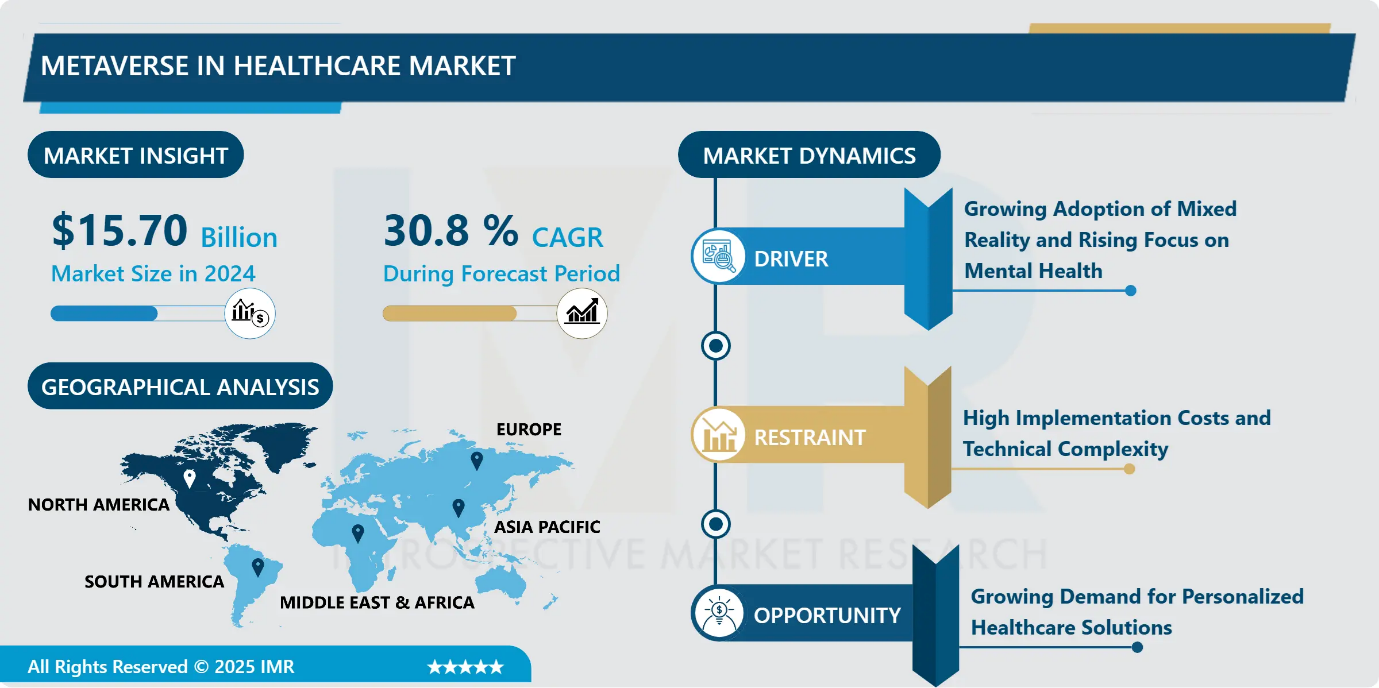
Metaverse In Healthcare Market Dynamics and Trend Analysis:
Metaverse In Healthcare Market Growth Driver
Growing Adoption of Mixed Reality and Rising Focus on Mental Health
- The increasing adoption of mixed reality (MR) technologies and the growing emphasis on mental health are key drivers of the Metaverse in Healthcare market. Mixed reality enables surgeons to visualize patient anatomy in real time, improving precision and efficiency in minimally invasive procedures while supporting remote collaboration among medical experts.
- At the same time, rising awareness of mental health issues is encouraging the use of metaverse platforms for virtual therapy sessions, wellness programs, and support groups in immersive environments. These technologies improve patient engagement and accessibility to care. As healthcare providers seek advanced digital solutions, the integration of immersive technologies is expected to accelerate market growth.
Metaverse In Healthcare Market Limiting Factor
High Implementation Costs and Technical Complexity
- High implementation costs and technical complexity act as major restraints in the Metaverse in Healthcare market. The deployment of immersive technologies such as virtual reality, augmented reality, and mixed reality requires substantial investments in advanced hardware, specialized software, system integration, and workforce training.
- These financial requirements can limit adoption, particularly among small and mid-sized healthcare providers. In addition, maintaining data security, protecting patient privacy, and complying with healthcare regulations increase operational complexity and costs. The lack of standardized platforms and technical expertise further slows adoption. Until more cost-effective and scalable solutions become available, widespread implementation of metaverse technologies in healthcare may remain limited.
Metaverse In Healthcare Market Expansion Opportunity
Growing Demand for Personalized Healthcare Solutions
- The increasing demand for personalized healthcare solutions presents a significant opportunity for the Metaverse in Healthcare market. Patients and healthcare providers are seeking individualized treatment approaches that improve outcomes and patient engagement. Metaverse platforms enable personalized care through data-driven insights, virtual interactions, and customized treatment planning within immersive digital environments.
- These technologies allow healthcare professionals to monitor patient conditions more effectively and deliver tailored therapies and rehabilitation programs. The integration of personalized medicine with metaverse technologies supports improved clinical decision-making and patient satisfaction. As healthcare shifts toward patient-centric models, the adoption of personalized metaverse solutions is expected to create substantial growth opportunities for market participants.
Metaverse In Healthcare Market Challenge and Risk
Cybersecurity and Patient Data Privacy Risks
- Cybersecurity and patient data privacy concerns represent a significant challenge in the Metaverse in Healthcare market. Immersive devices such as VR headsets collect sensitive biometric information, including eye movement and behavioral patterns, which require strong data protection measures. Healthcare organizations must address risks such as data breaches, unauthorized access, and user profiling within virtual environments. Implementing advanced security frameworks and encryption technologies can increase system complexity, latency, and operational costs.
- Additionally, varying data localization and privacy regulations across countries complicate cloud-based deployments. Rising cybersecurity risks and increasing insurance costs related to data breaches continue to create barriers for the secure and large-scale adoption of metaverse healthcare solutions.
Metaverse In Healthcare Market Trend
Integration of Advanced Technologies and Expansion of Telehealth Services
- The integration of advanced technologies such as virtual reality (VR) and augmented reality (AR), along with the increasing demand for telehealth services, represents a major trend in the Metaverse in Healthcare market. VR and AR technologies enable immersive medical training, surgical simulations, and real-time diagnostic support, improving clinical efficiency and patient outcomes.
- At the same time, the rapid expansion of telehealth services is encouraging the adoption of metaverse-based platforms for virtual consultations and remote patient monitoring. These immersive digital environments enhance patient interaction and accessibility to care. As technology becomes more affordable and widely available, healthcare providers are increasingly adopting metaverse solutions to improve service delivery and patient engagement.
Metaverse In Healthcare Market Segment Analysis:
Metaverse In Healthcare Market is segmented based on Component, Technology, Application, End-User, and Region.
By End User, Hospitals and surgical center segment is expected to dominate the market with around 26.8% share during the forecast period.
- Hospitals and surgical centers dominated the Metaverse in Healthcare market in 2024, accounting for the largest share due to extensive use of immersive technologies in surgical planning, clinical training, rehabilitation, and patient care. Healthcare institutions increasingly adopt virtual and augmented reality solutions to improve operational efficiency, enhance medical education, and support accurate diagnostics. Teaching hospitals also utilize virtual simulations to reduce training costs and improve clinical outcomes. This segment remains dominant because hospitals serve as primary healthcare delivery centers and are early adopters of advanced technologies. Meanwhile, healthcare payers and insurers are expected to witness strong growth, driven by cost savings from reduced hospital visits and faster patient recovery.
By Technology, Augmented reality (AR) is expected to dominate with close to 27.2% market share during the forecast period.
- Augmented reality (AR) dominated the Metaverse in Healthcare market in 2024, accounting for the largest share due to its ability to overlay real-time clinical information without obstructing the surgical field. AR smart glasses and visualization tools support improved accuracy in complex procedures such as orthopedic and cardiovascular surgeries.
- The technology enhances surgical guidance, training, and diagnostic precision, making it widely adopted across healthcare settings. AR remains dominant because of its practical clinical applications, ease of integration with existing systems, and lower operational complexity compared to other immersive technologies. Meanwhile, digital twin technology is gaining momentum, enabling simulation-based treatment planning and predictive patient monitoring through real-time data integration.
Metaverse In Healthcare Market Regional Insights:
North America region is estimated to lead the market with around 31.2% share during the forecast period.
- North America dominates the Metaverse in Healthcare market, accounting for over 40% of global revenue, supported by advanced healthcare infrastructure and strong investments in digital health technologies. The region benefits from the presence of major technology companies, established telehealth regulations, and supportive regulatory frameworks that encourage innovation. High adoption of virtual reality, augmented reality, and artificial intelligence solutions for medical training, remote care, and patient engagement further strengthens market growth. Robust research ecosystems and access to venture capital enable rapid development and commercialization of metaverse solutions. North America remains dominant due to its technological leadership, strong funding environment, and early adoption of immersive healthcare technologies.
Metaverse In Healthcare Market Active Players:
- 3D Systems Corporation (United States)
- AccuVein (United States)
- Brainlab (Germany)
- CAE Inc. (Canada)
- Google LLC (United States)
- ImmersiveTouch Inc. (United States)
- Medtronic plc (Ireland)
- Meta Platforms Inc. (United States)
- Microsoft Corporation (United States)
- NVIDIA Corporation (United States)
- Roblox Corporation (United States)
- Sesame Inc. (United States)
- Siemens Healthineers (Germany)
- Veyond Metaverse (United States)
- Zimmer Biomet Holdings Inc. (United States)
- Other Active Players
Key Industry Developments in the Metaverse In Healthcare Market:
- In June 2025, NVIDIA Corporation collaborated with IQVIA, Illumina, the Mayo Clinic, and the Arc Institute to advance healthcare innovation. The partnership focuses on integrating AI agents and accelerated computing technologies. The initiative aims to enhance efficiency and insights in clinical trials and genomics research.
Technical Market Overview – Metaverse in Healthcare Market
- The Metaverse in Healthcare market is driven by the convergence of immersive technologies, advanced computing, and connected healthcare systems to create interactive digital healthcare environments. The technical ecosystem includes hardware components such as head-mounted displays, smart glasses, haptic devices, and medical wearables, along with software platforms that support 3D visualization, simulation, and real-time collaboration.
- Technologies such as augmented reality, virtual reality, mixed reality, artificial intelligence, digital twins, and Internet of Things (IoT) enable remote consultations, surgical planning, medical training, and patient monitoring. Cloud computing and edge processing support real-time data exchange and scalable virtual environments. Integration with electronic health records and telehealth platforms enhances clinical workflows and decision-making. Advanced cybersecurity frameworks and data encryption technologies are essential to ensure patient data protection, regulatory compliance, and secure communication within metaverse-based healthcare systems.
|
Metaverse In Healthcare Market |
|||
|
Base Year: |
2024 |
Forecast Period: |
2025-2035 |
|
Historical Data: |
2018 to 2024 |
Market Size in 2024: |
USD 15.70 Bn. |
|
Forecast Period 2025-32 CAGR: |
30.8 % |
Market Size in 2035: |
USD 301.01 Bn. |
|
Segments Covered: |
By Component |
|
|
|
By Technology |
|
||
|
By Application |
|
||
|
By End-User |
|
||
|
By Region |
|
||
|
Growth Driver: |
|
||
|
Limiting Factor |
|
||
|
Expansion Opportunity |
|
||
|
Challenge and Risk |
|
||
|
Companies Covered in the Report: |
|
||
Chapter 1: Introduction
1.1 Scope and Coverage
Chapter 2:Executive Summary
Chapter 3: Market Landscape
3.1 Market Dynamics and Opportunity Analysis
3.1.1 Growth Drivers
3.1.2 Limiting Factors
3.1.3 Growth Opportunities
3.1.4 Challenges and Risks
3.2 Market Trend Analysis
3.3 Industry Ecosystem
3.4 Industry Value Chain Mapping
3.5 Strategic PESTLE Overview
3.6 Porter's Five Forces Framework
3.7 Regulatory Framework
3.8 Pricing Trend Analysis
3.9 Intellectual Property Review
3.10 Technology Evolution
3.11 Import-Export Analysis
3.12 Consumer Behavior Analysis
3.13 Investment Pocket Analysis
3.14 Go-To Market Strategy
Chapter 4: Metaverse In Healthcare Market by Component (2018-2035)
4.1 Metaverse In Healthcare Market Snapshot and Growth Engine
4.2 Market Overview
4.3 Software
4.3.1 Introduction and Market Overview
4.3.2 Historic and Forecasted Market Size in Value USD and Volume Units
4.3.3 Key Market Trends, Growth Factors, and Opportunities
4.3.4 Geographic Segmentation Analysis
4.4 Hardware
4.5 and Services
Chapter 5: Metaverse In Healthcare Market by Technology (2018-2035)
5.1 Metaverse In Healthcare Market Snapshot and Growth Engine
5.2 Market Overview
5.3 Augmented Reality
5.3.1 Introduction and Market Overview
5.3.2 Historic and Forecasted Market Size in Value USD and Volume Units
5.3.3 Key Market Trends, Growth Factors, and Opportunities
5.3.4 Geographic Segmentation Analysis
5.4 Virtual Reality
5.5 Mixed Reality
5.6 Artificial Intelligence
5.7 Blockchain
5.8 Digital Twin
5.9 Internet of Things (IoT)
5.10 and Medical Wearables
Chapter 6: Metaverse In Healthcare Market by Application (2018-2035)
6.1 Metaverse In Healthcare Market Snapshot and Growth Engine
6.2 Market Overview
6.3 Digital Therapeutics
6.3.1 Introduction and Market Overview
6.3.2 Historic and Forecasted Market Size in Value USD and Volume Units
6.3.3 Key Market Trends, Growth Factors, and Opportunities
6.3.4 Geographic Segmentation Analysis
6.4 Medical Diagnostics
6.5 Telehealth & Telemedicine
6.6 Medical Education & Surgery Training
6.7 Drug Discovery & Personalized Medicine
6.8 Patient Engagement
6.9 Pre-Operation & Post-Operation Planning
6.10 Immersive 3D Training & Lectures
6.11 VR Therapy
6.12 Remote Monitoring
6.13 and Other Applications
Chapter 7: Metaverse In Healthcare Market by End-User (2018-2035)
7.1 Metaverse In Healthcare Market Snapshot and Growth Engine
7.2 Market Overview
7.3 Healthcare Providers
7.3.1 Introduction and Market Overview
7.3.2 Historic and Forecasted Market Size in Value USD and Volume Units
7.3.3 Key Market Trends, Growth Factors, and Opportunities
7.3.4 Geographic Segmentation Analysis
7.4 Hospitals & Surgical Centers
7.5 Healthcare Payers
7.6 Pharmaceutical & Medtech Companies
7.7 Insurance Companies
7.8 and Others
Chapter 8: Company Profiles and Competitive Analysis
8.1 Competitive Landscape
8.1.1 Competitive Benchmarking
8.1.2 Metaverse In Healthcare Market Share by Manufacturer/Service Provider(2024)
8.1.3 Industry BCG Matrix
8.1.4 PArtnerships, Mergers & Acquisitions
8.2 3D SYSTEMS CORPORATION (UNITED STATES)
8.2.1 Company Overview
8.2.2 Key Executives
8.2.3 Company Snapshot
8.2.4 Role of the Company in the Market
8.2.5 Sustainability and Social Responsibility
8.2.6 Operating Business Segments
8.2.7 Product Portfolio
8.2.8 Business Performance
8.2.9 Recent News & Developments
8.2.10 SWOT Analysis
8.3 ACCUVEIN (UNITED STATES)
8.4 BRAINLAB (GERMANY)
8.5 CAE INC. (CANADA)
8.6 GOOGLE LLC (UNITED STATES)
8.7 IMMERSIVETOUCH INC. (UNITED STATES)
8.8 MEDTRONIC PLC (IRELAND)
8.9 META PLATFORMS INC. (UNITED STATES)
8.10 MICROSOFT CORPORATION (UNITED STATES)
8.11 NVIDIA CORPORATION (UNITED STATES)
8.12 ROBLOX CORPORATION (UNITED STATES)
8.13 SESAME INC. (UNITED STATES)
8.14 SIEMENS HEALTHINEERS (GERMANY)
8.15 VEYOND METAVERSE (UNITED STATES)
8.16 ZIMMER BIOMET HOLDINGS INC. (UNITED STATES).
8.17 AND OTHER ACTIVE PLAYERS.
Chapter 9: Global Metaverse In Healthcare Market By Region
9.1 Overview
9.2. North America Metaverse In Healthcare Market
9.2.1 Key Market Trends, Growth Factors and Opportunities
9.2.2 Top Key Companies
9.2.3 Historic and Forecasted Market Size by Segments
9.2.4 Historic and Forecast Market Size by Country
9.2.4.1 US
9.2.4.2 Canada
9.2.4.3 Mexico
9.3. Eastern Europe Metaverse In Healthcare Market
9.3.1 Key Market Trends, Growth Factors and Opportunities
9.3.2 Top Key Companies
9.3.3 Historic and Forecasted Market Size by Segments
9.3.4 Historic and Forecast Market Size by Country
9.3.4.1 Russia
9.3.4.2 Bulgaria
9.3.4.3 The Czech Republic
9.3.4.4 Hungary
9.3.4.5 Poland
9.3.4.6 Romania
9.3.4.7 Rest of Eastern Europe
9.4. Western Europe Metaverse In Healthcare Market
9.4.1 Key Market Trends, Growth Factors and Opportunities
9.4.2 Top Key Companies
9.4.3 Historic and Forecasted Market Size by Segments
9.4.4 Historic and Forecast Market Size by Country
9.4.4.1 Germany
9.4.4.2 UK
9.4.4.3 France
9.4.4.4 The Netherlands
9.4.4.5 Italy
9.4.4.6 Spain
9.4.4.7 Rest of Western Europe
9.5. Asia Pacific Metaverse In Healthcare Market
9.5.1 Key Market Trends, Growth Factors and Opportunities
9.5.2 Top Key Companies
9.5.3 Historic and Forecasted Market Size by Segments
9.5.4 Historic and Forecast Market Size by Country
9.5.4.1 China
9.5.4.2 India
9.5.4.3 Japan
9.5.4.4 South Korea
9.5.4.5 Malaysia
9.5.4.6 Thailand
9.5.4.7 Vietnam
9.5.4.8 The Philippines
9.5.4.9 Australia
9.5.4.10 New Zealand
9.5.4.11 Rest of APAC
9.6. Middle East & Africa Metaverse In Healthcare Market
9.6.1 Key Market Trends, Growth Factors and Opportunities
9.6.2 Top Key Companies
9.6.3 Historic and Forecasted Market Size by Segments
9.6.4 Historic and Forecast Market Size by Country
9.6.4.1 Turkiye
9.6.4.2 Bahrain
9.6.4.3 Kuwait
9.6.4.4 Saudi Arabia
9.6.4.5 Qatar
9.6.4.6 UAE
9.6.4.7 Israel
9.6.4.8 South Africa
9.7. South America Metaverse In Healthcare Market
9.7.1 Key Market Trends, Growth Factors and Opportunities
9.7.2 Top Key Companies
9.7.3 Historic and Forecasted Market Size by Segments
9.7.4 Historic and Forecast Market Size by Country
9.7.4.1 Brazil
9.7.4.2 Argentina
9.7.4.3 Rest of SA
Chapter 10 Analyst Viewpoint and Conclusion
Chapter 11 Our Thematic Research Methodology
10.1 Research Process
10.2 Primary Research
10.3 Secondary Research
Chapter 12 Case Study
Chapter 13 Appendix
11.1 Sources
11.2 List of Tables and figures
11.3 Short Forms and Citations
11.4 Assumption and Conversion
11.5 Disclaimer
|
Metaverse In Healthcare Market |
|||
|
Base Year: |
2024 |
Forecast Period: |
2025-2035 |
|
Historical Data: |
2018 to 2024 |
Market Size in 2024: |
USD 15.70 Bn. |
|
Forecast Period 2025-32 CAGR: |
30.8 % |
Market Size in 2035: |
USD 301.01 Bn. |
|
Segments Covered: |
By Component |
|
|
|
By Technology |
|
||
|
By Application |
|
||
|
By End-User |
|
||
|
By Region |
|
||
|
Growth Driver: |
|
||
|
Limiting Factor |
|
||
|
Expansion Opportunity |
|
||
|
Challenge and Risk |
|
||
|
Companies Covered in the Report: |
|
||


