Medical Batteries Market Synopsis:
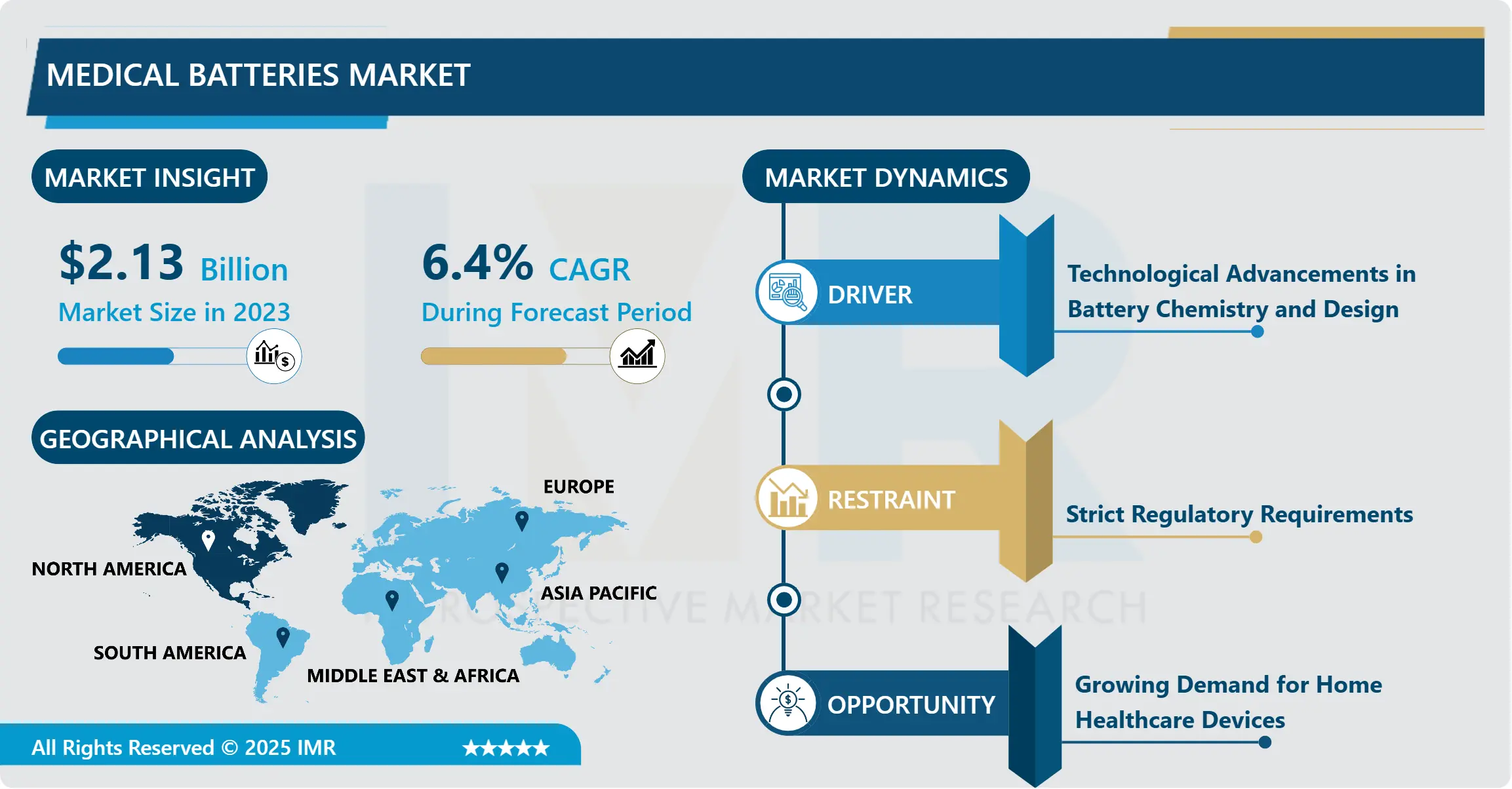
Medical Batteries Market Size Was Valued at USD 2.13 Billion in 2023, and is Projected to Reach USD 3.72 Billion by 2032, Growing at a CAGR of 6.4% From 2024-2032.
Medical Batteries refer to specific battery types fit for use in the Medical Batteries Market, including portable diagnostic instruments and implantable devices. These batteries are built for high reliability and safety, and deliver energy for various life supporting and sustaining health care apparatus in different healthcare settings.
The Medical Batteries Market has grown significantly over the years due increasing usage of better medical technologies and portable and easy to carry medical equipment’s. Medical batteries are central to many applications for many settings including hospitals ambulances as well as home care facilities. They allow the devices like cardiac monitor, infusion pump and respiratory system to operate and promote patient care, while providing a real-time data monitoring. This coupled with ever increasing prevalence of chronic diseases, increased life expectancy ,advancements in technology that call for portable and implantable medical equipments creates a special demand for highly durable and safe medical batteries.
EU medical batteries must meet necessary standards to guarantee that patients and equipment will not be endangered. The market offers differentiated battery types, such as lithium-ion, nickel-cadmium, and lead-acid depending on power requirements, kind of device and environmental conditions. The availability of the Li-ion batteries with recharging and longer backup duration is also increasing due to these options decreasing the replacement frequency and enhancing the usability of the device. Industry players need to optimize battery power delivery, battery cycle-life and adaptability to state-of-art medical equipment in a bid to trigger a positive impact on the quality of care and patient satisfaction.
Medical Batteries Market Trend Analysis:
Shift Towards Lithium-Ion Batteries in Medical Applications
- Market for medical batteries is shifting towards Lithium Ion (Li-ion) batteries because of their high energy density, small size, and long cycle life in comparison with conventional batteries. These batteries are gradually being adopted into devices that need to be frequently used and be sure of the power strength such as the patient monitoring system and the infusion pump. Lithium-ion batteries provide higher density of energy to volume ratio, and can be of intense value in mobile and wearable medical instruments, which require light-weight elements without compromising the energy capacity.
- This is further supported by improvements in battery safety and lifecycle enabling increasingly lithium-ion batteries to function reliably in life-support applications. Lithium-ion batteries are being made safer through improved heat resistance by manufacturers cut out this impending danger, thus making lithium-ion batteries ideal for use in patient care gadgets. Because miniaturized and portable medical devices are becoming more popular, lithium-ion batteries are likely to remain more relevant, prompting manufacturers to innovate for performance and patient protection.
Growing Demand for Home Healthcare Devices
- The growing trend for using home healthcare devices is one of the major opportunities in the Medical Batteries Market. The paradigm change to patient ownership and care together with the emphasis on treating chronic illnesses from home has caused an uptick in technology that is used for remote and home monitoring. These devices include portable ECG monitors, blood pressure monitors, respiratory support devices, etc., where a failure in the battery leads to an abrupt usage followed by device non-functionality in the interim.
- This trend presents battery makers with a good business model in manufacturing and marketing batteries that are long lasting and need to be rechargeable by the average homeowner. Market for home healthcare is expanding and technology of batteries must also evolve satisfying all the demands including ability of new devices, safety, high capacity, and durability. Efficient and cheaper batteries for home healthcare devices will let manufactures to explore a growing market niche with high potential demand.
Medical Batteries Market Segment Analysis:
Medical Batteries Market is Segmented on the basis of Product Type, Application, End User, and Region
By Product Type, Lithium-ion (Li-ion) Batteries segment is expected to dominate the market during the forecast period
- Due to the fact that Medical Batteries Market enlists different battery types, each of which is used for different purposes within medical devices. High energy density makes lithium-ion (Li-ion) batteries widely used because they fit portable and frequently used devices in the medical field. Nickel Cadmium (NiCd) and Nickel Metal Hydride (NiMH) are other types of batteries and they are not energy density as Li-ion batteries have. There are still uses for alkaline and lead-acid batteries for the devices which require a continuing low power output, such as medical diagnostic equipment.
- This diversity of battery types prevents generic solutions and allows optimizing solutions according to the energy and permissible duration of uses of a medical device. Nevertheless, each of them has its own advantages and disadvantages, which determine selection by requirements to devices, output power, and cost. The availability of both technology and chemistries allows the Medical Batteries Market to meet medical usage, which come in several forms requiring different levels of power output and durability in usage conditions.
By Application, Patient Monitoring Devices segment expected to held the largest share
- In medical applications medical batteries are used in various types of applications including, medical monitoring equipment, cardiac devices, analyzers, dispensing systems such as infusion pumps, and diagnostic imaging systems. For instance, the patient monitoring devices need very reliable batteries given that information needs to captured continuously and monitored in real time. Cardiac devices and infusion pumps are slightly different and need batteries with long life and very high reliability as those would be used in direct patient care.
- There is a growing demand for batteries in these applications due to the increasing use of enhanced medicine to enhance patient results by caregivers. Respiratory and orthopedic devices also need dependable sources of energy to facilitate patient mobility and manner, which most of the time call for rechargeable batteries. As these applications grow, the market for medical batteries has evolved to offer solutions to different power requirements that exist in various healthcare technologies.
Medical Batteries Market Regional Insights:
North America is Expected to Dominate the Market Over the Forecast period
- At present, the Medical Batteries Market is most prominent in North America due to the well-developed healthcare service industry, a higher usage of medical equipment, and a growing budget for healthcare. Lately, Medical device technology has gained a lot of prominence especially in USA, and an astounding amount of investment has been made in to research and development of Medical devices and thus a ubiquitous need for strong and robust batteries. The availability of such funds by the various governments along with some of the strict regulations for the healthcare industry have not only maintained, but strengthened North America’s dominance in this market.
- Furthermore, a few leading medical device makers and a rising interest in home healthcare products have boosted the use of superior battery types in the region. The high percentage of chronic diseases and long term patient surveillance requirement is demanding for medical devices and hence is boosting the medical batteries market in North America.
Active Key Players in the Medical Batteries Market:
- GE Healthcare (USA)
- Siemens Healthineers (Germany)
- Philips Healthcare (Netherlands)
- Medtronic (Ireland)
- Boston Scientific (USA)
- Omron Healthcare (Japan)
- EaglePicher Technologies (USA)
- Ultralife Corporation (USA)
- Saft Groupe S.A. (France)
- Tadiran Batteries GmbH (Germany)
- Energizer Holdings, Inc. (USA)
- Panasonic Corporation (Japan)
- Other Active Players
Key Industry Developments in the Medical Batteries Market:
- On 30 April 2024, A new battery research factory in Münster, Germany, backed by Fraunhofer-Gesellschaft applied research organizations and Siemens, focuses on digitalization. It aims to optimize battery production for industries like automotive. Europe's battery production capacity is projected to grow significantly by 2025 and 2030. The initiative, funded by the Federal Ministry of Education and Research and the State of North Rhine-Westphalia, aims to enhance Germany's competitiveness in battery technology.
- In January 2023, Ilika battery technology company and Cirtec Medical, provider of outsourced medical device has strengthened their collaboration through the signing of a memorandum of understanding. This agreement details the relocation of Stereax mm-scale battery manufacturing to Cirtec's facility in Lowell, MA. This move aims to enhance Cirtec's efforts in system-level miniaturization for the medical device sector. Meanwhile, Ilika will concentrate on advancing technology development and offering IP licensing to support Cirtec's manufacturing and commercialization endeavors.
|
Medical Batteries Market |
|||
|
Base Year: |
2023 |
Forecast Period: |
2024-2032 |
|
Historical Data: |
2017 to 2023 |
Market Size in 2023: |
USD 2.13 Billion |
|
Forecast Period 2024-32 CAGR: |
6.4% |
Market Size in 2032: |
USD 3.72 Billion |
|
Segments Covered: |
By Product Type |
|
|
|
By Application |
|
||
|
By End User |
|
||
|
By Region |
|
||
|
Key Market Drivers: |
|
||
|
Key Market Restraints: |
|
||
|
Key Opportunities: |
|
||
|
Companies Covered in the report: |
|
||
Chapter 1: Introduction
1.1 Scope and Coverage
Chapter 2:Executive Summary
Chapter 3: Market Landscape
3.1 Market Dynamics
3.1.1 Drivers
3.1.2 Restraints
3.1.3 Opportunities
3.1.4 Challenges
3.2 Market Trend Analysis
3.3 PESTLE Analysis
3.4 Porter's Five Forces Analysis
3.5 Industry Value Chain Analysis
3.6 Ecosystem
3.7 Regulatory Landscape
3.8 Price Trend Analysis
3.9 Patent Analysis
3.10 Technology Evolution
3.11 Investment Pockets
3.12 Import-Export Analysis
Chapter 4: Medical Batteries Market by Product Type
4.1 Medical Batteries Market Snapshot and Growth Engine
4.2 Medical Batteries Market Overview
4.3 Lithium-ion (Li-ion) Batteries
4.3.1 Introduction and Market Overview
4.3.2 Historic and Forecasted Market Size in Value USD and Volume Units (2017-2032F)
4.3.3 Key Market Trends, Growth Factors and Opportunities
4.3.4 Lithium-ion (Li-ion) Batteries: Geographic Segmentation Analysis
4.4 Nickel Cadmium (NiCd) Batteries
4.4.1 Introduction and Market Overview
4.4.2 Historic and Forecasted Market Size in Value USD and Volume Units (2017-2032F)
4.4.3 Key Market Trends, Growth Factors and Opportunities
4.4.4 Nickel Cadmium (NiCd) Batteries: Geographic Segmentation Analysis
4.5 Nickel Metal Hydride (NiMH) Batteries
4.5.1 Introduction and Market Overview
4.5.2 Historic and Forecasted Market Size in Value USD and Volume Units (2017-2032F)
4.5.3 Key Market Trends, Growth Factors and Opportunities
4.5.4 Nickel Metal Hydride (NiMH) Batteries: Geographic Segmentation Analysis
4.6 Alkaline Batteries
4.6.1 Introduction and Market Overview
4.6.2 Historic and Forecasted Market Size in Value USD and Volume Units (2017-2032F)
4.6.3 Key Market Trends, Growth Factors and Opportunities
4.6.4 Alkaline Batteries: Geographic Segmentation Analysis
4.7 Lead Acid Batteries
4.7.1 Introduction and Market Overview
4.7.2 Historic and Forecasted Market Size in Value USD and Volume Units (2017-2032F)
4.7.3 Key Market Trends, Growth Factors and Opportunities
4.7.4 Lead Acid Batteries: Geographic Segmentation Analysis
4.8 Others
4.8.1 Introduction and Market Overview
4.8.2 Historic and Forecasted Market Size in Value USD and Volume Units (2017-2032F)
4.8.3 Key Market Trends, Growth Factors and Opportunities
4.8.4 Others: Geographic Segmentation Analysis
Chapter 5: Medical Batteries Market by Application
5.1 Medical Batteries Market Snapshot and Growth Engine
5.2 Medical Batteries Market Overview
5.3 Patient Monitoring Devices
5.3.1 Introduction and Market Overview
5.3.2 Historic and Forecasted Market Size in Value USD and Volume Units (2017-2032F)
5.3.3 Key Market Trends, Growth Factors and Opportunities
5.3.4 Patient Monitoring Devices: Geographic Segmentation Analysis
5.4 Cardiac Devices
5.4.1 Introduction and Market Overview
5.4.2 Historic and Forecasted Market Size in Value USD and Volume Units (2017-2032F)
5.4.3 Key Market Trends, Growth Factors and Opportunities
5.4.4 Cardiac Devices: Geographic Segmentation Analysis
5.5 Infusion Pumps
5.5.1 Introduction and Market Overview
5.5.2 Historic and Forecasted Market Size in Value USD and Volume Units (2017-2032F)
5.5.3 Key Market Trends, Growth Factors and Opportunities
5.5.4 Infusion Pumps: Geographic Segmentation Analysis
5.6 Respiratory and Orthopedic Devices
5.6.1 Introduction and Market Overview
5.6.2 Historic and Forecasted Market Size in Value USD and Volume Units (2017-2032F)
5.6.3 Key Market Trends, Growth Factors and Opportunities
5.6.4 Respiratory and Orthopedic Devices: Geographic Segmentation Analysis
5.7 Diagnostic Imaging Devices
5.7.1 Introduction and Market Overview
5.7.2 Historic and Forecasted Market Size in Value USD and Volume Units (2017-2032F)
5.7.3 Key Market Trends, Growth Factors and Opportunities
5.7.4 Diagnostic Imaging Devices: Geographic Segmentation Analysis
5.8 Others
5.8.1 Introduction and Market Overview
5.8.2 Historic and Forecasted Market Size in Value USD and Volume Units (2017-2032F)
5.8.3 Key Market Trends, Growth Factors and Opportunities
5.8.4 Others: Geographic Segmentation Analysis
Chapter 6: Medical Batteries Market by End User
6.1 Medical Batteries Market Snapshot and Growth Engine
6.2 Medical Batteries Market Overview
6.3 Hospitals and Nursing Homes
6.3.1 Introduction and Market Overview
6.3.2 Historic and Forecasted Market Size in Value USD and Volume Units (2017-2032F)
6.3.3 Key Market Trends, Growth Factors and Opportunities
6.3.4 Hospitals and Nursing Homes: Geographic Segmentation Analysis
6.4 Diagnostic Centers
6.4.1 Introduction and Market Overview
6.4.2 Historic and Forecasted Market Size in Value USD and Volume Units (2017-2032F)
6.4.3 Key Market Trends, Growth Factors and Opportunities
6.4.4 Diagnostic Centers: Geographic Segmentation Analysis
6.5 Clinics
6.5.1 Introduction and Market Overview
6.5.2 Historic and Forecasted Market Size in Value USD and Volume Units (2017-2032F)
6.5.3 Key Market Trends, Growth Factors and Opportunities
6.5.4 Clinics: Geographic Segmentation Analysis
6.6 Home Healthcare Settings
6.6.1 Introduction and Market Overview
6.6.2 Historic and Forecasted Market Size in Value USD and Volume Units (2017-2032F)
6.6.3 Key Market Trends, Growth Factors and Opportunities
6.6.4 Home Healthcare Settings: Geographic Segmentation Analysis
Chapter 7: Company Profiles and Competitive Analysis
7.1 Competitive Landscape
7.1.1 Competitive Benchmarking
7.1.2 Medical Batteries Market Share by Manufacturer (2023)
7.1.3 Industry BCG Matrix
7.1.4 Heat Map Analysis
7.1.5 Mergers and Acquisitions
7.2 GE HEALTHCARE (USA)
7.2.1 Company Overview
7.2.2 Key Executives
7.2.3 Company Snapshot
7.2.4 Role of the Company in the Market
7.2.5 Sustainability and Social Responsibility
7.2.6 Operating Business Segments
7.2.7 Product Portfolio
7.2.8 Business Performance
7.2.9 Key Strategic Moves and Recent Developments
7.2.10 SWOT Analysis
7.3 SIEMENS HEALTHINEERS (GERMANY)
7.4 PHILIPS HEALTHCARE (NETHERLANDS)
7.5 MEDTRONIC (IRELAND)
7.6 BOSTON SCIENTIFIC (USA)
7.7 OMRON HEALTHCARE (JAPAN)
7.8 EAGLEPICHER TECHNOLOGIES (USA)
7.9 ULTRALIFE CORPORATION (USA)
7.10 OTHER ACTIVE PLAYERS
Chapter 8: Global Medical Batteries Market By Region
8.1 Overview
8.2. North America Medical Batteries Market
8.2.1 Key Market Trends, Growth Factors and Opportunities
8.2.2 Top Key Companies
8.2.3 Historic and Forecasted Market Size by Segments
8.2.4 Historic and Forecasted Market Size By Product Type
8.2.4.1 Lithium-ion (Li-ion) Batteries
8.2.4.2 Nickel Cadmium (NiCd) Batteries
8.2.4.3 Nickel Metal Hydride (NiMH) Batteries
8.2.4.4 Alkaline Batteries
8.2.4.5 Lead Acid Batteries
8.2.4.6 Others
8.2.5 Historic and Forecasted Market Size By Application
8.2.5.1 Patient Monitoring Devices
8.2.5.2 Cardiac Devices
8.2.5.3 Infusion Pumps
8.2.5.4 Respiratory and Orthopedic Devices
8.2.5.5 Diagnostic Imaging Devices
8.2.5.6 Others
8.2.6 Historic and Forecasted Market Size By End User
8.2.6.1 Hospitals and Nursing Homes
8.2.6.2 Diagnostic Centers
8.2.6.3 Clinics
8.2.6.4 Home Healthcare Settings
8.2.7 Historic and Forecast Market Size by Country
8.2.7.1 US
8.2.7.2 Canada
8.2.7.3 Mexico
8.3. Eastern Europe Medical Batteries Market
8.3.1 Key Market Trends, Growth Factors and Opportunities
8.3.2 Top Key Companies
8.3.3 Historic and Forecasted Market Size by Segments
8.3.4 Historic and Forecasted Market Size By Product Type
8.3.4.1 Lithium-ion (Li-ion) Batteries
8.3.4.2 Nickel Cadmium (NiCd) Batteries
8.3.4.3 Nickel Metal Hydride (NiMH) Batteries
8.3.4.4 Alkaline Batteries
8.3.4.5 Lead Acid Batteries
8.3.4.6 Others
8.3.5 Historic and Forecasted Market Size By Application
8.3.5.1 Patient Monitoring Devices
8.3.5.2 Cardiac Devices
8.3.5.3 Infusion Pumps
8.3.5.4 Respiratory and Orthopedic Devices
8.3.5.5 Diagnostic Imaging Devices
8.3.5.6 Others
8.3.6 Historic and Forecasted Market Size By End User
8.3.6.1 Hospitals and Nursing Homes
8.3.6.2 Diagnostic Centers
8.3.6.3 Clinics
8.3.6.4 Home Healthcare Settings
8.3.7 Historic and Forecast Market Size by Country
8.3.7.1 Russia
8.3.7.2 Bulgaria
8.3.7.3 The Czech Republic
8.3.7.4 Hungary
8.3.7.5 Poland
8.3.7.6 Romania
8.3.7.7 Rest of Eastern Europe
8.4. Western Europe Medical Batteries Market
8.4.1 Key Market Trends, Growth Factors and Opportunities
8.4.2 Top Key Companies
8.4.3 Historic and Forecasted Market Size by Segments
8.4.4 Historic and Forecasted Market Size By Product Type
8.4.4.1 Lithium-ion (Li-ion) Batteries
8.4.4.2 Nickel Cadmium (NiCd) Batteries
8.4.4.3 Nickel Metal Hydride (NiMH) Batteries
8.4.4.4 Alkaline Batteries
8.4.4.5 Lead Acid Batteries
8.4.4.6 Others
8.4.5 Historic and Forecasted Market Size By Application
8.4.5.1 Patient Monitoring Devices
8.4.5.2 Cardiac Devices
8.4.5.3 Infusion Pumps
8.4.5.4 Respiratory and Orthopedic Devices
8.4.5.5 Diagnostic Imaging Devices
8.4.5.6 Others
8.4.6 Historic and Forecasted Market Size By End User
8.4.6.1 Hospitals and Nursing Homes
8.4.6.2 Diagnostic Centers
8.4.6.3 Clinics
8.4.6.4 Home Healthcare Settings
8.4.7 Historic and Forecast Market Size by Country
8.4.7.1 Germany
8.4.7.2 UK
8.4.7.3 France
8.4.7.4 The Netherlands
8.4.7.5 Italy
8.4.7.6 Spain
8.4.7.7 Rest of Western Europe
8.5. Asia Pacific Medical Batteries Market
8.5.1 Key Market Trends, Growth Factors and Opportunities
8.5.2 Top Key Companies
8.5.3 Historic and Forecasted Market Size by Segments
8.5.4 Historic and Forecasted Market Size By Product Type
8.5.4.1 Lithium-ion (Li-ion) Batteries
8.5.4.2 Nickel Cadmium (NiCd) Batteries
8.5.4.3 Nickel Metal Hydride (NiMH) Batteries
8.5.4.4 Alkaline Batteries
8.5.4.5 Lead Acid Batteries
8.5.4.6 Others
8.5.5 Historic and Forecasted Market Size By Application
8.5.5.1 Patient Monitoring Devices
8.5.5.2 Cardiac Devices
8.5.5.3 Infusion Pumps
8.5.5.4 Respiratory and Orthopedic Devices
8.5.5.5 Diagnostic Imaging Devices
8.5.5.6 Others
8.5.6 Historic and Forecasted Market Size By End User
8.5.6.1 Hospitals and Nursing Homes
8.5.6.2 Diagnostic Centers
8.5.6.3 Clinics
8.5.6.4 Home Healthcare Settings
8.5.7 Historic and Forecast Market Size by Country
8.5.7.1 China
8.5.7.2 India
8.5.7.3 Japan
8.5.7.4 South Korea
8.5.7.5 Malaysia
8.5.7.6 Thailand
8.5.7.7 Vietnam
8.5.7.8 The Philippines
8.5.7.9 Australia
8.5.7.10 New Zealand
8.5.7.11 Rest of APAC
8.6. Middle East & Africa Medical Batteries Market
8.6.1 Key Market Trends, Growth Factors and Opportunities
8.6.2 Top Key Companies
8.6.3 Historic and Forecasted Market Size by Segments
8.6.4 Historic and Forecasted Market Size By Product Type
8.6.4.1 Lithium-ion (Li-ion) Batteries
8.6.4.2 Nickel Cadmium (NiCd) Batteries
8.6.4.3 Nickel Metal Hydride (NiMH) Batteries
8.6.4.4 Alkaline Batteries
8.6.4.5 Lead Acid Batteries
8.6.4.6 Others
8.6.5 Historic and Forecasted Market Size By Application
8.6.5.1 Patient Monitoring Devices
8.6.5.2 Cardiac Devices
8.6.5.3 Infusion Pumps
8.6.5.4 Respiratory and Orthopedic Devices
8.6.5.5 Diagnostic Imaging Devices
8.6.5.6 Others
8.6.6 Historic and Forecasted Market Size By End User
8.6.6.1 Hospitals and Nursing Homes
8.6.6.2 Diagnostic Centers
8.6.6.3 Clinics
8.6.6.4 Home Healthcare Settings
8.6.7 Historic and Forecast Market Size by Country
8.6.7.1 Turkiye
8.6.7.2 Bahrain
8.6.7.3 Kuwait
8.6.7.4 Saudi Arabia
8.6.7.5 Qatar
8.6.7.6 UAE
8.6.7.7 Israel
8.6.7.8 South Africa
8.7. South America Medical Batteries Market
8.7.1 Key Market Trends, Growth Factors and Opportunities
8.7.2 Top Key Companies
8.7.3 Historic and Forecasted Market Size by Segments
8.7.4 Historic and Forecasted Market Size By Product Type
8.7.4.1 Lithium-ion (Li-ion) Batteries
8.7.4.2 Nickel Cadmium (NiCd) Batteries
8.7.4.3 Nickel Metal Hydride (NiMH) Batteries
8.7.4.4 Alkaline Batteries
8.7.4.5 Lead Acid Batteries
8.7.4.6 Others
8.7.5 Historic and Forecasted Market Size By Application
8.7.5.1 Patient Monitoring Devices
8.7.5.2 Cardiac Devices
8.7.5.3 Infusion Pumps
8.7.5.4 Respiratory and Orthopedic Devices
8.7.5.5 Diagnostic Imaging Devices
8.7.5.6 Others
8.7.6 Historic and Forecasted Market Size By End User
8.7.6.1 Hospitals and Nursing Homes
8.7.6.2 Diagnostic Centers
8.7.6.3 Clinics
8.7.6.4 Home Healthcare Settings
8.7.7 Historic and Forecast Market Size by Country
8.7.7.1 Brazil
8.7.7.2 Argentina
8.7.7.3 Rest of SA
Chapter 9 Analyst Viewpoint and Conclusion
9.1 Recommendations and Concluding Analysis
9.2 Potential Market Strategies
Chapter 10 Research Methodology
10.1 Research Process
10.2 Primary Research
10.3 Secondary Research
|
Medical Batteries Market |
|||
|
Base Year: |
2023 |
Forecast Period: |
2024-2032 |
|
Historical Data: |
2017 to 2023 |
Market Size in 2023: |
USD 2.13 Billion |
|
Forecast Period 2024-32 CAGR: |
6.4% |
Market Size in 2032: |
USD 3.72 Billion |
|
Segments Covered: |
By Product Type |
|
|
|
By Application |
|
||
|
By End User |
|
||
|
By Region |
|
||
|
Key Market Drivers: |
|
||
|
Key Market Restraints: |
|
||
|
Key Opportunities: |
|
||
|
Companies Covered in the report: |
|
||