




Lymphedema Treatment Market Synopsis:
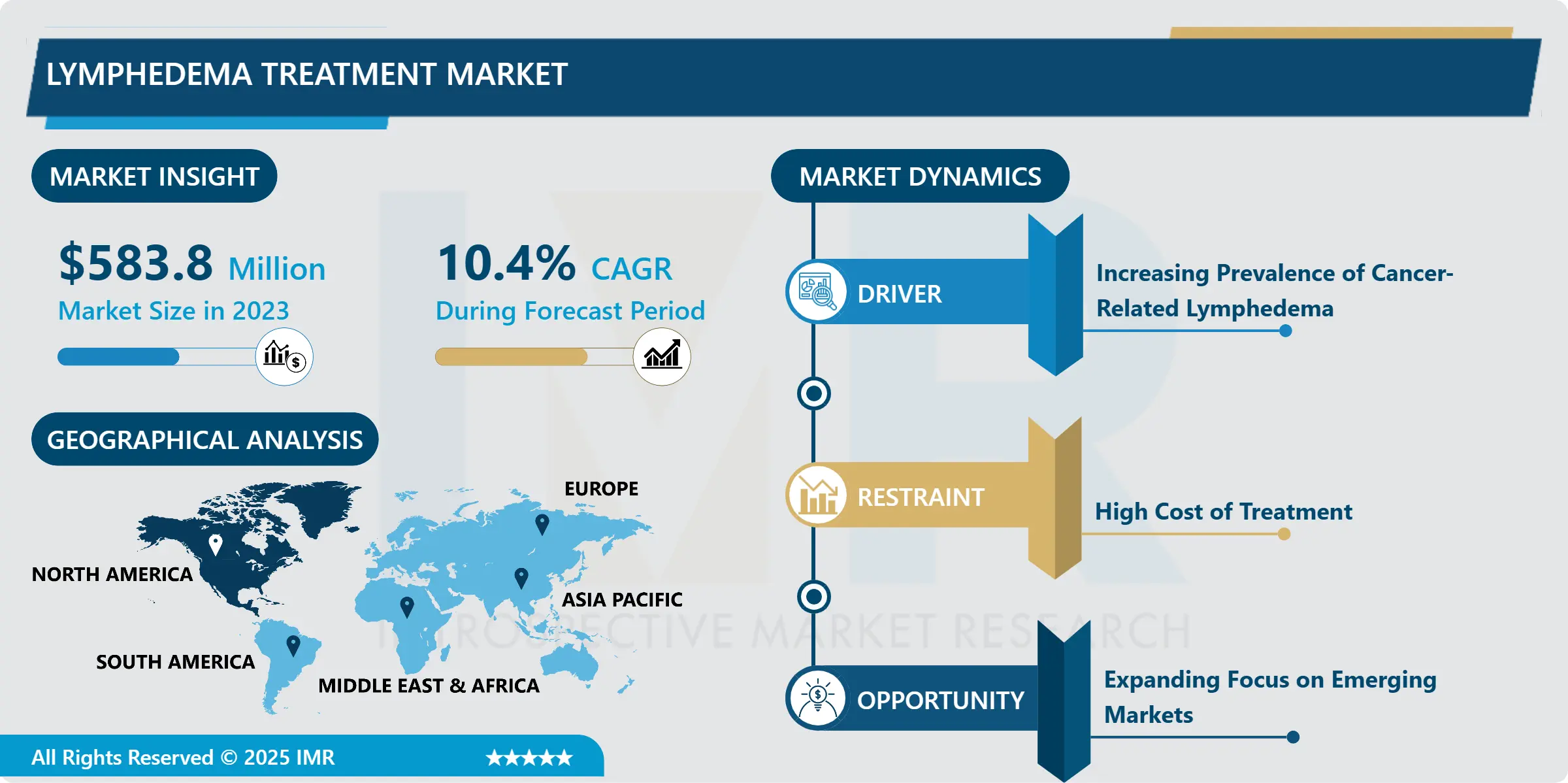
Lymphedema Treatment Market Size Was Valued at USD 583.8 Million in 2023, and is Projected to Reach USD 1,422.3 Million by 2032, Growing at a CAGR of 10.4% From 2024-2032.
The Lymphededa Treatment Market is the market of all therapies, devices and medical services for the treatment of lymphedema as a chronic pathological condition accompanied by lymphatic fluid stasis, which results in limb swelling. It considers the aspects of prevention, symptoms control, and breakthrough products and technologies that can help to treat the disease and enhance patient’s quality of life and slow the disease progression.
Lymphedema is a permanent complication that occurs in millions of people around the world and is secondary to surgery, oncological therapy, or inherited diseases of the lymphatic system. Workup and treatment of this disorder involve nonpharmacological and pharmacological management, surgical procedures, and targeted patient counseling. The growing incidence of cancer-related lymphedema has been a crucial force behind the improvement of the treatment approaches in the present health system. However, health/medical organisations’ awareness campaigns have also increased early detection and managing of this disorder.
The current market is greatly dynamic due to technological changes and other innovations, which have brought new treatment techniques such as laser therapy and improved pneumatic compression device. The staple of lymphedema therapeutic approach – compression garments – never cease to improve in terms of comfort and effectiveness. At the same time, possibilities of medications have been studied, and further research is carried out for the use of anti-inflammatory agents and enhancing lymphatic flow.
The market is highly expanding in the developed region because of well-developed health care facilities and favourable reimbursement regulations. On the other hand end user markets from emerging economy are coming up due to awareness and advancement in health care services. Still, there is a problem of high costs, skilled staff shortage, and low awareness in developing countries as well. As a result, the market of lymphedema treatment is expected to keep growing due to innovations and along with the enhancement of partnerships as well as the increasing number of patients.
Lymphedema Treatment Market Trend Analysis:
Adoption of Wearable Compression Devices
-
As technology advances, it evident that some of the newer products are band in the lymphedema treatment market in the wearables ares or wearable compression devices. These devices use new material technology and smart system to deliver constant and variable pressure support. These garments are not so tight and constraining as the conventional ones while the effectiveness of a treatment can also be assessed in real time.
- The combined use of IoT and data analytics in wearables has been revolutionary in the development of compression devices. Clients can also monitor their progress about the interconnected applications while clinicians gain insights about clients’ progress to help improve treatment plans. While it helps boost compliance with treatments, this trend also fits the modern world’s trend of patient-centered care. In the course of increasing advancement in wearable technology the use in chronic illness such as lymphedema is likely to grow.
Expanding Focus on Emerging Markets
-
The lymphedema treatment industry is currently in the exploratory stage in emerging markets. Asia, Africa and Latin American countries are seeing enhanced focus and spending on health care and campaigns about diseases such as lymphedema. The governments, and the non-governmental organizations are also paying attention in the improvement of availability of medical devices and therapies in these areas.
- With growth in the healthcare system, the manufacturers, therefore, get a chance to set into these areas with effective treatment solutions that are cheap. Mentioned above cooperation with local distributors and healthcare can also advance market development and penetration. Exploiting such possibilities can help fill the gaps in predefined treatment and simultaneously fuel growth across different markets in varying parts of the world.
Lymphedema Treatment Market Segment Analysis:
Lymphedema Treatment Market is Segmented on the basis of Treatment Type, Affected Area, End User, and Region.
By Treatment Type, Compression Therapy segment is expected to dominate the market during the forecast period
-
Lymphedema management is the present gold standard of care in the treatment of compression therapy on the basis of its efficacy in alleviating the symptoms of lymphedema such as reduced limb swelling and improved lymphatic drainage. They include the compression garments, bandages and pneumatic devices that forms part of the long-term treatment processes. Still, strategies include laser therapy and drug therapies are emerging, offering solutions for complicated problems.
- For severe forms of the disease, surgical treatments including lymphovenous anastomosis and vascularized lymph node transfer are now employed. Although both of these options are invasive and expensive, the recent technical developments in microsurgery have led to increased effectiveness numbers. A number of treatment types being offered out there demonstrate the market’s awareness of the different needs of the lymphedema patients.
By End User, Hospitals segment expected to held the largest share
-
The largest end user segment comprises hospitals as they fulfill a categorical diagnosis and therapeutic treatment and have the capability to perform various surgeries if necessary. Outpatient service providers like clinic and ambulatory surgical centers are also proving popular for those who need to undergo some form of surgery or require aftercare services. The above settings provide affordability as well as access to the patients.
- Homecare settings are already appearing as a unique segment, there is a tendency toward the administration of extended illnesses at home. Easy-to-transport pneumatic compression devices and accurate wearing instruments have improved the accessibility of a home-based treatment service, making this segment a significant opportunity.
Lymphedema Treatment Market Regional Insights:
North America is Expected to Dominate the Market Over the Forecast period
-
North America dominates the global market of lymphedema treatment due to good healthcare facilities and higher rates of cancer induced lymphedema. Strong reimbursement practices and the accessibility of modern technologies from clinical workstation strengthen the region’s superiority. Awareness campaigns and patient education initiatives have also gone hand in hand to ensure that early diagnosis has been made possible by the public together with effective management is being enhanced.
- That key market players are located in United States and Canada ensures constant advancement and availability of the therapies. Analyzing the regional trends in the global market, this area is very strong in the searching for new drugs and least invasive surgical interventions, which confirmed its leading position in the world.
Active Key Players in the Lymphedema Treatment Market:
-
Tactile Medical (USA)
- Bio Compression Systems (USA)
- SIGVARIS Group (Switzerland)
- 3M Health Care (USA)
- BSN Medical (Germany)
- Lohmann & Rauscher (Germany)
- Arjo (Sweden)
- Lympha Press (Israel)
- Paul Hartmann AG (Germany)
- AIROS Medical (USA)
- Koya Medical (USA)
- Mego Afek (Israel), and Other Active Players
Key Industry Developments in the Lymphedema Treatment Market:
-
In June 2023, PAUL HARTMANN AG announced its partnership with Sigvaris for the innovative compression wraps and liners range that are used as compression therapy for the treatment of lymphedema.
|
Global Lymphedema Treatment Market |
|||
|
Base Year: |
2023 |
Forecast Period: |
2024-2032 |
|
Historical Data: |
2017 to 2023 |
Market Size in 2023: |
USD 583.8 Million |
|
Forecast Period 2024-32 CAGR: |
10.4% |
Market Size in 2032: |
USD 1,422.3 Million |
|
Segments Covered: |
By Treatment Type |
|
|
|
By Affected Area |
|
||
|
By End User |
|
||
|
By Region |
|
||
|
Key Market Drivers: |
|
||
|
Key Market Restraints: |
|
||
|
Key Opportunities: |
|
||
|
Companies Covered in the report: |
|
||
Chapter 1: Introduction
1.1 Scope and Coverage
Chapter 2:Executive Summary
Chapter 3: Market Landscape
3.1 Market Dynamics
3.1.1 Drivers
3.1.2 Restraints
3.1.3 Opportunities
3.1.4 Challenges
3.2 Market Trend Analysis
3.3 PESTLE Analysis
3.4 Porter's Five Forces Analysis
3.5 Industry Value Chain Analysis
3.6 Ecosystem
3.7 Regulatory Landscape
3.8 Price Trend Analysis
3.9 Patent Analysis
3.10 Technology Evolution
3.11 Investment Pockets
3.12 Import-Export Analysis
Chapter 4: Lymphedema Treatment Market by Treatment Type
4.1 Lymphedema Treatment Market Snapshot and Growth Engine
4.2 Lymphedema Treatment Market Overview
4.3 Compression Therapy
4.3.1 Introduction and Market Overview
4.3.2 Historic and Forecasted Market Size in Value USD and Volume Units (2017-2032F)
4.3.3 Key Market Trends, Growth Factors and Opportunities
4.3.4 Compression Therapy: Geographic Segmentation Analysis
4.4 Drug Therapy
4.4.1 Introduction and Market Overview
4.4.2 Historic and Forecasted Market Size in Value USD and Volume Units (2017-2032F)
4.4.3 Key Market Trends, Growth Factors and Opportunities
4.4.4 Drug Therapy: Geographic Segmentation Analysis
4.5 Surgical Treatment
4.5.1 Introduction and Market Overview
4.5.2 Historic and Forecasted Market Size in Value USD and Volume Units (2017-2032F)
4.5.3 Key Market Trends, Growth Factors and Opportunities
4.5.4 Surgical Treatment: Geographic Segmentation Analysis
4.6 Pneumatic Compression Devices
4.6.1 Introduction and Market Overview
4.6.2 Historic and Forecasted Market Size in Value USD and Volume Units (2017-2032F)
4.6.3 Key Market Trends, Growth Factors and Opportunities
4.6.4 Pneumatic Compression Devices: Geographic Segmentation Analysis
4.7 Laser Therapy
4.7.1 Introduction and Market Overview
4.7.2 Historic and Forecasted Market Size in Value USD and Volume Units (2017-2032F)
4.7.3 Key Market Trends, Growth Factors and Opportunities
4.7.4 Laser Therapy: Geographic Segmentation Analysis
4.8 Others
4.8.1 Introduction and Market Overview
4.8.2 Historic and Forecasted Market Size in Value USD and Volume Units (2017-2032F)
4.8.3 Key Market Trends, Growth Factors and Opportunities
4.8.4 Others: Geographic Segmentation Analysis
Chapter 5: Lymphedema Treatment Market by Affected Area
5.1 Lymphedema Treatment Market Snapshot and Growth Engine
5.2 Lymphedema Treatment Market Overview
5.3 Lower Extremities
5.3.1 Introduction and Market Overview
5.3.2 Historic and Forecasted Market Size in Value USD and Volume Units (2017-2032F)
5.3.3 Key Market Trends, Growth Factors and Opportunities
5.3.4 Lower Extremities: Geographic Segmentation Analysis
5.4 Upper Extremities
5.4.1 Introduction and Market Overview
5.4.2 Historic and Forecasted Market Size in Value USD and Volume Units (2017-2032F)
5.4.3 Key Market Trends, Growth Factors and Opportunities
5.4.4 Upper Extremities: Geographic Segmentation Analysis
5.5 Genitalia
5.5.1 Introduction and Market Overview
5.5.2 Historic and Forecasted Market Size in Value USD and Volume Units (2017-2032F)
5.5.3 Key Market Trends, Growth Factors and Opportunities
5.5.4 Genitalia: Geographic Segmentation Analysis
5.6 Others
5.6.1 Introduction and Market Overview
5.6.2 Historic and Forecasted Market Size in Value USD and Volume Units (2017-2032F)
5.6.3 Key Market Trends, Growth Factors and Opportunities
5.6.4 Others: Geographic Segmentation Analysis
Chapter 6: Lymphedema Treatment Market by End User
6.1 Lymphedema Treatment Market Snapshot and Growth Engine
6.2 Lymphedema Treatment Market Overview
6.3 Hospitals
6.3.1 Introduction and Market Overview
6.3.2 Historic and Forecasted Market Size in Value USD and Volume Units (2017-2032F)
6.3.3 Key Market Trends, Growth Factors and Opportunities
6.3.4 Hospitals: Geographic Segmentation Analysis
6.4 Clinics
6.4.1 Introduction and Market Overview
6.4.2 Historic and Forecasted Market Size in Value USD and Volume Units (2017-2032F)
6.4.3 Key Market Trends, Growth Factors and Opportunities
6.4.4 Clinics: Geographic Segmentation Analysis
6.5 Ambulatory Surgical Centers
6.5.1 Introduction and Market Overview
6.5.2 Historic and Forecasted Market Size in Value USD and Volume Units (2017-2032F)
6.5.3 Key Market Trends, Growth Factors and Opportunities
6.5.4 Ambulatory Surgical Centers: Geographic Segmentation Analysis
6.6 Homecare Settings
6.6.1 Introduction and Market Overview
6.6.2 Historic and Forecasted Market Size in Value USD and Volume Units (2017-2032F)
6.6.3 Key Market Trends, Growth Factors and Opportunities
6.6.4 Homecare Settings: Geographic Segmentation Analysis
6.7 Others
6.7.1 Introduction and Market Overview
6.7.2 Historic and Forecasted Market Size in Value USD and Volume Units (2017-2032F)
6.7.3 Key Market Trends, Growth Factors and Opportunities
6.7.4 Others: Geographic Segmentation Analysis
Chapter 7: Company Profiles and Competitive Analysis
7.1 Competitive Landscape
7.1.1 Competitive Benchmarking
7.1.2 Lymphedema Treatment Market Share by Manufacturer (2023)
7.1.3 Industry BCG Matrix
7.1.4 Heat Map Analysis
7.1.5 Mergers and Acquisitions
7.2 TACTILE MEDICAL (USA)
7.2.1 Company Overview
7.2.2 Key Executives
7.2.3 Company Snapshot
7.2.4 Role of the Company in the Market
7.2.5 Sustainability and Social Responsibility
7.2.6 Operating Business Segments
7.2.7 Product Portfolio
7.2.8 Business Performance
7.2.9 Key Strategic Moves and Recent Developments
7.2.10 SWOT Analysis
7.3 BIO COMPRESSION SYSTEMS (USA)
7.4 SIGVARIS GROUP (SWITZERLAND)
7.5 3M HEALTH CARE (USA)
7.6 BSN MEDICAL (GERMANY)
7.7 LOHMANN & RAUSCHER (GERMANY)
7.8 ARJO (SWEDEN)
7.9 LYMPHA PRESS (ISRAEL)
7.10 PAUL HARTMANN AG (GERMANY)
7.11 AIROS MEDICAL (USA)
7.12 KOYA MEDICAL (USA)
7.13 MEGO AFEK (ISRAEL)
7.14 OTHER ACTIVE PLAYERS
Chapter 8: Global Lymphedema Treatment Market By Region
8.1 Overview
8.2. North America Lymphedema Treatment Market
8.2.1 Key Market Trends, Growth Factors and Opportunities
8.2.2 Top Key Companies
8.2.3 Historic and Forecasted Market Size by Segments
8.2.4 Historic and Forecasted Market Size By Treatment Type
8.2.4.1 Compression Therapy
8.2.4.2 Drug Therapy
8.2.4.3 Surgical Treatment
8.2.4.4 Pneumatic Compression Devices
8.2.4.5 Laser Therapy
8.2.4.6 Others
8.2.5 Historic and Forecasted Market Size By Affected Area
8.2.5.1 Lower Extremities
8.2.5.2 Upper Extremities
8.2.5.3 Genitalia
8.2.5.4 Others
8.2.6 Historic and Forecasted Market Size By End User
8.2.6.1 Hospitals
8.2.6.2 Clinics
8.2.6.3 Ambulatory Surgical Centers
8.2.6.4 Homecare Settings
8.2.6.5 Others
8.2.7 Historic and Forecast Market Size by Country
8.2.7.1 US
8.2.7.2 Canada
8.2.7.3 Mexico
8.3. Eastern Europe Lymphedema Treatment Market
8.3.1 Key Market Trends, Growth Factors and Opportunities
8.3.2 Top Key Companies
8.3.3 Historic and Forecasted Market Size by Segments
8.3.4 Historic and Forecasted Market Size By Treatment Type
8.3.4.1 Compression Therapy
8.3.4.2 Drug Therapy
8.3.4.3 Surgical Treatment
8.3.4.4 Pneumatic Compression Devices
8.3.4.5 Laser Therapy
8.3.4.6 Others
8.3.5 Historic and Forecasted Market Size By Affected Area
8.3.5.1 Lower Extremities
8.3.5.2 Upper Extremities
8.3.5.3 Genitalia
8.3.5.4 Others
8.3.6 Historic and Forecasted Market Size By End User
8.3.6.1 Hospitals
8.3.6.2 Clinics
8.3.6.3 Ambulatory Surgical Centers
8.3.6.4 Homecare Settings
8.3.6.5 Others
8.3.7 Historic and Forecast Market Size by Country
8.3.7.1 Russia
8.3.7.2 Bulgaria
8.3.7.3 The Czech Republic
8.3.7.4 Hungary
8.3.7.5 Poland
8.3.7.6 Romania
8.3.7.7 Rest of Eastern Europe
8.4. Western Europe Lymphedema Treatment Market
8.4.1 Key Market Trends, Growth Factors and Opportunities
8.4.2 Top Key Companies
8.4.3 Historic and Forecasted Market Size by Segments
8.4.4 Historic and Forecasted Market Size By Treatment Type
8.4.4.1 Compression Therapy
8.4.4.2 Drug Therapy
8.4.4.3 Surgical Treatment
8.4.4.4 Pneumatic Compression Devices
8.4.4.5 Laser Therapy
8.4.4.6 Others
8.4.5 Historic and Forecasted Market Size By Affected Area
8.4.5.1 Lower Extremities
8.4.5.2 Upper Extremities
8.4.5.3 Genitalia
8.4.5.4 Others
8.4.6 Historic and Forecasted Market Size By End User
8.4.6.1 Hospitals
8.4.6.2 Clinics
8.4.6.3 Ambulatory Surgical Centers
8.4.6.4 Homecare Settings
8.4.6.5 Others
8.4.7 Historic and Forecast Market Size by Country
8.4.7.1 Germany
8.4.7.2 UK
8.4.7.3 France
8.4.7.4 The Netherlands
8.4.7.5 Italy
8.4.7.6 Spain
8.4.7.7 Rest of Western Europe
8.5. Asia Pacific Lymphedema Treatment Market
8.5.1 Key Market Trends, Growth Factors and Opportunities
8.5.2 Top Key Companies
8.5.3 Historic and Forecasted Market Size by Segments
8.5.4 Historic and Forecasted Market Size By Treatment Type
8.5.4.1 Compression Therapy
8.5.4.2 Drug Therapy
8.5.4.3 Surgical Treatment
8.5.4.4 Pneumatic Compression Devices
8.5.4.5 Laser Therapy
8.5.4.6 Others
8.5.5 Historic and Forecasted Market Size By Affected Area
8.5.5.1 Lower Extremities
8.5.5.2 Upper Extremities
8.5.5.3 Genitalia
8.5.5.4 Others
8.5.6 Historic and Forecasted Market Size By End User
8.5.6.1 Hospitals
8.5.6.2 Clinics
8.5.6.3 Ambulatory Surgical Centers
8.5.6.4 Homecare Settings
8.5.6.5 Others
8.5.7 Historic and Forecast Market Size by Country
8.5.7.1 China
8.5.7.2 India
8.5.7.3 Japan
8.5.7.4 South Korea
8.5.7.5 Malaysia
8.5.7.6 Thailand
8.5.7.7 Vietnam
8.5.7.8 The Philippines
8.5.7.9 Australia
8.5.7.10 New Zealand
8.5.7.11 Rest of APAC
8.6. Middle East & Africa Lymphedema Treatment Market
8.6.1 Key Market Trends, Growth Factors and Opportunities
8.6.2 Top Key Companies
8.6.3 Historic and Forecasted Market Size by Segments
8.6.4 Historic and Forecasted Market Size By Treatment Type
8.6.4.1 Compression Therapy
8.6.4.2 Drug Therapy
8.6.4.3 Surgical Treatment
8.6.4.4 Pneumatic Compression Devices
8.6.4.5 Laser Therapy
8.6.4.6 Others
8.6.5 Historic and Forecasted Market Size By Affected Area
8.6.5.1 Lower Extremities
8.6.5.2 Upper Extremities
8.6.5.3 Genitalia
8.6.5.4 Others
8.6.6 Historic and Forecasted Market Size By End User
8.6.6.1 Hospitals
8.6.6.2 Clinics
8.6.6.3 Ambulatory Surgical Centers
8.6.6.4 Homecare Settings
8.6.6.5 Others
8.6.7 Historic and Forecast Market Size by Country
8.6.7.1 Turkiye
8.6.7.2 Bahrain
8.6.7.3 Kuwait
8.6.7.4 Saudi Arabia
8.6.7.5 Qatar
8.6.7.6 UAE
8.6.7.7 Israel
8.6.7.8 South Africa
8.7. South America Lymphedema Treatment Market
8.7.1 Key Market Trends, Growth Factors and Opportunities
8.7.2 Top Key Companies
8.7.3 Historic and Forecasted Market Size by Segments
8.7.4 Historic and Forecasted Market Size By Treatment Type
8.7.4.1 Compression Therapy
8.7.4.2 Drug Therapy
8.7.4.3 Surgical Treatment
8.7.4.4 Pneumatic Compression Devices
8.7.4.5 Laser Therapy
8.7.4.6 Others
8.7.5 Historic and Forecasted Market Size By Affected Area
8.7.5.1 Lower Extremities
8.7.5.2 Upper Extremities
8.7.5.3 Genitalia
8.7.5.4 Others
8.7.6 Historic and Forecasted Market Size By End User
8.7.6.1 Hospitals
8.7.6.2 Clinics
8.7.6.3 Ambulatory Surgical Centers
8.7.6.4 Homecare Settings
8.7.6.5 Others
8.7.7 Historic and Forecast Market Size by Country
8.7.7.1 Brazil
8.7.7.2 Argentina
8.7.7.3 Rest of SA
Chapter 9 Analyst Viewpoint and Conclusion
9.1 Recommendations and Concluding Analysis
9.2 Potential Market Strategies
Chapter 10 Research Methodology
10.1 Research Process
10.2 Primary Research
10.3 Secondary Research
|
Global Lymphedema Treatment Market |
|||
|
Base Year: |
2023 |
Forecast Period: |
2024-2032 |
|
Historical Data: |
2017 to 2023 |
Market Size in 2023: |
USD 583.8 Million |
|
Forecast Period 2024-32 CAGR: |
10.4% |
Market Size in 2032: |
USD 1,422.3 Million |
|
Segments Covered: |
By Treatment Type |
|
|
|
By Affected Area |
|
||
|
By End User |
|
||
|
By Region |
|
||
|
Key Market Drivers: |
|
||
|
Key Market Restraints: |
|
||
|
Key Opportunities: |
|
||
|
Companies Covered in the report: |
|
||


