Long-Term Care Market Synopsis:
Long Term Care Market Size Was Valued at USD 1.12 Trillion in 2023, and is Projected to Reach USD 2.01 Trillion by 2032, Growing at a CAGR of 6.69 % From 2024-2032.
The LTC market concerns a wide range of services and support systems necessary for those who need long-term care due to chronic illnesses, disabilities, or old age. It includes various types of care, including nursing homes, assisted living, home health care, and hospice. LTC aims to coordinate medical and non-medical care services that would make the patients meet their requirements as they go about their normal activities in their daily lives to improve their lifespan. As a result of the aging population in most countries due to prolonged lives of people, these services have been on the rise making LTC crucial in most global healthcare systems.
Long-Term Care market has been implementing at a very higher rate due to increasing life expectancy of care and increasing incidences of chronic diseases. The important factors include developed countries such as the United States, Europe, and Japan because many people within these regions have attained advanced age. Because this group of people is on the rise there is now a need for prudent care, such as skilled nursing centres and assisted living facilities. As to demography shifts, economic development, increasing rates of urbanization, new types of families, and healthcare expansion, the developing countries are responding to the growing need for long-term care. Growing urbanization therefore implies that many households are located in urban settings, and elderly individuals have no cultural resources of care, hence, the need for LTC services.
Another driver of the LTC market is technical advancement since new technologies enhance the management of the patient in such facilities. Also, existing government policies and funding resources for the healthcare sector and improvement of care services delivery arrangements are further acting as strategies for market expansion. Increased improvement in the quality of health and utilization of customer-based consuming health care, customer-friendly and comfortable services have forced many of the senior care suppliers to capture and use advanced care services to foster this market.
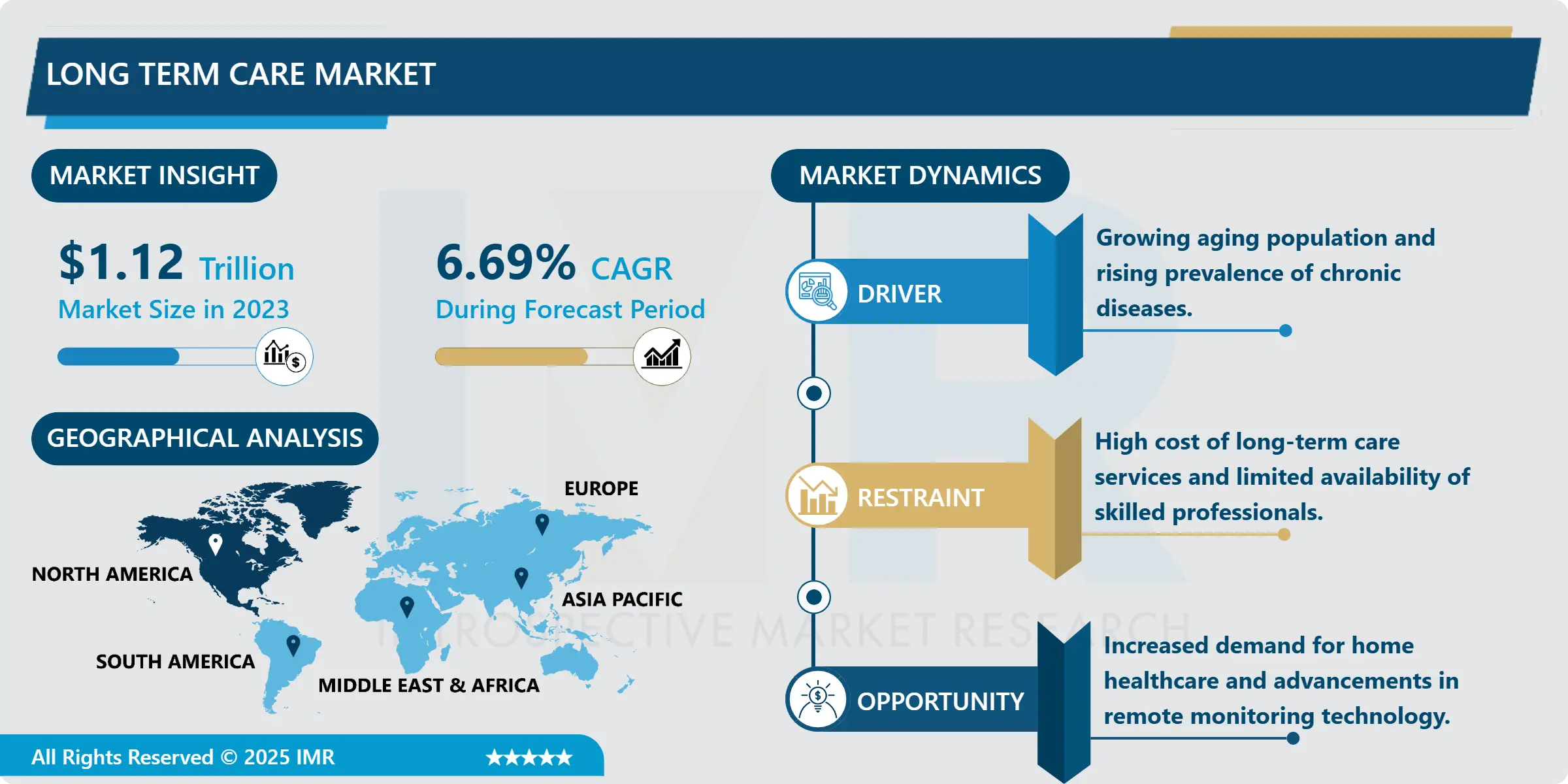
Long-Term Care Market Trend Analysis:
Technology Integration in Long-Term Care
- Another trend that has been experienced in the LTC market is the management use of technology in the delivery of services to enhance service delivery and reduce the cost. from the clothing devices used in health monitoring to the technologies fostering distant consultancies, technology is now redefining long-term healthcare. It can track temperature, and motion and be able to alert caregivers in the case that there is a relapse of life among the residents making it safe to contain residents. Also, the system includes an important component – electronic health records; this allows the sharing of any information about the patient and his/her condition with all caregiver’s physicians and families as well in an instant. AI and especially predictive analysis assist care providers in identifying potential health issues, and then develop means of preventing them. So, it is for the patient's convenience as well as it enhances the possibility of expanding the service offering of the LTC services factor especially where the services offered are for home health situations.
Growing Demand for Home-Based Care Solutions
- Taking into account the increase in the popularity of in-home care services in the future development might be linked to the development of the segment providing in-home services. Many more patents and families prefer home care since the patient would prefer to be in familiar territory where he or she feels at ease hence improving the efficiency and effectiveness of the patient. Mobile health and technology over the years, ways of managing patients away from face-to-face contact, remote patient monitoring, telemedicine – all these enable skilled-home based long-term care and may transform other aspects of healthcare services that are offered can be given to the patient without him or her being compelled to leave the house. Besides, the cost of health is raising, therefore, home care costs less than the institutional care. Further evidence for this change can be gathered from insurance firms, government departments, and incentive-based programs that are expanding their service portfolio to encompass home-based LTC services.
Long-Term Care Market Segment Analysis:
Long Term Care Market is Segmented on the basis of service, payer, and region.
By Service, the Home Health Care segment is expected to dominate the market during the forecast period
- Future market share of the HHC segment appears promising in the long-term care business because of increasing demand for convenient, cost-effective and customized care services. There are also home health care services that offer formal care in the client’s home to receive required medical and non-medical services while feeling at ease in their own surroundings. It has become the most appropriate given that many people especially the aging population wish to stay in their homes till they die and those with chronic ailments who will need frequent monitoring but do not meet hospital admission standards.: Technological advancements that spearhead remote patient monitoring, telehealth, as well as other mobile health applications, also work as drivers for this segment as healthcare becomes easier to provide outside the health system’s confines. LTC segment that is home healthcare is hugely in demand as insurers and healthcare providers carry on realizing that the market is helpful to them fiscally as patients appreciate receiving home healthcare more than institutionalized care.
By Payer, Public segment is expected to held the largest share
- The market share of LTCP in public zone will be segmenting the LTCP-funded facilities as well as the public projects, is going to have the largest market share. As for now, virtually every country of the world has state sponsored long term care system necessary for elders or disabled who cannot afford to pay for it privately. It is also important to underline that despite the developed social healthcare prevention in given countries public financing is defining a big share of expenses for LTC and state supported facilities remain being an essential part of health care complex. Some of the future government continuing care includes new nursing home care and other community-based services that allow a person to take care services right in his or her home. Further development of this segment is supported by measures in the sphere of development of free healthcare services, increasing DENSSAUD of quality, and financing in the sphere of LTC to meet the need of growing numbers of people for accessible and high-quality medical services.
Long-Term Care Market Regional Insights:
North America is Expected to Dominate the Market Over the Forecast period
- In the forecast period, North America is expected to lead this global market due to strong health care infrastructure, a huge population of people above the age of 65 years, and rising investment in care homes and care services. A relatively extensively used service in the United States, that is, the LTC services is more being consumed by the Baby Boomers as they join the retirement bracket more and therefore, would require immense overseeing, long term, specialized medical services. Senior citizens have a lot of services under such federal programs as Medicare as well as Medicaid, while the states have come up with new programs regarding the improvement of the LTC facilities and staffing since the senior care services market continues to expand.
- Also, the factors of increasing adoption trends from technology in the healthcare sector in the North American region make the increase in the long-term care services market. Telehealth services, RPM and HIE has been integrated in majority of the LTC facilities and home healthcare service providers as ways of improving patient care and administrative work. The fact that people need a higher quality of care due to technological advancement and the continuous growth of structures in LTC is why North America is an influential player in the global LTC market. Therefore, over the forecast period, the region is expected to be the largest market driven by its high contribution to the global LTC market size and setting best practices for LTC on a global level.
Active Key Players in the Long-Term Care Market:
- Amedisys Inc. (USA)
- Brookdale Senior Living (USA)
- Extendicare (Canada)
- Genesis Healthcare (USA)
- Golden Living Centers (USA)
- HCR ManorCare (USA)
- Home Instead Senior Care (USA)
- Kindred Healthcare (USA)
- LHC Group (USA)
- Orpea Group (France)
- Revera Inc. (Canada)
- Royal Dutch Shell (UK)
- Sunrise Senior Living (USA)
- The Ensign Group (USA)
- The Evangelical Lutheran Good Samaritan Society (USA)
- Other Active Players
|
Long-Term Care Market |
|||
|
Base Year: |
2023 |
Forecast Period: |
2024-2032 |
|
Historical Data: |
2017 to 2023 |
Market Size in 2023: |
USD 1.12 Trillion |
|
Forecast Period 2024-32 CAGR: |
6.69 % |
Market Size in 2032: |
USD 2.01 Trillion |
|
Segments Covered: |
By Service |
|
|
|
By Payer |
|
||
|
By Region |
|
||
|
Key Market Drivers: |
|
||
|
Key Market Restraints: |
|
||
|
Key Opportunities: |
|
||
|
Companies Covered in the report: |
|
||
Chapter 1: Introduction
1.1 Scope and Coverage
Chapter 2:Executive Summary
Chapter 3: Market Landscape
3.1 Market Dynamics
3.1.1 Drivers
3.1.2 Restraints
3.1.3 Opportunities
3.1.4 Challenges
3.2 Market Trend Analysis
3.3 PESTLE Analysis
3.4 Porter's Five Forces Analysis
3.5 Industry Value Chain Analysis
3.6 Ecosystem
3.7 Regulatory Landscape
3.8 Price Trend Analysis
3.9 Patent Analysis
3.10 Technology Evolution
3.11 Investment Pockets
3.12 Import-Export Analysis
Chapter 4: Long-Term Care Market by Service
4.1 Long-Term Care Market Snapshot and Growth Engine
4.2 Long-Term Care Market Overview
4.3 Home health care
4.3.1 Introduction and Market Overview
4.3.2 Historic and Forecasted Market Size in Value USD and Volume Units (2017-2032F)
4.3.3 Key Market Trends, Growth Factors and Opportunities
4.3.4 Home health care: Geographic Segmentation Analysis
4.4 Hospice
4.4.1 Introduction and Market Overview
4.4.2 Historic and Forecasted Market Size in Value USD and Volume Units (2017-2032F)
4.4.3 Key Market Trends, Growth Factors and Opportunities
4.4.4 Hospice: Geographic Segmentation Analysis
4.5 Nursing Care
4.5.1 Introduction and Market Overview
4.5.2 Historic and Forecasted Market Size in Value USD and Volume Units (2017-2032F)
4.5.3 Key Market Trends, Growth Factors and Opportunities
4.5.4 Nursing Care: Geographic Segmentation Analysis
4.6 Assisted Living Facilities
4.6.1 Introduction and Market Overview
4.6.2 Historic and Forecasted Market Size in Value USD and Volume Units (2017-2032F)
4.6.3 Key Market Trends, Growth Factors and Opportunities
4.6.4 Assisted Living Facilities: Geographic Segmentation Analysis
4.7 Others
4.7.1 Introduction and Market Overview
4.7.2 Historic and Forecasted Market Size in Value USD and Volume Units (2017-2032F)
4.7.3 Key Market Trends, Growth Factors and Opportunities
4.7.4 Others: Geographic Segmentation Analysis
Chapter 5: Company Profiles and Competitive Analysis
5.1 Competitive Landscape
5.1.1 Competitive Benchmarking
5.1.2 Long-Term Care Market Share by Manufacturer (2023)
5.1.3 Industry BCG Matrix
5.1.4 Heat Map Analysis
5.1.5 Mergers and Acquisitions
5.2 BROOKDALE SENIOR LIVING
5.2.1 Company Overview
5.2.2 Key Executives
5.2.3 Company Snapshot
5.2.4 Role of the Company in the Market
5.2.5 Sustainability and Social Responsibility
5.2.6 Operating Business Segments
5.2.7 Product Portfolio
5.2.8 Business Performance
5.2.9 Key Strategic Moves and Recent Developments
5.2.10 SWOT Analysis
5.3 EXTENDICARE
5.4 GENESIS HEALTHCARE
5.5 KINDRED HEALTHCARE
5.6 AND SUNRISE SENIOR LIVING
5.7 OTHER ACTIVE PLAYERS
Chapter 6: Global Long-Term Care Market By Region
6.1 Overview
6.2. North America Long-Term Care Market
6.2.1 Key Market Trends, Growth Factors and Opportunities
6.2.2 Top Key Companies
6.2.3 Historic and Forecasted Market Size by Segments
6.2.4 Historic and Forecasted Market Size By Service
6.2.4.1 Home health care
6.2.4.2 Hospice
6.2.4.3 Nursing Care
6.2.4.4 Assisted Living Facilities
6.2.4.5 Others
6.2.5 Historic and Forecast Market Size by Country
6.2.5.1 US
6.2.5.2 Canada
6.2.5.3 Mexico
6.3. Eastern Europe Long-Term Care Market
6.3.1 Key Market Trends, Growth Factors and Opportunities
6.3.2 Top Key Companies
6.3.3 Historic and Forecasted Market Size by Segments
6.3.4 Historic and Forecasted Market Size By Service
6.3.4.1 Home health care
6.3.4.2 Hospice
6.3.4.3 Nursing Care
6.3.4.4 Assisted Living Facilities
6.3.4.5 Others
6.3.5 Historic and Forecast Market Size by Country
6.3.5.1 Russia
6.3.5.2 Bulgaria
6.3.5.3 The Czech Republic
6.3.5.4 Hungary
6.3.5.5 Poland
6.3.5.6 Romania
6.3.5.7 Rest of Eastern Europe
6.4. Western Europe Long-Term Care Market
6.4.1 Key Market Trends, Growth Factors and Opportunities
6.4.2 Top Key Companies
6.4.3 Historic and Forecasted Market Size by Segments
6.4.4 Historic and Forecasted Market Size By Service
6.4.4.1 Home health care
6.4.4.2 Hospice
6.4.4.3 Nursing Care
6.4.4.4 Assisted Living Facilities
6.4.4.5 Others
6.4.5 Historic and Forecast Market Size by Country
6.4.5.1 Germany
6.4.5.2 UK
6.4.5.3 France
6.4.5.4 The Netherlands
6.4.5.5 Italy
6.4.5.6 Spain
6.4.5.7 Rest of Western Europe
6.5. Asia Pacific Long-Term Care Market
6.5.1 Key Market Trends, Growth Factors and Opportunities
6.5.2 Top Key Companies
6.5.3 Historic and Forecasted Market Size by Segments
6.5.4 Historic and Forecasted Market Size By Service
6.5.4.1 Home health care
6.5.4.2 Hospice
6.5.4.3 Nursing Care
6.5.4.4 Assisted Living Facilities
6.5.4.5 Others
6.5.5 Historic and Forecast Market Size by Country
6.5.5.1 China
6.5.5.2 India
6.5.5.3 Japan
6.5.5.4 South Korea
6.5.5.5 Malaysia
6.5.5.6 Thailand
6.5.5.7 Vietnam
6.5.5.8 The Philippines
6.5.5.9 Australia
6.5.5.10 New Zealand
6.5.5.11 Rest of APAC
6.6. Middle East & Africa Long-Term Care Market
6.6.1 Key Market Trends, Growth Factors and Opportunities
6.6.2 Top Key Companies
6.6.3 Historic and Forecasted Market Size by Segments
6.6.4 Historic and Forecasted Market Size By Service
6.6.4.1 Home health care
6.6.4.2 Hospice
6.6.4.3 Nursing Care
6.6.4.4 Assisted Living Facilities
6.6.4.5 Others
6.6.5 Historic and Forecast Market Size by Country
6.6.5.1 Turkiye
6.6.5.2 Bahrain
6.6.5.3 Kuwait
6.6.5.4 Saudi Arabia
6.6.5.5 Qatar
6.6.5.6 UAE
6.6.5.7 Israel
6.6.5.8 South Africa
6.7. South America Long-Term Care Market
6.7.1 Key Market Trends, Growth Factors and Opportunities
6.7.2 Top Key Companies
6.7.3 Historic and Forecasted Market Size by Segments
6.7.4 Historic and Forecasted Market Size By Service
6.7.4.1 Home health care
6.7.4.2 Hospice
6.7.4.3 Nursing Care
6.7.4.4 Assisted Living Facilities
6.7.4.5 Others
6.7.5 Historic and Forecast Market Size by Country
6.7.5.1 Brazil
6.7.5.2 Argentina
6.7.5.3 Rest of SA
Chapter 7 Analyst Viewpoint and Conclusion
7.1 Recommendations and Concluding Analysis
7.2 Potential Market Strategies
Chapter 8 Research Methodology
8.1 Research Process
8.2 Primary Research
8.3 Secondary Research
|
Long-Term Care Market |
|||
|
Base Year: |
2023 |
Forecast Period: |
2024-2032 |
|
Historical Data: |
2017 to 2023 |
Market Size in 2023: |
USD 1.12 Trillion |
|
Forecast Period 2024-32 CAGR: |
6.69 % |
Market Size in 2032: |
USD 2.01 Trillion |
|
Segments Covered: |
By Service |
|
|
|
By Payer |
|
||
|
By Region |
|
||
|
Key Market Drivers: |
|
||
|
Key Market Restraints: |
|
||
|
Key Opportunities: |
|
||
|
Companies Covered in the report: |
|
||