




Livestock Monitoring Market Synopsis
Livestock Monitoring Market Size Was Valued at USD 6.43 Billion in 2023, and is Projected to Reach USD 22.34 Billion by 2032, Growing at a CAGR of 15.4% From 2024-2032.
The Livestock Monitoring Market has been defined as the industry that is involved in the design, implementation and use of technologies like sensors, RFID tags, GPS tracking and software to track and manage health, behavior, location of livestock and their performance. This market being specifically tailored to agriculture and dairy industry, farmers and ranchers are able to use resources efficiently, improve stock, increase milk yield, and minimize loss from disease or suboptimal performance. The technology has IoT based devices, predictive analysis, and cloud base platforms to monitor and analyze the health of animals and timely AI assisted indication of diseases, breeding process control and efficient farming.
The market for livestock monitoring, as a segment of smart agriculture, experienced certain growth within the last several years due to the rising demand for environmentally friendly methods of farming, as well as constantly growing population of livestock across the globe. This is due to demands from the populace that want farmers to provide increase amount of food but with little capital to support the necessary increase in productivity and the increasing strain on the environment through the use of resources. These solutions are effective since they provide chances for tracking the health state of animals in real time, for disease detection at an early stage, and for making operations more efficient, which contributes to cost efficient and lower mortality of cattle. Moreover, the combination of AI and IoT in tracking animals in farms substituted a conventional farming approach and provides a predictive evaluation to inform the decision-making process.
New market opportunities are attributed to the higher levels of government backing for smart agriculture and raising customer awareness of cattle preservation. The increasing population’s need for dairy and meat and the desire for increased production have forced farmers to adopt modern monitoring technologies. Moreover, changes in sensors and cloud solutions have reduced the cost of the solutions and companies now use it even on small farms. With the change of the intensity and direction of global food consumption, the livestock monitoring market will continue to grow, promoting efficient farming industry.
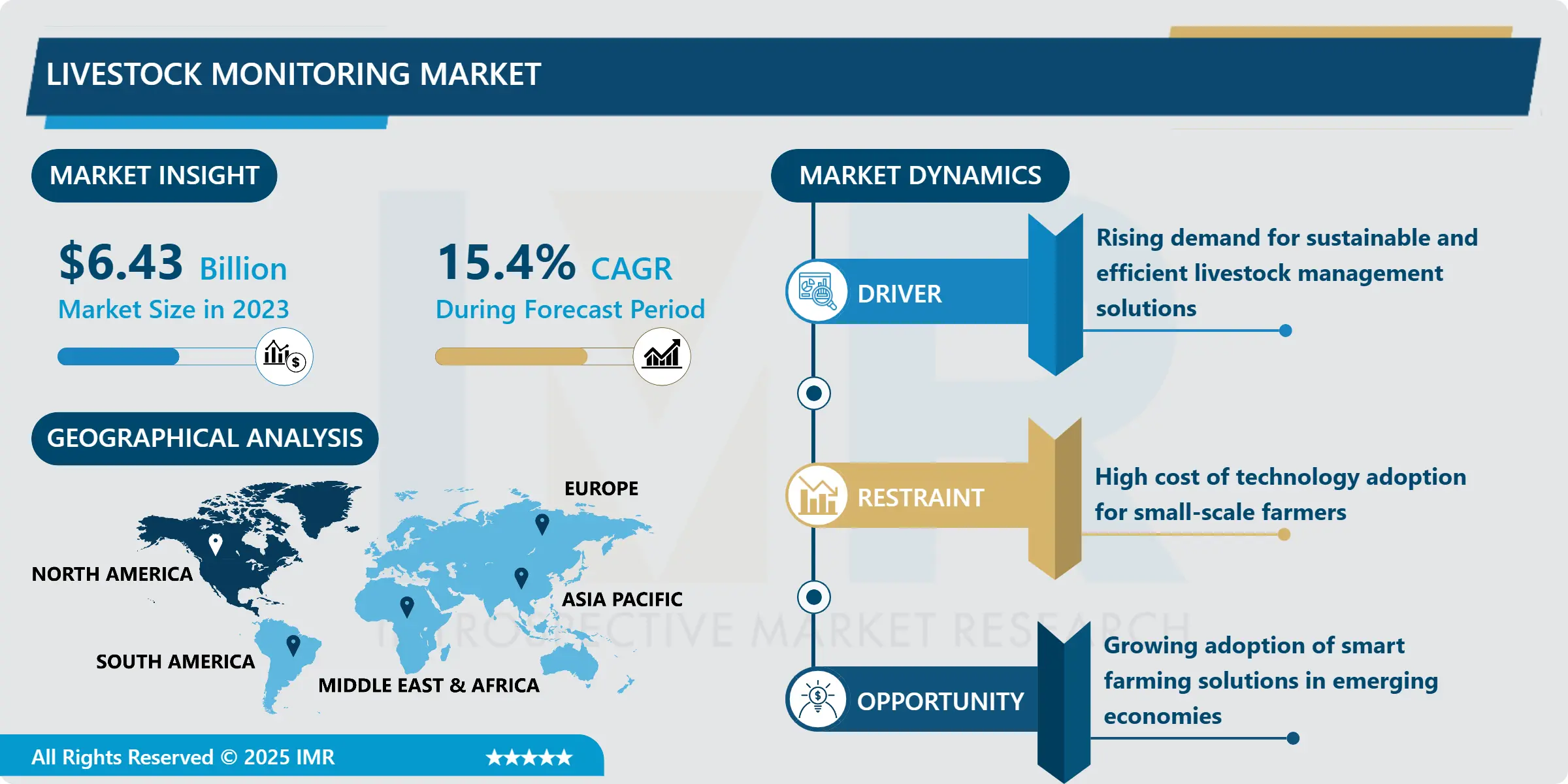
Livestock Monitoring Market Trend Analysis:
Rising Adoption of IoT in Livestock Monitoring
- Smart technologies and using the IoT is another tendency that appeared in the market of livestock monitoring systems. IoT makes it possible to monitor and capture actual data on the health, physical activity level and location of animals in real-time by means of sensors and other internet-connected appliances which then transfer the acquired information to the cloud.
- Trend is especially well observed in large-scale farms, where one may have to control thousands of animals. GroWTF-powered livestock tracking cuts on the involvement of human capital, enhances productivity, and enables early decision making based on data analytics. In addition, the growth of wearables and smart tags is making IoT integrated solutions far more practical applicably for farmers across the globe and integral to progress the use of these technologies.
Expansion of Livestock Monitoring in Emerging Economies
- Investment in livestock monitoring market among emerging economy players is a good opportunity for the market. Many countries in Asia-Pacific, Latin America and Africa are experiencing improvement in the number of livestock and increase in meat and dairy consumption. Nevertheless, these regions experience some issues that include low technology use and resource scarcities in conventional agriculture.
- Growing understanding of how smart solutions can help improve farming outcomes, combined with the support from governments in terms of funding or incentives, clarifying the importance of agriculture innovation, is paving the way for adoption of livestock monitoring systems. Challenges exist in these markets particularly the need for cheap and easily to use technologies which can change farming and increase yields in areas of scarce resources.
Livestock Monitoring Market Segment Analysis:
Livestock Monitoring Market is Segmented on the basis of Animal Type, Application, End User, and Region.
By Animal Type, Cattle segment is expected to dominate the market during the forecast period
- Hence, the cattle segment is predicted to hold the largest market share of the livestock monitoring market in the forecast period, attributed to a rapidly growing demand for milk and meat products all over the world. The technology safeguards cattle in various ways, promoting the production of milk, timely conception, and no cases of diseases in the huge herds that are majorly reared for dairy and beef production.
- Asin the case of dairy and beef cattle, large amounts of money are being spent on monitoring solutions because of farmer’s desire to get higher yields, as well as better health of their cattle. These systems let farmers recognize initial symptoms of diseases, feeding behaviors and even fertility cycles to improve profitability and sustainability among farming projects.
- In addition, newer technologies like the automatic milking and feeding systems have acted as a solid support to cattle monitoring solutions. By the progression of dairy and meat in production, particularly by countries in Europe and North America, there is a great demand of encouraging oversights of the cattle using the tracking systems. Thirdly, increased application of such technologies in the emerging markets continue to be expected to fuel the growth of this segment as awareness levels rise alongside government backing.
By Application, Milk Harvesting segment expected to held the largest share
- The milk harvesting segment is anticipated to remain the largest application for livestock monitoring as the global demand for milk and dairy products increases continuously. These systems for milking the cows are known as the automated milk harvesting and when combined with livestock monitoring, has had a significant positive impact with increased manufacturing throughput with the downstream effect of reducing countless somewhat manual labor. These systems are important in that they offer instantaneous views on milk production, udder conditions, and milking patterns, in terms of efficient use of resources and animal comfort.
- The progress of the robotic milking systems further enhances the consumption in the developed countries have boosted the sales of this segment. These systems enable farmers to produce high quantities of milk at the same time achieving high levels of quality and animal welfare. Given the increasing popularity of precision farming and smart dairy management milk harvesting segment will continue to grow, mainly in markets more saturated with dairy farms.
Livestock Monitoring Market Regional Insights:
North America is Expected to Dominate the Market Over the Forecast period
- As evaluated in a previous section, North America was the largest market for livestock monitoring in 2023 with a market share of approximately 35-40%. This may be attributed to the high levels of technology that has been installed in the farming of crops, and further enhanced by the many large-scale producers of dairy and meat products in this region.
- North American region especially the U.S and Canada have gained increased traction in adopting IoT-based solutions in livestock monitoring driven by government incentives and subsidies on smart farming. Also, the well-developed infrastructure and high level of awareness among farmers in the region have boosted the market in this region.
Active Key Players in the Livestock Monitoring Market:
- Afimilk Ltd. (Israel)
- Allflex (United States)
- BouMatic (United States)
- CowManager B.V. (Netherlands)
- Dairymaster (Ireland)
- DeLaval (Sweden)
- GEA Group AG (Germany)
- HerdInsights (Ireland)
- IceRobotics Ltd. (United Kingdom)
- Lely (Netherlands)
- Merck Animal Health (United States)
- Nedap N.V. (Netherlands)
- SCR Dairy (Israel)
- Smartbow (Austria)
- Zoetis Inc. (United States), and Other Active Players
|
Livestock Monitoring Market |
|||
|
Base Year: |
2023 |
Forecast Period: |
2024-2032 |
|
Historical Data: |
2017 to 2023 |
Market Size in 2023: |
USD 6.43 Billion |
|
Forecast Period 2024-32 CAGR: |
15.4% |
Market Size in 2032: |
USD 22.34 Billion |
|
Segments Covered: |
By Animal Type |
|
|
|
By Application |
|
||
|
By End User |
|
||
|
By Region |
|
||
|
Key Market Drivers: |
|
||
|
Key Market Restraints: |
|
||
|
Key Opportunities: |
|
||
|
Companies Covered in the report: |
|
||
Chapter 1: Introduction
1.1 Scope and Coverage
Chapter 2:Executive Summary
Chapter 3: Market Landscape
3.1 Market Dynamics
3.1.1 Drivers
3.1.2 Restraints
3.1.3 Opportunities
3.1.4 Challenges
3.2 Market Trend Analysis
3.3 PESTLE Analysis
3.4 Porter's Five Forces Analysis
3.5 Industry Value Chain Analysis
3.6 Ecosystem
3.7 Regulatory Landscape
3.8 Price Trend Analysis
3.9 Patent Analysis
3.10 Technology Evolution
3.11 Investment Pockets
3.12 Import-Export Analysis
Chapter 4: Livestock Monitoring Market by Animal Type
4.1 Livestock Monitoring Market Snapshot and Growth Engine
4.2 Livestock Monitoring Market Overview
4.3 Cattle
4.3.1 Introduction and Market Overview
4.3.2 Historic and Forecasted Market Size in Value USD and Volume Units (2017-2032F)
4.3.3 Key Market Trends, Growth Factors and Opportunities
4.3.4 Cattle: Geographic Segmentation Analysis
4.4 Poultry
4.4.1 Introduction and Market Overview
4.4.2 Historic and Forecasted Market Size in Value USD and Volume Units (2017-2032F)
4.4.3 Key Market Trends, Growth Factors and Opportunities
4.4.4 Poultry: Geographic Segmentation Analysis
4.5 Swine
4.5.1 Introduction and Market Overview
4.5.2 Historic and Forecasted Market Size in Value USD and Volume Units (2017-2032F)
4.5.3 Key Market Trends, Growth Factors and Opportunities
4.5.4 Swine: Geographic Segmentation Analysis
4.6 Equine
4.6.1 Introduction and Market Overview
4.6.2 Historic and Forecasted Market Size in Value USD and Volume Units (2017-2032F)
4.6.3 Key Market Trends, Growth Factors and Opportunities
4.6.4 Equine: Geographic Segmentation Analysis
4.7 Others
4.7.1 Introduction and Market Overview
4.7.2 Historic and Forecasted Market Size in Value USD and Volume Units (2017-2032F)
4.7.3 Key Market Trends, Growth Factors and Opportunities
4.7.4 Others : Geographic Segmentation Analysis
Chapter 5: Livestock Monitoring Market by Application
5.1 Livestock Monitoring Market Snapshot and Growth Engine
5.2 Livestock Monitoring Market Overview
5.3 Milk Harvesting
5.3.1 Introduction and Market Overview
5.3.2 Historic and Forecasted Market Size in Value USD and Volume Units (2017-2032F)
5.3.3 Key Market Trends, Growth Factors and Opportunities
5.3.4 Milk Harvesting: Geographic Segmentation Analysis
5.4 Breeding Management
5.4.1 Introduction and Market Overview
5.4.2 Historic and Forecasted Market Size in Value USD and Volume Units (2017-2032F)
5.4.3 Key Market Trends, Growth Factors and Opportunities
5.4.4 Breeding Management: Geographic Segmentation Analysis
5.5 Feeding Management
5.5.1 Introduction and Market Overview
5.5.2 Historic and Forecasted Market Size in Value USD and Volume Units (2017-2032F)
5.5.3 Key Market Trends, Growth Factors and Opportunities
5.5.4 Feeding Management: Geographic Segmentation Analysis
5.6 Animal Health Monitoring & Comfort
5.6.1 Introduction and Market Overview
5.6.2 Historic and Forecasted Market Size in Value USD and Volume Units (2017-2032F)
5.6.3 Key Market Trends, Growth Factors and Opportunities
5.6.4 Animal Health Monitoring & Comfort: Geographic Segmentation Analysis
5.7 Heat Stress
5.7.1 Introduction and Market Overview
5.7.2 Historic and Forecasted Market Size in Value USD and Volume Units (2017-2032F)
5.7.3 Key Market Trends, Growth Factors and Opportunities
5.7.4 Heat Stress: Geographic Segmentation Analysis
5.8 Behaviour Monitoring
5.8.1 Introduction and Market Overview
5.8.2 Historic and Forecasted Market Size in Value USD and Volume Units (2017-2032F)
5.8.3 Key Market Trends, Growth Factors and Opportunities
5.8.4 Behaviour Monitoring: Geographic Segmentation Analysis
5.9 Other
5.9.1 Introduction and Market Overview
5.9.2 Historic and Forecasted Market Size in Value USD and Volume Units (2017-2032F)
5.9.3 Key Market Trends, Growth Factors and Opportunities
5.9.4 Other : Geographic Segmentation Analysis
Chapter 6: Livestock Monitoring Market by End User
6.1 Livestock Monitoring Market Snapshot and Growth Engine
6.2 Livestock Monitoring Market Overview
6.3 Dairy Farm
6.3.1 Introduction and Market Overview
6.3.2 Historic and Forecasted Market Size in Value USD and Volume Units (2017-2032F)
6.3.3 Key Market Trends, Growth Factors and Opportunities
6.3.4 Dairy Farm: Geographic Segmentation Analysis
6.4 Beef Farm
6.4.1 Introduction and Market Overview
6.4.2 Historic and Forecasted Market Size in Value USD and Volume Units (2017-2032F)
6.4.3 Key Market Trends, Growth Factors and Opportunities
6.4.4 Beef Farm: Geographic Segmentation Analysis
6.5 Sheep Farm
6.5.1 Introduction and Market Overview
6.5.2 Historic and Forecasted Market Size in Value USD and Volume Units (2017-2032F)
6.5.3 Key Market Trends, Growth Factors and Opportunities
6.5.4 Sheep Farm: Geographic Segmentation Analysis
6.6 Deer Farm
6.6.1 Introduction and Market Overview
6.6.2 Historic and Forecasted Market Size in Value USD and Volume Units (2017-2032F)
6.6.3 Key Market Trends, Growth Factors and Opportunities
6.6.4 Deer Farm: Geographic Segmentation Analysis
6.7 Goat and Pig Farm
6.7.1 Introduction and Market Overview
6.7.2 Historic and Forecasted Market Size in Value USD and Volume Units (2017-2032F)
6.7.3 Key Market Trends, Growth Factors and Opportunities
6.7.4 Goat and Pig Farm: Geographic Segmentation Analysis
Chapter 7: Company Profiles and Competitive Analysis
7.1 Competitive Landscape
7.1.1 Competitive Benchmarking
7.1.2 Livestock Monitoring Market Share by Manufacturer (2023)
7.1.3 Industry BCG Matrix
7.1.4 Heat Map Analysis
7.1.5 Mergers and Acquisitions
7.2 AFIMILK LTD. (ISRAEL)
7.2.1 Company Overview
7.2.2 Key Executives
7.2.3 Company Snapshot
7.2.4 Role of the Company in the Market
7.2.5 Sustainability and Social Responsibility
7.2.6 Operating Business Segments
7.2.7 Product Portfolio
7.2.8 Business Performance
7.2.9 Key Strategic Moves and Recent Developments
7.2.10 SWOT Analysis
7.3 ALLFLEX (UNITED STATES)
7.4 BOUMATIC (UNITED STATES)
7.5 COWMANAGER B.V. (NETHERLANDS)
7.6 DAIRYMASTER (IRELAND)
7.7 DELAVAL (SWEDEN)
7.8 GEA GROUP AG (GERMANY)
7.9 HERDINSIGHTS (IRELAND)
7.10 ICEROBOTICS LTD. (UNITED KINGDOM)
7.11 LELY (NETHERLANDS)
7.12 MERCK ANIMAL HEALTH (UNITED STATES)
7.13 NEDAP N.V. (NETHERLANDS)
7.14 SCR DAIRY (ISRAEL)
7.15 SMARTBOW (AUSTRIA)
7.16 ZOETIS INC. (UNITED STATES)
7.17 OTHER ACTIVE PLAYERS
Chapter 8: Global Livestock Monitoring Market By Region
8.1 Overview
8.2. North America Livestock Monitoring Market
8.2.1 Key Market Trends, Growth Factors and Opportunities
8.2.2 Top Key Companies
8.2.3 Historic and Forecasted Market Size by Segments
8.2.4 Historic and Forecasted Market Size By Animal Type
8.2.4.1 Cattle
8.2.4.2 Poultry
8.2.4.3 Swine
8.2.4.4 Equine
8.2.4.5 Others
8.2.5 Historic and Forecasted Market Size By Application
8.2.5.1 Milk Harvesting
8.2.5.2 Breeding Management
8.2.5.3 Feeding Management
8.2.5.4 Animal Health Monitoring & Comfort
8.2.5.5 Heat Stress
8.2.5.6 Behaviour Monitoring
8.2.5.7 Other
8.2.6 Historic and Forecasted Market Size By End User
8.2.6.1 Dairy Farm
8.2.6.2 Beef Farm
8.2.6.3 Sheep Farm
8.2.6.4 Deer Farm
8.2.6.5 Goat and Pig Farm
8.2.7 Historic and Forecast Market Size by Country
8.2.7.1 US
8.2.7.2 Canada
8.2.7.3 Mexico
8.3. Eastern Europe Livestock Monitoring Market
8.3.1 Key Market Trends, Growth Factors and Opportunities
8.3.2 Top Key Companies
8.3.3 Historic and Forecasted Market Size by Segments
8.3.4 Historic and Forecasted Market Size By Animal Type
8.3.4.1 Cattle
8.3.4.2 Poultry
8.3.4.3 Swine
8.3.4.4 Equine
8.3.4.5 Others
8.3.5 Historic and Forecasted Market Size By Application
8.3.5.1 Milk Harvesting
8.3.5.2 Breeding Management
8.3.5.3 Feeding Management
8.3.5.4 Animal Health Monitoring & Comfort
8.3.5.5 Heat Stress
8.3.5.6 Behaviour Monitoring
8.3.5.7 Other
8.3.6 Historic and Forecasted Market Size By End User
8.3.6.1 Dairy Farm
8.3.6.2 Beef Farm
8.3.6.3 Sheep Farm
8.3.6.4 Deer Farm
8.3.6.5 Goat and Pig Farm
8.3.7 Historic and Forecast Market Size by Country
8.3.7.1 Bulgaria
8.3.7.2 The Czech Republic
8.3.7.3 Hungary
8.3.7.4 Poland
8.3.7.5 Romania
8.3.7.6 Rest of Eastern Europe
8.4. Western Europe Livestock Monitoring Market
8.4.1 Key Market Trends, Growth Factors and Opportunities
8.4.2 Top Key Companies
8.4.3 Historic and Forecasted Market Size by Segments
8.4.4 Historic and Forecasted Market Size By Animal Type
8.4.4.1 Cattle
8.4.4.2 Poultry
8.4.4.3 Swine
8.4.4.4 Equine
8.4.4.5 Others
8.4.5 Historic and Forecasted Market Size By Application
8.4.5.1 Milk Harvesting
8.4.5.2 Breeding Management
8.4.5.3 Feeding Management
8.4.5.4 Animal Health Monitoring & Comfort
8.4.5.5 Heat Stress
8.4.5.6 Behaviour Monitoring
8.4.5.7 Other
8.4.6 Historic and Forecasted Market Size By End User
8.4.6.1 Dairy Farm
8.4.6.2 Beef Farm
8.4.6.3 Sheep Farm
8.4.6.4 Deer Farm
8.4.6.5 Goat and Pig Farm
8.4.7 Historic and Forecast Market Size by Country
8.4.7.1 Germany
8.4.7.2 UK
8.4.7.3 France
8.4.7.4 Netherlands
8.4.7.5 Italy
8.4.7.6 Russia
8.4.7.7 Spain
8.4.7.8 Rest of Western Europe
8.5. Asia Pacific Livestock Monitoring Market
8.5.1 Key Market Trends, Growth Factors and Opportunities
8.5.2 Top Key Companies
8.5.3 Historic and Forecasted Market Size by Segments
8.5.4 Historic and Forecasted Market Size By Animal Type
8.5.4.1 Cattle
8.5.4.2 Poultry
8.5.4.3 Swine
8.5.4.4 Equine
8.5.4.5 Others
8.5.5 Historic and Forecasted Market Size By Application
8.5.5.1 Milk Harvesting
8.5.5.2 Breeding Management
8.5.5.3 Feeding Management
8.5.5.4 Animal Health Monitoring & Comfort
8.5.5.5 Heat Stress
8.5.5.6 Behaviour Monitoring
8.5.5.7 Other
8.5.6 Historic and Forecasted Market Size By End User
8.5.6.1 Dairy Farm
8.5.6.2 Beef Farm
8.5.6.3 Sheep Farm
8.5.6.4 Deer Farm
8.5.6.5 Goat and Pig Farm
8.5.7 Historic and Forecast Market Size by Country
8.5.7.1 China
8.5.7.2 India
8.5.7.3 Japan
8.5.7.4 South Korea
8.5.7.5 Malaysia
8.5.7.6 Thailand
8.5.7.7 Vietnam
8.5.7.8 The Philippines
8.5.7.9 Australia
8.5.7.10 New Zealand
8.5.7.11 Rest of APAC
8.6. Middle East & Africa Livestock Monitoring Market
8.6.1 Key Market Trends, Growth Factors and Opportunities
8.6.2 Top Key Companies
8.6.3 Historic and Forecasted Market Size by Segments
8.6.4 Historic and Forecasted Market Size By Animal Type
8.6.4.1 Cattle
8.6.4.2 Poultry
8.6.4.3 Swine
8.6.4.4 Equine
8.6.4.5 Others
8.6.5 Historic and Forecasted Market Size By Application
8.6.5.1 Milk Harvesting
8.6.5.2 Breeding Management
8.6.5.3 Feeding Management
8.6.5.4 Animal Health Monitoring & Comfort
8.6.5.5 Heat Stress
8.6.5.6 Behaviour Monitoring
8.6.5.7 Other
8.6.6 Historic and Forecasted Market Size By End User
8.6.6.1 Dairy Farm
8.6.6.2 Beef Farm
8.6.6.3 Sheep Farm
8.6.6.4 Deer Farm
8.6.6.5 Goat and Pig Farm
8.6.7 Historic and Forecast Market Size by Country
8.6.7.1 Turkey
8.6.7.2 Bahrain
8.6.7.3 Kuwait
8.6.7.4 Saudi Arabia
8.6.7.5 Qatar
8.6.7.6 UAE
8.6.7.7 Israel
8.6.7.8 South Africa
8.7. South America Livestock Monitoring Market
8.7.1 Key Market Trends, Growth Factors and Opportunities
8.7.2 Top Key Companies
8.7.3 Historic and Forecasted Market Size by Segments
8.7.4 Historic and Forecasted Market Size By Animal Type
8.7.4.1 Cattle
8.7.4.2 Poultry
8.7.4.3 Swine
8.7.4.4 Equine
8.7.4.5 Others
8.7.5 Historic and Forecasted Market Size By Application
8.7.5.1 Milk Harvesting
8.7.5.2 Breeding Management
8.7.5.3 Feeding Management
8.7.5.4 Animal Health Monitoring & Comfort
8.7.5.5 Heat Stress
8.7.5.6 Behaviour Monitoring
8.7.5.7 Other
8.7.6 Historic and Forecasted Market Size By End User
8.7.6.1 Dairy Farm
8.7.6.2 Beef Farm
8.7.6.3 Sheep Farm
8.7.6.4 Deer Farm
8.7.6.5 Goat and Pig Farm
8.7.7 Historic and Forecast Market Size by Country
8.7.7.1 Brazil
8.7.7.2 Argentina
8.7.7.3 Rest of SA
Chapter 9 Analyst Viewpoint and Conclusion
9.1 Recommendations and Concluding Analysis
9.2 Potential Market Strategies
Chapter 10 Research Methodology
10.1 Research Process
10.2 Primary Research
10.3 Secondary Research
|
Livestock Monitoring Market |
|||
|
Base Year: |
2023 |
Forecast Period: |
2024-2032 |
|
Historical Data: |
2017 to 2023 |
Market Size in 2023: |
USD 6.43 Billion |
|
Forecast Period 2024-32 CAGR: |
15.4% |
Market Size in 2032: |
USD 22.34 Billion |
|
Segments Covered: |
By Animal Type |
|
|
|
By Application |
|
||
|
By End User |
|
||
|
By Region |
|
||
|
Key Market Drivers: |
|
||
|
Key Market Restraints: |
|
||
|
Key Opportunities: |
|
||
|
Companies Covered in the report: |
|
||


