




Leber Congenital Amaurosis Market Synopsis:
Leber Congenital Amaurosis Market Size Was Valued at USD 1.17 Billion in 2023, and is Projected to Reach USD 1.74 Billion by 2032, Growing at a CAGR of 4.5% From 2024-2032.
Leber Congenital Amaurosis (LCA) is an inherited eye condition which results in almost complete blindness at birth or during the first years of life because of the inherited genetic defects in the functioning of the retina. LCA is inherited in an autosomal recessive pattern and it is one of the leading causes of congenital blindness. It targets the retina of the eye and can cause blindness as the child grows up to adulthood if the illness is not treated. Since its discovery, the LCA has advanced through various stages to embrace the ongoing discovery of gene therapies and other treatment that hold potential for its cure.
The ophthalmology and genetic therapy sectors have a new market area in the Leber Congenital Amaurosis (LCA). Due to growing knowledge of rare hereditary diseases and substantial development in gene technologies, the market has been growing rapidly over the last decade. Recent advancements in medical practices, and discovered drugs like Luxturna have shifted the general treatment of LCA significantly. The gene therapy market for rare eye disorders has especially emerged in recent years as more biopharmaceutical companies and academic institutions shift their attention to the development of personalized medicines and gene therapies to meet a range of unmet needs for LCA patients.
By directing more resources to R&D as well as providing favourable regulatory frameworks for new entrants particularly across North America and European regions, the market has diary been boosted. Various drugs manufacturing firms and research institutions have joined hands to discover several gene mutations that cause LCA. These collaborations have not only served to depress the drug discovery process calendar, but also brought in venture capital funding. Nevertheless, most gene therapies are expensive, and that is why the opportunities of their large-scale application are still very limited, especially in developing countries.
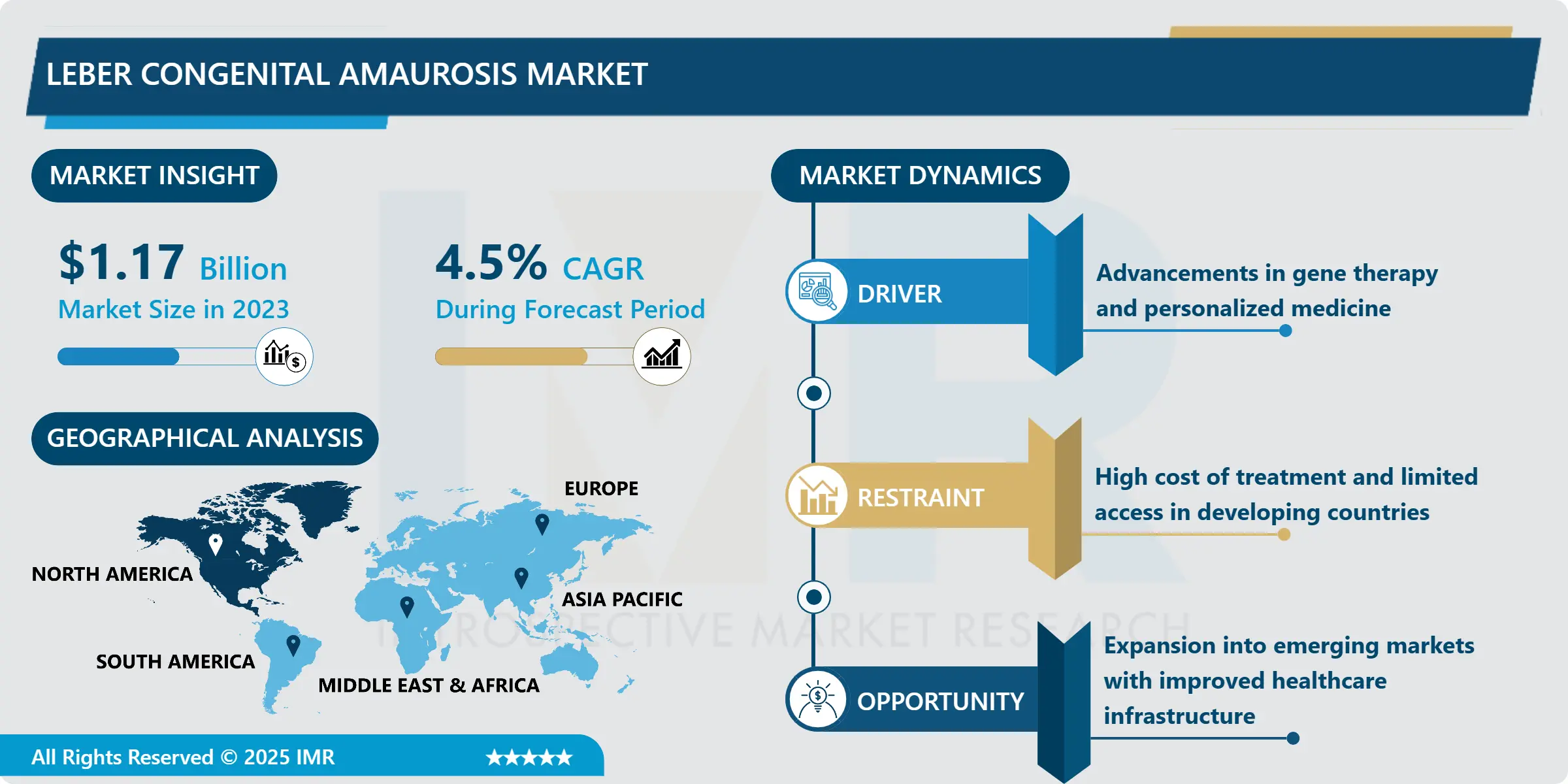
Leber Congenital Amaurosis Market Trend Analysis:
Advancement in Gene Therapy
- Of all the trends likely to define the Leber Congenital Amaurosis market, one of the most prominent is that of gene therapies. The Luxturna, for instance is the first FDA approved gene therapy for LCA due to RPE65 mutation and this makes room for development of other gene therapies towards other genetic mutations. Attested by the above, this fuels hope for gene therapy as a logical solution to the hereditary retinal diseases. Moreover, the progress of the new technologies such as CRISPR and other gene editing equipment also create a good potential for individual therapies. These technologies enable scientists to make precise corrections for certain mutations within the retina that ongoing experiments assert holds promise for a permanent cure of blindness in many of the affected patients who previously had no hope of a cure.
Expansion into Emerging Markets
- Based on data regarding the regions experiencing rapid growth in the LCA market, a definite trend can be stated; North America and European countries currently dominate this market, however long-term perspective holds great possibilities especially in such areas as Asia-Pacific and Latin countries. Government within these regions are establishing new hospitals, clinics and dedicated research for rare diseases hence offering more opportunities for growth within rare diseases diagnostic market. Furthermore, increased healthcare consciousness and increased availability of genetic testing and superior therapies are unlocking these opportunities. Those organizations, which target customers willing to buy cheap medicines and actively cooperate with local clinics, can target these regions, which become the part of the Global market demand in the nearest future.
Leber Congenital Amaurosis Market Segment Analysis:
Leber Congenital Amaurosis Market is Segmented on the basis of Type, Disease Type, End User, And Region
By Type, Target Gene segment is expected to dominate the market during the forecast period
- The Target Gene segment is also likely to account for a larger market share in the Leber Congenital Amaurosis (LCA) market during the given period due to the short treatment period that the company offers excellent precision for genetic mutations of the disease. Localized gene treatments such as Luxturna, which seeks to address only the RPE65 gene mutation, have produced outstanding effects because they tackle the problem at its source. More genetic variations of LCA are being identified due to improved genetic technology, which creates pathways for new treatment aiming at these certain genes. It not only enhances the impacts of treatments but also is concomitant with the new concept of people-tailor treatment services in which treatment services are based on the people’s genetic structure. The growth in clinical trials activity with positive outcomes and rising adoption of genetic diagnostics to identify potential patients for personalized treatments are also driving greater need for more targeted gene therapies. This segment is further expected to lead the market growth as more therapy products launch, as it has the ability to provide permanent vision corrections to patients who had no prior treatment available to them.
By End User, Hospitals segment expected to held the largest share
- The Hospitals segment is anticipated to contribute the largest engagement of the Leber Congenital Amaurosis (LCA) market end-user throughout the forecast period. Hospitals are more important for delivering such complex gene therapies as Luxturna because they possess all the required premises and equipment, qualified staff, and necessary equipment to provide both the therapy itself and the LCA patient support after the treatment. Because of the complexity of gene therapies, hospitals act as the best canters for diagnosis, treatment, and follow-up care and, therefore, assume a dominant market role. In addition, hospitals work closely with bio pharma companies and research organizations, since the hospitals are regarded as clinical trial centres and important research venues. This means that hospitals can be up to date with the latest medical research in the treatment of LCA. As the opportunities for genetic testing and gene therapies expand and with growing health care access, especially in the first-world countries, the role of the hospitals is expected to remain dominant for LCA patient care contributing to the overall market share.
Leber Congenital Amaurosis Market Regional Insights:
North America is Expected to Dominate the Market Over the Forecast period
- Expectedly, North America will lead the market by chewing 39.3% market share for Leber congenital amaurosis in the year 2024. A lion shares of market players constituting the major market are based in the USA and Canada. Consequently, based on market and industry plans, North American businesses enjoy a comparative advantage. Many of the large multinational pharmaceutical corporations based in the area expending a significant amount on R&D. Therefore, a number of innovative gene treatments and medications germane to lung cancer treatment surfaced in the NA market first. Additional patient access to these expensive therapies has also been made by the regions advanced & high health care expenditure. This has given firms more focus on the matter when it comes to delivering new treatment products to the market. In addition, the exportation of LCA medicines has also been recorded with Europe and the Asia pacific countries particularly from North America. Some potential issue might come from massive patent expiration in the future years; however, ample pipeline innovative medications in North American firms are handy.
Active Key Players in the Leber Congenital Amaurosis Market:
- AGTC (Applied Genetic Technologies Corporation) (USA)
- Allergan (USA)
- Astellas Pharma (Japan)
- Editas Medicine (USA)
- GenSight Biologics (France)
- Horama (France)
- Ionis Pharmaceuticals (USA)
- Iveric Bio (USA)
- MeiraGTx Holdings (UK)
- Nightstar Therapeutics (UK)
- Novartis AG (Switzerland)
- ProQR Therapeutics (Netherlands)
- Regenxbio Inc. (USA)
- Sanofi (France)
- Other Active Players
|
Leber Congenital Amaurosis Market |
|||
|
Base Year: |
2023 |
Forecast Period: |
2024-2032 |
|
Historical Data: |
2017 to 2023 |
Market Size in 2023: |
USD 1.17 Billion |
|
Forecast Period 2024-32 CAGR: |
4.5% |
Market Size in 2032: |
USD 1.74 Billion |
|
Segments Covered: |
By Type |
|
|
|
By Disease |
|
||
|
By End User |
|
||
|
By Region |
|
||
|
Key Market Drivers: |
|
||
|
Key Market Restraints: |
|
||
|
Key Opportunities: |
|
||
|
Companies Covered in the report: |
|
||
Chapter 1: Introduction
1.1 Scope and Coverage
Chapter 2:Executive Summary
Chapter 3: Market Landscape
3.1 Market Dynamics
3.1.1 Drivers
3.1.2 Restraints
3.1.3 Opportunities
3.1.4 Challenges
3.2 Market Trend Analysis
3.3 PESTLE Analysis
3.4 Porter's Five Forces Analysis
3.5 Industry Value Chain Analysis
3.6 Ecosystem
3.7 Regulatory Landscape
3.8 Price Trend Analysis
3.9 Patent Analysis
3.10 Technology Evolution
3.11 Investment Pockets
3.12 Import-Export Analysis
Chapter 4: Leber Congenital Amaurosis Market by Type
4.1 Leber Congenital Amaurosis Market Snapshot and Growth Engine
4.2 Leber Congenital Amaurosis Market Overview
4.3 Therapy and Diagnosis
4.3.1 Introduction and Market Overview
4.3.2 Historic and Forecasted Market Size in Value USD and Volume Units (2017-2032F)
4.3.3 Key Market Trends, Growth Factors and Opportunities
4.3.4 Therapy and Diagnosis: Geographic Segmentation Analysis
Chapter 5: Leber Congenital Amaurosis Market by Disease Type
5.1 Leber Congenital Amaurosis Market Snapshot and Growth Engine
5.2 Leber Congenital Amaurosis Market Overview
5.3 Infantile Type
5.3.1 Introduction and Market Overview
5.3.2 Historic and Forecasted Market Size in Value USD and Volume Units (2017-2032F)
5.3.3 Key Market Trends, Growth Factors and Opportunities
5.3.4 Infantile Type: Geographic Segmentation Analysis
5.4 Juvenile Type and Other
5.4.1 Introduction and Market Overview
5.4.2 Historic and Forecasted Market Size in Value USD and Volume Units (2017-2032F)
5.4.3 Key Market Trends, Growth Factors and Opportunities
5.4.4 Juvenile Type and Other: Geographic Segmentation Analysis
Chapter 6: Leber Congenital Amaurosis Market by End User
6.1 Leber Congenital Amaurosis Market Snapshot and Growth Engine
6.2 Leber Congenital Amaurosis Market Overview
6.3 Hospitals
6.3.1 Introduction and Market Overview
6.3.2 Historic and Forecasted Market Size in Value USD and Volume Units (2017-2032F)
6.3.3 Key Market Trends, Growth Factors and Opportunities
6.3.4 Hospitals: Geographic Segmentation Analysis
6.4 Specialty Clinics
6.4.1 Introduction and Market Overview
6.4.2 Historic and Forecasted Market Size in Value USD and Volume Units (2017-2032F)
6.4.3 Key Market Trends, Growth Factors and Opportunities
6.4.4 Specialty Clinics: Geographic Segmentation Analysis
6.5 Ambulatory Surgical Centres
6.5.1 Introduction and Market Overview
6.5.2 Historic and Forecasted Market Size in Value USD and Volume Units (2017-2032F)
6.5.3 Key Market Trends, Growth Factors and Opportunities
6.5.4 Ambulatory Surgical Centres: Geographic Segmentation Analysis
6.6 Home Healthcare and Others
6.6.1 Introduction and Market Overview
6.6.2 Historic and Forecasted Market Size in Value USD and Volume Units (2017-2032F)
6.6.3 Key Market Trends, Growth Factors and Opportunities
6.6.4 Home Healthcare and Others: Geographic Segmentation Analysis
Chapter 7: Company Profiles and Competitive Analysis
7.1 Competitive Landscape
7.1.1 Competitive Benchmarking
7.1.2 Leber Congenital Amaurosis Market Share by Manufacturer (2023)
7.1.3 Industry BCG Matrix
7.1.4 Heat Map Analysis
7.1.5 Mergers and Acquisitions
7.2 AGTC (APPLIED GENETIC TECHNOLOGIES CORPORATION) (USA)
7.2.1 Company Overview
7.2.2 Key Executives
7.2.3 Company Snapshot
7.2.4 Role of the Company in the Market
7.2.5 Sustainability and Social Responsibility
7.2.6 Operating Business Segments
7.2.7 Product Portfolio
7.2.8 Business Performance
7.2.9 Key Strategic Moves and Recent Developments
7.2.10 SWOT Analysis
7.3 ALLERGAN (USA)
7.4 ASTELLAS PHARMA (JAPAN)
7.5 EDITAS MEDICINE (USA)
7.6 GENSIGHT BIOLOGICS (FRANCE)
7.7 HORAMA (FRANCE)
7.8 IONIS PHARMACEUTICALS (USA)
7.9 IVERIC BIO (USA)
7.10 MEIRAGTX HOLDINGS (UK)
7.11 NIGHTSTAR THERAPEUTICS (UK)
7.12 NOVARTIS AG (SWITZERLAND)
7.13 PROQR THERAPEUTICS (NETHERLANDS)
7.14 REGENXBIO INC. (USA)
7.15 SANOFI (FRANCE)
7.16 OTHER ACTIVE PLAYERS
Chapter 8: Global Leber Congenital Amaurosis Market By Region
8.1 Overview
8.2. North America Leber Congenital Amaurosis Market
8.2.1 Key Market Trends, Growth Factors and Opportunities
8.2.2 Top Key Companies
8.2.3 Historic and Forecasted Market Size by Segments
8.2.4 Historic and Forecasted Market Size By Type
8.2.4.1 Therapy and Diagnosis
8.2.5 Historic and Forecasted Market Size By Disease Type
8.2.5.1 Infantile Type
8.2.5.2 Juvenile Type and Other
8.2.6 Historic and Forecasted Market Size By End User
8.2.6.1 Hospitals
8.2.6.2 Specialty Clinics
8.2.6.3 Ambulatory Surgical Centres
8.2.6.4 Home Healthcare and Others
8.2.7 Historic and Forecast Market Size by Country
8.2.7.1 US
8.2.7.2 Canada
8.2.7.3 Mexico
8.3. Eastern Europe Leber Congenital Amaurosis Market
8.3.1 Key Market Trends, Growth Factors and Opportunities
8.3.2 Top Key Companies
8.3.3 Historic and Forecasted Market Size by Segments
8.3.4 Historic and Forecasted Market Size By Type
8.3.4.1 Therapy and Diagnosis
8.3.5 Historic and Forecasted Market Size By Disease Type
8.3.5.1 Infantile Type
8.3.5.2 Juvenile Type and Other
8.3.6 Historic and Forecasted Market Size By End User
8.3.6.1 Hospitals
8.3.6.2 Specialty Clinics
8.3.6.3 Ambulatory Surgical Centres
8.3.6.4 Home Healthcare and Others
8.3.7 Historic and Forecast Market Size by Country
8.3.7.1 Russia
8.3.7.2 Bulgaria
8.3.7.3 The Czech Republic
8.3.7.4 Hungary
8.3.7.5 Poland
8.3.7.6 Romania
8.3.7.7 Rest of Eastern Europe
8.4. Western Europe Leber Congenital Amaurosis Market
8.4.1 Key Market Trends, Growth Factors and Opportunities
8.4.2 Top Key Companies
8.4.3 Historic and Forecasted Market Size by Segments
8.4.4 Historic and Forecasted Market Size By Type
8.4.4.1 Therapy and Diagnosis
8.4.5 Historic and Forecasted Market Size By Disease Type
8.4.5.1 Infantile Type
8.4.5.2 Juvenile Type and Other
8.4.6 Historic and Forecasted Market Size By End User
8.4.6.1 Hospitals
8.4.6.2 Specialty Clinics
8.4.6.3 Ambulatory Surgical Centres
8.4.6.4 Home Healthcare and Others
8.4.7 Historic and Forecast Market Size by Country
8.4.7.1 Germany
8.4.7.2 UK
8.4.7.3 France
8.4.7.4 The Netherlands
8.4.7.5 Italy
8.4.7.6 Spain
8.4.7.7 Rest of Western Europe
8.5. Asia Pacific Leber Congenital Amaurosis Market
8.5.1 Key Market Trends, Growth Factors and Opportunities
8.5.2 Top Key Companies
8.5.3 Historic and Forecasted Market Size by Segments
8.5.4 Historic and Forecasted Market Size By Type
8.5.4.1 Therapy and Diagnosis
8.5.5 Historic and Forecasted Market Size By Disease Type
8.5.5.1 Infantile Type
8.5.5.2 Juvenile Type and Other
8.5.6 Historic and Forecasted Market Size By End User
8.5.6.1 Hospitals
8.5.6.2 Specialty Clinics
8.5.6.3 Ambulatory Surgical Centres
8.5.6.4 Home Healthcare and Others
8.5.7 Historic and Forecast Market Size by Country
8.5.7.1 China
8.5.7.2 India
8.5.7.3 Japan
8.5.7.4 South Korea
8.5.7.5 Malaysia
8.5.7.6 Thailand
8.5.7.7 Vietnam
8.5.7.8 The Philippines
8.5.7.9 Australia
8.5.7.10 New Zealand
8.5.7.11 Rest of APAC
8.6. Middle East & Africa Leber Congenital Amaurosis Market
8.6.1 Key Market Trends, Growth Factors and Opportunities
8.6.2 Top Key Companies
8.6.3 Historic and Forecasted Market Size by Segments
8.6.4 Historic and Forecasted Market Size By Type
8.6.4.1 Therapy and Diagnosis
8.6.5 Historic and Forecasted Market Size By Disease Type
8.6.5.1 Infantile Type
8.6.5.2 Juvenile Type and Other
8.6.6 Historic and Forecasted Market Size By End User
8.6.6.1 Hospitals
8.6.6.2 Specialty Clinics
8.6.6.3 Ambulatory Surgical Centres
8.6.6.4 Home Healthcare and Others
8.6.7 Historic and Forecast Market Size by Country
8.6.7.1 Turkiye
8.6.7.2 Bahrain
8.6.7.3 Kuwait
8.6.7.4 Saudi Arabia
8.6.7.5 Qatar
8.6.7.6 UAE
8.6.7.7 Israel
8.6.7.8 South Africa
8.7. South America Leber Congenital Amaurosis Market
8.7.1 Key Market Trends, Growth Factors and Opportunities
8.7.2 Top Key Companies
8.7.3 Historic and Forecasted Market Size by Segments
8.7.4 Historic and Forecasted Market Size By Type
8.7.4.1 Therapy and Diagnosis
8.7.5 Historic and Forecasted Market Size By Disease Type
8.7.5.1 Infantile Type
8.7.5.2 Juvenile Type and Other
8.7.6 Historic and Forecasted Market Size By End User
8.7.6.1 Hospitals
8.7.6.2 Specialty Clinics
8.7.6.3 Ambulatory Surgical Centres
8.7.6.4 Home Healthcare and Others
8.7.7 Historic and Forecast Market Size by Country
8.7.7.1 Brazil
8.7.7.2 Argentina
8.7.7.3 Rest of SA
Chapter 9 Analyst Viewpoint and Conclusion
9.1 Recommendations and Concluding Analysis
9.2 Potential Market Strategies
Chapter 10 Research Methodology
10.1 Research Process
10.2 Primary Research
10.3 Secondary Research
|
Leber Congenital Amaurosis Market |
|||
|
Base Year: |
2023 |
Forecast Period: |
2024-2032 |
|
Historical Data: |
2017 to 2023 |
Market Size in 2023: |
USD 1.17 Billion |
|
Forecast Period 2024-32 CAGR: |
4.5% |
Market Size in 2032: |
USD 1.74 Billion |
|
Segments Covered: |
By Type |
|
|
|
By Disease |
|
||
|
By End User |
|
||
|
By Region |
|
||
|
Key Market Drivers: |
|
||
|
Key Market Restraints: |
|
||
|
Key Opportunities: |
|
||
|
Companies Covered in the report: |
|
||


