




Laser Vision Correction Market Synopsis:
Laser Vision Correction Market Size Was Valued at USD 6.6 Billion in 2023, and is Projected to Reach USD 12.33 Billion by 2032, Growing at a CAGR of 7.20% From 2024-2032.
Laser Vision Correction means the operation that can be done with the use of laser in order to correct refractive vision disorders such as myopia, hyperopia, astigmatism, and presbyopia. PRK, LASIK, SMILE and other tongue twisters are the other procedures that are common eye procedures that change cornea or other parts of the eye through surgery aimed at correcting menial vision and minimizing or even erasing the need for spectacles or contacts.
The global trend of increasing number of people with refractive errors remains one of the main growth factors of the laser vision correction market. In issues to do with myopia, hyperopia, and astigmatism which vary due to aging and screen time among other factors, vision correction surgeries are increasingly becoming popular. With increasing demand for non-eye Glasses and contact lenses, laser vision correction give patients permanent cure with high satisfaction.
Another important reason is the improvement of the laser that utilizes for these kind of eye surgeries like LASIK, PRK, SMILE etc. These advancements have lowered the probability of complications as well as cut the time required to heal from vision correction procedures, increasing the likelihood that people will seek them out. Further, positive tendencies in the state reimbursement policies as well as the constant growth of public awareness of the outcomes of laser vision correction also put a positive impact on the market demand.
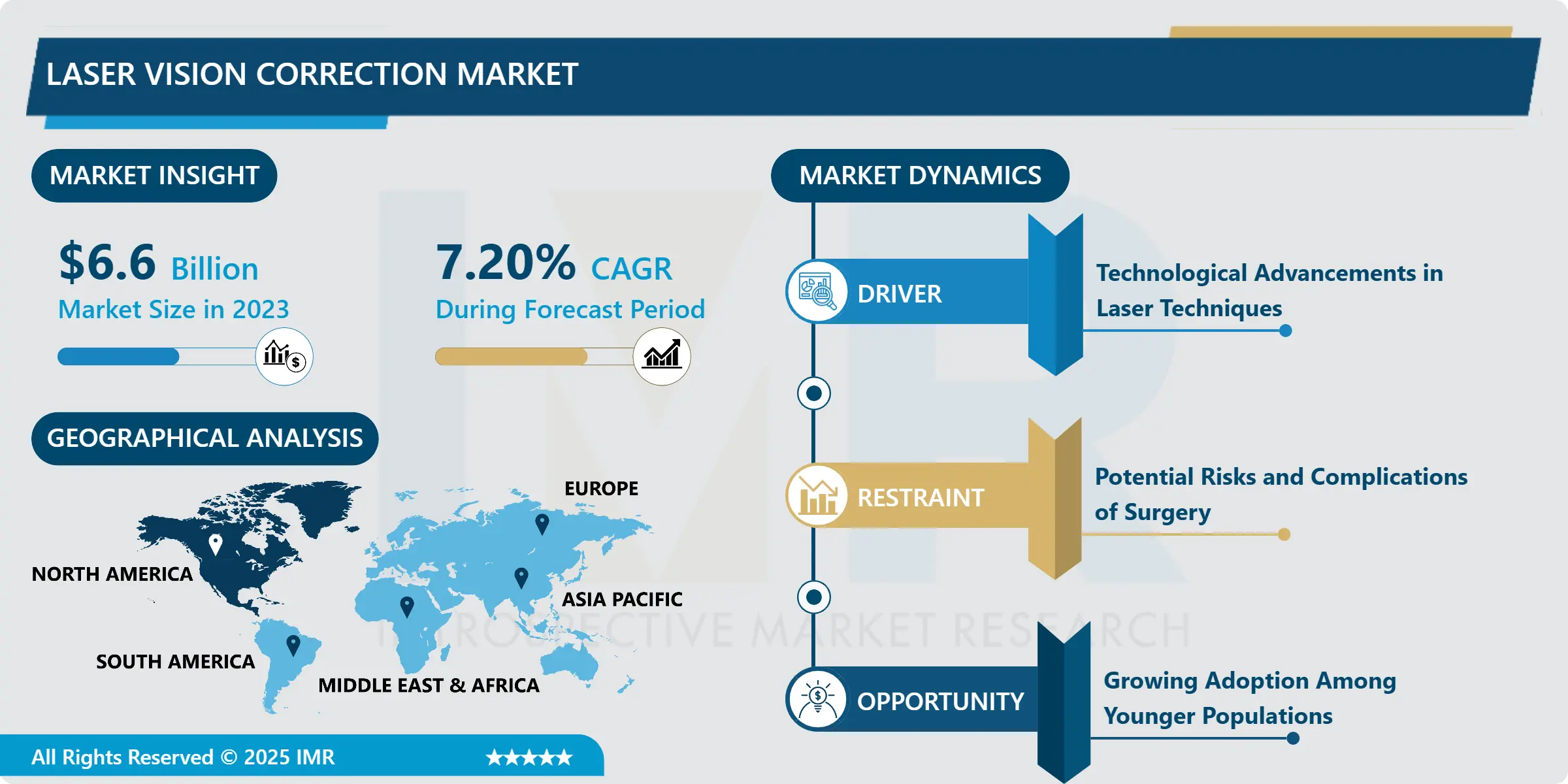
Laser Vision Correction Market Trend Analysis:
Growing adoption of minimally invasive techniques
- A key area of interest in the laser vision correction market is concern with the minimally invasive procedures especially the SMILE. Another LASIK procedure is known as SMILE which, contrary to LASIK, creates smaller incisions on the surface of the eye and has fewer consequences for the cornea, and shorter healing times. This procedure is on the increase due to its safety and being able to regain vision faster compared to other procedures which is an important factor for those patient willing to undergo vision correction surgery.
- Moreover, advancement in technologies like femtosecond technology is paving its way into the market more and more. Among such laser technologies, femtosecond lasers can be mentioned as the ones used in LASIK and SMILE surgeries, which significantly increase the operational accuracy of the interventions and improve the noticeable results, as well as patients’ comfort. That is, the availability of these technologies is leading to increased usage and penetration across developed as well as emerging economies.
The growing demand for laser vision correction
- Business growth in terms of market expansion is particularly possible because of the increasing demand for laser vision correction in regions that are still developing. For extensive growth, Asia Pacific Countries especially China, India and Japan hold a great promise because of the growing consciousness of the refractive problems, rising disposable income and improved healthcare access. Medical tourism is rapidly increasing due to reputed vision correction surgeries at low costs in these regions which is boosting the growth in opportunities even more rapidly.
- Other opportunities in the laser vision correction market are: Markets for customers, especially those located in emerging nations, are becoming more acquainted with laser visual correc6tion as a one-time permanent enhancement for young individuals with refractive disorders. As more young generation myopes and astigmats demand long-term solutions the demographic however holds a positive growth forecast from this segment especially in regions of high youth density.
Laser Vision Correction Market Segment Analysis:
Laser Vision Correction Market is Segmented on the basis of type, Technology, Application, End User, and Region.
By Type, LASIK segment is expected to dominate the market during the forecast period
- The Laser Vision Correction market based on type is categorized into LASIK, PRK, SMILE, and others. Two procedures dominate the market: LASIK, or Laser-Assisted in Situ Keratomileusis, a surgical operation to reshape the cornea employing a laser. PRK (Photorefractive Keratectomy) is somewhat similar, but in this the surface layer of the cornea is removed and is ideal for patients with thin corneas. For we have two major surgical procedures: LASEK (Laser-Assisted Subepithelial Keratectomy) and SMILE (Small Incision Lenticule Extraction). These procedures are not as common as the ones mentioned before and they are in the so-called “others”, such as LASEK or conductive keratoplasty. Unlike PK, these procedures differ in the method of transplantation, the time it takes for recovery and the degree of compatibility in the patient’s affected eye & corneal architecture?.
By Application, Myopia segment expected to held the largest share
- Laser Vision Correction market has been classified based on application into myopia, hyperopia, astigmatism, presbyopia, and other applications. Hyperopia or difficulty in focusing on nearby objects is another type of refractive error, apart from myopia which is common and which responds well to laser vision correction especially LASIK. Myopia which is the condition that fails to distinguish distant objects is also treated through lasers. Astigmatism associated with irregular corneal stroma and presbyopia or the loss of near vision with age are correctable by these surgical procedures. Under “others” fall patients with atypical uses that may include keratoconus or irregular corneas that may be suited for other treatment forms.
Laser Vision Correction Market Regional Insights:
North America is Expected to Dominate the Market Over the Forecast period
- Currently, North America, especially the United States, is the largest consumer and market for laser vision correction instrument, due to factors such as improvement of the medical environment and per capita income, and the positive trend of reimbursement. The U.S. market enjoys a high level of patient knowledge regarding refractive surgery options, as well as a high number of people interested in finding a solution less dependent on spectacles and contact lenses.
- Both the leading industry player and technology are also located in the U.S., which can also explain the dominance. North America currently holds the dominant position in the LASIK and other laser vision correction constituent market for a reason – North American has the greatest installed base of LASIK- and other laser vision correction provision hospitals, specialized clinics and ASCs that is forecast to remain market-leading throughout the forecast period.
Active Key Players in the Laser Vision Correction Market
- Alcon (Switzerland)
- Bausch + Lomb (USA)
- Carl Zeiss Meditec AG (Germany)
- iVIS Technologies (South Korea)
- Johnson & Johnson Vision (USA)
- LaserSight Technologies, Inc. (USA)
- Nidek Co., Ltd. (Japan)
- SCHWIND eye-tech-solutions GmbH & Co. KG (Germany)
- Topcon Corporation (Japan)
- Ziemer Ophthalmic Systems AG (Switzerland)
- Other Active Players
|
Laser Vision Correction Market |
|||
|
Base Year: |
2023 |
Forecast Period: |
2024-2032 |
|
Historical Data: |
2017 to 2023 |
Market Size in 2023: |
USD 6.60 Billion |
|
Forecast Period 2024-32 CAGR: |
7.20 % |
Market Size in 2032: |
USD 12.33 Billion |
|
Segments Covered: |
By Type |
|
|
|
By Technology |
|
||
|
By Application |
|
||
|
By End User |
|
||
|
By Region |
|
||
|
Key Market Drivers: |
|
||
|
Key Market Restraints: |
|
||
|
Key Opportunities: |
|
||
|
Companies Covered in the report: |
|
||
Chapter 1: Introduction
1.1 Scope and Coverage
Chapter 2:Executive Summary
Chapter 3: Market Landscape
3.1 Market Dynamics
3.1.1 Drivers
3.1.2 Restraints
3.1.3 Opportunities
3.1.4 Challenges
3.2 Market Trend Analysis
3.3 PESTLE Analysis
3.4 Porter's Five Forces Analysis
3.5 Industry Value Chain Analysis
3.6 Ecosystem
3.7 Regulatory Landscape
3.8 Price Trend Analysis
3.9 Patent Analysis
3.10 Technology Evolution
3.11 Investment Pockets
3.12 Import-Export Analysis
Chapter 4: Laser Vision Correction Market by Type
4.1 Laser Vision Correction Market Snapshot and Growth Engine
4.2 Laser Vision Correction Market Overview
4.3 LASIK (Laser-Assisted in Situ Keratomileusis)
4.3.1 Introduction and Market Overview
4.3.2 Historic and Forecasted Market Size in Value USD and Volume Units (2017-2032F)
4.3.3 Key Market Trends, Growth Factors and Opportunities
4.3.4 LASIK (Laser-Assisted in Situ Keratomileusis): Geographic Segmentation Analysis
4.4 PRK (Photorefractive Keratectomy)SMILE(Small Incision Lenticule Extraction)
4.4.1 Introduction and Market Overview
4.4.2 Historic and Forecasted Market Size in Value USD and Volume Units (2017-2032F)
4.4.3 Key Market Trends, Growth Factors and Opportunities
4.4.4 PRK (Photorefractive Keratectomy)SMILE(Small Incision Lenticule Extraction): Geographic Segmentation Analysis
4.5 Others)
4.5.1 Introduction and Market Overview
4.5.2 Historic and Forecasted Market Size in Value USD and Volume Units (2017-2032F)
4.5.3 Key Market Trends, Growth Factors and Opportunities
4.5.4 Others): Geographic Segmentation Analysis
Chapter 5: Laser Vision Correction Market by Technology
5.1 Laser Vision Correction Market Snapshot and Growth Engine
5.2 Laser Vision Correction Market Overview
5.3 Excimer Laser
5.3.1 Introduction and Market Overview
5.3.2 Historic and Forecasted Market Size in Value USD and Volume Units (2017-2032F)
5.3.3 Key Market Trends, Growth Factors and Opportunities
5.3.4 Excimer Laser: Geographic Segmentation Analysis
5.4 Femtosecond Laser
5.4.1 Introduction and Market Overview
5.4.2 Historic and Forecasted Market Size in Value USD and Volume Units (2017-2032F)
5.4.3 Key Market Trends, Growth Factors and Opportunities
5.4.4 Femtosecond Laser: Geographic Segmentation Analysis
5.5 Others
5.5.1 Introduction and Market Overview
5.5.2 Historic and Forecasted Market Size in Value USD and Volume Units (2017-2032F)
5.5.3 Key Market Trends, Growth Factors and Opportunities
5.5.4 Others: Geographic Segmentation Analysis
Chapter 6: Laser Vision Correction Market by Application
6.1 Laser Vision Correction Market Snapshot and Growth Engine
6.2 Laser Vision Correction Market Overview
6.3 Myopia (Nearsightedness)
6.3.1 Introduction and Market Overview
6.3.2 Historic and Forecasted Market Size in Value USD and Volume Units (2017-2032F)
6.3.3 Key Market Trends, Growth Factors and Opportunities
6.3.4 Myopia (Nearsightedness): Geographic Segmentation Analysis
6.4 Hyperopia (Farsightedness)
6.4.1 Introduction and Market Overview
6.4.2 Historic and Forecasted Market Size in Value USD and Volume Units (2017-2032F)
6.4.3 Key Market Trends, Growth Factors and Opportunities
6.4.4 Hyperopia (Farsightedness): Geographic Segmentation Analysis
6.5 Astigmatism
6.5.1 Introduction and Market Overview
6.5.2 Historic and Forecasted Market Size in Value USD and Volume Units (2017-2032F)
6.5.3 Key Market Trends, Growth Factors and Opportunities
6.5.4 Astigmatism: Geographic Segmentation Analysis
6.6 Presbyopia
6.6.1 Introduction and Market Overview
6.6.2 Historic and Forecasted Market Size in Value USD and Volume Units (2017-2032F)
6.6.3 Key Market Trends, Growth Factors and Opportunities
6.6.4 Presbyopia: Geographic Segmentation Analysis
6.7 Others
6.7.1 Introduction and Market Overview
6.7.2 Historic and Forecasted Market Size in Value USD and Volume Units (2017-2032F)
6.7.3 Key Market Trends, Growth Factors and Opportunities
6.7.4 Others: Geographic Segmentation Analysis
Chapter 7: Laser Vision Correction Market by End User
7.1 Laser Vision Correction Market Snapshot and Growth Engine
7.2 Laser Vision Correction Market Overview
7.3 Hospitals
7.3.1 Introduction and Market Overview
7.3.2 Historic and Forecasted Market Size in Value USD and Volume Units (2017-2032F)
7.3.3 Key Market Trends, Growth Factors and Opportunities
7.3.4 Hospitals: Geographic Segmentation Analysis
7.4 Ophthalmology Clinics
7.4.1 Introduction and Market Overview
7.4.2 Historic and Forecasted Market Size in Value USD and Volume Units (2017-2032F)
7.4.3 Key Market Trends, Growth Factors and Opportunities
7.4.4 Ophthalmology Clinics: Geographic Segmentation Analysis
7.5 Ambulatory Surgical Centers (ASCs)
7.5.1 Introduction and Market Overview
7.5.2 Historic and Forecasted Market Size in Value USD and Volume Units (2017-2032F)
7.5.3 Key Market Trends, Growth Factors and Opportunities
7.5.4 Ambulatory Surgical Centers (ASCs): Geographic Segmentation Analysis
Chapter 8: Company Profiles and Competitive Analysis
8.1 Competitive Landscape
8.1.1 Competitive Benchmarking
8.1.2 Laser Vision Correction Market Share by Manufacturer (2023)
8.1.3 Industry BCG Matrix
8.1.4 Heat Map Analysis
8.1.5 Mergers and Acquisitions
8.2 JOHNSON & JOHNSON VISION (USA)
8.2.1 Company Overview
8.2.2 Key Executives
8.2.3 Company Snapshot
8.2.4 Role of the Company in the Market
8.2.5 Sustainability and Social Responsibility
8.2.6 Operating Business Segments
8.2.7 Product Portfolio
8.2.8 Business Performance
8.2.9 Key Strategic Moves and Recent Developments
8.2.10 SWOT Analysis
8.3 CARL ZEISS MEDITEC AG (GERMANY)
8.4 BAUSCH + LOMB (USA)
8.5 NIDEK CO. LTD. (JAPAN)
8.6 ZIEMER OPHTHALMIC SYSTEMS AG (SWITZERLAND)
8.7 SCHWIND EYE-TECH-SOLUTIONS GMBH & CO. KG (GERMANY)
8.8 TOPCON CORPORATION (JAPAN)
8.9 IVIS TECHNOLOGIES (SOUTH KOREA)
8.10 LASERSIGHT TECHNOLOGIES INC. (USA)
8.11 OTHER ACTIVE PLAYERS
Chapter 9: Global Laser Vision Correction Market By Region
9.1 Overview
9.2. North America Laser Vision Correction Market
9.2.1 Key Market Trends, Growth Factors and Opportunities
9.2.2 Top Key Companies
9.2.3 Historic and Forecasted Market Size by Segments
9.2.4 Historic and Forecasted Market Size By Type
9.2.4.1 LASIK (Laser-Assisted in Situ Keratomileusis)
9.2.4.2 PRK (Photorefractive Keratectomy)SMILE(Small Incision Lenticule Extraction)
9.2.4.3 Others)
9.2.5 Historic and Forecasted Market Size By Technology
9.2.5.1 Excimer Laser
9.2.5.2 Femtosecond Laser
9.2.5.3 Others
9.2.6 Historic and Forecasted Market Size By Application
9.2.6.1 Myopia (Nearsightedness)
9.2.6.2 Hyperopia (Farsightedness)
9.2.6.3 Astigmatism
9.2.6.4 Presbyopia
9.2.6.5 Others
9.2.7 Historic and Forecasted Market Size By End User
9.2.7.1 Hospitals
9.2.7.2 Ophthalmology Clinics
9.2.7.3 Ambulatory Surgical Centers (ASCs)
9.2.8 Historic and Forecast Market Size by Country
9.2.8.1 US
9.2.8.2 Canada
9.2.8.3 Mexico
9.3. Eastern Europe Laser Vision Correction Market
9.3.1 Key Market Trends, Growth Factors and Opportunities
9.3.2 Top Key Companies
9.3.3 Historic and Forecasted Market Size by Segments
9.3.4 Historic and Forecasted Market Size By Type
9.3.4.1 LASIK (Laser-Assisted in Situ Keratomileusis)
9.3.4.2 PRK (Photorefractive Keratectomy)SMILE(Small Incision Lenticule Extraction)
9.3.4.3 Others)
9.3.5 Historic and Forecasted Market Size By Technology
9.3.5.1 Excimer Laser
9.3.5.2 Femtosecond Laser
9.3.5.3 Others
9.3.6 Historic and Forecasted Market Size By Application
9.3.6.1 Myopia (Nearsightedness)
9.3.6.2 Hyperopia (Farsightedness)
9.3.6.3 Astigmatism
9.3.6.4 Presbyopia
9.3.6.5 Others
9.3.7 Historic and Forecasted Market Size By End User
9.3.7.1 Hospitals
9.3.7.2 Ophthalmology Clinics
9.3.7.3 Ambulatory Surgical Centers (ASCs)
9.3.8 Historic and Forecast Market Size by Country
9.3.8.1 Russia
9.3.8.2 Bulgaria
9.3.8.3 The Czech Republic
9.3.8.4 Hungary
9.3.8.5 Poland
9.3.8.6 Romania
9.3.8.7 Rest of Eastern Europe
9.4. Western Europe Laser Vision Correction Market
9.4.1 Key Market Trends, Growth Factors and Opportunities
9.4.2 Top Key Companies
9.4.3 Historic and Forecasted Market Size by Segments
9.4.4 Historic and Forecasted Market Size By Type
9.4.4.1 LASIK (Laser-Assisted in Situ Keratomileusis)
9.4.4.2 PRK (Photorefractive Keratectomy)SMILE(Small Incision Lenticule Extraction)
9.4.4.3 Others)
9.4.5 Historic and Forecasted Market Size By Technology
9.4.5.1 Excimer Laser
9.4.5.2 Femtosecond Laser
9.4.5.3 Others
9.4.6 Historic and Forecasted Market Size By Application
9.4.6.1 Myopia (Nearsightedness)
9.4.6.2 Hyperopia (Farsightedness)
9.4.6.3 Astigmatism
9.4.6.4 Presbyopia
9.4.6.5 Others
9.4.7 Historic and Forecasted Market Size By End User
9.4.7.1 Hospitals
9.4.7.2 Ophthalmology Clinics
9.4.7.3 Ambulatory Surgical Centers (ASCs)
9.4.8 Historic and Forecast Market Size by Country
9.4.8.1 Germany
9.4.8.2 UK
9.4.8.3 France
9.4.8.4 The Netherlands
9.4.8.5 Italy
9.4.8.6 Spain
9.4.8.7 Rest of Western Europe
9.5. Asia Pacific Laser Vision Correction Market
9.5.1 Key Market Trends, Growth Factors and Opportunities
9.5.2 Top Key Companies
9.5.3 Historic and Forecasted Market Size by Segments
9.5.4 Historic and Forecasted Market Size By Type
9.5.4.1 LASIK (Laser-Assisted in Situ Keratomileusis)
9.5.4.2 PRK (Photorefractive Keratectomy)SMILE(Small Incision Lenticule Extraction)
9.5.4.3 Others)
9.5.5 Historic and Forecasted Market Size By Technology
9.5.5.1 Excimer Laser
9.5.5.2 Femtosecond Laser
9.5.5.3 Others
9.5.6 Historic and Forecasted Market Size By Application
9.5.6.1 Myopia (Nearsightedness)
9.5.6.2 Hyperopia (Farsightedness)
9.5.6.3 Astigmatism
9.5.6.4 Presbyopia
9.5.6.5 Others
9.5.7 Historic and Forecasted Market Size By End User
9.5.7.1 Hospitals
9.5.7.2 Ophthalmology Clinics
9.5.7.3 Ambulatory Surgical Centers (ASCs)
9.5.8 Historic and Forecast Market Size by Country
9.5.8.1 China
9.5.8.2 India
9.5.8.3 Japan
9.5.8.4 South Korea
9.5.8.5 Malaysia
9.5.8.6 Thailand
9.5.8.7 Vietnam
9.5.8.8 The Philippines
9.5.8.9 Australia
9.5.8.10 New Zealand
9.5.8.11 Rest of APAC
9.6. Middle East & Africa Laser Vision Correction Market
9.6.1 Key Market Trends, Growth Factors and Opportunities
9.6.2 Top Key Companies
9.6.3 Historic and Forecasted Market Size by Segments
9.6.4 Historic and Forecasted Market Size By Type
9.6.4.1 LASIK (Laser-Assisted in Situ Keratomileusis)
9.6.4.2 PRK (Photorefractive Keratectomy)SMILE(Small Incision Lenticule Extraction)
9.6.4.3 Others)
9.6.5 Historic and Forecasted Market Size By Technology
9.6.5.1 Excimer Laser
9.6.5.2 Femtosecond Laser
9.6.5.3 Others
9.6.6 Historic and Forecasted Market Size By Application
9.6.6.1 Myopia (Nearsightedness)
9.6.6.2 Hyperopia (Farsightedness)
9.6.6.3 Astigmatism
9.6.6.4 Presbyopia
9.6.6.5 Others
9.6.7 Historic and Forecasted Market Size By End User
9.6.7.1 Hospitals
9.6.7.2 Ophthalmology Clinics
9.6.7.3 Ambulatory Surgical Centers (ASCs)
9.6.8 Historic and Forecast Market Size by Country
9.6.8.1 Turkiye
9.6.8.2 Bahrain
9.6.8.3 Kuwait
9.6.8.4 Saudi Arabia
9.6.8.5 Qatar
9.6.8.6 UAE
9.6.8.7 Israel
9.6.8.8 South Africa
9.7. South America Laser Vision Correction Market
9.7.1 Key Market Trends, Growth Factors and Opportunities
9.7.2 Top Key Companies
9.7.3 Historic and Forecasted Market Size by Segments
9.7.4 Historic and Forecasted Market Size By Type
9.7.4.1 LASIK (Laser-Assisted in Situ Keratomileusis)
9.7.4.2 PRK (Photorefractive Keratectomy)SMILE(Small Incision Lenticule Extraction)
9.7.4.3 Others)
9.7.5 Historic and Forecasted Market Size By Technology
9.7.5.1 Excimer Laser
9.7.5.2 Femtosecond Laser
9.7.5.3 Others
9.7.6 Historic and Forecasted Market Size By Application
9.7.6.1 Myopia (Nearsightedness)
9.7.6.2 Hyperopia (Farsightedness)
9.7.6.3 Astigmatism
9.7.6.4 Presbyopia
9.7.6.5 Others
9.7.7 Historic and Forecasted Market Size By End User
9.7.7.1 Hospitals
9.7.7.2 Ophthalmology Clinics
9.7.7.3 Ambulatory Surgical Centers (ASCs)
9.7.8 Historic and Forecast Market Size by Country
9.7.8.1 Brazil
9.7.8.2 Argentina
9.7.8.3 Rest of SA
Chapter 10 Analyst Viewpoint and Conclusion
10.1 Recommendations and Concluding Analysis
10.2 Potential Market Strategies
Chapter 11 Research Methodology
11.1 Research Process
11.2 Primary Research
11.3 Secondary Research
|
Laser Vision Correction Market |
|||
|
Base Year: |
2023 |
Forecast Period: |
2024-2032 |
|
Historical Data: |
2017 to 2023 |
Market Size in 2023: |
USD 6.60 Billion |
|
Forecast Period 2024-32 CAGR: |
7.20 % |
Market Size in 2032: |
USD 12.33 Billion |
|
Segments Covered: |
By Type |
|
|
|
By Technology |
|
||
|
By Application |
|
||
|
By End User |
|
||
|
By Region |
|
||
|
Key Market Drivers: |
|
||
|
Key Market Restraints: |
|
||
|
Key Opportunities: |
|
||
|
Companies Covered in the report: |
|
||


