




Laparoscopic Devices Market Synopsis:
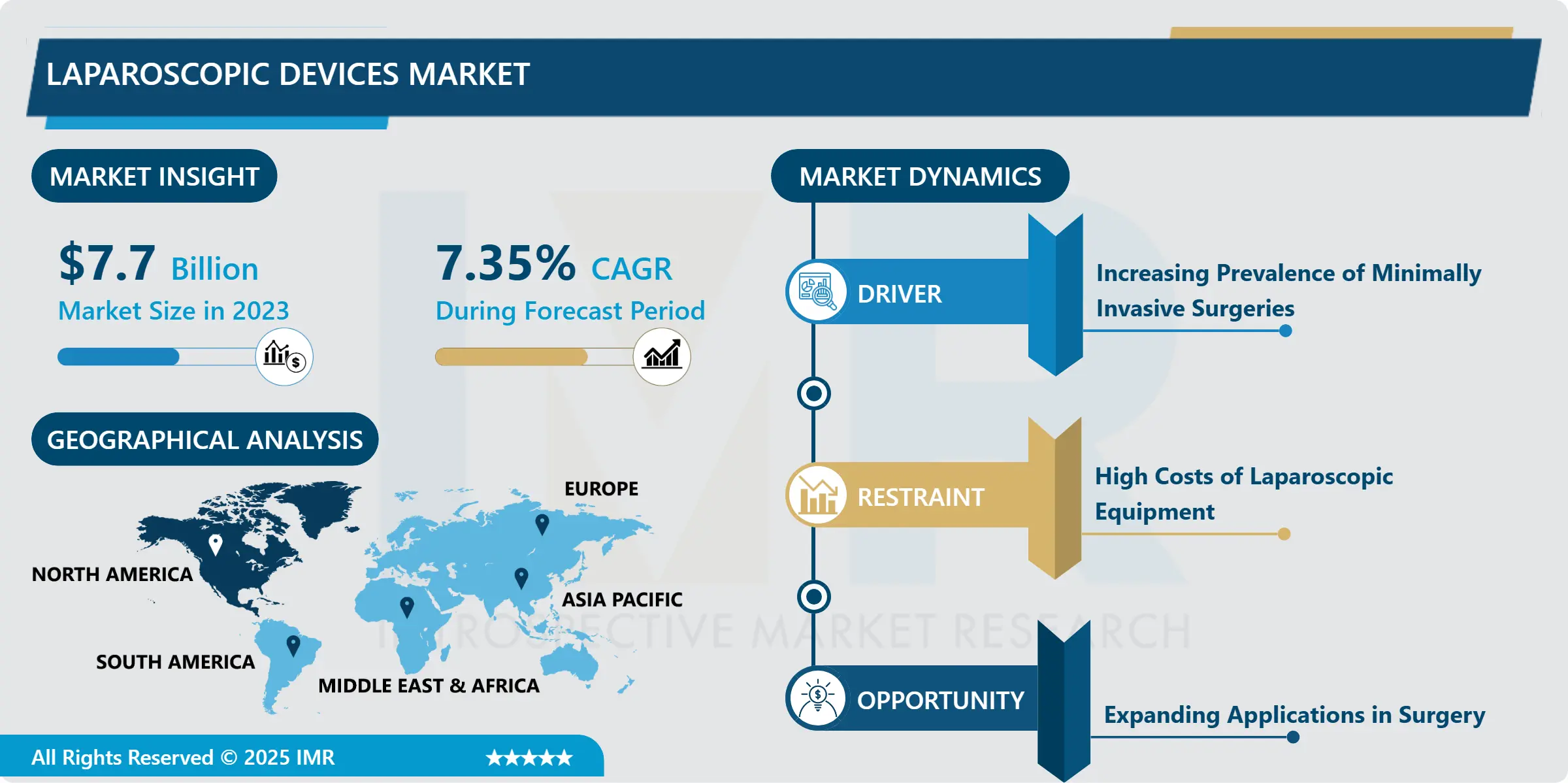
Laparoscopic Devices Market Size Was Valued at USD 7.70 Billion in 2023, and is Projected to Reach USD 14.58 Billion by 2032, Growing at a CAGR of 7.35% From 2024-2032.
Laparoscopic devices scope include all the gadgets and tools that help surgeons to operate through small invisible incisions using a camera and some slender instruments incorporated in the abdomen area. Such devices include laparoscopes, trocar, insufflator and other equipment like graspers, scissors, suture devices to improve intra operative and post operative accuracy, the latter offers clients quicker healing time and reduced pain compared to conventional open surgery. The market is thus fueled by the rise in cases of ailment conditions that necessitate surgery, development in the technology and equipment for use during surgical procedures, and by patients’ preference and Surgeons’ preference for minimally invasive procedures.
The growth within the laparoscopic devices market has been steady due to the increase in the incidence of chronic diseases and the utilization of minimally invasive surgical gadgets. These are; laparo scopes, trocars and endoscopic surgical instruments that are used in many surgeries like cholecstectomy, hernia repair and bariatric surgeries. This shift is due to rationale as improved postoperative pain management, length of hospital stay and duration of recovery for patients. Being developed as more healthcare providers strive at achieving higher patient satisfaction and improving efficiency in surgeries, the need for better laparoscopic instruments also increases.
Global laparoscopic devices market are fostered by factors that are associated with technology such as advancement in technology. Facilities like high definition, the use of robots in surgical procedures, surgery with reduced need for physical strength, enhanced features of surgical tools are increasing efficiency of surgical procedures. Besides, there is a prediction that such advancements as augmented reality and artificial intelligence will take laparoscopic surgery to the next level. These improvements do not only enhance the results of surgeries but also diversify the range of treatments for which the laparoscope can be used.
On regional level, North America is a prominent holder of laparoscopic devices market because of the key players operating in this region, availability of technologically advanced healthcare facilities and continuously rising health care spending. However, Asia-Pacific will experience the highest growth rate in the forecast year due to better healthcare infrastructure, increasing awareness regarding minimal invasive surgery and increasing patient pool of chronic diseases. Moreover, rising healthcare infrastructure amongst them and support from stringently governmental policies in developing countries are the factors that would fuel the market growth in this region.
In conclusion, the growth of the laparoscopic devices market will continue to grow significantly over the next years following the surgical volume growth, technologies innovation as well as the shift towards minimally invasive surgeries. Due to ongoing healthcare reforms and commitment of care givers to offer quality health care to patients, more people would seek laparoscopic procedures thus making the market more volatile for manufacturers and providing room for product development and market entry.
Laparoscopic Devices Market Trend Analysis:
Growing Demand and Technological Innovations in the Laparoscopic Devices Market
- The increasing incidence of chronic disorders, such as obesity, cancer, and gastrointestinal diseases is extensively contributing to the use of laparoscopic surgeries. Open surgery has numerous drawbacks compared to these minimally invasive techniques – less recovery time, fewer complications. There is less postoperative pain, shorter hospital stay and faster functional recovery in patients who have undergone Laparoscopic surgery, these procedures are becoming popular with patients and surgeons. Generally, health care systems seem overwhelmed with the increasing demand for managing chronic diseases, and laparoscopic surgeries offers a solution, making interventions timely and offered in a preferred and less invasive procedures.
- As more and more patients seek laparoscopic operations, technological advancements are quickly shifting the nature of laparoscopy devices. High definition cameras, endoscopy, mammography, MRI targets and 3D computer graphics improve maneuverability within the body. Also, the use of the robotic-assisted surgical instruments is increasing the factors of accuracy, and speed in laparoscopy procedures. These technologies do not only enhance the effectiveness of surgeries, but also the call for sophisticated laparoscopic instruments from hospitals. Hospitals and surgical centres are always expanding their latest technologies, and thus, laparoscopic devices will have a strong market growth backed up by the increase disease rate coupled by innovations in surgeries process.
Growth Potential in the Laparoscopic Devices Market
- Over the recent past, there has been a shift from doing open surgeries to laparoscopic operations, and this is so because of the benefits that are likely to accrue from minimal access surgeries.. Performa nce gains incorporated by these advantages include short and more efficient react times, fewer postoperative complications, and cosmetically appealing first-time incisions that guarantee patients’ satisfaction and shorter length of stay post operations. These increasing popularity and need for the laparoscopic surgeries are creating a suitable climate for expansion in the laparoscopic devices industry. Today’s products like graspers, scissors and cameras are experiencing increased demand since they are used in performing these enhanced surgeries and also increasing surgery productivity.• Along with standard tools, the growing pace of advancement in novel technologies, such as robotic control of laparoscopic instruments, improves the accuracy of the surgical operation and extends the laparoscopic indications.lude significantly reduced recovery times, a lower risk of complications, and minimal scarring, all of which enhance patient satisfaction and allow for quicker returns to normal activities. This growing acceptance and demand for laparoscopic surgeries are fostering a favorable environment for growth within the laparoscopic devices sector. Essential instruments such as graspers, scissors, and cameras are witnessing heightened demand, as they are critical in facilitating these advanced surgical procedures and improving overall surgical efficiency.
- In addition to traditional instruments, the rapid development of innovative technologies, including robotic-assisted laparoscopic tools, is enhancing surgical precision and expanding the range of applications for laparoscopic procedures. Most of these enhancements do not only contribute to better surgical performances but also motivate more practitioners to employ such modern techniques. With the adoption of these innovations the hospitals and surgical centres would be readily likely to gain better operational and patient health outcome thus opening opportunities for more revenues. Therefore, there are significant opportunities for growth in the global laparoscopic devices market thanks to ongoing advances in surgical practices and a greater readiness of health care organizations to adopt minimally invasive approaches.
Laparoscopic Devices Market Segment Analysis:
Laparoscopic Devices Market is Segmented on the basis of Product, Application, End-user, and Region.
By Product, Laparoscopes segment is expected to dominate the market during the forecast period
- Laparoscopes are essential tools used in laparoscopy, operations in which the surgeon can examine the abdominal or pelvic cavities without large incisions. Such apparatuses generally include a long and slender optical instrument which has been furnished with a camera and light system to enable the relay of brightly focused images in the operation theatre. This enables the surgeon to control movements and precise on the task area during the task at hand thus a tool with advantage. Besides, they reduce the tissue damage associated with large incisions, give reduced blood loss, increased resistance to infections, and therefore improve patient results.
- The increase in the usage of laparoscopes is due to the increasing need for less invasive operations, which provide a number of advantages like short a recovery duration, less having soreness after the operation, and less tissue scarring. With an increasing number of patients desiring rapid ways to find relief from chronic pain with speedy surgeries, health care providers are gradually leaning more on laparoscopy with many specialties. This shift towards minimally invasive approaches is reinforced by progress a in laparoscopic technology such as imaging technologies, and in the innovations in instruments, thus propelling the market for laparoscopes and transforming surgical practices.
By End-user, Hospital segment expected to held the largest share
- Medical centers are the major user group of laparoscopic surgical devices since they provide numerous surgical care services. One of the clear trends related to hospital environments is the growing focus on minimally invasive surgeries, which has arisen due to patient demand for surgeries that ensure shorter recovery, as well as less pain. Laparoscopic methods transforming operations into minimal invasive ones, which not only reduces bodily harm to patients but also reduces global chances of diseases and illnesses including infections. Such a change in surgical practice is a sure sign of the kind of paradigm shift that is taking place to improve the quality of patient care in hospital settings.
-
Furthermore, the expansion of the laparoscopic market in hospitals is driven by the continual investments on the new surgical techniques and equipment as well as improvements in the existing facilities. While in their effort to deliver high quality health care and contain costs, healthcare providers continue to seek competitive advantage, they are gradually investing in modern laparoscopic systems in the operating rooms. These investments not only lead to increased efficiency of surgeries but also of the general capabilities the more patients – centered hospital. Technological improvements in imaging and sophisticated instrumentation, and preparedness of the state of the art hospitals, allows them to fully harness the opportunity of increased utilization of laparoscopic surgery and meet the current diverse patient needs and sundry surgical results.
Laparoscopic Devices Market Regional Insights:
North America is Expected to Dominate the Market Over the Forecast period
- The specific regional market for these devices in North America continues to show remarkable growth, thanks to the readily increasing rate at which these technologies are being adapted alongside continued research towards the enhancement of these innovations. The United States holds a paramount position in this market because of a large number of manufacturers of medical devices and advanced healthcare facilities. Such environment is conducive for innovation and speeding up the rate at which new products are developed, thus improving the availability of advanced laparoscopic devices. However, the regulation for approval and development of new surgical technology in this region is accommodative thus enhancing the market growth.
- Also, the shift in the demography of North America where the geriatric population is on the rise and the growing incidence of obesity severely descends the rate of laparoscopic procedures. Larger populations around the world are now facing age-related diseased and hence they require surgery with less post-operation complication and time for recovery. The heightened knowledge of the patients about the prospects of laparoscopic surgery propels the demand for related devices. In aggregated, these factors predispose to augment the market for laparoscopic devices, and North America remains in the vanguard of utilizing and adopting progressive surgical tools.
Active Key Players in the Laparoscopic Devices Market:
- Karl Storz SE & CO. Kg
- Medtronic
- Johnson and Johnson
- Olympus Corporation
- CONMED Corporation
- B. Braun Melsungen AG
- The Cooper Companies Inc.
- Richard Wolf GmbH
- Microline Surgical
- BD
- Welfare Medical Ltd
- DEAM
- Intuitive Surgical
- Shenzen Mindray Bio Medical Electronics Co., Ltd
- Other Active Players
|
Laparoscopic Devices Market |
|||
|
Base Year: |
2023 |
Forecast Period: |
2024-2032 |
|
Historical Data: |
2017 to 2023 |
Market Size in 2023: |
USD 7.70 Billion |
|
Forecast Period 2024-32 CAGR: |
7.35% |
Market Size in 2032: |
USD 14.58 Billion |
|
Segments Covered: |
By Product |
|
|
|
By Application |
|
||
|
By End-user |
|
||
|
By Region |
|
||
|
Key Market Drivers: |
|
||
|
Key Market Restraints: |
|
||
|
Key Opportunities: |
|
||
|
Companies Covered in the report: |
|
||
Chapter 1: Introduction
1.1 Scope and Coverage
Chapter 2:Executive Summary
Chapter 3: Market Landscape
3.1 Market Dynamics
3.1.1 Drivers
3.1.2 Restraints
3.1.3 Opportunities
3.1.4 Challenges
3.2 Market Trend Analysis
3.3 PESTLE Analysis
3.4 Porter's Five Forces Analysis
3.5 Industry Value Chain Analysis
3.6 Ecosystem
3.7 Regulatory Landscape
3.8 Price Trend Analysis
3.9 Patent Analysis
3.10 Technology Evolution
3.11 Investment Pockets
3.12 Import-Export Analysis
Chapter 4: Laparoscopic Devices Market by Product
4.1 Laparoscopic Devices Market Snapshot and Growth Engine
4.2 Laparoscopic Devices Market Overview
4.3 Laparoscopes
4.3.1 Introduction and Market Overview
4.3.2 Historic and Forecasted Market Size in Value USD and Volume Units (2017-2032F)
4.3.3 Key Market Trends, Growth Factors and Opportunities
4.3.4 Laparoscopes: Geographic Segmentation Analysis
4.4 Energy Systems
4.4.1 Introduction and Market Overview
4.4.2 Historic and Forecasted Market Size in Value USD and Volume Units (2017-2032F)
4.4.3 Key Market Trends, Growth Factors and Opportunities
4.4.4 Energy Systems: Geographic Segmentation Analysis
4.5 Trocars
4.5.1 Introduction and Market Overview
4.5.2 Historic and Forecasted Market Size in Value USD and Volume Units (2017-2032F)
4.5.3 Key Market Trends, Growth Factors and Opportunities
4.5.4 Trocars: Geographic Segmentation Analysis
4.6 Closure Devices
4.6.1 Introduction and Market Overview
4.6.2 Historic and Forecasted Market Size in Value USD and Volume Units (2017-2032F)
4.6.3 Key Market Trends, Growth Factors and Opportunities
4.6.4 Closure Devices: Geographic Segmentation Analysis
4.7 Suction/ Irrigation Device
4.7.1 Introduction and Market Overview
4.7.2 Historic and Forecasted Market Size in Value USD and Volume Units (2017-2032F)
4.7.3 Key Market Trends, Growth Factors and Opportunities
4.7.4 Suction/ Irrigation Device: Geographic Segmentation Analysis
4.8 Insufflation Device
4.8.1 Introduction and Market Overview
4.8.2 Historic and Forecasted Market Size in Value USD and Volume Units (2017-2032F)
4.8.3 Key Market Trends, Growth Factors and Opportunities
4.8.4 Insufflation Device: Geographic Segmentation Analysis
4.9 Robot Assisted Systems
4.9.1 Introduction and Market Overview
4.9.2 Historic and Forecasted Market Size in Value USD and Volume Units (2017-2032F)
4.9.3 Key Market Trends, Growth Factors and Opportunities
4.9.4 Robot Assisted Systems: Geographic Segmentation Analysis
4.10 Hand Access Instruments
4.10.1 Introduction and Market Overview
4.10.2 Historic and Forecasted Market Size in Value USD and Volume Units (2017-2032F)
4.10.3 Key Market Trends, Growth Factors and Opportunities
4.10.4 Hand Access Instruments: Geographic Segmentation Analysis
Chapter 5: Laparoscopic Devices Market by Application
5.1 Laparoscopic Devices Market Snapshot and Growth Engine
5.2 Laparoscopic Devices Market Overview
5.3 Bariatric Surgery
5.3.1 Introduction and Market Overview
5.3.2 Historic and Forecasted Market Size in Value USD and Volume Units (2017-2032F)
5.3.3 Key Market Trends, Growth Factors and Opportunities
5.3.4 Bariatric Surgery: Geographic Segmentation Analysis
5.4 Urological Surgery
5.4.1 Introduction and Market Overview
5.4.2 Historic and Forecasted Market Size in Value USD and Volume Units (2017-2032F)
5.4.3 Key Market Trends, Growth Factors and Opportunities
5.4.4 Urological Surgery: Geographic Segmentation Analysis
5.5 Gynaecological Surgery
5.5.1 Introduction and Market Overview
5.5.2 Historic and Forecasted Market Size in Value USD and Volume Units (2017-2032F)
5.5.3 Key Market Trends, Growth Factors and Opportunities
5.5.4 Gynaecological Surgery: Geographic Segmentation Analysis
5.6 General Surgery
5.6.1 Introduction and Market Overview
5.6.2 Historic and Forecasted Market Size in Value USD and Volume Units (2017-2032F)
5.6.3 Key Market Trends, Growth Factors and Opportunities
5.6.4 General Surgery: Geographic Segmentation Analysis
5.7 Colorectal Surgery
5.7.1 Introduction and Market Overview
5.7.2 Historic and Forecasted Market Size in Value USD and Volume Units (2017-2032F)
5.7.3 Key Market Trends, Growth Factors and Opportunities
5.7.4 Colorectal Surgery: Geographic Segmentation Analysis
5.8 Other Surgeries
5.8.1 Introduction and Market Overview
5.8.2 Historic and Forecasted Market Size in Value USD and Volume Units (2017-2032F)
5.8.3 Key Market Trends, Growth Factors and Opportunities
5.8.4 Other Surgeries: Geographic Segmentation Analysis
Chapter 6: Laparoscopic Devices Market by End-User
6.1 Laparoscopic Devices Market Snapshot and Growth Engine
6.2 Laparoscopic Devices Market Overview
6.3 Hospital
6.3.1 Introduction and Market Overview
6.3.2 Historic and Forecasted Market Size in Value USD and Volume Units (2017-2032F)
6.3.3 Key Market Trends, Growth Factors and Opportunities
6.3.4 Hospital: Geographic Segmentation Analysis
6.4 Clinic
6.4.1 Introduction and Market Overview
6.4.2 Historic and Forecasted Market Size in Value USD and Volume Units (2017-2032F)
6.4.3 Key Market Trends, Growth Factors and Opportunities
6.4.4 Clinic: Geographic Segmentation Analysis
6.5 Ambulatory
6.5.1 Introduction and Market Overview
6.5.2 Historic and Forecasted Market Size in Value USD and Volume Units (2017-2032F)
6.5.3 Key Market Trends, Growth Factors and Opportunities
6.5.4 Ambulatory: Geographic Segmentation Analysis
Chapter 7: Company Profiles and Competitive Analysis
7.1 Competitive Landscape
7.1.1 Competitive Benchmarking
7.1.2 Laparoscopic Devices Market Share by Manufacturer (2023)
7.1.3 Industry BCG Matrix
7.1.4 Heat Map Analysis
7.1.5 Mergers and Acquisitions
7.2 MEDTRONIC
7.2.1 Company Overview
7.2.2 Key Executives
7.2.3 Company Snapshot
7.2.4 Role of the Company in the Market
7.2.5 Sustainability and Social Responsibility
7.2.6 Operating Business Segments
7.2.7 Product Portfolio
7.2.8 Business Performance
7.2.9 Key Strategic Moves and Recent Developments
7.2.10 SWOT Analysis
7.3 STRYKER CORPORATION
7.4 KARL STORZ SE & CO. KG
7.5 JOHNSON AND JOHNSON
7.6 OLYMPUS CORPORATION
7.7 CONMED CORPORATION
7.8 B. BRAUN MELSUNGEN AG
7.9 THE COOPER COMPANIES INC.
7.10 RICHARD WOLF GMBH
7.11 MICROLINE SURGICAL
7.12 BD
7.13 WELFARE MEDICAL LTD.
7.14 DEAM
7.15 INTUITIVE SURGICAL
7.16 SHENZEN MINDRAY BIO MEDICAL ELECTRONICS CO. LTD
7.17 OTHER ACTIVE PLAYERS
Chapter 8: Global Laparoscopic Devices Market By Region
8.1 Overview
8.2. North America Laparoscopic Devices Market
8.2.1 Key Market Trends, Growth Factors and Opportunities
8.2.2 Top Key Companies
8.2.3 Historic and Forecasted Market Size by Segments
8.2.4 Historic and Forecasted Market Size By Product
8.2.4.1 Laparoscopes
8.2.4.2 Energy Systems
8.2.4.3 Trocars
8.2.4.4 Closure Devices
8.2.4.5 Suction/ Irrigation Device
8.2.4.6 Insufflation Device
8.2.4.7 Robot Assisted Systems
8.2.4.8 Hand Access Instruments
8.2.5 Historic and Forecasted Market Size By Application
8.2.5.1 Bariatric Surgery
8.2.5.2 Urological Surgery
8.2.5.3 Gynaecological Surgery
8.2.5.4 General Surgery
8.2.5.5 Colorectal Surgery
8.2.5.6 Other Surgeries
8.2.6 Historic and Forecasted Market Size By End-User
8.2.6.1 Hospital
8.2.6.2 Clinic
8.2.6.3 Ambulatory
8.2.7 Historic and Forecast Market Size by Country
8.2.7.1 US
8.2.7.2 Canada
8.2.7.3 Mexico
8.3. Eastern Europe Laparoscopic Devices Market
8.3.1 Key Market Trends, Growth Factors and Opportunities
8.3.2 Top Key Companies
8.3.3 Historic and Forecasted Market Size by Segments
8.3.4 Historic and Forecasted Market Size By Product
8.3.4.1 Laparoscopes
8.3.4.2 Energy Systems
8.3.4.3 Trocars
8.3.4.4 Closure Devices
8.3.4.5 Suction/ Irrigation Device
8.3.4.6 Insufflation Device
8.3.4.7 Robot Assisted Systems
8.3.4.8 Hand Access Instruments
8.3.5 Historic and Forecasted Market Size By Application
8.3.5.1 Bariatric Surgery
8.3.5.2 Urological Surgery
8.3.5.3 Gynaecological Surgery
8.3.5.4 General Surgery
8.3.5.5 Colorectal Surgery
8.3.5.6 Other Surgeries
8.3.6 Historic and Forecasted Market Size By End-User
8.3.6.1 Hospital
8.3.6.2 Clinic
8.3.6.3 Ambulatory
8.3.7 Historic and Forecast Market Size by Country
8.3.7.1 Russia
8.3.7.2 Bulgaria
8.3.7.3 The Czech Republic
8.3.7.4 Hungary
8.3.7.5 Poland
8.3.7.6 Romania
8.3.7.7 Rest of Eastern Europe
8.4. Western Europe Laparoscopic Devices Market
8.4.1 Key Market Trends, Growth Factors and Opportunities
8.4.2 Top Key Companies
8.4.3 Historic and Forecasted Market Size by Segments
8.4.4 Historic and Forecasted Market Size By Product
8.4.4.1 Laparoscopes
8.4.4.2 Energy Systems
8.4.4.3 Trocars
8.4.4.4 Closure Devices
8.4.4.5 Suction/ Irrigation Device
8.4.4.6 Insufflation Device
8.4.4.7 Robot Assisted Systems
8.4.4.8 Hand Access Instruments
8.4.5 Historic and Forecasted Market Size By Application
8.4.5.1 Bariatric Surgery
8.4.5.2 Urological Surgery
8.4.5.3 Gynaecological Surgery
8.4.5.4 General Surgery
8.4.5.5 Colorectal Surgery
8.4.5.6 Other Surgeries
8.4.6 Historic and Forecasted Market Size By End-User
8.4.6.1 Hospital
8.4.6.2 Clinic
8.4.6.3 Ambulatory
8.4.7 Historic and Forecast Market Size by Country
8.4.7.1 Germany
8.4.7.2 UK
8.4.7.3 France
8.4.7.4 The Netherlands
8.4.7.5 Italy
8.4.7.6 Spain
8.4.7.7 Rest of Western Europe
8.5. Asia Pacific Laparoscopic Devices Market
8.5.1 Key Market Trends, Growth Factors and Opportunities
8.5.2 Top Key Companies
8.5.3 Historic and Forecasted Market Size by Segments
8.5.4 Historic and Forecasted Market Size By Product
8.5.4.1 Laparoscopes
8.5.4.2 Energy Systems
8.5.4.3 Trocars
8.5.4.4 Closure Devices
8.5.4.5 Suction/ Irrigation Device
8.5.4.6 Insufflation Device
8.5.4.7 Robot Assisted Systems
8.5.4.8 Hand Access Instruments
8.5.5 Historic and Forecasted Market Size By Application
8.5.5.1 Bariatric Surgery
8.5.5.2 Urological Surgery
8.5.5.3 Gynaecological Surgery
8.5.5.4 General Surgery
8.5.5.5 Colorectal Surgery
8.5.5.6 Other Surgeries
8.5.6 Historic and Forecasted Market Size By End-User
8.5.6.1 Hospital
8.5.6.2 Clinic
8.5.6.3 Ambulatory
8.5.7 Historic and Forecast Market Size by Country
8.5.7.1 China
8.5.7.2 India
8.5.7.3 Japan
8.5.7.4 South Korea
8.5.7.5 Malaysia
8.5.7.6 Thailand
8.5.7.7 Vietnam
8.5.7.8 The Philippines
8.5.7.9 Australia
8.5.7.10 New Zealand
8.5.7.11 Rest of APAC
8.6. Middle East & Africa Laparoscopic Devices Market
8.6.1 Key Market Trends, Growth Factors and Opportunities
8.6.2 Top Key Companies
8.6.3 Historic and Forecasted Market Size by Segments
8.6.4 Historic and Forecasted Market Size By Product
8.6.4.1 Laparoscopes
8.6.4.2 Energy Systems
8.6.4.3 Trocars
8.6.4.4 Closure Devices
8.6.4.5 Suction/ Irrigation Device
8.6.4.6 Insufflation Device
8.6.4.7 Robot Assisted Systems
8.6.4.8 Hand Access Instruments
8.6.5 Historic and Forecasted Market Size By Application
8.6.5.1 Bariatric Surgery
8.6.5.2 Urological Surgery
8.6.5.3 Gynaecological Surgery
8.6.5.4 General Surgery
8.6.5.5 Colorectal Surgery
8.6.5.6 Other Surgeries
8.6.6 Historic and Forecasted Market Size By End-User
8.6.6.1 Hospital
8.6.6.2 Clinic
8.6.6.3 Ambulatory
8.6.7 Historic and Forecast Market Size by Country
8.6.7.1 Turkiye
8.6.7.2 Bahrain
8.6.7.3 Kuwait
8.6.7.4 Saudi Arabia
8.6.7.5 Qatar
8.6.7.6 UAE
8.6.7.7 Israel
8.6.7.8 South Africa
8.7. South America Laparoscopic Devices Market
8.7.1 Key Market Trends, Growth Factors and Opportunities
8.7.2 Top Key Companies
8.7.3 Historic and Forecasted Market Size by Segments
8.7.4 Historic and Forecasted Market Size By Product
8.7.4.1 Laparoscopes
8.7.4.2 Energy Systems
8.7.4.3 Trocars
8.7.4.4 Closure Devices
8.7.4.5 Suction/ Irrigation Device
8.7.4.6 Insufflation Device
8.7.4.7 Robot Assisted Systems
8.7.4.8 Hand Access Instruments
8.7.5 Historic and Forecasted Market Size By Application
8.7.5.1 Bariatric Surgery
8.7.5.2 Urological Surgery
8.7.5.3 Gynaecological Surgery
8.7.5.4 General Surgery
8.7.5.5 Colorectal Surgery
8.7.5.6 Other Surgeries
8.7.6 Historic and Forecasted Market Size By End-User
8.7.6.1 Hospital
8.7.6.2 Clinic
8.7.6.3 Ambulatory
8.7.7 Historic and Forecast Market Size by Country
8.7.7.1 Brazil
8.7.7.2 Argentina
8.7.7.3 Rest of SA
Chapter 9 Analyst Viewpoint and Conclusion
9.1 Recommendations and Concluding Analysis
9.2 Potential Market Strategies
Chapter 10 Research Methodology
10.1 Research Process
10.2 Primary Research
10.3 Secondary Research
|
Laparoscopic Devices Market |
|||
|
Base Year: |
2023 |
Forecast Period: |
2024-2032 |
|
Historical Data: |
2017 to 2023 |
Market Size in 2023: |
USD 7.70 Billion |
|
Forecast Period 2024-32 CAGR: |
7.35% |
Market Size in 2032: |
USD 14.58 Billion |
|
Segments Covered: |
By Product |
|
|
|
By Application |
|
||
|
By End-user |
|
||
|
By Region |
|
||
|
Key Market Drivers: |
|
||
|
Key Market Restraints: |
|
||
|
Key Opportunities: |
|
||
|
Companies Covered in the report: |
|
||


