




Key Market Highlights
Lancet Market Size Was Valued at USD 2.92 Billion in 2024, and is Projected to Reach USD 12.68 Billion by 2035, Growing at a CAGR of 8.54% from 2025-2035.
- Market Size in 2024: USD 2.92 Billion
- Projected Market Size by 2035: USD 12.68 Billion
- CAGR (2025–2035): 8.54%
- Leading Market in 2024: North America
- Fastest-Growing Market: Asia-Pacific
- By Type: The Safety Lancets segment is anticipated to lead the market by accounting for 57.71% of the market share throughout the forecast period.
- By Application: The blood Glucose Texting segment is expected to capture 37.59% of the market share, thereby maintaining its dominance over the forecast period.
- By Region: North America region is projected to hold 31.56% of the market share during the forecast period.
- Active Players: Abbott Laboratories, (USA), B. Braun Melsungen AG, (Germany), F. Hoffmann?La Roche Ltd (Switzerland), Greiner Bio?One GmbH, (Austria), HTL?Strefa S.A, (Poland), and Other Active Players.
Lancet Market Synopsis:
The blood lancets market includes small, minimally invasive devices used to collect capillary blood, mainly for diabetes monitoring, diagnostic testing, and routine screenings. The market is expanding steadily as chronic diseases rise and home healthcare becomes more common. Manufacturers are focusing on safety-engineered, painless, and user-friendly lancets to meet growing patient and clinician expectations.
Although pricing pressure and strong competition persist, demand remains strong, supported by digital glucose monitoring trends, increasing diagnostic volumes, and improved access to point-of-care testing across both developed and emerging healthcare systems.
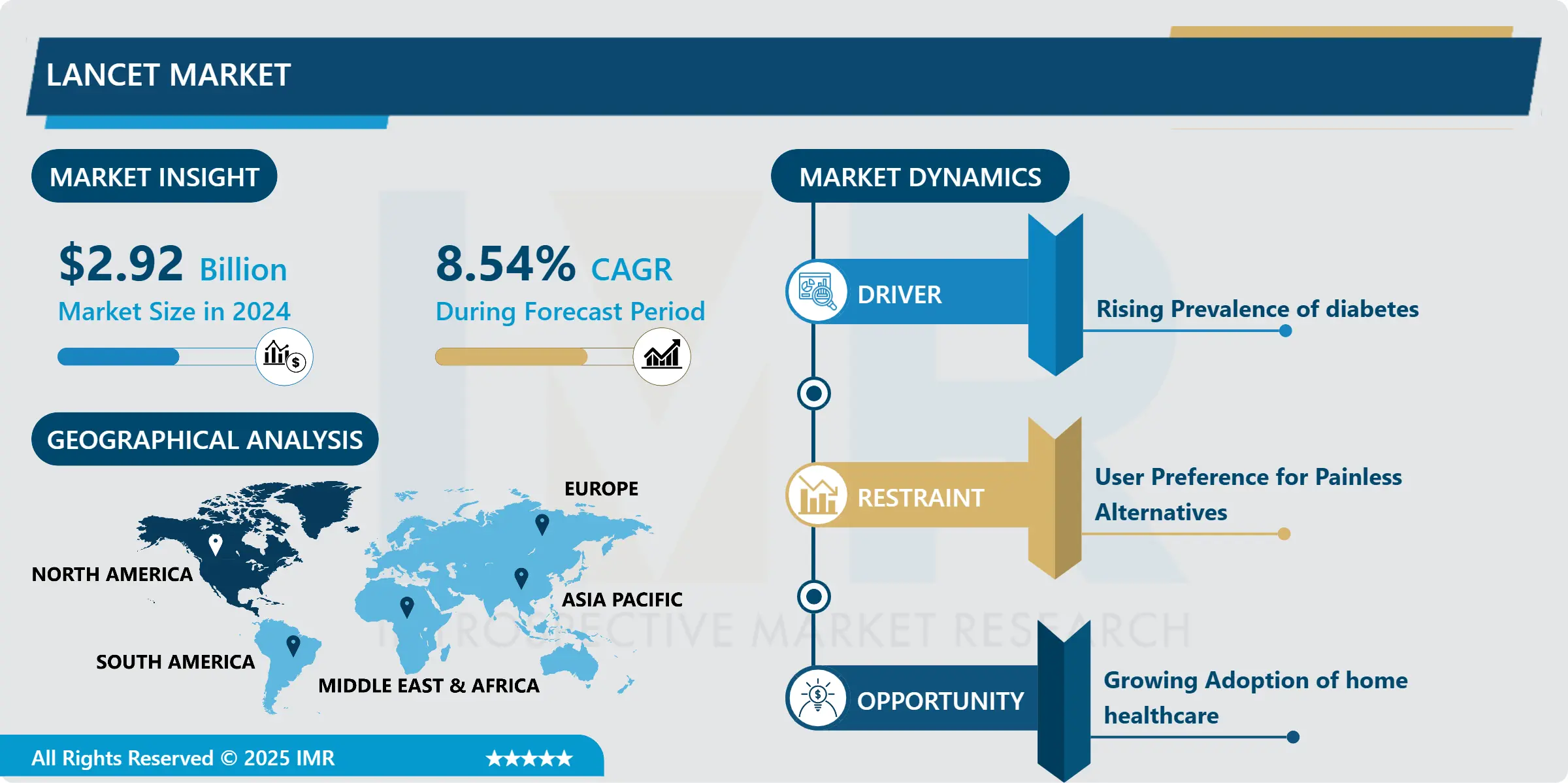
Lancet Market Dynamics and Trend Analysis:
Lancet Market Growth Driver- Rising Prevalence of Diabetes
- The number of people living with diabetes is rising mainly because of unhealthy eating habits, lack of exercise, higher obesity rates, and an aging population. As more people get diagnosed, they need to check their blood sugar regularly to stay healthy. This creates a steady demand for easy, safe, and low-pain lancets.
- Doctors also encourage early detection and frequent monitoring, which increases how often people test. With home testing becoming a normal part of life, patients prefer simple tools that make daily checks quick and comfortable. Overall, the growing diabetes burden directly drives the need for lancets in both homes and clinics.
Lancet Market Limiting Factor-User Preference for Painless Alternatives
- Many users prefer painless or less invasive alternatives, which affects the regular use of traditional lancets. Finger-pricks can be uncomfortable, especially for children, older adults, and people who need to test frequently. Because of this, patients often look for options that reduce pain, such as ultra-thin needles, automatic safety lancets, or even sensor-based devices like CGMs.
- When these alternatives become more popular, the use of standard lancets naturally decreases. This shift in user preference limits market growth, as people choose methods that offer a smoother, more comfortable testing experience. Overall, the desire for pain-free solutions reduces dependence on traditional lancets.
Lancet Market Expansion Opportunity- Growing Adoption of Home Healthcare
- The growing shift toward home healthcare is creating a strong opportunity for the lancet market. More patients especially those with diabetes, chronic conditions, or mobility challenges prefer checking their health at home instead of visiting clinics. This trend is driven by convenience, lower costs, and the rise of digital health tools.
- As a result, people need reliable, simple, and low-pain lancets for regular self-testing. With home monitoring becoming part of daily routines, demand for user-friendly lancets continues to rise, giving manufacturers a chance to introduce safer, smarter, and more comfortable products tailored for personal use.
Lancet Market Challenge and Risk- Price Pressure and Low Differentiation
- Price pressure and low differentiation are major challenges in the lancet market. Since most lancets have similar designs and functions, it becomes difficult for companies to clearly stand out. This creates tough competition, where many brands are forced to lower prices just to stay in the market.
- As a result, profit margins shrink, and manufacturers struggle to invest in innovation or premium features. Buyers especially hospitals and distributors often choose cheaper options because the products appear almost identical, which further intensifies price competition and limits the market’s ability to grow sustainably.
Lancet Market Trend- Integration with Digital Health Ecosystems
- Integration with digital health ecosystems is becoming a major trend in the lancet market. Today, lancets are often packaged with smart glucose meters, mobile apps, and digital monitoring platforms. This helps users track their readings more easily and stay consistent with testing.
- By connecting lancets to digital tools, companies improve user experience, increase adherence, and create stronger brand loyalty. It also allows patients and doctors to access real-time data, making diabetes management more efficient and personalized. Overall, this trend supports better health outcomes and encourages more regular use of lancets.
Lancet Market Segment Analysis:
Lancet Market is segmented based on Type, Application, End-Users, and Region
By Type, Safety Lancet segment is expected to dominate the market with around 57.71% share during the forecast period.
- Safety lancets are designed to reduce the risk of needlestick injuries and contamination, making them more reliable for both clinical and home use. They are usually single-use, easy to operate, and often come with features like automatic needle retraction or pressure-activated mechanisms, which improve user safety and comfort.
- With growing awareness about hygiene, infection control, and patient safety, hospitals, clinics, and home users are increasingly choosing safety lancets over standard lancets, driving strong demand and making this segment the market leader.
By Application, Blood Glucose Testing Segment is expected to dominate with close to 37.59% market share during the forecast period.
- This is because diabetes is becoming increasingly common worldwide, and people with diabetes need to monitor their blood sugar levels regularly often multiple times a day. Blood glucose testing requires frequent capillary blood sampling, which makes lancets essential for both home use and clinical settings.
- Safety, ease of use, and comfort are especially important, so patients and healthcare providers prefer reliable lancets for this purpose. The steady rise in diabetes cases, along with the growing trend of self-monitoring and home healthcare, ensures that blood glucose testing remains the largest and fastest-growing application for lancets.
Lancet Market Regional Insights:
North America region is estimated to lead the market with around 31.56% share during the forecast period.
- This is mainly because of high diabetes and chronic disease rates, which create steady demand for regular blood glucose testing. The region benefits from advanced healthcare infrastructure, reimbursement policies, and widespread adoption of home-based monitoring, making lancets easily accessible.
- Strong market maturity, established manufacturers, and continuous product innovations also support its leading position. While North America remains the largest market, Asia-Pacific is emerging rapidly due to rising diabetes prevalence and expanding healthcare access, presenting significant growth opportunities for lancet manufacturers in the coming years.
Lancet Market Active Players:
- Abbott Laboratories, (USA)
- B. Braun Melsungen AG, (Germany)
- F. Hoffmann?La Roche Ltd (Switzerland)
- Greiner Bio?One GmbH, (Austria)
- HTL?Strefa S.A, (Poland)
- Nipro Corporation, (Japan)
- Owen Mumford Ltd, (United Kingdom)
- Terumo Corporation, (Japan)
- Ypsomed AG, (Switzerland)
- Other Active Players
Key Industry Developments in the Lancet Market:
- In January 2025, BD (Becton, Dickinson and Company) , a leading global medical technology company, today announced additional investments in its U.S. manufacturing network to add capacity for critical medical devices, including syringes, needles and IV catheters, to meet the ongoing needs of the nation's health care system.
- In March 2023, Astellas entered an agreement in March 2023 with Roche Diabetes Care Japan Co., Ltd. to integrate a blood glucose monitoring system, which uses lancets, with a digital health solution for the Japanese market
Overview of the Blood Lancet Market: Function, Advancements, and Future Outlook
- Blood lancets are small, precision medical devices designed to obtain capillary blood samples safely and efficiently, mainly for glucose testing, haemoglobin checks, and other point-of-care diagnostics. They work by creating a quick, controlled puncture on the fingertip or other capillary-rich areas, allowing a drop of blood to be collected for testing. Modern lancets emphasize safety, featuring retractable needles, automatic release mechanisms, and ultra-thin designs to minimize pain and reduce the risk of accidental needlestick injuries.
- Recent advancements focus on patient comfort and accuracy. Safety-engineered lancets, ultra-fine needles, and pressure-activated devices make self-monitoring simpler and less intimidating. Integration with digital health tools, such as smart glucose meters and mobile apps, allows real-time tracking and improved adherence, particularly for home-based users.
- The future of the lancet market looks promising, driven by rising diabetes prevalence, home healthcare adoption, and growing point-of-care testing. Companies are expected to innovate further with biodegradable materials, painless lancing technology, and seamless integration with wearable and digital monitoring systems. Overall, lancets will continue to play a crucial role in efficient, safe, and patient-friendly blood sampling globally.
|
Lancet Market |
|||
|
Base Year: |
2024 |
Forecast Period: |
2025-2035 |
|
Historical Data: |
2018 to 2023 |
Market Size in 2024: |
USD 2.92 Bn. |
|
Forecast Period 2025-35 CAGR: |
8.54 % |
Market Size in 2035: |
USD 12.68 Bn. |
|
Segments Covered: |
By Type |
|
|
|
By Application
|
|
||
|
By End-Users |
|
||
|
By Region |
|
||
|
Growth Driver: |
|
||
|
Limiting Factor |
|
||
|
Expansion Opportunity |
|
||
|
Challenge and Risk |
|
||
|
Companies Covered in the Report: |
|
||
Chapter 1: Introduction
1.1 Scope and Coverage
Chapter 2:Executive Summary
Chapter 3: Market Landscape
3.1 Market Dynamics and Opportunity Analysis
3.1.1 Growth Drivers
3.1.2 Limiting Factors
3.1.3 Growth Opportunities
3.1.4 Challenges and Risks
3.2 Market Trend Analysis
3.3 Industry Ecosystem
3.4 Industry Value Chain Mapping
3.5 Strategic PESTLE Overview
3.6 Porter's Five Forces Framework
3.7 Regulatory Framework
3.8 Pricing Trend Analysis
3.9 Intellectual Property Review
3.10 Technology Evolution
3.11 Import-Export Analysis
3.12 Consumer Behavior Analysis
3.13 Investment Pocket Analysis
3.14 Go-To Market Strategy
Chapter 4: Lancets Market by Type (2018-2035)
4.1 Lancets Market Snapshot and Growth Engine
4.2 Market Overview
4.3 Safety Lancets
4.3.1 Introduction and Market Overview
4.3.2 Historic and Forecasted Market Size in Value USD and Volume Units
4.3.3 Key Market Trends, Growth Factors, and Opportunities
4.3.4 Geographic Segmentation Analysis
4.4 Standard lancet
Chapter 5: Lancets Market by End-User (2018-2035)
5.1 Lancets Market Snapshot and Growth Engine
5.2 Market Overview
5.3 Hospitals
5.3.1 Introduction and Market Overview
5.3.2 Historic and Forecasted Market Size in Value USD and Volume Units
5.3.3 Key Market Trends, Growth Factors, and Opportunities
5.3.4 Geographic Segmentation Analysis
5.4 Blood Banks
5.5 Diagnostic Laboratories
5.6 Home Care
5.7 Others
Chapter 6: Lancets Market by Application (2018-2035)
6.1 Lancets Market Snapshot and Growth Engine
6.2 Market Overview
6.3 Blood Glucose Testing
6.3.1 Introduction and Market Overview
6.3.2 Historic and Forecasted Market Size in Value USD and Volume Units
6.3.3 Key Market Trends, Growth Factors, and Opportunities
6.3.4 Geographic Segmentation Analysis
6.4 Cholesterol/Lipid Profile Testing
6.5 Infectious Disease Diagnostics
Chapter 7: Company Profiles and Competitive Analysis
7.1 Competitive Landscape
7.1.1 Competitive Benchmarking
7.1.2 Lancets Market Share by Manufacturer/Service Provider(2024)
7.1.3 Industry BCG Matrix
7.1.4 PArtnerships, Mergers & Acquisitions
7.2 ABBOTT LABORATORIES(USA)
7.2.1 Company Overview
7.2.2 Key Executives
7.2.3 Company Snapshot
7.2.4 Role of the Company in the Market
7.2.5 Sustainability and Social Responsibility
7.2.6 Operating Business Segments
7.2.7 Product Portfolio
7.2.8 Business Performance
7.2.9 Recent News & Developments
7.2.10 SWOT Analysis
7.3 BBRAUN MELSUNGEN AG(GERMANY)
7.4 FHOFFMANN?LA ROCHE LTD (SWITZERLAND)
7.5 GREINER BIO?ONE GMBH(AUSTRIA)
7.6 HTL?STREFA S.A (POLAND)
7.7 OTHER ACTIVE PLAYERS.
Chapter 8: Global Lancets Market By Region
8.1 Overview
8.2. North America Lancets Market
8.2.1 Key Market Trends, Growth Factors and Opportunities
8.2.2 Top Key Companies
8.2.3 Historic and Forecasted Market Size by Segments
8.2.4 Historic and Forecast Market Size by Country
8.2.4.1 US
8.2.4.2 Canada
8.2.4.3 Mexico
8.3. Eastern Europe Lancets Market
8.3.1 Key Market Trends, Growth Factors and Opportunities
8.3.2 Top Key Companies
8.3.3 Historic and Forecasted Market Size by Segments
8.3.4 Historic and Forecast Market Size by Country
8.3.4.1 Russia
8.3.4.2 Bulgaria
8.3.4.3 The Czech Republic
8.3.4.4 Hungary
8.3.4.5 Poland
8.3.4.6 Romania
8.3.4.7 Rest of Eastern Europe
8.4. Western Europe Lancets Market
8.4.1 Key Market Trends, Growth Factors and Opportunities
8.4.2 Top Key Companies
8.4.3 Historic and Forecasted Market Size by Segments
8.4.4 Historic and Forecast Market Size by Country
8.4.4.1 Germany
8.4.4.2 UK
8.4.4.3 France
8.4.4.4 The Netherlands
8.4.4.5 Italy
8.4.4.6 Spain
8.4.4.7 Rest of Western Europe
8.5. Asia Pacific Lancets Market
8.5.1 Key Market Trends, Growth Factors and Opportunities
8.5.2 Top Key Companies
8.5.3 Historic and Forecasted Market Size by Segments
8.5.4 Historic and Forecast Market Size by Country
8.5.4.1 China
8.5.4.2 India
8.5.4.3 Japan
8.5.4.4 South Korea
8.5.4.5 Malaysia
8.5.4.6 Thailand
8.5.4.7 Vietnam
8.5.4.8 The Philippines
8.5.4.9 Australia
8.5.4.10 New Zealand
8.5.4.11 Rest of APAC
8.6. Middle East & Africa Lancets Market
8.6.1 Key Market Trends, Growth Factors and Opportunities
8.6.2 Top Key Companies
8.6.3 Historic and Forecasted Market Size by Segments
8.6.4 Historic and Forecast Market Size by Country
8.6.4.1 Turkiye
8.6.4.2 Bahrain
8.6.4.3 Kuwait
8.6.4.4 Saudi Arabia
8.6.4.5 Qatar
8.6.4.6 UAE
8.6.4.7 Israel
8.6.4.8 South Africa
8.7. South America Lancets Market
8.7.1 Key Market Trends, Growth Factors and Opportunities
8.7.2 Top Key Companies
8.7.3 Historic and Forecasted Market Size by Segments
8.7.4 Historic and Forecast Market Size by Country
8.7.4.1 Brazil
8.7.4.2 Argentina
8.7.4.3 Rest of SA
Chapter 9 Analyst Viewpoint and Conclusion
Chapter 10 Our Thematic Research Methodology
10.1 Research Process
10.2 Primary Research
10.3 Secondary Research
Chapter 11 Case Study
Chapter 12 Appendix
12.1 Sources
12.2 List of Tables and figures
12.3 Short Forms and Citations
12.4 Assumption and Conversion
12.5 Disclaimer
|
Lancet Market |
|||
|
Base Year: |
2024 |
Forecast Period: |
2025-2035 |
|
Historical Data: |
2018 to 2023 |
Market Size in 2024: |
USD 2.92 Bn. |
|
Forecast Period 2025-35 CAGR: |
8.54 % |
Market Size in 2035: |
USD 12.68 Bn. |
|
Segments Covered: |
By Type |
|
|
|
By Application
|
|
||
|
By End-Users |
|
||
|
By Region |
|
||
|
Growth Driver: |
|
||
|
Limiting Factor |
|
||
|
Expansion Opportunity |
|
||
|
Challenge and Risk |
|
||
|
Companies Covered in the Report: |
|
||


