Key Market Highlights
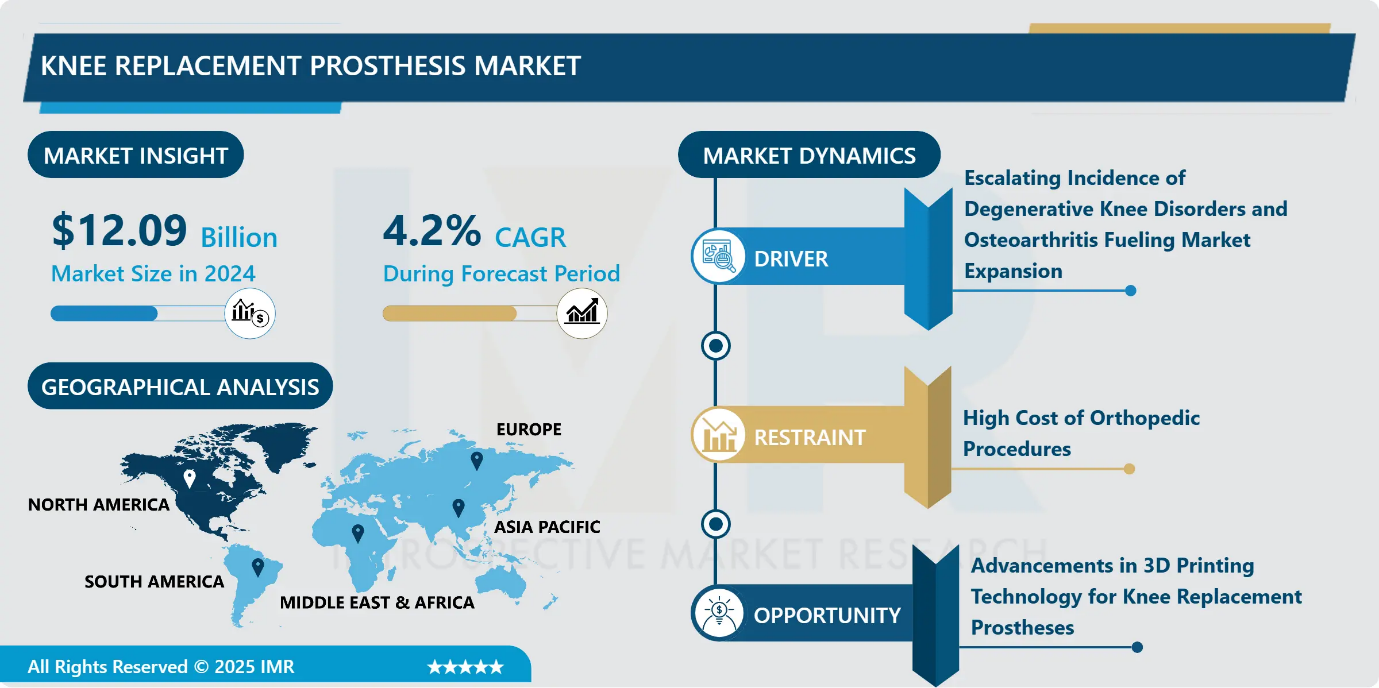
Knee Replacement Prosthesis Market Size Was Valued at USD 12.09 Billion in 2024, and is Projected to Reach USD 19.01 Billion by 2035, Growing at a CAGR of 4.2% from 2025-2035.
- Market Size in 2024: USD 12.09 Billion
- Projected Market Size by 2035: USD 19.01 Billion
- CAGR (2025–2035): 4.2%
- Leading Market in 2024: North America
- Fastest-Growing Market: Asia Pacific
- By End-User: The Hospital segment is anticipated to lead the market by accounting for 33.90% of the market share throughout the forecast period.
- By Product: The Total Knee Replacement segment is expected to capture 38.89% of the market share, thereby maintaining its dominance over the forecast period.
- By Region: North America region is projected to hold 29.62% of the market share during the forecast period.
- Active Players: Arthrex (United States), BBraun Aesculap (Germany), ConforMIS (United States), Corin Group (United Kingdom), DePuy Synthes (United States), and Other Active Players.
Knee Replacement Prosthesis Market Synopsis:
The knee replacement prosthesis market refers to the global industry focused on the development, manufacturing, and adoption of artificial knee implants used in knee arthroplasty procedures. These prosthetic devices replace damaged cartilage and bone caused by osteoarthritis, rheumatoid arthritis, post-traumatic arthritis, aging, or injury, restoring joint function and relieving chronic pain. The market scenario is characterized by strong growth due to a rising geriatric population, increasing prevalence of arthritis, and growing lifestyle- and sports-related knee disorders. Continuous advancements in implant materials, 3D printing, cementless fixation, and robotic-assisted surgery are improving surgical outcomes and implant longevity. Favorable reimbursement policies, expanding orthopedic infrastructure, and increased patient awareness further support market expansion globally.
Knee Replacement Prosthesis Market Dynamics and Trend Analysis:
Knee Replacement Prosthesis Market Growth Driver - Escalating Incidence of Degenerative Knee Disorders and Osteoarthritis Fueling Market Expansion
-
The rising prevalence of knee osteoarthritis is a key driver accelerating the growth of the knee replacement prosthesis market. Increasing life expectancy, sedentary lifestyles, and a growing obese population are contributing to higher osteoarthritis incidence, particularly among adults and the elderly. Utilization of knee arthroplasty remains high in individuals aged 65–74, while the fastest growth is observed in the 75–84 age group, with women undergoing procedures at significantly higher rates in developed markets.
- Advancements in implant durability and surgical precision now enable earlier intervention, expanding the eligible patient pool. Improved diagnostic rates, wider insurance coverage, and the adoption of digital technologies, including AI-assisted surgical planning, are further supporting demand for knee replacement procedures globally.
Knee Replacement Prosthesis Market Limiting Factor - High Cost of Orthopedic Procedures
-
The high cost associated with knee replacement procedures remains a major limitation for market growth, particularly in low- and middle-income regions. Knee arthroplasty involves expensive implants manufactured using advanced materials and precision technologies, along with preoperative diagnostics, surgical intervention, and postoperative care. In developed markets, procedure costs can range widely depending on implant type and surgical complexity, making affordability a concern despite insurance coverage.
- Additionally, price-cap regulations in countries such as China and India have significantly reduced implant prices, pressuring manufacturers’ margins and limiting investment in innovation. Limited reimbursement and out-of-pocket expenses further restrict patient access to knee replacement surgeries.
Knee Replacement Prosthesis Market Expansion Opportunity - Advancements in 3D Printing Technology for Knee Replacement Prostheses
-
The increasing adoption of 3D printing technology presents a significant growth opportunity for the knee replacement prosthesis market. 3D printing enables the design and manufacturing of patient-specific knee implants tailored to individual anatomical requirements, improving implant fit, alignment, and long-term outcomes. This technology reduces material wastage, shortens production timelines, and lowers dependency on bulk manufacturing, making it a cost-effective solution for orthopedic applications. The growing availability of advanced yet affordable 3D printing systems is supporting wider adoption across hospitals and specialized orthopedic centers. Additionally, rising investments in research, product innovation, and regulatory approvals for 3D-printed implants are expected to accelerate their commercialization, enhancing procedural efficiency and expanding market penetration globally.
Knee Replacement Prosthesis Market Challenge and Risk - Limited Availability of Skilled Surgeons
-
The shortage of skilled orthopedic surgeons and limited access to advanced surgical infrastructure pose significant challenges to market expansion. Knee replacement procedures require specialized expertise, particularly with robotic-assisted and minimally invasive techniques. In developing regions, the lack of trained professionals and modern technologies reduces patient confidence and limits procedural adoption. Stringent regulatory requirements and delayed product approvals also hinder the timely introduction of advanced implants, restricting market penetration.
Knee Replacement Prosthesis Market Trend - Growing Adoption of Robot-Assisted and Computer-Navigated Knee Arthroplasty Procedures
- Technological advancements in surgical procedures are emerging as a key trend shaping the knee replacement prosthesis market. The growing adoption of robotic-assisted surgery, computer-assisted navigation, and artificial intelligence is enhancing surgical precision, reducing intraoperative errors, and improving postoperative outcomes. AI-enabled platforms allow personalized surgical planning based on patient-specific knee anatomy and movement patterns, increasing implant alignment accuracy and longevity.
- Robot-assisted systems also minimize invasiveness and shorten recovery times, driving higher patient acceptance. Increasing awareness of advanced implant materials, customized designs, and digital surgical tools is further supporting adoption. Continuous investments in research and development, along with product launches by leading manufacturers, are expected to accelerate the integration of advanced technologies in knee replacement procedures globally.
Knee Replacement Prosthesis Market Segment Analysis:
The Knee Replacement Prosthesis Market is segmented into Product, Procedure, Surgical, Implant, End-User and Region.
By End-User, Hospital segment is expected to dominate the market with around 33.90% share during the forecast period.
-
Based on end user, the knee replacement prosthesis market is segmented into hospitals, orthopedic clinics, ambulatory surgical centers, and others. Among these, hospitals dominated the market in 2024, accounting for the largest revenue share due to their well-established infrastructure, availability of advanced surgical equipment, and presence of skilled orthopedic surgeons. Knee replacement procedures often involve complex cases that require comprehensive perioperative care, which hospitals are best equipped to provide.
- High patient footfall, rising orthopedic injury cases, and an increasing number of joint replacement surgeries further support hospital dominance. Additionally, hospitals benefit from favorable reimbursement frameworks and the ability to adopt advanced technologies such as robotic-assisted surgery. Meanwhile, ambulatory surgical centers are witnessing rapid growth, driven by efficiency, lower costs, and expanding outpatient knee replacement procedures.
By Product, Total knee replacement is expected to dominate with close to 38.89% market share during the forecast period.
-
Total knee replacement remains the dominant segment in the knee replacement prosthesis market, primarily due to the rising geriatric population and the increasing prevalence of advanced knee degeneration requiring complete joint replacement. The rapid adoption of robot-assisted surgical technologies is further strengthening this dominance by improving surgical precision, implant alignment, and clinical outcomes.
- Although manual techniques still account for a major share, robotic-assisted procedures are witnessing strong growth as they reduce revision rates and enhance patient recovery. This trend is important as robotic platforms enable standardized, data-driven procedures, increase surgeon confidence, and expand patient acceptance, ultimately improving long-term implant performance and healthcare efficiency.
Knee Replacement Prosthesis Market Regional Insights:
North America region is estimated to lead the market with around 29.62% share during the forecast period.
-
North America accounted for the largest share of the global knee replacement prosthesis market in 2024, driven by a high procedural volume, advanced healthcare infrastructure, and strong adoption of innovative technologies. The United States performs more than 700,000 knee replacement surgeries annually, supported by favorable reimbursement policies, high healthcare expenditure, and widespread use of robotic-assisted and computer-aided surgical techniques.
- A large geriatric population and high prevalence of osteoarthritis and joint disorders continue to fuel demand. The presence of leading orthopedic device manufacturers and ongoing investments in digital orthopedics, 3D-printed implants, and smart surgical solutions further strengthen the region’s position. Additionally, strong patient awareness and access to advanced treatment options make North America the dominant regional market.
Knee Replacement Prosthesis Market Active Players:
- Arthrex (USA)
- B. Braun (Aesculap) (Germany)
- ConforMIS (USA)
- Corin (UK)
- DePuy Synthes (J&J) (USA)
- Exactech (USA)
- LimaCorporate (Italy)
- Mathys (Switzerland)
- Medacta (Switzerland)
- MicroPort (China)
- Smith & Nephew (S&N) (UK)
- Stryker (USA)
- United Orthopedic (UOC) (Taiwan)
- Waldemar Link (LINK) (Germany)
- Zimmer Biomet (ZB) (USA)
- Other Active Players
Key Industry Developments in the Knee Replacement Prosthesis Market:
- In March 2025: Stryker presented its next-generation Mako SmartRobotics platform at the AAOS 2025 Annual Meeting, highlighting enhanced planning and guidance capabilities for total and partial knee procedures, along with expanded robotic-assisted hip applications, strengthening its leadership in robotic surgery.
- In March 2025: Smith+Nephew showcased its latest innovations in orthopedic reconstruction at the American Academy of Orthopaedic Surgeons Annual Meeting in San Diego, emphasizing advancements in implant technology and digital surgical solutions.
Engineering Innovations in Knee Implant Materials, Design, and Biomechanics
-
The technical landscape of the knee replacement prosthesis market is characterized by continuous innovation in implant design, materials science, and surgical technologies. Modern knee prostheses are engineered using advanced metal alloys such as cobalt-chromium and titanium, combined with high-performance polyethylene and ceramic components to enhance durability, biocompatibility, and wear resistance. Design advancements include fixed-bearing and mobile-bearing implants, patient-specific instrumentation, and anatomically contoured components that improve joint kinematics and stability.
- Technological integration plays a critical role, with robotic-assisted and computer-navigated systems enabling precise bone resection, optimal implant alignment, and real-time soft-tissue balancing. Additive manufacturing (3D printing) is increasingly used to produce customized implants and porous structures that support bone ingrowth in cementless procedures. In addition, digital planning software, AI-driven analytics, and smart implants with sensor capabilities are enhancing surgical accuracy, postoperative monitoring, and long-term implant performance, advancing overall procedural efficacy.
|
Knee Replacement Prosthesis Market |
|||
|
Base Year: |
2024 |
Forecast Period: |
2025-2035 |
|
Historical Data: |
2018 to 2024 |
Market Size in 2024: |
USD 12.09 Bn. |
|
Forecast Period 2025-35 CAGR: |
4.2% |
Market Size in 2035: |
USD 19.01 Bn. |
|
Segments Covered: |
By Product
|
|
|
|
By Procedure
|
|
||
|
By Surgical Technology |
|
||
|
By Implant |
|
||
|
By End-User |
|
||
|
By Region |
|
||
|
Growth Driver: |
|
||
|
Limiting Factor |
|
||
|
Expansion Opportunity |
|
||
|
Challenge and Risk |
|
||
|
Companies Covered in the Report: |
|
||
Chapter 1: Introduction
1.1 Scope and Coverage
Chapter 2:Executive Summary
Chapter 3: Market Landscape
3.1 Market Dynamics and Opportunity Analysis
3.1.1 Growth Drivers
3.1.2 Limiting Factors
3.1.3 Growth Opportunities
3.1.4 Challenges and Risks
3.2 Market Trend Analysis
3.3 Industry Ecosystem
3.4 Industry Value Chain Mapping
3.5 Strategic PESTLE Overview
3.6 Porter's Five Forces Framework
3.7 Regulatory Framework
3.8 Pricing Trend Analysis
3.9 Intellectual Property Review
3.10 Technology Evolution
3.11 Import-Export Analysis
3.12 Consumer Behavior Analysis
3.13 Investment Pocket Analysis
3.14 Go-To Market Strategy
Chapter 4: Knee Replacement Prosthesis Market by Product (2018-2035)
4.1 Knee Replacement Prosthesis Market Snapshot and Growth Engine
4.2 Market Overview
4.3 Total Knee Replacement
4.3.1 Introduction and Market Overview
4.3.2 Historic and Forecasted Market Size in Value USD and Volume Units
4.3.3 Key Market Trends, Growth Factors, and Opportunities
4.3.4 Geographic Segmentation Analysis
4.4 Partial Knee Replacement
4.5 Patellofemoral Replacement
Chapter 5: Knee Replacement Prosthesis Market by Procedure (2018-2035)
5.1 Knee Replacement Prosthesis Market Snapshot and Growth Engine
5.2 Market Overview
5.3 Primary Knee Replacement
5.3.1 Introduction and Market Overview
5.3.2 Historic and Forecasted Market Size in Value USD and Volume Units
5.3.3 Key Market Trends, Growth Factors, and Opportunities
5.3.4 Geographic Segmentation Analysis
5.4 Revision Knee Replacement
Chapter 6: Knee Replacement Prosthesis Market by Surgical Technology (2018-2035)
6.1 Knee Replacement Prosthesis Market Snapshot and Growth Engine
6.2 Market Overview
6.3 Manual
6.3.1 Introduction and Market Overview
6.3.2 Historic and Forecasted Market Size in Value USD and Volume Units
6.3.3 Key Market Trends, Growth Factors, and Opportunities
6.3.4 Geographic Segmentation Analysis
6.4 Robotic-Assisted
Chapter 7: Knee Replacement Prosthesis Market by Implant (2018-2035)
7.1 Knee Replacement Prosthesis Market Snapshot and Growth Engine
7.2 Market Overview
7.3 Fixed Bearing
7.3.1 Introduction and Market Overview
7.3.2 Historic and Forecasted Market Size in Value USD and Volume Units
7.3.3 Key Market Trends, Growth Factors, and Opportunities
7.3.4 Geographic Segmentation Analysis
7.4 Mobile Bearing
Chapter 8: Knee Replacement Prosthesis Market by End User (2018-2035)
8.1 Knee Replacement Prosthesis Market Snapshot and Growth Engine
8.2 Market Overview
8.3 Hospitals
8.3.1 Introduction and Market Overview
8.3.2 Historic and Forecasted Market Size in Value USD and Volume Units
8.3.3 Key Market Trends, Growth Factors, and Opportunities
8.3.4 Geographic Segmentation Analysis
8.4 Orthopedic Clinics
8.5 Ambulatory Surgical Centers
8.6 Specialty Clinics
Chapter 9: Company Profiles and Competitive Analysis
9.1 Competitive Landscape
9.1.1 Competitive Benchmarking
9.1.2 Knee Replacement Prosthesis Market Share by Manufacturer/Service Provider(2024)
9.1.3 Industry BCG Matrix
9.1.4 PArtnerships, Mergers & Acquisitions
9.2 ARTHREX (UNITED STATES)
9.2.1 Company Overview
9.2.2 Key Executives
9.2.3 Company Snapshot
9.2.4 Role of the Company in the Market
9.2.5 Sustainability and Social Responsibility
9.2.6 Operating Business Segments
9.2.7 Product Portfolio
9.2.8 Business Performance
9.2.9 Recent News & Developments
9.2.10 SWOT Analysis
9.3 BBRAUN AESCULAP (GERMANY)
9.4 CONFORMIS (UNITED STATES)
9.5 CORIN GROUP (UNITED KINGDOM)
9.6 DEPUY SYNTHES (UNITED STATES)
9.7 EXACTECH (UNITED STATES)
9.8 LIMACORPORATE (ITALY)
9.9 MATHYS (SWITZERLAND)
9.10 MEDACTA (SWITZERLAND)
9.11 MICROPORT (CHINA)
9.12 SMITH & NEPHEW (UNITED KINGDOM)
9.13 STRYKER (UNITED STATES)
9.14 UNITED ORTHOPEDIC (TAIWAN)
9.15 WALDEMAR LINK (GERMANY)
9.16 ZIMMER BIOMET (UNITED STATES) AND OTHER ACTIVE PLAYERS
Chapter 10: Global Knee Replacement Prosthesis Market By Region
10.1 Overview
10.2. North America Knee Replacement Prosthesis Market
10.2.1 Key Market Trends, Growth Factors and Opportunities
10.2.2 Top Key Companies
10.2.3 Historic and Forecasted Market Size by Segments
10.2.4 Historic and Forecast Market Size by Country
10.2.4.1 US
10.2.4.2 Canada
10.2.4.3 Mexico
10.3. Eastern Europe Knee Replacement Prosthesis Market
10.3.1 Key Market Trends, Growth Factors and Opportunities
10.3.2 Top Key Companies
10.3.3 Historic and Forecasted Market Size by Segments
10.3.4 Historic and Forecast Market Size by Country
10.3.4.1 Russia
10.3.4.2 Bulgaria
10.3.4.3 The Czech Republic
10.3.4.4 Hungary
10.3.4.5 Poland
10.3.4.6 Romania
10.3.4.7 Rest of Eastern Europe
10.4. Western Europe Knee Replacement Prosthesis Market
10.4.1 Key Market Trends, Growth Factors and Opportunities
10.4.2 Top Key Companies
10.4.3 Historic and Forecasted Market Size by Segments
10.4.4 Historic and Forecast Market Size by Country
10.4.4.1 Germany
10.4.4.2 UK
10.4.4.3 France
10.4.4.4 The Netherlands
10.4.4.5 Italy
10.4.4.6 Spain
10.4.4.7 Rest of Western Europe
10.5. Asia Pacific Knee Replacement Prosthesis Market
10.5.1 Key Market Trends, Growth Factors and Opportunities
10.5.2 Top Key Companies
10.5.3 Historic and Forecasted Market Size by Segments
10.5.4 Historic and Forecast Market Size by Country
10.5.4.1 China
10.5.4.2 India
10.5.4.3 Japan
10.5.4.4 South Korea
10.5.4.5 Malaysia
10.5.4.6 Thailand
10.5.4.7 Vietnam
10.5.4.8 The Philippines
10.5.4.9 Australia
10.5.4.10 New Zealand
10.5.4.11 Rest of APAC
10.6. Middle East & Africa Knee Replacement Prosthesis Market
10.6.1 Key Market Trends, Growth Factors and Opportunities
10.6.2 Top Key Companies
10.6.3 Historic and Forecasted Market Size by Segments
10.6.4 Historic and Forecast Market Size by Country
10.6.4.1 Turkiye
10.6.4.2 Bahrain
10.6.4.3 Kuwait
10.6.4.4 Saudi Arabia
10.6.4.5 Qatar
10.6.4.6 UAE
10.6.4.7 Israel
10.6.4.8 South Africa
10.7. South America Knee Replacement Prosthesis Market
10.7.1 Key Market Trends, Growth Factors and Opportunities
10.7.2 Top Key Companies
10.7.3 Historic and Forecasted Market Size by Segments
10.7.4 Historic and Forecast Market Size by Country
10.7.4.1 Brazil
10.7.4.2 Argentina
10.7.4.3 Rest of SA
Chapter 11 Analyst Viewpoint and Conclusion
Chapter 12 Our Thematic Research Methodology
12.1 Research Process
12.2 Primary Research
12.3 Secondary Research
Chapter 13 Case Study
Chapter 14 Appendix
14.1 Sources
14.2 List of Tables and figures
14.3 Short Forms and Citations
14.4 Assumption and Conversion
14.5 Disclaimer
|
Knee Replacement Prosthesis Market |
|||
|
Base Year: |
2024 |
Forecast Period: |
2025-2035 |
|
Historical Data: |
2018 to 2024 |
Market Size in 2024: |
USD 12.09 Bn. |
|
Forecast Period 2025-35 CAGR: |
4.2% |
Market Size in 2035: |
USD 19.01 Bn. |
|
Segments Covered: |
By Product
|
|
|
|
By Procedure
|
|
||
|
By Surgical Technology |
|
||
|
By Implant |
|
||
|
By End-User |
|
||
|
By Region |
|
||
|
Growth Driver: |
|
||
|
Limiting Factor |
|
||
|
Expansion Opportunity |
|
||
|
Challenge and Risk |
|
||
|
Companies Covered in the Report: |
|
||