




Kidney Cancer Drugs Market Synopsis:
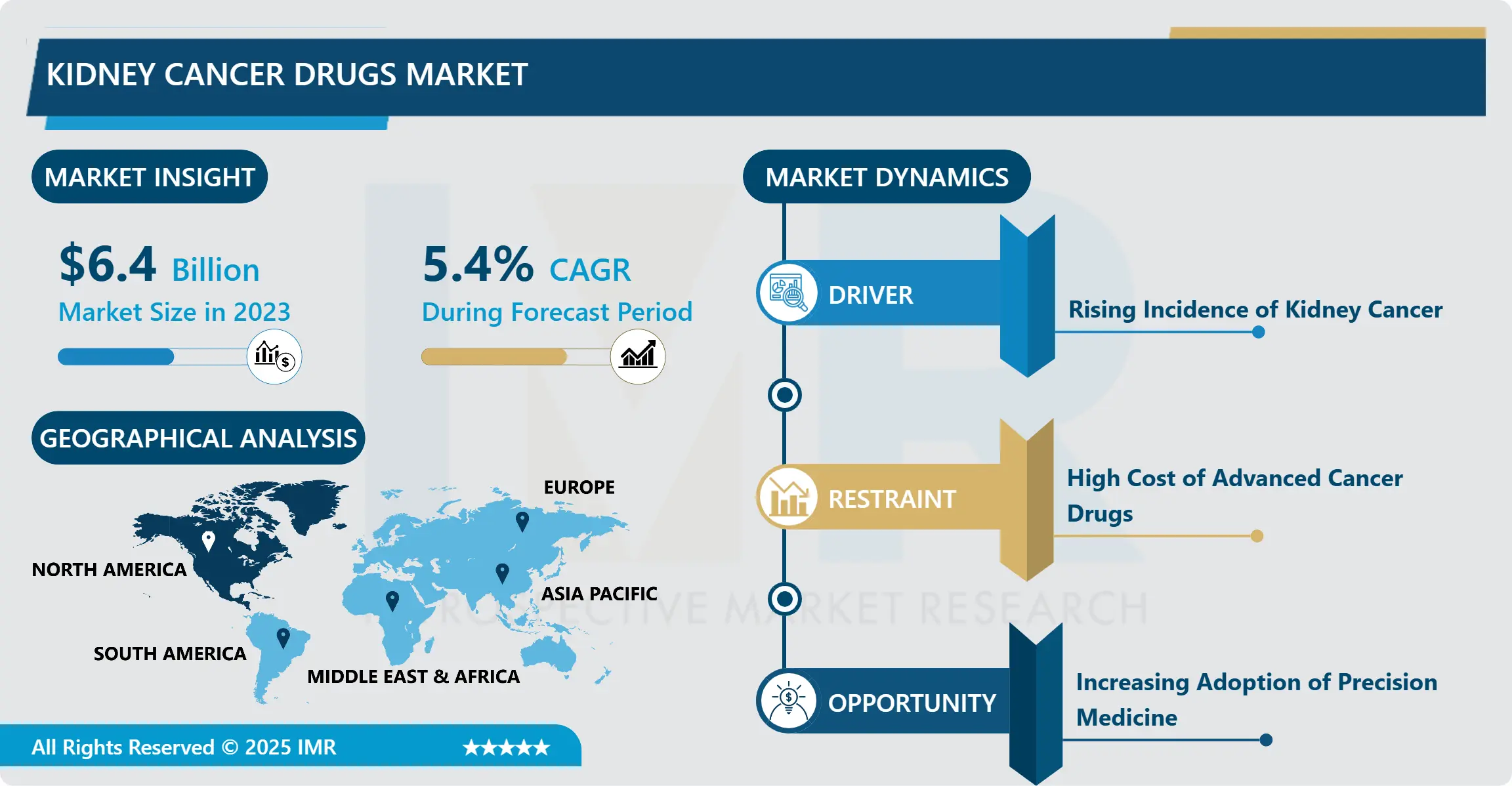
Kidney Cancer Drugs Market Size Was Valued at USD 6.4 Billion in 2023, and is Projected to Reach USD 10.3 Billion by 2032, Growing at a CAGR of 5.4% From 2024-2032.
Therefore, the kidney cancer drugs market refers to the pharmaceutical industry whose main business is the discovery, production and distribution of drugs for the cure of kidney cancer. Cancer of the kidneys is also termed renal cell carcinoma, which starts in the kidneys and may extend to other body organs if the disease progresses. The market for ABL comprises all the therapeutic drugs such as target therapy, immune checkpoint inhibitors, and anti angiogenic treatment in order to control the growth of tumor, alter the symptoms, and enhance the survival rate of the patients. The growth of kidney cancer drugs market is thus boosted by discovery and development of new drug, increase in kidney cancer cases globally and innovations in comprehensive cancer care and infrastructure.
The market for kidney cancer drugs is gradually on the rise mainly because there is an increase in the global incidence of kidney cancer, improvement in health awareness and expenditure, and development in cancer therapy. Thanks to the development of new diagnostic tools, kidney cancer is increasingly diagnosed in the early stages, which creates a need for effective drugs and treatments. Further, the advancement of therapies that are specifically designed and developed for particular illnesses and jointly with immune therapies and individual treatment plans has also boosted the market more exceptionally. From the aspects of awareness, there are more options when it comes to cancer treatment today than before, due to advanced knowledge in cancer treatment and the drugs available as more and more patients enjoy better outcomes and longer survival.
In the recent past, there has been an increase in the size of the geriatric population, which is at a higher risk of getting affected by kidney cancer, has also provided added encouragement to the development of kidney cancer drugs. Furthermore, high scientific research for clinical trials and the approval of new drugs is also projected to expand opportunities of the market. Top pharma firms persist with substantial R&D advances to develop new therapies more effective, safer, and more acceptable to patients. This market is also experiencing massive merger, cooperation, and affiliation between biotech companies and major pharmaceutical companies, to bring out sophisticated solutions for kidney cancer and thereby fueling the market.
 Kidney Cancer Drugs Market Trend Analysis:
Immunotherapy Leading the Charge
-
One of the trend emerging in the market for kidney cancer drugs is the rather fast integration of immunotherapy that have changed the approaches to treating cancer significantly. These therapies operate on the premise that the patient’s Immunological system is activated to identify cancer cells and destroy them: such therapies offer a new paradigm in the treatment of cancer. Unlike chemotherapy, immunotherapy seems to be associated with several side effects, however it is the most recommended treatments by many patients and specialists. These drugs, including Nivolumab and Pembrolizumab cancer, are growing to be standard medications for advanced kidney cancer and remain a key factor in market development. Players in the pharmaceutical industry are exploring immunotherapy, and the emerging clinical trials may put new effective drugs in the market in the coming future.
Growing Demand for Personalized Medicine
-
The increasing trend of personalized medicine is giving new avenues to the kidney cancer drugs market. Modern cancer treatment depends on the genetic tissue analysis and could be targeted specifically to the patient’s genotype. Such an approach means that different forms of treatments applied to cancer patients will achieve higher rates of effectiveness since the doctors can recommend treatments specific to the cancer type. More and more pharmaceutical firms are involving biomarkers and companion diagnostic in order to create a new therapy that will target certain patients. Finally, the application of artificial intelligence (AI) and data in the development of new drugs is enhancing the discovery of fresh treatments for kidney cancer; it has presented companies in the pharmaceutical industry with the window to develop new and more personalized drugs.
Kidney Cancer Drugs Market Segment Analysis:
Kidney Cancer Drugs Market is Segmented on the basis of Therapy Type, Class Type, Distribution Channel, and Region.
By Therapy Type, Targeted Therapy segment is expected to dominate the market during the forecast period
-
According to the therapy type, the targeted therapy category is expected to hold the largest market share in the kidney cancer drugs market during the forecast period. Molecular therapy is a class of drugs that home on the cancerous cells while sparing the normal cells which are one step ahead of traditional methods such as chemotherapy. Treatment outcomes of molecular kinase inhibitors like TKIs and mTOR inhibitors have made targeted therapy more useful in patients with advanced RCC. Sunitinib and Pazopanib are among the drugs that as evidenced by different studies have proven to be effective in preventing cancer growth and enhancing patient’s longevity. Continued efforts to develop newer targeted therapies are anticipated to enhance this segment’s position in the market, as globally, renal cell carcinoma incidence increases and patient interest in safer, more efficacious treatments grows.
By Class Type, Angiogenesis Inhibitors segment expected to held the largest share
-
Geographically, it is believed that North America would dominate the kidney cancer drugs market followed by Europe Market by class type angiogenesis inhibitors segment is likely to emerge as the most prominent segment in the global market for kidney cancer drugs. These drugs have been design to interfer with the development of new blood vessels, which supply the cancers with nutrient base thus halting development of the cancerous cells. With products like Bevacizumab and Axitinib angiogenesis inhibitors have widely been used in the advanced kidney cancer treatments through extending the patient’s life span. The ever increasing approved clinical reports recommending the use of angiogenesis inhibitors in treatment of kidney cancer due to their effectiveness in first and second line therapies putting them in a commanding position in the market.
Kidney Cancer Drugs Market Regional Insights:
North America is Expected to Dominate the Market Over the Forecast period
- According to research conducted in the year 2023, North America is expected to have the largest market share for the kidney cancer drugs market in the entire world. This area boasts of good health facilities, greatly endowed research on cancer, and a wide range of quality treatments and care. Of the analyzed regions, the highest growth is characteristic of the USA attributed to the headquarters of significant market participants, technological advancements, and growing patient awareness. According to the report, North America is expected to hold a 40-45% share of the global kidney cancer drugs market by 2023. The continually growing incidence rate of kidney cancer along with successful implementation of advanced technologies puts North America in front of other regions, in terms of market growth. Besides that, refund policies for reagents and substances are also sensitive in this region and the government pays considerable attention to treat cancer.
Active Key Players in the Kidney Cancer Drugs Market:
-
AbbVie Inc. (USA)
- Amgen Inc. (USA)
- AstraZeneca (UK)
- Bayer AG (Germany)
- Bristol-Myers Squibb (USA)
- Eisai Co., Ltd. (Japan)
- Exelixis, Inc. (USA)
- GlaxoSmithKline plc (UK)
- Ipsen Pharma (France)
- Merck & Co., Inc. (USA)
- Novartis AG (Switzerland)
- Pfizer, Inc. (USA)
- Roche Holding AG (Switzerland)
- Sanofi (France)
- Takeda Pharmaceutical Company (Japan)
- Other Active Players
|
Kidney Cancer Drugs Market |
|||
|
Base Year: |
2023 |
Forecast Period: |
2024-2032 |
|
Historical Data: |
2017 to 2023 |
Market Size in 2023: |
USD 6.4 Billion |
|
Forecast Period 2024-32 CAGR: |
5.4% |
Market Size in 2032: |
USD 10.3 Billion |
|
Segments Covered: |
By Therapy Type |
|
|
|
By Class Type |
|
||
|
By Distribution Channel |
|
||
|
By Region |
|
||
|
Key Market Drivers: |
|
||
|
Key Market Restraints: |
|
||
|
Key Opportunities: |
|
||
|
Companies Covered in the report: |
|
||
Chapter 1: Introduction
1.1 Scope and Coverage
Chapter 2:Executive Summary
Chapter 3: Market Landscape
3.1 Market Dynamics
3.1.1 Drivers
3.1.2 Restraints
3.1.3 Opportunities
3.1.4 Challenges
3.2 Market Trend Analysis
3.3 PESTLE Analysis
3.4 Porter's Five Forces Analysis
3.5 Industry Value Chain Analysis
3.6 Ecosystem
3.7 Regulatory Landscape
3.8 Price Trend Analysis
3.9 Patent Analysis
3.10 Technology Evolution
3.11 Investment Pockets
3.12 Import-Export Analysis
Chapter 4: Kidney Cancer Drugs Market by Therapy Type
4.1 Kidney Cancer Drugs Market Snapshot and Growth Engine
4.2 Kidney Cancer Drugs Market Overview
4.3 Targeted Therapy
4.3.1 Introduction and Market Overview
4.3.2 Historic and Forecasted Market Size in Value USD and Volume Units (2017-2032F)
4.3.3 Key Market Trends, Growth Factors and Opportunities
4.3.4 Targeted Therapy: Geographic Segmentation Analysis
4.4 Immunotherapy
4.4.1 Introduction and Market Overview
4.4.2 Historic and Forecasted Market Size in Value USD and Volume Units (2017-2032F)
4.4.3 Key Market Trends, Growth Factors and Opportunities
4.4.4 Immunotherapy: Geographic Segmentation Analysis
4.5 Chemotherapy
4.5.1 Introduction and Market Overview
4.5.2 Historic and Forecasted Market Size in Value USD and Volume Units (2017-2032F)
4.5.3 Key Market Trends, Growth Factors and Opportunities
4.5.4 Chemotherapy: Geographic Segmentation Analysis
Chapter 5: Kidney Cancer Drugs Market by Class Type
5.1 Kidney Cancer Drugs Market Snapshot and Growth Engine
5.2 Kidney Cancer Drugs Market Overview
5.3 Angiogenesis Inhibitors
5.3.1 Introduction and Market Overview
5.3.2 Historic and Forecasted Market Size in Value USD and Volume Units (2017-2032F)
5.3.3 Key Market Trends, Growth Factors and Opportunities
5.3.4 Angiogenesis Inhibitors: Geographic Segmentation Analysis
5.4 mTOR Inhibitors
5.4.1 Introduction and Market Overview
5.4.2 Historic and Forecasted Market Size in Value USD and Volume Units (2017-2032F)
5.4.3 Key Market Trends, Growth Factors and Opportunities
5.4.4 mTOR Inhibitors: Geographic Segmentation Analysis
5.5 Cytokinesis
5.5.1 Introduction and Market Overview
5.5.2 Historic and Forecasted Market Size in Value USD and Volume Units (2017-2032F)
5.5.3 Key Market Trends, Growth Factors and Opportunities
5.5.4 Cytokinesis: Geographic Segmentation Analysis
Chapter 6: Kidney Cancer Drugs Market by Distribution Channel
6.1 Kidney Cancer Drugs Market Snapshot and Growth Engine
6.2 Kidney Cancer Drugs Market Overview
6.3 Hospital Pharmacies
6.3.1 Introduction and Market Overview
6.3.2 Historic and Forecasted Market Size in Value USD and Volume Units (2017-2032F)
6.3.3 Key Market Trends, Growth Factors and Opportunities
6.3.4 Hospital Pharmacies: Geographic Segmentation Analysis
6.4 Retail Pharmacies
6.4.1 Introduction and Market Overview
6.4.2 Historic and Forecasted Market Size in Value USD and Volume Units (2017-2032F)
6.4.3 Key Market Trends, Growth Factors and Opportunities
6.4.4 Retail Pharmacies: Geographic Segmentation Analysis
6.5 Online Pharmacies
6.5.1 Introduction and Market Overview
6.5.2 Historic and Forecasted Market Size in Value USD and Volume Units (2017-2032F)
6.5.3 Key Market Trends, Growth Factors and Opportunities
6.5.4 Online Pharmacies: Geographic Segmentation Analysis
Chapter 7: Company Profiles and Competitive Analysis
7.1 Competitive Landscape
7.1.1 Competitive Benchmarking
7.1.2 Kidney Cancer Drugs Market Share by Manufacturer (2023)
7.1.3 Industry BCG Matrix
7.1.4 Heat Map Analysis
7.1.5 Mergers and Acquisitions
7.2 ABBVIE INC. (USA)
7.2.1 Company Overview
7.2.2 Key Executives
7.2.3 Company Snapshot
7.2.4 Role of the Company in the Market
7.2.5 Sustainability and Social Responsibility
7.2.6 Operating Business Segments
7.2.7 Product Portfolio
7.2.8 Business Performance
7.2.9 Key Strategic Moves and Recent Developments
7.2.10 SWOT Analysis
7.3 AMGEN INC. (USA)
7.4 ASTRAZENECA (UK)
7.5 BAYER AG (GERMANY)
7.6 BRISTOL-MYERS SQUIBB (USA)
7.7 EISAI CO. LTD. (JAPAN)
7.8 EXELIXIS INC. (USA)
7.9 GLAXOSMITHKLINE PLC (UK)
7.10 IPSEN PHARMA (FRANCE)
7.11 MERCK & CO. INC. (USA)
7.12 NOVARTIS AG (SWITZERLAND)
7.13 PFIZER INC. (USA)
7.14 ROCHE HOLDING AG (SWITZERLAND)
7.15 SANOFI (FRANCE)
7.16 TAKEDA PHARMACEUTICAL COMPANY (JAPAN)
7.17 .
7.18 OTHER ACTIVE PLAYERS
Chapter 8: Global Kidney Cancer Drugs Market By Region
8.1 Overview
8.2. North America Kidney Cancer Drugs Market
8.2.1 Key Market Trends, Growth Factors and Opportunities
8.2.2 Top Key Companies
8.2.3 Historic and Forecasted Market Size by Segments
8.2.4 Historic and Forecasted Market Size By Therapy Type
8.2.4.1 Targeted Therapy
8.2.4.2 Immunotherapy
8.2.4.3 Chemotherapy
8.2.5 Historic and Forecasted Market Size By Class Type
8.2.5.1 Angiogenesis Inhibitors
8.2.5.2 mTOR Inhibitors
8.2.5.3 Cytokinesis
8.2.6 Historic and Forecasted Market Size By Distribution Channel
8.2.6.1 Hospital Pharmacies
8.2.6.2 Retail Pharmacies
8.2.6.3 Online Pharmacies
8.2.7 Historic and Forecast Market Size by Country
8.2.7.1 US
8.2.7.2 Canada
8.2.7.3 Mexico
8.3. Eastern Europe Kidney Cancer Drugs Market
8.3.1 Key Market Trends, Growth Factors and Opportunities
8.3.2 Top Key Companies
8.3.3 Historic and Forecasted Market Size by Segments
8.3.4 Historic and Forecasted Market Size By Therapy Type
8.3.4.1 Targeted Therapy
8.3.4.2 Immunotherapy
8.3.4.3 Chemotherapy
8.3.5 Historic and Forecasted Market Size By Class Type
8.3.5.1 Angiogenesis Inhibitors
8.3.5.2 mTOR Inhibitors
8.3.5.3 Cytokinesis
8.3.6 Historic and Forecasted Market Size By Distribution Channel
8.3.6.1 Hospital Pharmacies
8.3.6.2 Retail Pharmacies
8.3.6.3 Online Pharmacies
8.3.7 Historic and Forecast Market Size by Country
8.3.7.1 Russia
8.3.7.2 Bulgaria
8.3.7.3 The Czech Republic
8.3.7.4 Hungary
8.3.7.5 Poland
8.3.7.6 Romania
8.3.7.7 Rest of Eastern Europe
8.4. Western Europe Kidney Cancer Drugs Market
8.4.1 Key Market Trends, Growth Factors and Opportunities
8.4.2 Top Key Companies
8.4.3 Historic and Forecasted Market Size by Segments
8.4.4 Historic and Forecasted Market Size By Therapy Type
8.4.4.1 Targeted Therapy
8.4.4.2 Immunotherapy
8.4.4.3 Chemotherapy
8.4.5 Historic and Forecasted Market Size By Class Type
8.4.5.1 Angiogenesis Inhibitors
8.4.5.2 mTOR Inhibitors
8.4.5.3 Cytokinesis
8.4.6 Historic and Forecasted Market Size By Distribution Channel
8.4.6.1 Hospital Pharmacies
8.4.6.2 Retail Pharmacies
8.4.6.3 Online Pharmacies
8.4.7 Historic and Forecast Market Size by Country
8.4.7.1 Germany
8.4.7.2 UK
8.4.7.3 France
8.4.7.4 The Netherlands
8.4.7.5 Italy
8.4.7.6 Spain
8.4.7.7 Rest of Western Europe
8.5. Asia Pacific Kidney Cancer Drugs Market
8.5.1 Key Market Trends, Growth Factors and Opportunities
8.5.2 Top Key Companies
8.5.3 Historic and Forecasted Market Size by Segments
8.5.4 Historic and Forecasted Market Size By Therapy Type
8.5.4.1 Targeted Therapy
8.5.4.2 Immunotherapy
8.5.4.3 Chemotherapy
8.5.5 Historic and Forecasted Market Size By Class Type
8.5.5.1 Angiogenesis Inhibitors
8.5.5.2 mTOR Inhibitors
8.5.5.3 Cytokinesis
8.5.6 Historic and Forecasted Market Size By Distribution Channel
8.5.6.1 Hospital Pharmacies
8.5.6.2 Retail Pharmacies
8.5.6.3 Online Pharmacies
8.5.7 Historic and Forecast Market Size by Country
8.5.7.1 China
8.5.7.2 India
8.5.7.3 Japan
8.5.7.4 South Korea
8.5.7.5 Malaysia
8.5.7.6 Thailand
8.5.7.7 Vietnam
8.5.7.8 The Philippines
8.5.7.9 Australia
8.5.7.10 New Zealand
8.5.7.11 Rest of APAC
8.6. Middle East & Africa Kidney Cancer Drugs Market
8.6.1 Key Market Trends, Growth Factors and Opportunities
8.6.2 Top Key Companies
8.6.3 Historic and Forecasted Market Size by Segments
8.6.4 Historic and Forecasted Market Size By Therapy Type
8.6.4.1 Targeted Therapy
8.6.4.2 Immunotherapy
8.6.4.3 Chemotherapy
8.6.5 Historic and Forecasted Market Size By Class Type
8.6.5.1 Angiogenesis Inhibitors
8.6.5.2 mTOR Inhibitors
8.6.5.3 Cytokinesis
8.6.6 Historic and Forecasted Market Size By Distribution Channel
8.6.6.1 Hospital Pharmacies
8.6.6.2 Retail Pharmacies
8.6.6.3 Online Pharmacies
8.6.7 Historic and Forecast Market Size by Country
8.6.7.1 Turkiye
8.6.7.2 Bahrain
8.6.7.3 Kuwait
8.6.7.4 Saudi Arabia
8.6.7.5 Qatar
8.6.7.6 UAE
8.6.7.7 Israel
8.6.7.8 South Africa
8.7. South America Kidney Cancer Drugs Market
8.7.1 Key Market Trends, Growth Factors and Opportunities
8.7.2 Top Key Companies
8.7.3 Historic and Forecasted Market Size by Segments
8.7.4 Historic and Forecasted Market Size By Therapy Type
8.7.4.1 Targeted Therapy
8.7.4.2 Immunotherapy
8.7.4.3 Chemotherapy
8.7.5 Historic and Forecasted Market Size By Class Type
8.7.5.1 Angiogenesis Inhibitors
8.7.5.2 mTOR Inhibitors
8.7.5.3 Cytokinesis
8.7.6 Historic and Forecasted Market Size By Distribution Channel
8.7.6.1 Hospital Pharmacies
8.7.6.2 Retail Pharmacies
8.7.6.3 Online Pharmacies
8.7.7 Historic and Forecast Market Size by Country
8.7.7.1 Brazil
8.7.7.2 Argentina
8.7.7.3 Rest of SA
Chapter 9 Analyst Viewpoint and Conclusion
9.1 Recommendations and Concluding Analysis
9.2 Potential Market Strategies
Chapter 10 Research Methodology
10.1 Research Process
10.2 Primary Research
10.3 Secondary Research
|
Kidney Cancer Drugs Market |
|||
|
Base Year: |
2023 |
Forecast Period: |
2024-2032 |
|
Historical Data: |
2017 to 2023 |
Market Size in 2023: |
USD 6.4 Billion |
|
Forecast Period 2024-32 CAGR: |
5.4% |
Market Size in 2032: |
USD 10.3 Billion |
|
Segments Covered: |
By Therapy Type |
|
|
|
By Class Type |
|
||
|
By Distribution Channel |
|
||
|
By Region |
|
||
|
Key Market Drivers: |
|
||
|
Key Market Restraints: |
|
||
|
Key Opportunities: |
|
||
|
Companies Covered in the report: |
|
||


