




Intraoperative Neuromonitoring Market Synopsis:
Intraoperative Neuromonitoring Market Size Was Valued at USD 3.26 Billion in 2023, and is Projected to Reach USD 4.98 Billion by 2032, Growing at a CAGR of 4.80% From 2024-2032.
Intraoperative neuromonitoring (IONM) is also known as real time monitoring of neural pathways during surgeries in an effort to minimize the incidences of nerve damage or other neurological handle during surgeries. With the help of specialized medical instruments used by this technique, doctors can regulate and observe brain, spinal and nerves functions during the operation. This makes it possible to protect vital neurological formations in operations, including spinal, orthopedic and neurosurgical procedures. The goal is to enable the surgeons to be in a position to make right decisions that will in turn improve the quality of surgical care delivered to the patients.
The intraoperative neuromonitoring market is one of the upcoming segment under the medical devices industry across the world. They have experienced stiff technological development and a growing use of modern gadgets, including real-time monitoring gadgets and multi-channel monitoring equipment. In recent years, since hospitals are becoming more keen on the safety of patients and most importantly on post-surgical patients, more IONM devices are being bought. The usage of these systems has grown because surgeons can reduce the risk of the patient’s neurological compromise during intricate surgeries improving care.
Other factors, including progress in technology, increasing use of devices for monitoring such as less invasive technology, have also contributed in the growth of the market. Apart from these innovations, there has been a growing concern on safety and individualized care and treatment, which spur larger practice of IONM. However, rising healthcare costs and governments’ focus on enhancing operation results have been the key factors for the growth in this market. This growth trajectory is complimented by the increasing number of surgeries globally including spinal, brain surgeries as well as orthopedic surgeries that essentially apply IONM to monitor the neural health.
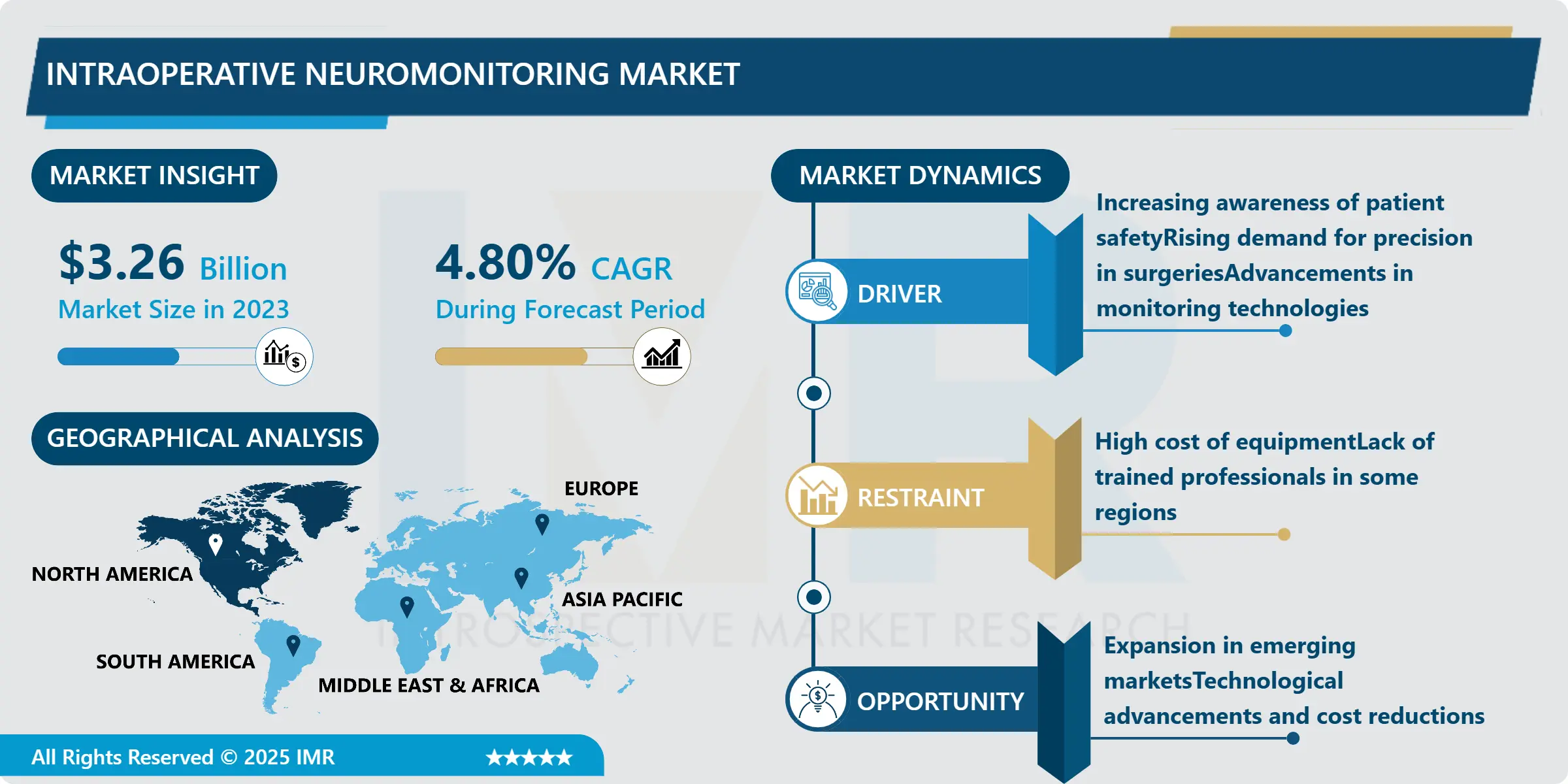
Intraoperative Neuromonitoring Market Trend Analysis:
Shift Toward Real-Time Monitoring Technologies
- Another change in the Intraoperative Neuromonitoring market is the shift to real-time intraoperative neural technologies. Surgeons and clinicians have now shifted to those that give real time feedback during surgeries so the technique used to effect a rectification can be changed from time to time thereby decreasing the risks associated with nerve damage. The growing techniques like electromyography (EMG), electroencephalography (EEG) and evoked potential monitoring has greatly improved real time data demands ahead of surgical group with very precise data. These real-time abilities assists recognize possible problems before they occur; hence, optimizing successful surgeries and patient safety. Consequently, these technologies have been invaluable in risky operations especially those affecting the neural structures; spinal, brain and orthopedic operations.
- Furthermore, as surgical procedures decrease invasive procedures, needs for accurate tracking technologies also increase significantly. Such technologies are crucial in giving the level of accuracy coupled with safety while conducting complicated surgeries that involve lesser cuts, and where standard means of monitoring might be inconsequential. The continued advances in portable and easy to use systems which provide good data feeds still continues to improve them. This research explores the role of these innovations in continuing to help shape the future of surgery as INM is positioned to become a standard practice in today’s surgical procedures especially with respect to lowering the risk of complications and enhancing patient outcomes.
Expansion in Emerging Markets
- Of all the strategic opportunities in the IONM market, the richest is to extend IONM services in growing markets. Thus, companies from North America and Europe reign supreme at the moment, but Asia-Pacific, Latin American and the Middle Eastern markets are steadily emerging as potential growth areas. Some of the emerging markets in the healthcare sector include China, India and Brazil and since their healthcare systems are rapidly improving the need for better technologies in healthcare is on the rise, and this can include IONM systems. These regions are also observing improvement in perceptions about patient safety during surgeries; thus, the enhanced use of IONM technology. With the countries performing more surgeries, precession and timely tracking is a necessity, these markets pose potential for growth.
- Moreover emerging market governments are now increasing their spending on health care and medical technology due to growing demand. Combined with the governmental policies in favour of technology implementation, great business opportunities are given to both incumbents and new market participants in the IONM industry. When the economic situations of these regions stabilize and health care department developed, the use of enhanced technologies in surgery such as IONM will uptake dramatically. This shift is the new opportunities for companies to continue growth, provide innovative solutions and meet the increasing need in the improvement of surgeries’ safety in these regions.
Intraoperative Neuromonitoring Market Segment Analysis:
Intraoperative Neuromonitoring Market is Segmented on the basis of Type Of Monitoring, Application, End User, and Region
By Type of Monitoring, Electromyography (EMG) segment is expected to dominate the market during the forecast period
- This market is further classified by the type of monitoring done during surgeries with the major techniques as EEG, EMG, Evoked Potential Monitoring and Nerve Conduction Monitoring. They use EEG a lot to evaluate the electrical activity of the brain particularly in neurosurgical procedures to confirm the brain function is intact. While EKG tracks electrical conduction within the heart, EMG assesses electrical signalling in muscles and nerves therefore assisting in preserving the nerves especially during spinal or orthopedic operations.
- Evoked potential monitoring is used to evaluate the functional status of neural tracts during spinal and brain operations measuring electrical responses of the brain to sensory stimuli. Nerve conduction is important in peripheral nerve function and should be done in operations that involve limbs and extremities. Moreover, we have added other forms of monitoring that might be used in other kinds of operations or technologies that might be in the process of development. The variation in these monitoring methods enables a selection of the most appropriate technique to use in accordance with the surgery needs that has a significant role to play in patient’s safety as well as the surgery outcomes.
By Application, spinal surgery segment expected to held the largest share
- The intraoperative neuromonitoring market has been divided based on various application, each which fulfils different requirements of surgeries. The largest segment here is spinal surgery where IONM is used to safeguard neural elements during lengthy procedures like spinal fusion or correction surgeries. IONM is also used in neurosurgery, for instance in cases of removal of brain tumours and other operations on the brain. These applications have emerged and grown fast because of the growing number of spinal and brain surgeries done worldwide.
- Other IONM applications include orthopedic surgery where the functioning of nerves during joint replacements or trauma surgeries is protected and cardiovascular surgery whereby potential neurological complications during heart operations are protected for amendment. IONM is also used in ENT surgery in particular in operations on the head and neck where facial nerves must be safeguarded against injury. The “Others” include many other applications, where IONM is applied, which are minimally invasive or some particular kinds of operation, where the danger to nerves and neural tracts is still present. The array is evidence of the increasing role of IONM in different areas of surgery.
Intraoperative Neuromonitoring Market Regional Insights:
North America is Expected to Dominate the Market Over the Forecast period
- According to the report, North America held the largest market share of approximately 45% for the intraoperative neuromonitoring (IONM) in year 2023. The dominance can be paid to the increased health care spending in the region, a large number of surgeries conducted in the region and the strong presence of key market players in the American region. Healthcare has become one of the most significant sectors in the United States; recently more attention has been paid to the avoidance of neurological complications during operations. The region has therefore embraced IONM systems more as the awareness amongst the healthcare providers on the need you have a precise monitoring system has been enhanced hence becoming key to the growth of the global market. Furthermore, North America has consistently favourable legislation supportive of the application of HC technology, which enhances the region’s position in the market accordingly.
- Also, care has been made to ensure that the region has sound policies on health care delivery that champion the use of technology and safe patient care. The constant change in the American health care system to invest in micro-surgery equipment and innovative practical techniques for intraoperative neurophysiological monitoring makes North America the key player in the IONM market. While North American is expected to hold its position for several years, market competition from the emerging Asia-Pacific market is growing. There will be constant growth in the standard of healthcare, thus raising the call for specifically surgical goods and services in countries such as China and India; thus the IONM market can be determined to experience dynamic shifts with Asia-Pacific acting as a competitive rival.
Active Key Players in the Intraoperative Neuromonitoring Market:
- Alphatec Spine (USA)
- BK Ultrasound (USA)
- Cadwell Laboratories, Inc. (USA)
- Clinical Monitor (USA)
- Medtronic (Ireland)
- NeuroPro (USA)
- Natus Medical Incorporated (USA)
- NeuroVision Medical Products (USA)
- NuVasive, Inc. (USA)
- Ortho Sensor, Inc. (USA)
- Sentient Medical Systems (USA)
- Sparc Neuro (USA)
- Viking Medical (USA)
- Xltek (Canada)
- Other Active Players
|
Intraoperative Neuromonitoring Market |
|||
|
Base Year: |
2023 |
Forecast Period: |
2024-2032 |
|
Historical Data: |
2017 to 2023 |
Market Size in 2023: |
USD 3.26 Billion |
|
Forecast Period 2024-32 CAGR: |
4.80 % |
Market Size in 2032: |
USD 4.98 Billion |
|
Segments Covered: |
By Type Of Monitoring |
|
|
|
By Application |
|
||
|
By End User |
|
||
|
By Region |
|
||
|
Key Market Drivers: |
|
||
|
Key Market Restraints: |
|
||
|
Key Opportunities: |
|
||
|
Companies Covered in the report: |
|
||
Chapter 1: Introduction
1.1 Scope and Coverage
Chapter 2:Executive Summary
Chapter 3: Market Landscape
3.1 Market Dynamics
3.1.1 Drivers
3.1.2 Restraints
3.1.3 Opportunities
3.1.4 Challenges
3.2 Market Trend Analysis
3.3 PESTLE Analysis
3.4 Porter's Five Forces Analysis
3.5 Industry Value Chain Analysis
3.6 Ecosystem
3.7 Regulatory Landscape
3.8 Price Trend Analysis
3.9 Patent Analysis
3.10 Technology Evolution
3.11 Investment Pockets
3.12 Import-Export Analysis
Chapter 4: Intraoperative Neuromonitoring Market by Type of Monitoring
4.1 Intraoperative Neuromonitoring Market Snapshot and Growth Engine
4.2 Intraoperative Neuromonitoring Market Overview
4.3 Electroencephalography (EEG)
4.3.1 Introduction and Market Overview
4.3.2 Historic and Forecasted Market Size in Value USD and Volume Units (2017-2032F)
4.3.3 Key Market Trends, Growth Factors and Opportunities
4.3.4 Electroencephalography (EEG): Geographic Segmentation Analysis
4.4 Electromyography (EMG)
4.4.1 Introduction and Market Overview
4.4.2 Historic and Forecasted Market Size in Value USD and Volume Units (2017-2032F)
4.4.3 Key Market Trends, Growth Factors and Opportunities
4.4.4 Electromyography (EMG): Geographic Segmentation Analysis
4.5 Evoked Potential Monitoring
4.5.1 Introduction and Market Overview
4.5.2 Historic and Forecasted Market Size in Value USD and Volume Units (2017-2032F)
4.5.3 Key Market Trends, Growth Factors and Opportunities
4.5.4 Evoked Potential Monitoring: Geographic Segmentation Analysis
4.6 Nerve Conduction Monitoring
4.6.1 Introduction and Market Overview
4.6.2 Historic and Forecasted Market Size in Value USD and Volume Units (2017-2032F)
4.6.3 Key Market Trends, Growth Factors and Opportunities
4.6.4 Nerve Conduction Monitoring: Geographic Segmentation Analysis
4.7 Others
4.7.1 Introduction and Market Overview
4.7.2 Historic and Forecasted Market Size in Value USD and Volume Units (2017-2032F)
4.7.3 Key Market Trends, Growth Factors and Opportunities
4.7.4 Others: Geographic Segmentation Analysis
Chapter 5: Intraoperative Neuromonitoring Market by Application
5.1 Intraoperative Neuromonitoring Market Snapshot and Growth Engine
5.2 Intraoperative Neuromonitoring Market Overview
5.3 Spinal Surgery
5.3.1 Introduction and Market Overview
5.3.2 Historic and Forecasted Market Size in Value USD and Volume Units (2017-2032F)
5.3.3 Key Market Trends, Growth Factors and Opportunities
5.3.4 Spinal Surgery: Geographic Segmentation Analysis
5.4 Neurosurgery
5.4.1 Introduction and Market Overview
5.4.2 Historic and Forecasted Market Size in Value USD and Volume Units (2017-2032F)
5.4.3 Key Market Trends, Growth Factors and Opportunities
5.4.4 Neurosurgery: Geographic Segmentation Analysis
5.5 Orthopedic Surgery
5.5.1 Introduction and Market Overview
5.5.2 Historic and Forecasted Market Size in Value USD and Volume Units (2017-2032F)
5.5.3 Key Market Trends, Growth Factors and Opportunities
5.5.4 Orthopedic Surgery: Geographic Segmentation Analysis
5.6 Cardiovascular Surgery
5.6.1 Introduction and Market Overview
5.6.2 Historic and Forecasted Market Size in Value USD and Volume Units (2017-2032F)
5.6.3 Key Market Trends, Growth Factors and Opportunities
5.6.4 Cardiovascular Surgery: Geographic Segmentation Analysis
5.7 ENT Surgery
5.7.1 Introduction and Market Overview
5.7.2 Historic and Forecasted Market Size in Value USD and Volume Units (2017-2032F)
5.7.3 Key Market Trends, Growth Factors and Opportunities
5.7.4 ENT Surgery: Geographic Segmentation Analysis
5.8 Others
5.8.1 Introduction and Market Overview
5.8.2 Historic and Forecasted Market Size in Value USD and Volume Units (2017-2032F)
5.8.3 Key Market Trends, Growth Factors and Opportunities
5.8.4 Others: Geographic Segmentation Analysis
Chapter 6: Intraoperative Neuromonitoring Market by End User
6.1 Intraoperative Neuromonitoring Market Snapshot and Growth Engine
6.2 Intraoperative Neuromonitoring Market Overview
6.3 Spinal Surgery
6.3.1 Introduction and Market Overview
6.3.2 Historic and Forecasted Market Size in Value USD and Volume Units (2017-2032F)
6.3.3 Key Market Trends, Growth Factors and Opportunities
6.3.4 Spinal Surgery: Geographic Segmentation Analysis
6.4 Neurosurgery
6.4.1 Introduction and Market Overview
6.4.2 Historic and Forecasted Market Size in Value USD and Volume Units (2017-2032F)
6.4.3 Key Market Trends, Growth Factors and Opportunities
6.4.4 Neurosurgery: Geographic Segmentation Analysis
6.5 Orthopedic Surgery
6.5.1 Introduction and Market Overview
6.5.2 Historic and Forecasted Market Size in Value USD and Volume Units (2017-2032F)
6.5.3 Key Market Trends, Growth Factors and Opportunities
6.5.4 Orthopedic Surgery: Geographic Segmentation Analysis
6.6 Cardiovascular Surgery
6.6.1 Introduction and Market Overview
6.6.2 Historic and Forecasted Market Size in Value USD and Volume Units (2017-2032F)
6.6.3 Key Market Trends, Growth Factors and Opportunities
6.6.4 Cardiovascular Surgery: Geographic Segmentation Analysis
6.7 ENT Surgery
6.7.1 Introduction and Market Overview
6.7.2 Historic and Forecasted Market Size in Value USD and Volume Units (2017-2032F)
6.7.3 Key Market Trends, Growth Factors and Opportunities
6.7.4 ENT Surgery: Geographic Segmentation Analysis
6.8 Others
6.8.1 Introduction and Market Overview
6.8.2 Historic and Forecasted Market Size in Value USD and Volume Units (2017-2032F)
6.8.3 Key Market Trends, Growth Factors and Opportunities
6.8.4 Others: Geographic Segmentation Analysis
Chapter 7: Company Profiles and Competitive Analysis
7.1 Competitive Landscape
7.1.1 Competitive Benchmarking
7.1.2 Intraoperative Neuromonitoring Market Share by Manufacturer (2023)
7.1.3 Industry BCG Matrix
7.1.4 Heat Map Analysis
7.1.5 Mergers and Acquisitions
7.2 ALPHATEC SPINE (USA)
7.2.1 Company Overview
7.2.2 Key Executives
7.2.3 Company Snapshot
7.2.4 Role of the Company in the Market
7.2.5 Sustainability and Social Responsibility
7.2.6 Operating Business Segments
7.2.7 Product Portfolio
7.2.8 Business Performance
7.2.9 Key Strategic Moves and Recent Developments
7.2.10 SWOT Analysis
7.3 BK ULTRASOUND (USA)
7.4 CADWELL LABORATORIES INC. (USA)
7.5 CLINICAL MONITOR (USA)
7.6 MEDTRONIC (IRELAND)
7.7 NEUROPRO (USA)
7.8 NATUS MEDICAL INCORPORATED (USA)
7.9 NEUROVISION MEDICAL PRODUCTS (USA)
7.10 NUVASIVE INC. (USA)
7.11 ORTHO SENSOR INC. (USA)
7.12 SENTIENT MEDICAL SYSTEMS (USA)
7.13 SPARC NEURO (USA)
7.14 VIKING MEDICAL (USA)
7.15 XLTEK (CANADA)
7.16 .
7.17 OTHER ACTIVE PLAYERS
Chapter 8: Global Intraoperative Neuromonitoring Market By Region
8.1 Overview
8.2. North America Intraoperative Neuromonitoring Market
8.2.1 Key Market Trends, Growth Factors and Opportunities
8.2.2 Top Key Companies
8.2.3 Historic and Forecasted Market Size by Segments
8.2.4 Historic and Forecasted Market Size By Type of Monitoring
8.2.4.1 Electroencephalography (EEG)
8.2.4.2 Electromyography (EMG)
8.2.4.3 Evoked Potential Monitoring
8.2.4.4 Nerve Conduction Monitoring
8.2.4.5 Others
8.2.5 Historic and Forecasted Market Size By Application
8.2.5.1 Spinal Surgery
8.2.5.2 Neurosurgery
8.2.5.3 Orthopedic Surgery
8.2.5.4 Cardiovascular Surgery
8.2.5.5 ENT Surgery
8.2.5.6 Others
8.2.6 Historic and Forecasted Market Size By End User
8.2.6.1 Spinal Surgery
8.2.6.2 Neurosurgery
8.2.6.3 Orthopedic Surgery
8.2.6.4 Cardiovascular Surgery
8.2.6.5 ENT Surgery
8.2.6.6 Others
8.2.7 Historic and Forecast Market Size by Country
8.2.7.1 US
8.2.7.2 Canada
8.2.7.3 Mexico
8.3. Eastern Europe Intraoperative Neuromonitoring Market
8.3.1 Key Market Trends, Growth Factors and Opportunities
8.3.2 Top Key Companies
8.3.3 Historic and Forecasted Market Size by Segments
8.3.4 Historic and Forecasted Market Size By Type of Monitoring
8.3.4.1 Electroencephalography (EEG)
8.3.4.2 Electromyography (EMG)
8.3.4.3 Evoked Potential Monitoring
8.3.4.4 Nerve Conduction Monitoring
8.3.4.5 Others
8.3.5 Historic and Forecasted Market Size By Application
8.3.5.1 Spinal Surgery
8.3.5.2 Neurosurgery
8.3.5.3 Orthopedic Surgery
8.3.5.4 Cardiovascular Surgery
8.3.5.5 ENT Surgery
8.3.5.6 Others
8.3.6 Historic and Forecasted Market Size By End User
8.3.6.1 Spinal Surgery
8.3.6.2 Neurosurgery
8.3.6.3 Orthopedic Surgery
8.3.6.4 Cardiovascular Surgery
8.3.6.5 ENT Surgery
8.3.6.6 Others
8.3.7 Historic and Forecast Market Size by Country
8.3.7.1 Russia
8.3.7.2 Bulgaria
8.3.7.3 The Czech Republic
8.3.7.4 Hungary
8.3.7.5 Poland
8.3.7.6 Romania
8.3.7.7 Rest of Eastern Europe
8.4. Western Europe Intraoperative Neuromonitoring Market
8.4.1 Key Market Trends, Growth Factors and Opportunities
8.4.2 Top Key Companies
8.4.3 Historic and Forecasted Market Size by Segments
8.4.4 Historic and Forecasted Market Size By Type of Monitoring
8.4.4.1 Electroencephalography (EEG)
8.4.4.2 Electromyography (EMG)
8.4.4.3 Evoked Potential Monitoring
8.4.4.4 Nerve Conduction Monitoring
8.4.4.5 Others
8.4.5 Historic and Forecasted Market Size By Application
8.4.5.1 Spinal Surgery
8.4.5.2 Neurosurgery
8.4.5.3 Orthopedic Surgery
8.4.5.4 Cardiovascular Surgery
8.4.5.5 ENT Surgery
8.4.5.6 Others
8.4.6 Historic and Forecasted Market Size By End User
8.4.6.1 Spinal Surgery
8.4.6.2 Neurosurgery
8.4.6.3 Orthopedic Surgery
8.4.6.4 Cardiovascular Surgery
8.4.6.5 ENT Surgery
8.4.6.6 Others
8.4.7 Historic and Forecast Market Size by Country
8.4.7.1 Germany
8.4.7.2 UK
8.4.7.3 France
8.4.7.4 The Netherlands
8.4.7.5 Italy
8.4.7.6 Spain
8.4.7.7 Rest of Western Europe
8.5. Asia Pacific Intraoperative Neuromonitoring Market
8.5.1 Key Market Trends, Growth Factors and Opportunities
8.5.2 Top Key Companies
8.5.3 Historic and Forecasted Market Size by Segments
8.5.4 Historic and Forecasted Market Size By Type of Monitoring
8.5.4.1 Electroencephalography (EEG)
8.5.4.2 Electromyography (EMG)
8.5.4.3 Evoked Potential Monitoring
8.5.4.4 Nerve Conduction Monitoring
8.5.4.5 Others
8.5.5 Historic and Forecasted Market Size By Application
8.5.5.1 Spinal Surgery
8.5.5.2 Neurosurgery
8.5.5.3 Orthopedic Surgery
8.5.5.4 Cardiovascular Surgery
8.5.5.5 ENT Surgery
8.5.5.6 Others
8.5.6 Historic and Forecasted Market Size By End User
8.5.6.1 Spinal Surgery
8.5.6.2 Neurosurgery
8.5.6.3 Orthopedic Surgery
8.5.6.4 Cardiovascular Surgery
8.5.6.5 ENT Surgery
8.5.6.6 Others
8.5.7 Historic and Forecast Market Size by Country
8.5.7.1 China
8.5.7.2 India
8.5.7.3 Japan
8.5.7.4 South Korea
8.5.7.5 Malaysia
8.5.7.6 Thailand
8.5.7.7 Vietnam
8.5.7.8 The Philippines
8.5.7.9 Australia
8.5.7.10 New Zealand
8.5.7.11 Rest of APAC
8.6. Middle East & Africa Intraoperative Neuromonitoring Market
8.6.1 Key Market Trends, Growth Factors and Opportunities
8.6.2 Top Key Companies
8.6.3 Historic and Forecasted Market Size by Segments
8.6.4 Historic and Forecasted Market Size By Type of Monitoring
8.6.4.1 Electroencephalography (EEG)
8.6.4.2 Electromyography (EMG)
8.6.4.3 Evoked Potential Monitoring
8.6.4.4 Nerve Conduction Monitoring
8.6.4.5 Others
8.6.5 Historic and Forecasted Market Size By Application
8.6.5.1 Spinal Surgery
8.6.5.2 Neurosurgery
8.6.5.3 Orthopedic Surgery
8.6.5.4 Cardiovascular Surgery
8.6.5.5 ENT Surgery
8.6.5.6 Others
8.6.6 Historic and Forecasted Market Size By End User
8.6.6.1 Spinal Surgery
8.6.6.2 Neurosurgery
8.6.6.3 Orthopedic Surgery
8.6.6.4 Cardiovascular Surgery
8.6.6.5 ENT Surgery
8.6.6.6 Others
8.6.7 Historic and Forecast Market Size by Country
8.6.7.1 Turkiye
8.6.7.2 Bahrain
8.6.7.3 Kuwait
8.6.7.4 Saudi Arabia
8.6.7.5 Qatar
8.6.7.6 UAE
8.6.7.7 Israel
8.6.7.8 South Africa
8.7. South America Intraoperative Neuromonitoring Market
8.7.1 Key Market Trends, Growth Factors and Opportunities
8.7.2 Top Key Companies
8.7.3 Historic and Forecasted Market Size by Segments
8.7.4 Historic and Forecasted Market Size By Type of Monitoring
8.7.4.1 Electroencephalography (EEG)
8.7.4.2 Electromyography (EMG)
8.7.4.3 Evoked Potential Monitoring
8.7.4.4 Nerve Conduction Monitoring
8.7.4.5 Others
8.7.5 Historic and Forecasted Market Size By Application
8.7.5.1 Spinal Surgery
8.7.5.2 Neurosurgery
8.7.5.3 Orthopedic Surgery
8.7.5.4 Cardiovascular Surgery
8.7.5.5 ENT Surgery
8.7.5.6 Others
8.7.6 Historic and Forecasted Market Size By End User
8.7.6.1 Spinal Surgery
8.7.6.2 Neurosurgery
8.7.6.3 Orthopedic Surgery
8.7.6.4 Cardiovascular Surgery
8.7.6.5 ENT Surgery
8.7.6.6 Others
8.7.7 Historic and Forecast Market Size by Country
8.7.7.1 Brazil
8.7.7.2 Argentina
8.7.7.3 Rest of SA
Chapter 9 Analyst Viewpoint and Conclusion
9.1 Recommendations and Concluding Analysis
9.2 Potential Market Strategies
Chapter 10 Research Methodology
10.1 Research Process
10.2 Primary Research
10.3 Secondary Research
|
Intraoperative Neuromonitoring Market |
|||
|
Base Year: |
2023 |
Forecast Period: |
2024-2032 |
|
Historical Data: |
2017 to 2023 |
Market Size in 2023: |
USD 3.26 Billion |
|
Forecast Period 2024-32 CAGR: |
4.80 % |
Market Size in 2032: |
USD 4.98 Billion |
|
Segments Covered: |
By Type Of Monitoring |
|
|
|
By Application |
|
||
|
By End User |
|
||
|
By Region |
|
||
|
Key Market Drivers: |
|
||
|
Key Market Restraints: |
|
||
|
Key Opportunities: |
|
||
|
Companies Covered in the report: |
|
||


