




Intracranial Stents Market Synopsis:
Intracranial Stents Market Size Was Valued at USD 3.07 Billion in 2023, and is Projected to Reach USD 6.96 Billion by 2032, Growing at a CAGR of 5.04% From 2024-2032.
Intracranial stents are the medical devices which have been sanctioned for use within the arteries of the brain to address a number of ailments including intracranial atherosclerotic disease- a circumstance where the arteries supplying blood to the brain are either narrowed or blocked. These stents are employed to widen arteries and decrease chances of stroke or other neurological complications in patients with some forms of circulatory conditions in the brain. These are crafted from biocompatible metals including nickel-titanium alloys or stainless steel features and implanted through a catheter through minimally invasive processes.
The intracranial stents market is a subsection of the global neurovascular market which has exhibited remarkable evolution over the last decade. Intracranial stents mostly aim at provision of blood flow in constricted or occluded intracranial arteries with a view of eliminating strokes which are among the leading causes of deaths all over the world. On one hand, the increasing cases of stroke act as a driving force for the development of intracranial stents since endovascular surgical procedures have become more popular. This has made fine changes to the development of related technology and manufacture of self-expanding stents and biocompatible stents which has enhanced patient utility and reduced risks and side effects hence expanding the market.
The growth rate recorded in the intracranial stents market in a global context is gradually progressive due to factors such as enhancing cerebrovascular diseases prevalence and proportional upswing in healthcare expenditure in developing countries and new technological innovations with minimally invasive surgeries. North America and Europe have emerged as dominant markets for the development of cerebrovascular treatment methods owing to highly developed health care systems and increased research grants as well as increased incidence of cerebrovascular diseases. Still, the Asia-Pacific, and Latin America have slowly integrating neurovascular interventions, and thus the market is expected to grow rapidly in these regions. The rising number of interventional neurology and the growing trend toward preventing stroke are also likely to contribute to the growth of demand for intracranial stents in the coming years.
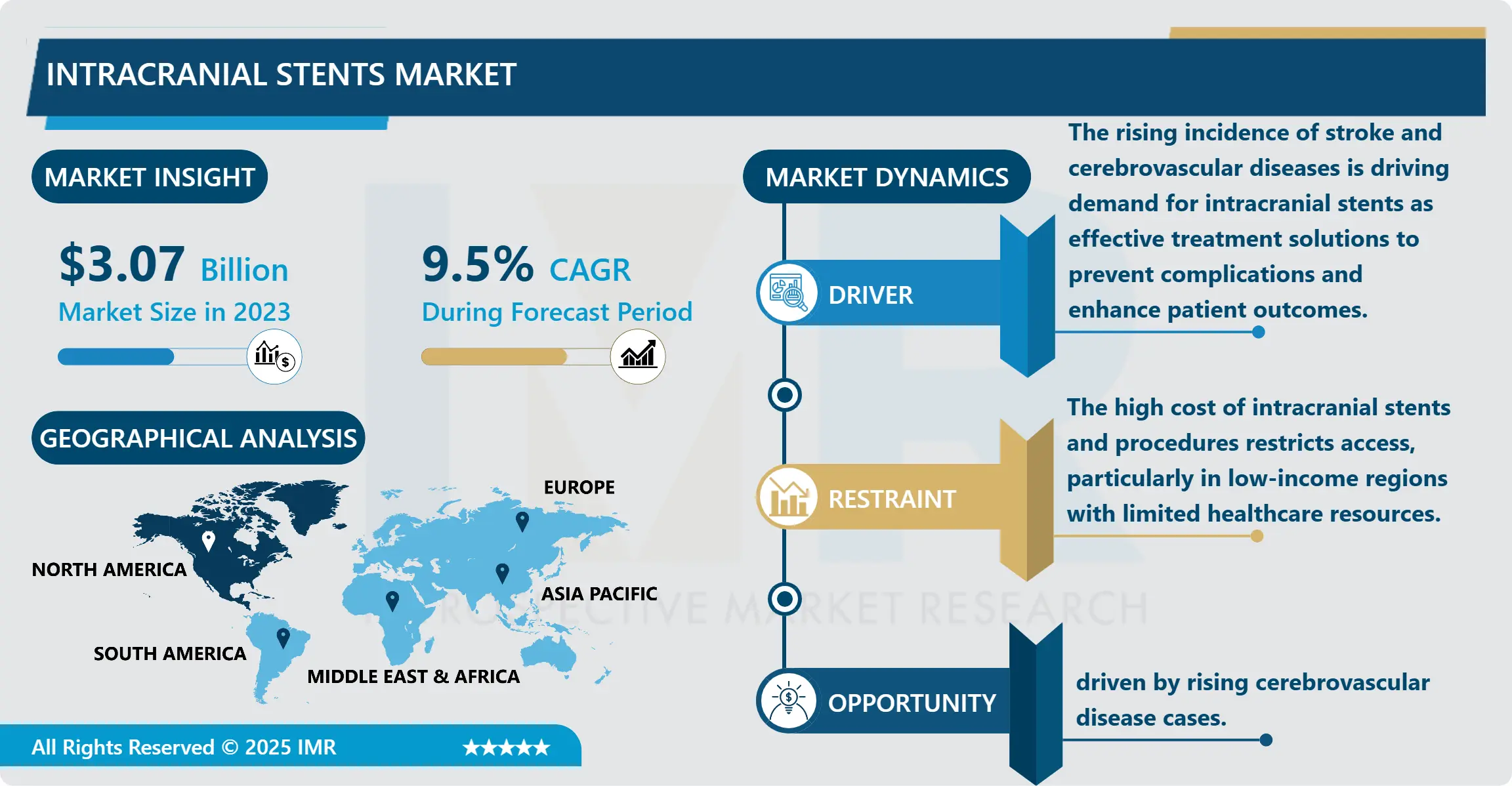
Intracranial Stents Market Trend Analysis:
Technological Advancements in Stent Design
-
Another major factor which could be seen to have a fairly perceptible effect on the intracranial stents market is the element of design innovation and development of novel material of intracranial stents. New technological solutions, such as bioresorbable stents with a planned lifetime of the around two years, are also predicted to change the market situation and decrease the possibility of complications after the treatment. These next generation stents dissolve over time and after the artery has been successfully cleared, there is no need for new surgeries or long-term medications. Unlike other stents, which remain in a patient’s body for years or for the rest of their lives, bioresorbable stents have an unmatched ability to return the artery to its natural state and have less long-term impact on a patient’s health.
- Also, extending from the uses of intracranial stents, the implementation of drug eluting stents that discharge medication in order to avoid further constriction of arteries has helped to boost the effectiveness of stenting for intracranial arteries. These stents not only increase the possibility of the effectiveness of the initial procedure but also minimize the possibilities of restenosis – a frequent complication of stenting. Future innovations in the treatment of intracranial atherosclerosis – such stents for instance, are believed to create much attention to the market both from the manufacturers and healthcare providers that seek to enhance their patient care services. These technologies in the market, which are new stent designs, should propel the market into a new dimension of safety, efficacy and patient long-term status for those suffering from cerebrovascular diseases.
Expansion into Emerging Markets
-
As for intracranial stents increase in treatment offerings in developing nations appears to have a great potential. Developing Asian-Pacific, Latin American and Middle Eastern countries will require the more advanced interventional solutions like neurovascular or for instance, the intracranial stenting. These regions have a higher burden and load of burden from moderate and severe diseases during which stroke continues to be among the leading causes of mortality and morbidity. Likewise there are more people gaining knowledge on the management of stroke which increases pressure on new methods such as intracranial stenting. These gaps allowed a wide opportunity to stent manufacturers to search for business in these portions of the orb where the demand for criticism is growing day by day.
- The current position of manufacturers in the global market offers a great opportunity to offer affordable, quality intracranial stent tailored to population needs. To enter such markets, appropriate ties to various players and authorities of healthcare in target markets that would enhance the choices’ access, cost and awareness among people will be necessary. Furthermore, growth of health facility and grants from the government agencies pertaining treatment shall also extend the market. It will help Companies to expand the availability of intracranial stents and serve the increasing patient pool of cerebrovascular diseases.
Intracranial Stents Market Segment Analysis:
Intracranial Stents Market is Segmented on the basis of Type, Application, End User, and Region
By Product Type, Balloon-Expandable Stents segment is expected to dominate the market during the forecast period
-
Balloon-Expandable Stents are one variety of intracranial stents where the use of a balloon catheter is necessary in order to deploy the stent fully once it has been placed in the artery. Perhaps the most common of these are made of stainless steel or other rigid materials that form a strong scaffold to hold the artery open after it has been implanted. Balloon catheter is used at the site of blockage or narrowing; the balloon is inflated resulting to expansion of the stent to the walls of the vessels. Balloon expandable stents are typically used in those situations in which one requires the most rigid support for the vessel, and the ability to expand evenly is crucial in order to achieve proper blood flow. Still, they may be associated with some drawbacks, which are complications like restenosis as compared to self expanders; the vessel wall could distort after the inflation of the balloon.
- Self-Expanding Stents are specific in their function to expand as soon as they are inserted by the doctor and do not require any balloon catheter. These stents are usually fabricated of such materials as nitinol—a nickel-titanium alloy through which the stent can expand after it has been released due to its ‘shape-memory effect’. The self-expanding variety is often preferable if the shape of the artery is less predictable or more meandering – like a corkscrew – because they can take the shape of the vessel more successfully. They also offer less traumatic contact during the stent deployment with decreased risks of such complications of restenosis. Because of these features self-expandable stents are applied in such diseases as intracranial atherosclerosis, the treatment of which implies the need to use more flexible and applicable tools for the long term results.
By Application, Intracranial Atherosclerotic Disease segment expected to held the largest share
-
Intracranial Atherosclerotic Disease which we may also call intracranial arterial atherosclerosis means a situation whereby atheromatous plaques infiltrate arteries within the brain, hence narrowing them and slightly reducing blood flow. This condition is one of the leading causes of stroke because the plaques may burst or form a blood clot that interferes with blood circulation to important parts of the brain. This condition is treated by using intracranial stents to keep the arteries open and thus allow the right blood flow. Endovascular stenting for intracranial atherosclerosis remains important for controlling stroke and avoiding additional neurologic injury. With the increase in patients presenting with atherosclerotic disease and with the increase in population, particularly the aging population, there has been an increase in the use of stenting as a treatment modality.
- Intracranial stenosis is the constriction of cerebral vessels because of atherosclerotic or fibromuscular dysplastic changes. This is a troublesome risk factor to ischemic stroke since the low blood supply typically results in damage to the affected tissues in the brain. Stenting is used more frequently to reopen the constricted arteries and avoid the situation called stroke. The procedure tends to be done on patients experiencing symptomatic intracranial stenosis who do not show improvement after medical treatments. Further, cerebral aneurysms which is a localized dilation of a blood vessel in the brain owing to the poor-quality arterial wall can be treated using intracranial stents. These stents just keep the fragile artery strong enough so that the blood flow will not rupture but will stay on the safe side. Other neurological disorders that may benefit from stenting include other diseases that create change in vasculature and structure of the blood vessels in the brain that subsequently leads to strokes or other problems.
Intracranial Stents Market Regional Insights:
North America is Expected to Dominate the Market Over the Forecast period
-
North America maintains its position as the largest consumer in the intracranial stents market in 2023 while occupying a large share of the worldwide market. The United States, in particular, can be largely attributed to the fact that the USA has one of the most developed systems of healthcare, spends a lot of money on it, and cerebrovascular diseases are quite common there. Currently, the region is responsible for 40 to 45 percent of global market share of intracranial stents boosted by the increased utilisation of minimally invasive systems and state-of-the-art technologies. The extensive adoption of sophisticated medical technologies means better patient care, putting intracranial stents squarely in the region’s management of stroke prevention and treatment strategy.
- Also, the constant research activities with support from the appropriate authorities and a sound reimbursement policy have made North America a dominant player in intracranial stents market. There will always be resources for innovation to occur, and both government and insurance can help to supply the populace with the newest health care technologies. Due to high incidence of stroke and other forms of vascular diseases in the population, there is continued strong demand in North America for intracranial stents; North America remains the largest, and most mature market for these products. This growth is expected to increase further due to the increasing demand for better solutions to manage the healthcare industry for dealing with cerebrovascular disorders.
Active Key Players in the Intracranial Stents Market:
-
Abbott Laboratories (USA)
- Acandis GmbH (Germany)
- Boston Scientific Corporation (USA)
- Cardinal Health, Inc. (USA)
- Cook Medical (USA)
- Cordis (USA)
- Medtronic PLC (Ireland)
- Micro Vention, Inc. (USA)
- Nipro Corporation (Japan)
- Stryker Corporation (USA)
- Terumo Corporation (Japan)
- W. L. Gore & Associates (USA)
- Other Active Players
|
Intracranial Stents Market |
|||
|
Base Year: |
2023 |
Forecast Period: |
2024-2032 |
|
Historical Data: |
2017 to 2023 |
Market Size in 2023: |
USD 3.07 Billion |
|
Forecast Period 2024-32 CAGR: |
9.50% |
Market Size in 2032: |
USD 6.96 Billion |
|
Segments Covered: |
By Product Type |
|
|
|
By Application |
|
||
|
By End User |
|
||
|
By Region |
|
||
|
Key Market Drivers: |
|
||
|
Key Market Restraints: |
|
||
|
Key Opportunities: |
|
||
|
Companies Covered in the report: |
|
||
Chapter 1: Introduction
1.1 Scope and Coverage
Chapter 2:Executive Summary
Chapter 3: Market Landscape
3.1 Market Dynamics
3.1.1 Drivers
3.1.2 Restraints
3.1.3 Opportunities
3.1.4 Challenges
3.2 Market Trend Analysis
3.3 PESTLE Analysis
3.4 Porter's Five Forces Analysis
3.5 Industry Value Chain Analysis
3.6 Ecosystem
3.7 Regulatory Landscape
3.8 Price Trend Analysis
3.9 Patent Analysis
3.10 Technology Evolution
3.11 Investment Pockets
3.12 Import-Export Analysis
Chapter 4: Intracranial Stents Market by Type
4.1 Intracranial Stents Market Snapshot and Growth Engine
4.2 Intracranial Stents Market Overview
4.3 Balloon-Expandable Stents
4.3.1 Introduction and Market Overview
4.3.2 Historic and Forecasted Market Size in Value USD and Volume Units (2017-2032F)
4.3.3 Key Market Trends, Growth Factors and Opportunities
4.3.4 Balloon-Expandable Stents: Geographic Segmentation Analysis
4.4 Self-Expanding Stents
4.4.1 Introduction and Market Overview
4.4.2 Historic and Forecasted Market Size in Value USD and Volume Units (2017-2032F)
4.4.3 Key Market Trends, Growth Factors and Opportunities
4.4.4 Self-Expanding Stents: Geographic Segmentation Analysis
Chapter 5: Intracranial Stents Market by Application
5.1 Intracranial Stents Market Snapshot and Growth Engine
5.2 Intracranial Stents Market Overview
5.3 Intracranial Atherosclerotic Disease
5.3.1 Introduction and Market Overview
5.3.2 Historic and Forecasted Market Size in Value USD and Volume Units (2017-2032F)
5.3.3 Key Market Trends, Growth Factors and Opportunities
5.3.4 Intracranial Atherosclerotic Disease: Geographic Segmentation Analysis
5.4 Intracranial Stenosis
5.4.1 Introduction and Market Overview
5.4.2 Historic and Forecasted Market Size in Value USD and Volume Units (2017-2032F)
5.4.3 Key Market Trends, Growth Factors and Opportunities
5.4.4 Intracranial Stenosis: Geographic Segmentation Analysis
5.5 Aneurysms
5.5.1 Introduction and Market Overview
5.5.2 Historic and Forecasted Market Size in Value USD and Volume Units (2017-2032F)
5.5.3 Key Market Trends, Growth Factors and Opportunities
5.5.4 Aneurysms: Geographic Segmentation Analysis
5.6 Other Neurological Disorders
5.6.1 Introduction and Market Overview
5.6.2 Historic and Forecasted Market Size in Value USD and Volume Units (2017-2032F)
5.6.3 Key Market Trends, Growth Factors and Opportunities
5.6.4 Other Neurological Disorders: Geographic Segmentation Analysis
Chapter 6: Intracranial Stents Market by End User
6.1 Intracranial Stents Market Snapshot and Growth Engine
6.2 Intracranial Stents Market Overview
6.3 Hospitals
6.3.1 Introduction and Market Overview
6.3.2 Historic and Forecasted Market Size in Value USD and Volume Units (2017-2032F)
6.3.3 Key Market Trends, Growth Factors and Opportunities
6.3.4 Hospitals: Geographic Segmentation Analysis
6.4 Ambulatory Surgical Centers
6.4.1 Introduction and Market Overview
6.4.2 Historic and Forecasted Market Size in Value USD and Volume Units (2017-2032F)
6.4.3 Key Market Trends, Growth Factors and Opportunities
6.4.4 Ambulatory Surgical Centers: Geographic Segmentation Analysis
6.5 Specialized Clinics
6.5.1 Introduction and Market Overview
6.5.2 Historic and Forecasted Market Size in Value USD and Volume Units (2017-2032F)
6.5.3 Key Market Trends, Growth Factors and Opportunities
6.5.4 Specialized Clinics: Geographic Segmentation Analysis
Chapter 7: Company Profiles and Competitive Analysis
7.1 Competitive Landscape
7.1.1 Competitive Benchmarking
7.1.2 Intracranial Stents Market Share by Manufacturer (2023)
7.1.3 Industry BCG Matrix
7.1.4 Heat Map Analysis
7.1.5 Mergers and Acquisitions
7.2 ABBOTT LABORATORIES (USA)
7.2.1 Company Overview
7.2.2 Key Executives
7.2.3 Company Snapshot
7.2.4 Role of the Company in the Market
7.2.5 Sustainability and Social Responsibility
7.2.6 Operating Business Segments
7.2.7 Product Portfolio
7.2.8 Business Performance
7.2.9 Key Strategic Moves and Recent Developments
7.2.10 SWOT Analysis
7.3 ACANDIS GMBH (GERMANY)
7.4 BOSTON SCIENTIFIC CORPORATION (USA)
7.5 CARDINAL HEALTH INC. (USA)
7.6 COOK MEDICAL (USA)
7.7 CORDIS (USA)
7.8 MEDTRONIC PLC (IRELAND)
7.9 MICRO VENTION INC. (USA)
7.10 NIPRO CORPORATION (JAPAN)
7.11 STRYKER CORPORATION (USA)
7.12 TERUMO CORPORATION (JAPAN)
7.13 W. L. GORE & ASSOCIATES (USA)
7.14 .
7.15 OTHER ACTIVE PLAYERS
Chapter 8: Global Intracranial Stents Market By Region
8.1 Overview
8.2. North America Intracranial Stents Market
8.2.1 Key Market Trends, Growth Factors and Opportunities
8.2.2 Top Key Companies
8.2.3 Historic and Forecasted Market Size by Segments
8.2.4 Historic and Forecasted Market Size By Type
8.2.4.1 Balloon-Expandable Stents
8.2.4.2 Self-Expanding Stents
8.2.5 Historic and Forecasted Market Size By Application
8.2.5.1 Intracranial Atherosclerotic Disease
8.2.5.2 Intracranial Stenosis
8.2.5.3 Aneurysms
8.2.5.4 Other Neurological Disorders
8.2.6 Historic and Forecasted Market Size By End User
8.2.6.1 Hospitals
8.2.6.2 Ambulatory Surgical Centers
8.2.6.3 Specialized Clinics
8.2.7 Historic and Forecast Market Size by Country
8.2.7.1 US
8.2.7.2 Canada
8.2.7.3 Mexico
8.3. Eastern Europe Intracranial Stents Market
8.3.1 Key Market Trends, Growth Factors and Opportunities
8.3.2 Top Key Companies
8.3.3 Historic and Forecasted Market Size by Segments
8.3.4 Historic and Forecasted Market Size By Type
8.3.4.1 Balloon-Expandable Stents
8.3.4.2 Self-Expanding Stents
8.3.5 Historic and Forecasted Market Size By Application
8.3.5.1 Intracranial Atherosclerotic Disease
8.3.5.2 Intracranial Stenosis
8.3.5.3 Aneurysms
8.3.5.4 Other Neurological Disorders
8.3.6 Historic and Forecasted Market Size By End User
8.3.6.1 Hospitals
8.3.6.2 Ambulatory Surgical Centers
8.3.6.3 Specialized Clinics
8.3.7 Historic and Forecast Market Size by Country
8.3.7.1 Russia
8.3.7.2 Bulgaria
8.3.7.3 The Czech Republic
8.3.7.4 Hungary
8.3.7.5 Poland
8.3.7.6 Romania
8.3.7.7 Rest of Eastern Europe
8.4. Western Europe Intracranial Stents Market
8.4.1 Key Market Trends, Growth Factors and Opportunities
8.4.2 Top Key Companies
8.4.3 Historic and Forecasted Market Size by Segments
8.4.4 Historic and Forecasted Market Size By Type
8.4.4.1 Balloon-Expandable Stents
8.4.4.2 Self-Expanding Stents
8.4.5 Historic and Forecasted Market Size By Application
8.4.5.1 Intracranial Atherosclerotic Disease
8.4.5.2 Intracranial Stenosis
8.4.5.3 Aneurysms
8.4.5.4 Other Neurological Disorders
8.4.6 Historic and Forecasted Market Size By End User
8.4.6.1 Hospitals
8.4.6.2 Ambulatory Surgical Centers
8.4.6.3 Specialized Clinics
8.4.7 Historic and Forecast Market Size by Country
8.4.7.1 Germany
8.4.7.2 UK
8.4.7.3 France
8.4.7.4 The Netherlands
8.4.7.5 Italy
8.4.7.6 Spain
8.4.7.7 Rest of Western Europe
8.5. Asia Pacific Intracranial Stents Market
8.5.1 Key Market Trends, Growth Factors and Opportunities
8.5.2 Top Key Companies
8.5.3 Historic and Forecasted Market Size by Segments
8.5.4 Historic and Forecasted Market Size By Type
8.5.4.1 Balloon-Expandable Stents
8.5.4.2 Self-Expanding Stents
8.5.5 Historic and Forecasted Market Size By Application
8.5.5.1 Intracranial Atherosclerotic Disease
8.5.5.2 Intracranial Stenosis
8.5.5.3 Aneurysms
8.5.5.4 Other Neurological Disorders
8.5.6 Historic and Forecasted Market Size By End User
8.5.6.1 Hospitals
8.5.6.2 Ambulatory Surgical Centers
8.5.6.3 Specialized Clinics
8.5.7 Historic and Forecast Market Size by Country
8.5.7.1 China
8.5.7.2 India
8.5.7.3 Japan
8.5.7.4 South Korea
8.5.7.5 Malaysia
8.5.7.6 Thailand
8.5.7.7 Vietnam
8.5.7.8 The Philippines
8.5.7.9 Australia
8.5.7.10 New Zealand
8.5.7.11 Rest of APAC
8.6. Middle East & Africa Intracranial Stents Market
8.6.1 Key Market Trends, Growth Factors and Opportunities
8.6.2 Top Key Companies
8.6.3 Historic and Forecasted Market Size by Segments
8.6.4 Historic and Forecasted Market Size By Type
8.6.4.1 Balloon-Expandable Stents
8.6.4.2 Self-Expanding Stents
8.6.5 Historic and Forecasted Market Size By Application
8.6.5.1 Intracranial Atherosclerotic Disease
8.6.5.2 Intracranial Stenosis
8.6.5.3 Aneurysms
8.6.5.4 Other Neurological Disorders
8.6.6 Historic and Forecasted Market Size By End User
8.6.6.1 Hospitals
8.6.6.2 Ambulatory Surgical Centers
8.6.6.3 Specialized Clinics
8.6.7 Historic and Forecast Market Size by Country
8.6.7.1 Turkiye
8.6.7.2 Bahrain
8.6.7.3 Kuwait
8.6.7.4 Saudi Arabia
8.6.7.5 Qatar
8.6.7.6 UAE
8.6.7.7 Israel
8.6.7.8 South Africa
8.7. South America Intracranial Stents Market
8.7.1 Key Market Trends, Growth Factors and Opportunities
8.7.2 Top Key Companies
8.7.3 Historic and Forecasted Market Size by Segments
8.7.4 Historic and Forecasted Market Size By Type
8.7.4.1 Balloon-Expandable Stents
8.7.4.2 Self-Expanding Stents
8.7.5 Historic and Forecasted Market Size By Application
8.7.5.1 Intracranial Atherosclerotic Disease
8.7.5.2 Intracranial Stenosis
8.7.5.3 Aneurysms
8.7.5.4 Other Neurological Disorders
8.7.6 Historic and Forecasted Market Size By End User
8.7.6.1 Hospitals
8.7.6.2 Ambulatory Surgical Centers
8.7.6.3 Specialized Clinics
8.7.7 Historic and Forecast Market Size by Country
8.7.7.1 Brazil
8.7.7.2 Argentina
8.7.7.3 Rest of SA
Chapter 9 Analyst Viewpoint and Conclusion
9.1 Recommendations and Concluding Analysis
9.2 Potential Market Strategies
Chapter 10 Research Methodology
10.1 Research Process
10.2 Primary Research
10.3 Secondary Research
|
Intracranial Stents Market |
|||
|
Base Year: |
2023 |
Forecast Period: |
2024-2032 |
|
Historical Data: |
2017 to 2023 |
Market Size in 2023: |
USD 3.07 Billion |
|
Forecast Period 2024-32 CAGR: |
9.50% |
Market Size in 2032: |
USD 6.96 Billion |
|
Segments Covered: |
By Product Type |
|
|
|
By Application |
|
||
|
By End User |
|
||
|
By Region |
|
||
|
Key Market Drivers: |
|
||
|
Key Market Restraints: |
|
||
|
Key Opportunities: |
|
||
|
Companies Covered in the report: |
|
||


